

 Français
 Polski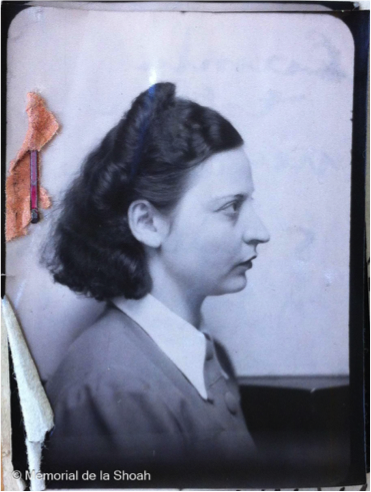
Esther CAMHI, née Eskenazy (1905-1944)
Photo from the Shoah Memorial in Paris
Esther was born on August 14, 1905 in Constantinople in the Ottoman Empire. Her parents were Eliezer Eskenazy and Rebecca Tchiprout, both of whom were Turkish citizens. She arrived in France in 1919. When she married Albert Camhi on September 16, 1933, she was living with her parents in Bourg d’Oisans in the Isère department of France and was working as a sales assistant.
Esther did not sign a declaration in accordance with a French law enacted on August 10, 1927, under which she could have acquired French nationality through her marriage to Albert, who had become a French citizen in 1928. She applied for French citizenship on October 3, 1939, but her application was put on hold on August 25, 1942. However, some later records, dated after her death, state that she had indeed been naturalized as a French citizen.
The couple had one son, Victor, who was born on July 6, 1934 in la Tronche, also in the Isère department of France.
Did Esther continue working after she got married? Was her military pension enough for her to live on while Albert was serving on the front line in the early days of the war? While he was away, did she move back in with her parents, who lived nearby?
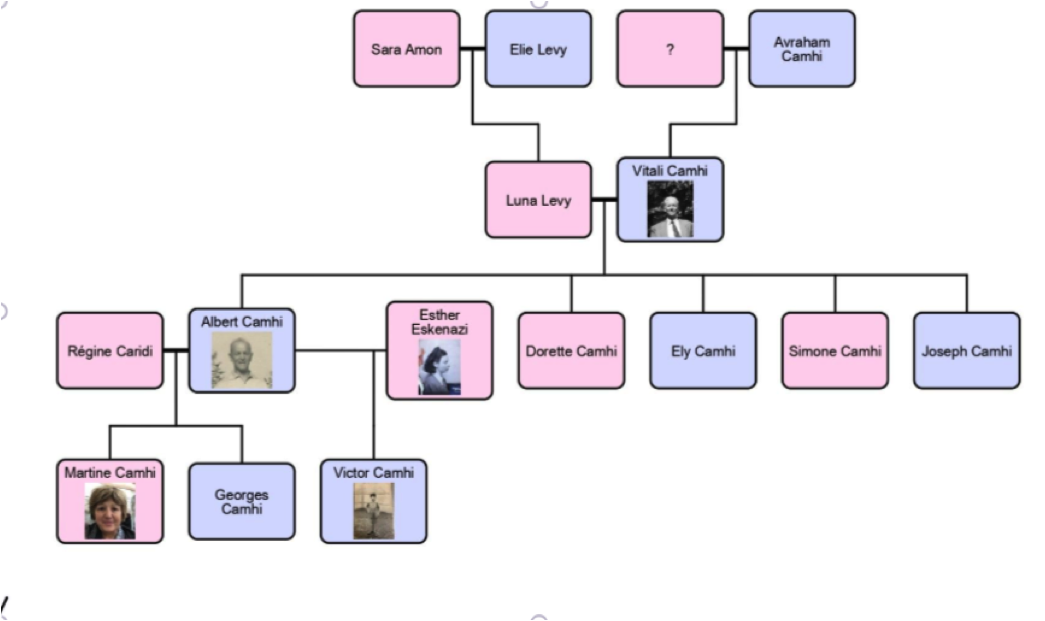
The Camhi family tree
ARREST AND DEPORTATION
The Gestapo and the French militia arrested the Camhi family at their home at 18 rue Lakanal in Grenoble, also in the Isère department of France, on June 18, 1944. However, various records list Esther and little Victor’s last known address as a hospital, the Clinique des Alpes in La Tronche. Had they been hiding in the hospital? Had one of them been sick at some point? Had Esther found a job there that kept her and her son safe at a time when other Jews were being arrested? According to Holocaust historian Tal Bruttman, “Starting in October 1943, the German police, and the French working with them, began systematically arresting Jews in Grenoble and the surrounding area”. The SSJ (Service Social des Jeunes or Youth Social Service), a Grenoble branch of the Éclaireurs Israélites de France (Jewish Scouts), which was involved in saving Jewish children, arranged to have some children hidden in the La Tronche hospital. A physician at the hospital, Dr. Gaston Valois, also kept some Resistance fighters hidden there until he himself was arrested and deported.
Whatever the case, Esther’s death was registered at the town hall in La Tronche, near Grenoble. The words “Died during Deportation” were added to in 1989.
It is worth noting that the Enfants déportés de Lyon (Children deported from Lyon) website, which includes a page on Victor, suggests that Esther was arrested in Lyon, while Albert and Victor were arrested in Grenoble. However, Albert himself, after the war, stated otherwise.
Esther and her husband were taken to the Gestapo headquarters in Lyon, in the Rhone department of France. Albert was tortured into confessing that he knew the location of a weapons stockpile, but by that time, the weapons had already been moved and so were never found. However, as a Jewish family now suspected of being involved in the Resistance, Albert and Esther found themselves in the Nazi’s sights.
Esther, who was then imprisoned in a women’s cell in Montluc jail in Lyon, was separated from her son. He was taken to the the Antiquaille hospital, which was being used a children’s shelter. It was run by the UGIF (Union Générale des Israélites de France, or General Union of French Jews), an organization founded by the Vichy government and the Germans but run by Jews. Albert, meanwhile, was held in the men’s section of Montluc jail.
Esther was reunited with her husband and son on July 24, when they were transferred to Drancy internment camp, northeast of Paris.
On July 31, 1944, they were all loaded into the same cattle car and deported on Convoy 77 to Auschwitz-Birkenau.
When the train arrived in Auschwitz, during the night of August 3-4, 1944, Esther saw her husband Albert for the very last time.
Together with all the other mothers and children, Esther and her son were sent straight to their deaths in the gas chambers.
AFTER THE WAR
After the war, Esther’s parents and Albert, who was selected to work in the Auschwitz concentration camp, surivived and returned to France, undertook the necessary formalities to have Esther granted “Political deportee” status and to have her death registered. In 1948, in order to settle her estate, a notary by the name of Piloz, in Grenoble, requested a certificate of exemption from death duties. This implies that Esther left a legacy which was passed on to her family.
Esther’s parents filed a claim for the loss of their daughter but her mother, Rébecca, died on July 1, 1962, before they received a response. In 1972, the authorities replied saying that the claim could not be met because they were not French, but foreign nationals. Nevertheless, on November 15, 1963, Eliezer Eskenazy received a payment of 132 francs. Albert, who had remarried by that time, was not eligible for compensation.
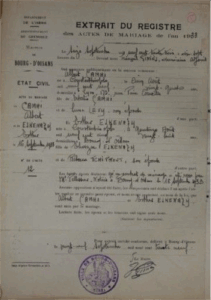
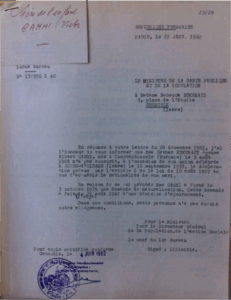
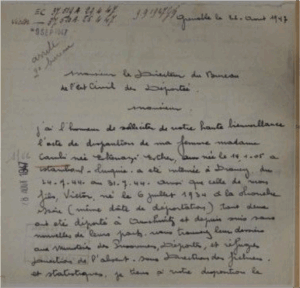
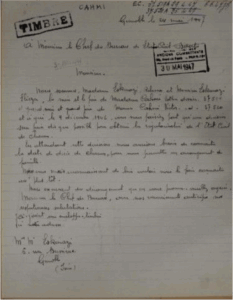
These records are from the file on Esther Camhi née Eskenazy held by the Victims of Contemporary Conflicts Archives Division of the French Ministry of Defense Historical Service, in Caen, ref. 21 P 432 816


