Français
 Polski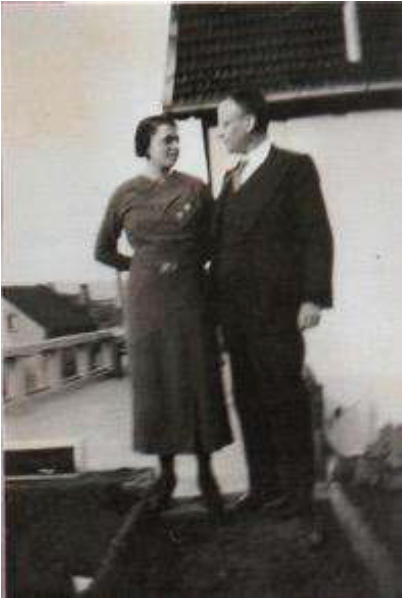
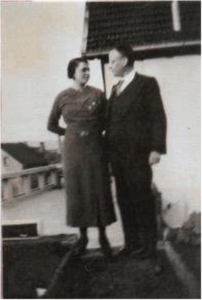
Flora CAHEN (1874-1944) et Mirthil CAHEN (1873-1944)
Flora and Mirthil Cahen, personal archives, ©Howard Baum
———————————————————————————————–
Für unsere deutschsprachigen Leser*innen: Der Text ist unterhalb der französischen Version auch auf deutsch verfügbar.
————————————————————————————————
The biography you are about to read was written by the 9th grade students from class 3eA at the Franco-German junior high and high school in Buc, in the Yvelines department of France, under the guidance of their German teachers, Lisa Rech and Marianne Hoock-Douilly, and their history teacher, Hélène Guerder. The school is jointly administered by the French and German governments, and focuses on biculturalism and French-German relations. The biography is therefore available in both French and German, in keeping with the school’s ethos, and has also been translated into English so that Flora and Mirthil Cahen’s descendants, who live in the United States, can read it.
Our research focused on three deportees: Flora and Mirthil Cahen, and Riven Kirschbaum. Our work took us from Paris, where all three lived, to Berlin, where Riven Kirschbaum was born. We felt it was important to learn more about their lives in these places before, during, and, in Riven Kirschbaum’s case, after World War II.
Although this biography focuses only on Flora and Mirthil Cahen, we encourage you to read our biography of Riven Kirschbaum as well.
Enjoy!
I. MIRTHIL’S ROOTS
Mirthil Marx Cerf Cahen was born on May 4, 1873, in Metzervisse, then in Germany (now in the Moselle department of France), where his family had lived for several generations. His parents, Louis Cahen and Mathilde Cerf[1], were Jewish. Louis Cahen was a butcher.
Mirthil Cahen’s birth certificate, Metzervisse town hall
The village had been home to a Jewish community since at least the 18th century[2]. In 1748, a small synagogue was built there, which helped the community to grow. This synagogue was located at 13 Grand’rue, but was not visible from the street: access was via a private house, usually that of the rabbi [3]. In the mid-19th century, 17% of the population of Metzervisse was Jewish[4]. The daily life of the village’s Jewish community was very similar to that of the other residents: they all spoke the same dialect, Luxembourgish Franconian. Many also understood French and German[5].
The members of the Jewish community in Metzervisse worked in various trades: butcher, cattle dealer, peddler, acting middlemen with farmers for basic necessities, grocers, etc.[6] The Jewish cemetery in Metzervisse is believed to be one of the oldest in the department (probably built shortly after the synagogue; this cemetery is now located on the D60 road, in the center of the village).
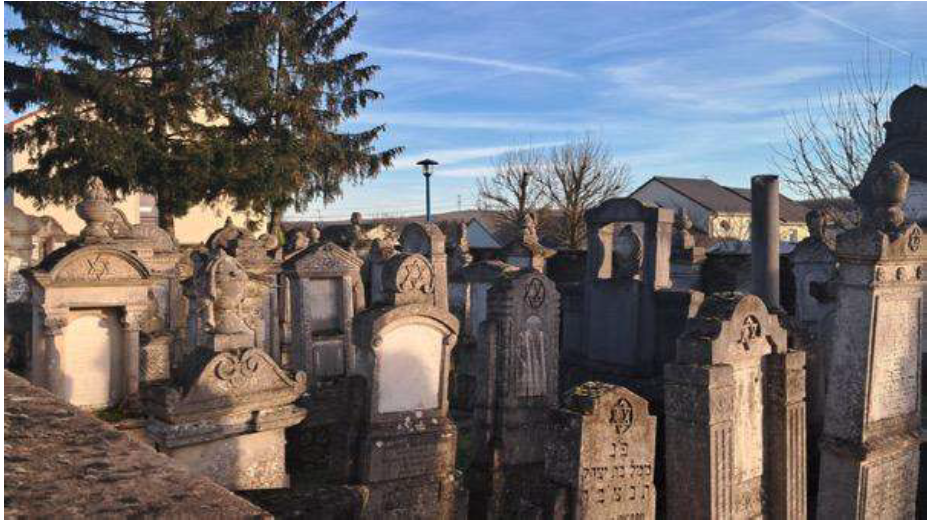
The Jewish cemetery in Metzervisse from the D60 road, personal archives,
© Hélène Guerder, 2024
Mirthil had three siblings: Régine Cahen (born in 1869), Berthe-Hortense Cahen (born in 1871), and Simon Cahen (born in 1878), who was also murdered in Auschwitz on February 15, 1944, along with his wife, Laura Schwartz[7].
FLORA
Flora Kaufmann was born on May 8, 1874, in the Hilbringen district of the town of Merzig in Saarland, Germany[8].
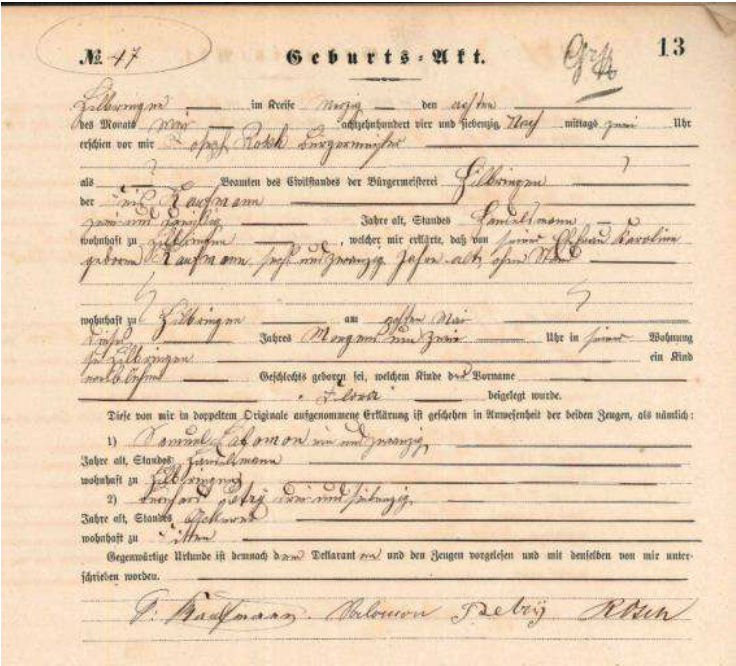
Flora Kaufmann’s birth certificate, Landesarchiv, Saarbrücken
This area had been part of the German Empire since its foundation in 1871. Flora came from a Jewish family with three children. Her parents were Karoline and Feist and she had a sister, Ida, (born November 13, 1878) and a brother, Hermann.
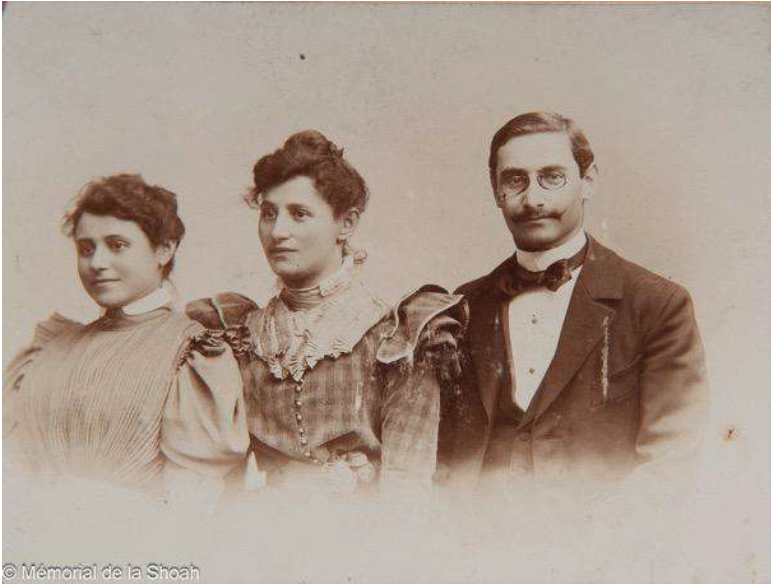
Ida, Flora, and Hermann Kaufmann © Shoah Memorial/Coll. Simon Oungre
Flora spent her youth in this small town in Saarland with a population of around 6,000, where the Jewish community represented around 8% of the population[9]. There was a synagogue and several shops run by Jewish families, including Kaufhaus Kahn at 15 Kirchplatz, a building that is still standing today[10].
Feist Kaufmann died in 1891, when Flora was 17 and her sister Ida was 13.
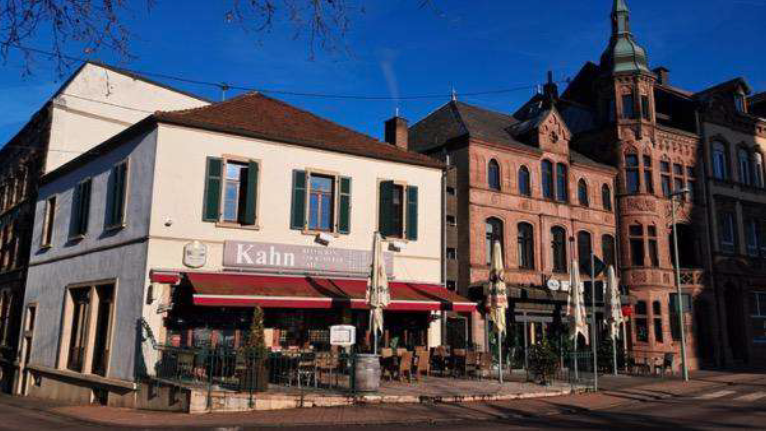
The Kaufhaus Kahn building, personal archives © Hélène Guerder, 2024
Flora’s sister, Ida[11], married Julius Kahn in 1900[12]. Julius Kahn (born in 1867) was a cattle dealer. Ida and Julius lived at 66 Hochwaldstraße in Merzig[13].
II. MIRTHIL AND FLORA’S LIFE TOGETHER IN METZERVISSE AND THIONVILLE
Flora and Mirthil Cahen were married on January 17, 1899, in Metzervisse[14], which was still in Germany at the time. Their first daughter Mathilde was born there on March 13, 1900[15], followed by their second daughter Ester on February 22, 1902[16]. They lived at 53 Grand-Rue. Their grocery store was located on the ground floor.
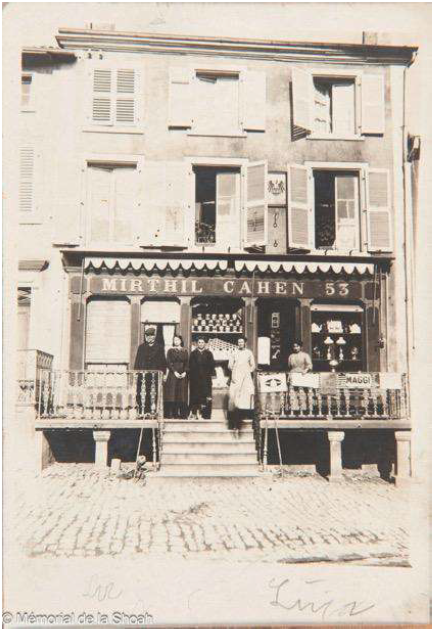
Mirthil and Flora Cahen’s grocery store © Shoah Memorial/Coll. Simon Oungre
On August 3, 1914, when war was declared on France, Mirthil was drafted into the German army.
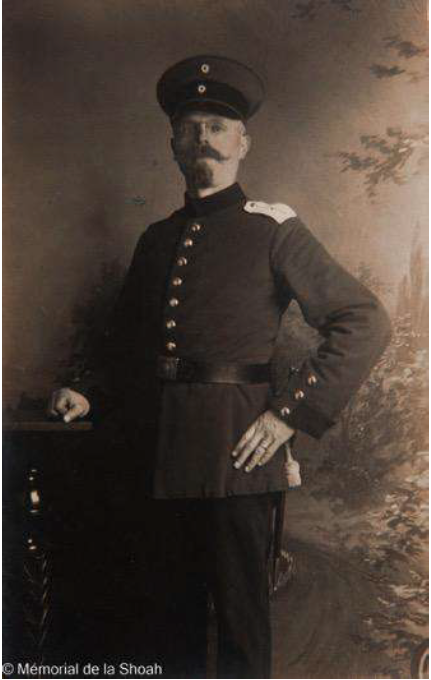
Mirthil Cahan © Shoah Memorial/Simon Oungre Collection
He was sent to fight as a private in East Prussia. Flora and their daughters remained in Metzervisse.
After the end of World War I, on November 11, 1918, Moselle once again became part of France As a result, the Cahens became French citizens.
On August 18, 1921, in Metzervisse, Mathilde married Max Baum, a German doctor born in Bacharach (Rhineland-Palatinate) on March 21, 1894, and who lived in Hilbringen (Saarland), around 20 miles from Metzervisse.
The marriage certificate states that the spouses were “of the Jewish faith.”[17] The Concordat regime in Alsace-Moselle had introduced a specific regulatory framework for religious groups in 1802. Religion was therefore included in civil status records.
By marrying a foreigner, Mathilde lost her French nationality and took that of her husband.
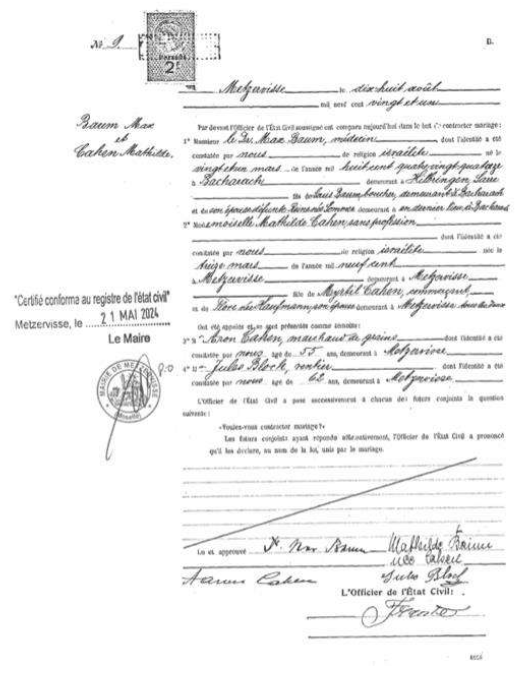
Mathilde Cahen and Max Baum’s marriage certificate, Metzervisse town hall
The couple moved to Mechenerstraße in Hilbringen, where their only son, Edgar Baum, was born on October 13, 1922[18].
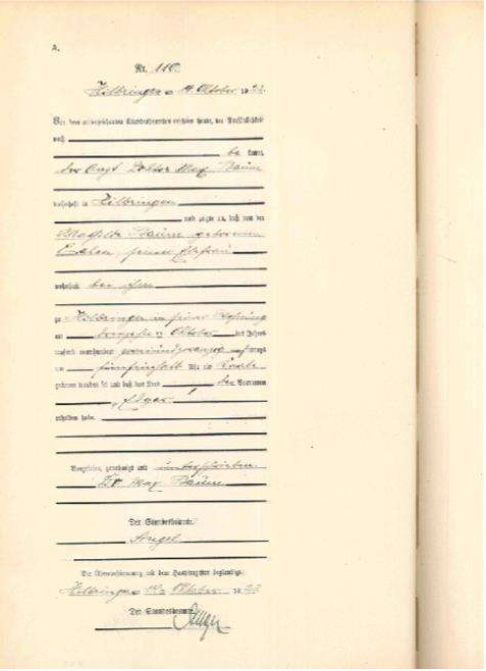
Edgar Baum’s birth certificate, no. 110, Landesarchiv Saarbrücken
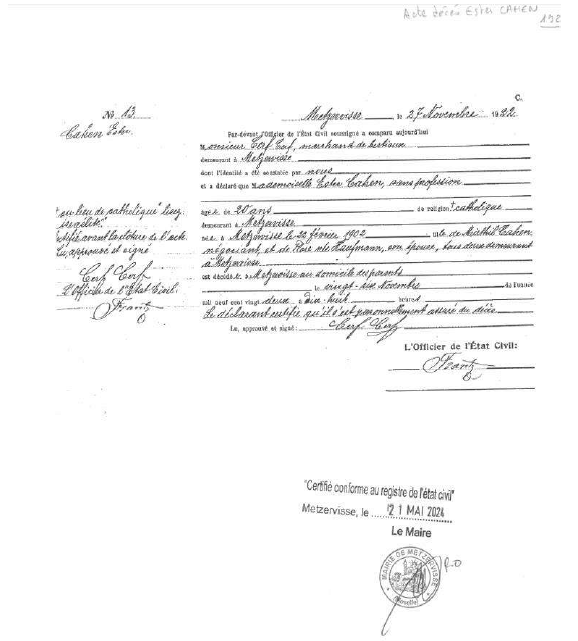
A few weeks later, tradegy struck the family. Ester (known as Else) Cahen, Flora and Mirthil’s youngest daughter, became sick and died on November 26, 1922, at her parents’ home in Metzervisse. She was 20 years old, unemployed, and unmarried. There is an error on her death certificate, which first states that she was “Catholic” and then “Jewish.”
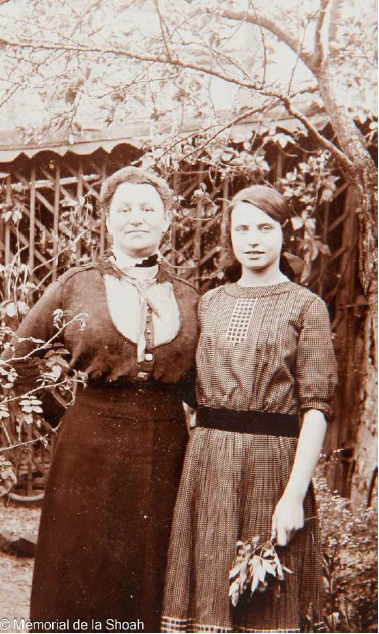
Flora and Esther Cahen, © Shoah Memorial/Simon Oungre Collection
Ester Cahen’s death certificate, Metzervisse town hall
Flora and Mirthil had a home in Thionville, where Mirthil set himself up as a furniture repairer. We do not know whether they moved there or if it was a second home, nor do we know exactly when they arrived there.
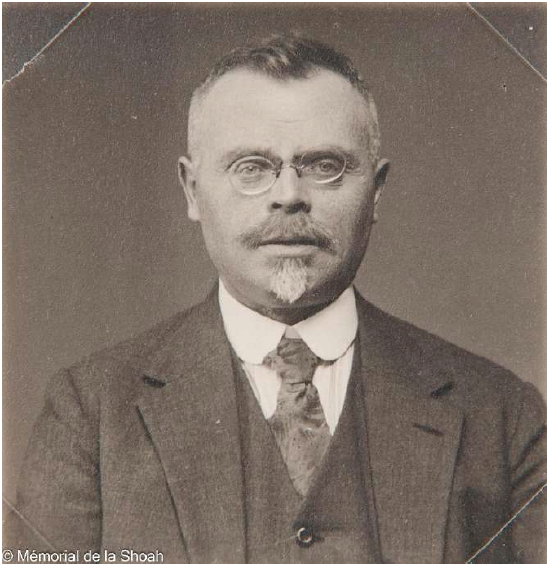
Mirthil Cahen © Shoah Memorial/Simon Oungre Collection
Edgar Baum, their only grandson, joined them there in 1934, having left his family home in Germany due to the worsening conditions for Jews under the Third Reich. He did not speak French at first, but learned it very quickly[19].
His parents, Mathilde and Max Baum, also decided to move to France to escape anti-Semitic persecution when the the Third Reich annexed Saarland following a referendum in 1935. They had to leave behind their beautiful home, Max’s medical practice, their car, and all their possessions. The couple set up home in Paris, in a small two-room apartment at 12/14 rue du Général Niox, in the 16th district. As a refugee from the Saarland, Max Baum was not allowed to practice medicine in France. He did not speak French at the time, so took classes to enable him to integrate more quickly into French society and so he could become a French citizen later on. He still needed to make a living, however, so he became a masseur. Edgar stayed on with his maternal grandparents in Thionville, who pampered him, and did well in school. In 1938, when he was 16, had to leave school so went to live with his parents in Paris, with no prospect of continuing his education. One of his father’s clients, a businessman, offered him a job as an apprentice. Edgar did not enjoy the world of commerce, but was grateful to have been given the opportunity nonetheless. Max Baum, Flora and Mirthil’s son-in-law, became a French citzen by decree on January 19, 1939, along with his wife Mathilde and his son Edgar[20].
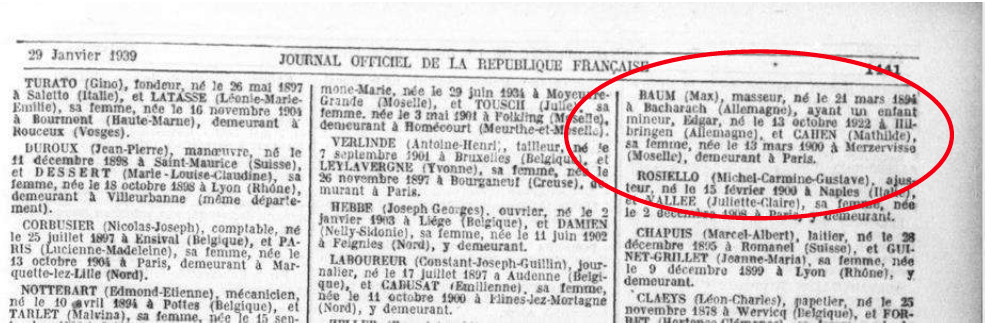
French Official Journal dated January 29, 1939
There is a photo of Mirthil and Edgar with their family and cousins in Alençon, in the Orne department of France, on Pentecost in 1939, which Béatrice Heffès entrusted to the Shoah Memorial[21].
III. LIFE DURING THE WAR, ARREST AND DEPORTATION
On August 19, 1939, another tragedy befell Mirthil and Flora: their daughter Mathilde died in Paris at the age of 39 after a short illness. Her son Edgar was devastated, convinced that his mother had become sick due to the despair of being driven into exile from her home in the Saarland.[22] She was buried on August 22 in the Jewish cemetery in Metzervisse[23]. Just a few days later, war was declared, which prevented the family from observing the Jewish mourning period, the shiva[24].
Max Baum, Mathilde’s husband, enlisted in the French army[25]. After Mathilde died, Flora and Mirthil Cahen moved to Paris in September 1939 to be with their 17-year-old grandson, Edgar[26]. They left their large apartment in Thionville and moved into their daughter’s old apartment at 12/14 rue du Général Niox. All their belongings in Moselle were subsequently looted[27].
On June 21, 1940, the Germans marched into Paris. Edgar fled on his bicycle, during what became known as the exodus[28]. Flora and Mirthil, aged 66 and 67, decided to remain in the German-occupied capital. Edgar stayed for a while in Limoges, in the Haute-Vienne department of France. While he was there, he happened bump into his father, who was hiding from the French and German police, who were hunting down German Jews in order to send them to concentration camps (Max and Edgar, like many other foreigners and Jews, were stripped of their French nationality on January 26, 1942, following a review of their situation in 1941)[29].
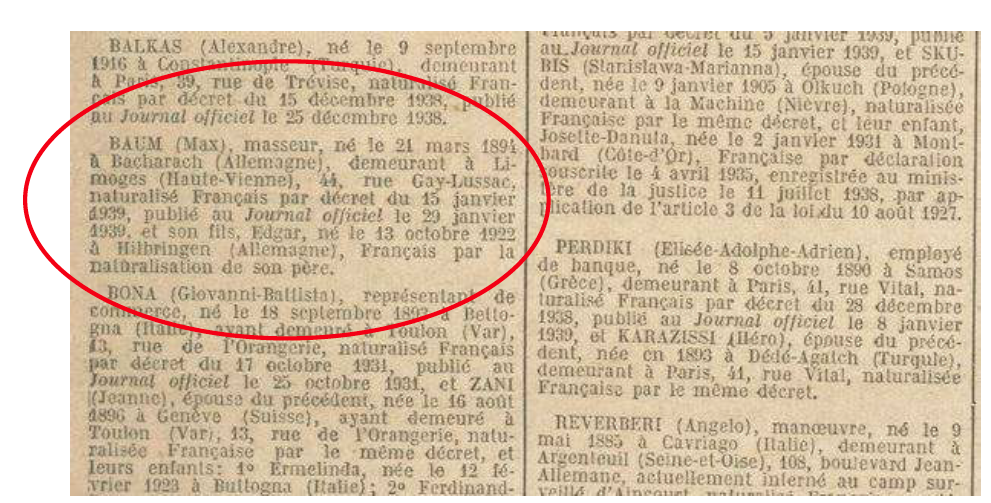
French Official Journal dated January 30, 1942, p. 421, “Decree No. 113 of January 26, 1942, on the withdrawal of French nationality” (Ministry of Justice).
In 1941, Edgar moved to Lyon, in the Rhone department of France. He then found out that his father had married Régine, known as Bronner, Raber in Nieul in the Haute-Vienne department on January 18, 1942. Despite the danger, he crossed the demarcation line twice to visit his maternal grandparents in Paris. His German paternal grandparents were deported to Theresienstadt, where they were murdered by the Nazis[30]. Edgar noticed that Flora and Mirthil were really struggling due to the food rationing [31]. In late 1942, he went to see them again, this time under a false identity with some counterfeit ration coupons[32]. He later recounted in his memoires that took care of his grandparents as well as he could, but did not move in with them so as not to put them in danger if he was arrested by the Gestapo[33]. Flora and Mirthil were over 70 years old by then, and living in extreme poverty. Max Baum was also living in Paris, together with his new wife, and was working as an interpreter[34].
As of June 7, 1942, Flora and Mirthil had to wear the yellow star, as did all Jews living in the occupied zone[35]. Thanks to his cousin Louis, Edgar got a job in a factory that was working for the Germans. The manager of the firm, who was German and knew that Edgar was Jewish, prevented him from being arrested and deported in 1944, when the police came to arrest him after someone had reported him[36].
In her diary, Ida Kahn mentioned Mirthil, Flora, and Edgar several times between February 18 and September 23, 1942. She wrote about their letters, good and bad news about life during the occupation, and how Mirthil was seeking information about some family members who were interned in the Pithiviers camp (Gustel Bonnem, Ida and Julius’ daughter, and her children Berthold and Edith[37] had been arrested during the roundup in Alençon and the surrounding area in July).
Julius and Ida Kahn, who had moved to Alençon in the Orne department in 1935, were arrested at their home at 25 rue des Granges on October 9, 1942, along with Rébecca Bonnem (79) and Rudolf Bonnem (13)[38]. On November 5, 1942, they were taken from Alençon to Drancy camp, and then deported on to Auschwitz the following day on Convoy 42. None of them survived.
On July 11, 1944, a few weeks after the Allied landings in Normandy, Flora and Mirthil, aged 70 and 71 respectively, were arrested at their home at 12/14 Rue du Général Niox and interned in the Drancy transit camp.[39]
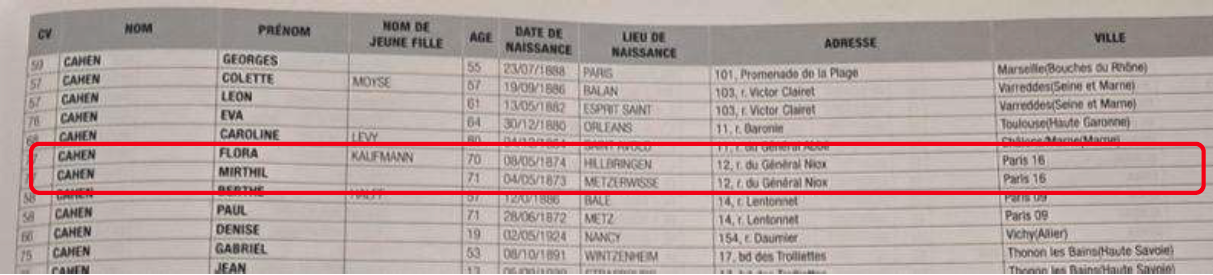
Serge Klarsfeld, Memorial to the Deportation of Jews from France, available at the Shoah Memorial, Paris
Flora and Mirthil, along with 1,304 other people, were deported from Drancy to Auschwitz on Convoy 77, the last large convoy to leave Bobigny station for Auschwitz, on July 31, 1944. They had been in Drancy for twenty days. Paris was liberated just three weeks later. Due to their age, they would have been sent to the gas chambers and murdered along with 834 other deportees, including more than 250 children, as soon as they arrived at Auschwitz II Birkenau on the night August 3-4, 1944[40]. It is also possible that, like many other elderly and sick people, they did not even survive the appaling travelling conditions.
After the Liberation of Paris, Louis, Edgar Baum’s cousin, took over Flora and Mirthil’s apartment, which fortunately had remained intact, as the Nazis had not had time to loot it. Edgar meanwhile, had enlisted in the French army in September 1944 and, after two months training, served as a radio operator until May 1945. After the war ended on May 8, 1945, he served in Allied-occupied Germany. He was discharged from the army in December 1945, and then returned to Paris[41].
A commemorative plaque at the entrance to the Jewish cemetery in Metzervisse bears the inscription “In memory of the descendants of Louis and Mathilde Cahen, who died in Auschwitz, with no grave, as victims of Nazism.” In total, sixteen members of the Cahen family were murdered in Auschwitz.
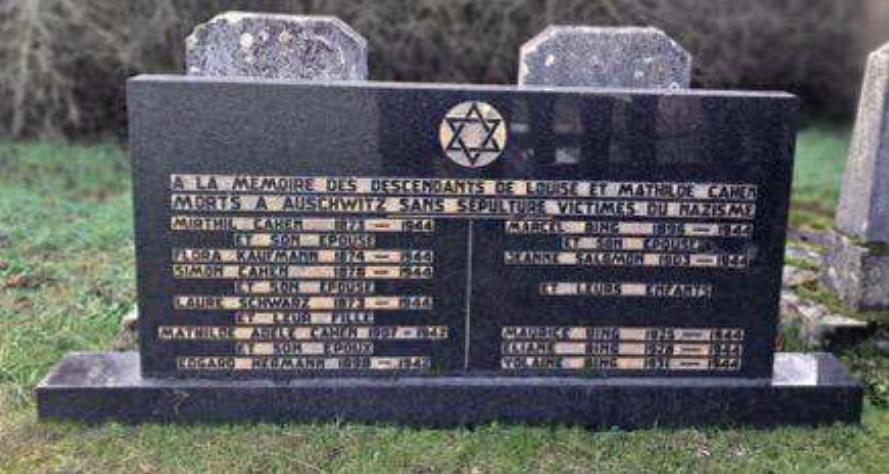
Memorial stone in the Jewish cemetery in Metzervisse, personal archives,
© Hélène Guerder, 2024
IV. AMERICAN DESCENDANTS
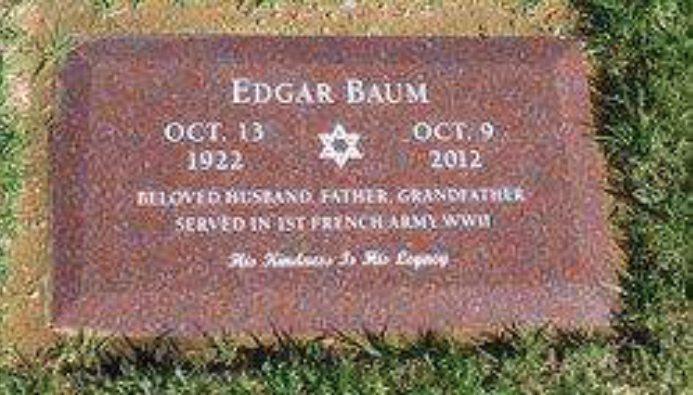
Edgard Baum, Flora and Mirthil’s grandson and their only direct descendant, emigrated to the United States on July 9, 1946[42]. He went to join his maternal great-uncle, Hermann Kaufmann (Flora’s brother), who had been living near Los Angeles since 1930[43]. On March 24, 1951, he married Estelle S. Podlipski, who was born on February 7, 1924, in New York.[44] They had two children: Marsha (born in April 1953) and Howard (born on March 17, 1964).[45] Edgar Baum died in Los Angeles on October 9, 2012.[46]
We found Howard Baum (Flora and Mirthil Cahen’s great-grandson) and his son Brandon on social media. We got in touch with them on January 8, 2025 and then had the opportunity to speak with Howard, his wife Rosa, and their three children: Brandon, Joshua, and Savannah during an online meeting on February 6, 2025.
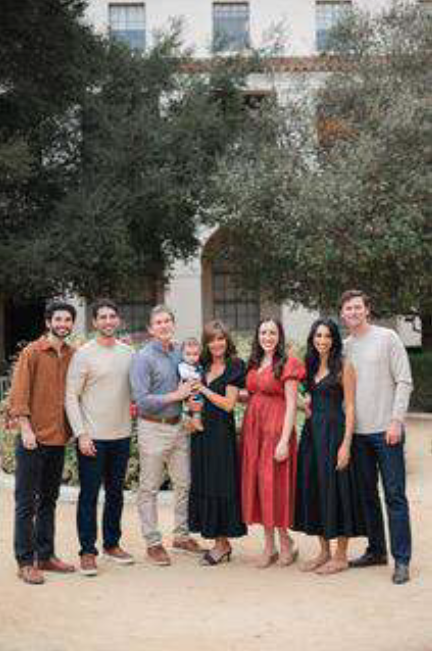
Photograph of Flora and Mirthil Cahen’s American descendants. From left to right: Joshua and Brandon, Flora and Mirthil’s great-grandsons; Howard, another great-grandson, holding their great-great-grandson, Oliver; and Rosa, Howard’s wife. Flora and Mirthil’s great-great-granddaughter, Savannah, is second from the right. ©Brandon Baum personal archives.
During the video call, Howard told us that his father, Edgar Baum, never spoke about what he did during the war. However, in 2004, he wrote his memoirs for his grandchildren, Brandon, Joshua, and Savannah[47]. Howard was kind enough to share with us these memoirs, in which he recounted much of his life before, during, and after World War II[48].
V. FRENCH DESCENDANTS
Ida Kahn, Flora’s sister, who lived in Merzig, left the Saarland with her entire family in 1935, the year the Saarland was annexed by Germany, to escape the anti-Semitic persecution of the National Socialist regime[49].
Ida and her husband Julius went to join their eldest son, Alfred Kahn, and his wife, as well as their daughter Béatrice and the rest of their family, a total of 19 people, in Alençon in the Orne department of France[50].
Ida began writing a diary [51] on February 12, 1942, documenting not only the difficulties of daily life for a Jewish family during the war, but also how some family members fled to the free zone and how others had been arrested, which made her very anxious.
She wrote the last page of her diary on October 6, 1942, three days before she was arrested, on October 9[52].
Ida mentions Mirthil and Flora several times in her diary. The appendices to the diary include a family tree[53] featuring Herbert Friedemann, Ida’s grandson and Flora and Mirthil’s great-nephew, now 95 years old. He is the last living person to have known Flora and Mirthil Cahen.
On March 11, 2025, Herbert Friedemann spoke to us about his experiences during World War II. He spoke in particular about the two attempts he, his mother and brothers made to cross the demarcation line to join his father, their arrival in the free zone in November 1941, and how they reached Saint-Nicolas-La-Chapelle in the Savoie department of France, which was in the Italian-controlled zone, on February 28, 1943[54] . He described in great detail his life as a hidden child and the constant risk of being arrested by the Nazis. His invaluable testimony gave us a better understanding of the lives of Jews living in hiding in France between 1939 and 1945.
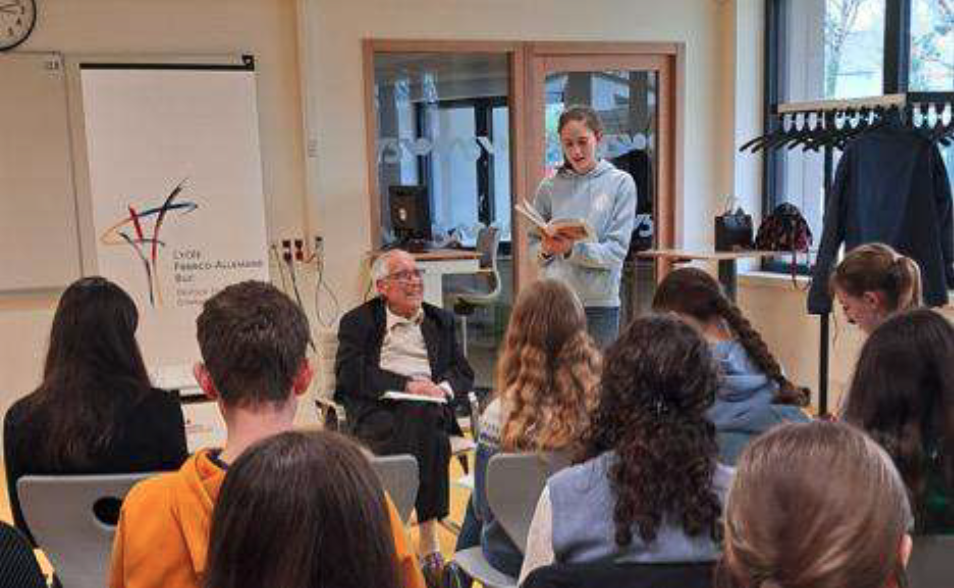
Témoignage d’Herbert Friedemann au Lycée Franco-Allemand, 11 mars 2025
Notes & réfences
[1] Cahen, Mirthil, birth certificate, Metzervisse town hall.
[2] Jacki Kleiser, La Communauté juive de Metzervisse, vie et culture (The Jewish Community of Metzervisse, Life and Culture), self-published, donated by the Metzervisse Town Hall, p. 1.
[3] Jacki Kleiser, op. cit., p. 3. This refers to the hazzan, or “cantor,” who sings in the synagogue.
[4] Jacki Kleise, op. cit., p. 2.
[5] Jacki Kleiser, op. cit., p. 12.
[6] Jacki Kleiser, op. cit.
[7] https://lesdeportesdesarthe.wordpress.com/cahen-simon/
[8] Flora Kaufmann, birth certificate, Geburtsakt Nr. 47, Landesarchiv Saarbrücken
[9] de.wikipedia.org/wiki/Merzig
de.wikipedia.org/wiki/Synagoge_ (Merzig)
[10] This is the Kahn Restaurant Bar, which preserves the memory of the place through a photo exhibition and the restoration of the historic façade of the Kaufhaus; see also www.alemannia-judaica.de
[11] Le Journal d’Ida Kahn, February-October 1942, translation and presentation by Joë Friedemann, history collection – Éditions Elkana, Foreword, p. 7.
[12] The Diary of Ida Kahn, February-October 1942, op. cit., p. 75.
[13] https://www.erinnert-euch.de/de/erinnerungsort/1199/1204/1355/hochwaldstra%C3%9Fe—stolpersteine- familie-kahn
[14] Marriage certificate of Mirthil and Flora Cahen, Metzervisse Town Hall
[15] Birth certificate of Mathilde Cahen, Metzervisse Town Hall
[16] Birth certificate of Ester Cahen, Metzervisse Town Hall
[17] Marriage certificate of Mathilde Cahen and Max Baum, Metzervisse Town Hall
[18] Edgar Baum, Birth certificate no. 110, Landesarchiv Saarbrücken.
[19] Memoirs of Edgar Baum, p. 2, private archives of Howard Baum (United States).
[20] Memoirs of Edgar Baum, pp. 2–3, private archives of Howard Baum (United States). AN, naturalization file 14694 X 38. Official Journal, January 29, 1939.
[21] ressources.memorialdelashoah.org
[22] Memoirs of Edgar Baum, ibid., p. 3.
[23] Ida Kahn’s Diary, February-October 1942, op. cit., pp. 29-30: “August 19, 1942. Three years ago, Alfred and I left for Paris to be at Thilde’s bedside as she was dying. […] On Tuesday, August 22, 1939, the funeral took place in the presence of a large crowd.”
[24] The Diary of Ida Kahn, February–October 1942, ibid., p. 58.
[25] Memoirs of Edgar Baum, op. cit., p. 3,
[26] Memoirs of Edgar Baum, ibid.
[27] Memoirs of Edgar Baum, ibid.
[28] Memoirs of Edgar Baum, ibid., p. 4
[29] National Archives, Reference numbers: BB/27/1422-BB/27/1445; Vichy’s denaturalized citizens: letters A to C. Decree published in the Official Journal of January 30, 1942.
[30] Memoirs of Edgar Baum, op. cit., p. 5. Theresienstadt (Terezin) was a Nazi deportation camp in Czechoslovakia occupied by the armies of the Third Reich.
[31] Memoirs of Edgar Baum, op. cit., p. 4.
[32] Memoirs of Edgar Baum, ibid., p. 5.
[33] Memoirs of Edgar Baum, ibid., p. 4.
[34] Memoirs of Edgar Baum, ibid., p. 5.
[35] Verordnungsblatt des Militärbefehlhabers in Frankreich (VOBIF) of June 7, 1942
[36] Memoirs of Edgar Baum, p. 5, ibid.
[37] Ida Kahn’s Diary, February-October 1942, op. cit.
[38] Minutes drawn up by the Alençon police commissioner on October 17, 1942, marked “Arrest of Jews,” published in Ida Kahn’s Diary, February-October 1942, op. cit. p. 67.
[39] Memoirs of Edgar Baum, op. cit., p. 6.
[40] Serge Klarsfeld, Memorial to the Deportation of Jews from France.
[41] Memoirs of Edgar Baum, ibid, p. 6.
[42] Memoirs of Edgar Baum, February 11, 2004, ibid., p. 6.
[43] Memoirs of Edgar Baum, February 11, 2004, ibid., p. 6, ibid.
[44] Baum family tree, provided by Howard Baum (United States).
[45] Memoirs of Edgar Baum, February 11, 2004, ibid.
[46] https://fr.findagrave.com
[47] Baum family tree, personal archives of Howard Baum (United States)
[48] Memoirs of Edgar Baum, ibid., p. 2.
[49] Ida Kahn’s Diary, February-October 1942, op. cit., p. 76 (appendices)
[50] The Diary of Ida Kahn, February-October 1942, op. cit., pp. 7, 8, and 9 (foreword)
[51] The Diary of Ida Kahn, February-October 1942, op. cit.
[52] The Diary of Ida Kahn, February-October 1942, op. cit., p. 65 (appendices).
[53] The Diary of Ida Kahn, February-October 1942, op. cit., pp. 72-73 (appendices).
[54] Until September 1943, the Italian occupation zone was a refuge for persecuted Jews. “In fact, the Italian authorities provided a certain degree of protection to Jews in this territory, refraining from applying many of the anti-Semitic measures implemented by the Germans and the Vichy authorities in the rest of France,” in: https://www.museedelaresistanceenligne.org
 Flora CAHEN (1874-1944) et Mirthil CAHEN (1873-1944)
Flora et Mirthil Cahen, archives personnelles, ©Howard Baum
Die Biographie, die Sie lesen werden, wurde von den Schülern der 9. Klasse des Deutsch-Französischen Gymnasiums von Buc mit der Hilfe von Hélène Guerder (Geschichtslehrerin), Lisa Rech und Marianne Hoock-Douilly (Deutschlehrerinnen) geschrieben. Es handelt sich um ein Gymnasium, das vom französischen und vom deutschen Staat gefördert wird und im Zeichen der Deutsch-Französischen Freundschaft und Bikulturalität steht. Deshalb ist diese Arbeit auf Französisch und auf Deutsch geschrieben. Eine Übersetzung auf Englisch wurde auch gemacht, damit die Nachkommen der Familie, die in den USA leben, sie auch verstehen können.
Wir haben über Flora Cahen, Mirthil Cahen und Riven Kirschbaum recherchiert. Unsere Arbeit führte uns von Paris, wo alle drei gelebt haben, nach Berlin, wo Riven Kirschbaum geboren wurde.
Obwohl diese Biographie nur Flora und Mirthil Cahen betrifft, laden wir Sie ein, auch die Biographie von Riven Kirschbaum zu lesen.
Viel Spaß beim Lesen!
Übersetzung: Elena Domi, Schülerin der 9.Klasse (3A)
I. HERKUNFT
MIRTHIL
Mirthil Marx Cerf Cahen wird am 4. Mai 1873 in Metzervisse geboren, damals in Deutschland (heute in Frankreich, in der Mosel), wo seine Familie, darunter seine Eltern, Louis Cahen und Mathilde Cerf, schon seit mehreren Generationen lebte. Seine Eltern sind jüdischen Glaubens. Louis Cahen ist als Metzger tätig.
Cahen, Mirthil, acte de naissance, mairie de Metzervisse
In diesem Dorf in der Mosel wohnt mindestens seit dem 18. Jahrhundert eine jüdische Gemeinde. 1748 wird dort eine kleine Synagoge gebaut, was der jüdischen Gemeinde ermöglicht, sich zu vergrößern. Diese Synagoge befindet sich Grand’Rue Nummer 13. Sie ist nicht von der Straße aus sichtbar: Man kommt durch ein privates Haus hinein, meistens das vom Chasan. In der Mitte des 19. Jahrhunderts ist 17 % der metzervisser Bevölkerung jüdisch. Der Alltag der jüdischen Bewohner ist dem der anderen Einwohner sehr ähnlich: Alle sprechen denselben Dialekt, das luxemburgische Moselfränkisch. Viele verstehen auch Französisch und Deutsch.
Die Mitglieder der jüdischen Gemeinde üben in Metzervisse verschiedene Berufe aus: Schlachter, Viehhändler, Hausierer, Zwischenhändler für Grundnahrungsmittel bei den Bauern, Lebensmittelhändler… In Metzervisse gibt es einen jüdischen Friedhof, der einer der ältesten des Departements ist (wahrscheinlich kurz nach der Synagoge gebaut; heute befindet sich dieser Friedhof an der D60, in der Mitte des Dorfes).
Le cimetière israélite de Metzervisse depuis la D60, archives personnelles,
© Hélène Guerder, 2024
Mirthil ist der Bruder von Regine Cahen (geboren 1869), von Berthe-Hortense Cahen (geboren 1871) und von Simon Cahen, geboren 1878, der während seiner Deportation in Auschwitz am 15. Februar 1944 mit seiner Frau Laura Schwartz ermordet wurde.
FLORA
Flora Kaufmann wird am 8. Mai 1874 in Hilbringen, einer Ortschaft des Bezirks Merzig im Saarland (Deutschland), geboren.
Kaufmann, Flora, acte de naissance, Landesarchiv, Saarbrücken
Dieses Gebiet ist seit seiner Gründung 1871 Teil des Deutschen Reiches. Flora stammt aus einer jüdischen Familie mit drei Kindern. Ihre Eltern heißen Karoline und Feist, ihre Schwester Ida und ihr Bruder Hermann.
Ida, Flora et Hermann Kaufmann © Mémorial de la Shoah/Coll. Simon Oungre
Flora verbringt ihre Jugend in dieser kleinen saarländischen Stadt von ungefähr 6000 Einwohnern, wo die jüdische Gemeinde ungefähr 8% der Bevölkerung ausmacht. Man findet dort eine Synagoge und mehrere Geschäfte, die von jüdischen Familien geführt werden, darunter das Kaufhaus Kahn, Kirchplatz 15, ein Gebäude, das heute noch steht.
Feist Kaufmann stirbt 1891, als Flora 17 Jahre alt ist und ihre Schwester Ida 13.
Le bâtiment du Kaufhaus Kahn, Archives personnelles © Hélène Guerder, 2024
Floras Schwester Ida, die am 13. November 1878 geboren wird, heiratet 1900 Julius Kahn. Julius Kahn (geboren 1867) ist Viehhändler. Ida und Julius leben Hochwaldstraße 66 in Merzig.
II. GEMEINSAMES LEBEN IN METZERVISSE UND THIONVILLE
Flora und Mirthil Cahen heiraten am 17. Januar 1899 in Metzervisse, das damals noch zu Deutschland gehört. Ihre älteste Tochter Mathilde wird dort am 13. März 1900 geboren und ihre zweite Tochter Ester kommt dort am 22. Februar 1902 zur Welt. Sie wohnen in der Grand Rue 53. Im Erdgeschoss befindet sich ihr Krämerladen.
L’épicerie de Mirthil et Flora Cahen © Mémorial de la Shoah/Coll. Simon Oungre
Im Jahr 1914, als der Krieg gegen Frankreich ausbricht, wird Mirthil in die Wehrmacht eingezogen.
Cahen, Mirthil © Mémorial de la Shoah/Coll. Simon Oungre
Mirthil wird als einfacher Soldat nach Ostpreußen geschickt, während Flora und ihre Töchter in Metzervisse bleiben.
Am Ende des Ersten Weltkrieges, ab dem 11. November 1918, wird die Mosel Französisch. Die Cahen werden Franzosen.
Am 18. August 1921 heiratet Mathilde in Metzervisse den deutschen Arzt Max Baum, der in Bacharach (Rheinland-Pfalz) geboren wurde und in Hilbringen (Saarland), nur 32 Kilometer von Metzervisse entfernt, wohnhaft ist.
Auf der Heiratsurkunde wird vermerkt, dass das Brautpaar “israelitischen Glaubens” ist. Seit 1802 führt in der Tat das “Concordat” im Elsass und in der Mosel dazu, dass die religiöse Angehörigkeit in allen offiziellen Dokumenten angegeben wird.
Da sie einen Ausländer heiratet, verliert Mathilde ihre französische Staatsangehörigkeit und erhält diejenige ihres Ehemannes.
Acte de mariage de Mathilde Cahen et Max Baum, mairie de Metzervisse
Das Ehepaar wohnt dann in der Mechenerstaẞe in Hilbringen, wo der einzige Sohn Edgar Baum am 13. Oktober 1922 geboren wird.
Edgar Baum, Acte de naissance n° 110, Landesarchiv Saarbrücken
Einige Wochen später erleidet die Familie einen Verlust. Ester Cahen (auch Else genannt), Mirthils und Floras jüngste Tochter, stirbt am 26. November 1922, im Haus ihrer Eltern in Metzervisse an einer Krankheit. Sie ist 20 Jahre alt, ohne Beruf und ledig. Man bemerkt einen Fehler in ihrer Sterbeurkunde, die sie zuerst als “katholisch” und dann als “jüdisch” registriert.
Flora et Esther Cahen, © Mémorial de la Shoah/Coll. Simon Oungre
Cahen, Ester, acte de décès, mairie de Metzervisse
Flora und Mirthil haben einen Wohnsitz in Thionville, wo Mirthil sich als Möbelrestaurator niederlässt. Wir wissen nicht, ob es sich um einen Umzug oder einen zweiten Wohnsitz handelt und wir kennen das genaue Datum dieses Wechsels nicht.
Mirthil Cahen © Mémorial de la Shoah/Coll. Simon Oungre
Edgar Baum, ihr einziger Enkel, kommt im Jahr 1934 zu ihnen, nachdem er sein Familienheim im deutschen Saarland wegen der Verfolgung der Juden im Dritten Reich verlassen hat. Er spricht in dieser Zeit kein Französisch, aber es gelingt ihm, sehr schnell ein sehr guter Schüler zu werden.
Seine Eltern Mathilde und Max Baum beschließen nach Frankreich zu ziehen, um der antisemitischen Verfolgung zu entkommen, als das Saarland nach der Volksabstimmung 1935 an das Dritte Reich angeschlossen wird. Sie müssen ihre schöne Wohnung, die Arztpraxis, ihr Auto und ihr gesamtes Vermögen hinter sich lassen. Max Baums Status als saarländischer Flüchtling hindert ihn daran, als Arzt in Frankreich zu arbeiten. Er spricht damals kein Französisch und nimmt Kurse, um seine Integration zu fördern und um später Franzose werden zu können. Das Ehepaar zieht nach Paris, in eine kleine 2-Zimmer-Wohnung in der General-Niox Straße 12/14, im 16. Arrondissement. Um seinen Lebensunterhalt zu verdienen, wird Max Masseur. Edgar bleibt bei seinen Großeltern mütterlicherseits in Thionville, wo er umsorgt wird und bis 1938 in der Schule aufblüht. Zu diesem Zeitpunkt muss er die Schule verlassen (er ist damals 16 Jahre alt) und schließt sich seinen Eltern in Paris ohne Aussicht auf ein weiteres Studium an. Ein Kunde seines Vaters, der in der Wirtschaft arbeitet, bietet ihm eine Lehrstelle in seiner Firma an. Edgard gefällt es nicht, in der Wirtschaft zu arbeiten, aber er ist für diese Gelegenheit dankbar. Max Baum, Floras und Mirthils Schwiegersohn, erhält durch ein Dekret am 19. Januar 1939 die französische Staatsangehörigkeit für sich, seine Frau Mathilde und seinen Sohn Edgar.
Journal officiel du 29 janvier 1939
Mirthil und Edgar finden sich zu Pfingsten 1939 bei ihren Cousins in Alençon, im Département Orne wieder. Sie posieren auf einem Gruppenfoto, das von Béatrice Heffès dem Mémorial de la Shoah anvertraut wird.
III. LEBEN WÄHREND DES KRIEGS UND DEPORTATION
Am 19. August 1939 stirbt Mathilde im Alter von 39 Jahren nach einer kurzen Krankheit in Paris. Für ihren Sohn Edgar ist es eine Tragödie, denn er ist überzeugt, dass die Krankheit seiner Mutter mit der Verzweiflung zusammenhängt, die aus dem erzwungenen Exil aus dem Saarland resultiert. Sie wird am 22. August auf dem jüdischen Friedhof in Metzervisse beerdigt. Der Krieg bricht wenige Tage später aus und verhindert so die Einhaltung der Trauerzeit, der Shiva.
Max Baum, Mathildes Ehemann, tritt in die französische Armee ein. Nach dem Tod ihrer Tochter Mathilde reisen Flora und Mirthil Cahen im September 1939 zu ihrem 17-jährigen Enkel Edgar nach Paris. Sie geben ihre große Wohnung in Thionville auf und ziehen in die Rue du Général Niox 12/14, in die Wohnung, die zuvor von Max, Mathilde und Edgar Baum bewohnt war. Ihr gesamter Besitz in der Mosel wird geplündert.
Am 21. Juni 1940 besetzen die Deutschen Paris. Edgar flieht während des Exodus mit dem Fahrrad. Flora und Mirthil, die 66 und 67 Jahre alt sind, beschließen, in der besetzten Hauptstadt zu bleiben. Edgar lässt sich für einige Zeit in Limoges nieder, wo er zufällig seinen Vater trifft, der sich vor den französischen und deutschen Polizisten versteckt, die zu dieser Zeit deutsche Juden verfolgen, um sie in Konzentrationslager zu schicken (Max und Edgar, wie vielen Ausländern und Juden wurde die französische Staatsangehörigkeit am 26. Januar 1922 nach einer Untersuchung ihrer Situation 1941 aberkannt).
Journal officiel du 30 janvier 1942 p.421, “décret n°113 du 26 janvier 1942 portant retrait de la nationalité française” (Ministère de la Justice”)
1941 lässt sich Edgar in Lyon nieder und erfährt, dass sein Vater am 18. Januar 1942 in Nieul, im Departement der Haute-Vienne, Régine Raber, auch Bronner genannt, geheiratet hat. Trotz der Gefahr überquert Edgar zweimal die Demarkationslinie, um seine Großeltern mütterlicherseits in Paris zu besuchen. Seine deutschen Großeltern väterlicherseits werden nach Theresienstadt deportiert, wo sie von den Nazis ermordet werden. Edgar stellt fest, dass Flora und Mirthil stark unter den Lebensmittelrestriktionen leiden.
Am Ende des Jahres 1942 kommt Edgar mit einer gefälschten Identität und gefälschten Lebensmittelkarten zu ihnen zurück. Er kümmert sich so viel wie möglich um seine Großeltern, ohne jedoch mit ihnen zu leben, um sie nicht der Gefahr einer Verhaftung durch die Gestapo auszusetzen. Flora und Mirthil sind damals mehr als 70 Jahre alt und leben in größter Armut. Ihr Enkel Edgar hilft ihnen so gut er kann, wie er es Jahre später in seinen Memoiren erklärt. Max Baum wohnt von nun an auch mit seiner zweiten Frau in Paris und arbeitet als Dolmetscher.
Ab dem 7. Juni 1942 müssen Flora und Mirthil, wie alle Juden, die in der besetzten Zone leben, den Judenstern tragen. Dank seinem Cousin Louis findet Edgar eine Stelle in einer Fabrik, die für Deutschland arbeitet. Der deutsche Leiter dieser Firma weiß, dass er Jude ist und rettet ihn 1944 vor einer Verhaftung und der Deportation, als die Polizei kommt, um ihn nach einer Denunzierung festzunehmen.
Zwischen dem 18. Februar und dem 23. September 1942 erwähnt Ida Kahn mehrmals Mirthil, Flora und Edgar in ihrem Tagebuch.
Darin geht es um Briefe, gute und weniger gute Nachrichten, die das Leben unter der Besetzung schildern und Mirthils Bemühungen zeigen, um Informationen über die Mitglieder der Familie (Gustel Bonnem, Idas und Julius Tochter und ihre Kinder Berthold und Edith) zu erhalten, die nach Razzien in Alençon und seiner Umgebung in Pithiviers interniert sind.
Julius und Ida Kahn, die sich 1935 im Departement der Orne in Alençon niedergelassen hatten, werden ihrerseits am 9. Oktober 1942 an ihrem Wohnort in der Rue des Granges 25 mit Rébecca Bonnem (79 Jahre alt) und Rudolf Bonnem (13 Jahre alt) festgenommen. Sie werden am 5. November 1942 von Alençon nach Drancy verschickt, von wo sie am nächsten Tag nach Auschwitz mit dem Transport 42 wieder losfahren. Keiner überlebt.
Am 11. Juli 1944, einige Wochen nach der Landung der Alliierten in der Normandie, werden Flora und Mirthil, die jeweils 70 und 71 Jahre alt sind, an ihrem Wohnort in der Rue du Général Niox 12/14 verhaftet und im Transitlager Drancy interniert.
Serge Klarsfeld, Mémorial de la Déportation des Juifs de France, consultable au Mémorial de la Shoah, Paris
Flora und Mirthil werden am 31. Juli 1944, zwanzig Tage nach ihrer Ankunft in Drancy und nur drei Wochen vor der Befreiung von Paris mit 1304 anderen Personen von Drancy nach Auschwitz mit dem Transport 77, dem letzten großen Transport, der vom Bahnhof von Bobigny in Richtung Auschwitz abgefahren ist, deportiert. Angesichts ihres fortgeschrittenen Alters werden sie mit 834 anderen Deportierten, darunter mehr als 250 Kindern, gleich nach ihrer Ankunft in Auschwitz II Birkenau am 3. August 1944 ermordet, es sei denn, sie haben den schrecklichen Bedingungen des Transports nicht standgehalten.
Nach der Befreiung von Paris übernimmt Louis, Edgar Baums Cousin, Floras und Mirthils Wohnung, die unversehrt geblieben ist und von den Nazis nicht geplündert wurde. Edgard engagiert sich im September 1944 in der französischen Armee und nimmt bis Mai 1945 als Radio-Betreiber nach einer zweimonatigen Ausbildung und einem militärischen Training an den Kämpfen teil. Nach dem 8. Mai 1945 ist er bei den Besatzungstruppen in Deutschland. Er wird im Dezember 1945 aus der Wehrpflicht entlassen und kommt zurück nach Paris.
Im jüdischen Friedhof von Metzervisse trägt eine Gedenktafel die Inschrift: “à la mémoire des descendants de Louis et Mathilde Cahen morts à Auschwitz sans sépulture victimes du nazisme” (in Erinnerung an die Nachkommen von Louis und Mathilde Cahen, ohne Begräbnis in Auschwitz als Opfer des Nationalsozialismus gestorben). Insgesamt werden 16 Mitglieder der Familie Cahen in Auschwitz ermordet.
Plaque se situant dans le cimetière israélite de Metzervisse, archives personnelles,
© Hélène Guerder, 2024
IV. AMERIKANISCHE NACHKOMMEN
Edgard Baum, Floras und Mirthils Enkel und ihr einziger direkter Nachkomme, wandert im Juli 1946 in die USA aus. Er schließt sich seinem Großonkel mütterlicherseits, Hermann Kaufmann (Floras Bruder) an, der seit 1930 in der Nähe von Los Angeles lebt. Er heiratet am 24. März 1951 Estelle S. Podlipski, geboren am 7. Februar 1924 in New York. Sie haben zwei Kinder : Marsha (geboren im April 1953) und Howard (geboren am 17. März 1964). Edgar Baum stirbt am 9. Oktober 2012 in Los Angeles.
Wir haben Howard Baum (Flora und Mirthil Cahens Urenkel) und seinen Sohn Brandon dank der sozialen Netzwerke wiedergefunden und sind am 8. Januar 2025 mit ihnen in Kontakt getreten. Am 6. Februar 2025 hatten wir das Glück, eine Videokonferenz mit Howard, Rosa, seiner Frau und ihren drei Kindern, Brandon, Joshua und Savannah zu haben.
Photographie des descendants américains de Flora et Mirthil Cahen. De gauche à droite : Joshua et Brandon, les arrière-petits-fils de Flora et Mirthil, Howard, leur arrière-petit-fils, qui tient dans ses bras l’arrière-arrière- arrière-petit-fils de Flora et Mirthil, Oliver ; Rosa, la femme d’Howard. Savannah, l’arrière-arrière-petite-fille de Flora et Mirthil est la deuxième en partant de la droite. ©Archives personnelles Brandon Baum.
Während der Videokonferenz hat uns Howard erzählt, dass sein Vater (Edgar Baum) nie über seine Kriegserlebnisse berichtet hatte. Jedoch schreibt er 2004 seine Memoiren für seine Enkel: Brandon, Joshua und Savannah. In diesem Text, den Howard uns freundlicherweise geschickt hat, erzählt Edgar einen Großteil seines Lebens vor, während und nach dem Zweiten Weltkrieg.
V. FRANZÖSISCHE NACHKOMMEN
Ida Kahn, Floras Schwester, die in Merzig wohnt, verlässt 1935 mit ihrer ganzen Familie das Saarland, im Jahr des Anschlusses des Saarlandes an Deutschland, um der antisemitischen Verfolgung des nationalsozialistischen Regimes zu entkommen.
Ida und ihr Mann Julius schließen sich ihrem älteren Sohn Alfred Kahn und seiner Frau, sowie ihrer Tochter Beatrice und dem Rest der Familie, insgesamt 19 Personen in Alençon im Departement der Orne, an.
Ida führt ein Tagebuch, das sie am 12. Februar 1942 beginnt: Sie dokumentiert darin die Schwierigkeiten des Alltags einer jüdischen Familie während des Kriegs, aber auch die Flucht einiger Familienmitglieder in die freie Zone, oder auch die
aufeinanderfolgenden Verhaftungen anderer Familienmitglieder, Quellen intensiver Angst für sie. Sie schreibt die letzte Seite ihres Tagebuches am 6. Oktober 1942, drei Tage vor ihrer Verhaftung am 9. Oktober. In ihrem Tagebuch erwähnt sie mehrmals Mirthil und Flora. Die Anhänge des veröffentlichten Tagebuches enthalten einen Stammbaum ihrer Familie, auf dem Herbert Friedemann Floras und Mirthils Großneffe, der heute 95 Jahre alt ist, erscheint. Er ist der letzte lebende Mensch, der Flora und Mirthil Cahen gekannt hat.
Am 11. März 2025 hat er uns von dem, was er im Zweiten Weltkrieg erlebt hat, berichtet. Er hat insbesondere zwei Versuche erwähnt, die Demarkationslinie mit seiner Mutter und seinen Brüdern zu überqueren, um sich seinem Vater anzuschließen, und dann die Ankunft in die freie Zone am 28. Februar 1942, bevor er Saint-Nicolas-La-Chapelle, in Savoyen, in der italienischen Zone am 30. Juli 1942 erreicht.
Er hat uns sein Leben als verstecktes Kind und das ständige Risiko, von den Nazis verhaftet zu werden, mit vielen Details beschrieben
Dieses wertvolle Zeugnis hat uns geholfen, das Leben der Juden, die zwischen 1939 und 1945 in Frankreich versteckt waren, besser zu verstehen.
Témoignage d’Herbert Friedemann au Lycée Franco-Allemand, 11 mars 2025