

 Français
 Polski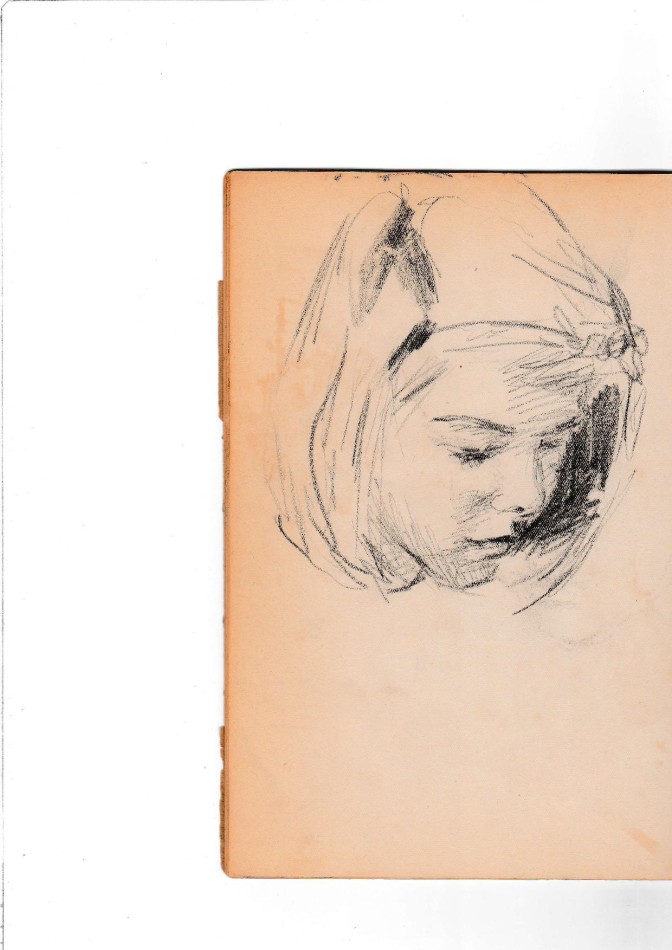
Biography of Ruth MENTZEL
Project carried out by a 9th-grade class at the Schillerschule in Frankfurt-am-Main in 2015-2016.
Biography of Ruth Mentzel, the daughter of Charlotte Mentzel, née Rothschild.
The sketch of her reading, done by her father, opposite and the two photographs below were handed over to us by Ruth’s sister, Catherine, who we are grateful to.
——————————————————————————————————————————————————-
After the result of the work done by the german students, we reproduce, with the kind authorization of Catherine, sister of Ruth, the following text, non translated :
Written, for the association convoi 77, by her daughter Catherine, from the memories, Points de fuite, by Albert Flocon,her father, published by Ides et Calendes in 1994.
Charlotte, Lo was the second of the four daughters of Henry and Bertha Rothschild. Born Nov 10, 1909 in Francfort.
——————————————————————————————————————————————————-
Ruth was born on February 10, 1932 in Frankfurt-am-Main or in Berlin (Germany). Her middle name was Carla, probably after her mother, Charlotte Josephine Rothschild, called “Lotte” [1]. Charlotte met a young Berliner, Albert Mentzel, at the Bauhaus in Dessau, where they were both studying graphic arts. They got married soon after that and settled on March 3, 1933 in a Frankfurt housing estate (Heimatsiedlung), at 15 Unter den Platanen, ground floor on the left. The building was not destroyed in the war and is still standing.
After the National Socialist Party came to power the Mentzel family’s situation became critical. From 1935 on, mixed marriages were forbidden by the new race laws. The union of Charlotte and Albert fell under this law: Albert was German; Charlotte was Jewish. But their marriage, like all those that took place before that date, was not invalidated. Like the other couples in their situation, however, their diplomas were rescinded and they were excluded and stripped of their dignity.
In 1933 events and political developments in Germany provoked the family’s flight to Paris. Ruth was not yet two years old. Although Albert found work as an advertising designer, close relatives helped the family to survive in exile. Two more children were born to the young couple, Catherine-Anne on January 5, 1937, and Henry on May 31, 1939.
At the start of the war Albert, who still held German citizenship, was interned in the Chambaran military camp before enlisting in the French Foreign Legion. He was demobilized at Pibrac (today in the Haute-Garonne department). His family, fleeing before the German advance, joined him in Toulouse. Their last residence was at Sainte-Hélène in the Gironde department.
On December 2, 1941 they were deprived of their nationality. Charlotte worked in the aviation factories. Albert was actively involved in the Resistance. In the summer of 1944 the level of danger for the Jews increased, and they placed their two youngest children, Catherine-Anne and Henry, in the orphanage in Loure-Barousse, where they remained until 1946 [2]. They kept twelve-year-old Ruth with them.
On June 20, 1944 Charlotte and Ruth were turned in and arrested by the German military security police (Geheime Feldpolizei). They were imprisoned in Toulouse, then sent to the holding camp at Drancy on June 25th, where they were both attributed the I.D. number 21481. On July 31 Charlotte and Ruth were deported to the concentration and extermination camp at Auschwitz, where all trace of them disappeared. The official date of their death is August 2, 1944 [3].
After the Second World War, Albert pursued his artistic career from 1954 under the name Flocon (that of his maternal grandmother, who was of French origin), teaching design at the l’École Estienne in Paris. He wrote several books, remarried and was again a father. He obtained a full professorship in the subject of perspective at the Paris École des Beaux-Arts in 1964. He died in Paris in 1994 [4]. Catherine-Anne and Henry survived the war but came home only in 1946.
In the old Jewish cemetery in Frankfurt-am-Main near the Jewish Museum a wall has been put up in memory of the city’s Shoah victims. A small stone plaque bearing the names of Charlotte and Ruth recalls their fate.
[1] See her biography.
[2] Children’s Center opened by the Secours National, cf Wikipedia article.
[3] Although Legifrance gives this date, various testimony states that convoy 77 arrived at Auschwitz on the evening of August 3.
[4] His engraver’s archives were given to the IMEC. See the text by Yves Chevrefils Desbiolles, « La douceur du graveur Albert Mentzel-Flocon », in Les Carnets de l’Imec, n° 4, automne 2015.


[…] Charles Péguy de Palaiseau, qui ont travaillé sur les biographies des déportées Charlotte et Ruth Mentzel, ont été choisis pour l’accompagner dans ce […]