Français
 Polski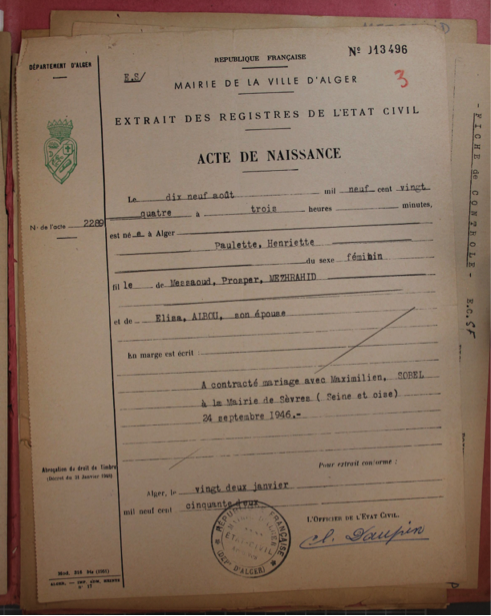
Paulette Henriette MEZRAHID
(August 19, 1924 Algiers, French Algeria– August 16, 2020, Antibes, France)
Document: Paulette Mezrahid’s birth certificate
The Mezrahid family
Paulette Henriette was the youngest of four daughters born into an Algerian Jewish family. Her father Messaoud Prosper Mezrahid[1] who was born on December 13, 1886, and had served in the First World War (he was discharged due to emphysematous bronchitis resulting from campaigns against the German army during the Great War, which he fought in part on Algerian territory[2]) was a tailor. He, his wife Élisa, also known as Louise, née Albou, who was born in 1887, and their children emigrated from Algiers to Paris, France. His military service record states that he was in Paris in both July 1925 and December 1936. It was probably around that time, in late 1936, that the Mezrahid family settled in Paris.
Paulette had three sisters, Fortunée Reine, born in 1915, Marie Marthe Berthe, born on October 1, 1916, and Yvonne Camille, born on November 13, 1917 and one brother, Georges.
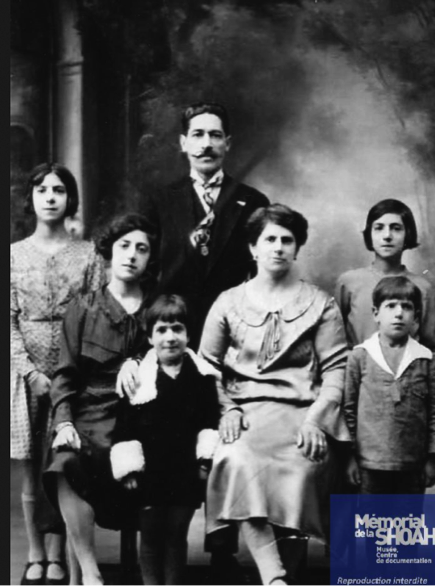
Photo of the Mezrahid family © Shoah Memorial, Paris / Josiane Piquard collection
This family photo was taken by a photographer in Algiers, but we do not know when exactly[3].
From left to right: Marie Berthe Mezrahid, Reine Mezrahid, Paulette Mezrahid, Messaoud Prosper Mezrahid, Elisa Mezrahid, Yvonne Mezrahid and Georges Mezrahid
The family met a tragic fate, as only Paulette and Georges survived.
Élisa, their mother, who was born on January 23, 1887, was deported on Convoy 63, which Drancy on December 17, 1943. She arrived there on December 7, and was assigned the serial number 9790.

Elisa’s name on the Wall of Names at the Shoah Memorial in Paris[4]
Marie Berthe, who was born on October 1, 1916, was deported from Drancy to Auschwitz on Convoy 71 on April 13, 1944. She arrived in Drancy on April 6 or 7 and her serial number was 19082.
Simone Veil was also deported on this convoy.

Marie’s name is on the Wall of Names at the Shoah Memorial in Paris[5], not far from Paulette’s
Yvonne Camille was deported on Convoy 72, which left Drancy on April 29, 1944. Her name is also inscribed on the Wall of Names at the Shoah Memorial in Paris[6].
Georges was interned in Drancy in 1941, when he was 16 or 17 years old, but managed to escape with the help of a French gendarme (military police officer).
Prosper was not deported, as he died after he accidentally fell down the stairs in Drancy. He therefore never witnessed the fate that befell his family.
Yvonne, Paulette’s eldest sister, was a single mother of two daughters, Josiane, who was born in 1939, and Micheline, born in 1941. She married a Mr. Perot on April 19, 1941, at which time he officially recognized the children as his. She worked as a saleswoman and was deported on Convoy 72 on April 29, 1944. Her serial number in Drancy was 19401. She was interned under the name of Yvonne Kahn, but on the typed deportation manifest, in German, she is listed as Yvonne Perot.
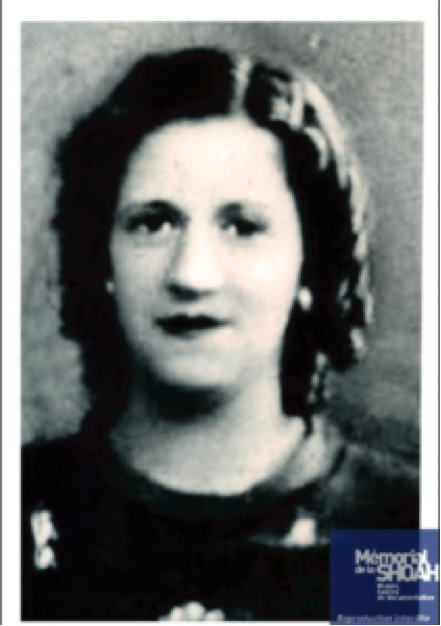
Yvonne Pérot née Mezrahid. No date of place © Shoah Memorial, Paris / Josiane Piquard collection
Her little daughters were kept hidden in a Catholic orphanage, which saved their lives. As for Yvonne, sadly she never returned from the camps.
Josiane Piquard, Yvonne’s daughter and Paulette’s niece, kindly shared with us some information that we had failed to find in the archives. Her assistance was invaluable and helped us to revive the memory of her family.
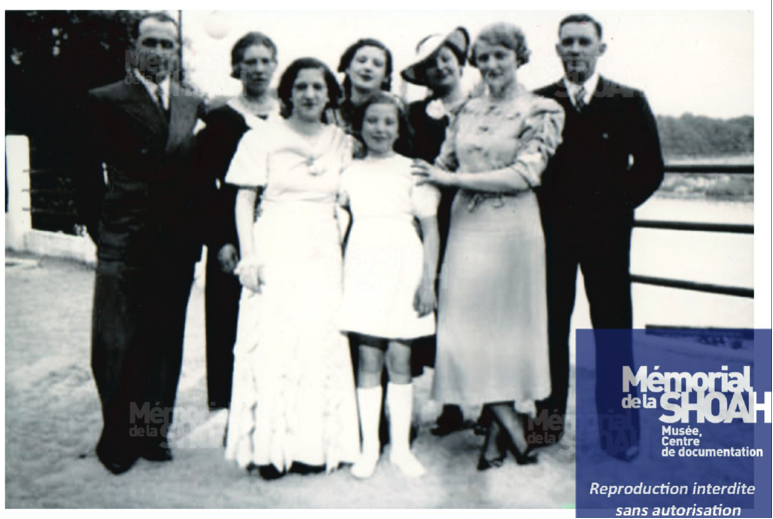
Yvonne Pérot née Mezrahid with a group of unidentified people in Algiers. Undated. Yvonne is on the left in the front row © Shoah Memorial, Paris / Josiane Piquard collection.
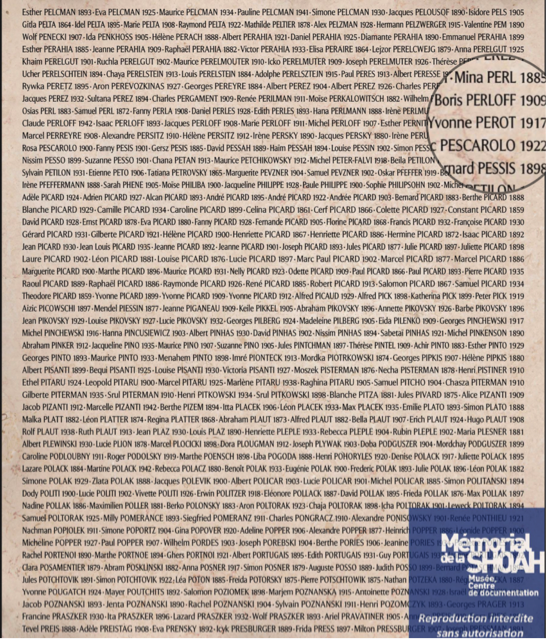
Yvonne Pérot’s name on the Wall of Names at the Shoah Memorial in Paris[7]
The arrest
Paulette was arrested in the 11th district of Paris on July 11, 1944, during a militia round-up in the neighborhood. The arrest may have taken place on rue Charonne, but she later stated in one record that it happened at the Place de la Bastille. It was around noon and she was on her way to a restaurant on rue Charonne. A police report dated October 15, 1952 stated that she was not carrying her identity card[8]. According to her grandniece, she had a false identity card in the name of Paulette Bertrand. The militia also noted that she was in breach of the 8th German order of May 29, 1942, regarding the wearing of the yellow star in public, i.e., she was not wearing the obligatory star at the time. She was initially taken to the police station on Place Voltaire in the 11th district of Paris. At 8 p.m. on July 12, she arrived at the police headquarters depot, and then at 3 p.m. on July 13 she left the depot and was interned in the Drancy camp, northeast of Paris.
The police headquarters depot register states that at the time of her arrest, Paulette was working as a milliner and living at 44 Rue Basfroi in the 11th district, although we later found a reference to a different address. Might she have been living with another family, since she was alone by that time, or perhaps staying in a hotel?
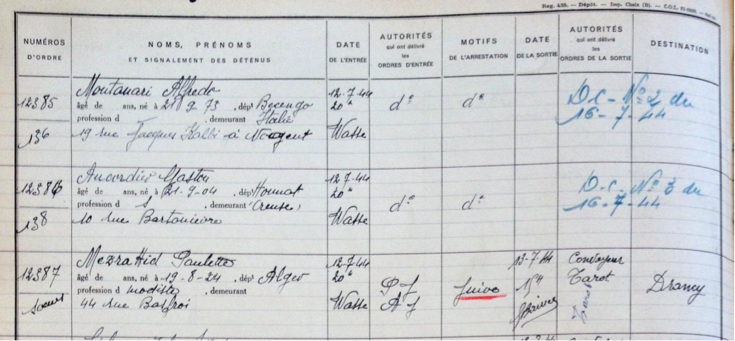
Page from the arrest register. Paris police headquarters depot records, ref. APP_CC2-8.
Paulette was interned in Drancy camp for two weeks. On July 31, 1944, she was deported on Convoy 77 from the nearby Bobigny station to the Auschwitz-Birkenau concentration camp and killing center in Poland.
When the convoy arrived, during the night of August 3-4, 1944, she was selected to go into the camp for forced labor. As she entered the camp, she had the number A-16 771 tattooed on her forearm.
In October 1944, Paulette was transferred along with a number of other women to the Bergen-Belsen camp in Germany, where they worked in an aircraft factory. The British army liberated the camp on April 15, 1945. Earlier in April 1945, a large number of convoys of deportees from the Auschwitz, Buchenwald, Dora, Dachau, and Sachsenhausen amps had been transferred to Bergen-Belsen, which soon became a death camp. When the British troops arrived, they discovered vast numbers of corpses, all victims of hunger, thirst, and typhus. They initially quarantined the camp and prevented anyone who was still alive from leaving.
Repatriation to France and post-war life
Paulette was eventually repatriated to Paris on 8, 1945. She arrived at the Lutetia hotel, which was being used as a reception center for returning deportees, just before her 21st birthday. She must have been in very poor health as she was repatriated by plane, which only happened to people who were extremely weak. According to the medical form filled out when she arrived back in France, she had lost around 35 pounds. She was 5’2” tall and weighed just 44 pounds[9].
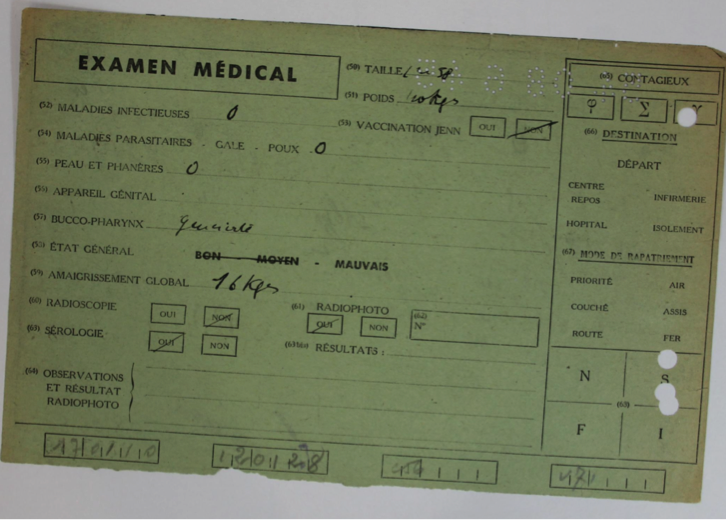
The medical form filled in when Paulette returned to France. © Victims of Contemporary Conflicts Archives Division of the French Ministry of Defense Historical Service, in Caen, dossier no. 21 P 676 236
After the war, the SSJ (Service Social des Jeunes, or Youth Social Services department) was responsible for following up Paulette. Some time later, at a meeting of Auschwitz survivors, she met Maximilien Sobel, who was born on July 7, 1910, in Cernauti (Chernivtsi in present-day Ukraine, on the Romanian border). He had been deported to Auschwitz on March 27, 1944, on Convoy 70[10].
The couple were married on September 24, 1946 in Sèvres, in the Hauts-de-Seine department of France. Maximilien, who had defended his doctoral thesis in Lyon, in the Rhône department of France in 1937, was a doctor. He and Paulette moved to Argenteuil, in the Val d’Oise department. They were living there in June 1948, and his medical practice was up and running in 1949.
In 1952, Paulette applied to be officially recognized as having been a political deportee. She said that she had been arrested on grounds of her “race”. In April 1954, she received the deportees’ and internees’ compensation payment of 13,200 francs (equivalent to around 300 dollars in today’s money).
Paulette also submitted an application to be recognized as a former Resistance member, but this was turned down. In the course of her efforts to obtain political deportee status, she got back in contact with her niece, Josiane, who was 25 or 26 at the time, and they kept in touch. Josiane, who trained as a nursing assistant and later became a nurse, corresponded with Simone Veil several times.
Maximilien and Paulette had three children, Ghislaine, Sylvie and Yves.
When Maximilien retired, he and Paulette moved to Antibes, in the Alpes-Maritimes department of France. Her brother Georges moved there too, having lived most of his life in Marseille. He died a few years ago.
Paulette was still living in Antibes when she died on August 16, 2020, at the age of 95.
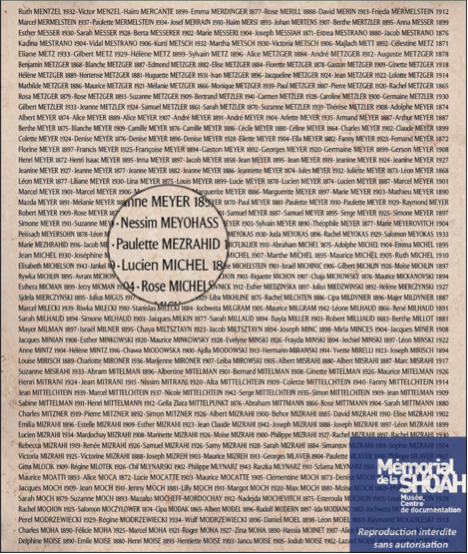
Paulette Mezrahid’s name on the Wall of Names at the Shoah Memorial in Paris[11].
Sources
- Victims of Contemporary Conflicts Archives Division of the French Ministry of Defense Historical Service, in Caen, file on Paulette MEZRAHID (married name SOBEL), dossier no. 21 P 676 236
- Arolsen archives
- Shoah Memorial, Paris, museum and documentation center
- United States Holocaust Memorial Museum
- French overseas departments archives
Thanks
Many thanks to Ms. Josiane Piquard, née Pérot, for taking the time to speak with us and for providing us with so much helpful information.
Notes & references
[1] Prosper’s parents were Moïse Mezrahid and Messaouda Lelouch.
[2] French overseas departments archives:
[3] In this photo, the family was dressed in elegant Western-style clothing from the late 1920s or early 1930s. This was in line with the children’s ages, the youngest being Georges and Paulette. On June 25, 1933, L’Echo d’Alger, reported that Georges was one of a group of boys selected to go to an “open-air school”, a type of summer camp in Cap Matifou, near Algiers. This shows that family was still in Algeria in the summer of 1933. Might it have been the large anti-Jewish demonstrations that took place on August 3-6, 1934, that prompted Prosper Mezrahid to leave Algeria?
[4] Slab n° 33, column n° 11, row n° 3. The names are listed by year of deportation and in alphabetical order. As can be seen, five other people by the name of Mezrahid were deported in 1943. For more on the deportation of Jews from Algeria, see Jean Laloum’s “La déportation des Juifs natifs d’Algérie” (The Deportation of Jews Born in Algeria), published in Le Monde Juif, 1988/1 No. 129, pp. 33-48.
[5] Slab n° 28, column n° 10, row n° 1.
[6] Slab 31, column n° 11, row n° 1 (see below).
[7] Slab n° 31, column n° 11, row n° 1.
[8] Victims of Contemporary Conflicts Archives Division of the French Ministry of Defense Historical Service, in Caen, dossier no. 21 P 676 236. This police report contains numerous inaccuracies, particularly with regard to dates.
[9] She gave her pre-war address as 14 Rue de Charonne. Later, she filed a claim for “war damages” for the looting of her apartment at that address. According to a compilation of data from her file, she apparently lived at 2 Rue Gaston-Cavaignac when she returned to France, perhaps while waiting to get her old apartment back?
[10] He was initially sent to a Foreign Workers Group (GTE) in the Indre department and then transferred to the 701st GTE in Miramas, where he worked for the Todt organization. The Gestapo took him to the Les Beaumettes prison in Marseille on February 26, 1944, and he was then transferred to Drancy.
[11] Slab n° 28, column n° 10, row n° 1.