Français
 Polski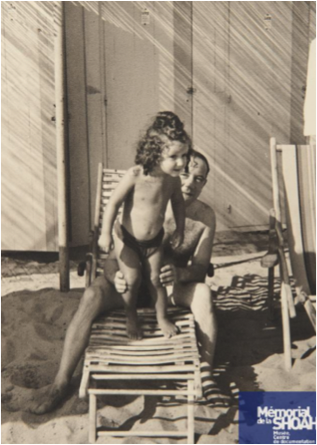
Claude BROÏDO
Photo: Claude and his father Isaac © Shoah Memorial, Paris /Coll. Delphine Ouazan Labrosse
Claude Broïdo (or Broydo) was deported together with his mother and father on Convoy 77, the last large convoy to leave France for the Auschwitz-Birkenau extermination camp in Poland. He was one of the six million people killed during the Holocaust.
Claude was born on May 5, 1940, in the 7th district of Paris[1]. His parents were Isaac Albert Broïdo and Brana Blanche Broïdo, née Weintraub. They had been married since 1924[2] and Claude was their second child. His father was a salesman and his mother a shorthand typist. Claude had an older brother, Marc, who was born on January 13, 1928[3]. The family was Jewish.
For the first two years of his life, Claude and his family lived at 33 Boulevard Saint-Martin in the 3rd district of Paris[4]. His parents also owned a second home, the Villa Cacho Maïo on Avenue Commandant Bret in Cannes, on the south coast of France. This became the main family home in 1942. In the wake of the roundups in Paris in the summer of that year, including the well-known Vel d’Hiv roundup, many Jews fled to the “free” zone in the southern half of France. Cannes was then in the area run by the Italians, who were much less inclined to enforce the anti-Jewish legislation passed by the German occupiers and the French collaborationist government led by Marshal Pétain. Albert, Claude’s father, also stated later that his work with the Franch Resistance movement was another reason that they moved south[5]. We can just imagine Claude spending afternoons with his parents and his brother on the beach in Cannes. In a photograph of Claude and his father, held at the Shoah Memorial, he appears to be excited by something on the beach or in the ocean.
Claude’s father resumed his resistance work with the Mithridate network[6] in the Alpes-Maritimes department of France. The was ultimately what enabled the Gestapo to track down the Broïdo family.
On November 11, 1942, the Wehrmacht invaded free zone, at which point the Italian government decided to take control of the eight departments on the Italian border. Jews were allowed to live in this area legally. However, on September 8, 1943, Marshal Badoglio surrendered and by October that year, the Italian troops had all left France. Heinz Röthke, the SS officer in charge of deporting Jews from France, then sent Aloïs Brunner, the commandant of Drancy transit camp, just north of Paris, to hunt down Jews on the French Riviera. From September 10 through December 15, 1943, with between twelve and fourteen henchmen, including the infamous Brückler, they organized a full-scale “manhunt”[7], during which they rounded up not only able-bodied men, but also women and children, seniors and even sick and disabled people. Brunner’s team then beat and tortured them, and even brought in a Jewish doctor from Drancy, Dr. Abraham Drucker, to revive anyone from whom they wanted to extract specific information. The local population in Nice was furious. Brunner failed to bring in his “quota” of Jews despite his extreme brutality, but still managed to send 1,900 people to Drancy to be deported. When Brunner returned to Paris, other Nazi teams took over the hunt for the Jews. This put the Broïdo family at risk on two counts: firstly, because they were Jews, and secondly due to Albert’s involvement in the Resistance.
ARREST AND DEPORTATION
On June 27, 1944, just a month after he turned four years old, the Gestapo and the French militia arrested Claude and his parents at their home in the Villa Cacho Maïo. His older brother, Marc, who was 16 by then, managed to escape and hide on the roof, after which he went to stay with his paternal grandparents[8]. According to Albert’s daughter Martine Broïdo, who was born after the war, Claude was not actually at home at the time: “Claude was playing at the neighbor’s house and when he saw his parents being arrested. ‘Where are you going? I want to go with you!’, he said. The car, which was about to drive away, stopped. The two Germans said, ‘We’re not taking the kid!’ but the two Frenchmen said, ‘Yes, we are! We have to take him!’ so he was taken away.” she wrote in her testimony[9].
The Broïdo family was taken straight to the Hôtel Excelsior in Nice, the headquarters of the anti-Jewish squad, where Claude’s father was interrogated for several days. The Gestapo confiscated the family’s belongings[10]. Official records state that Claude and his family were arrested on grounds of their “race”, and that they were Jewish[11].
Claude and his family were then transferred to Drancy, where they arrived on July 12, 1944. Claude’s name is not listed on his mother Brana’s interment record, he is simply referred to as “+ fam.” He therefore shared his mother’s serial number, 25075, and was “immediately deportable,” as indicated by the letter B on their card[12]. The family spent over a fortnight in Drancy camp, with Claude and his mother in room 1 on staircase 3[13].
Claude was deported on Convoy 77, terrified and clinging to his father, on July 31, 1944. After a horrific journey, during which the 1,306 deportees were crammed into cattle cars 60 at a time, with straw on the floor and no sanitation and next to no food, water or fresh air, the train arrived at the Auschwitz-Birkenau camp in Poland.
As soon as the train arrived, during the night of August 3-4, 1944[14] , Brana and Claude were loaded onto a waiting truck and taken to the gas chambers, where they were murdered[15]. He was only four years old.
His father, Albert, was selected to enter the camp to work. He survived, returned to France and was reunited with Claude’s brother, Marc, in 1945. In 1947, Albert began the necessary paperwork to have Claude and his mother officially recognized as having “died for France” and as “political deportees” (meaning that they were deported simply because they were Jewish). The first was granted in 1947[16] and the second in 1953[17]. Albert also tried to have Claude and his mother awarded the French “Diplôme d’Honneur” (Honorary Diploma), but this was is refused in November 1957, because at that time, deportees who were family members of military personnel or Resistance fighters were not eligible.
In 1990, forty-six years after he died, his paternal aunt, Suzanne Képès, paid him a final tribute by filling in a testimonial sheet for him at the Yad Vashem memorial in Jerusalem[18].
All that remains of Claude’s life is one single photograph and an archived file containing documents submitted by his father to have him recognized as having been a political deportee. Claude’s life had only just begun when the Nazis snatched it away during the Holocaust.
Notes & references
[1] File on Claude Broïdo © Victims of Contemporary Conflicts Archives Division of the French Ministry of Defense Historical Service, in Caen, n° 21P43107876973
[2] File on Brana Blanche Broïdo © Victims of Contemporary Conflicts Archives Division of the French Ministry of Defense Historical Service, in Caen, n°21P431077(24)
[3] File on Brana Blanche Broïdo © Victims of Contemporary Conflicts Archives Division of the French Ministry of Defense Historical Service, in Caen, n°21P431077(49)
[4] File on Brana Blanche Broïdo © Victims of Contemporary Conflicts Archives Division of the French Ministry of Defense Historical Service, in Caen, n°21P431077(33)
[5] File on Brana Broïdo © Victims of Contemporary Conflicts Archives Division of the French Ministry of Defense Historical Service, in Caen, n°21P431077(44) / File on Albert Broïdo © French Ministry of Defense Historical Service in Vincennes, ref. GR 16 P 92380
[6] Pierre Herbinger founded the Mithridate network in June 1940 at the request of the British intelligence service, MI6. Laure Diebold, Jean Moulin’s secretary, was also member of the network.
[7] Mary Felstiner, “Commandant de Drancy: Alois Bruner et les Juifs de France” (Commandant of Drancy: Alois Brunner and the Jews from France), Le Monde juif (Jewish World) 1987/4, p. 143 à 172. https://shs.cairn.info/revue-le-monde-juif-1987-4-page-143?lang=fr#re1no24
[8] File on Brana Blanche Broïdo © Victims of Contemporary Conflicts Archives Division of the French Ministry of Defense Historical Service, in Caen, Dossier n°21P431077(44-45)
[9] See below for a more detailed testimony.
[10] File on Isaac Albert Broïdo © Victims of Contemporary Conflicts Archives Division of the French Ministry of Defense Historical Service, in Caen, Dossier n°21P71845476971.
The property stolen from Jews was used to pay for the hotel: https://museedelaresistanceenligne.org/media3565-Stle-de-lHtel-Excelsior
[11] File on Claude Broïdo © Victims of Contemporary Conflicts Archives Division of the French Ministry of Defense Historical Service, in Caen, n°21P43107876973
[12] File on Brana Broïdo © Shoah Memorial, Paris (FRAN107_F_9_5683_114079_L)
[13] File on Brana Broïdo © Shoah Memorial, Paris (FRAN107_F_9_5683_114079_L)
[14] Claude’s father was mistaken when he gave his death date as August 11. No young children went into the camp. They were all killed in the gas chambers, often with their mothers, as soon as they arrived in Auschwitz.
[15] File on Claude Broïdo © Victims of Contemporary Conflicts Archives Division of the French Ministry of Defense Historical Service, in Caen, Dossier n°21P43107876973
[16] File on Claude Broïdo © Victims of Contemporary Conflicts Archives Division of the French Ministry of Defense Historical Service, in Caen, Dossier n° 21P43107876973
[17] File on Claude Broïdo © Victims of Contemporary Conflicts Archives Division of the French Ministry of Defense Historical Service, in Caen, Dossier n° 21P43107876973
[18] File on Claude Broïdo © Yad Vashem