Français
 Polski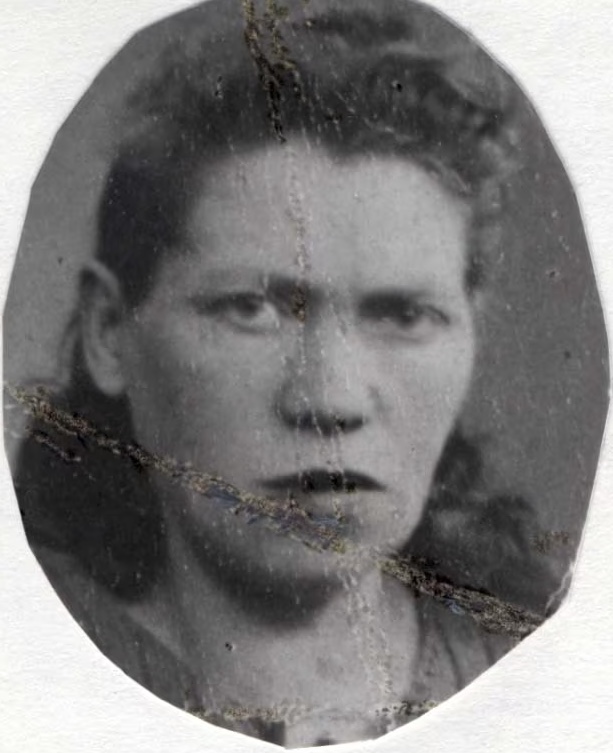
Esther GRINBERG
Portrait photo of Esther Gittel Grinberg (taken in the 1940s?) © Yad Vashem
We were able to retrace Esther’s life story with the help of the various historical records. In addition to writing this biography, we produced some maps in order to compile an “Atlas of the Grinberg family”, and recorded a series of podcasts. These are included throughout the biography.
You will find the Atlas, in French here.
Esther Gittel Spatz (Schlank/Shank) was born on December 16, 1902 in Siedlanka, a suburb of Lezajsk, a small town some 30 miles northeast of Rzeszow, which was then in the Austro-Hungarian Empire but is now in Poland. Her parents were Zolme Schank and Hinde Spatz.
Esther’s parents wanted to send their children “to America” in order to escape poverty and, more importantly, the pogroms. Her hometown of Lezajsk also got caught up in the fighting between the Russians and Austro-Hungarians between November 1914 and May 1915, which would hardly have enticed them to stay.
The family emigrated to France from Eastern Europe
The first podcast report, in French
Her future husband, Shil Grinberg, was born on January 16, 1904 in Bar, in Vinnytsia, which was then in the Russian Empire but is now in the Ukraine, not far from the Romanian border. He appears to have grown up a little further south, however, in Secureni in Bessarabia, in present-day Moldavia. According to the records, his parents were Leib (Louis) Grinberg and Freida Rothstein, but oddly, he also appears to have had or lived with a second family, Mendel and Chana Reider, who, along with their daughter Doudle, died while on a death march in 1943 [1]. According to his naturalization application, Shil had two younger brothers.
Esther met Shil Grinberg in 1922 or 1923. He had arrived in France from Bessarabia or Moldavia, she from Poland. They were not yet 20, and both were hoping to emigrate to America (Esther had a sister in Brooklyn) but in the end, they stayed on in Paris. They met in a refugee “shelter” on rue Lamarck and then set up home together in a shanty-town in the Saint-Ouen flea market, an area in which many Jews from Eastern Europe lived. Between themselves, they always spoke Yiddish. They were naturalized as French citizens on December 4, 1933. The Grinberg family built up a network of work colleagues, neighbors and friends, including two other families from Eastern Europe, the Blumbergs and the Schlosses (or Szlos), whose children all played together.
Below are two maps that chart their journey into exile.


Esther, who was later known as Georgette, had never been interesting in learning to read and write. “She was a savage,” her daughter Renée used to quip. She regretted it later in life, and insisted that her children did not follow her example. Renée, when she was around 6, began to read the newspapers to her and help her learn French. Esther never let her children speak Yiddish and only let them speak French at home, although when she said, “Kindlerkh, kimt shoyn!” they obviously understood that they had to come, and if she added, “Kimt zim Tish!”, they knew it was mealtime.
The move from the shanty-town to a low-cost housing development near Porte d’Aubervilliers
When Rivbaka was born, Esther and Shil were living at 35 rue du Couédic in the 14th district of Paris (but they were no longer there at the time of the 1926 census). When her brother Maurice was born, two years later, they were living at 7 rue Saint-Laurent in the 10th district.

Shil and Esther with their daughter Rivbaka/Rivka/Renée in their shack
in the shanty town (in the late 1920s?) © Family archives
Shil and Esther were married on July 22, 1930 in Saint-Ouen, to the north of Paris, where they lived at 100 rue Jules Vallès, in the flea market, not far from what would become the Malik market in the 1940s. They lived in a neat, well-kept shack in what was known as the “zone”, a shanty town that had sprung up on the site of some old fortifications (now under the Paris ring road). Renée’s father became a secondhand dealer, hunting for old objects in the nicer neighborhoods, initially with a handcart. Then, so he could sell larger pieces of furniture and earn more money, he bought a horse called KikI, and a horse-drawn cart. Later still, he bought a motor car, a Citroën convertible. This same car later enabled him to become a delivery driver (perhaps only in 1941, when he was no longer allowed to work legally).

A model of the “zone”, seen from the Saint-Ouen side, at the Carnavalet Museum in Paris © Darley photos
 An old postcard of the rue Jules Vallès in the Saint-Ouen flea market © Saint-Ouen municipal archives
According to the 1936 census, they moved to 18 rue Charles Lauth, in the 18th district of the city. Rue Charles Roth was part of a low-rent housing complex built in 1935. Only French nationals, which the Grinbergs were by that time, were allowed to live there!
Here is a map of the area around rue Charles Lauth, in Porte d’Aubervilliers:


Their apartment had all “mod cons”: two bedrooms, a living room, a kitchen with a coal-fired stove, a shower and a toilet.

The Grinberg family in around 1939: they already had five children by then (from right to left, by age, oldest first: Rivbaka/Rivka/Renée, Maurice, Jeannette, Berthe and Simone) © Shoah Memorial, Paris
The family was reasonably religious: Esther prayed every Friday evening. As for Shil, according Renée, he was more of a Communist.
They had seven children in all: Rivbaka/Rivka/Renée (1925-2024), Maurice (1927-1945?), Jeannette (1930-2018), Berthe (1933-2019), Simone (1935), Daniel (1940) and Monique (1942-1944). As far as we are aware, there is only one photo of the family, and only the five older children are in it.
The first signs of trouble
In 1934, the family went on vacation to Poland, where they stayed with Esther’s sister and her family. Esther took with her the four children that she had at the time: Renée, who was 9, Maurice, 7, Jeannette, 4 and Berthe, who was just a year old. They did not book seats on the train, and the children had to sleep in the overhead baggage nets. The children remembered the Polish countryside vividly, as they had only ever known Saint-Ouen. Their grandmother was a wonderful woman, who still had four of her children with her, but the eldest sister had emigrated to America (where Esther had also intended to go), and another sister and two brothers had moved to Palestine.
They had to cross Germany on the way to Poland. Esther must surely have heard about what was happening to the Jews there…
Esther’s husband was rounded-up and disappeared
The second podcast report, in French
The family was evacuated out of Paris in 1939: they had a large number of children and Esther was pregnant again, so were a priority case. This explains why she gave birth to Daniel in January 1940 in Saint-Nazaire. They then moved back to Paris, where not only the war but also the Vichy government’s antisemitic legislation made life increasingly difficult for Jews. The couple then went their separate ways, but not for those reasons: they split up for a while because Shil was unfaithful to Esther, although they got back together soon afterwards and had another baby, Monique.
The situation continued to worsen, and then in the summer of 1941, Shil was arrested. Perhaps, in their last few weeks together as a family, Maurice overheard his parents talking, and would surely have understood what they were saying in Yiddish: “Oy vay! Vous vet vern fin indz?“ Esther might have said ”Oh my! What’s going to become of us?” What if she discussed with Shil what they should do with the children? Send them somewhere safe? Keep them hidden? “Vous tit mit di kindas? Zoln mir zey yo avekshikn ahin? Ofn dorf?” Send them to stay in the country somewhere?
But then in late August, 1941, tragedy struck: Shil was arrested in a little restaurant in Saint-Ouen that was popular with Jewish flea market traders. Between August 20 and 24, 1941, the French police and the German Feldgendarmerie carried out a major round-up in Paris, during which they arrested French as well as foreign Jewish men between the ages of 18 and 50. On the 21st, they targeted the 18th district, and from there they only had a go a few hundred yards to get to Saint-Ouen. In all, 4,232 people were taken to Drancy camp, which from this point on it became an internment camp for Jews.
The family must have been aware of what happened to people who were sent to Drancy, and that the same was probably in store for them too.


A recent photo of the café opposite the Cité de la Muette in Drancy
In fact, Renée and her mother, Esther, went to Drancy to “see” Shil. They had to wait in the bistro opposite the camp (no doubt the same one that is now opposite the Cité de la Muette) until the prisoners came out on the balconies, but as Renée later explained: “It was very difficult to communicate with them because the guards were so intimidating”.
With no income of her own and a family to support, Esther soon found it hard to make ends meet. She managed to secure an allowance from the U.G.I.F. (Union Générale des Israélites de France, or General Union of French Jews) [2] for her seven children, as well as ration coupons and a soldier’s pension (had Shil served in the army in 1939?). She had to sell off everything she had that was of any value, such as the car Shil used for work.
The younger children were sent into hiding
In 1943, the younger children (except for the baby, Monique) were sent into hiding in Brittany, thanks to the assistance of Father Devaux from the order of Notre-Dame de Sion.


Two sisters who lived in Amanlis, near Rennes, took them in. In 1943, these two young women, who were themselves wards of the French welfare system, had decided to open a home for abandoned children in Janzé. The nuns from Notre-Dame de Sion placed six children from the Paris area with them. The social worker who brought the children to them explained that their parents had been deported and that they had no food ration cards. In late 1943, the shelter was moved to Amanlis. A local support network, made up of some farmers, a baker and Les Docks du Ménage, a Rennes-based firm, helped out and provided the food. Jeannette, Berthe, Simon and Daniel Grinberg were placed with two families in the village. Their older sister, Renée, took them there because Esther had too strong a Polish accent, so could not travel around without drawing attention to herself. Their lives were saved as a result, as were those of all the other children who were kept hidden in Amanlis. Renée, who was also deported but survived her time in the camps, went to collect them after she returned to France in May or June 1945.
However, neither Renée nor her mother found the strength to leave little Monique in Amanlis, either in 1943, at the same time as the others, or in late May/early June 1944, just before the Normandy landings: she really was still only a baby! Renée therefore took Monique back to Paris: something she regretted for the rest of her life.
Esther too was arrested and deported, along with two of her older children and the baby
The third podcast report, in French
Esther and three of her children, Renée, Maurice et Monique, were rounded-up on the night of July 8, 1944. Five men (militiamen, French police and Gestapo agents) arrived at their apartment, on the pretext of checking their identity papers, but then arrested them. Some other people who lived in the building were arrested at the same time, including Léone (or Anna) Ribault, who testified after the war to having witnessed the arrest of the Grinberg family, and the family, whose daughter Madeleine was around the same age as Renée and Maurice. They were all taken to Drancy, including Mrs. Blumberg, who was nine months pregnant.
When they arrived in Drancy, they were sent to room 2 on staircase 18 (except for Maurice, who was sent to room 4 with the other men). They remained there until July 31, 1944, when they were deported to Auschwitz on Convoy 77.
According to Renée, during the three-day journey to Auschwitz, Maurice tried to make his mother and sisters as comfortable as possible in the cattle car, and shared out the water. Whenever he could, he gave his mother a break by taking baby Monique in his arms, but Monique, who was distraught, tried to cling on to her mother.
As soon as they arrived in Auschwitz-Birkenau, Esther and Monique were sent to the gas chambers and murdered. Her older children were selected to enter the concentration camp to work.
 D’après Renée, les parents d’Esther se sont cachés en Union soviétique pendant la guerre et ils ont été tués par des Polonais après la guerre (fin 1945 ?) quand ils ont voulu rentrer chez eux. Les parents de Shil, quant à eux, ont été tués sur les routes de Bessarabie au cours de marches forcées.
Renée later said that Esther’s parents went into hiding in the Soviet Union during the war, and were killed by the Polish when they tried to return home after the war (in late 1945?). As for Shil’s parents, they were sent on a forced march and died on the road somewhere in Bessarabia.
Notes
[1] This second family remains a mystery, but Renée and Jeannette Grinberg filled in testimonial sheets at Yad Vashem for these two people, stating that they were their granddaughters and great-nieces.
[2] The U.G.I.F. was founded in 1941 by the Vichy government at the behest of the Germans, and was supervised by the Commissariat Général aux Questions Juives (General Commissariat for Jewish Questions). It was, among other things, responsible for helping Jews in need.
Sources
- File on Esther Grinberg née Spatz held by the Victims of Contemporary Conflicts Archives Division of the French Ministry of Defense Historical Service;
- The Victims of Contemporary Conflicts Archives Division file on Esther’s husband, Shil Grinberg, who was deported on Convoy 3 in July 1942 ;
- Shil and Esther Grinberg’s naturalization application file;
- Records for various members of the extended family on the Yad Vashem website;
- The testimony of their daughter, Renée Nedjar née Grinberg, recorded in 2006.
Thanks
We would like to thank Renée Nedjar’s son, Alain, and her nephews, Jacques Nedjar and Olivier Szlos, for their personal accounts and the many valuable documents still in their possession, which contributed greatly to this biography, and David Choukroun, who helped us trace the family of Renée Nedjar, Esther’s daughter, supplied Shil and Esther Grinberg’s naturalization file and helped us with our research.
Thanks also to: Claire Stanislawski at the Shoah Memorial in Paris and to the guides at the Shoah Memorial at Drancy; to Charlène Ordonneau from the Saint-Ouen municipal archives, who allowed us to explore the archives relating to the “zone” and the flea market; and to Macha Fogel of the French Yiddish Cultural Centre for giving us a brief introduction to the Yiddish language.
We would also like to thank Laurence Klejman for proofreading our biographies of the Grinberg family and providing us with a wealth of additional information, making them the most detailed we could ever have wished for!