

 Français
 Polski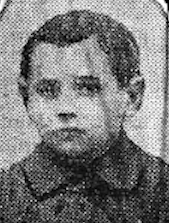
Léon KOUNOVSKI
Léon Kounovski was deported on Convoy 77. Although he survived, he never testified about his experience, even to his nephews and nieces. In order to retrace the incredible story of this man, we had to retrieve records from various sources, and this was no easy task, as the spelling of his surname varies greatly and changed according to the period in question: Kounovski, Kounowski, Kounouski, and so on. Similarly, his first name varies between Leiba, Leibe, Leisha and Léon. Each of the following records is described by one or two students from the 9th grade class 3°1 at the Jacques Prévert secondary school in Saint-Orens-de-Gameville, in the Haute Garonne department of France.

Class 3°1 from the Jacques Prévert secondary school (2024-2025), beside the stone that represents block 30 in Dachau, where Léon spent time during his deportation
A foreign family in early 20th-century France

The Kounovski family’s registration form dating back to when they first arrived in France in 1901. Source: Family archives
LUCAS N and NATHAN P.: This document, kept by the family, is the oldest record we were able to obtain. It is a registration form that foreigners had to have stamped at the prefecture in order to reside legally in France. It reveals that the family came from “Russia”, or more specifically from the outskirts of Minsk, which is in present-day Belarus. The father was born in 1865 in Slutsk, the mother in 1867 in Minsk, and all the children were born in Lubca, east of Minsk: Marcelle (or Moucha, married name Sofer) in 1893, Abraham around 1894, Paulette (married name Himelfarb) in 1898 and Ginette (married name Weinstein) in 1899. At that time, the Russian Tsar ruled the region. In common with many other families, the Kunovskis fled the Russian Empire for France: by the time of the 1911 census, there were some 35,000 Russians in France. They migrated for a variety of reasons. They probably fled the attacks on Jews, known as pogroms, or they may have migrated for financial reasons, given that that they came from a relatively poor area. The third possibility is that they simply wanted to leave their native village to make a new life for themselves in France. Léon, however, is not listed on the form, and we have no explanation as to why.
AMAURY: We do know, on the other hand, where the family lived. The prefecture records list three successive addresses for them in Paris: 119 rue des Boulets, 99 rue de Montreuil and 8 rue de Buzenval. The 11th district was home to a large Jewish population, mainly as a result of migration from Eastern Europe in the late 19th century, as people fled persecution. Attracted by affordable housing and work opportunities in and around the Marais district, these immigrants founded a close-knit community.

9-year-old Léon Kounovski made the front page of Le Petit Journal for saving another boy’s life, September 25, 1907, French National Library.
ISMAEL: It was in this neighborhood that Léon Kounovski grew up and blended into French society. In this article on the front page of the Petit Journal in 1907, there is a photo of Léon Kounovski, described as a “life-saver at the age of 9”. One day, when he was out playing with his friends, one of them, who could not swim, fell into the Canal Saint-Martin. On impulse, Léon and his friend Lucien Gewis jumped in to rescue him. When he got home, he told his mother all about it. Aside from this remarkable feat, this article reveals just how well integrated the family was. Léon had friends in school. His parents, Merdouck and Sarah, who were also interviewed for the article, spoke good French and worked in central Paris.
ELOISE: Through a network of family and marital relationships, Merdouk (Maurice) and his children went into the furniture-making trade. The Sofer family probably helped them get started, as Jean Sofer married Léon’s sister Marcelle. Léon’s uncle, his mother’s brother Leibe Nochimovski, may also have played a role. The Kunovskis opened their store in 1919 at 164 boulevard Magenta, which was a central location for the Eastern European Jewish community. A continuation of Boulevard Barbès, this street was a major thoroughfare with numerous furniture stores. Families such as Gross, Lévitan, Blachère and Sofer also set up their businesses there. In fact, David Blachère was Léon’s uncle, as he married his mother’s sister Chanah. The furniture business is documented in a number of records, including this one. The two Kounovski brothers were “like their father before them, cabinetmakers”.

Source: record no. 19940457 dossier no. 18373 from the “Moscow collection”, held by the French National archives in Pierrefitte
STÉPHANIE, PALOMA and LOLA: This record, from the Moscow collection, reveals that the police were monitoring the Kounovski brothers. The Moscow collection is a series of police records seized by the German army when it invaded Paris in 1940. The Germans subsequently took them to Berlin, and the Red Army moved them to Moscow after the war ended in 1945. They were finally returned to France between 1994 and 2004. The collection comprises both public and private documents. It contains thousands of individual files and dossiers written and drafted by police and homeland security personnel between 1880 and 1940, in the wake of the First World War, when “Russians” were suspected of being communist revolutionaries. In the Kounovski brothers’ case, the investigation concluded that they merely advocated a socialist system, not a revolution. What this archive does show, however, is how poor the family was during the First World War: “the rent, 630 francs a year, has not been paid since the outbreak of hostilities”. It also reveals that the Kounovski brothers refused to join the French Foreign Legion because they felt it was “made up of hooligans and bandits”.
The war – a challenging time

Military service record. Source: Family archives.
ALIX and ZOE: Between the wars, Léon continued to work in the furniture trade, and was also involved in an experimental theater club called Art et Action, with Edouard Autant and Louise Lara, among others. He also joined a Freemasons lodge in Reims for a few years. In 1939, after the invasion of Poland, the Kounovski brothers enlisted to fight against the Nazis. Léon Kounovsky was not a French citizen, however, so, like his brother Abraham, he may have joined the Polish Army in France.
The Polish Army in France was established soon after Nazi Germany and the Soviet Union invaded Poland, and Polish general Wladyslaw Sikorski spoke to the BBC on June 25, 1940. It was officially founded as a result of a French-Polish agreement on September 9, 1939, and confirmed by a second agreement on January 4, 1940. It comprised 80,000 Polish men and was involved in several battles between May 10 and June 25, 1940. As for Léon, he was assigned to the 15th section of the COA in Marseille, as shown by this record in the family archive. His first name is listed here as Leiba, known as “Counod”. His brother, meanwhile, was posted to Toulouse. It is not known what they did exactly during the “debacle”. France, which had been counting on the Maginot Line to defend itself from invasion, turned out to be vulnerable to the German advance nevertheless. On June 14, 1940, Paris fell to the Germans. Soon afterwards, on June 22, 1940, France signed an armistice with Germany. The brothers were both demobilized later in the summer.

SSource: Family archives
ALICE: We see from this postcard that André, who was in Toulouse at the time, invited his brothers and sisters to join him there. He also wrote that they had received the “bags”. The spoliation records reveal that when the authorities tried to take possession of their sister’s business, the premises were empty and all the equipment had been taken away. Neighbors also reported that Ginette had fled to the “free” zone in the southern half of France, possibly to Toulouse. Léon and his sisters must have followed Abraham to what is known in France as the “ville rose”, or pink city, to escape Nazi-occupied Paris. In fact, thousands of people fled to Toulouse. From May 15, 1940 onwards, there was a massive influx of Belgian refugees, who left their country soon after it was invaded. As Jean Estèbe explains in his book Toulouse 1940 -1944, the main hall of Toulouse’s Matabiau station “was packed day and night with a bustling crowd”. The days following the armistice saw thousands of people leave the north and east of France, including Paris, in what became known as the exodus. It is estimated that by June 1940, Toulouse’s population had risen to almost 500,000, from just 213,000 in 1936.

Toulouse five years after the war, when the Jolimont district was undergoing a complete transformation. 7 place Jolimont had already been demolished.
LINA: Léon’s application for the status of Deported Resistant fighter lists his address as 7 place Jolimont in Toulouse. The area has changed enormously since then. Back then, it was on the outskirts of the city, overlooking open countryside. It was in this working-class neighborhood, characterized by low-cost housing developments and home to many Spanish immigrants, that Léon Kounovski chose to live. Rent was more affordable, and it was probably easier to blend into the background. In the early 1950s, many of the buildings were demolished to make way for what is now the “Cité Joliment” (which, as it happens, is where Lina’s father now owns a store!).
Involvement in the French Resistance
CHLOÉ: Léon joined the Resistance in the early days of the Occupation. His Resistance involvement is documented in several case files. A file on him, numbered GR16P322997, is kept at the French Defense Historical Service in Vincennes, alongside those on some 600,000 other Resistance members. If a person’s application was approved, he or she was eligible for a military pension, whether they served in the Free French Forces, the French Interior Forces, the Fighting French Forces, or, like Léon, were deported or interned due to their involvement in the Resistance.

Lettre from “Camus” in Charles Bodio’s file, GR6P66700, French Defense Historical Service
LOU and LENA: Léon’s initial involvement in the Resistance is documented in the file of his network leader, Chabor, but only in terms of his links with other Resistance fighters. It includes a letter from Grodner, alias Camus, one of the first Resistance fighters in Toulouse. He wrote that he had been friends with Léon Kounovski since “September 1940, when we met in Toulouse after the retreat”. Grodner was heavily involved in the Bertaud network, a group of left-wing intellectuals including Jean Cassou and Pierre Bertaux, who met in a bookstore on rue du Languedoc that belonged to the Italian anti-fascist, Silvio Trentin. They passed on intelligence to London, helped people escape across the Pyrenees mountains to Spain and and took delivery of guns, ammunition and other supplies from Britain. However, on November 22, 1941, they were arrested on place Esquirol and put in jail. Grodner escaped and set up the Guyenne group (part of the REIMS organization), then joined up with “Françoise”, a well-known figure in the Toulouse resistance movement, who assigned him to her Evasion group in 1943 and subsequently smuggled him into Spain. Grodner was therefore a very committed Resistance fighter and said that Léon Kounovski was “always willing to be of service”, and that he had “been a great help to him”. He even requested that his friend be awarded the Legion of Honor.

Source: Application for the status of Deported and Interned Resistance fighter, file on Léon Kounouski (sic), GR 16P 322997, French Defense Historical Service, Vincennes.
ANAE and JADE: However, Léon was best known for his involvement in the Kléber network. The SR Kléber Vénus network was primarily an intelligence gathering unit. It reported initially to the French Intelligence Service, then to the Central Intelligence Bureau in London, and from 1943 onwards to the General Directorate of Special Intelligence Services in Algiers in Algeria. Although based mainly in Lyon and Vichy, it had sub-networks throughout France, notably the Toulouse-based Vénus et Chabor sub-network, which was headed by Charles Bodio. During his time in this network, Léon was “not under Chabor’s command”, but was nevertheless arrested “while carrying out a mission for Chabor”. As a liaison officer, he played a crucial role in transporting messages, weapons and information between clandestine networks. Liaison agents were often young and inconspicuous, operated under fake identities, travelled by bicycle or by train, and hid in plain sight to avoid the Gestapo. Léon, for example, carried a sales representative’s card. Each assignment was fraught with danger: if arrested, they faced torture or execution.
ABDALLAH: Léon was arrested on June 25, 1944, while on his way to meet Chabor. He refused to talk: “despite threats and torture, he refused to give away the slightest clue”. The letter highlights his fortitude, as he did not denounce his network leader, whose address he knew. He also refrained from trying to escape, so as not to provoke “reprisals against a member of Chabor’s network”. As the Germans identified Léon as a Jew, he did not suffer the same fate as other arrested Resistance fighters, but instead found himself faced with genocide at the hands of the Nazis.
Deportation
LORALI: A few days after he was arrested, Léon Kounovski was transferred to Drancy. Located around three miles northeast of Paris, Drancy camp was based in the Cité de la Muette, an unfinished low-cost housing development. SS officer Aloïs Brunner had been in charge of the camp since June 1943. Drancy served as a transit camp for Jews who were to be deported from France. Soon after they arrived at the camp, prisoners were deported, first from Le Bourget station and then from Bobigny, to eastern Europe, primarily to Auschwitz-Birkenau. Léon Kounovski was one such prisoner, and on July 31, 1944, less than three weeks before the Allies liberated the camp, he was deported to Auschwitz-Birkenau, as was his uncle, David Blachère.
LINA: Convoy 77 was the last of the large deportation convoys to leave France for the Auschwitz-Birkenau extermination camp. There were 1,306 people on board, including 324 children, all of whom had been arrested because they were deemed to be “Jews”. They were crammed into cattle cars with little food or water. Although some people tried to escape along the way, none succeeded. When the train arrived at Auschwitz, 63.5% of the people who were still alive were sent straight to the gas chambers. 291 men and 183 women were selected to enter the camp for forced labor and tattooed with a serial number. Only 221 of them survived: 147 women and 74 men.

Source: Dachau dossier, International Tracing Service, Bad Arolsen
KELYA: The record above reveals that Leon Kunovsky was classified as “of Jewish race and of the Mosaic* religion”. He was also a Schutzhaft, i.e. “detained for security reasons” on account of his involvement in the Resistance. It also lists the various camps in which he was held. First of all, Auschwitz, where he was tattooed with the number B3822. From that moment on, he became a mere number, etched into his flesh; a number he had to learn by heart, in German. This was a way of stripping him of his identity. He must therefore have been deemed “fit for work”, perhaps because he was a tischler, meaning carpenter, and perhaps also because he spoke several languages and/or was in good physical shape.The record also shows that on January 28, 1945, when Auschwitz was evacuated, Léon Kounovski was transferred to Dachau. He arrived there on February 4, 1945, and this time he was assigned the serial number 13990.
* Translator’s note: Mosaicism is a concept linked to the Jewish religion and refers to the character of the Mosaic Law, which is the set of laws handed down by Moses to the Hebrews. These laws are derived from the Pentateuch, the first five books of the Hebrew Bible, also known as the Torah.

Source: International Tracing Service, Bad Arolsen
ENZO: On this typewritten list of several hundred names, Léon’s name is among those of other prisoners deported on Convoy 77. His last workplace at Auschwitz is listed as Letxte Arbeitsstelle. He is described as a “schreiber”, meaning a type of secretary, and also as a “Blindgänger SuchKdo”. Our hypothesis is that Léon worked in both of these kommandos during the six months he spent in Auschwitz. Schreiber probably referred to the person who drew up the deportees’ Häftlings-personnalnogen, or individual information sheets. In order to manage this gigantic complex, the Nazis needed written records. The sheets were then sent to the Politische Abteilung which was responsible for updating them to include details of prisoners’ deaths. At some point, he became a “BlindgängerSuchKdo”, an “unexploded ordnance search commando”: a bomb-clearing operative who had to search for shells that could be re-used. By that time, the fighting was getting dangerously close to Auschwitz.

A letter written by Léon Kounovski in 1953, as part of his application for the status of Deported and Interned Resistance fighter. File on Léon Kounouski (sic), GR 16P 322997
PAUL and LÉO: In January 1945, as the Soviets were advancing, the Nazis evacuated the camps closest to the front line. The SS moved the prisoners on foot, in appalling conditions including starvation, thirst and extreme cold. Anyone too weak to keep walking was beaten and killed. Leon Kounovski was forced to take part in the death marches from Auschwitz to Gross-Rosen, and then on to Dachau. He recounted this journey in a letter, held in a file relating to his Resistance work: “In February 1945, as a member of a convoy evacuated from Gross-Rosen to Dachau, I was assigned to pick up the dead bodies along the way. Exhausted by lack of food and water, barely able to drag myself along, I did not move fast enough for the torturers keeping watch over us, and one of them hit me with the barrel of his rifle”.
NATHAN F.: Leon Kounovski survived the death marches, but arrived in Dachau suffering with a phlegmon of the lower leg, i.e. cellulitis. Nowadays, cellulitis can be treated with antibiotics, but they were not available in those days. Instead, another French deportee, Pierre Suire, helped to treat Léon’s wound. He had to do so with no anesthetic nor any surgical equipment. Another deportee by the name of Zameknic, who worked as a nurse in the “revier” (camp infirmary) and is now a leading Dachau historian, described the most common method: the patient’s foot had to be pressed against “the operator”, and an assistant would incise the foot to allow the pus to flow out of the wound. The bandages and dressings were so bad that the pus would spread all over the mattress, emanating a foul odor and soaking into the bed. On the bright side, however, the SS the fled the block due to the stench.

Source: International Tracing Service, Bad Arolsen.
NATHAN D: Léon Kounovski recovered after the surgery and was then transferred to the Dachau concentration camp. Of some 200,000 prisoners held there, 41,500 perished. This record shows not only Leon’s marital status, his registration number and the reason for which he was deported, but it also provides an insight into his last days in the camp. He was assigned to block 30, at the far end of the camp, which was one of the blocks hardest hit by typhus. On April 29, 1945, as the US army arrived to liberate Dachau, the Nazis attempted a last-minute evacuation. Prisoners were marched towards the Otzal camp in the Tyrol, but amid the panic and confusion, the convoy soon got split up and some of the of the prisoners managed to escape. Leon must have been among them, as he soon stumbled across some American troops. This is evidenced by the stamp “delivered in out-detail by US army”.

Source: File on Léon Kounovski, French Defense Historical Service in Caen, ref. AC21P731767
AMIR: This is a French document. It says that Léon was to be repatriated by train. The most likely scenario is that this health questionnaire was completed in Strasbourg, just after he was liberated from Dachau. His physical condition was assessed as “average”. He needed some dental work, was suffering from chronic bronchitis and had lost almost 45 pounds in less than a year. However, as he was carrying no parasites or contagious diseases, he was allowed to go home.
The return to civilian life in a France of “brighter tomorrows”

Screenshot of Claude Autant-Lara’s 1958 movie, in which Léon Kounovski played a bit part as a policeman who prevented the well known French actor Jean Gabin from entering the crime scene.

Source: From the army file on Leisha Kounowski (sic), French Historical Defense Service in Pau.
Léon Kounovski survived the Shoah. Many other people from France, including some of his own family, were not so lucky. His uncle, David Blachère, two cousins and two nieces never made it home from the camps.
Léon went on to rebuild his life. He was certified as having been a Resistance fighter and was even awarded the French War Cross in 1945. He was finally granted French nationality in 1950. In 1960, he officially changed his name to Léon Counod, his former nickname. Although his wounds left him permanently disabled, Léon embraced life to the full after the war. He became closely involved in the “bohemian” scene in Paris. According to his nephew, he made friends with Jacques Prévert, a well-known French poet and screenwriter. He also resumed his acting career. He was friendly with Claude Autant-Lara and his family, and appeared as an extra in his 1958 movie, En cas de malheur with, among others, Jean Gabin and Brigitte Bardot, both famous French actors. His friendship with the Autant-Lara family dated back to the experimental theater scene between the wars. In the records above, we can see that it was Claude Autant-Lara himself who vouched for Léon after he was demobilized in 1940.
Léon got married in 1965 in the town hall of the 18th district of Paris. He died in 1996, at the age of almost 100, just a year after his wife. He is buried in the Père Lachaise cemetery in Paris.
This research project ended on June 12, 2025, with a conference organized by the students. Jean-Alain Fayerstein, one of Léon’s great-nephews, came to meet the students. They were able to compare his family memories with the biography that we had written based on official sources. It was thanks to him that we were fortunate enough to be able to access the “family archives”.

Jean-Alain Fayerstein and the 9th grade students during the “Léon Kounovski” conference on June 12, 2025


