Français
 Polski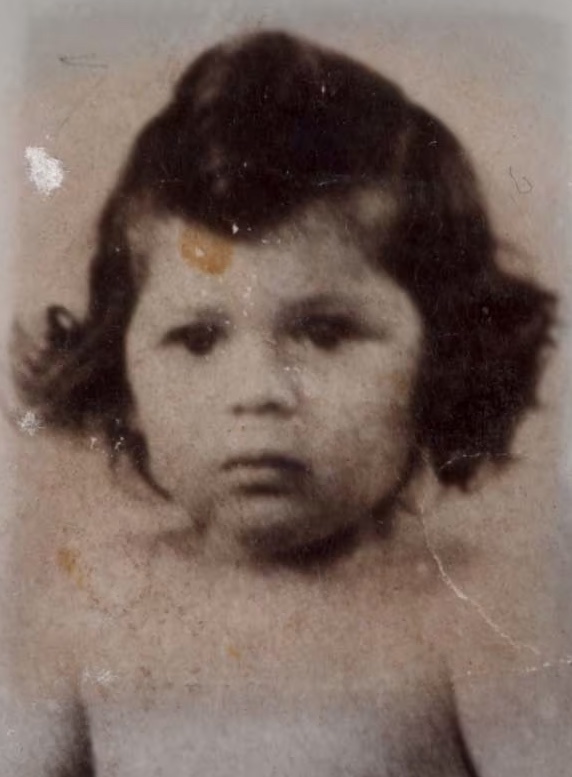
Monique GRINBERG
Photo of Monique Grinberg, taken in around 1944 © Yad Vashem
Little Monique Eliane Grinberg was born on April 23, 1942 in the Bichat hospital, not far from her family’s apartment on rue Charles-Lauth in the 18th district of Paris. Born soon after her parents got back together after having separated for a while, she was only just over two years old when she was deported.
We were able to retrace Monique’s life story with the help of the various historical records. In addition to writing this biography, we produced some maps in order to compile an “Atlas of the Grinberg family”, and recorded a series of podcasts. These are included throughout the biography.
You will find the Atlas, in French here.
The family emigrated to France from Eastern Europe
The first podcast report, in French:
Monique’s father, Shil Grinberg, was born on January 16, 1904 in Bar, in Vinnytsia, which was then in the Russian Empire but is now in the Ukraine, not far from the Romanian border. He appears to have grown up a little further south, however, in Secureni in Bessarabia, in present-day Moldavia. Shil was a secondhand dealer at the Saint-Ouen flea market (and later became a delivery driver, but possibly not until 1941).
Monique’s mother, Esther Gittel Spatz (Schlank/Shank), who was born on December 16, 1902 in Siedlanka, a suburb of Lezajsk, a small town some 30 miles northeast of Rzeszow, which was then in the Austro-Hungarian Empire but is now in Poland. Her mother, Maurice’s grandmother, was Hinde Spatz, and her father was Zolme Schank).
Esther’s parents wanted to send their children “to America” in order to escape poverty and, more importantly, the pogroms. Her hometown of Lezajsk also got caught up in the fighting between the Russians and Austro-Hungarians between November 1914 and May 1915, which would hardly have enticed them to stay
Below are two maps that chart Monique’s parents’ journey into exile.

Monique’s parents met in Paris in 1922 or 1923. He came from Bessarabia or Moldavia, she from Poland. They were not yet 20, and both were hoping to emigrate to America (Esther had a sister in Brooklyn), but in the end, they stayed on in Paris. They met in a refugee “shelter” on rue Lamarck in Montmartre, and then set up home together in a shanty-town in the Saint-Ouen flea market, an area in which many Jews from Eastern Europe lived. Between themselves, they always spoke Yiddish, and even though Monique was only two years old, and her siblings spoke to her in French, she must have picked up a little of the language and understood when her mother lamented, “Oy vay! Vout vet vern fin indz?” – Oh my, what’s going to become of us? Perhaps Monique’s first words in Yiddish were “A git your” – to say hello to people, ‘Naan ’ for all little children say “No’’, and “A dank” because she would surely have been taught to always say thank you.
Her parents were naturalized as French citizens on December 4, 1933, and as a result their children also became French. However, their naturalization was rescinded retrospectively in 1943.
A large family
When their seventh child was born, the Grinbergs had long since moved out of the shanty town in the flea market area of Saint-Ouen. They had moved to a new apartment in a low-cost housing development, at 18, rue Charles-Lauth in Porte d’Aubervilliers, in the north of Paris: this was the only home that Monique ever knew before she was arrested and deported (see map below).
However, Monique, who was born when her parents got back together after having separated for a while due to Shil’s infidelity, never knew her father or siblings, apart from the oldest, Renée and Maurice. They stayed in Paris when the younger ones were sent to live in hiding in Brittany, thanks to the Sisters of Sion order’s support network.


The family was evacuated out of Paris in 1939: they had a large number of children and Esther was pregnant again, so were a priority case. This is why, in January 1940, Esther gave birth to Daniel in Saint-Nazaire. They then moved back to Paris, where not only the war but also the Vichy government’s antisemitic legislation made life increasingly difficult for Jews. The couple then went their separate ways, but not for those reasons: they split up for a while because Shil was unfaithful to Esther, although they got back together soon afterwards, as Monique’s birth clearly illustrates. She was the seventh child in the family. Her sister Rivbaka, known as Renée, was 17 at the time, Maurice was 15, Jeannette 12, Berthe 9 and Simone 7. The youngest, Daniel was just 2: this meant there were two babies in the house.
Monique’s father was rounded up and disappeared before she was born
The second podcast, in French
In August 1941, a good while before Monique was born, her father was arrested during one of the first major roundups in Paris and its inner suburbs. He was in a little restaurant in Saint-Ouen that was popular with Jewish flea market traders when it happened. He had the unfortunate privilege of being one of the first men (although he was one of over 400 of them) to “inaugurate” Drancy camp as a transit camp for Jews destined to be deported “to the East”.
Shil spent six months in Drancy, so the family must have known what happened to people there, and what was in store for them too. And unless Esther managed to show Monique to Shil from a distance, he never even saw his baby daughter, and little Monique never knew her father at all. We do not know exactly what happened to Shil, but his death was not noted on his daughter’s birth certificate, as is usually the case in France.
The younger children were sent into hiding… except for Monique
We know very little about little Monique, other than that her mother once tried to send her to live in hiding, but could not bear to part with her. In late May or early June 1944, just before the Normandy landings, her older sister Renée tried again: she went off on her own with the little girl in her arms, as Esther’s Yiddish accent was likely to attract attention. But in the end, Renée could not abandon her cute little sister, who, as she said later “really was still just a baby”. (see Esther and Renée biographies).
Monique’s parents and siblings (who, like her, were all born in France), were all French citizens, having been naturalized on December 4, 1933. This was an important part of integrating into French society… and supposedly a minor advantage for Jews in the post-June 1940 era of state-sponsored anti-Semitism. This advantage came to an end, however, in 1943, when Marshal Pétain agreed to a “de-naturalization” policy, meaning that Esther and her children lost their French nationality. Monique was therefore born stateless.
Jeannette, Berthe, Simone and Daniel, the four youngest children apart from Monique, were kept hidden in Brittany from 1943 onwards. This was arranged by Father Deveaux of a religious order called Notre-Dame de Sion.

Two sisters who lived in Amanlis, near Rennes, took them in. In 1943, these two young women, who were themselves wards of the French welfare system, had decided to open a home for abandoned children in Janzé. The nuns from Notre-Dame de Sion placed six children from the Paris area with them. The social worker who brought the children to them explained that their parents had been deported and that they had no food ration cards. In late 1943, the shelter was moved to Amanlis. A local support network, made up of some farmers, a baker and Les Docks du Ménage, a Rennes-based firm, helped out and provided the food. Jeannette, Berthe, Simon and Daniel Grinberg were placed with two families in the village. Their older sister, Renée, took them there because Esther had too strong a Polish accent, so could not travel around without drawing attention to herself. Their lives were saved as a result, as were those of all the other children who were kept hidden in Amanlis. Renée, who was also deported but survived her time in the camps, went to collect them after she returned to France in May or June 1945.
Monique was arrested and deported with her mother and her oldest brother and sister
The third podcast report, in French
Esther and three of her children, Renée, Maurice and Monique, were rounded-up on the night of July 8, 1944. Five men (militiamen, French police and Gestapo agents) arrived at their apartment, on the pretext of checking their identity papers, but then arrested them. Some of their friends and neighbors, such as the Blumberg family, were arrested at the same time.
They were all taken straight to Drancy camp, north of Paris. When they arrived, they were all assigned a serial number, even baby Monique, whose number was 24,946.
The four members of the Grinberg family, along with the neighbors who were arrested on the same night, were interned in the cramped, filthy camp until Convoy 77 set off for Auschwitz on July 31, 1944.
The prisoners were loaded into cattle cars, 60 at a time. While the children from the U.G.I.F. (Union Générale des Israélites de France, or General Union of French Jews) children’s homes, who had been rounded up by Aloïs Brunner, the commandant of Drancy camp, were grouped together in cars with a little food, Monique was with her mother, brother and sister in a mixed car, with no fresh air and hardly any water (one bucket for 60 people, even though the train had been standing in the sun all morning!). According to Renée, during the three-day journey to Auschwitz, Maurice tried to make his mother and sisters as comfortable as possible in the cattle car, and shared out the water. Whenever he could, he gave his mother a break by taking baby Monique in his arms, but Monique, who was distraught, tried to cling on to her mother.
As soon as the train arrived in Auschwitz-Birkenau, Monique and her mother were loaded onto trucks and sent straight to the gas chambers. She probably died in her mother’s arms. She was just 27 months old.

Died for France
Monique’s older sister Renée, who was the only one of the family to survive, went back to the family’s apartment after the war. It had been vandalized, but not as much as those of the other families who lived nearby. There, on the floor, she found one of Monique’s little shoes, which must have slipped off in the rush when the family was arrested.
Renée, who always blamed herself for not leaving Monique with her siblings in the village in Brittany, undertook the necessary paperwork to have her little sister officially recognized as having died during the deportation. Her friend Simone Benhamu, who was arrested the same night as Monique and with whom she spent her entire time in the camps, testified to the fact that Monique had been deported, as did her neighbor Léone Blumberg, who was also arrested on the night of July 8, 1944.
Monique’s death certificate was issued on August 9, 1952, eight years after she died. She was granted the status of “political deportee” (meaning that she was deported on grounds of her “race”). She was also declared a French citizen, as “denaturalization” was abolished after the war, and Monique would have been born French if it were not for that policy. As a result, the words “Died for France” were added to her death certificate.
Family members of people who were interned, deported and died in the camps were entitled to claim a “compensation” payment for their loss. Monique’s sister Jeannette allowed Renée to claim her payment as well as her own. It was a paltry sum of just 1,200 old French francs, the equivalent of a few hundred dollars in today’s money.
Sources
- Files on Monique Grinberg and the other members of the family (Shil, Esther, Rivbaka/Renée and Maurice) held by the Victims of Contemporary Conflicts Archives Division of the French Ministry of Defense Historical Service;
- Shil and Esther Grinberg’s naturalization application file;
- Records for various members of the extended family on the Yad Vashem website;
- The testimony of her sister, Renée Nedjar née Grinberg, recorded in 2006 by Jérémy Nedjar.
Thanks
We would like to thank Renée Nedjar’s son, Alain, and her nephews, Jacques Nedjar and Olivier Szlos, for their personal accounts and the many valuable documents still in their possession, which contributed greatly to this biography, and David Choukroun, who helped us trace the family of Renée Nedjar, Esther’s daughter, supplied Shil and Esther Grinberg’s naturalization file and helped us with our research.
Thanks also to: Claire Stanislawski at the Shoah Memorial in Paris and to the guides at the Shoah Memorial at Drancy; to Charlène Ordonneau from the Saint-Ouen municipal archives, who allowed us to explore the archives relating to the “zone” and the flea market; and to Macha Fogel of the French Yiddish Cultural Centre for giving us a brief introduction to the Yiddish language.
We would also like to thank Laurence Klejman for proofreading our biographies of the Grinberg family and providing us with a wealth of additional information, making them the most detailed we could ever have wished for!