Français
 Polski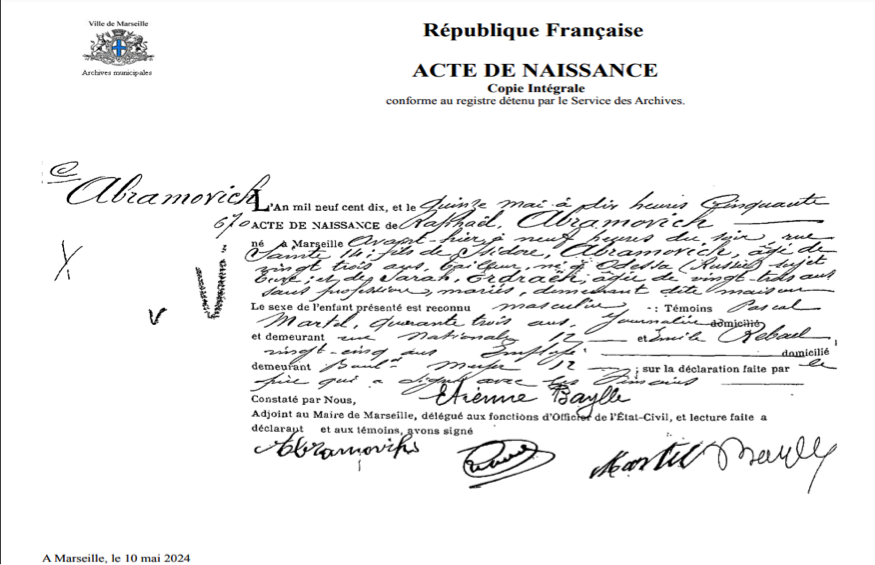
Raphaël ABRAMOVICH (1910-1944)
This biography was written during the 2023-24 school year by a group of 9th grade students from the Les Blés d’Or middle school in Bailly-Romainvilliers, in the Seine-et-Marne department of France, with the guidance of their French teacher, Ms. Jorrion and their history and geography teacher, Ms. Garilliere.
It was written as part of the Convoy 77 project.
The purpose of this organization is to bring together the families and friends of people deported on Convoy 77, along with anyone else interested in keeping the memory of the Shoah alive. It also contributes to Holocaust research and education. Convoy 77 was the last large convoy to leave Drancy camp bound for Auschwitz death camp. It left on 31 July 1944, with 1,306 men, women and children on board.
We would therefore like to tell you the story of one such deportee, Raphaël Abramovich
Raphaël Abramovich was born at 9 p.m. on May 13, 1910 at 14 de la rue Sainte, in the 7th district of Marseille, in the Bouches-de-Rhone department of France. The family lived in a working-class area not from the old port.
His father was Isidore Abramovich (although he signed his name as Abramoviks on Raphaël’s birth certificate). He was 23 years old when Raphaël was born, and was working as a tailor. He was born in Odessa, which was then in Russia but is now in Ukraine, but was a “Turkish subject”.
His mother was Sarah, maiden name Erdraëh (the spelling may be inaccurate); she too was 23 when Raphaël was born and was not working at the time.
His parents were married.
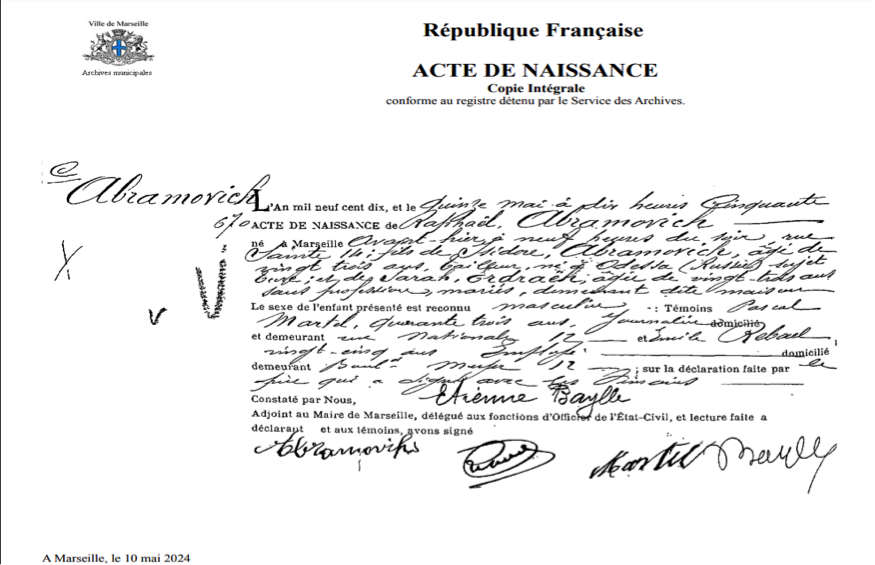
Raphaël’s birth certificate, from the civil registry at Marseille city hall.
Raphaël was born at home on rue Sainte, rather than in hospital. His birth was registered two days later. Although we searched the Marseille census, we were unable to find any further details about the family because, sadly, they had moved away from rue Sainte by the time of the 1911 census.
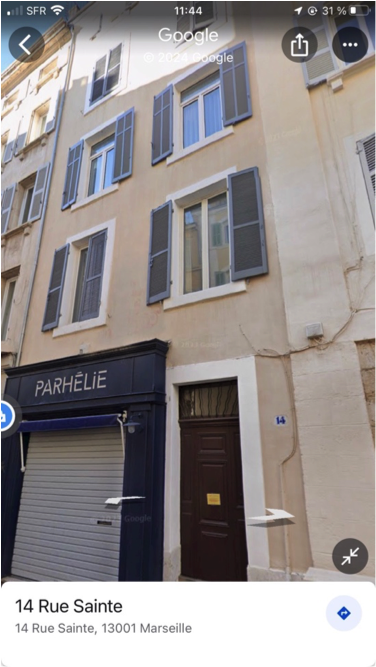
The building in Marseille, where Raphaël Abramovich was raised
© Google maps
Raphaël had an older brother, Jacques, who was born on August 15, 1908 in Smyrna, in Turkey.
Abramovich is a Jewish name. It comes from the Hebrew name Avraham, which means “father of a multitude” or “father of nations.” The suffix ‘ovich’ refers to a paternal relationship (son of), meaning that the name translates as “son of Avraham.” It is a relatively common surname among Ashkenazi Jews, in particular in Russia and other Central and Eastern European countries[1].
Raphaël’s early years were spent in Marseille with his parents and his older brother, Jacques, about whom we have no other details. We only know of his existence because after the war, he signed a request for information in an attempt to locate Raphaël, and he is listed in the 1931 census, by which time the family was living in Paris.
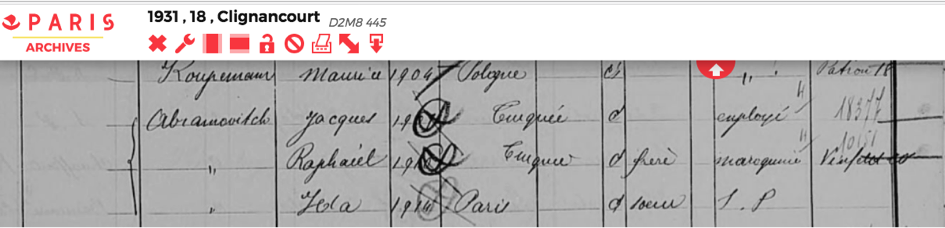
From the 1931 census of Paris, 18th district, 26 rue Feutrier, Clignancourt quarter @Paris city archives. Note that surname is spelled “Abramovitch”, with a “t”.
Raphaël’s younger sister, Ida Abramovitch, was born on rue Rochechouart in the 9th district of Paris on September 13, 1914. Her birth certificate states that her father had died before she was born. Raphaël must therefore lost his father when he was 4 years old.
One more thing: on his sister’s birth certificate, their mother’s surname is different: she is listed as Sarah Merdraz or Herdraz, aged 26, a cleaner, living at 12 rue des Saules[2]. Erdraëh became Merdraz, which seems to be just as obscure as Erdraëh, and both are probably spelled incorrectly. Sarah’s age does match, however.
12 rue des Saules was a Jewish night shelter[3], in Montmartre, in the 18th district of Paris. The shelter provided accommodation for Polish and Russian immigrants and was a daycare center for Jewish children. This implies that Sarah was both destitute and homeless.
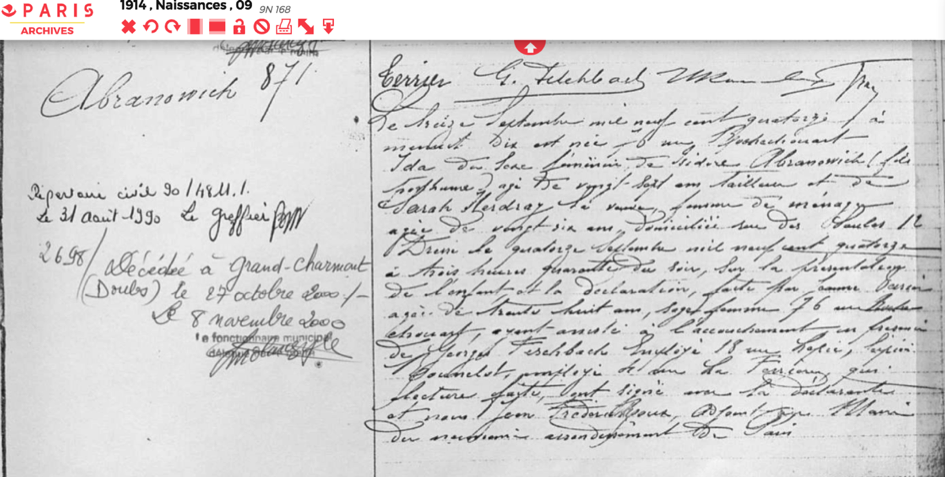
Ida’s birth record, civil register of the 9th district of Paris, 1914 @Paris city archives.
This time, the surname is spelled “ Abramovich”, without the “t”.
As he was born in 1910, Raphaël was a child between the ages of 4 and 8 during the First World War.
Raphaël is listed, together with his brother Jacques, aged 23, and his sister Ida, aged 18, in the 1931 census, when they were living at 26 Rue Feutrier in the 18th district of Paris. The census record states that Raphaël was born in Turkey, but we know this to be incorrect because we found his birth certificate, which was issued in Marseille.
His brother Jacques is also listed as having been born in Turkey, his occupation as “employed” and his marital status as “single.” His year of birth is hard to read, but appears to be 1907. Raphaël is listed as a leatherworker, also single, aged 21. His sister Ida is listed as 17 years old, no occupation is given, and her place of birth is clearly listed as Paris.
In 1936, Raphaël was still living at the same address, but by that time he was alone: he was 26 years old, single and unemployed. Had Ida got married and moved away? What about Jacques?
He was sometimes listed as a laborer and at other times as a cook, depending on the source.

From the 1931 census of Paris, 18th district, 26 rue Feutrier, Clignancourt quarter @Paris city archives. The surname is once again spelled “Abramovitch”, with a “t”.
On May 5, 1940, Raphaël went to register himself as a Jew at the Clignancourt police station. He did not have an ID card with him at the time[4].
In October 1940, the Vichy government began enacting a series of decrees that discriminated against the Jews. Because he was Jewish, Raphaël was stripped of various rights and freedoms. Jews were banned from working in certain professions, subject to curfews, at risk of being rounded up as of 1941 and had to wear the yellow star as of 1942.
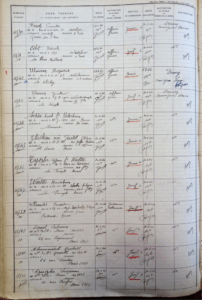
Paris Police Headquarters archives, APP_CC2-8
Raphaël was arrested on June 26, 1944[5]. The German police took him away during the night of June 29-30, 1944. According to the police headquarters’ register, above, he was not the only one, as several names are listed. It says that he was taken into custody at 2 a.m..
On June 30, he was interned in Drancy camp, where he was assigned the serial number 24,642.
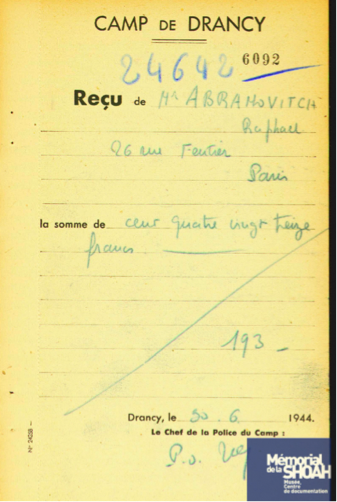
Raphaël Abramovitch’s search receipt from Drancy camp, dated June 30, 1944.
@ Shoah Memorial, Paris
Raphaël spent a month in the transit camp. He was then deported to Auschwitz-Birkenau on July 31, 1944: Early that morning, he was loaded onto a bus brought there from Paris, and taken to Bobigny train station, where he was crammed into a cattle car.
The journey, which took three days and three nights, was spent in appalling, inhumane conditions. There was little or no water, no food and no sanitation. This proved fatal for some of the sick and weak deportees[6].
The French authorities later declared that Raphaël Abramovitch died on August 5, 1944[7].
There is no trace of Raphaël after he arrived in Auschwitz. He may have been sent to the gas chambers during the selection, which took place on the ramp in Birkenau as soon as the train arrived. Or was he selected to enter the camp to work? He was only 34 years old, which was normally too young for someone to be sent straight to their death. There were trucks waiting to take people to the gas chambers: did he perhaps get into a truck because he was so tired?
POST-WAR PAPERWORK
After the war, Raphaël’s brother, Jacques Abramovich, began a search for him. Jacques had been a prisoner of war but had been released and was living on route de Corbeil in Saint-Germain-Les-Arpajon, in the Seine-et-Oise department of France.
Records show that a missing person certificate was issued to Jacques on June 12, 1945.
An official search was carried out on 27 August 1947.
Although the registrar at the town hall in Arpajon was of great help, our search for further details about Jacques proved fruitless.
We also searched for information about Raphaël’s sister, Ida. We discovered that she died on October 27, 2000, in Grand Charmont, in the Doubs department of France, at the age of 86. We requested further information from the local town hall and the newspaper L’Est républicain, but received no response. She may well have died at the Le Havre des Jonchets nursing home in the town. As far as we can tell, she never married or had children.
Part of the difficulty we had in finding out what happened to his family was the many different spellings of their surname.
By way of an epilogue
In May 2010, the O.N.A.C. (French National War Veterans’ Office) granted Raphaël the status of “Died during deportation”. A letter stated that this had been recorded in the Paris civil registry since 24 October 1947. However, we found no record of it until 2010. Was a note added to Raphaël’s death certificate in the civil registry of the 18th district of Paris, where he was last known to have lived, in 2010? The death certificate was officially issued on June 25, 2010.
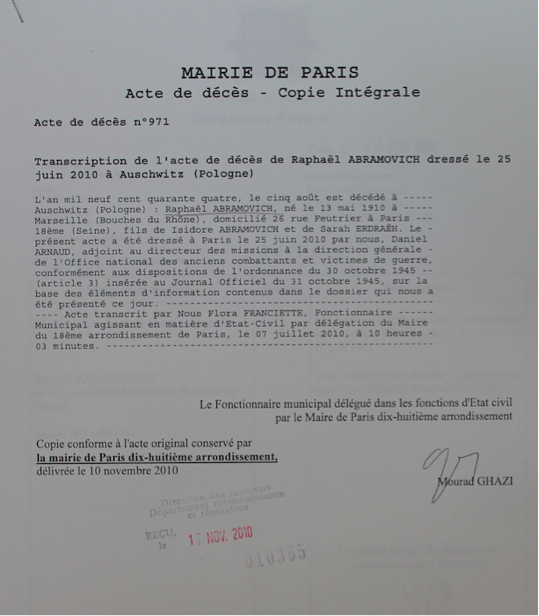
Raphaël Abramovich’s death certificate, issued on June 25, 2010.
Town Hall of the 18th district of Paris, dossier ref. 21 P 481 829.
Notes & references
[1] Aside from Abramovich, the various other spellings are: Abramovitch (with a t), Abramowitz, Abramovitz, Abramvocic, Abramowich, Abramovici (notably in Romania) and Abramovski.
[2] The building that was then 12 rue des Saules is now no. 42.
[3] L’Asile Israélite de Nuit (Jewish Night Shelter) was set up in 1900 by 40 associates, including Moïse Fleishter, chairman and founder, and had 800 active members when it opened in 1901. Its purpose was to “welcome and offer temporary accommodation for refugees passing through Paris and provide them with hot meals”. It was Initially located at 15 Rue du Figuier, in the Marais district, not far from Paris City Hall. In 1910, it moved to 12 Rue des Saules in Montmartre, and was renamed the Centre Israélite de Montmartre (Montmartre Jewish Center). Also in 1910, the charity founded a children’s daycare center and a sewing workshop, which were run by a Comité des dames (Women’s committee) called the Société Philanthropique de l’Asile de Nuit et la Crèche Israélites de Paris (Philanthropic Society for the Jewish Night Shelter and Nursery of Paris). More information, in French only, is available at https://maclarema.fr/blog/les-organisations-de-bienfaisance-israelites-face-a-limmigration-juive-en-france-1880-1930/ (Jewish Charitable Organizations and Jewish Immigration to France (1880–1930). In 1920, it moved to 16 Rue Lamarck and became a U.G.I.F. home for Jewish children and orphans during the Occupation. In August 1942, and again on February 10, 1943, children over the age of 12 whose parents were Russian or Polish were arrested at the home, then deported.
[4] Shoah Memorial archives.
[5] Research record sheet and missing person certificate, dosser ref. 21 P 481 829.
[6] We know that Raphaël Abramovitch traveled in a men’s car, known as a “bachelor car.” The Germans kept a particularly close eye on single men, as they feared they might try to escape. There were indeed such attempts on Convoy 77. While the Germans never found about the escape attempt from the car in which Joseph Wachspress and Jérôme Skorka were travelling was not discovered, they did uncover the one from the car in which Dr Rosenrauch was travelling. The 60 men in that car were made to strip naked, chained, moved in a prison car at the front of the train, and locked in with no food nor water until the convoy arrived at Auschwitz. They were then loaded into a truck and taken straight to their deaths in the gas chambers. See Jérôme Skorka/Scorin‘s self-published account, L’Itinéraire d’un adolescent juif de 1939 à 1945, (The Story of a Jewish Teenager from 1939 to 1945). See also Régine Skorka-Jacubert’s Fringale de vie contre usine à mort, published by Le Manuscrit.
Was Raphaël one of those 60 men? We can only speculate; he was young and within the age range to be selected to enter the camp to work. However, we know nothing about his physical condition, and perhaps he was sent to the gas chambers, with all the sick and elderly adults and the children (about 300), as well as anyone who was traveling with children or people who did not want to leave children alone.
[7] Although Convoy 77 arrived in Auschwitz on the night of August 3-4, 1944, the French authorities, in the absence of any other information, later declared anyone who never returned to France to have died on August 5, i.e. five days after the convoy left Drancy.