Français
 Polski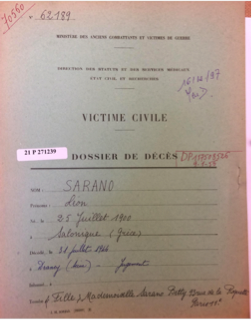
Léon SARANO
Léon (Juda) Sarano was born on July 25, 1900 in Salonika (now Thessaloniki), which was then in the Ottoman Empire. He was Jewish and held Spanish nationality. His parents were Azriel Sarano and Béa Gateno.
He had one older brother, one older sister and a younger sister, who was born in 1907.
Migration to France and family life
We were unable to find out exactly when Léon emigrated to France, but we found some records in the Paris archives that reveal he had been living there since at least 1931, which is when he got married.
On March 19, 1931, in the 3rd district of Paris, he married Olga David, who was born on February 16, 1911, also in Salonika. Her parents were Abraham David, who had died by the time Léon and Olga got married, and Rachel Nahmias, a laundry worker, who lived at 15, rue Saint-Gilles in the 3rd district of Paris, in the heart of the Marais.
When he got married, Léon Sarano was living at 57, rue Saint-Sébastien, in the 11th district of Paris. His parents were dead and he was unable to provide a birth certificate. A notary therefore drew up an affidavit to certify his identity. He was working as a sales clerk at the time.
The witnesses to the wedding were Vital Sarano (Léon’s brother perhaps?) and Samuel David, Olga’s brother.
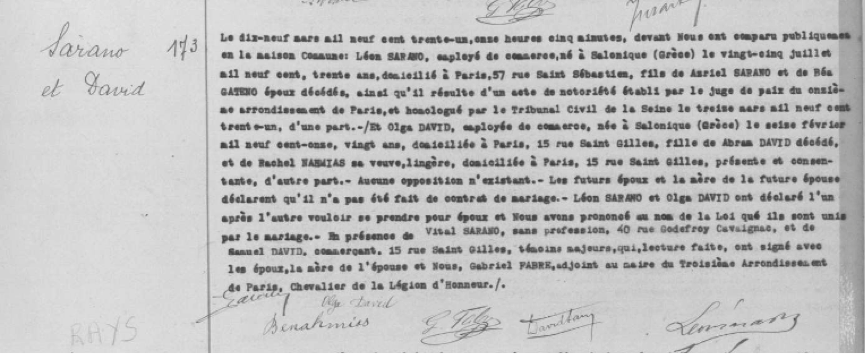
Léon and Olga’s marriage certificate, from the town hall of the 3rd district of Paris
© Paris city archives
The couple went on to have a daughter, Betty Sarano, who was born in 1932, in the 12th district of Paris[1].
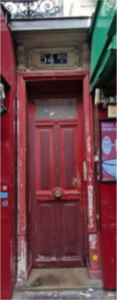
In October 1933, after Betty was born, the family set up home at 93, rue de La Roquette in the 11th district of Paris. They rented an apartment in a large building that was home to working-class families, both French and foreign. There was a large Sephardic Jewish (Judeo-Spanish) community in the neighborhood, most of whom came from the Ottoman Empire (Greece and Turkey). The area had so many shops and places to socialize that it was nicknamed “Little Turkey.” According to the 1936 census records, Léon was still a sales clerk and Olga was an “unskilled worker.”
The war and the persecution
Soon after the war broke out in September 1939, Léon Sarano signed up to fight in the French Foreign Legion at the Seine department recruitment office[2]. He was 39 years old by then. After France was defeated in June 1940 and the Germans occupied part of the country, he returned to Paris.
Germany was quick to introduce anti-Semitic legislation, which Philippe Pétain’s collaborationist government enforced and extended. The first decree on the “Status of the Jews” was drafted on October 3, 1940, and enacted on October 18. Jews were prohibited from working in the civil service, the military, education, and journalism. In October 1940, they were required to take part in a special census. Léon Sarano and his family most likely went to the local police station to register themselves as Jews[3].
The first arrest
It was on August 21, 1941, at his home at 93, rue de la Roquette that Léon was arrested for the first time, after which he was interned in Drancy camp[4]. This was the day on which the second mass arrest of Jews, both French and foreign, took place in Paris. Although the roundup was only organized after the German offensive against the USSR had begun, Nazi propaganda nevertheless portrayed this anti-Jewish crackdown as “an operation carried out in retaliation for Communist unrest”[5]. On August 20, 4.232 Jewish men (between the ages of 18 and 50) were arrested in the 11th district, where Léon Sarano lived. However, SS officer Theodor Dannecker of the Gestapo, who was in charge of the “Jewish issue”, wanted to arrest even more men. The very next day, the roundup was extended to cover almost all of Paris and the inner suburbs, such as Saint-Ouen. French police took part in the roundup alongside the German Feldgendarmerie. All the men who were arrested were taken to a camp in an unfinished low-rent housing complex called the Cité de la Muette in Drancy, a few miles north of Paris [6].
A few days after Léon Sarano arrived, the camp became seriously overcrowded. The sanitary facilties were appalling and as time went on, the prisoners became increasingly hungry. Disease began to spread throughout the camp. By April 3, 1942, the situation had become so desperate that around 800 prisoners, including Léon Sarano, were released. Perhaps he was sick? We should note, however, that although he was Jewish, he was also still a Spanish citizen, and as such held a special status because Spain was a “neutral” country. Could that have been the reason that he was let out[7]?
The second, fateful arrest
We know nothing of Léon Sarano’s life after he was released from Drancy, other than that he was arrested again on July 6, 1944[8].
The Paris Police Headquarters archives [9] reveal that a large number of Jewish men who were born in Constantinople and Salonika arrived there at the same time as Léon, at 9 p.m. on July 6. None of their addresses are listed, however, contrary to normal police procedure. All but two of them were taken to Drancy at 3:30 p.m. the following day. The remaining two were turned over to the “Jewish Affairs” department on July 19.
Neither Leon’s wife nor his daugther were arrested with him: The French police caught him during a roundup, perhaps in one of the many cafés in “Little Turkey”, where Spanish Jews often gathered, which made them easy prey.
Léon’s landlord, a man by the name of Jean-Lucien, provided a statement after the war in which he confirmed that Léon Sarano was indeed living in France prior to his deportation; according to him, Léon “left his home” on July 6, 1944.
After spending the night at the Paris Police Headquarters, Léon Sarano was interned in Drancy camp, where he was assigned prisoner number 24,923[10]. He arrived there on July 7 and handed over 114 francs during the “search”. He stated that he worked as a “laborer”, one of the few jobs that Jews were still allowed to do.
Deportation to Auschwitz
On July 31, 1944, Léon Sarano was deported to the Auschwitz extermination camp on Convoy 77, which left Bobigny Station with 1,306 people on board, including babies, children, senior citizens, and men and women of all ages. As he was travelling alone, i.e., without his family, he was assigned a men-only car. They were 60 of them crammed into the cattle car, with straw on the floor and with hardly any food or water
We were unable to find any records to confirm that Léon Sarano spent any time in Auschwitz, or even that he arrived there alive. Records were only kept of the deportees who were selected to work in the Auschwitz-Birkenau camp. Everyone else – the elderly, sick and disabled people, the children, and anyone who refused to abandon a child or a relative who had not been selected for work, was sent straight to waiting trucks that took them to the gas chambers. After they were murdered, their bodies were burned in the crematoria. The names of the people who died along the way were not recorded either.
The quest for official recognition of Léon Sarano’s death
When Léon’s wife, Olga, realized that he would not be coming home, she set about seeking offfical acknowledgment that he had been deported but had never returned to France. For the authorities, however, it was difficult to determine the date on which a deported person had died, especially when so little was known about what had happened to them.
The dates on which Léon Sarano was said to have died
- One record states that Léon Sarano died in Drancy on July 31, 1944, although we know this was the date on which the convoy set off, and that he was on the train. This date was often used in records relating to deportees immediately after the war in order to simpliy the formalities for the families of people who had not come home, who were officially called “non-returnees”.
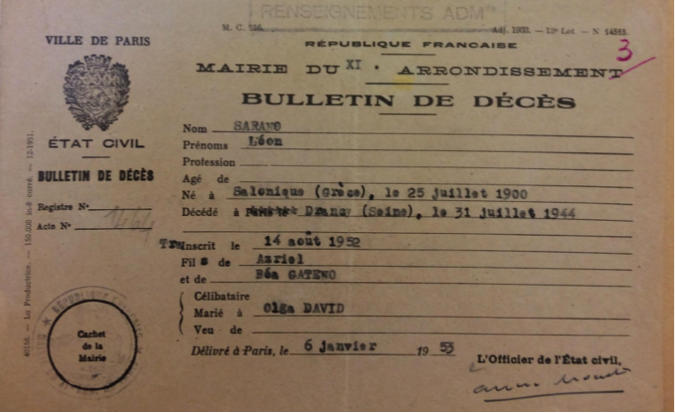
Death notice © File on Léon Sarano, Victims of Contemporary Conflicts Archives Division of the French Ministry of Defense Historical Service, in Caen, ref. 21 P 271.239.
This official document was issued at the request of Betty Sarano so that she could submit a compensation claim.
- The Victims of Contemporary Conflicts Archives division then deemed that Léon Sarano died in Auschwitz five days after he was deported from Drancy, this being August 5, 1944.
In fact, we now know, thanks to survivors’ testimonies, that the deportees who were sent to the gas chambers were killed very soon after Convoy 77 arrived, which was during the night of August 3-4. However, when there was no news of a deportee several months after the war ended, the French authorities decided that the death date should be deemed to be five days after the convoy in question set off. In the case of Convoy 77, therefore, the date was August 5, 1944.
Léon Sarano is believed to have died on August 3-4, but it is also possible that he did not survive the appalling travelling conditions on the journey from Bobigny to Auschwitz.
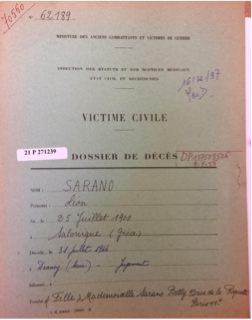
Léon Sarano’s death record, ref. 21 P 271.239 SHD
The French Ministry of Veterans and War Victims declared Léon Sarano missing and on August 3, 1948, the civil registry office issued a certificate to that effect. This was a document that could be amended to become a death certificate five years later, in accordance with legislation passed on April 5, 1944.
The Head of the National Office for Research on Political Internees and Deportees confirmed, based on documentation in his possession, that “Mr. Léon Sarano, born on July 25, 1900, in Thessaloniki (Greece), was arrested on July 4, 1944, deported to Germany on July 31, 1944, and had not been repatriated as of May 21, 1946.”
In accordance with French law No. 48-1404, passed on September 9, 1948, the French Ministry of Veterans and War Victims officially granted Léon Sarano the status of “Political deportee” (which effectively means that he was deported because he was Jewish[11]). This status also meant that a political deportee card was issued to his daughter, as his legal heir, which made a number of formalities more straightforward.
Official recognition and reparations for deportation
Olga[12], Léon’s wife, died at the age of 39 on May 6, 1950 in the 12th district of Paris. She is buried in the Jewish section of Pantin cemetery in Paris[13].
Their daughter, Betty Sarano, thus became an orphan when she was still a minor. Once she came of age, she undertook the necessary formalities to have her father’s civil status updated. The Civil Court of the Seine declared him legally dead on a March 21, 1952, and sent the ruling to the town hall of the 11th district of Paris, where he last lived. His death was registered three on January 6, 1953.
Betty then filed a claim for reparations for the loss of her father. On October 12, 1956, the French Ministry of Finance awarded her, as his legal heir, the sum of 12,000 francs, known as a “pécule”. According to the French National Institute of Statistics and Economic Studies website, 12,000 old francs in 1956 would be equivalent to €297.02 in 2024 (around $350 nowadays), so it was by no means a large sum of money…
According to a decree dated February 24, 1998, the words “Died during deportation” were added to Léon Sarano’s civil status records and death certificate (and thus to the records kept at the town hall of the 11th district of Paris).
Léon Sarano’s short life was shaped by Thessaloniki’s multicultural society, his emigration to France, and the tragic events that unfolded during the Second World War. Some other members of his family, including his brother Haïm/Vital and his wife, were also deported and killed during the Holocaust, simply because they were Jewish.
Betty Serano died on August 24, 2016.
Sources
- Records provided by the Convoy 77 team.
- The Victims of Contemporary Conflicts Archives Division of the French Ministry of Defense Historical Service, in Caen: files on Léon Sarano, refs. 21 P 535 797 and 21 P 271 239.
- The Shoah Memorial database and the Paris City Hall online archives were also useful sources.
Notes & references
[1] Files on Léon Sarano, refs. 21 P 535 797 and 21 P 271 239 held by the Victims of Contemporary Conflicts Archives Division of the French Ministry of Defense Historical Service, in Caen. Unless otherwise stated, most of the information comes from these files, which were compiled after the war as part of efforts to prove that Léon Sarano had been deported.
[2] Shoah Memorial Paris –UEVACJEA collection, and www.memoiredeshommes.defense.gouv.fr
[3] 151,000 too part in the census of Jews in Paris and the suburbs. The records were used to create a database of Jews known as the “Jewish file”.
[4] According to the Paris Police Headquarters archives and those of the Civil Status Office for Deportees. From the abovementioned file on Léon Sarano, ref. 21 P 535 797.
[5] Operation Barbarossa, which began on June 22, 1941, also referred to as the breach of the German-Soviet Pact.
[6] This site had previously been used by the French police to intern communists (suspected of treason due to the German-Soviet Pact) during the “Phoney War”; the Germans later used it to hold prisoners of war before they were sent to Germany. The buildings later became a transit camp for Jews from prior to their deportation from France. The Germans used the term “Judenlager,” meaning a concentration camp for Jews.
[7] This is something of a paradox, given how the Jewish community in Spain was treated by Franco’s regime during the Second World War. Of the 35,000 Sephardic Jews who were living in France, 3,000 held Spanish citizenship. At the request of several of this group, Consul Bernardo Rolland went (to a degree that went further than Spain’s official stance) to try to protect the Spanish Jews in France as best he could.
[8] According to records held by the Victims of Contemporary Conflicts Archives Division and those held in the Paris Police Headquarters archives.
[9] Paris Police Headquarters archives, ref. CC2-8.
[10] Shoah Memorial, Paris.
[11] The deportation of Jews was initially referred to as “racial” in nature, but the French government deemed this term too “loaded” and began using the term “political” instead. This may have led to some confusion with the status of “Deported Resistance Fighter,” which was granted to people involved in the Resistance during the Nazi occupation.
[12] In 1947, Member of the French Parliament Florimond Bonte used his influence to ensure that Léon’s wife, Olga—who was clearly in a difficult financial position—received her reparations (the “pécule”) for the loss of her husband. See file loc. cit.
[13] Léon’s brother, Haïm (also known as Vital) who was born in 1896, was deported on Convoy 67 on February 3, 1944, along with his wife Louisa. They never returned to France. He first arrived in Drancy on November 26, 1943. They had one son, who went on to have two children of his own.