Français
 Polski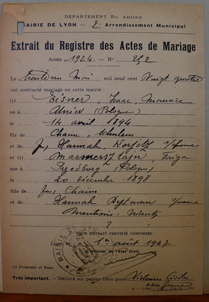
Maurice (Isaac) EISNER (1894-1944)
1. Introduction to the remembrance workshop: Understanding, describing, and retracing the journeys of deported people (by Clément and Jules)
We are a group of ninth-grade students the Gilbert-Dru middle school in the 3rd district of Lyon, in the Rhône department of France. At the very beginning of the 2024–2025 school year, our history teacher, Ms. Foselle, introduced us to her “remembrance workshop” program. We were immediately drawn to the idea and eagerly volunteered to get involved. This research assignment was incorporated into our regular curriculum and took place during lunch break on Thursdays.
The remembrance workshop is carried out in partnership with the Convoy 77 nonprofit organization and the French National Memorial Museum of Montluc Prison. Together with our teacher and a guide from the Memorial, we set out to write the biographies—based on previously unexplored sources—of a couple who were deported on Convoy 77 : Maurice and Faïga Eisner.
The workshop also seeks to draw attention to a remembrance and conservation initiative relating to the history of Montluc Prison: built in 1921 as a military prison, the German occupying forces used it during World War II to hold a large number of Resistance members and Jews prior to their deportation or execution. The site, which became a memorial museum in 2010, is also near our school.
The project was carried out in stages, which helped us to succeed in our task and to broaden our overall knowledge about the Holocaust and the Second World War.
First of all, we had classes focusing specifically on the war, and on what happened in Lyon during that period. We studied the plight of the Jewish population between 1941 and 1945. We also met with Ms. Muriel Nemoz, an active member of the Convoy 77 association, who told us the story of her uncle, who was deported on this convoy.
This introductory stage helped us to analyze and better understand the historical records available to us (Shoah Memorial, Yad Vashem, the Victims of Contemporary Conflicts Archives Division of the French Ministry of Defense Historical Service, in Caen, Normandy, and the Rhône Departmental archives).
For the second stage, in order to share the research work, we split into several groups. We analyzed the records using a questionnaire that we had to complete and that helped us piece together the Faïga and Maurice Eisner’s life stories.
In the third stage, we sorted the documents into chronological order and realized that we needed to compare the various sources of information. The questionnaire we had been given earlier enabled us to carry out this exercise methodically and to gain an insight into what the work of a real historian entails.
After pooling our work and discussing it with our teacher at the end of each class, we were able to make a start on writing this biography.
To this end, we worked in pairs, and then we were each assigned a section to write based on the outline of the biography. Some of us were asked to write the text and plan the layout, while others were assigned to work on Faïga and Maurice’s stories.
Once that part was done and our teacher had gone over it, we all worked together on the layout, editing, and proofreading.
This project means even more to us because Maurice and Faïga were interned in Montluc prison, which is now a memorial museum and is only a stone’s throw from our school. Every year, the 9th-grade students from Gilbert-Dru middle school visit the memorial, which is an important part of France’s history. They also take part in the annual ceremony on January 27, 1945, the day on which the Auschwitz camp was liberated, in order to remember the genocide victims and to work towards preventing future crimes against humanity.
2. Birth and family: Maurice Eisner (by Gabriel and Nathan)
Maurice Isaac Eisner was born on April 14, 1894 in Uniev (Uniejów), a little town near Lodz, in Poland. His parents were Chaïm Schulem Eisner and Hannah Eisner, née Korjats.
We found very little information about Maurice’s life prior to the war, so we do not know when he arrived in France. We know that in the early 1920s, he was living in Lyon. He married Faïga Marmersztajn on May 31, 1924, in the town hall of the 2nd district of Lyon. At the time, Maurice was 30 and Faïga was 26. They went on to have three children: two daughters, including Rosa Vogel, and one son.
Maurice first worked as a mechanic, then as an electrician and also as a plumber, after which he became a janitor at the Great Synagogue of Lyon, at 13 Quai Tilsitt. It is not known when he began working there, but he and his family lived on site.
Maurice and Faïga Eisner’s marriage certificate, 1924
© Victims of Contemporary Conflicts Archives Division of the French Ministry of Defense Historical Service, in Caen, Dossier n°21 P 447 185.
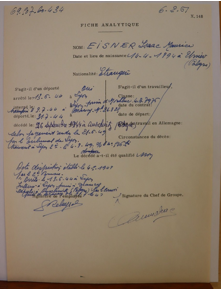
Summary sheet relating to Maurice Eisner
© Victims of Contemporary Conflicts Archives Division of the French Ministry of Defense Historical Service, in Caen, Dossier n°21 P 253 307.
3. Maurice’s work at the Great Synagogue of Lyon (by Raphaël and Mathis)
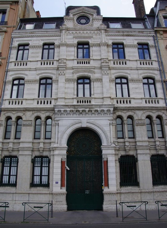

The Great Synagogue is at 13 Quai Tilsitt in the 2nd district of Lyon, on the banks of the Saône River. It was built between 1863 and 1864 and has been listed as a historic monument since 1984.
Maurice and Faïga’s roles as janitors involved cleaning the building, overseeing opening and closing times, ensuring that everything was in good working order, and facilitating various Jewish events. At that time, the synagogue and its ancillary buildings were used as a shelter for Jews who had lost their homes. It essentially served as a night shelter.
In 1941, the U.G.I.F. (Union Générale des Israélites de France, or General Union of French Jews) [1] had its headquarters in the synagogue, before they were moved to the Montée des Carmélites, a very old street in the 1st district of the city.
Following the German invasion of the “Free Zone”, in the southern part of France, on November 11, 1942, Jews living in Lyon came under increasing pressure due to the anti-Jewish policies put in place by the German occupiers and Marshal Pétain’s collaborationist government, the Vichy Regime. Roundups and arrests grew more frequent. On February 9, 1943, on the orders of the notorious Klaus Barbie, the Gestapo raided the U.G.I.F. offices on rue Sainte-Catherine and arrested 86 Jews, many of them foreigners. 80 of them were subsequently deported, including Robert Badinter’s father, Simon. The Great Synagogue of Lyon fared no better. The Chief Rabbi of Lyon, Bernard Schonberg, was arrested on May 26, 1943, in Ambérieu, in the Ain department of France, and deported to Auschwitz on Convoy 62.
A few months later, on Friday, December 10, 1943, at the beginning of Shabbat, the synagogue was attacked. The service had only just begun, and the congregation was singing Lekha dodi and turning toward the central door, as is the Jewish custom. At that very moment, someone threw two grenades into the synagogue and then sped away in a car. The perpetrators were never identified, but the attack was later attributed to the local militia, led by Paul Touvier [2].
Before they entered the sacred building, two men had gone into the janitors’ lodge. Maurice’s wife, Faïga, and two of their children, Rosa and her brother, were inside. The militiamen pinned them up against the wall and ripped out the telephone cable.
8 people were injured in the grenade attack, including Maurice Eisner. According to her daughter Rosa, Faïga went to the police station the following day to give a statement. On Friday, December 17, the next Shabbat, Rabbi Kaplan spoke about the attack on the synagogue[3] and said that the attackers had gone into in the janitor’s room.
On June 13, 1944, the French Militia, under the command of Paul Touvier, entered the synagogue premises, which included a residential building, and arrested everyone they found there: Benjamin Dreyfus, the chief rabbi of the synagogue; Mr. Heymann; Perla Zandt, the cleaning lady; Émile Cahen, head of the Jewish Social Welfare Office in Lyon and Faiga and Maurice Eisner[4].
Soon afterwards, the synagogue was looted and vandalized, after which the militiamen used it as a drinking and gambling den. It was abandoned a short time later. In September, after Lyon was liberated, it re-opened as a synagogue and gathering place for the Jewish community.
Eugène Weill, the president of the Jewish community of Lyon, gave a written testimony on April 12, 1945, in which he described the condition of the synagogue on September 2, 1944, the day before Lyon was liberated. He wrote:
“The synagogue was in a disgraceful state. The sanctuary had been used as a drinking den by the militiamen; the plaques in memory of the soldiers killed in the First World War had been used as targets, as had the Torah scrolls. There were still shell casings strewn across the floor; the chandeliers, chairs, and benches had been smashed, and the prayer books were scattered all over the place”.
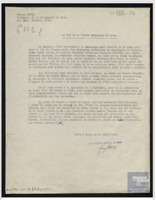
Eugène Weill’s testimony, dated April 12, 1945, in which he described the state of the synagogue © Shoah Memorial, Paris, CCXVIII-96. https://ressources.memorialdelashoah.org
4. Arrest and deportation (by Mathias)
It was June 13, 1944. Maurice Eisner, who was born in 1894, had just turned 50 years old when it happened. The French Militia arrested him in his home in the synagogue at 13 quai Tilsitt. They then took him away, along with his wife, Faïga, and a number of other people.
Unfortunately, the records we have available provide no further details either about the circumstances of the arrest or the exact reasons for it, other than that it took place during wartime, when the Nazi regime and their collaborators in the Militia, such as Paul Touvier, were trying to arrest as many Jews as possible.
The only information we have comes from the testimony of the Eisners’ daughter, Rosa, who was 14 years old when it happened. She has been married to Abraham Vogel since June 1948 . She was not there when her parents were arrested, and when she heard what had happened to them, she went to stay with her older sister, Omar Issé, who lived in the Perrache neighborhood in Lyon. She later found out that her parents had been taken to the Militia headquarters on Place Bellecour. She never saw them again.

The minutes of an interview with Rosa Vogel, Maurice and Faïga Eisner’s daughter, dated 1950 © Victims of Contemporary Conflicts Archives Division of the French Ministry of Defense Historical Service, in Caen, Dossier n°21 P 447185.
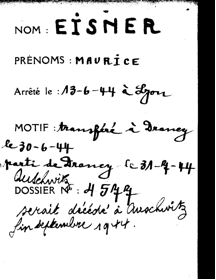
Information sheet on Maurice Eisner
© Rhône Departmental and Metropolitan archives, refs. 3335 W 13 and 3335 W 22.

Maurice Eisner’s search record from Drancy camp, dated 1944
© Shoah Memorial, Paris. https://ressources.memorialdelashoah.org
According to the testimony of Dr Isaac Fischer (see his biography here on the Convoy 77 website), we know that Maurice Eisner was spotted in Montluc Prison on June 23, 1944. He and his wife were interned there after they were arrested. Built in 1921 as a military prison, it was requisitioned by the German army on February 17, 1943. From then until August 24, 1944, it was used by and their Militia collaborators. During that time, around 10,000 people were held there because they were Resistance members, Jews, or in some cases both. The prison had 127 cells, 122 of which were only 43 square feet (4m2) and soon became overcrowded. Other buildings were then used as cells for large groups. When Faïga and Maurice Eisner arrived in Montluc prison they were split up, as was the case for all prisoners. Groups of men and women were held separately. In late June 1944, Faiga and Maurice were told to “pack their bags”—a phrase German soldiers used to mean that they were soon going to leave the prison. On June 30, according to Dr. Fischer, they were both taken by train to Drancy camp, just north of Paris. When he arrived there, Maurice had to hand over 9,455 francs during the “search” and was assigned prisoner number 24,825.
In a statement made on September 1, 1950[5], Rosa Eisner recounted that she had received a letter from her father saying that they were leaving Drancy for Germany the following day. They had been in the transit camp for a month when; on 31 July 1944; they were deported on Convoy 77 to the Auschwitz-Birkenau extermination and forced-labor camp.
1,306 people of varying ages (the youngest was just 15 days old) were crammed into cattle cars. Conditions were appalling: the prisoners were thirsty, hungry, and short of air, sweltering in the summer heat. They were packed 60 to a car, with little or no sanitation.
According to Dr. Isaac Fischer, when the train arrived in Auschwitz during the night of August 3-4, 1944, Maurice Eisner, despite having been wounded during the attack on the synagogue, was selected to enter the camp for forced labor. However, during another selection in late September, he was sent to his death in the gas chambers. He was 50 years old.
5. Official recognition of his death
When the war was over, Rosa Eisner-Vogel, one of the couple’s two daughters, searched for her parents among the deportees who made it back to France. A few months later, when there was still no sign of them, she set about completing the necessary paperwork to prove that they had been deported and died in the camps.
She sent requests to the National Movement Against Racism for the Lyon region, which sent them on for further investigation. Her request is dated March 13, 1946[6]. It includes information she already knew or had managed to find:
- Arrested on June 13, 1944
- Interned in Montluc
- Transferred to Drancy
- Deported on July 31, 1944 to Auschwitz on grounds that they were Jewish
On March 25, 1948[7], Rosa submitted a request to the Department of Veterans Affairs. She asked that her parents’ civil status be updated to that of “non-returned person”. On May 4, 1948, the Ministry issued a certificate confirming that Maurice Eisner had not returned to France. This document enabled the applicant to seek a court ruling declaring the person missing, which could subsequently be amended to a ruling declaring the person deceased if he or she was a foreign national and had still not returned after five years (counting from the exact date on which they were deported), or a death certificate, if he or she was a French national.
On May 11, 1949, the prosecutor reviewed Maurice Eisner’s case file and reported that he had no further information other than Maurice had spent time in Lyon, then in Drancy, and had arrived in Auschwitz. Thus, on June 21, 1949, a court ruled that Maurice Eisner had died on September 26, 1944, in Auschwitz-Birkenau. His death was then registered at Lyon City Hall on August 4, 1949.
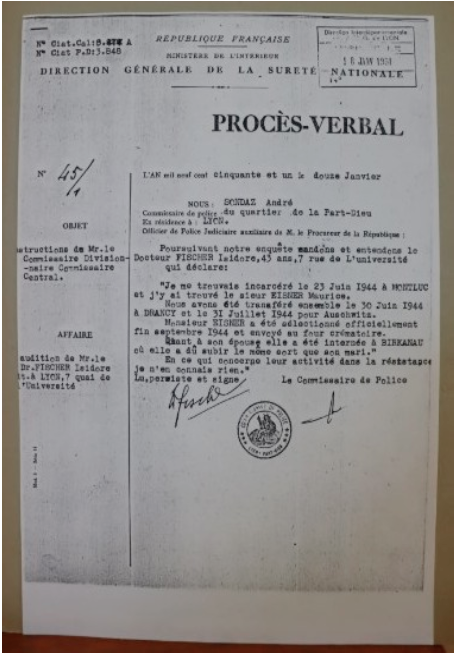
Minutes of a police interview with Dr. Isaac Fischer relating to Maurice Eisner’s internment and deportation, dated 1951 © Victims of Contemporary Conflicts Archives Division of the French Ministry of Defense Historical Service, in Caen, Dossier n°21 P 447185.
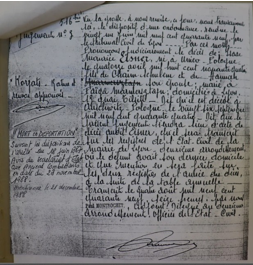
Maurice Eisner’s death certificate © Victims of Contemporary Conflicts Archives Division of the French Ministry of Defense Historical Service, in Caen, Dossier n°21 P 447 185.
6. The designation “Died for France”: why it was refused (by Ales and Djibril)
In order to have her parents officially declared “Mort pour la France”, meaning “Died for France”, Rosa submitted an application to the Ministry of Veterans Affairs in 1961.
The distinction “Died for France” is awarded to individuals who lost their lives while serving their country, typically during a conflict or in certain circumstances. The French government awards it only to those who meet specific criteria.
In order to apply for it, a request must be submitted to the Ministry of the Armed Forces. The person in question must have been a French citizen or have been born in France. The criteria also stipulate that the person must have died while serving France (as a member of the military or of the Resistance), either during a war or as a result of actions taken in connection with a armed conflict. In the case of Resistance fighters, it had to be proven that the person had been officially identified as a member of the Resistance, for example by having been granted the status of Deported Resistance Fighter. This process often required documentary evidence and detailed supporting information.
Rosa requested that her parents be awarded this designation because it would have entitled her to various benefits, such as financial aid or a pension. It would also have been a token of recognition, which can be very important to victims’ relatives. However, the French authorities denied her request because her parents were foreign nationals and had not been arrested for acts of resistance, but because they were Jewish.
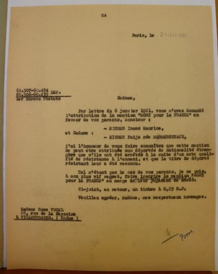
The letter confirming that Maurice Eisner had been denied the designation “Died for France”, dated February 21, 1961 © Victims of Contemporary Conflicts Archives Division of the French Ministry of Defense Historical Service, in Caen, Dossier n°21 P 447 184.
7. Official recognition that Maurice “Died during deportation (by Thomas)
Applications to have the words “Died during deportation” added to a person’s death certificate had to be submitted to the French National Office for Veterans and War Victims. A copy of the death certificate had to be included with the application. If the authorities did not respond within two months, the application was deemed to have been denied.
The difference between “Died for France” and “Died during deportation”.
The main difference between the is that the status of “Died for France” entitled the applicant to bury their family member in a French military cemetery, where the person would have a permanent grave. This is an honorary recognition, whereby the state undertakes to maintain the grave. Given that the Eisners died in the gas chambers at Auschwitz, this was obviously not an issue.
After Rosa’s request for her parents to be recognized as having “Died for France” was denied, she set about trying to have them granted the status of “Died during deportation”. On May 15, 1985, French President François Mitterrand signed into effect French law 85-528, which states that “for any person who was deported and died during World War II, the phrase ‘Died during Deportation’ shall be entered on their death certificate.”
Rosa therefore submitted an application to the Secretary of State for Veterans Affairs, along with a cover sheet requesting the status of “Died during deportation”. After a lengthy bureaucratic process, it was finally decided that it should be granted. An excerpt from the French Official Gazette dated August 12, 1987[8], confirms this. On November 29, 1988, the words “Died during deportation” were written in the margin of Maurice Isaac Eisner’s death certificate.
Meanwhile, on December 29, 1974, Rosa Vogel traveled Jerusalem in Israel to visit Yad Vashem, the World Holocaust Remembrance Center, where she filled out testimonial forms in memory of her parents.
This gesture bears witness to the fact that Maurice Eisner was a victim of genocide and, in a way, restores his lost identity.
Maurice Eisner’s name is also inscribed on the Wall of Names at the Jewish cemetery at Gerland, in Lyon.
From the 1970s through the 1990s, Rosa Vogel campaigned to see those responsible for the attack on the Lyon synagogue and the deportation of Jews from Lyon brought to justice. In November 1973, having identified Paul Touvier in a photograph, she took part in a lawsuit against him, as the former regional commander of the Second Division of the Lyon Militia. She testified at the trial on December 13, 1979. The case went to the Court of Appeal and then to the Supreme Court. Rosa’s testimony was deemed inadmissible because she was only 14 years old when the events took place and had misremembered some people’s names. Paul Touvier was, however, retried for the murder of seven Jewish hostages in Rillieux-la-Pape. After forty-five years on the run, despite having been sentenced to death in absentia twice (1946 and 1947), Touvier reappeared in 1967 only to go into hiding again. He was the first Frenchman to be convicted of crimes against humanity. He died in Fresnes Prison in Paris on July 17, 1996.
In 1987, Rosa also joined the class action lawsuit against Klaus Barbie.
Notes & references
[1] The U.G.I.F., which was founded by the Vichy government on November 29, 1941, was supposed to provide help and support to Jews in France, all of whom were required to join the organization. It took over the assets of all other Jewish associations, which had been closed down. The managers, who were Jewish, were appointed by the C.G.Q.J. (Commissariat général aux Questions juives, or General Commissariat for Jewish Affairs), which liaised with the Nazis on behalf of the French authorities. Its role was controversial, and after the war it was accused by some of having helped to implement the government’s anti-Semitic policies. Almost all of the children cared for by the U.G.I.F. in the Paris area were rounded up and deported on Convoy 77, as were Faïga and Maurice.
[2] Rosa Eisner, Maurice and Faiga’s daughter, who witnessed the scene, was one of a number of people who filed a complaint against Paul Touvier in 1973. She described how the two men forced their way into the janitor’s lodge one of whom was “a blond man with such a cruel look.” In a letter to the public prosecutor, she stated that she had recognized him in a photo published in “La Tribune juive” newspaper; the letter was reprinted with the headline “New Complaint Against Paul Touvier” in the magazine “Notre volonté” in October 1973, p. 2. On December 13, 1979, as reported in Le Monde on December 17, Rosa was interviewed by the chief investigating judge in Paris as part of the investigation into Paul Touvier. The Paris Court of Appeal decided not to charge Paul Touvier with crimes against humanity, and called Rosa’s evidence into question because she was only 14 years old at the time of the events and had got the names of some well-known Jewish leaders mixed up. The Supreme Court upheld that ruling in November 1992. Paul Touvier was then retried, but only in connection with the murder of “seven people of Jewish origin in Rillieux-la-Pape on June 28 and 29, 1944.”
[3] See Faïga Eisner’s biography for the text.
[4] See the account given by Rosa, their daughter, who had just left the building but heard the story directly from the rabbi’s non-Jewish housekeeper. See Faïga Eisner’s biography on this website.
[5] File on Maurice Eisner, Victims of Contemporary Conflicts Archives Division of the French Ministry of Defense Historical Service, in Caen, ref. 21 P 447 185.
[6] File on Faïga Eisner née Marmersztajn, Victims of Contemporary Conflicts Archives Division of the French Ministry of Defense Historical Service, in Caen, ref. 21 P 447 184.
[7] Request by Rosa Vogel for the rectification of the civil status of a non-returned person, sent to the Ministry of Veterans and War Victims, March 25, 1948 © Victims of Contemporary Conflicts Archives Division of the French Ministry of Defense Historical Service, in Caen, ref. Dossier n°21 P 447 184.
[8] File on Maurice Eisner © Victims of Contemporary Conflicts Archives Division of the French Ministry of Defense Historical Service, in Caen, ref. n°21P 447 185.