Français
 Polski
Raphaël BAROUCH (1904 – ?)
A Convoy 77 survivor
As part of the Convoy 77 project, here is a written transcript of the biography from the film made by the students at the Philippe-Lamour high school in Nîmes, in the Gard department of France, about the life of Raphaël Barouch, who was deported on Convoy 77 from Drancy to Auschwitz-Birkenau. As we do not have all the copyright permissions for the voices and images, we cannot link to the film.
Raphaël Barouch, sometimes spelled Baruch, was born on April 20, 1904, in Istanbul, Turkey. He was a Turkish national, born into a Jewish family. His parents were Isaac Barouch and Estreya Siva (Savariego on his marriage certificate). In 1933, his mother was living in “Stamboul”; Isaac had died by then.
In the 1930s, Raphaël lived in Paris[1]. He was a hat finisher, a craftsman who fashioned leather for hats and shoes. In 1936, he was working for a man named Lonka or Lonkcz in the Marais quarter, in the 4th district of Paris[2].
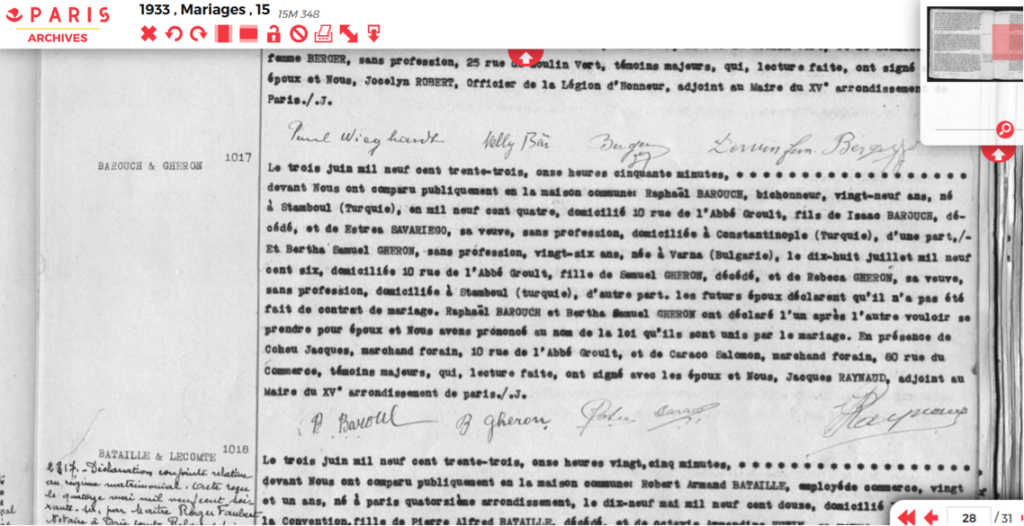
On June 3, 1933, Raphaël married Berthe Gheron, who was born on July 18, 1906, in Varna, Bulgaria. Her mother, Rebecca, was living in “Stamboul” at the time and her father, Samuel, had died sometime earlier, in Turkey.
They were married in the town hall of the 15th district of Paris. The couple lived at 10 rue de l’Abbé Groult, in the Javel neighborhood, as did one of their witnesses, Jacques Cohen, a market trader. Berthe came from a family of travelling salespeople who may have sold hosiery.
They were still living in the 15th district in 1936.
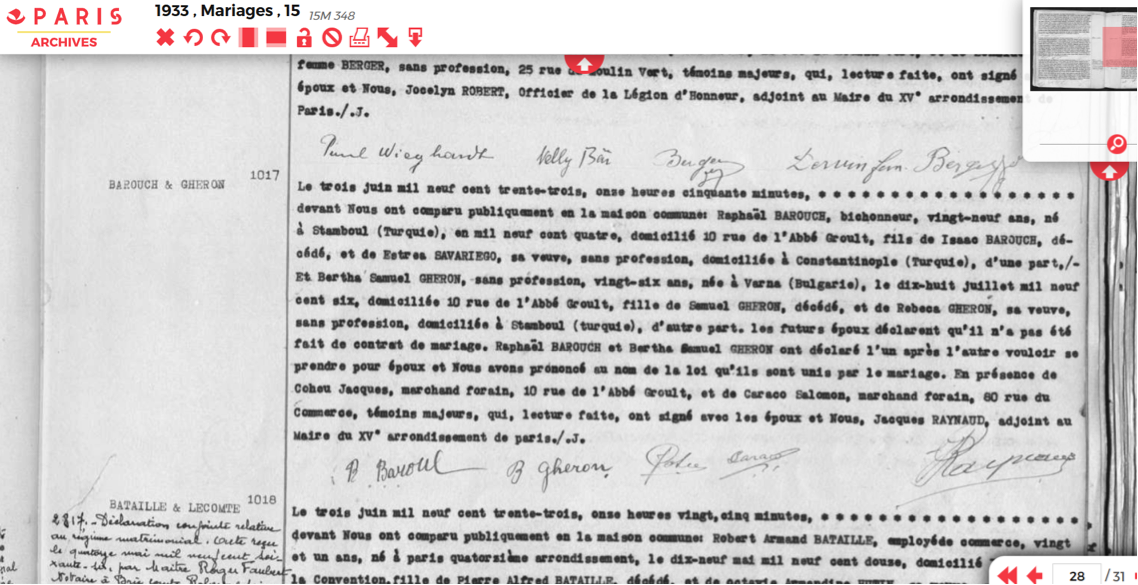
Paris City Archives. Marriage register, June 1933.
They went on to have three children together, all of whom became French nationals by declaration:
- Robert (registered at birth as Isaac Robert), born on March 27, 1935, in the 12th district of Paris;
- Maurice Sylvain, born on August 22, 1937, in the 12th district of Paris;
- Éliane Rose, born on December 4, 1941, in Nîmes, in the Gard department of France.
On January 12, 1938, Raphaël applied to the foreigners and passports department of the Seine prefecture to exchange his identity card[3].
The French Foreign Legion
In September 1939, when war broke out, Raphaël’s wife and sons left Paris and moved to Nîmes. Some other members of the Ghéron (Guéron) and Barouch families were already living in this town in the south of France, so that gave Raphaël’s family a starting point.
Raphaël, who was a Turkish citizen, rather than French, enlisted as a foreign volunteer. He signed up at the central recruiting office of the Seine, 1st Military Region, and was assigned the service number 9895. He served in the French Foreign Legion until he was demobilized after France signed the armistice on June 22, 1940.

UEVACJEA collection, Shoah Memorial, Paris
In August 1940, Raphaël went to live with his wife and children in Nîmes. Did they initially live at 11 rue Dorée, where one of Berthe’s relatives was already living? Did they move to 17 rue de l’Aspic when their third child, Éliane, arrived on December 4, 1941? The rue de l’Aspic address is on the deportation list.
Raphaël was able to find work, but he had to give up the hat trade and take laboring jobs on building sites, as Jews were still allowed to do that type of work.
Arrest and Deportation
Like most Jews in France, Raphaël and Berthe registered themselves with the French authorities during the Occupation[4].
In the spring of 1944, Pierre Augustin Izern, a 60-year-old man who was a collaborator of the Vichy regime, reported about thirty Jews, including the Barouch family. They were arrested and interned in Marseille, in the Bouches-du-Rhône department of France[5].
On June 13, 1944, Berthe and her children, aged 9, 6 and 2½, arrived at Drancy camp. During the search, she had to hand over the 30 francs she had on her. On June 30, they were deported to Auschwitz on Convoy 76.
After they left Drancy and were loaded onto the train at Bobigny station, Berthe and the children vanish from the records. They were most likely murdered as soon as they arrived in Auschwitz, victims of the Nazi extermination policy, as were thousands of other Jews living in France who were arrested, deported and killed during the Holocaust. Their official date of death was later deemed to be July 5, 1944.
Their memory lives on in the archives and in testimonies gathered after the war. Surprisingly, their names appear on the memorial plaque to the Jews deported from the Vaucluse department of France, in Avignon. The three children’s names are also listed on the plaque in memory of the Jewish children from Nîmes and the Gard department. And the whole family’s names are engraved on the Wall of Names at the Shoah Memorial and on the plaque to the people deported from Nîmes, which was unveiled in the Nîmes cemetery in April 2001.
Raphaël arrived at Drancy camp a month later and was assigned prisoner number 25,650. On July 31, 1944, he was deported to Auschwitz on Convoy 77[6]. 1,306 deportees, from two-week-old babies to people over 80, were aboard the convoy. Among them were the children from the UGIF (Union Générale des Israélites de France, or General Union of French Jews) children’s homes in and around Paris, whom Aloïs Brunner, the SS commander in charge of Drancy camp, had rounded up a few days earlier. Very few of these deportees survived, but Raphaël was one of those that did.
ADDITIONAL INFORMATION BY CONVOY 77
RAPHAËL BARUCH’S DIFFICULT JOURNEY TO FREEDOM
Raphaël Barouch arrived in Auschwitz, in Poland, during the night of August 3-4, 1944 after a horrific three-day, three-night journey from Bobigny. He was selected to enter the camp to work.
In a typed “statement” taken on June 1, 1945, and now held in the French National Archives[7], this death camp survivor gave a brief but harrowing account of what he and his “comrades” went through.
Raphaël said nothing about his first glimpse of the camp, nor about how he realized what must have happened to his wife and children. He did not mention the registration number tattooed on his arm. He skipped straight to his time in the Buna camp, one of the Auschwitz subcamps, commonly referred to as Auschwitz III or Monowitz-Buna (the town of Monowice, where the IG Farben company’s Buna Werke plant was located). This forced-labor camp was also used to exterminate prisoners through hard work and exhaustion. The work was grueling, and the deportees were abused and poorly fed. It involved work on a rubber factory that IG Farben had been building since 1942, but never put into operation. In November 1943, Buna became a completely separate camp from Auschwitz.
About 12,000 prisoners worked on building the factory at Monowitz-Buna. Most were Jewish, but they also included political prisoners and common criminals, who were assigned to slightly easier work. The staff at Buna were civilians employed by the German company, but the SS, headed by SS Captain Heinrich Schwarz, was in charge.
“I stayed in Silesia for a year, in the Bouna camp,” Raphaël said. He was mistaken about how long he spent there, as he arrived in Auschwitz in the summer[8]. “I worked on the earthworks (as a laborer).” Prisoners did all the heavy construction work at Buna, which explains Raphaël’s role there. Primo Levi was in the infirmary at Buna when the Red Army liberated the camp on January 27, 1945.
The Allies deliberately bombed Buna four times in 1944, after Raphaël arrived there in early August. It was the only camp they ever targeted deliberately, yet he made no mention of the bombing in his testimony.
“After that, we had to evacuate,” he said. He was referring the death marches that the Nazis forced prisoners from many camps to take part in as the Allied troops were approaching. Rather than flee on their own, the Nazis dragged thousands of prisoners with them across Poland and Germany, through the snow, on foot or in makeshift transport such as open freight cars. At Auschwitz, they left behind around 1,000 sick prisoners. They had already started burning the camp records and had begun dismantling the crematoria in November 1944.
Raphaël was among the prisoners who traveled exclusively on foot as the Nazis retreated: “We walked more than eighty kilometers [50 miles] in just a few days, in the middle of winter,” he told the person who recorded his testimony. Although he did not mention the date, they probably set off around mid-January 1945, by which time the deportees could hear the sound of Russian and German forces fighting nearby.
The prisoners, along with the soldiers and SS men escorting them, stopped off for two weeks in Buchenwald, where Raphaël was assigned the prisoner number 123,208. From there, they went on by train to Langenstein-Zwieberge in Germany, which was a subcamp of Buchenwald opened in April 1944. Raphaël referred to it as an “extermination camp.” He also recalled how “we were machine-gunned,” along the way and “more than a hundred of our comrades died.”
During his time at the Langenstein-Zwieberge Kommando, Raphaël “worked in the tunnels,” which were part of a network of underground galleries 8 miles (13 km) long.
“Twelve hours a day (this work was very bad for the chest),” he added. The working conditions were particularly hard, with only “a liter of water, a hunk of bread and twenty grams [about 3/4 oz] of margarine a day” to keep them going. Some 7,000 prisoners worked for the Junkers aircraft company in this underground factory.
“We had three hours of waiting in the middle of winter,” he said, referring to the endless roll calls held outdoors before dawn, before work, and again when they came back in the evening. “No beds, four hours of sleep.” Death was never far away. “About two hundred of our comrades died every day. We had to carry the coffins.”
As the Allies advanced, the prisoners moved on again: “We were evacuated; we went through several villages, leaving masses of dead along the way.” He emphasized how: “The SS had no pity for the weak. Of more than four thousand of us, only a thousand or so arrived.” But he did not say where they ended up… or where he was finally liberated.
In his statement, dated June 1945, Raphaël gave his address as 40 rue Balthazar de Montrond in Marseille, in the Bouches-du-Rhône department of France. There is no trace of him after that. He never filed a claim for compensation.
Notes & References
[1] We do not know when he arrived in France.
[2] Paris Archives, 1936 census.
[3] French National Archives, central file of the Sûreté nationale (national police), known as the “Moscow collection,” 1938; 19940434-90-7250.
[4] On October 3, 1940, the French State passed a law on “The Status of Jews”. It applied in both the Occupied Zone and the Free Zone and stated: “Any person descended from three grandparents of the Jewish race, or from two grandparents of the same race if his or her spouse is also Jewish, shall be considered a Jew.” On June 2, 1941, the French State ordered a census across the whole country and passed a second decree on the Status of Jews, which widened the criteria for people they deemed to be of “Jewish race.” The authorities later used the resulting files to arrest and deport Jews.
[5] The Gard branch of the Amis de la Fondation pour la Mémoire de la Déportation (Friends of the Foundation for the Memory of the Deportation) has so far identified 1,111 people deported from the Gard department. It reports that on November 6, 1947, the Nîmes Court of Justice sentenced Pierre Izern to death for denouncing about thirty Jews, on a charge of collusion with the enemy, and confiscated all his personal assets. He was executed by firing squad on January 21, 1948. Georges Krebs and Georges Muller have written entries about members of the Barouch family. https://afmdgard.org/barouch-maurice/ and Les-Fusillés-de-la-Libération // AD 30.
[6] Five other men arrested in Nîmes were on the same convoy. One of them, 20-year-old Samuel Guéron, may have been related to Berthe Ghéron. Although he was born in Havana in September 1924, his father, like Berthe’s, came from Bulgaria, and his mother came from Istanbul, as did Raphaël’s. Samuel and the Barouch family also lived at the same address in Nîmes, at 11 rue Dorée. Samuel survived the Holocaust and became a French citizen on April 12, 1947.
[7] French National Archives (AN), F9-5565, Baruch Raphaël.
[8] Only one deportee with this first name and surname appears in the deportation databases, but he was deported in September 1942 and was over 50 years old.