Français
 Polski
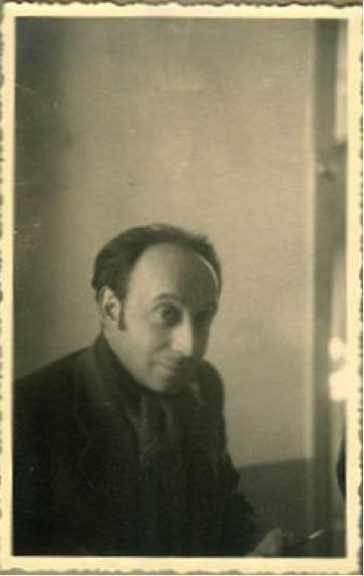
Henri SUSSMANN (1904–1986)
Artist, Resistance fighter and Holocaust survivor
© Family archives, undated photo
Henri Sussmann was an Austrian-born painter, set designer, Communist activist and French Resistance fighter. He was born Henryk Sussmann on November 20, 1904, in Tarnopol1, a town in Galicia that was then part of Austria-Hungary and is now Ternopil, in Ukraine. He later went by the name of Heinrich, and then Henri. His time spent in exile and his years of resistance to Nazism shaped his life, and as an artist he worked hard to keep the memory of the Holocaust alive.
Early life and education
His parents were Samuel, a traveling salesman, and Rachel, known as Rosa, Leibeles. Heinrich grew up in an Orthodox Jewish family. During the First World War the family fled to Vienna, and he went to high school there starting in 1914. In the 1920s he studied interior design and set design under Oskar Strnad at the Vienna School of Applied Arts, and then continued his studies at the Académie de la Grande Chaumière in Paris.
He then moved to Berlin, where he worked as a set designer, graphic artist and poster designer for Universum Film AG and the Ullstein publishing house. He made a name for himself there and married his first wife, Margot Amalia Loewenberg. When the Nazis came to power in 1933 and he had to flee Berlin, he first went to Vienna and then to Paris. There he carried on working as an artist, and also became politically active in the Communist Party.
Exile in France and joining the Resistance
After he moved to France and divorced his first wife, he married Anna Goldscheider (see Anna Sussmann’s biography) at the town hall of the 19th district of Paris on November 4, 1937. Paul Goldscheider, a doctor in Vienna, was one of their witnesses.
The couple initially set up home at 5 rue Manin, in the 19th district, and later moved to 8 place du Danube, in the same neighborhood. They struggled to make ends meet: he managed to sell a few paintings, while she sold jewelry and rugs.
Heinrich was still living in France when the Second World War broke out. As of September 1939, the authorities interned him as an “enemy alien,” even though he no longer held Austrian nationality and was opposed to the Nazis. He was held in several camps, including the soccer stadium in Colombes, a Paris suburb. When the stadium was cleared in December, he was moved to the camp at Meslay-du-Maine, in the Mayenne department of France, where his wife was able to visit him.
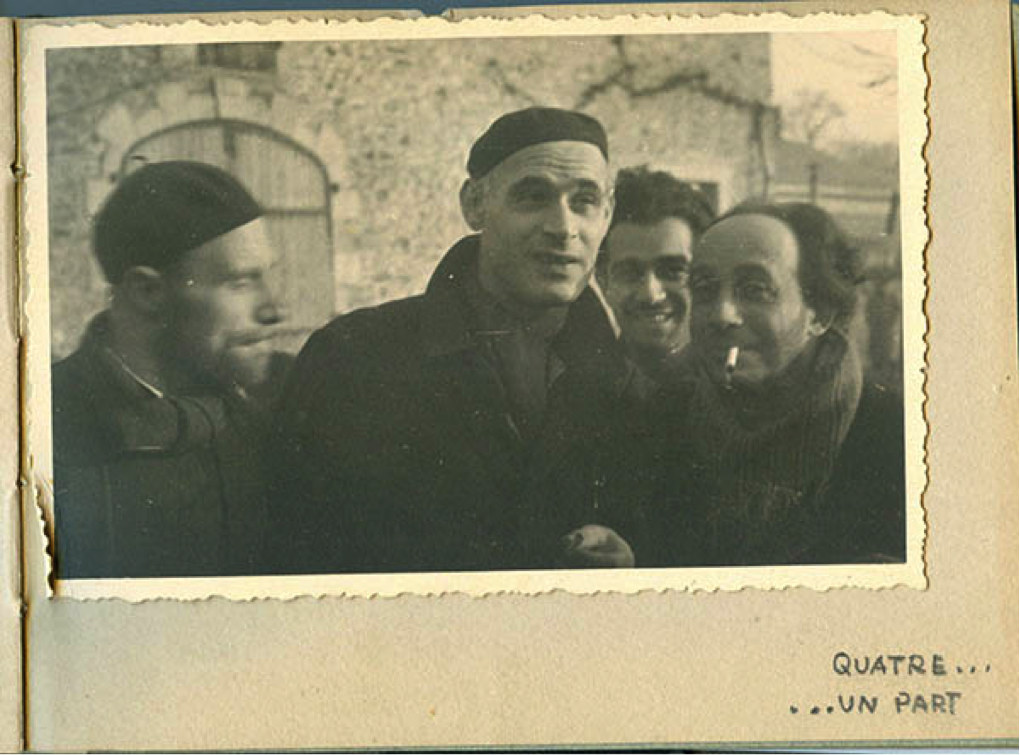
Henri Sussmann in Meslay-du-Maine, 1940
©All rights reserved doew.at
After he was released, a police superintendent from his Paris neighborhood kept pressing Henri to join the army, and in 1940 he finally managed to enlist in the Service de prestations militaires (a military labor service for foreigners). He did his basic training in Laval, again in the Mayenne department. On May 1, 1940, his wife, who was still living at 8 place du Danube in the 19th district, began receiving a military allowance as a soldier’s wife. After France was defeated in June 1940, Henri was demobilized in the Free Zone.
In May 1941, he joined the Resistance movement as part of the MOI (Main-d’œuvre immigrée, a labor union for foreign workers). In Paris, for example, he made false papers for Vilma Geiringer, a fellow Austrian Jew who was also in the Resistance. In 1942 he joined the newly formed FTP-MOI (Francs-tireurs et partisans – Main-d’œuvre immigrée), a Communist urban guerrilla movement. The first operations he was involved in were in Marseille, in the Bouches-du-Rhône department of France, which was in the Free Zone at the time. He was living there with Anna, her brother and her brother’s wife.
In December 1943, the organization’s political leadership sent Heinrich/Henri and his wife Anni back to Paris to work on anti-Nazi propaganda. His job was to produce and distribute leaflets in German urging German soldiers to desert2. Needless to say, he also made use of his skills as a painter and graphic artist to make false identity papers for the Resistance3.
The Sussmanns moved from one hiding place to another, living under the false names Henri and Annie Béranger. The Gestapo identified them after officers from the BS1, the Brigade Spéciale (a French police unit that hunted down Resistance members), put a tail on them in connection with Henri’s underground activities. At one point, they spotted the couple on the rue de Rivoli, a major Paris thoroughfare, and nicknamed them “Rivoli Man” and “Rivoli Woman,” but then lost track of them. Eventually, on June 1, 1944, the Sussmanns were arrested in a hotel at 45 rue Truffaut, in the 17th district of Paris4 5. After the war, in his application for official recognition of his Resistance work, Henri stated that they had been betrayed by “a member of his group, D.W., who led the police” to their location.
The couple were brought to the Paris Police Headquarters depot (detention center), where Henri was held from June 1 to 6. They were repeatedly taken out and subjected to brutal interrogations by the Gestapo, during which Henri was tortured in front of his wife. In the end, they admitted to being in contact with other Communist Resistance members.
On June 6, 1944, the Gestapo moved Henri to Fresnes Prison, south of Paris, and on July 14, he was transferred to Drancy. According to the Drancy camp arrival register (the cahier de mutations) and his search record, held at the Shoah Memorial in Paris, he was assigned the registration number 25,118 and placed in a room on the 5th floor on staircase 19. He had 65 francs on him, which he had handed over in Fresnes, had returned to him, and then had to hand over again when he arrived in Drancy.
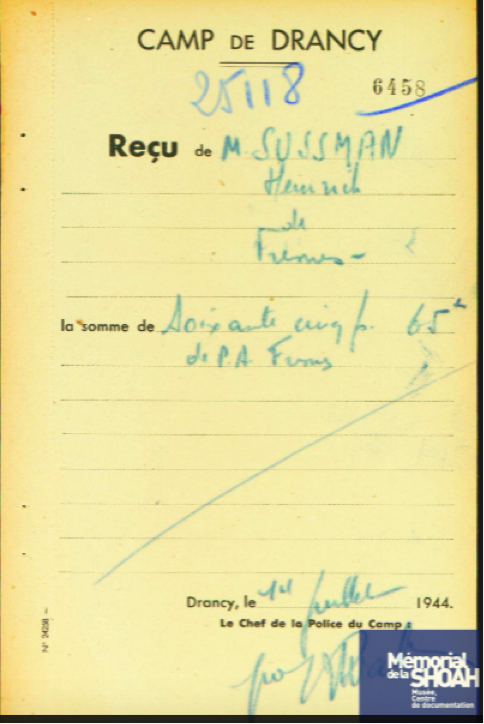
©Shoah Memorial, Paris.
Anna was also put in prison, and then taken to Drancy transit camp. On July 31, the couple were deported from there to Auschwitz6. Anna was pregnant at the time.
- DAVCC (Division des archives des victimes des conflits contemporains, Victims of Contemporary Conflicts Archives Division of the French Ministry of Defense Historical Service, in Caen), file on Henri Sussmann, ref. 21 P 679 229. On the camp for foreigners in Colombes, see also the blog campdesindesirables.blogspot.com. On the Meslay-du-Maine camp, there is a short archive film at www.amorce.eu
- Document of the Front National de Lutte pour la Libération et l’Indépendance de la France (National Front for the Liberation and Independence of France), letter signed by Camphin, the official responsible for winding up the Front National, April 25, 1962, in the DAVCC file cited above.
- DAVCC, file on Henri Sussmann
- Félix Kreissler, L’Audacieux Défi du « Travail Anti-Allemand » (The Audacious Challenge of “Anti-German Activities”), Austriaca: Cahiers universitaires d’information sur l’Autriche (University Papers on Austria), 2008, pp. 145–155. persee.fr
- DAVCC, file on Henri Sussmann
- DAVCC, file on Henri Sussmann
Deportation to Auschwitz and surviving in the camp
Early on the morning of July 31, 1944, the Sussmanns and 1,304 other people, the youngest a two-week-old baby and the oldest over 80, were put on buses that shuttled back and forth to the nearby Bobigny station. When they arrived, a train made up of “cattle cars” was waiting for them. Sixty people were crammed into each car, with nothing but straw on the floor and not even enough room to sit down. One single bucket of water and a little food had to last them the whole journey, and a second bucket was their only toilet. A French driver took the train, which became known as Convoy 77, as far as the border, where a German driver took over for the rest of the journey to Auschwitz, in occupied Poland.
We do not know whether Henri and Anni were put in the same car, or if Henri traveled separately with other so-called “single” men, including members of the Resistance, who were kept under closer guard. Either way, when the train reached Auschwitz during the night of August 3, Henri and Anni, like all the other deportees, were separated on the platform for the selection. Both avoided being sent to the gas chambers as they were selected to enter the camp to work. He was sent to wait in the men’s line, she with the other women.
Once inside the camp, Henri Sussmann was tattooed with the number B-3936. After spending some time in quarantine, he was assigned to Blok 18 in Auschwitz I, the Lager central (main camp), where he remained until January 1945.
During his time there, he worked in a Kommando in which he and five other deportees had to illustrate greeting cards for the SS. He also met Hermann Langbein, who went on to become a “Nazi hunter.” Thanks to the support of fellow Resistance members and his status as an artist, he was spared the worst treatment, and he even managed to take part in the camp’s underground resistance, helping to pass on information about Nazi atrocities.
During one of the regular selections, Henri was one of the deportees singled out to be sent to the gas chambers, but he survived somehow and was still there when the camp was liberated on January 27, 1945, by what he called “the Russian troops”7. He was hiding in a coal bunker with some other prisoners who were too weak for the death march when the Soviets found him, in tears. They had not expected to find any survivors at Auschwitz, and their primary objective was to move on to Berlin. Henri set off with them and after a long journey, ended up in Odessa, where the “liberated Westerners” were being gathered. He was at last repatriated to France by boat, and arrived in Marseille, on the south coast of France, on May 10, 19458, just after Germany surrendered. A huge crowd was waiting on the quayside.
On June 14, 1945, just over a year after he was arrested, a man by the name of G. Gosse, from the Ministry of Prisoners, Deportees and Refugees, interviewed Henri Sussmann in Paris. Henri described the evacuation of Auschwitz on January 18, when the prisoners were taken out “by numbers and by blocks,” and estimated how many sick men and women had been left behind, all of them brought together from Monowitz and Birkenau into Auschwitz I. He thought there were about 1,000 French survivors at that point, of whom 80% might have survived. He also said he wanted to carry out “an inquiry” into what happened to “the children of the July 31 convoy, some of whom came from Frankfurt,” and promised to send the results to the ministry (although it seems he never did). He also mentioned the men in “car 1 and the escape car from Metz,” who “arrived naked at Auschwitz station.”[1]
Anni Sussmann’s escape
Anni Sussmann was pregnant when she arrived at Auschwitz-Birkenau. She later testified to the appalling conditions in the camp, where she saw her baby murdered just after it was born: Josef Mengele threw the newborn into a blazing oven9.
In late October 1944, Anni was transferred to the Kratzau camp in Czechoslovakia, where she worked in an arms factory. As the Soviet army advanced, she and a friend, Lilli Schlesinger, managed to escape and were taken in by French prisoners of war and German civilians who opposed the Nazi regime. Nearly two weeks after they escaped, they reached Switzerland, and Anni became one of the first Auschwitz survivors to testify about what was happening there10.
After the war: testimony and art
The return to Vienna and dealing with indifference
After Henri was repatriated to France in 1945, the couple returned to Vienna. They hoped to start a new life there and to play a part in rebuilding a recently liberated Austria. Instead, they found that the Austrian public chose to ignore its Nazi past, or even remained hostile to Jewish survivors. Henri Sussmann described one chilling moment: “We were greeted by the caretaker of the building, who exclaimed, ‘Jesus, the Jews are back already!’”
Undeterred by this hostile welcome, Henri devoted his time to educating people about Nazi crimes and, through his art, to making sure they would never be forgotten. In 1946, he took part in the Niemals vergessen! (Never Forget!) exhibition at the Künstlerhaus in Vienna, with works exposing the horror of the camps.
He went on working as an artist, and in 1978 he created the stained-glass windows for the Austrian memorial at Auschwitz, a landmark project paying tribute to the Austrians who had stood up to Nazism.
- Ibid. 110382-SUSSMANN_Henri_21_P_679_229, DAVCC
- Ibid. 110382-SUSSMANN_Henri_21_P_679_229, DAVCC
- https://convoi77.org/deporte_bio/anna-sussmann/#_ftnref2
- https://convoi77.org/deporte_bio/anna-sussmann/#_ftn8
Honors and recognition
Although Henri Sussmann was living in Austria, he applied to the Veterans and War Victims department of the French Ministry of War for official recognition of the fact that he had been deported from France and arrested as a Resistance fighter.
The French Communist Party (PCF) launched the Front national de lutte pour la libération et l’indépendance de la France (National Front for the Liberation and Independence of France), with a call to action published on May 15, 1941. After the war, this organization issued a certificate to confirm that Henri Sussmann had fought “against the German Army, in liaison with the M.O.I. Dangerous missions. Intelligence gathered from German soldiers on behalf of the French Resistance FTPF. Arrest: wanted by the Brigade Spéciale and the Gestapo for this work against the German army.” After a long struggle through the maze of French bureaucracy, Henri was finally granted the status of Déporté Résistant (Deported Resistance fighter) in November 1962, and was given a red deportee card.
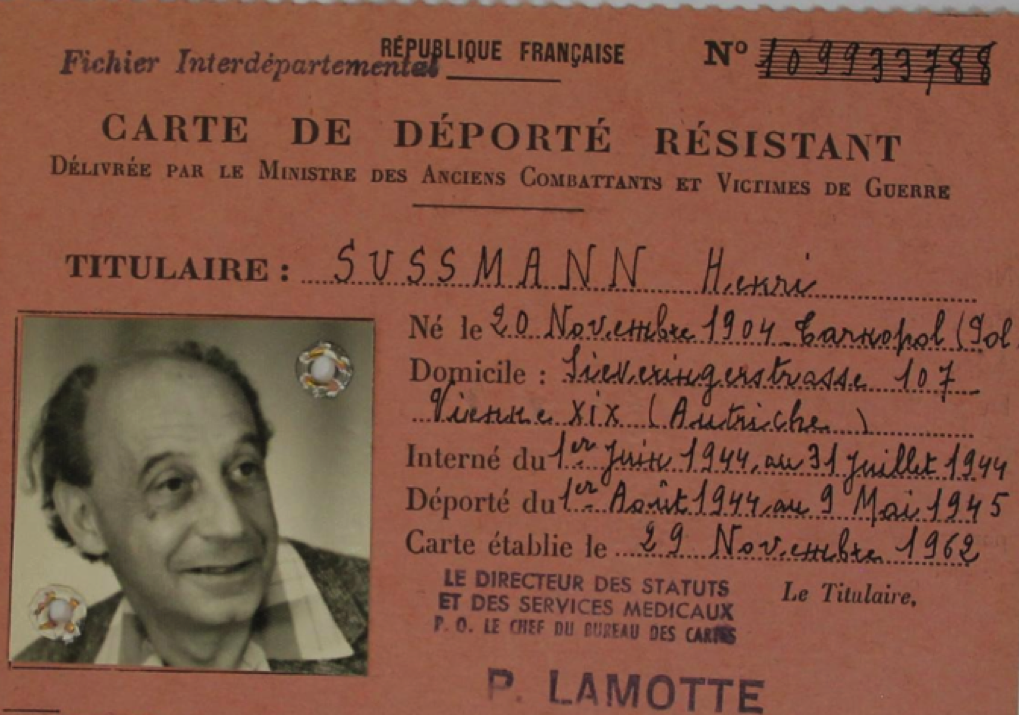
Henri Sussmann’s Déporté Résistant (Deported Resistance fighter) card
©Family archives.
He also asked the French military to acknowledge his army service, and in 1964 he was granted the status of “private second class, deportee.” Finally, in 1985, he was decorated for his wartime service.
The Austrian authorities also recognized the part he had played in both the Austrian and the French Resistance.
Final years and legacy
Henri and Anni Sussmann went on testifying in public for the rest of their lives. In a 1985 interview, they took issue with those who wanted to “turn the page,” and insisted that people must keep talking about the Holocaust. “Auschwitz deserves its place in history. I think people need to know about it, especially young people,” said Henri.
Henri Sussmann died in Vienna on December 12, 1986. The Anni and Heinrich Sussmann Foundation was then set up to preserve his artistic and political legacy. The Foundation awards grants to young artists whose work is inspired by the ideal of freedom.
This biography was written by the 11th grade students at the Martin Nadaud vocational high school in Saint-Pierre-des-Corps, in the Indre-et-Loire department of France, under the guidance of Mr. François Huguet, in the 2024–2025 school year.
Sources
- Archives provided by the Convoy 77 association. This file, held at the French Ministry of Defense Historical Service archives in Caen, contains documents from various French government departments, including the Ministry of Veterans and War Victims. File on Henri Sussmann, ref. 21 P 679 229
- Archives de la Ville de Paris (Paris City Archives), civil records, marriages, 1937, 19th district of Paris.
- Paris Police Headquarters archives, file viewed at the Shoah Memorial in Paris, interrogation of June 2, 1944. APP. Gb 87 and register of internees. CC2
- Shoah Memorial, Paris, Drancy cahier de mutations (register of arrivals), July–August 1944, and search record.
- French National Archives, F9-5588, Henri Sussmann’s testimony after he returned from the camps, June 14, 1945.
- ITS Archives, Bad Arolsen: name crossed out on a handwritten list, probably for an upcoming “transport.”
- Blog about the 1939 camp for foreigners in Colombes, campdesindesirables.blogspot.com
- Ö1 Anna und Heinrich Sussmann, Fälscher der Resistance (Anna and Heinrich Sussmann, Forgers for the Resistance)
- Ö1, interview with Anna and Heinrich Sussmann, broadcast on February 9, 1985. mediathek.at
- Documentation Centre of Austrian Resistance (DÖW), article: “Heinrich Sussmann: Meslay 1940” URL: doew.at
- Heinrich Sussmann, Ich erinnere mich wieder an Auschwitz (I Remember Auschwitz Again), Vienna
- Exhibition Niemals vergessen! (Never Forget!), 1946, Künstlerhaus, Vienna
- Gerhard Botz, Nationalsozialismus in Wien – Machtübernahme und Herrschaftssicherung 1938/39 (National Socialism in Vienna: Seizure and Consolidation of Power, 1938/39), DVO, Buchloe.
- Sophie Lillie & Arye Wachsmuth, Im Schatten der Veränderung (In the Shadow of Change) (in Dépossession (Dispossession), Künstlerhaus Vienna, 2021)
- Maitron online (biographical dictionary of the French labor and social movements) maitron.fr
- File on Sussmann
[1] This is a reference to the failed escape attempt planned with the help of the resistance in Drancy camp. You can search this site for other biographies that cover this event.