Français
 Polski
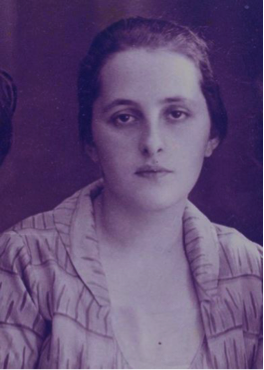
Emmy WOLFF
Through the lens: the shattered life of photographer Emmy Wolff
© Shoah Memorial, Paris – Marianne Saksik collection
Family background and early years
Emmy Wolff[1] was born on May 23, 1899, in Dudweiler, in the Saarland region of Germany, into a large, well-educated German Jewish family.
Her parents were Moritz (Moses/Maurice) Wolff, who was born in 1869, and Friederike (Frieda) Hanau, born in 1870. Emmy was the third of their seven children: Johanna (1895), Siegfried (1897), Emmy (1899), Gertrud-Meta (1902), Martha (1904), Friedrich-Joseph, known as Fritz (1906), and Richard (1910).
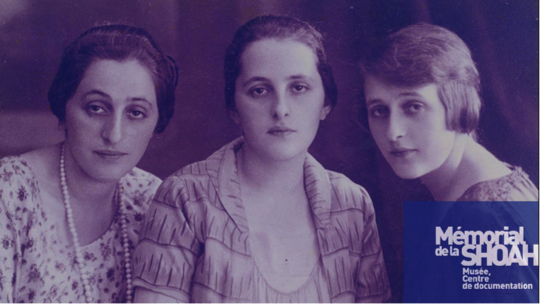
Emmy Wolff (center)
© Shoah Memorial, Paris – Marianne Saksik collection.
In 1892, Frieda opened a department store in Dudweiler. After she and Moritz married in 1894, they built up the business together and renamed it Waarenhaus Hanau & Cie. However, they had to close the store in 1910, and the family moved to Bochum, in the Ruhr region.
Moritz took over the Frohwein studio in Bochum, a thriving photography business he had inherited, which soon became one of the best-known in the city. He also played an active role in public life, as a member of organizations such as the German Peace Society and the German League for Human Rights.
Two of his daughters, Martha and Meta, became actresses. Meta started out in the theater. She converted to Christianity to marry Joachim Gottschalk, a famous movie actor. Siegfried, the eldest son, became a photographer.
In an interview with the students in 2025, Emmy’s nephew, Pierre Wolff, explained that the Wolff family were not practicing Jews and did not keep the Sabbath, but that they did celebrate the traditional Jewish holidays such as Passover and Yom Kippur[2]. Even before 1933, however, Moritz’s political activism and their Jewish background inevitably made them targets for the Nazis.
A promising career cut short
Emmy’s[3] father began teaching her photography when she was a young child. In the 1920s, she worked with him at the Frohwein studio, and in 1928 she opened her own studio in Essen, southwest of Bochum, in the Lichtburg building, a lively, modern movie theater and cultural center. She soon made a name for herself as a talented photographer, particularly for her portraits.
When Hitler came to power in 1933, her life was turned upside down. As Jewish businesses were boycotted, their windows smashed and antisemitic laws passed, she gradually lost both her customers and her rights. She then went to work for Imago, a company owned by Schwartz, where she was the first woman to work as a camera operator.
Rather than endure this persecution, Emmy decided to leave Germany, as had most of her brothers and sisters. She followed in the footsteps of some other family members who had already emigrated to France: two of her brothers, Siegfried and Charles, her sister-in-law Gustel, known as Augustine (born Auguste Wittgenstein), her niece Marianne (born in 1931) and her parents, Frieda and Moritz.
The Wolff family in France: from Metz to Lyon
Siegfried had believed that, as a former German soldier, he was in no danger, but a police superintendent in Bochum apparently persuaded him and his family to leave, and they left Germany in April or May 1933. Emmy and Siegfried’s sister Johanna was already living in San Francisco with her husband, Paul, so they decided to emigrate to the United States, but they were refused entry. They settled for the nearest country, France, even though they did not speak French.
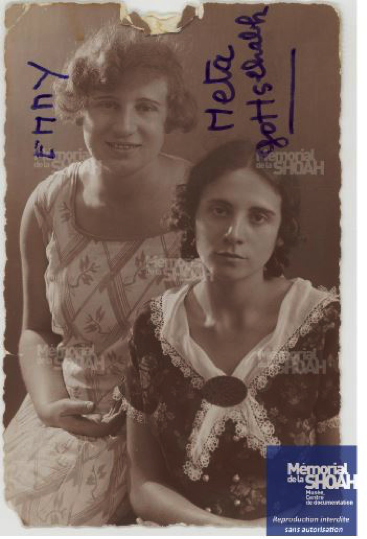
Emmy and Meta Wolff
© Shoah Memorial, Paris – Marianne Seksik collection.
Siegfried found a place to live on the place Saint-Louis in Metz, in the Moselle department of France. His wife, their little daughter and his parents followed later, bringing some of the photography equipment and furniture with them. He started work with the mayor’s permission, but he seems to have had trouble with his assistant, as he filed a complaint against him for breach of trust.
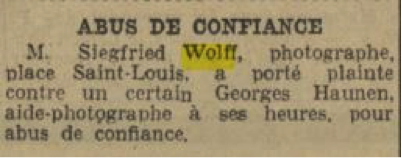
Notice in the Metz newspaper Le Lorrain, September 20, 1933.
RetroNews, French National Library (BnF).
As they were unable to obtain a residence permit, Siegfried and his family had to leave Metz six months later. As a result, he lost almost everything he had managed to bring from Germany to earn a living and rebuild his life in France[4]. After this unfortunate episode, in November 1933, the family decided to move to Lyon. According to his son Pierre, Siegfried’s siblings, who were by then “scattered to the four corners of the world,” helped them out financially, above all Meta and her husband, who was a star in Germany even though he was married to a Jewish woman.
In 1934, Emmy also went into exile. She moved in with her family, who lived in a villa at 26 rue du Capitaine in Montchat, a quiet, working-class neighborhood in the 3rd district of Lyon, on the left bank of the Rhône, on the edge of Villeurbanne[5]. Emmy helped Siegfried, who was the family’s main breadwinner, as the two brothers had no work.
Exile in France, with war on the horizon
Once settled in Lyon, the family tried to make a fresh start. Siegfried opened a new photography studio[6], in the hope of bringing some stability to their lives. As Emmy had no residence permit, she stayed home and helped him behind the scenes.
Lyon did not become a haven for refugees until the start of the war, but it was already home to a well-established Jewish community. In 1936, an estimated 7,000 Jewish people were living there[7].
According to Pierre Wolff, the family rented the villa at first and eventually bought it with help from the brother who emigrated to San Francisco after the war. They set up the photo lab there, and Siegfried and Emmy did contract work for various photographers.
Despite all their efforts, money was always tight and their legal status remained uncertain. The studio itself was legal, as Siegfried had registered the business in Lyon as soon as he arrived. However, as foreigners, the family had to contend with French bureaucracy. In 1934, soon after Emmy arrived, she and her parents were served with a removal order, which was upheld the following year[8]. The family did everything they could to avoid being expelled, as it would have meant being sent back to Germany just as the Nazis were stepping up their antisemitic campaign. In late 1935, the French authorities granted them a temporary reprieve, which had to be renewed every three months[9]. This gave them some breathing space, but no lasting right to stay in France. The government could decide to withdraw it at any time, so the threat of expulsion hung over them like the sword of Damocles. In any case, public opinion in France was not particularly sympathetic to refugees at the time.
The police, who worked closely with the prefecture, regularly investigated the family’s “morality and conduct.” Based on their findings, they advised the prefecture whether to renew or withdraw the family’s right to stay in Lyon. According to their reports, Emmy was unemployed and helped her parents at home on rue du Capitaine[10], but she likely worked in her brother’s studio as well. Meanwhile, there was a new addition to the family: Siegfried’s son, Pierre, was born on August 6, 1935.
Things changed for refugees when the Popular Front came to power and Marx Dormoy became Minister of the Interior in November 1936. The new government had no real policy for taking in refugees, but it eased the red tape and took a kinder view of the many people who had arrived in France over the previous few years. Life looked set to become more settled for the family. In September 1937, the removal order was “withdrawn”[11]: as long as their “conduct was beyond reproach,” they could stay in France as “refugees from Germany” without fear of expulsion[12]. They filed the paperwork, and in January 1938 they were issued foreigners’ identity cards[13].
The outbreak of war
Meanwhile, the world was becoming a more dangerous place by the day. When Germany invaded Poland, Poland’s allies, France and Britain, declared war on Germany on September 3, 1939, and Europe slid into what would become the Second World War.
Emmy’s younger brother Richard enlisted in the French Foreign Legion.
As soon as war broke out, in September 1939, Siegfried’s property was seized and placed in the hands of a court-appointed administrator.

Notice published in the Journal officiel (French government gazette), November 5, 1939, p. 12896.
Lyon court.
As Siegfried was German by birth, he was interned in the Chambaran camp, in the Isère department of France, and then in Le Cheylard, in the Ardèche department. He was released in the summer of 1940[14], and on August 23 he was able to return to Lyon, which was in the non-occupied “Free Zone” (in the southern half of the country). For the family, who had feared the worst ever since France fell, the German occupation of Lyon, although it only lasted from June 19 to July 7, 1940[15], was an ominous warning.
According to a record dated March 1959, Emmy was held in 1940 in the Gurs camp in Béarn, now in the Pyrénées-Atlantiques department of France. The record was part of Siegfried’s post-war application to have her officially recognized as a deportee[16]. After France and Germany signed the armistice on June 22, 1940, and the Vichy government issued its decrees on “the status of Jews” on October 3 and 4, 1940, prefects had the power to intern foreign Jews living in their department, and Gurs was used to hold Jews of every nationality except French[17]. However, if Emmy really was interned in Gurs, there is nothing to tell us why she was released. The question of her internment only came up after the war, when the city of Bochum, in Germany, asked for more information as part of a war compensation claim. Was Emmy arrested under the law passed on October 4, 1940? Or did the authorities simply assume she had been, as she was a foreigner, and a German one at that?
Once France surrendered and Marshal Pétain was granted full powers, the new regime wasted no time in introducing anti-Jewish decrees, known as the Statut des Juifs (Statute on Jews). Jews were banned from working in the civil service, the medical professions, teaching, the judiciary and the army. Anyone deemed to be Jewish on the basis of their family background had to register, and some were placed under house arrest. Emmy and her family probably registered themselves as Jews in the summer of 1941, as required by a French law passed that year.
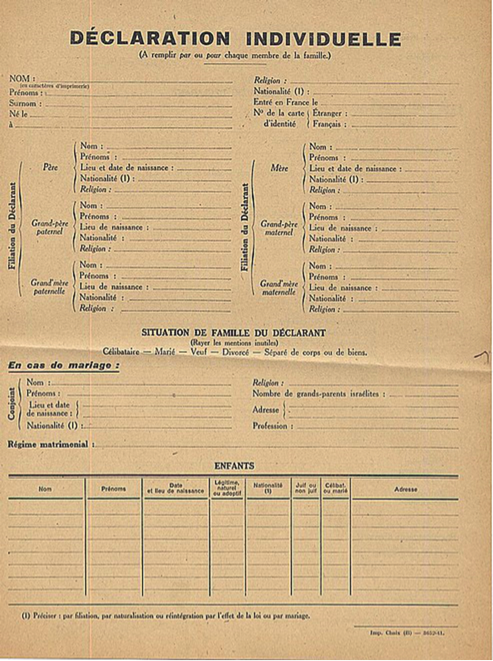
Blank copy of the individual registration form for Jews
© Musée de la Résistance en ligne (Online Museum of the Resistance). museedelaresistanceenligne.org
As of December 11, 1942, the Vichy government required identity papers and ration cards to be stamped with the word “Juif” (for men) or “Juive” (for women). The French authorities confiscated and destroyed the family’s identity cards, and Emmy and her parents were issued new documents that had to be endorsed by the authorities at regular intervals. Until 1942, the family corresponded with the Rhône prefecture several times to get them renewed[18]. However, Jews in the Free Zone were never made to wear the yellow star.
Jews and foreigners were not the only ones affected: the Vichy government wanted to be able to identify everyone in France. Under a law passed on October 27, 1940, every French citizen over the age of 16 had to obtain a “French identity card” from the prefecture. However, many people dragged their feet, so the new system was slow to take effect.
The end of the Free Zone
Under the terms of the armistice, France was divided into two zones: the north and the Atlantic coast were occupied by the Germans, while the area south of the Loire was run by the Vichy government. Lyon became the largest city south of the demarcation line. When the Vichy government began introducing its anti-Jewish decrees in October 1940, it had a powerful ally in Lyon: Alexandre Angéli, who had been appointed regional prefect in September and was deeply committed to the collaborationist policies of Philippe Pétain’s government[19].
Worse was yet to come, however. On November 11, 1942, the Germans crossed the demarcation line and invaded the Free Zone. Parts of the southern half of France, along the Mediterranean coast (Nice, Cannes, etc.) and in Savoie, came under the control of the Italian army, which was much less eager to enforce the German and French anti-Jewish measures.
The Germans occupied Lyon, which became the nerve center of both the Resistance and Nazi repression. This heralded a crackdown on Jews, and the number of arrests in the region increased, providing ever more victims for the Nazi genocide.
The Wolff family was forced to keep a low profile and to look for safer places than Lyon. One of these was Valloire, in the Savoie department, which had been under Italian occupation since December 24, 1942, and where Jews were left almost entirely alone. In a memo to the German consulate in Lyon dated October 16, 1956, Siegfried wrote that the only help they had there came from “the local population.”
However, Emmy and Siegfried’s father, Moritz, was not well enough to stay in Savoie, so the family returned to Lyon in January 1943, after the local prefect issued them a safe-conduct pass[20].
Pierre Wolff later recalled that on February 20, 1943, all the Jewish men who stayed behind in Valloire were arrested in retaliation for an attack on German officers in Paris. It was the French police or gendarmerie (military police) who rounded them up, despite objections from the Italian authorities, and some were interned in Gurs, Annecy or Chambéry. Under pressure from the Italians, most of them were later released[21].
The future looked increasingly bleak for the Wolff family. Along with the rest of the population, they watched as the Germans became ever more ruthless and the repression spread. From the summer of 1942 onward, after the Vel’ d’Hiv (Vélodrome d’Hiver, or winter cycling track) roundup in the Paris area, roundups took place all over France. Throughout 1943, increasing numbers of Jews were arrested and deported. The infamous SS officer Klaus Barbie orchestrated the raids in the Lyon region[22].
Siegfried moved his parents into a retirement home in Villefranche-sur-Saône. By then, Marianne and Pierre, his two children, had already spent time in a number of different places. In 1939, they were sent to Le Chambon-sur-Lignon, in the Haute-Loire department of France, where many Jewish children were later sheltered and saved, mainly through the Protestant church. Next came Valloire, where they stayed with the rest of the family. After that, the Mutualité du Rhône (a mutual aid society) found them a place in a children’s home in the Beaujolais, the wine-growing region just north of Lyon, where they were always hungry. They were then taken in by a kind farming family in Orliénas, in the Rhône department: Madame Bihan, a widow, her two sons and her granddaughter. When the students met him in 2025, Pierre Wolff told them, “Before the war, we were part of a community,” but although the children knew they were Jewish, he thought, as a child, that he was a refugee “because of the bombings.”
Siegfried, Gustel and Emmy, meanwhile, had taken refuge with one of their customers, Madame Grand, who lived in Bron, on the outskirts of Lyon. They shared their hiding place with a Jewish friend who was “also wanted.” In May 1943, however, Emmy and Gustel moved back to Lyon “so as not to be a burden on our hostess,” as Siegfried put it, and Emmy kept the photo lab running for other photographers in the city.
Living in hiding was very expensive, and the family struggled to make ends meet. Siegfried supported them all almost single-handedly[23], but he was forced to lie low to avoid arrest.
For the family, 1944 would turn out to be a terrible year. In January, Emmy’s mother, Frieda, who had grown very frail, died in the retirement home.
Arrest and deportation
On June 26, 1944[24], Emmy and Gustel were arrested at home, probably after a woman who lived nearby reported them[25]. Accounts differ as to whether they were arrested by the Gestapo or by the Milice (the Vichy regime’s paramilitary police force). According to Pierre, who passed on what his father later found out, the two women had just cycled home after collecting their food rations, and the Milice were waiting for them.
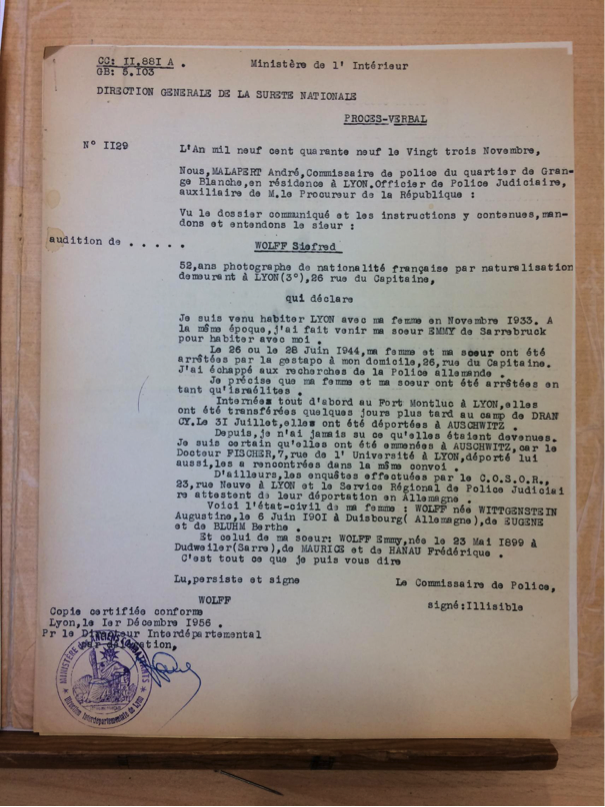
French Ministry of Defense Historical Service, file on Emmy Wolff
That same evening, Siegfried was at Madame Grand’s house when he saw a car pull up. He realized at once what was happening, so he jumped out of the window. The Gestapo went inside and arrested Madame Grand. Friends of Siegfried and Gustel went to collect the children from the Bihans’ farm, and the next day they took them to a village near Aix-les-Bains, in the Savoie department of France.
Emmy and Gustel, meanwhile, had been taken straight to Montluc, the German-run prison in Lyon. A few days later, they were transferred to Drancy transit camp.
When Emmy arrived in Drancy on July 4, she was assigned prisoner number 24,802. She was then searched and had to hand over “1 gold double-case watch, 1 lady’s gold wristwatch, 1 lady’s gold and enamel watch, 2 gold chains, 1 gold and pearl pendant, 2 gold rings,” as well as “2 gold rings with diamonds and pearls, 1 gold ring,” which were listed on a separate receipt. The family had probably only managed to get by at all by selling their jewelry.
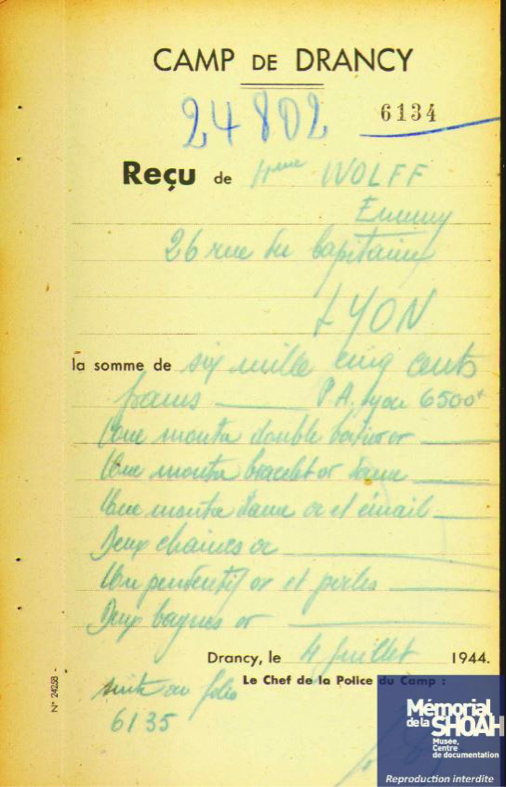
While in Drancy, Emmy and her sister-in-law crossed paths with Dr. Isic Fischer, a Romanian doctor and Resistance member who lived in Lyon. In 1956, he testified that he had seen them there. On July 31, 1944, Emmy and Gustel were both deported to Auschwitz on the convoy that later became known as Convoy 77. Soon after they arrived, during the night of August 3–4, 1944, they were most likely sent straight to the gas chambers and murdered. Dr. Fischer, who was led away with the men selected for forced labor, never saw them again[26].
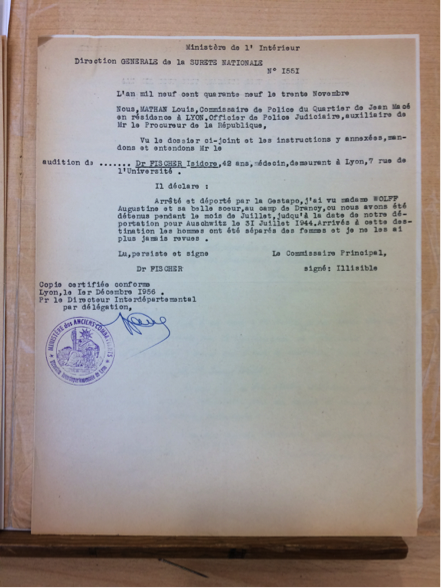
Isic Fischer’s testimony about Emmy Wolff
© French Ministry of Defense Historical Service, Caen, ref. 21 P 551 037
The family left behind
Emmy’s father, Moritz, died penniless in January 1945, at the age of 75, in an old people’s home run by the Little Sisters of the Poor. Did he ever find out what had happened to his daughter Meta? She and her husband, Joachim Gottschalk, had chosen not to get divorced. On November 6, 1941, when Meta and their little boy, Michael, were about to be deported, the couple took their own lives with gas in Berlin, and Michael died with them. It seems unlikely that Moritz ever knew, as Goebbels had ordered a complete news blackout on their tragic death, even though Meta had written to her brother Friedrich’s mother-in-law the day before[27]. Was he also kept in the dark about the fact that his daughter Emmy and his daughter-in-law Gustel had been deported?
As for Emmy and Siegfried, had they heard that their brother Richard had died in February 1944 in Tonkin (now northern Vietnam), during the war against the Japanese? Communication was difficult for everyone during the Occupation, and even more so for people in hiding, so it seems unlikely.
As mentioned earlier, Emmy’s niece and nephew, Marianne and Pierre, were kept hidden for much of the war so that they would not be caught in the roundups. They were moved around the Lyon area under the false name of “Jacquemin,” to keep them safe from the Germans and informers[28].
When their mother and aunt were arrested, Siegfried went to ground at a neighbor’s house and turned to his network of friends for help. Some of them fetched the children from the farm and took them to stay with other families in Trévignin, near Aix-les-Bains. That was when the children were told that their mother and aunt had been arrested.
After the Liberation, Pierre, who was nearly 10, and his 13-year-old sister went back to live with their father, Siegfried, who had been deeply traumatized when Gustel and Emmy were arrested. Pierre remembers how the war and the deportation of his mother and aunt scarred his childhood, and how the wounds left by Nazi barbarity never healed. In the first few weeks, the family went to the station in Montchat every day, hoping that Emmy and Gustel would step off a train and come home. They never did.
Siegfried requested a search for his sister and began putting together a file on her for the French authorities. Did all the paperwork wear him down in the end? Whatever the reason, he never completed it, and Emmy’s death was never registered at the town hall in Lyon, where she lived before she was murdered.
Pierre went back to school, and when he was about 15, he began helping his father in the studio. He later became a photographer himself. Siegfried, encouraged by his Jewish friends, eventually remarried. His second wife, a young German Jewish mother who had been held in the Rivesaltes camp, in the Pyrénées-Orientales department of France, had been helping him bring up the children. Siegfried, who had become a French citizen by then, died in June 1968 after surgery for brain cancer.
To this day, Pierre gives his time to make sure that what happened to his family during the Holocaust is never forgotten[29]. His sister, Marianne, was one of the civil parties (victims or relatives of victims who join the prosecution) at the trial of Klaus Barbie, the “Butcher of Lyon,” which was held before the Rhône criminal court, in the Lyon courthouse, from May 11 to July 4, 1987. Serge Klarsfeld was among the lawyers who represented her. However, according to her brother, she could not get into the courtroom.
Emmy and Gustel’s names are inscribed on the war memorial in Montchat and on the Wall of Names at the Shoah Memorial in Paris.
Emmy Wolff was an independent artist, a woman of conviction and a victim of her times. She embodies the silent courage of those who resisted in their own way, by being creative, standing by their families and remaining dignified. Her story reminds us how important it is to preserve history, so that the faces, names and work of victims such as Emmy are never erased.
This biography was written by the 11th grade class at the Martin-Nadaud vocational high school in Saint-Pierre-des-Corps, in the Indre-et-Loire department of France, under the guidance of Mr. François Huguet. It was part of a European project that brought together 10th grade students (class 2PROA) from the Martin-Nadaud high school, led by S. Coatleven, A. Esnon and F. Huguet, and students from the Berufsschulzentrum des Landkreises Stendal – Europaschule (a vocational school in Germany), led by Dörte Metelmann, in the 2025–2026 school year.
Our sincere thanks to Pierre Wolff, Isabelle Flattot (archivist at the Rhône Departmental Archives) and Sylvie Altar (historian) for their help and their time.
Meta Wolff (1902–1941): an actress whose life was cut short by Nazi hatred

Meta Wolff-Gottschalk (1902–1941)
Meta Wolff, Emmy’s younger sister, was born in Dudweiler in 1902. She went on to become a well-known actress in Weimar Germany. In 1930, she married Joachim Gottschalk, one of the most popular actors of the day, and their son, Michael, was born in 1933. However, as theirs was a “mixed” marriage (Meta was Jewish, while Joachim was not), the Nazis soon began to persecute them.
Joseph Goebbels, the Nazi Minister of Propaganda, insisted that the couple get divorced. He gave orders for Meta and their son to be deported, and for Joachim to be sent to the Eastern Front. Rather than let the Nazis tear their family apart, they made a tragic decision: on November 6, 1941, to escape deportation, Meta and Joachim took their own lives, taking their son, Michael, with them.
The tragedy shocked the artistic community in Germany. In 1947, their story was immortalized in the film Ehe im Schatten (Marriage in the Shadows), directed by Kurt Maetzig, which became a symbol of the persecution Jewish artists suffered under the Nazis.
Notes & references
[1] gedenkbuch.saarbruecken.de
[2] Conversations between Pierre Wolff, Siegfried’s son, and students from the Martin-Nadaud high school and the EPJT, a journalism school in Tours, in Lyon on February 5, 2025, and with Alexandre Doulut for the Shoah Memorial, 2025. ressources.memorialdelashoah.org
[3] Hubert Schneider and Reinhart Jakobs, “Meta Wolff, de la famille de marchands Hanau à Dudweiler” (Meta Wolff, from the Hanau merchant family in Dudweiler), dudweiler-geschichtswerkstatt.de
[4] Filmed interview with Pierre Wolff, recorded on January 16, 2006, by Sylviane Oling.
[5] There was already a Jewish community in the “Gratte-Ciel” (Skyscrapers) neighborhood of Villeurbanne, but the Wolffs did not want to live there, according to Pierre Wolff’s testimony, op. cit., Lyon, 2025.
[6] Trade register, Rhône Departmental Archives, Lyon Commercial Court. archives.rhone.fr
[7] Sylvie Altar, Être juif à Lyon et ses alentours (1940-1944) (Being Jewish in Lyon and the surrounding area, 1940–1944), Éditions Tiresias, 2019.
[8] AD069-10-829W-000070-019943-0959
[9] AD069-10-829W-000070-019943-0933
[10] AD069-10-829W-000070-019943-0983
[11] AD069-10-829W-000070-019943-0958; AD069-10-829W-000070-019943-0956
[12] AD069-10-829W-000070-019943-0954
[13] AD069-10-829W-000070-019943-0950. Identity cards were not compulsory in France at the time, but in April 1917, the government issued a decree requiring foreigners to carry one. As well as meeting various other conditions, they had to pay a fee for the card. “The decree-laws of May 2 and November 12, 1938 (under the Daladier government) tightened the registration measures,” in histoire-immigration.fr. Illegal immigrants were hunted down and expelled.
[14] dudweiler-geschichtswerkstatt.de
[15] Être juif à Lyon pendant la Shoah (Being Jewish in Lyon during the Holocaust), lecture by Sylvie Altar, 2021, www.youtube.com, and Journal officiel de la République française (Official Gazette of the French Republic), November 5, 1939, p. 12896
[16] French Ministry of Defense Historical Service, Caen, file on Emmy Wolff, ref. 21 P 551 037.
[17] The Gurs internment camp was opened on April 2, 1939, at first for Spanish Republican men who had fled after Franco’s victory. As of May 10, 1940, it was used mainly for “undesirables,” most of them women from Germany and the countries occupied by the Reich. From September 1940 onward, even before the Statut des Juifs (Statute on Jews) of October 3 and 4, 1940, foreign Jews were also interned there, until August 25, 1944. The last people held there, until December 1945, were collaborators. campgurs.com
[18] AD069-10-829W-000070-019943-0936. Generally speaking, the French administration kept the Wolffs under some form of surveillance and control throughout the period, as can be seen from their entire file, no. 19.943, at the Rhône Departmental Archives; see also French Ministry of Defense Historical Service, file on Emmy Wolff, op. cit.
[19] Être Juif à Lyon pendant la Shoah (Being Jewish in Lyon during the Holocaust), lecture by Sylvie Altar, 2021.
[20] AD069-10-829W-000070-019943-0940
[21] See Société savoisienne d’histoire et d’archéologie (Savoy Society of History and Archaeology), ssha.fr/dossiers-thematiques
[22] Filmed interview with Pierre Wolff, recorded on January 16, 2006, by Sylviane Oling.
[23] Être Juif à Lyon pendant la Shoah (Being Jewish in Lyon during the Holocaust), lecture by Sylvie Altar, 2021
[24] dudweiler-geschichtswerkstatt.de
[25] AD069-4657W-541-Wolff_Emmy
[26] Conversation with Pierre Wolff, January 16, 2006; biography of Augustine Wolff, born Wittgenstein, convoi77.org; conversation between Pierre Wolff and Alexandre Doulut for the Shoah Memorial, in Lyon in June 2025, ressources.memorialdelashoah.org; and testimony of Isidore (Isic) Fischer, November 30, 1949, in Lyon, in French Ministry of Defense Historical Service, Caen, file on Emmy Wolff, op. cit.
[27] AD069-4657W-541-Wolff_Emmy; convoi77.org
[28] Filmed interview with Pierre Wolff, recorded on January 16, 2006.
[29] Conversation between Pierre Wolff and students from the Martin-Nadaud high school and the EPJT, a journalism school in Tours, in Lyon on February 5, 2025.