Français
 Polski
Caroline GUTHEIM, née GOLDENBERG (1903–1944)
Caroline’s early years
Caroline Goldenberg was born in the 18th district of Paris on May 12, 1903. Although she was born in France, she had Romanian and Ukrainian roots, and she grew up in a loving family with strong Jewish traditions. Her father, Philippe Goldenberg, was born in Bucharest, Romania, on November 17, 1875, and her mother, Berthe Orenstain, was also born there on May 13, 1885.
Caroline was the eldest of four children. She had one brother, Maurice, and two sisters, Marguerite and Jeannette[1]. When she was born, the family was living at 30 rue Muller, in the Montmartre neighborhood of Paris, but they moved many times over the years. They were not well off: her father, Philippe, was a tailor, and her mother, Berthe, looked after the home and the children[2].
After she left school, Caroline worked for a time as a sales clerk[3].
Caroline and Léon’s wedding: happy times
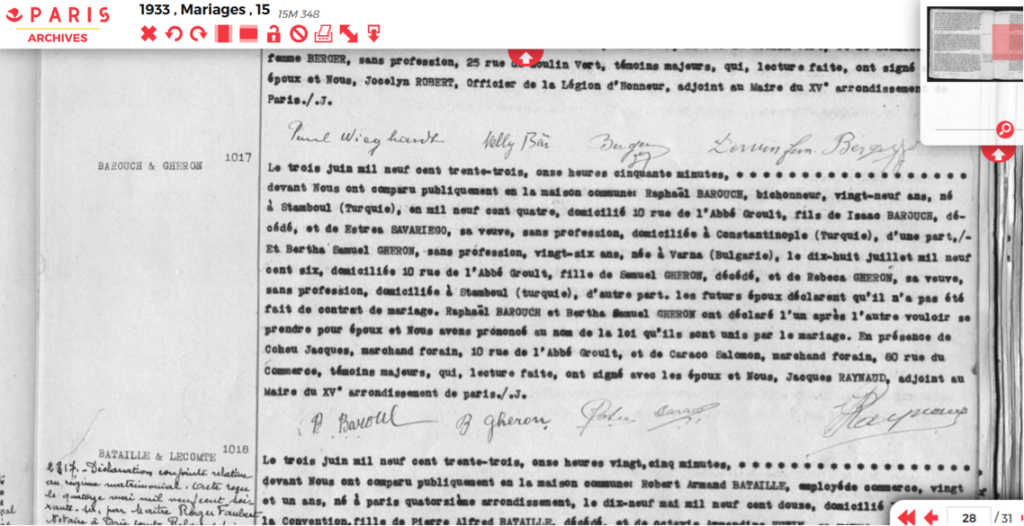
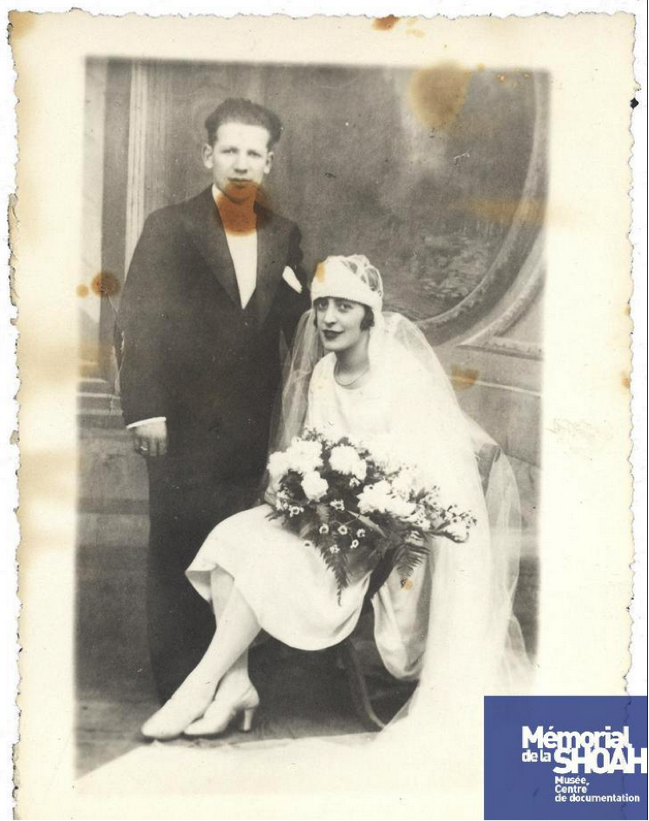
In 1920s Paris, Caroline fell in love with Léon Gutheim. They were married in a civil ceremony at the town hall of the 13th district on August 20, 1929. The marriage is recorded in town hall register 289 as certificate number 1188.
It was a simple, intimate wedding, with family and close friends gathered around the couple. As they set up home in a Europe facing an uncertain future, it was a moment of unity and hope.
Léon’s parents, Szulim Icek Gutheim and Estera Goldberg, had emigrated from Warsaw, the Polish capital, to France in 1904. He was their eldest son and had one sister and four brothers: Rachel, Albert, Maurice, Jacob and David. Léon followed in his father’s footsteps and became an upholsterer. Unlike Caroline, Léon was not born in France, although he had become a French citizen in 1928, before they got married. Nor had he spent his whole childhood in France, as he had to leave the country after his father died in 1910 (see Léon Gutheim’s biography on this website). He did not move back to Paris until 1921, after he finished his military service in Poland.
With no money or property to speak of, Caroline and Léon did not see the need for a marriage contract. Caroline appears in their wedding photo as a modern young woman with a fashionable short, boyish haircut.

© Shoah Memorial, Paris
From a couple to a family of four…
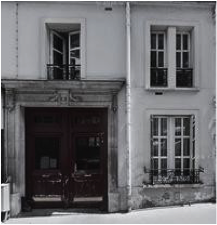
20 rue Oudry, 13th district of Paris
The couple set up home in an apartment at 20 rue Oudry in the 13th district, in the lively, working-class Salpêtrière neighborhood, where workers and craftsmen lived side by side. Caroline’s parents lived in the same area.
Caroline and Léon were happy there, and their home was soon filled with children’s laughter. Serge was born on August 1, 1930, in the 13th district of Paris, and Mauricette followed at 6 a.m. on July 9, 1934, in the 14th district[4]. As they grew up, the children went to the local school. Caroline took care of the home, and the rent of 2,000 francs a year was always paid on time.
To provide for the family, Léon worked as an upholsterer at Maison Reiss, at 21 rue du Faubourg Saint-Antoine in the 11th district of Paris.
The outbreak of war and the German occupation of Paris
Léon worked at Reiss from 1921 until November 14, 1939, when he was called up to fight in the war, which had been declared in September. According to his naturalization application, he was earning 1,200 francs a month in 1926.
Caroline had worked as a sales clerk before she married, and as well as caring for the children, she started looking for a job again[5].

Paris Soir newspaper, April 20, 1940
After France was defeated in June 1940, Léon was demobilized and returned to Maison Reiss, where he worked from October 4, 1940, to April 9, 1941.
On May 10, 1941, he began work at Maison Tavernier, on the same street, where he earned 600 francs a week[6], according to a police report. The same source says that Caroline was not working at the time.
The Vichy regime and antisemitism: a struggle to survive
When the first anti-Jewish decrees were issued in October 1940, the Gutheims duly registered themselves as Jews. They did everything the authorities required of them, but life still became very hard for Jewish people. The persecution had begun, and it affected French and foreign Jews alike across mainland France.
The Gutheim family was no exception. The authorities reviewed Léon’s case to decide whether he could remain a French citizen. Eventually, on November 23, 1942, they decided that he could keep his French nationality.
Caroline’s younger sister, Marguerite, was arrested at the age of 33, along with her husband, David Davidovici, a dentist. Léon had been one of the witnesses at their wedding in 1932. David’s sister, Ella, who was also a dentist, was arrested with her husband and children during the Vel’ d’Hiv (Vélodrome d’Hiver, or winter cycling track) roundup, and they were deported on Convoy 44 on November 9, 1942. None of them survived the Holocaust.
Caroline realized she had no choice but to try to keep her children safe by sending them away. Serge and Mauricette were placed in the care of the OSE (Oeuvre de Secours aux Enfants, Children’s Aid Society). Founded in 1912, this organization worked to protect and rescue thousands of Jewish children at risk of deportation, including in the 4th district of Paris. The La Mère et l’Enfant (Mother and Child) clinic[7] took charge of the Gutheim children and paid 600 francs a month for their room and board. In March 1943, Mauricette was staying in Draveil, now in the Essonne department of France, at the OSE home that became known as Les Glycines after the Liberation.
The escape to Lyon
Caroline, Léon and their children fled Paris, where they were at constant risk of arrest, police checks, roundups and denunciation, and sought refuge in Lyon[8], in the Rhône department of France. We do not know when they arrived there. Caroline’s sister Jeannette had also fled to Lyon, where, on June 29, 1944, she married Samuel Goldemberg at the town hall of the 3rd district.
The family found a place to live at 36 rue Moncey in the 3rd district of Lyon, and life almost returned to normal. According to the OSE records on Serge and Mauricette, Léon got a job as an upholsterer in a Lyon workshop. He had to support his family despite the danger, while Caroline took care of the home. Fear had become a part of everyday life.
Arrested, interned at Montluc and Drancy, then deported
Léon was arrested at his workplace in Lyon on July 18, 1944 (OSE records). A few hours later, the “German authorities” arrested Caroline at home, at 36 rue Moncey, according to the paperwork their family submitted in 1961, after the war. Was it a Gestapo raid? Had someone turned them in? We cannot say for sure…
By sheer luck, Serge and Mauricette happened to be in the countryside at the time, according to the OSE records, and that saved them. Caroline must have been terribly worried about them…
Caroline and Léon were then both interned in Montluc, a German-run prison in Lyon used to hold Jewish people, Resistance members and people suspected of being in the Resistance. It was particularly overcrowded that summer and living conditions were terrible. Many of the Jewish prisoners were to be transferred to Drancy internment camp. On July 24, they were loaded onto buses and driven to Perrache station, where passenger trains had been chartered to take them to Drancy, guarded by French gendarmes, with two German soldiers in each car.
When she arrived in Drancy, Caroline was assigned prisoner number 25,777, the first step in the dehumanization process… She was put in a room for women on the 2nd floor of Staircase 5, but she could still see Léon and talk to him in the courtyard. They were not free, but they were together, except at night, when the men and women went back to their separate rooms. Caroline must have thought about how things used to be, and above all about her children… Adversity brought people closer, and they supported one another…
Toward the end of July, the atmosphere in Drancy became extremely tense and oppressive, almost suffocating. The bare central courtyard baked in the summer sun, and the rooms were overcrowded. As the Allied armies advanced, some people hoped that liberation was near. SS commandant Aloïs Brunner, who was in charge of the camp, ruled with an iron fist, and everyone lived in terror of him. Rumors were spreading about where the trains were really going. What if they were not just going to labor camps? Caroline clung to Léon. She must also have thought about little Mauricette, with her beautiful brown eyes, her chestnut hair, her lovely smile and the tiny scar on her left eye… and about Serge too, naturally.
The Gutheims’ names were on the list for the next convoy. At dawn on July 31, the deportees were gathered in a small courtyard, apart from the other internees. Once again, Caroline and Léon were loaded onto a bus, this time to Bobigny station, two miles (3 km) from Drancy and away from prying eyes. There, hundreds of men, women and children, some of them very young, were herded into cattle cars, and the doors were locked at once. The guards barked orders, and once inside, the deportees could hardly breathe. The mood was one of distress and resignation, with one last glimmer of hope.
Late that morning, Convoy 77 pulled out of the station. The 1,306 people on board were being deported to Auschwitz, in southern Poland. Many of them, including Caroline and Léon, would never come home.
The train reached Auschwitz during the night of August 3–4, 1944. Caroline Gutheim was sent to the gas chambers and murdered soon after she arrived, as were the vast majority of the people deported on this last large convoy of the summer. She was 41 years old, a wife and mother. A victim of the Nazi extermination policy, she was killed simply because she was Jewish.
She was later officially declared to have died on August 5, 1944, a date the French authorities worked out by estimating how long the journey had taken.
What became of Serge and Mauricette…

Although Serge, who was 14, and Mauricette, who was 10, were not arrested, interned or deported, they had lost their parents, other relatives and people they loved. All of a sudden, they were orphans. Their aunt Jeannette and her husband had not been arrested, but they were unable to take the children in.
The children were then looked after by organizations such as the OSE. They were sent to live in hiding with a Madame Magny on rue Bergon, in the Vaise neighborhood of Lyon, and then with a Madame Dupeyron at 2 rue Bourgchanin in the Cusset neighborhood of Villeurbanne, on the outskirts of Lyon. Madame Dupeyron continued to take in children placed with her by Jewish organizations until 1945, and they paid her to look after them. She had hated the Germans ever since her son was killed in 1940.
In June 1946, the Gutheim children went to live at Les Glycines, a children’s home at 83 rue Henri-Barbusse in Draveil. On December 7, 1946, the staff at the home described Mauricette in their notebooks as healthy, and said she found school difficult but was improving. They also mentioned how honest and direct she was, and that month they described her as intelligent and bright.
In 1947, they went to live with their aunt Jeannette and uncle Samuel Goldemberg, who was appointed as their legal guardian, at 18 bis rue du Parc in Sainte-Geneviève-des-Bois, then in the Seine-et-Oise department of France[9].
Léon’s brothers, Maurice and Albert Guttheim, along with Jeannette and her husband, made official inquiries to find out what had happened to Caroline and Léon.
In 1948, the children were “adopted by the Nation” and declared “wards of the State,” which entitled them to financial support from the government. The paperwork took a long time, however. Following a court ruling on October 13, 1948, the words Mort pour la France (Died for France) were added to Caroline and Léon Gutheim’s death certificates. In December 1961, Mauricette applied for her parents to be granted the status of Déporté Politique (Political deportee), and her application was approved in June 1962. In their case, it meant that they had been deported on racial grounds, because they were Jewish.
On June 19, 1958, Serge married Monique Germaine Simon, who was born in 1936, in Stockholm, Sweden. He became a Swedish citizen on April 19, 1961. They had two sons, Armand and Allan, a musician and an artist who are well known in Sweden. Serge died in Helsingborg on May 13, 2022, at the age of 91. His wife, Monique Germaine Simon, is still alive.
As an adult, Mauricette lived in Paris. In 1968, she was living in a low-rent housing development called the Cité Lesage-Bullourde, home to many Jewish residents who struggled to make ends meet. She later moved to Limoges, in the Haute-Vienne department of France. She died in Azerables, in the Creuse department, on July 27, 2016, at the age of 82. Mauricette Gutheim is buried in the cemetery in Lourdoueix-Saint-Michel, in the Indre department, with the Lacharpagne family. She never married or had children.
In remembrance
Caroline and Léon’s names are listed on the memorial stone honoring members of the Bichor Cholim (meaning “charity saves from death”) and Tsedoko Tatsil Mimoves religious communities in Bagneux, in the Hauts-de-Seine department of France.
Caroline and Léon Gutheim’s names are engraved on the Wall of Names at the Shoah Memorial in Paris, under the year 1944.
SOURCES
- Archives of the French Ministry of Defense Historical Service, Caen, file on Caroline Gutheim, ref. 20 P 460 627.
- Paris City Archives, civil records: marriages, births and deaths, and census records for 1926, 1933 and 1936.
- Shoah Memorial, Paris / French National Archives, Drancy records.
- French National Archives, file on Léon Gutheim, ref. BB11 10294 28466×27, review of the request for denaturalization (in his naturalization file).
- OSE archives.
- Rhône Departmental Archives, people interned in Montluc prison in Lyon, 1939–1945, 3335W 1-3335W31 (source: Lyon Regional Criminal Investigation Department / SRPJ).
- French National Library / Retronews, press articles and classified advertisements.
Notes & references
[1] Maurice was born in 1907 at 48 rue Ramey, in the 18th district of Paris; Marguerite was born in 1909 at 56 rue du Faubourg-Saint-Denis, in the 10th district; and Jeannette was born in 1912 in London, England.
[2] In October 1928, Philippe Goldenberg and his daughter Jeannette became French citizens (Journal officiel [Official Gazette], October 21, 1928). As his other children, Caroline, Marguerite and Maurice, were born in France, he must have made a declaration of French nationality for each of them before a justice of the peace.
[3] She is listed as “Romanian” and a “sales clerk” in the 1926 census register for the Salpêtrière neighborhood of the 13th district, when she was still living with her parents.
[4] Paris City Archives, civil records, 14th district, register 715, certificate 2456.
[5] Caroline may well have placed an advertisement in the Paris Soir newspaper on April 20, 1940: “French lady, husband mobilized, speaks fluent English, seeks position as sales clerk, very good references, can come for interview in the evening after 6:30. Mme Gutheim, 18 bis rue du Parc, Sainte-Geneviève des Bois (S & O).” It could also have been written by Jeannette, who was born in London in 1912 and was living at the same address in 1948. However, Jeannette was not married in 1940! The address suggests that the family had left Paris for the relative safety of the suburbs.
[6] Léon’s in-laws lived with the family until Caroline’s father died at Saint-Antoine Hospital, in the 12th district, on February 14, 1941. He was buried in Bagneux, in a communal grave for men only that belonged to the Bikor Cholim of Montmartre, a Jewish association.
[7] The clinic was unofficially run by the Amelot Committee under the name Colonie Scolaire (originally a summer camp organization for children).
[8] They left in secret: Jews were not allowed to change their address, let alone move to another department.
[9] This was the address given in the job advertisement Caroline placed during the war.