Français
 Polski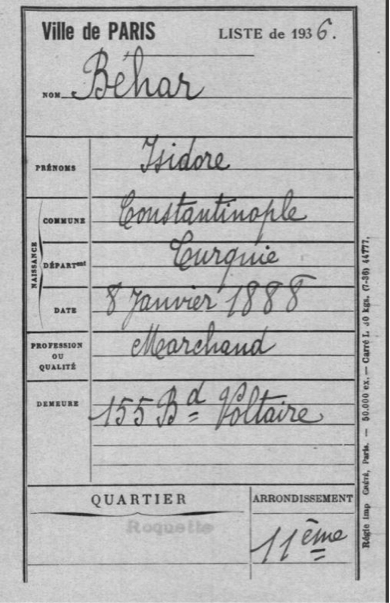
Isidore BEHAR (1888-1944)
This is a compilation of two biographies, one written by the 9th grade students at the Saint Louis middle school in Villemonble, in the Saint-Seine-Denis department of France, under the guidance of Ms. Lobjois, and the other by students at the Goethe Gymnasium in Germersheim, Germany, led by Mr. Steul.
Isidore Behar was born into a Sephardic Jewish family on January 8, 1888, in Constantinople (now Istanbul, Turkey), thirty-four years before the fall of the Ottoman Empire. His parents were Pinto Joïda and Ovadia Behar.
Turkey in turmoil
In the Ottoman Empire, people who were not Muslim were known as “People of the Book” and, in principle, were no longer covered by a special status under Islamic law known as “dhimmi.” They were free to work in professional roles, to trade in goods and to real estate and other assets. There was a sizeable Jewish population in Constantinople, and the Hakham Bachi (Chief Rabbi), the Jewish leader for the whole of the vast Ottoman Empire, lived there. However, the year after Isidore was born, the Young Turks movement was founded. This was an anti-establishment, nationalistic political faction with contrasting, and at times even conflicting, views on a number of key issues. The Spanish-Jewish community was understandably unsettled by this development. In January 1913, Enver Pasha successfully staged a coup d’état. Against the tense background of the Balkan Wars and various other conflicts, the Turkish government aligned itself more closely with the German Empire and went on to become its ally during the First World War. The Jews in Turkey, many of whom had attended schools run by the Alliance Israélite Universelle (a Jewish-French educational organization), where they had learned French and may also have benefited from its welfare programs for people in need, tended to hold a good opinion of France. Was this one of the reasons that prompted Isidore to emigrate to France?
We know very little about Isadore’s life in Constantinople, other than that he moved to France together with his parents and his sister Louise, who was born on May 15, 1897[1].
France, a land of opportunity?
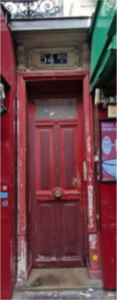
On February 10, 1914, Isidore married Rachel Mizrahi, a seamstress born on May 15, 1892, also in Constantinople. At the time, he was still living with his parents at 53 rue de La Roquette in the 11th district of Paris, not far from the Bastille. Rachel was living at the same address. The marriage certificate includes no details about her parents other than their names, which are listed in an affidavit.
Both of them were able to sign their names, although Joïa Behar was not, and Isidore’s father signed in the Hebrew alphabet. The three witnesses, who were fellow countrymen who lived nearby, also signed the civil register.
We found no record of Isadore and Rachel having had a religious wedding ceremony.
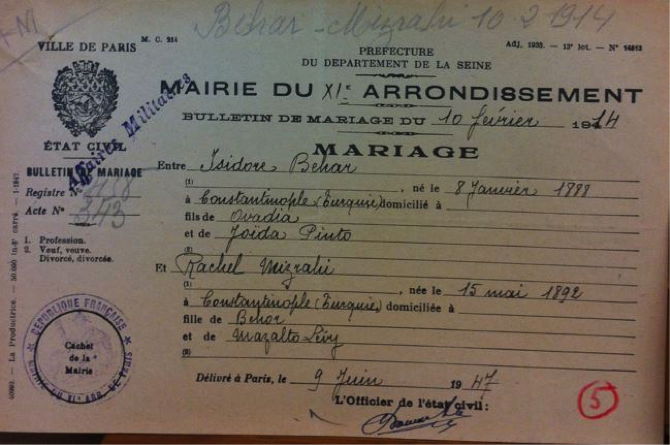
Isidore Behar and Rachel Mizrahi’s wedding certificate, from dossier 21 P 422 089 © Victims of Contemporary Conflicts Archives Division of the French Ministry of Defense Historical Service, in Caen.
The couple went on to have three children: Fanny, born on December 27, 1914 in the 12th district of Paris, Léopold, born December 18, 1916 and René, born July 26, 1918. When Fanny and Léopold were born, they were still living at 53 rue de la Roquette (most likely with Isadore’s parents[2]).
In the summer of 1914, when Fanny was six months old, the First World war broke out. We have no record of Isidore having enlisted as a foreign volunteer, unlike 40,000 other foreign Jews who fought for France, a third of whom died in battle[3].
Isidore became a knitwear and hosiery merchant, which was a common occupation for Turkish Jews in France. He, like many others, set up shop in a neighborhood where merchants had begun to cluster as new waves immigrants arrived. We do not know whether he worked as a street vendor or sold his wares to other merchants.
In 1927[4], the Behar family was living at 26 rue Basfroi, not far from rue de la Roquette and still in the 11th district of Paris. By 1931, they were living at 190 rue du Faubourg Saint-Antoine, in the 12th district, where he declared himself a “commercial business owner”. Then, on April 1,1935, according to the owner of the apartment, they moved to 155 boulevard Voltaire, although Fanny[5] was no longer living with them. On May 24, 1934, she had married Michon Moïse Pardo[6] in the town hall of the 11th district of Paris, after which they had a Jewish wedding at the synagogue on rue Notre-Dame de Nazareth, in the 3rd district. Fanny and Michon went on to have two daughters together.
By 1936, according to that year’s census records, the family was living on Boulevard Voltaire, in a part of the 11th district known as “Little Turkey,” where Jews originally from Turkey often spoke their native language, Judeo-Spanish (also known as Ladino). They could also worship according to the Sephardic tradition in prayer rooms and synagogues, and chat and play cards and games in cafés run by their fellow countrymen. One such well-known café was called the Istanbul.
In October 1931, Isidore became a French citizen[7]. His children are not listed in the naturalization decree published in the French Official Gazette, but he declared Fanny, Léopold, and René, all of whom were born in France, to be French citizens before the Justice of the Peace in the 11th district on July 1,1927. Having become a French citizen, he immediately registered to vote.
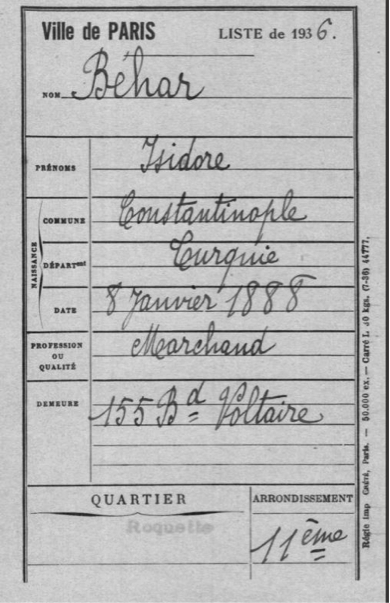
Isodore’s voter registration card ©Paris city archives
There were numerous people named Béhar in Paris, mainly in the same neighborhood as Isidore. Some of them were probably related to Isidore in some way.
The war, arrest and deportation
Léopold, Isidore and Rachel’s eldest son, was called up as soon as the war began. He served as a 2nd class Private Class in the 3rd R.I.C. 194, was taken prisoner at Châlons-sur-Marne, and sent to a prisoner-of-war camp[8].
In June 1940, after Germany defeated the French and British armies, it occupied France and placed it under military rule. A strict curfew was introduced in Paris, which was occupied by the German army, including the Gestapo, the Nazi secret police. The first anti-Semitic legislation came into effect on October 3 and was soon followed by further restrictions. In 1942, the Jews, who had already had to register themselves, could only leave their homes at certain times and had to abide by a strict curfew, also had to wear the yellow star, which had to be sewn on their clothing and be clearly visible[9].
1942 was also the year in which the noose began to tighten around Isidore’s family. Nissim Sotil, his sister’s husband, who lived on Rue Popincourt, was arrested, sent to the Pithiviers camp in the Loiret department of France and then deported to Auschwitz, where he was murdered at the age of 52.
Isidore Béhar and his family lived like this for four years, as did countless other Jews, who also feared for their lives. Isidore, like all Jewish traders, was banned from working. His small business may even have been “Aryanized”[10], which means that it would have been confiscated and put into the hands of an administrator to be sold, along with all his stock. In any case, how could a knitwear and hosier vendor possibly have made a living in a France, given that most such products were sent to Germany and clothing could only be bought with textile ration coupons or else on the black market?
The arrest
On July 6, 1944, Isidore, who was having a drink at the Istanbul café on Rue Popincourt, not far from his home, was arrested at 5:00 p.m. during a Gestapo raid. In 1952, a Mr. Nathan, who lived at the same address, testified to having witnessed the arrest. Isidore was taken to the Paris Police Headquarters, where he arrived at 9:00 p.m., along with several other customers arrested in the café.
He left there at 3:30 p.m. the following day and was taken to Drancy camp, where he was interned. He was assigned prisoner number 24,931. He was then searched, and, according to his receipt, had to hand over the 145 francs he had on him.
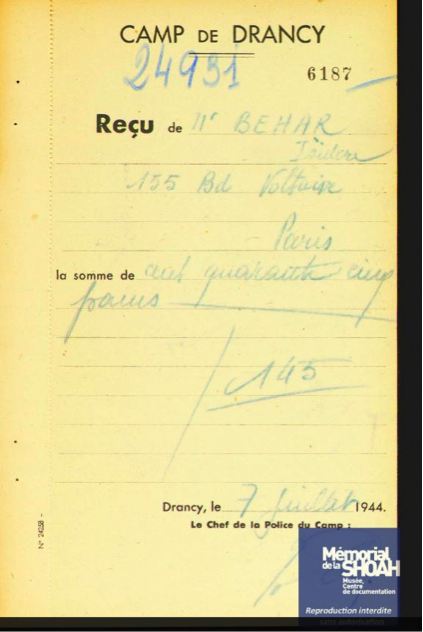
Isidore Behar’s search receipt from Drancy camp, dated July 7, 1944
©Shoah Memorial, Paris
Isidore Behar’s story is typical of that of many foreign Jews who had become French citizens but were nevertheless caught up in the turmoil of Nazi persecution in occupied France. The fact that he was arrested just a few weeks before Paris was liberated, highlights the brutality of the occupying forces’ desperate attempts at repression, even at the last minute.
Isidore remained in Drancy transit camp until July 31, 1944, when he was deported to Auschwitz on Convoy 77. He never came home.
Jacques Todolano, whose marriage Isidore witnessed on November 11, 1916, in the town hall of the 11th district of Paris, was also deported on Convoy 77[11]. The same was true of most of the Sephardic Jewish men (from Turkey or Thessaloniki) who were arrested along with him, including Isaac Mechoulam, Haïm Salti, and Salomon Passy.
Deportation to Auschwitz
After a horrific journey, during which he was crammed into one of the “bachelors’” cars, so called because men deported without their families were herded into cars that were even more heavily guarded than the rest of cattle cars, he arrived at Auschwitz during the night of August 2–3, 1944. Given his age, he was most likely sent straight to one of the waiting trucks that took the older, exhausted, and disabled, mothers with children, and all the other children, straight to their deaths in the gas chambers. There was a unusually large number of children on this particular convoy, as SS commandant Aloïs Brunner, who was in charge of Drancy camp, had expressly ordered that they be rounded up from the U.G.I.F. (Union Générale des Israélites de France, or General Union of French Jews) children’s homes in and around Paris.
Isidore Behar was almost certainly killed in the gas chambers soon after he arrived in Auschwitz, on August 3, 1944. After the war, however, the French government decided to use August 5, 1944, as the date of death for all Convoy 77 deportees if there was no further news of them.
The Second World War finally came to an end thirteen months after Isadore died.
After the war: official recognition of Isadore’s death
Isidore was reported missing shortly after he was arrested. His wife, Rachel, then submitted several formal requests for information in an effort to piece together what had become of him and ultimately to have his death officially recognized. She also requested that he be granted the status of “Political Deportee.” This was granted posthumously, and Rachel was issued with a deportee card in Isadore’s name. This entitled her to a so-called “military” allowance and the “lump-sum payment” awarded to deportees or their families. The sums involved were ridiculously small.
Isidore Behar was also officially recognized as having “Died for France”.
Rachel Behar, née Mizrahi, died on October 11, 1962. She is buried in the Jewish section of the Bagneux cemetery in Paris. Her sister Sol, the widow of Jacob (known as Jacques) Lemor, was present at her burial. Her son René, who was an inspector, died in Paris three years later, on June 9, 1965[12]. He too is buried in the Bagneux cemetery.
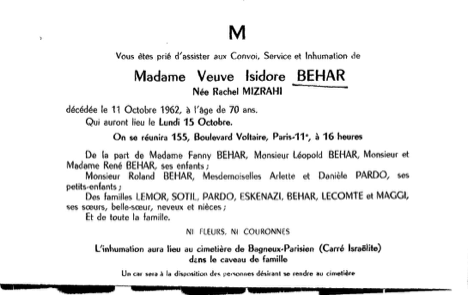
Rachel Behar’s funeral notice
Isidore Behar’s story is one of countless similar tragic tales that must never be forgotten. 1.1 million people perished in Auschwitz[13]. And even though information about some of the victims is extremely limited, it is essential to remember that every one of them was a human being with their own unique life story. These events have left an indelible stain on human history and continue to shape our world to this day. It is our duty to remember the courage of so many of these people. However, the lack of information available about many of the victims raises important questions: How did they feel at the time? How were they perceived? All we can do is reflect on survivors’ testimonies, both spoken and recorded, and written.
SOURCES
- Victims of Contemporary Conflicts Archives Division of the French Ministry of Defense Historical Service, in Caen, dossier 21 P 422 089.
- Paris Police Headquarters archives, ref. APP CC2
- French National archives, naturalization application, ref. BB/34/477, 25231 X 30; October 20, 1931.
- Shoah Memorial, Paris
- Geneanet and Filiae websites
Notes & references
[1] Louise Béhar married Nissim Sotil, an upholsterer who lived at 14 Rue Keller, on August 3, 1920, in the 11th district of Paris. He was born in Constantinople on April 18, 1892, and his parents were Isaac and Mazantou Dalva, who lived in Constantinople. (Act 2907, p. 27). She died in the Tenon Hospital in Paris on September 24, 1968, and was buried in the Pantin Cemetery. She lived at 20 rue Popincourt and was naturalized as a French citizen on January 22, 1928.
[2] We were unable to verify the Behar family’s address when René was born; the records are missing from the City of Paris online archives website.
[3] Véronique Chemla’s webpage in French “Les engagés volontaires Juifs étrangers dans les armées françaises durant les deux guerres mondiales”, (“Foreign Jewish Volunteers in the French Armed Forces During the Two World Wars”), published on May 12, 2022, about the exhibition about this subject at the Shoah Memorial in Paris.
[4] When Isidore declared his children to be French citizens.
[5] Having remarried in 1967, again in the 11th district of Paris, Fanny in Le Chesnay, in the Yvelines department of France, on September 24, 1994.
[6] Fanny and Moïse were divorced in 1951.
[7] French National archives, naturalization application, ref. BB/34/477, 25231 X 30; October 20, 1931.
[8] Leopold’s name is on List 35 of prisoners of war, published on October 23, 1940. He died on October 31, 2005, in the 12th district of Paris, the same district in which he was born.
[9] The 8th German order was issued on May 29, 1942, to take effect in the occupied zone on June 7, 1942. Jews had to wear the yellow star starting at “the age of 6.” The penalty for failing to wear it was imprisonment and a fine, or even “internment in a camp for Jews.”
[10] This would require further research in the French National Archives, but unfortunately we did not have time to do this. The provisional administrator was appointed by the SCAP (Service du Contrôle des Administrateurs Provisoires, or Office for the Supervision of Provisional Administrators set up by the Vichy government in December 1940. In June 1941, the SCAP became part of the CGQJ, (Commissariat Général aux Questions juives, or General Commissariat for Jewish Affairs), which was founded by the Vichy government on March 29, 1941, and controlled by the Germans. It was merged with the CGQJ’s Directorate of Financial Aryanization in May 1942, according to the CGQJ inventory at the National Archives (AJ 38).
[11] Many thanks to Colette Murat for finding this information. Jacques Todolano, who had lived at 106 Rue de la Roquette since 1911, was born in 1887 in Constantinople. He was interned at Drancy on July 26, 1944. Like Isidore, he was over 60 years old when he was deported, and never returned home. He worked for Renault, the French car manufacturer, and was rounded up in his home by the French police.
[12] René had been married to Gabrielle Maggi since January 5, 1950.
[13] According to estimates made in 1998 by Franciszek Piper, a historian at the Auschwitz-Birkenau Museum.