Français
 Polski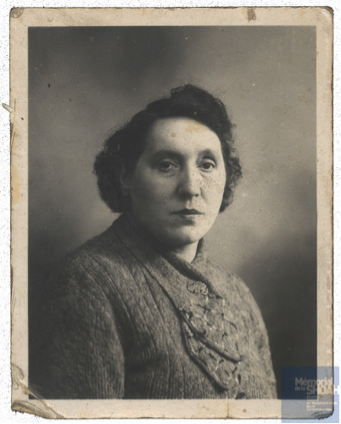
Berthe WAINFELD, née HOCHSTEIN (1902-1944)
Berthe Wainfeld © Shoah Memorial, Paris
This biography was written by students at the Goethe Gymnasium in Germersheim, Germany, under the guidance of Mr. Steul and with help from Laurence Klejman.
Berthe Wainfeld, née Hochstein, was born at 10 a.m. on July 12, 1902, in the 18th district of Paris.
Berthe’s parents and her many brother and sisters
Berthe’s parents were Isaac Hochstein[1] and Léa Kessler. She was their second child.
Isaac Hochstein was born in Brezna in “Russia”, (probably Berezne, now in Ukraine) on March 20, 1875. His parents were Wolf[2] and Feiga Hochstein. Léa Kessler was also born in Brezna, on July 3, 1876. Her parents were Haïm Kessler and Rébecca Kaplan.
We do not know why they decided to emigrate to France[3], nor whether they relocated to Paris as a couple or met after they arrived. We do know, however that were in the French capital by at least September 1897, when they were living at 4, impasse Barrier, in the Quinze-Vingt quarter, a poor area of the 12th district of the city. They then moved to another poor area, on the lower slopes of Montmartre hill, which, in time, became home to a significant Ashkenazi Jewish community. The family moved many times over the years.
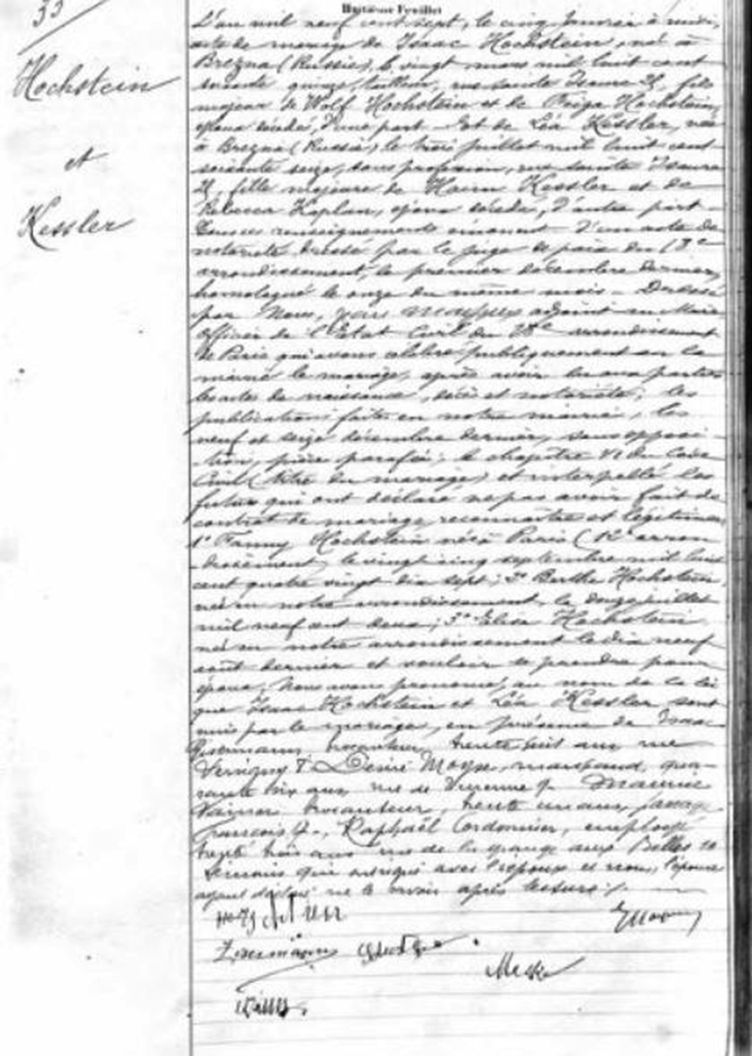
Isaac Hochstein and Lea Kessler’s marriage certificate
© Paris city archives, online
Isaac and Léa got married in Paris on January 5, 1907. They were then living at 25 Rue Sainte-Isaure, in the 18th district of Paris. They already had three daughters, who thus became legitimate: The eldest, Fanny, was born in the 12th district of Paris on September 25, 1897, then came Berthe, followed by Elisa, the youngest child born before they were married, who was born on August 19, 1906, also in the 18th district. (They also had another baby a girl named Louise, who was born on August 16, 1904, at her parents’ home at 4 rue Letort in the 18th district, but sadly she died when she was just 4 months old, on January 15, 1905, in the Bretonneau Hospital).
Not far away, at 13–15 Rue Sainte-Isaure, there was a prayer hall dating back to 1904, which Russian and Polish Jews often attended. In 1907, it became a synagogue[4]. Whether Isaac and Leah had a religious ceremony there, we do not know.
The family became naturalized French citizens on October 20, 1906. It is interesting to note that they gave all of their children, even the older ones, French first names.
In 1905, when little Louise died, Léa was working as a seamstress, and by 1907, when they got married, Isaac was a tailor and Léa was a stay at home mother. However, in 1912, when their sixth daughter (i.e. their seventh child), Germaine, was born in the 19th district, Isaac was a clothing merchant, most likely a secondhand clothes, and Léa was working with him, despite having been pregnant so many times. After she got married, Léa went on to have Marie, born in 1908 in the 18th district, then Henriette, born in 1909 (the family was living at 5 rue Charles-Robin in the 10th district at that point), and Paul, born in 1910 in the 19th district. After she had Germaine in 1912, she had two boys, Charles in 1913 and then Raymond in 1915, the final addition to this already large family. However, Raymond died when he was just 6 months old, reportedly in Charbonnières. Either the family must have left Paris during the war, or he was being cared for there by a wet nurse. Whatever the case, his body was brought back to Paris, where he was buried in the Bagneux cemetery on August 30, 1915.
In 1916, Berthe, her sisters, and her little brothers had to deal with yet another death in the family: their mother died on May 12 at the Pitié-Salpêtrière Hospital in the 13th district of Paris. She was buried in the Bagneux cemetery on May 15. Léa had not even turned 40 when she died, and Berthe was only 14.
In keeping with Jewish tradition, Isaac soon got married again. Six months later, on December 12, in the town hall of the 19th district of Paris, he married Rosa Leibovici, who was born in 1884 in Botosani[5] Romania. Rosa already had a son, who was born in 1906 in Romania. In 1917, Isaac and Rosa had another son together, who they named Albert[6].
According to their birth and death records, the family moved from the 18th to the 19th district, where they lived at 114 boulevard de la Villette.
We cannot say for certain if or where Berthe went to school, or for how long. However, we suppose that as one of the older children in such a large family, she would have had to do her share of household chores and help care for her brothers and sisters, especially as in 1917, her older sister, Fanny, married Salomon Bercovici and had a son of her own, Georges. Then in 1932, her younger sister, Marie, married Hermann Zissermann.
Berthe herself also left the family home in Argenteuil in 1923, when she got married.
Berthe married Joseph (known as Maurice) Wainfeld
On June 14, 1923, Berthe married Joseph Mendel (known as Maurice) Wainfeld in Argenteuil[7], about 8 miles northwest of Paris. Joseph Wainfeld was born in Warsaw, Poland on May 8, 1897. His parents were Mathis Wainfeld (an antiques dealer) and his wife, Sarah Federshloss.
Berthe did not go out to work: she stayed home to take care of the housework. Joseph worked in the printing industry. They lived at 176 Rue de Noisy in Bagnolet, a suburb east of Paris. Joseph-Mendel was naturalized as a French citizen on March 9, 1930.
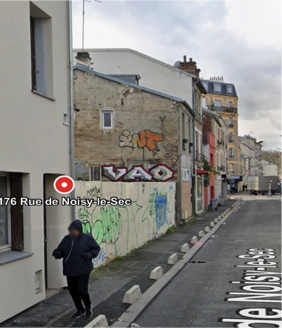
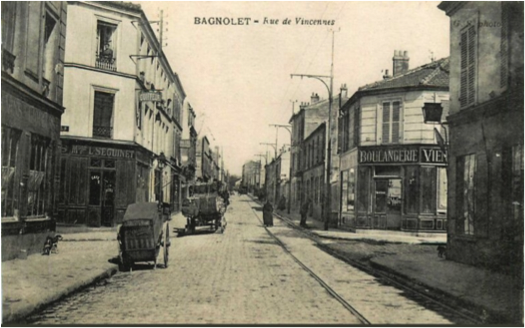
Rue de Noisy-le-Sec today / Bagnolet in the 19th century
Just under a year after they were married, on May 1924, Berthe gave birth to their son, Serge Paul Wainfeld, in the 11th district of Paris.
For the next sixteen years, the Wainfelds went about their lives as normal. Everything changed, however, in June 1940, when the Germans invaded Paris.
The war and deportation
We know nothing about Berthe’s life during the war and the German occupation, other than that she renewed her identity card on August 23, 1943, which implies that she must have registered herself as Jewish, as required by law, and had the word “Jew” stamp on her identity card (and also on her ration cards). Did she wear the yellow star sewn onto her clothes, on the left side of the chest? She must have, as not doing so would have meant she was at risk of being arrested, or even being sent straight to Drancy transit camp.
After four years of living under Nazi rule, on July 26, 1944, Berthe was arrested by the Gestapo, simply because she was Jewish. One of her neighbors, a Mr. Boricki, was arrested at the same time. Her husband was not home at the time, so narrowly escaped being arrested, but their son, Serge Paul Wainfeld, who lived at the same address, had no such luck.
Berthe was then taken to Drancy transit camp, where she was interned from July 26 to July 31, 1944. When she arrived there, she was assigned prisoner number 25,987.
At dawn on July 31, 1944, Berthe and 1305 other people were gathered together in a courtyard in Drancy. The crowd included elderly people, babies, children, and teenagers, many of whom who had been rounded up in U.G.I.F. homes in and around Paris. There were entire families among them, and many single adults. They were all then crammed into buses operated by the Paris public transport company, which shuttled back and forth between Drancy and the nearby Bobigny train station, where German soldiers with dogs herded them into cattle cars. Berthe spent three days and two nights locked in one of those cars, with no fresh air, very little water, hardly any food, and just one bucket for 60 people to use as a toilet. We do not know who she travelled with, nor do we know if she even survived the journey, terrified and in the intense heat. If she did, it is highly unlikely that she was sent into the Auschwitz camp to work; she was almost certainly killed the gas chambers, and her body burned in the crematoria.
Serge Paul Wainfeld, who was also deported on Convoy 77 on July 31, 1944, died on March 3, 1945 in Flossenbürg, Germany[8], after being selected to enter the Auschwitz camp to work and then being transferred to different camps, each as horrific as the last. He was both Jewish and a communist, and was only 20 years old. His fiancée, Jacqueline, whose father was deported to Mauthausen in 1943 and never came back, later became the second person to testify to Berthe having been deported[9].
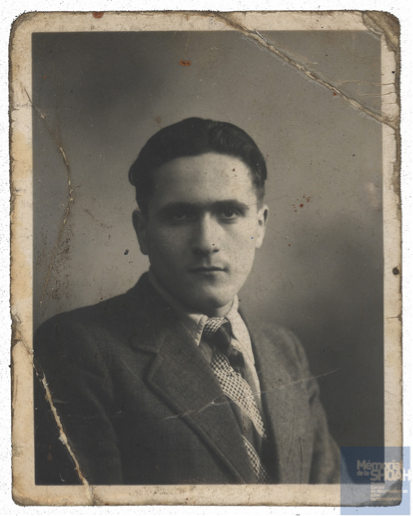
Serge Paul Wainfeld © Shoah Memorial, Paris
The process of obtaining official recognition of Berthe’s death:
“Maurice,” Berthe’s husband, having lost not only his wife but also his only son, had to face yet another ordeal: having their deaths officially recognized by the French authorities.
The fact that Berthe had been deported and had then disappeared was officially acknowledged and a certificate issued to that effect. However, it was not an actual death certificate, so her death could not be entered into the civil register at the local town hall. In accordance with Article 88 of the French Civil Code, a “certificate of disappearance”, was typically issued in cases where people were known to have been deported but it was impossible to determine what had become of them or when and where they had died.
Joseph Wainfeld requested a death certificate for his wife in order to obtain compensation for war-related losses, to which family members or surviving deportees were entitled after World War II. The death certificate had to be entered into the civil registry and then sent in as proof of the loss. The compensation was a small sum of money, known as a “pécule” and, in many cases, the granting of “Political Deportee” status for people who had been deported on grounds of their “race”, or “Deported Resistance Fighter” status for those who had been arrested for carrying out an act of resistance (provided that they had been on French territory on the eve of the declaration of war in 1939).
Only the parents, grandparents, children, or spouse of the deported person were eligible to apply for the payment and the Political Deportee card.
In order to obtain a death certificate, two witnesses who had direct knowledge of the deportation had to provide statements to that effect. In addition, if the deported person had been imprisoned prior to June 16, 1940, two additional statements had to be provided explaining why they could be perceived as a threat to the enemy. The person who submitted such a request also had to swear to tell the truth, to have never been convicted of crimes such as collaboration with the Nazis, and to be legally entitled to make it. Anyone caught giving false testimony could face imprisonment or a heavy fine.
Berthe’s husband began the process of having her officially recognized as having been a “Political Deportee” (which replaced the term “racial deportee”, which had been used during and just after the war) in April 1957. The first step involved requesting the death certificate and providing some basic information about her.
After he received Berthe’s death certificate, which confirmed that she had died in the camps, Maurice submitted several other documents needed to have her declared a Political Deportee. He had to send in their marriage certificate and family certificate, Berthe’s death certificate, a list of their children (only one in their case), and his birth certificate. In addition, he had to complete an official form including proof that Berthe did not provide a false name when she was arrested. The last forms he submitted provided information about the circumstances of her arrest and deportation.
After checking all the documents, Joseph filled out one last form, which he sent to the French government to ask that his wife be granted Political Deportee status. At long last, he received official confirmation that his request had been approved.
Berthe was posthumously recognized as a Political Deportee in 1958.
Berthe Wainfeld’s story, and the painstaking process that her husband went through to secure official recognition of what happened to her, are a testament to the difficulties families faced in gathering information about their loved ones after they were arrested and deported by the Nazis. This was largely due to the fact that the documents left behind after the war were unreliable, incomplete or in some cases even falsified. This poignant account serves as a stark reminder that such atrocities must never be allowed to happen again.
SOURCES
- Victims of Contemporary Conflicts Archives Division of the French Ministry of Defense Historical Service, in Caen, file on Berthe Wainfeld, dossier 21 P 548 862.
- City of Paris civil registry archives
- Geneanet and Filiae websites
Notes & references
[1] Isaac Hochstein died in 1950 in Argenteuil and was buried in a vault in the Bagneux cemetery in Paris on June 17 of that year.
[2] According to the Geneanet website, Isaac’s middle name was Hirsch, and his second name was his mother’s maiden name; her husband’s surname was Schuster. With no confirmation available, we can only say that Isaac’s father was called Wolf.
[3] Pogroms in Russia and Ukraine occurred frequently and were particularly violent in the late 19th century, which prompted large numbers of Jews to emigrate.
[4] The synagogue was rebuilt between 1937 and 1939 by the architects Germain Debré and Julien Hirsch. On the night of October 2–3, 1941, the building was attacked by Eugène Deloncle’s Revolutionary Social movement, a far-right organization. Its facade, in particular, was damaged. It reopened in the 1970s. The modern-looking concrete building, which belongs to the Jewish Consistory of Paris, was restored in 1994. The City of Paris authorities financed half of the restoration costs.
[5] Botosani is a city located about 60 miles northwest of Iasi.
[6] Albert died in Bagnolet on October 1, 1989.
[7] The Hochstein family appears to have been based in Argenteuil for quite some time. Elisa died there in 1987.
[8] x-resistance.polytechnique.org (PDF) The French in Flossenbürg. He was first transferred from Auschwitz to Sachsenhausen and from there to Flossenbürg on February 6, 1945.
[9] Victims of Contemporary Conflicts Archives Division of the French Ministry of Defense Historical Service, in Caen, file on Berthe Wainfeld, dossier 21 P 548 862.