Français
 Polski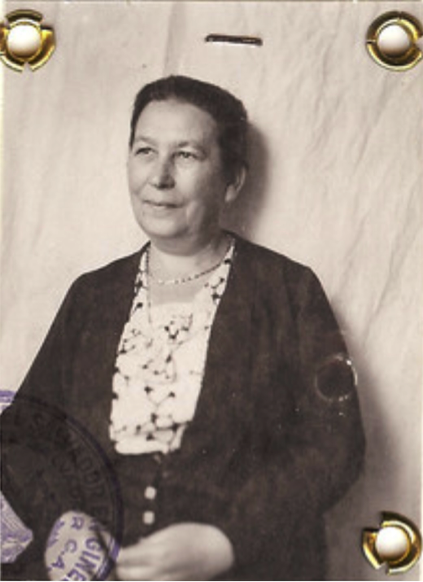
Adèle HUMMEL (épouse ERLENBACH), 1873-1944
Photo of Adèle Hummel on her citizenship certificate from the Republic of El Salvador, issued in 1942
© collections.ushmm.org
Birth and social background
Adèle Hummel was born on November 23, 1873 in Fürth, not far from Nuremberg in Bavaria, Germany. She came from a well-established Jewish family[1]. Her father, Simon Hummel (1834-1901), and her mother, Betty Schweizer (1843-1905), were both descended from local industrial families. Adele’s maternal grandfather, Abraham Schweizer, was a pioneer in the manufacture of steel eyeglass frames in Fürth. In 1840, he founded a toy manufacturing business called ASIF (short for Abraham Schweitzer in Fürth) and soon afterwards he began making eyeglass frames as well. The company continued to flourish as it was passed down through in the family[2][3]. In 1852, Abraham Schweizer recruited some craftsmen from France who specialized in optics and soon shifted from making handmade eyeglasses to industrial-scale production of metal frames[4]. In 1853 he went into partnership with a French man by the name of Buverier, and by the second half of the 19th century, the family business was exporting frames all over Europe[2]. When Abraham Schweitzer died in 1866, his wife and sons, Adele’s uncles Max and Albert, took over the running of the company. Simon Hummel, who had previously been a manufactured goods dealer, joined the management team in 1879.
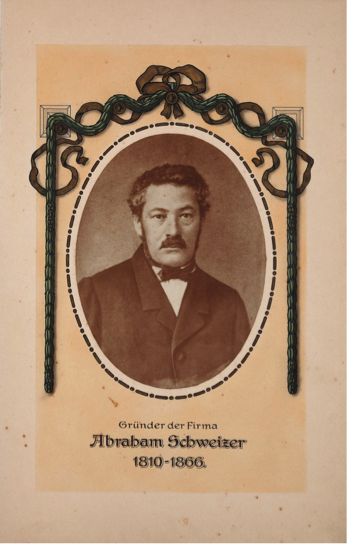
Abraham Schweitzer, Adèle Hummel’s maternal grandfather
www.schweizer-optik.com
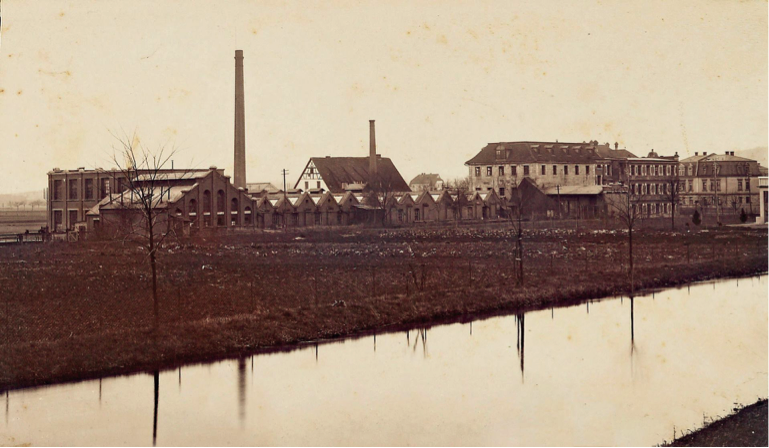
The Schweizer factory at Forchheim
© DR www.schweizer-optik.com
In the 1937, the company name was changed to Optische Fabrik A. Schweizer GmbH (A. Schweizer, optical manufacturer). It is still in business today[5].
Adèle grew up in a large family, with five brothers and one sister. The eldest, Max, was born on September 13, 1863. Next came Moritz (Maurice), who was deaf from birth and was born in 1865; followed by Abraham Adolf, born in 1868; then Theodor[1-1], born in 1871; and finally Robert Isidor, born in 1875. She also had a sister, Sigmunde, affectionately known as “Mundi,” who was born on September 6, 1872, and who married Oskar Ludwig Wulff, a merchant from Hamburg, on May 31, 1895, in the town hall of Fürth. We shall come back to her later on in our story.
We know very little about Adele’s childhood, other than that she lived in a very affluent environment and in a town, one of the few in Germany, if not in all of Europe, where Jews had always been treated well.
Fürth: a city where Jews were welcome
The Jewish community in Fürth, which had existed since the 15th century and had welcomed Jews who had been driven out of other parts of Germany, came to play a vital role in local economic, educational, and religious life. From businesses, stores and cafes (there were hundreds of them in the city), to banks, the Jews in Fürth were unusually well-integrated as compared to elsewhere in Europe. In 1719, the Reglement für Allgemeine Judenschafft (Regulations for the Jewish Community as a whole) ensured that, for a fee, the city’s Jews would be granted special rights in terms of religious freedom. Two Jewish delegates were appointed to the city council, but the Jewish community also had its own council, its own orphanage (the first in Germany) as well as its own hospital, elementary schools and high schools. Shortly after Adèle was born, there were four Jewish judges and eleven Jewish representatives on the city council.
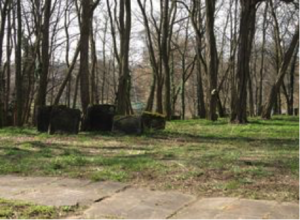
The old Jewish cemetery Fürth, dating back to 1607
www.loquis.com
Due to its dynamic cultural life and its distinguished scholars and rabbis, Fürth became known as “Franconian Jerusalem”[6]. Its prestigious yeshivas (religious schools) drew in Jewish students from all over Europe. The Altschul, built between 1617 and 1618, and Fürth’s grand Baroque synagogue, built in 1719, stand as symbols of the city’s religious and cultural energy. Three other synagogues, including one built in 1868, continued to welcome worshippers right up to the Second World War[7].
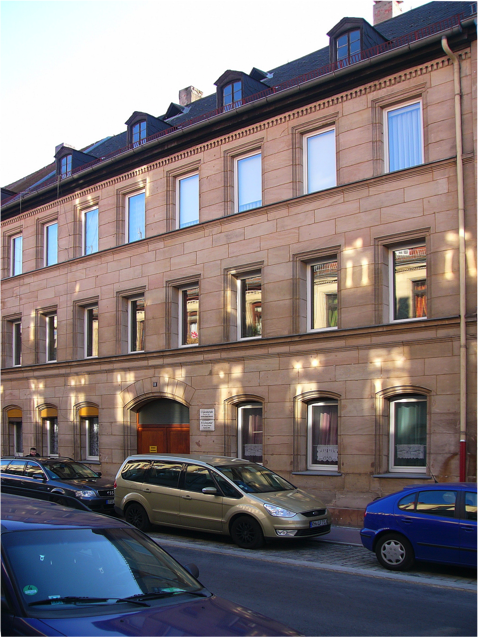
Rosenstraße 11, 90762 Fürth, Germany
© Wikipedia
Marriage and children
On June 10, 1900, Adèle Hummel married Arnold Erlenbach, a merchant born on March 4, 1868, in Fürth who specialized in Feingold und Blattmetall (high-grade gold and metal leaf)[8] and ran his own business in the city. The couple set up home at 11 Rosenstraße, right in the heart of Fürth[1].
Adèle and Arnold went on to have two children. The first, a boy named Ludwig, who was born on March 19, 1901, died when he was just a few weeks old, on April 23, 1901[9]. Some genealogical sources suggest, incorrectly, that Ludwig survived until 1955, but the civil registry records in Fürth confirm that he died as a baby.
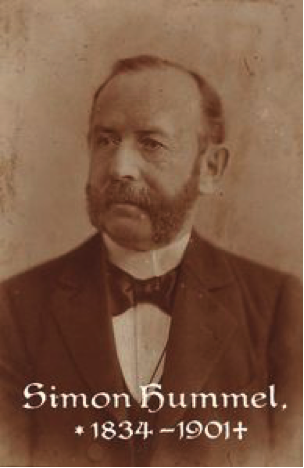
Simon Hummel, Adèle’s father
©DR. www.schweizer-optik.com
Stefan, their second son, was born on August 19, 1902[9]. In 1896, Adèle’s sister, Mundi, who had left Fürth and was living in Hamburg, also had a son called Ludwig[2-2].
In 1901, the same year that little Ludwig was born and died, Adèle lost her father, Simon. Four years later, on July 28, 1905 her mother Betty died[10]. On July 6, 1917, Adèle was struck by another tragedy, when her husband Arnold died: he was only 49 years old[3-3][8]. Suddenly widowed, Adèle was left to raise Stefan on her own. Then in 1928, her sister, who had been divorced in 1910, moved back to Fürth. Adèle remained actively involved in the Jewish community in Fürth between the wars; she attended social events and supported local charities.
The early days of the persecution
When Hitler and his Nazi party came to power in Germany on January 30, 1933, life for German Jews changed abruptly. The persecution began almost immediately, and over the first few months, Jewish businesses were boycotted, Jews were banned from working in numerous professions, as in the civil service, and more. An early Nazi decree even set out the criteria for determining who they viewed as “Jewish” or “non-Aryan.” The Nuremberg Laws, which were passed in September 1935, further increased the level of segregation: they prohibited marriage and sexual relationships between Jews and non-Jews, revoked Jews’ German citizenship (reducing them to “state subjects”) and paved the way for stripping Jews of their rights and confiscating their property[11].
In September 1933, Adèle’s sister Mundi went to visit her son, Ludwig Wulff, who at the time was in Milan, in Italy. She tried to have her passport validity extended from there.
Adèle was over sixty years old by then. She looked on, helpless, as her range of options gradually dwindled. The restrictions and threats against Jews grew worse with each passing year. She was still able to go abroad, however, at least for a short visit: in September 1937, she acquired a German passport* and set off for England to attend her nephew Sidney Hummel’s wedding in London on September 16, 1937[12]. Her stay in England reignited a spark of hope. While there, she met up with some of her family members who had managed to flee Germany: her brother Moritz Hummel, who had been deaf since birth, had taken refuge in London a few years earlier together with his wife, Emilie. He had managed to rebuild his life in Great Britain, safe from persecution, and his son Sidney had recently decided to start a family there[13]. After this short family get-together across the Channel, however, Adèle went back home to Germany.
*NB: There is currently no digitized copy of Adèle Erlenbach (Hummel)’s passport. However, a local source reveals that she applied for a passport to attend her nephew Sidney Hummel’s wedding in London on September 16, 1937, which confirms that she made a formal application, even though the passport itself unavailable.
The decision to leave Fürth and go into exile
In 1938, German Jews came under tremendous pressure. An example of this was the Nazi regime’s Reichsfluchtsteuer (Reich flight tax), which the Weimar Republic had introduced in 1931. Originally intended to prevent opponents of the regime from fleeing the country and taking their capital with them, it effectively became a means of stripping Jews of all their assets if they chose to leave Germany. Anyone who left the country without paying the tax had everything they owned confiscated and also became liable to prosecution for tax evasion[11].
Adèle Erlenbach finally decided that she had to leave Germany. On August 26, 1938, she officially registered herself an emigrant, paid the steep departure tax and then left Fürth for Milan[13]. She managed to flee Germany just in time: a few weeks later, on the night of November 9–10, 1938, pogroms swept across Germany in what became known as Kristallnacht. In Fürth, the great synagogue, built in 1719, and the caretaker’s house were set on fire and vandalized by Nazis from the German National Socialist Party. The Jewish orphanage was also set on fire. The fire department was ordered not to extinguish the burning buildings but merely to prevent the fire from spreading elsewhere in the town. The synagogue was burned to the ground[4-4]. On November 12, the Nazi regime fined German Jews a collective fine of a billion Reichsmarks as “compensation” for the damage caused during Kristallnacht. Adèle narrowly avoided both the pogroms and the fine, but living in exile in Italy by no means meant that she was safe…
Adèle’s escape route: from Italy, via Belgium, to France
Merano: a safe haven for Jews, at least for a while
As 1938 drew to an end, Adèle was in Italy. In November of that year, she was staying with her sister Mundi in Merano, a spa town in the South Tyrol[14], a region that had been part of Austria prior to the First World War. The town was home to a thriving Jewish community of 600 people, with a sanatorium for Jewish tuberculosis patients (among them artists such as Franz Kafka and some well-known scientists), and a number of kosher hotels. From 1933 to 1939, many Jews who faced persecution elsewhere in Europe sought refuge there. Schools were even built for their children.
Her son Stefan, who had still been living with her in 1936, also left Germany on August 26, 1938. He too went to Italy initially, where he worked as a sales clerk, but later moved to 22 Schmelzbergstraße in Zurich, Switzerland, where he lived safely for the rest of the war. Italy meanwhile, under Mussolini’s fascist regime, despite being less hostile to exiled German Jews at first, began passing its own anti-Semitic legislation on November 17, 1938. The situation deteriorated further when war broke out in 1939, which only increased the risks for Jews. Adèle left Italy soon afterwards. She left for Belgium first and then travelled on to France, as did many Jewish refugees from Germany in the early days of the war. We do not know how she was able to arrange to travel to France, nor exactly when she arrived, but the French National Security authorities opened a file on her soon after she arrived in the country. Like countless other displaced persons, Adèle had to travel far and wide and resort to various stratagems in her quest to find a safe haven. The question remains as to why she did not go to Switzerland with her son or why, at her age and all alone, she embarked on such a perilous journey. Whether she was interned early on in the war because she was German, in the Gurs camp or elsewhere in the south of France, remains unclear.
The Free Zone and living in hiding
When the Germans defeated the French and Hitler’s army invaded France, Adèle was in the non-occupied zone in the southern half of the country (also known as the Free Zone). She was staying in Saint-Paul-de-Fenouillet, in the Pyrénées-Orientales department of France, which had become home to a number of foreign Jews, mainly from Germany. Saint-Paul-de-Fenouillet was a small industrial town where the working-class population, partly made up of immigrant workers, had previously shown their solidarity with Spanish Republican refugees, particularly during the Retirada. There were 27 Jewish refugees registered in the village in June 1941; some of them had already spent time in nearby detention camps such as Saint-Cyprien, Gurs and Rivesaltes. Although the Vichy regime, rather than the Nazis, governed the so-called Free Zone, the Jews were still in danger.
On August 26, 1942, in the wake of the notorious Vel’ d’Hiv’ roundup in Paris and during an operation aimed at rounding up foreign Jews from all over the department, a group of French gendarmes (military police) arrested eight foreign Jews who were living in Saint-Paul-de-Fenouillet[5-5] and took them to the Rivesaltes internment camp[6-6]. Adèle only narrowly missed being captured in. However, Johanna Buxbaum Kazda and Henrich Schuloff were not so lucky. Adèle was subsequently deported on the same transport as them.
Citizenship of El Salvador
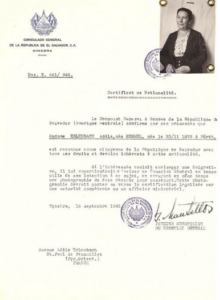
©United States Holocaust Memorial Museum
On September 16, 1942, the Consul of the Republic of El Salvador in Geneva wrote to Adèle at her address in Saint-Paul-de-Fenouillet enclosing a certificate confirming that she was an El Salvadorian national (this is where we found the photo of her). We do not know if or when she requested it, but the application was well-timed. The certificate should have been enough to guarantee her safety, given that El Salvador was a neutral country.
Her son in Zurich may well have applied for the certificate on her behalf, as he would surely have been aware of the determined efforts of the First Secretary to the Consul of El Salvador in Geneva, George Mandel-Mantello (1903–1992), whose birth name was Gyorgy Mandl. Born into a wealthy Orthodox Jewish family in the city of Bistrita, Transylvania, he was a businessman who was later made the Honorary Consul of the Republic of El Salvador, covering Romania, Czechoslovakia, and Hungary. According to the United States Holocaust Memorial Museum [7-7], as of 1939, “he issued thousands of Salvadoran citizenship documents to Jewish refugees in Nazi-occupied Europe between 1942 and 1944.” In August 1942, Consul General Colonel Jose Arturo Castellanos arranged for a position to be created specifically for George in Switzerland. Despite the thousands of requests that poured in through organizations and private individuals, it did not take him long to respond in Adele’s case!
In November 1942, when the German army invaded and occupied the rest of France, thus putting an end to the Free Zone, the hunt for Jews intensified. Many more Jews were arrested in Saint-Paul-de-Fenouillet over the next few months. The French gendarmerie then took them to Drancy transit camp, north of Paris, after which they were deported to Auschwitz. Adèle, meanwhile, somehow managed to evade arrest for several months. Did the certificate of El Salvadorian nationality play its intended role of keeping her safe, or did she go into hiding?
Eventually, in June 1944, despite her El Salvadorian “citizenship” Adèle Erlenbach was arrested, (we believe somewhere near Perpignan), most likely during a roundup carried out by the German occupiers or the French Militia. The exact circumstances surrounding her arrest are unclear, but it appears that she was arrested along with two other Jews and subsequently transferred to Paris. On the same day, along with the Kazda and Schuloff couple mentioned above, Henri Levin and Hilde Sternhell were also sent to Paris. They were all deported on the same transport on July 31, 1944.
Drancy, Convoy 77 and Auschwitz
After she was arrested, Adèle was interned in the Drancy camp, north of Paris—a grim transit camp used to hold Jews arrested in France until they were deported. The Drancy records show that Adèle Erlenbach entered the camp on July 2, 1944, and was assigned the registration number 24,687. The Allies were advancing rapidly towards Paris, and the rail lines were being bombed relentlessly, but the head of the Drancy camp, SS officer Aloïs Brunner, was nevertheless determined to continue deporting as many Jews as possible. They included people already interned at the camp, others rounded up on the streets and a large number of children staying in U.G.I.F. (Union Générale des Israélites de France, or General Union of French Jews) children’s homes in and around Paris. On June 30, shortly before Adèle arrived at Drancy, a convoy of 1100 people, including 161 children, had left the camp. Adèle was to be deported on the next convoy, which scheduled to leave at the end of the month[8-8].
On July 31, 1944, Adèle was taken to Bobigny station and loaded onto a train (which later became known as Convoy 77) bound for Auschwitz-Birkenau[15]. There were 1,306 people on board the train, which was the last major convoy of Jews to leave occupied France. The youngest deportee was just two weeks old (he was born in Drancy), and the oldest was over 80. The travelling conditions were appalling: crammed 60 to a cattle car, with no space, barely any water or food, and in the stifling heat of summer, many of the deportees (in particular those who were sick or very old) did not even survive the three-day journey, and others went crazy.
We do not know what became of Adèle. Even if she managed to hold out until the train arrived at Auschwitz on the night of August 3-4 1944, she was 70 years old by then, and at that age, she would surely have been sent to her death in the gas chambers.
There are no records to confirm either that she survived or that she died. The names of the deportees who were sent straight to the gas chambers and their bodies burned in the Auschwitz crematoria were not listed anywhere. Only those who were detained to work in the camp and had numbers tattooed on their arms were recorded in the register of what one of the surviving deportees from Convoy 77, Régine Jacubert, later described in her book as the “death factory.”
The records list Adèle Erlenbach as verschollen (“missing”) in Auschwitz. There is no grave with her name on it, as her body was never found. The person from Fürth who later wrote her obituary noted that “the grave set aside for her, beside that of her husband, still lies empty.”
Family and legacy
Adèle Erlenbach’s story highlights just how cruel violent the years 1930–1945 really were. Her family did not escape unscathed either. Her older sister, Sigmunde Wulff, who went into exile with her in Italy in 1938, also perished in the Holocaust (she is listed as a victim of Nazi persecution in the archives in Fürth)[16].
Her brother Theodor’s wife, son Walter Simon (born in 1907), and daughter Elsbeth were all deported from Nuremberg, destined never to return.
By contrast, Stefan Erlenbach, Adèle’s son, survived the war by taking refuge in Switzerland. His name is listed in the post-1945 restitution records as Adèle’s legal beneficiary and heir to the family home at 11 Rosenstraße, in Fürth[17][18]. Adèle’s house, which had stood empty during the war, was officially transferred to her son: in the words of one witness, “a tangible yet visible absence.” Stefan Erlenbach died in 1995, after making sure that memories of his family were kept alive.
Commemoration
Adèle Hummel Erlenbach’s name is listed in the German Bundesarchiv’s Gedenkbuch (Book of Remembrance), the memorial database documenting Jewish Holocaust victims originally from Germany. Her name is also inscribed on the Wall of Names at the Shoah Memorial in Paris, under the year 1944, among those of some 76,000 other Jews deported from France.
In her hometown of Fürth, her story is part of the broader history of a once-thriving Jewish community (the so-called “Franconian Jerusalem”), which was almost entirely annihilated by the Nazis after 1938[19].
That, then, is how Adèle Hummel Erlenbach’s life unfolded, from each event to the next. A brief yet accurate biography, patiently pieced together despite gaps in the historical record, it reflects the destiny of not just one woman, but a family, a community and a town, caught up in the tragedy of Jewish genocide in Europe. Adèle Hummel’s legacy lives on today in records, memorial stones and engraved names, and indeed in the hearts of all those who keep her story alive.
SOURCES
- Archives from Fürth and from Merano, “Jüdisch in Fürth” database[8][13],
- FürthWiki (list of Holocaust victims from Fürth)[1],
- Shoah Memorial, Paris
- Genealogical websites (Geni, Ancestry),
- Various historical publications on the Jewish community in Fürth and on the Holocaust
Notes & references
[1] Fürther Opfer der Shoah/E (Victims of the Shoah from Fürth) – FürthWiki www.fuerthwiki.de
[2] History | Schweizer Optik www.schweizer-optik.com
[3] www.optik-akademie.com
[4] [5] History | Schweizer Optik www.schweizer-optik.com
[6] [7] 15 Fascinating Facts About Fürth: Exploring the Heart of Franconia – Explorial.com
[8] [9] [10] [12] [13] [14] Personen – Jüdisch in Fürth (People – Jews in Fürth)
juedisch-in-fuerth.repositorium.gf-franken.de
[11] Capital control — Wikipédia wikipedia.org
[12] [13] [14] Personen – Jüdisch in Fürth – (People – Jews in Fürth)
juedisch-in-fuerth.repositorium.gf-franken.de
[15] The deportees – Commemoration – July 31, 1944 Convoy 77 website
[16] Personen – Jüdisch in Fürth (People – Jews in Fürth) juedisch-in-fuerth.repositorium.gf-franken.de
[17] [18] Fürth, Rosenstr. 11, Wohnhaus; Georg u. Anna Bruder; ehem. jüd. Eigentümer: Ernst u. Stefan Erlenbach – Deutsche Digitale Bibliothek www.deutsche-digitale-bibliothek.de : Status of Confiscated Jewish Property and Restitutions in Fürth.
[19] 15 Fascinating Facts About Fürth: Exploring the Heart of Franconia – Explorial.com
[1-1] Theodor, an engineer, factory owner, and partner at the Schweizer company, married Rosa Merzbacher on March 25, 1906. They had a daughter named Elsbeth Friederike and a son named Walter Simon.
[2-2] Ludwig Wulff had a son named Eric, who testified for the biographical entry about his grandmother, Sigmunde, juedisch-in-fuerth.repositorium.gf-franken.de
[3-3] Over the next five years, at least four of Arnold’s siblings died. One of his sisters died in the Theresienstadt ghetto in occupied Czechoslovakia, and another died in Palestine in 1942.
[4-4] nazicrimesatlas.org
[5-5] Cf https://66.pcf.fr “Les étrangers à Saint-Paul-de-Fenouillet (1939-1944). Entre répression officielle et solidarité de la population”, conférence de Georges Senlis, site internet du PCF, Fédération des Pyrénées-Orientales, 23 août 2022 (“Foreigners in Saint-Paul-de-Fenouillet (1939–1944): Between Official Repression and Solidarity from the Local Population,” lecture by Georges Senlis, PCF website, Pyrénées-Orientales Federation, August 23, 2022.)
[6-6] Between August 11 and 26, 1942, more than 700 foreign Jews were arrested in the Pyrénées-Orientales department and transferred to Drancy transit camp. Cf Alexandre Doulut, Les Juifs au camp de Rivesaltes : internement et déportation (1941-1942), Lienart éditions – 2014.
[7-7] Although George Mantello was a diplomat, he was arrested in Hungary. The original certificates were kept in Switzerland, and in 2009, his son Enrico donated more than 1,000 of them to the United States Holocaust Memorial Museum. Adele Hummel Erlenbach’s certificate was among them. The USHMM website says of him “In addition to issuing citizenship certificates, Mandel-Mantello went to great lengths to disseminate reports on the massacre of European Jews after he was given a copy of the Auschwitz Protocols by the head of the Palestinian office in Budapest in early June 1944. These were detailed reports on the massacres carried out in Auschwitz, based on information provided by prisoners who had escaped from the camp in the spring of 1944, as well as reports on the deportation of Hungarian Jews.” According to The Times of Israel issue of May 17, 2016, Consul Castellanos saved more than 25,000 Jews through “Operation Salvador.” The film The Rescue is dedicated to him. He was named Righteous Among the Nations in 2010.
[8-8] A convoy of 257 people left Drancy for Bergen-Belsen on July 23. It was mainly made up of prisoners’ wives and children (77), but also included a few “prominent figures” such as the former Minister of Merchant Marine and mayor of Le Havre, Léon Meyer, who, although he was 75 years old at the time, survived.