Français
 Polski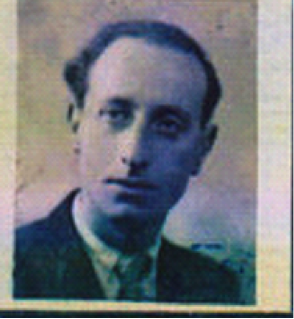
Léon LEVY-BULTINET
Léon Albert Yvan Bultinet Levy © blog by Marcel Martine Argoyti.
The 1939-1945 war. Resistance fighters deported from Hendaye[1].
The research on which Léon Lévy’s biography is based was undertaken by a group of 9th-grade students from the Jules-Verne secondary school in Carcassonne, in the Aude department of France. However, rather than simply publishing the results of their research, the students opted to share their thought process and their insights as they explored records from the French civil registry and from the French Ministry of Defense Historical Service archives, and thus to offer readers the opportunity to follow every step of their investigation, with all its joys and disappointments.
There were many surprises in store for the students, and Léon Lévy’s life story raised yet more intriguing questions. More information can be found in the notes at the end of the biography.
The soundtracks of the videos below include the students’ discussions, in French, exactly as they took place. It is not possible to translate them into English word-for-word, but what follows conveys the substance of their conversation.
Here is what we currently know about Léon Albert Bultinet Lévy, who was born to French parents in Constantine, Algeria, and died at the age of 34 in an extermination camp in Germany, simply because he was born Jewish.
Introduction
Lohen: Hello… Are you daydreaming, Mélie?
Mélie: Err, no, sorry, I was just thinking!
“Every death is a mystery because life itself is a mystery.”
Lohen: What a philosopher!
Mélie: Ha, no! It’s a quote by Jean d’Ormesson, a French scholar and philosopher (1925–2017).
Lohen: But the teacher isn’t asking us to look up quotes—we’re supposed to be looking through the Convoy 77 archives!
Mélie: I know, Lohen! Thanks alot! But Léon Levy’s life story is so mysterious that I’m looking up quotes as I’m thinking about it.
1 – Investigating Léon’s birth
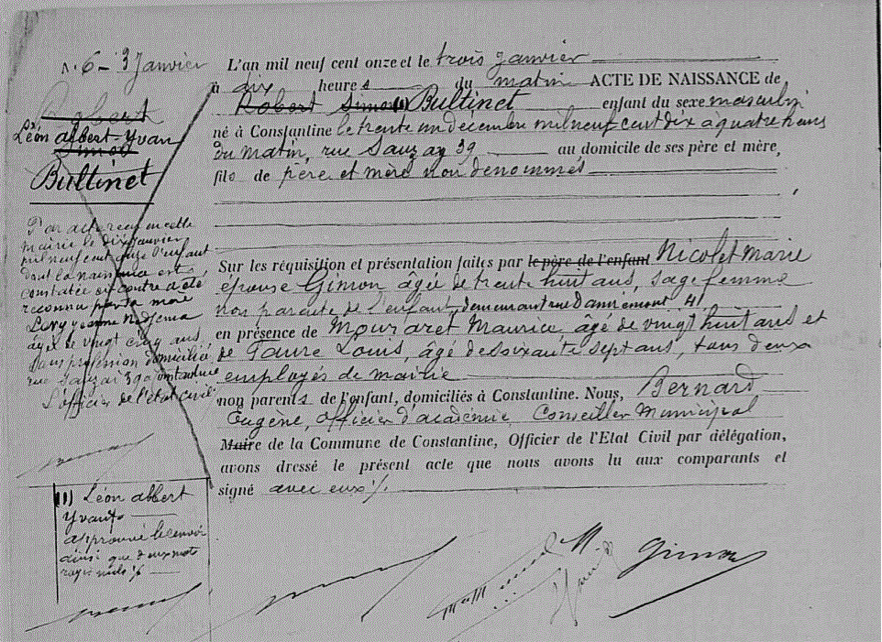
Léon Bultinet Levy’s birth certificate, dated January 3, 1911, stating that he was born on December 31, 1910, in Constantine, Algeria © ANOM[2]
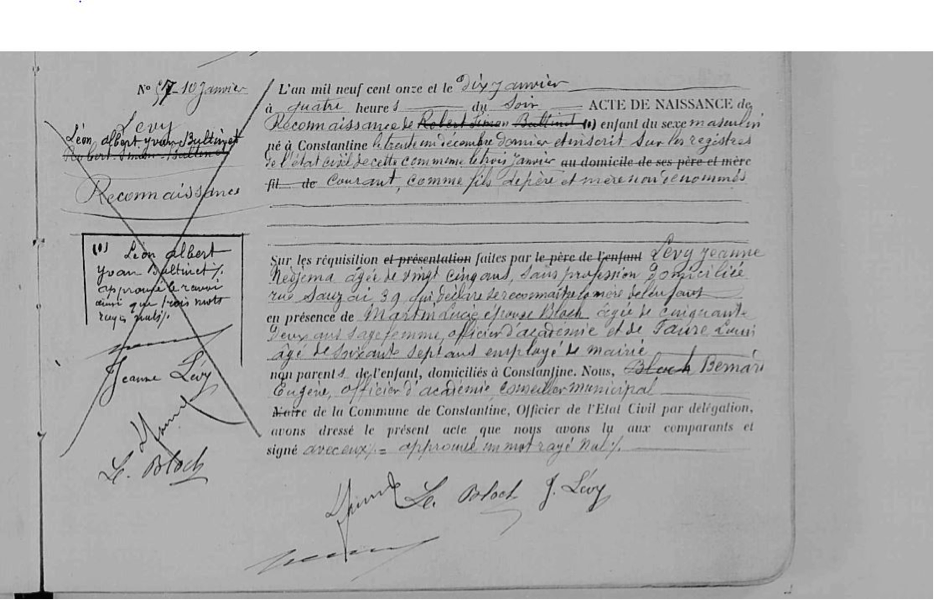
Declaration made by Jeanne Lévy to acknowledge that Léon Bultinet Lévy was her son, dated January 10, 1911© ANOM
Mélie: Léon Albert Yvan Bultinet Lévy’s life was shrouded in mystery. From the moment he was born to the day he died, so many aspects of his life are unclear. He was born at 4:00 a.m. on December 31, 1910, but the birth was registered, on January 3, 1911, by “midwife Marie Nicolet, married name Gimon, unrelated to the child” [3]. She registered him under the name of Robert Simon Bultinet, “father and mother not named”.
Lohen: But why did the midwife register the birth[4]? Is it not up to the parents to do that?
Mélie: You see, there’s the first mystery! A few days later, on January 10,1911, his mother officially acknowleged him as her child, but under the name Léon Albert Yvan Bultinet Lévy. However, he used the name Léon Bultinet or Léon Levy Bultinet all his life.
Lohen: Do we know at least know where he was born?
Mélie: Yes, he came into the world at his mothers home at 39 rue Sauzay, in Constantine, Algéria.
Lohen: Were there Jews[5] in Algeria then?
Mélie: I don’t know… ask the teacher!
Lohen: Teacher! Were there Jews in Algeria?
The teacher: Absolutely. It’s a fascinating and complex subject. There’s evidence of a Jewish presence in Algeria dating back to ancient times. The Jews first settled in North Africa after the First Temple in Jerusalem was destroyed in the 6th century B.C.; their communities were scattered across various places, such as Timgad and Hippo (in present-day Algeria), and Carthage (in Tunisia). In the Middle Ages, when North Africa was ruled by Muslims, Jews were granted a form of protected status: they were tolerated even though they were not Muslim, but were subject to various taxes and restrictions. They did, however, benefit from some religious freedom.
Inès: The two religions lived side by side, in peace!
The teacher: There were difficult periods, but in general the Jews were well-accepted. Later on, under the Ottoman Empire (beginning in 1671), Jews in Algeria lived in similar circumstances to those found in many other Jewish communities throughout the Muslim world. They were generally well-integrated into mainstream society, at least in all the major cities in Algeria, including Constantine. They worked mainly in business, skilled trades, and the financial sector. They were relatively free, although they still had to live under the dhimmi system.
Inès: What does dhimma mean?
The teacher: I mentioned this earlier: dhimma[6] was the “protected” status granted to Jews and Christians. However, a major turning point took place for the Jews in Algeria when the French began colonizing the country in 1830. Initially, Jews were treated better than Muslims in some ways, primarily because the French authorities viewed them as allies. Then in 1870, under the terms of the Crémieux decree, they were granted French nationality. As such, they had the same rights as all other French citizens, which inevitably caused friction between Jews and Muslims[7]. Many Algerian Jews developed closer ties with France as a result, while the Muslim population saw it as a form of discrimination.
Julia: Perhaps Léon encountered this kind of friction? That would explain why he moved to France.
Ndeye: Or maybe he simply got a job at the PTT (Post, Telegraph and Telecommunications service) in France?
Inès: And now? Are there still Jews in Algeria these days?
The teacher: Sadly, the Jewish community in Algeria is almost non-existent now. Some Jews still live there, most of them descendants of the people who left back then, but there are very few of them. That said, there are still some synagogues and Jewish cemeteries in the country, although many of them have been neglected or abandoned. The history of the Jews of Algeria remains an important aspect of the nation’s social and cultural history. Now, please carry on with your research, so we can get on with writing the biography…
Lohen: I don’t dare ask the teacher just yet, but Lévy is a Jewish name, isn’t it??
This begs the question: was Léon a member of the Jewish community, or not? On Léon’s birth certificate, it looks as if his mother Jeanne’s married name was Levy, an old Jewish name[8], so we initially thought that his father, who is not named on the birth certificate, must have been Jewish. We then thought it said her name was Jeanne Levy, née Jema, whereas it actually says Jeanne Néojema Levy. It turns out that she was not married after all, so in fact Léon bore her maiden name, Lévy[9].
Ndeye: Don’t forget that “Jewish” is not a nationality! Léon was French.
Inès: Absolutely, Algeria was French back then…
2 – Léon’s arrival in mainland France
Lylia: I don’t get this at all! I thought he was arrested in France, not in Constantine!
Ndeye: He was indeed arrested in France. I haven’t found any record of why or when he arrived in the country, but we can assume he came either for work or to escape the political unrest in Algeria[10] as I was just discussing with the teacher. You’re not listening, Lylia!
Lylia: I get it now!!! So Léon moved to Paris. When did he leave Constantine? Yet another unresolved question!
Julia: I have a declaration made by his wife!
Ndeye: Is there a marriage certificate[11]?
Julia: If only! It would make our research so much easier! A few years’ worth of civil registry records are missing from the Compiègne archives. They were destroyed in a fire in 1940. Although they have been partially reconstructed, they can only be viewed in the reading room in Beauvais.
Ndeye: It really is complicated!
Julia: All we know is that he married a woman called Madeleine Ciret[12], and before they got married, they had a son, Serge Roger Albert, who was born on November 15, 1931, in the 6th district of Paris!
Lylia: Maybe his wife’s family didn’t want them to get married because he was Jewish?
Julia: Yes another mystery! I only have his wife’s birth certificate; she was born at 3:00 a.m. on July 14, 1914, in Vierzon-Villages, in central France. The copy of the marriage certificate states that she married Léon Bultinet Levy in Compiègne on April 18, 1932.
Ndeye: The certificate states that they were living at 34 Rue Custine in the 18th district of Paris[13].
Julia: Léon worked for the PTT (Postes, Téléphones et Télécommunications, the predecessor of the French postal service, La Poste); he appears to have led a pretty ordinary life… until events took a dramatic turn!
3 – Arrest and deportation
Lylia: What do you mean by events, Julia?
Julia: The Second World War of course! Léon was victim right from the start. As he was Jewish, he lost his job at the PTT.
Lylia: But why did he lose his job? I don’t remember exactly what happened in France in 1940…
Lohen: In May 1940, Nazi Germany attacked France[14], and won. Marshall Philippe Pétain signed the armistice with Germany and took over the country on July 10. This marked the beginning of a dark chapter for the Jews. Philippe Pétain’s new government passed two decrees on the status of the Jews.
Lylia: What were the decrees all about? What was their intended purpose??
Lohen: The first, dated October 3, 1940, was published in the Journal officiel (the French Official Gazette) on October 18, 1940. It was drafted by Raphaël Alibert, the Minister of Justice and Marcel Peyrouton, the Minister of the Interior[15]. It was the first legislation in France to formally define who belonged to the “Jewish race” and represented in no uncertain terms the beginning of state-sanctioned antisemitism. Jews were banned from working in a wide range of professions, such as the civil service, the legal profession, and in education. In France, where there was previously nothing to distinguish Jews from their non-Jewish fellow citizens, this decree fundamentally challenged Jews’ place in French society, which had remained unchanged since the Constitution was first written in 1791[16].
Lylia: It must have been terrible for folks to lose their jobs like that and be ostracized from the rest of society!
Lizi: Sadly, Léon’s troubles were not over! In 1944, as the war was already drawing to a close[17], the situation took a turn for the worse. At 9:00 a.m. on July 10, the Gestapo arrived at his home and arrested him[18] in connection with “an act of resistance”.
Sherine: The circumstances surrounding his arrest are unclear. We have a written statement from his wife, Madeleine Andrée Ciret, who submitted a request for information to the Ministry of Veterans and War Victims, in which she states that her husband was arrested on grounds of his “race” rather than for engaging any resistance activity.
Lizi: It says that the Gestapo arrested him for resistance activities, but I wouldn’t be surprised if that were just a pretext to avoid openly admitting that it was racial discrimination!
Sherine: Wait! I have another document in which Madeleine stated that he was reported by a Corsican man by the name of Crossini and that he was undoubtedly working with the Resistance.
Lizi: I think Madeleine must have investigated so thoroughly that she was able to find out more details about her husband’s arrest. Also, according to a map of Paris during the Occupation, the place where Léon is said to have been taken, a Gestapo building at 11 rue Cambacérès[19], which is not far from La Madeleine church.
Lylia: What happened to him after that?
Lilou: On July 11, he was transferred to the Paris Police Headquarters and from there, as evidenced by his internment record, to the sadly infamous Drancy camp, where he was assigned prisoner number 25,020. He was then deported to Auschwitz on July 31, 1944; he is on the Convoy 77 deportation list that was put together after the war. His registration number in Auschwitz was B-3848.
Lylia: Are we sure he’s dead?
Shérine: Absolutely! Otherwise, he would have gone home to his wife. Just think of all the different government departments that Madeleine contacted when she was trying to find out what had happened to him! The Seine Court even filed a request for a search to be carried out in Switzerland!
Lizi: She put so much effort into it, and yet there are still some unanswered questions…! What a courageous woman! What perseverance!
Lilou: I have a letter from the Minister of Veterans and War Victims addressed to the Public Prosecutor of the Court in Bayonne, which explains how the date of death of Levy Léon Albert was arrived at, given that he had not arrived back from the camps by July 1, 1946. In accordance with legislation dated April 30, 1946, it was suggested that the date of death be declared as August 5, 1944, that being five days after he left Drancy internment camp.
Lilya: But are we sure that he was exterminated as soon as he arrived in Auschwitz?
Lizi: At the end of one document, I see there’s a note written by Madeleine in May 1946, in which she says she was told that her husband had been killed on the road somewhere in France and his body thrown into lime[20]! How awful!
Shérine: And I have a letter from the Seine Prefecture dated January 1949 stating that he died in Drancy camp! But this is clearly incorrect, because we have proof that he arrived in Auschwitz!
Lizi: Whatever happened, his wife applied to have him officially honored as having “Died for France”[21].
Lylia: Did she get a reply?
Sherine: According to this record dated April 11, 1949, the Ministry of Veterans Affairs requested that the words “Died for France” be added to the death certificate of Léon Albert Yvan Vultinet (this is the name, albeit incorrect, that was recorded on his death certificate and entered into the civil registry in the 18th district of Paris). This was done on May 7, 1949.
Lilou: All this paperwork took such a long time; Madeleine did not receive notification that Léon had been granted the status of “political deportee”, which entitled her to a “compensation” payment, until 1955[22]! She had filed the request on November 29, 1954!
Shérine: She also received a payment of 18,000 francs[23].
Lylia: I don’t think such a small amount of money would have brought her much solace for the loss of her husband, but I suppose it was better than nothing.
Lilou: This story is steeped in mystery and full of twists and turns …
Shérine: And there are still a lot more surprises in store!
4 – Léon’s death
Karima: Yet another mystery! I still have no idea where he died—in Drancy, on the train, or in Auschwitz?
Mélie: He died in the infirmary in his Kommando, which was attached to the Echterdingen camp, at 8:20 a.m. on March 1, 1945, according to the Struthof camp death register[24] in which he is listed as number 1611.
Lilou: What a horrific end!
Karima: I’m totally confused now — isn’t this supposed to be about Convoy 77 to Auschwitz?
Inès: It’s complicated; the records show that not all deportees sent to Auschwitz actually died there, as some were selected to work in other camps. This must have been what happened to Léon.
Karima: Do we know which camps he was sent to?
Mélie: According to the various records relating to Convoy 77, Léon probably passed through at least five camps after Drancy: Auschwitz, Stutthof, Natzweiler-Struthof, Echterdingen, and Vaihingen-sur-l’Enz. However, according to the International Tracing Service in Bad Arolsen, the only things we know for certain are that he was held at Auschwitz and Natzweiler (where his prisoner number was 43,175) and that he was sent to a work in a Kommando attached to Echterdingen.
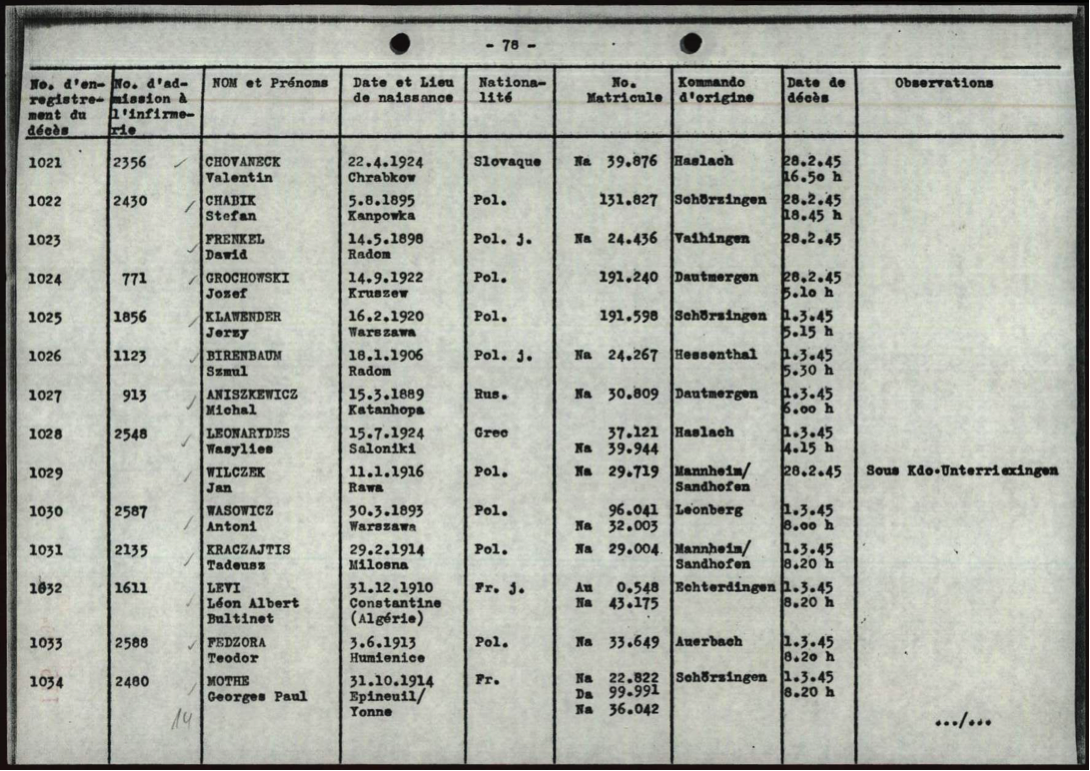
ITS. Bad Arolsen
Karima: Oh the poor man, what he went through! Have you done any research on the Kommando and the various Struthof camps?
Ines: The Struthof camp was a Nazi concentration camp opened in 1941 in the Alsace region, which had been annexed by Germany. His Kommando in Echterdingen was a forced-labor unit in Nazi Germany, where prisoners were forced to undertake specific types of work, often away from the main concentration camp.
Karima: What happened to them all?
Lilou: I don’t know! I’m not a teacher! Teacher, please can you explain it?
The teacher: Of the 1,306 people deported on Convoy 77 who arrived at Auschwitz alive, more than half[25], including young children, were sent to the gas chambers immediately. 291 men and 183 women were selected to enter the camp to work. On October 26, 1944, at least 75 of the men were sent to the Stutthof concentration camp near Gdańsk, Poland, from where, in November 1944, they were transferred to satellite camps at Hailfingen/Tailfingen, Echterdingen, and Dautmergen (Schömberg) in Germany. Some were then transferred to Vaihingen-sur-l’Enz, a camp for those who were sick or dying, and a few were transferred to Bergen-Belsen[26].
Inès: Thank you. We’ll carry on with our research now. Karima, where were some of the camps located?
Karima: Drancy camp, north-east of Paris in the town of the same name, was founded by the Germans in August 1941 to intern more than 4,200 Jewish men arrested in Paris. By the summer of 1942, it had become the main transit camp for Jews who were to be deported from France[27].
Inès: And what about Auschwitz, where they were deported?
Lilou: Auschwitz is the most well-known of all the camps! It was in Poland, near the city of Krakow. It was the Third Reich’s largest concentration camp complex, used as “a concentration camp, a killing center, and an extermination-through-work camp.” More than 1.1 million people died at Auschwitz, nearly a million of whom were Jews. Those who were not sent straight to the gas chambers were condemned to undertake forced labor,” according to the Multimedia Encyclopedia of the Shoah.
Ines: Do you have any information about the other three camps?
Shérine: No, I haven’t had time to look! But you said you’d do some research too, Inès.
Inès: I forgot …
Lilou: Don’t worry, I have! Let me just connect my USB drive… then I’ll list them for you… Ok, first, there’s the Konzentrationslager Natzweiler, “better known in France as the Struthof Camp or the Natzweiler-Struthof Concentration Camp, it was a Nazi concentration camp established in 1941 in Alsace, which had been annexed by Nazi Germany. It was attached to the Vaihingen-sur-l’Enz camp. The Echterdingen concentration camp was founded in November 1944 as a satellite camp of the Natzweiler-Struthof concentration camp. The only concentration camp on French soil, it was located on the Echterdingen air base. The Vaihingen-sur-l’Enz concentration camp, in Bad-Wurtemberg, was a labor camp where prisoners made weapons for the Organisation Todt. Towards the end of the war, it became a concentration camp for sick and dying prisoners.”
Karima: But what was the Organisation Todt?
Lilou: “Organisation Todt (OT) was a civil and military engineering group in the Third Reich that was responsible for carrying out a large number of construction projects in both the civil and military sectors. During the war, the OT had only a small number of managers, technical advisors, and architects, but employed a significant number of foreign workers (1,400,000 in 1944), primarily through forced labor or the STO (Compulsory Labor Service), which was managed by Fritz Sauckel[28].”
Karima: What do we know about the causes of Léon’s death?
Mélie: According to a report by a camp doctor, it seems likely that Léon died of dysentery[29] in appalling conditions, with no medical care and in a totally abandoned barracks. Had he not, he would have been transferred to the Bergen-Belsen camp, as the Germans were evacuating the camps ahead of the Allied advance.
Karima: There are so many gray areas in Léon Albert Bultinet Lévy’s life story! What do we know for sure?
Sherine: Hang on! Looking through the Arolsen archives[30], I found a German-language record dated December 14, 1955, that refers to Léon Lévy Bultinet.
Lohen: Do you understand German?
Sherine: No, but I’m going to ask Ms.Fuentes!
Ms. Fuentes: Among other things, this tells us that Léon died of nephritis[31].
Mélie: Regardless of how he died, it’s tragic that he didn’t live until the camp was liberated, just one month later!
Sherine: Which of the Allies liberated the camp?
Mélie: The French! On the first of April, 1945, and Léon died on the 1st of March.
Lohen: To this day, the exact circumstances of his arrest and death remain unclear. Yet his story, like that of thousands of other silent victims of the Vichy regime, exemplifies the brutal nature of the anti-Semitic ideology at the highest levels of the French political establishment.
5 – Further developments
Ndeye: Stop, we can’t finalise Léon’s biography while there are still so many gray areas. I’ve found some new information!
Lohen: Hurry up and tell us then!
Ndeye: Léon Albert’s mother’s name was Jeanne Nedjema Lévy. She was born in Philippeville, in Algeria, on July 28, 1885. Her parents were Aaron Lévy and Zora Cohen. She was the eldest of their ten children.
Lohen: How did you find that out?
Ndeye: From a transcription of Léon’s birth certificate. His mother’s name is clearly listed, but due to a transcription error, the “N” was written as an “M”! Her name was indeed Jeanne Nedjema Lévy—you were right, Sherine! That’s how I figured out her family’s roots.
Sherine: You’re brilliant! We were sure Léon was one of a kind! Please can you tell us all about his family history?
Ndeye: Of course! Léon Albert was indeed born into an Algerian Jewish family. His grandfather, Aaron Levy, was born on March 13, 1862, in Constantine. He was a sales representative and, on September 10, 1884, he married Zora Cohen, who was born on September 10, 1864, in Sétif. The couple’s first five children were born in Philippeville, including their eldest daughter, Jeanne Nedjema, Léon Albert’s mother. The family then relocated to Constantine, which is where the other four children were born. When Aaron died on January 13, 1925, only six of his children were still alive: Jeanne-Nedjema and Louise Louna, born in Philippeville; Henri Baroukh; Blanche Baïda; and Marie and Léon Judas, twins born in Constantine. His wife, Zora, was also dead by then. From that point on, there is no further record of any of the siblings in Constantine.
6 – Back to the time he spent living in Paris…
Ndeye: Now, I need your help! We need to go through the City of Paris census records. We know that Léon got married there, so we’re sure to find some mention of his family. At least I hope so!
Lohen: That’ll take too long! It would be better to look to see if any other genealogists have family trees that include his family members…
Mélie: Good idea—let’s go!
Sherine: There are some interesting records on one of the genealogy websites!
Lohen: Result! There’s a record of Jeanne, Léon’s mother, in the 1931 census of Paris. She was working at the Social Insurance agency and lived with her two sisters, Louise and Marie, in a furnished apartment at 17 Passage Bouchardy, in the 11th district of Paris.
Mélie: I’ve found Léon Albert! He was living with his uncles, Henri Baroukh and Léon Judas, in the Saint-Lambert neighborhood in the 15th district. In August 1936, when his sister Marie married André Sarazin, Jeanne was living at 32 rue Rochechouart in the 9th district.
The teacher: These are great finds!
Ndeye: For sure, as far as our research goes! But for them, sadly, things took a turn for the worse in 1940. In 1943, Blanche was arrested[32] and deported on Convoy 55 to Auschwitz, where she was murdered as soon as she arrived on June 23. She lived at 34 Rue Fondary in the 15th district. That’s the only trace of her we could find. Was she married? Did she have children? Why wasn’t she living with her sisters?
Mélie: Ndeye, stop—this is heartbreaking. Besides, shouldn’t we be focusing on Léon?
Shérine: Poor guy—he lost his mother, who was only 57, on July 19, 1943; she died at home. At the time, they were living at 50 Rue de Dunkerque, in the 9th district of Paris[33].
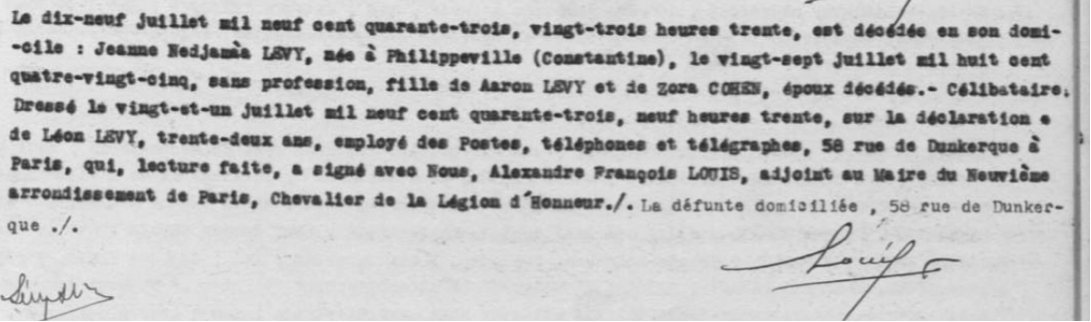
Jeanne Levy’s death certificate, signed by her son Léon, July 19, 1943, 9th district of Paris
©Paris city archives
Mélie: She died young, didn’t she?
Shérine: We have no further details… Léon was arrested a year later, in May 1944, and then again on July 10, 1944, after which he was deported. He died on March 1, 1945, in Germany.
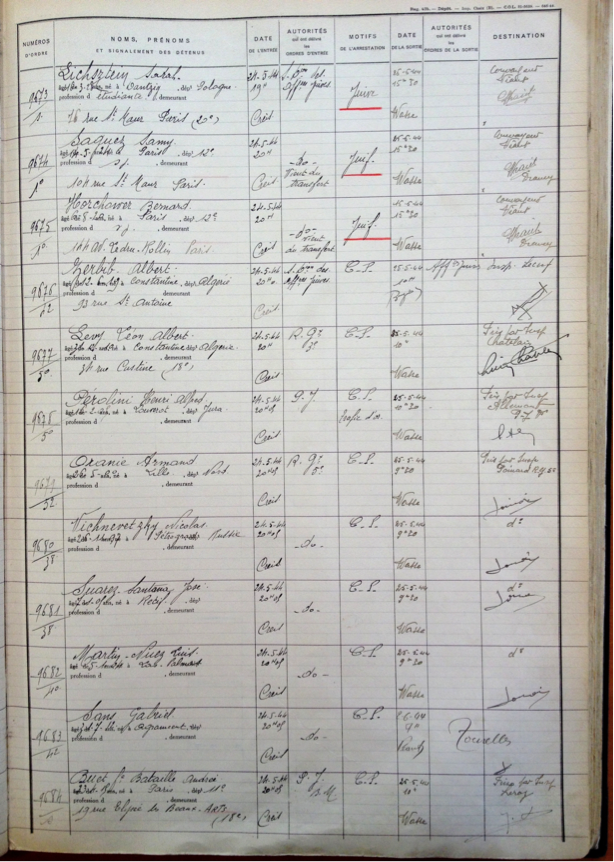
Booking of detainees at the Paris Police Headquarters, May 24, 1944
© APP CC2-8
Lohen: On July 2, 1945, Louise[34], who lived at 34 rue Custine, in the 18th district of Paris, died at the Hotel-Dieu hospital in the 4th district. Léon was arrested at that address[35], I believe?
Mélie: Exactly!
Shérine: The 1946 census also lists Henri and Léon Judas as living at that address.
Mélie: We can therefore conclude that the entire family was living there in 1944 when Léon Albert was arrested [36].
Lohen: So why was he the only one who was arrested in 1944?
7 – After the war
Ndeye: We need to have at least one mystery left! We’ve managed to figure out so many!
Mélie: Four members of the family survived the war; his wife sought to uncover the truth. We have only his wife’s account, as we discussed earlier.
Ndeye: I found something about his son after the war! Serge Albert married Denise Subot on June 18, 1955, in the 11th district of Paris[37]. Serge Albert did on May 29, 2009 at Saint-Doulchard, in the Cher department of France.
Lohen: What a shame—if only we could have met him! He was 13 when his father was arrested; he might have been able to shed some light on what happened.
Ndeye: Marie, Léon Albert’s aunt, who got married on August 18, 1936, got divorced in 1955. We also don’t know if the couple had any children. She died on December 18, 1997, in Saint-Georges-d’Orques, in the Hérault department of France.
Shérine: But that’s in the Occitanie region, right next door to us!
Ndeye: Henri Baroukh, Léon Albert’s uncle, who was born in November 1896, was married twice and died on May 25, 1964, at 21 rue de Saintonge in the 3rd district of Paris. He was a driver in 1937 and 1946, and a sales representative when he died. Léon Judas[38], another of Léon Albert’s uncles, who was born on July 27, 1902, was married three times. His first wife was Julie Zarade, who died on May 25, 1933 in the Laënnec hospital in the 7th district. They lived at 7 rue de Bezons in Courbevoie, in the Hauts-de-Seine department of France. He had only been a widower for three months when he married Anna Taïeb on August 24, 1933 in Paris. He was working for the Post Office and living at 12 rue de Colombes in Courbevoie at the time. They had one son, Henri Aaron, who was born on October 24, 1935 in Courbevoie, married Claude-Annie Beaujard on November 14, 1959 in Nevers in the Nièvre department of France and died on December 7, 1994 in Morocco. Léon Judas got married for the third time, to Anna Djian on March 30, 1950. They had one son, Claude, who went on to have two children.
Shérine: They must still be alive, surely!
The teacher: Well done everyone for all this research, and for being so committed to the project. We’re going to try to get in touch with this branch of the family, as Claude has put together the family tree that enabled us to establish the link between Léon Albert and the rest of his family.
Several family trees include the Levy family, but none of them mention Léon Albert, which supports our doubts about his birth and the fact that his unknown father never officially recognized him… But thanks to your genealogical research, we were able not only to connect Léon Albert to his family but also to other Jewish families from the Constantine area, in particular the Nakache family, including the famous Jewish swimmer Alfred Nakache, himself a Holocaust survivor…
Several family trees include the Levy family, but none of them mention Léon Albert, which supports our doubts about his birth and the fact that his unknown father never officially recognized him… But thanks to your genealogical research, we have been able to connect not only Léon Albert to his family but, beyond that, to other Jewish families from the Constantine region, notably the Nakache family, of the famous Jewish swimmer Alfred Nakache, a Holocaust survivor…
The grey areas are gradually fading, enabling us to remember the man: Léon Albert Lévy Bultinet…
This biography was planned and written as an ongoing investigation during which the students from 9th grade class 1 at Jules-Verne Middle School in Carcassonne explored the archives with the help of their history and geography teacher, C. Carême.
The text was written by Mélie, Lohen, Ndeye, Shérine, Inès, Julia, Lylia, Lizi, Lilou, Karima during the 2024-2025 school year. The video was planned and produced by T. Carême, with the help of Sondos from 9th grade class 3 during the 2025-2026 school year.
We would like to thank Ms. Ben Mohamed, who teaches French, and Ms. Fuentes, who teaches German, for their help.
EPILOGUE
Just when the students thought they had explored every possible angle in their investigation into Léon Lévy, something incredible happened during one final online check!
Léon Lévy Bultinet is named in a blog about the town of Hendaye, in the Pyrénées-Atlantiques department of France, and what happened there during the 1939–1945 war[39]. To my great surprise, in a section on “Resistance members from Hendaye who were deported,” there is a photo of him alongside those of the other deportees on this sad list.
His prisoner number at the Etcherdingen camp, 43,175, is beside a short description of him. He is listed as having been living in Hendaye (where his wife was still living in 1947–1948). The date of his death, March 1, 1945 is the same, and he is listed as working for the PTT, but with no further details. This therefore confirms that the information we found is accurate, although we were unaware that he had spent time in Hendaye.[40].
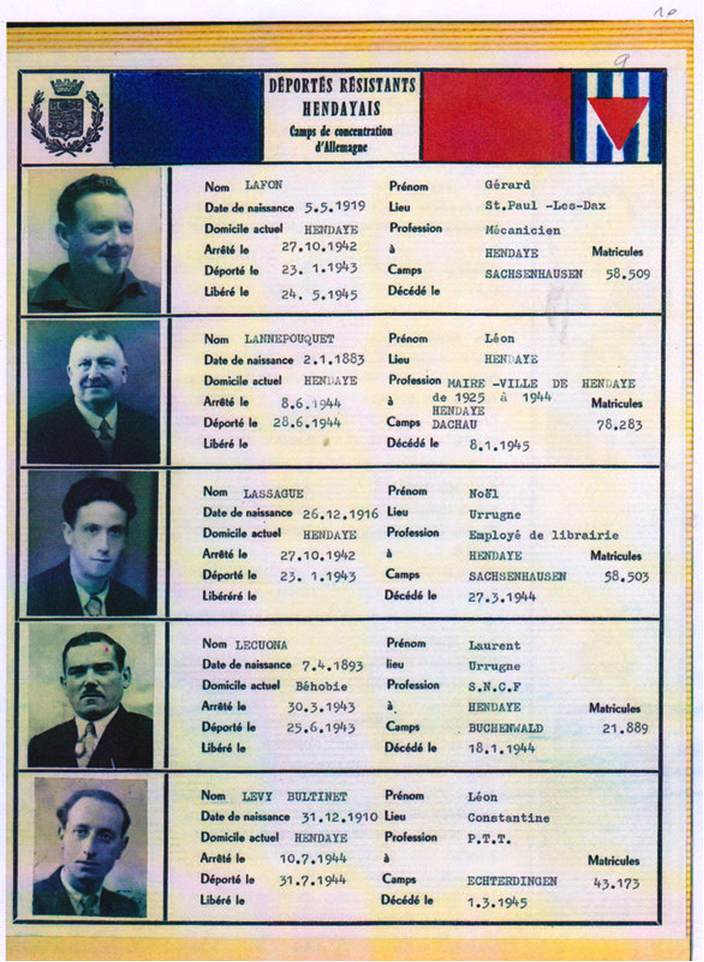
The page is priceless, if only for the photo (which we suppose Madeleine must have given to the person who compiled the list of the Resistance members deported from Hendaye). It also raises even more questions!
Where does this list, sorted alphabetically and with very few photos missing, come from? The blog refers to it as the “Lafont List,” but beyond that? When was it compiled? The blog appears to date back to 2013. The person who reportedly posted the list online, “Marcel Martine Argoy,” seems in fact to be two people: Marcel and Martine Argoyti.
Marcel Argoyti died in 2018 at the age of 98. He was the founding president of the Hendaye History Research Circle, according to his obituary in the Sud-Ouest newspaper, and of the Oroitza history association. Martine Argoyti is his daughter. Might she be able to help us as regards the source of the list, or perhaps Oroitza?
What does the phrase “Deported Resistance Members” mean? The red triangle signifies that the person was deported in connection with their involvement in the Resistance. However, we know that most Jews who were intially arrested for acts of resistance, (except those who were executed, such as Missak Manouchian and his group), were taken from prison to Drancy camp and deported to Auschwitz as “Jews”, rather than as Resistance fighters. This also made things difficult for the few Jewish Resistance fighters who survived their time in Drancy and Auschwitz: French police officers and postwar government officials tasked with investigating (yes, there were investigations into survivors), who were often either ill-informed or simply uninterested in obtaining accurate information, tended to claim that anyone who had spent time in Drancy must have been a “Political Deportee”. This was a euphemism, coined in 1948, to replace the term “Racial Deportee,” which had been widely used when the deportees returned from the camps. The status of “Deported Resistance Fighter” was rarely granted to Jews, and even then often years or even decades later.
Resistance activities in Hendaye ?
As for Léon Lévy, as we discussed earlier, in records from the French Ministry of Defense Historical Service file, his widow made two references to the possibility of him having been arrested for resistance-related activities.
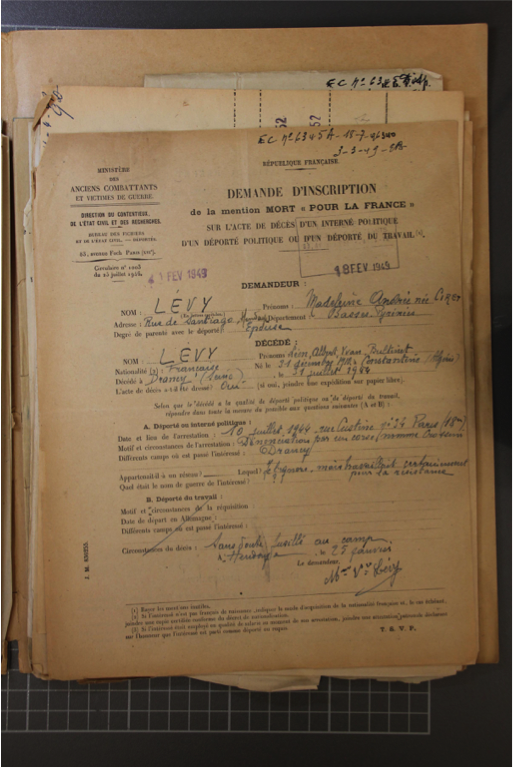
File on Léon Albert Levy, dossier number 21 P 477 877 ©Victims of Contemporary Conflicts Archives Division of the French Ministry of Defense Historical Service, in Caen
Was Léon Levy perhaps involved in acts of resistance, but not as part of a network? And in Hendaye? He is not listed on the handwritten list of Free French Forces (FFI) members from Hendaye published on the blog cited above, nor is his name on the monument to the resistance fighters and people deported from Hendaye, which lists numerous Second World war victims , regardless of the reason for which they were deported . Moreover, there are several records of him having been in Paris (when his mother died in 1943 and when he was first arrested in May 1944, for example)
According to his file from the French Ministry of Defense Historical Service, in Caen, it was the Civil Court in Bayonne (which, like Hendaye, is in the Pyrénées-Atlantiques department of France), that declared him legally dead on October 10, 1947. Was that because his wife lived near there? His death was then registered on June 14, 1948, by the city hall of the 18th district of Paris, which was deemed to be his last place of residence.
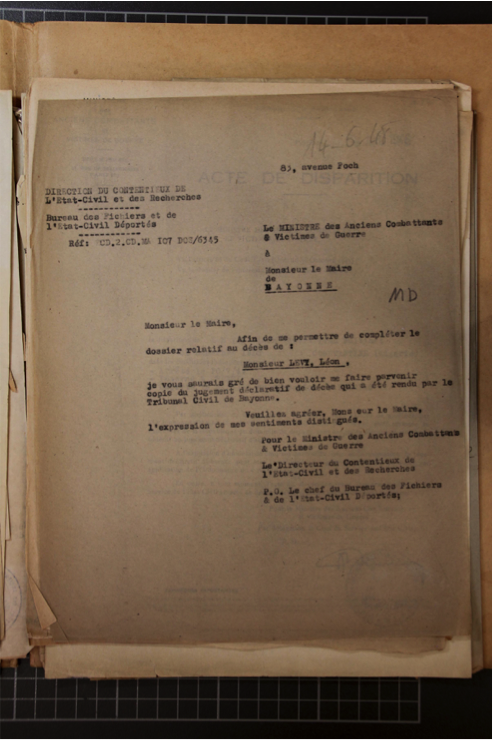
File on Léon Albert Levy, dossier number 21 P 477 877 ©Victims of Contemporary Conflicts Archives Division of the French Ministry of Defense Historical Service, in Caen
Why, then, is Léon Levy named on this webpage relating to Hendaye? Did he actually live in Hendaye? Or was he perhaps he was held there in a forced-labor camp, a GTE (Groupes de Travailleurs Etrangers, Foreign Workers Groups). Let us not forget that as an Algerian Jew, he had been stripped of his French citizenship on October 3, 1940, and had thus reverted to the status of an “indigenous person.”
An “official” record in the French Ministry of Defense Historical Service archives states that in September 1939, just before the war began, he was in Sète, in the Hérault department of France, but there are no further details. We also know that he was definitely in Paris on May 24, 1944, when he was arrested for the first time and interrogated on several occasions by the Jewish Affairs Section of the Gestapo. The address he gave then, 34 rue Custine in the 18th district of Paris, was where one of his aunts was living when she died in July 1945, and where other members of the Levy family may also have been living.
What about Vierzon?
An address in the town of Hendaye is listed in a file on Léon Lévy that his widow submitted after the war, but only as her own address.
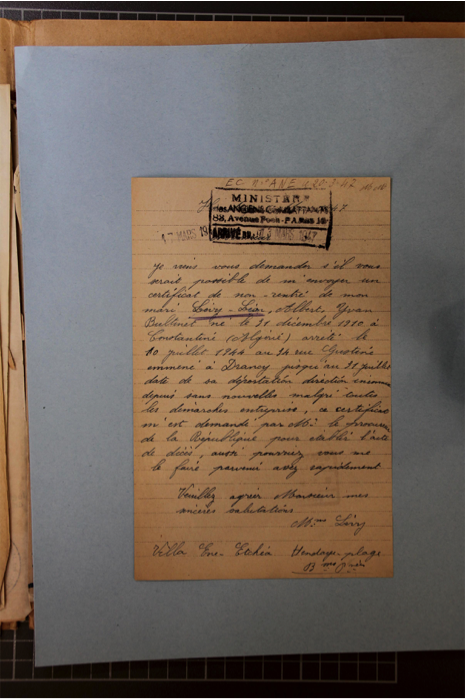
Letter from Mrs Lévy, given an address in Hendaye-Plage, dated March 1947.
File on Léon Albert Levy, dossier number 21 P 477 877 ©Victims of Contemporary Conflicts Archives Division of the French Ministry of Defense Historical Service, in Caen
However, in her initial correspondence with French authorities in November 1944, Madeleine gave an address in Vierzon, her hometown, where her family must have been living.
Léon’s internment card from Drancy camp also lists an address in Vierzon. The card is purple, which means that when he arrived at the camp, Léon, as he was married to an “Aryan” (“spouse of an Aryan,” in Nazi terminology), would not have been among the prisoners who were to be deported immediately. The card originally listed his place of residence as Paris, but this has been crossed out and changed to Vierzon, Place du Château.
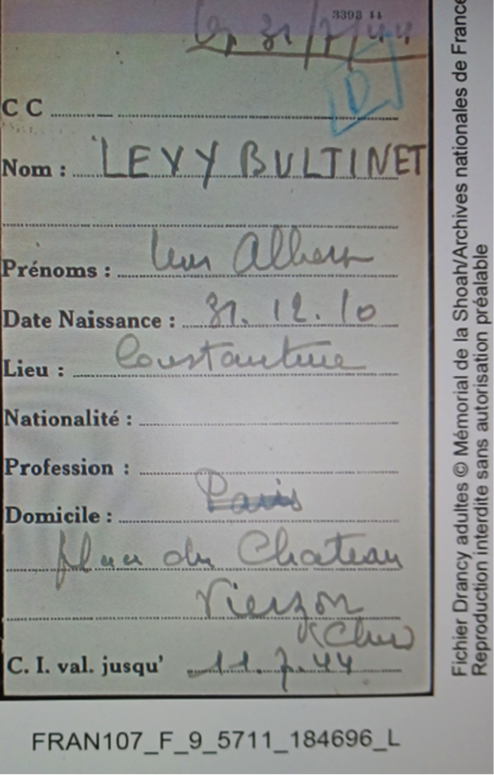
Léon Albert Levy’s first internment card from Drancy camp, with a purple band at the top
©Shoah Memorial, Paris / French National archives
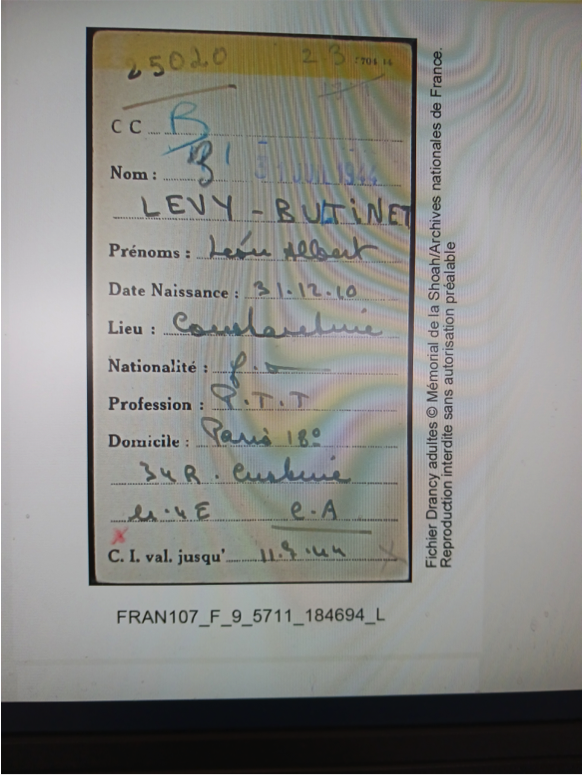
Léon Albert Levy’s second internment card from Drancy camp, with a yellow band at the top
©Shoah Memorial, Paris / French National archives
However, there is a second internment card, also from Drancy camp, with a yellow band at the top and a letter “B” written in blue pencil. This meant that the fact that Léon was married to a non-Jewish woman was no longer relevant: he was to be deported nonetheless. His name is on the deporation list for the convoy that left on July 31. From room 4 on staircase 18, he was moved to room 3 on staircase 2, which was in a building closest to a small courtyard that was not visible from the rest of the camp. This was the departure point for the journey to the Bobigny train station. On this card, his address is listed as 34 Rue Custine, Paris. He is listed as “Married, 4 children” (M.4 E) and his nationality is listed as “French”.
So, was Léon really involved in the Resistance? In the application for “Political Deportee,” status, there is a note, (not in Madeleine Levy’s handwriting) that says that he was arrested for “racial” reasons. Could it be that his widow, who urgently needed to have her husband officially recognized as a deportee so that she and her son could claim a small “compensation” payment, did not dare enter into battle with the authorities, who were reluctant to confirm that deportees had been in the Resistance. Or was Léon in fact arrested simply because he was born Jewish, which those who identified, arrested, and deported him viewed as a stain upon society that needed to be eradicated?
Gray areas
As we come to the end of our attempt to rescue Léon Bultinet Lévy from anonymity among the countless other Holocaust victims, various questions still remain.When did he move to mainland France?
Did he take the Postal Service entrance exam, and when? We know from a register of Jews in France dating from 1941 (although it is not actually dated), kept in the “Jewish file,” that Léon Bultinet Lévy was an “auxiliary employee at the Postal Service,” before the war, but that is all.
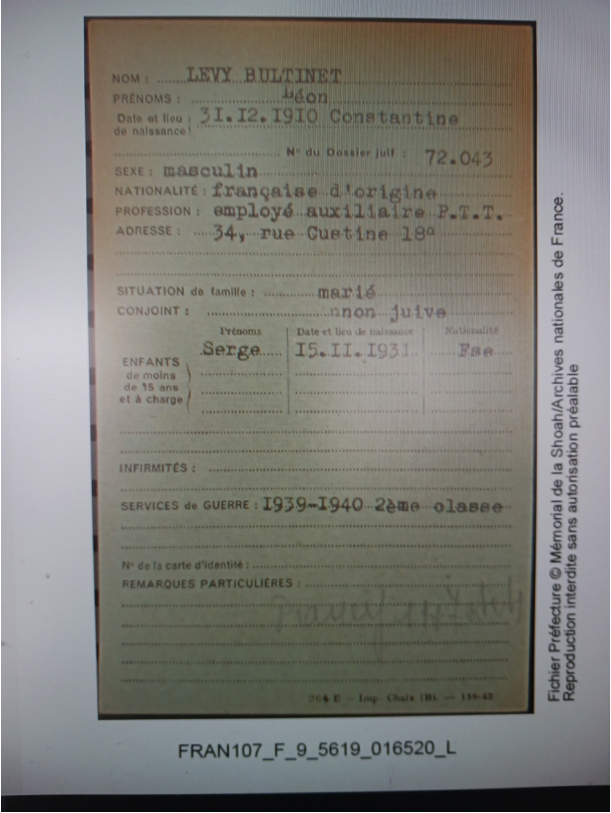
Information sheet on Léon Albert Lévy from the “Jewish file”
© Shoah Memorial, Paris / French National archives.
The information sheet also reveals that Léon Lévy served as a second-class private in the French army in 1939–1940. But did he see active combat, and if so, where? Where was he demobilized? We have yet to find out. A statement by Madeleine Lévy in her application to have him granted Political Deportee status refers to a Colonel Gaffé and a period between September 7 and December 30, 1939, but the original documentation is not in the file held in Caen.
How did Léon and his wife, who was not Jewish, get by during the Occupation? He was no longer allowed to work for the Postal Service as that was a government job, from which Jews were banned. Madeleine later stated that he got a job as a “laborer”.
What did Léon do between May 27, after he was arrested for the first time, and July 10? Did he and Madeleine manage to send their son Serge into hiding, somewhere safe? Why did Léon’s privileged position as the husband of a non-Jewish woman not work in his favor? And why was he deported on the very first convoy after he arrived in Drancy?
How come there is a note that says “Deported on July 31, 1944, bound for Breslau” (Wroclaw in Polish) on a copy of a missing person certificate issued by the Ministry of Veterans and War Victims on July 18, 1946?
Will we ever find out what happened to him between Auschwitz and Etcherdingen? Or how much he suffered? Or whether he held out hope until the very end that he would one day return home to his family?
Is he buried in the Etcherdingen cemetery in a grave bearing his name? Might he be buried in France, alongside his family? Or is the only remaining trace of him his name carved into the Wall of Names at the Shoah Memorial in Paris?
So yes, even aside from the unknowns surrounding the paternal side of his family and the difficulties he must have faced as a child, having been born in 1910 in Algeria, out of wedlock, into a Jewish community (at a time when a single mother was labelled a “daughter-mother” in French, and an “unwed mother” in English), Léon Lévy Bultinet’s life still remains something of a mystery.
However, thanks to the historians from Hendaye, we can at least put a face to his name.
SOURCES
- Benjamin Stora, Les Trois Exils, 2006, Stock.
- Credits and notes relating to the visual content
- The videos featured in this biography were produced by the students who took part in the project, under the guidance of their teacher.
They include various types of visual content:
- Professional video and image archive material: Some clips come from specialist image libraries. The rights to use this content are held by an authorized third party.
- Images generated by artificial intelligence: In cases where no historical archives were available, some images were produced using artificial intelligence tools. These visuals are intended solely for educational and documentary purposes and are not intended to represent actual concentration or extermination camps. The copyright to these images is held by their designer, Thierry Careme.
- Historical archives: records and documents from the Victims of Contemporary Conflicts Archives Division of the French Ministry of Defense Historical Service, in Caen, the Shoah Memorial in Paris and the French National archives in Pierrefitte.
ARCHIVES
- Victims of Contemporary Conflicts Archives Division of the French Ministry of Defense Historical Service, in Caen, dossier ref. 21 P 477.877
- Shoah Memorial / French National archives: Drancy files and the “Jewish file”
- International Tracing Service, Bad Arolsen
- Paris City archives: civil registers and census records.
- Paris Police Headquarters archives: detention records, CC2
- ANOM, (National Archives of French Overseas Territories), civil registry of Algeria – Constantine
- Marcel and Martine Argoyti’s blog.The 1939-1945 war. Resistance fighters deported from Hendaye: hendayetxingudi.canalblog.com
- Wikipedia: Convoy 77
- Shoah Memorial: documentation on Auschwitz and the Nazi concentration and extermination camps.
- The Multimedia Encyclopedia of the Holocaust
Notes & references
[1] hendayetxingudi.canalblog.com
[2] ANOM (National Archives of French Overseas Territories) website: anom.archivesnationales.culture.gouv.fr
[3] According to a copy of the birth certificate, issued after the war and included in the file submitted by his widow to have him officially recognized as a Political Deportee.
[4] It was quite common, especially in maternity wards, for the person who delivered the baby to register the birth, and the witnesses were often other healthcare workers. In this case, the mother gave birth at home. Perhaps she lived alone and no family member was available to register the birth? Or perhaps, as a single mother, she was not sure if she wanted to raise the child alone?
[5] In French, the words “jewish,” “catholic,” and “muslim” are written in lower case when referring to a religious community. “Jewish” is capitalized, especially when referring to the Holocaust. Jews were not categorized as such because they actually practiced their religion; converts, non-practicing Jews, and atheists were also deported.
[6] The status of a dhimmi ranked below that of a Muslim, particularly in terms of taxation and social benefits.
[7] Following the French conquest, and after much debate during the Second Empire, the “native Jews and Muslims” of Algeria, as well as foreigners residing in the territory conquered by France, acquired French nationality, but not French citizenship. In 1865, they were all eligible to apply for French citizenship. However, the proposition failed to gain support, and the influence of religious institutions was cited as the reason for the lack of enthusiasm. Nevertheless, according to historian Benjamin Stora, the idea was well received within the Jewish community. An initial attempt at collective naturalization of the Jews was proposed by the Minister of Justice and Religious Affairs, Émile Ollivier, in March 1870. With the Crémieux Decree passed by the recently established Third Republic, Jews became fully-fledged French citizens. Muslims could also apply for French citizenship, but very few actually did so. In 1889, foreigners (Italians, Spaniards, Maltese, etc.) residing in Algeria were also automatically granted French citizenship. The Jewish community in Constantine was the largest in Algeria. It was estimated to be around 20,000 strong shortly after World War I.
[8] Levi and Cohen are both surnames that refer to Jewish religious lineages dating back to biblical times. Lévy or Levy was Léon’s mother Jeanne’s maiden name.
[9] Her death certificate states that she was indeed “single”; see below.
[10] Anti-Semitism among French settlers sparked riots and widespread unrest in Algeria, in which the so-called “indigenous” population also played a part. Edouard Drumont, one of France’s most virulent anti-Semitic journalists and authors, was elected as a representative for Algeria from 1898 to 1902, during the Dreyfus Affair. His influence persisted long afterward. By the 1920s, local branches of far-right parties were well established, and in Constantine, the mayor founded the “Amitiés françaises” to “organize opposition to the Israelites of Constantine.” His supporters cried.“Down with the Jews! Throw the Yids into the ravine!” It is hardly surprising that the Lévy family was eager to relocate to mainland France.
[11] An extract from the Compiègne civil registry is included in the case file 21 P 477 877. The marriage took place on April 18, 1932.
[12] Madeleine died on July 2, 1997 in Buzançais, the the Indre department of France.
[13] When war was declared in 1939, he was living in Sète, according to a record from 1949.
[14] France and the United Kingdom declared war on Nazi Germany on September 3, 1939, after Hitler’s army invaded their ally, Poland, on September 1st. On September 8, the French launched an offensive in the German Saar region to lend support to the Poles. However, on September 17, the USSR occupied another part of Poland. After a few weeks, French troops withdrew from the Saarland and retreated behind the Maginot Line. Troop movements came to a standstill. This became known as the “Phoney War,” but in May and June 1940, the German army launched a major offensive, and won. The French government, led by Philippe Pétain, then requested an armistice, which was signed on June 22. Pétain had the deputies and senators vote to grant him full powers. He dissolved the Republic and established the Vichy regime (named after the city in the Free Zone to which he had retreated when the Germans occupied Paris), sometimes referred to as the French State. The regime entered into a collaboration with Hitler’s Germany. On October 7, 1940, Marcel Peyrouton (1887, Paris – 1983) signed the repeal of the Crémieux Decree, which stripped Léon Bultinet Levy and his family of their French citizenship. He was convicted, then acquitted by the High Court on December 22, 1948, after fifty-five months of so-called “preventive” detention under common law; he wrote his memoirs in 1949.
[15] On September 27, 1891, during the French Revolution, representative Adrien Duport (a nobleman and reformer) secured a vote to end discrimination against Jews in France. The French National Assembly then decreed that they be granted full and equal citizenship.
[16] In fact, Léon Albert Lévy arrived at the Paris Police Headquarters at 8:00 p.m. on May 24, brought in by the General Intelligence Division of the 3rd district of Paris. The following day, at 10:00 a.m., a French police officer took him to the “Jewish Affairs” department. On May 25, he was brought back to the Paris Police Headquarters at 8:00 p.m.; on May 26, 1944, he left at 9:00 a.m., then was brought back at 7:00 p.m. by the Jewish Affairs police. On the 27th, he was again taken out at 9:30 a.m. and brought back to the “Jewish Affairs” department. This suggests that he was interrogated repeatedly. On May 24, one of Léon’s fellow countrymen, Albert Zerbib, who was born in Constantine on June 12, 1919, arrived via the Jewish Affairs department and went through the same process as Léon (Paris Police Headquarters archives, CC2). We do not know what happened to Léon Albert following these back-and-forth trips between the Police Headquarters and the Jewish Affairs department. Was he released? When he arrived at the Police Headquarters for the last time on July 11, he was brought in at 1:00 a.m. by the German occupation authorities’ military police. At 2;:30 p.m. that same day, he was taken to Drancy, where he was registered under the name Levy-Bultinet with the number 25,020. He only had 66 francs on him, which he was forced to hand over during the “search” (Shoah Memorial / French National Archives).
[17] On September 27, 1891, during the French Revolution, representative Adrien Duport (a nobleman and reformer) secured a vote to end discrimination against Jews in France. The French National Assembly then decreed that they be granted full and equal citizenship.
[18] This was a statement made by his wife, but she did not say that she was present at the time of the arrest. Furthermore, she made no mention of the previous arrest, in May. Madeleine was living in Vierzon (presumably with her family) in November 1944, and in Hendaye in 1946; perhaps she and her son had sought refuge there during the Occupation? It is worth noting that a Robert Lévy, who was living in Biarritz, also requested a copy of Léon’s death certificate in April 1947.
[19] That is where the German police’s Jewish Affairs department was located, not far from Rue des Saussaies, where the SD (including Section IV, SIPO-SD, known as the Gestapo) was based).
[20] There were widespread rumors surrounding the deportations after the war. In this account, we see how the bombings in France, the Nazi Death Marches, and various other barbaric Nazi methods of disposing of corpses are all conflated. Convoy 77, the last large convoy to leave Drancy for Auschwitz before the liberation of Paris, gave rise to much speculation, including the notion that Allied bombings prevented the train from ever reaching the Auschwitz camp.
[21] This acknowledgement granted Léon Levy’s widow and his orphaned son certain “financial entitlements”.
[22] The statuses of « Deported Resistance fighter and “Political Deportee” were introduced in 1948, and the fist requests were granted in the early 1950s. Madeleine applied on behalf of Léon on September 29, 1954, when she was living in the Basses-Pyrénées department of France (now the Pyrénées-Atlantique).
[23] This money, known as a “lump-sum payment,” works out to just over $50 (€46.83). According to the French law on Military Disability and War Victims’ Pensions: Section 3: Lump-Sum Payments and Miscellaneous Compensation, “Political deportees and internees, or their beneficiaries, are granted a lump-sum payment at a rate set as follows: For political deportees, €1.83 ($2.08 at the time of writing) per month of internment or deportation; for political internees, €0.61 ($0.69) per month of internment. Political deportees or members of the Resistance receive a special allowance known as the ‘deportation allowance,’ the amount of which is set at €12.20 ($13.85).” From the French government legal site, legifrance.gouv.fr.
[24]. Several people deported on Convoy 77 died in this camp, where prisoners were treated extremely harshly. For the list of those who died at Echterdingen cf. filderstadt.de
[25] Testimonies given by people who survived after having been deported on this convoy attest to the fact that a large number of people died before they even arrived at the camp, due to stress, the extreme heat in the overcrowded cars (60 people crammed into cattle cars with no windows), lack of air, water, and medicine, and very little food. The journey lasted three days and three nights, and the deportees included some very old people, babies, and young children. See their biographies on this website.
[26] Source Wikipedia: Convoy 77.
[27] Source Wikipedia.
[28] Source collections.arolsen-archives.org The person who devised this system of forced labor was named Todt.
[29] See the following note.
[30] The Arolsen archives is the international center for documentation on Nazi persecution. It holds a wealth of records (other than those from Auschwitz, almost all of which the Nazis burned before they abandoned the camp in January 1945) that make it possible to trace the journeys of deportees who were sent to various concentration and extermination camps. Known as the ITS (International Tracing Service), the center holds more than 30 million records.
[31] The Germans made up causes of death, but survivors testified that most of the deaths were the result of extreme abuse.
[32] On the deportation list drawn up at Drancy camp, which is available online on the Shoah Memorial database, Blanche Lévy is listed as a “French subject.” As discussed above, following the repeal of the Crémieux Decree on October 7, 1940, Jews from Algeria or of Algerian descent were stripped of their French citizenship. They only regained it on October 20, 1943, around a year after the Allied troops landed in Algeria and the French republican government was restored. In the meantime, they were classed as “subjects” rather than citizens.
[33] There is no record of anyone named Léon listed as a resident in the Paris census records from 1926 to 1936. In September 1939, he was in Sète. Was he working there? Was he there when he was called up when war was declared? This remains to be determined.
[34] Louise is buried in the Pantin cemetery in Paris. Interestingly, Léon Lévy’s name is listed in the burial register. He had probably just bought the rights to the burial plot.
[35] The address 34 rue Custine is on Léon’s search record from Drancy, dated July 11, 1944, and had previously been listed in 1941 on a record in the “Jewish file”. On Louise’s death certificate, registered in the 18th district of Paris, the address given is number 56… which does not exist. However, on the original certificate from the 4th district, the address is indeed number 34. It was either a furnished apartment or a boarding house. The street was severely damaged during an Allied bombing raid in April 1944
[36] Léon’s uncles were in fact able to move in at this address after the war.
[37] We do not know whether the couple had any children, as the records are not yet available to the public. We have discovered, however, that the couple divorced on November 9, 1981.
[38] A boy named Léon Judas Lévy, whose parents were named Aaron and Zora, died on May 9, 1891, at 22 months of age. He was born in 1889, as was his twin sister, Esther. This second Léon Judas also had a twin sister called Marie.
[39] hendayetxingudi.canalblog.com
[40] The website Bidasoko Deportatuak Erausketa lists Léon among the four people from Hendaye who were murdered in Auschwitz. kepaordokimhb.eus