Français
 Polski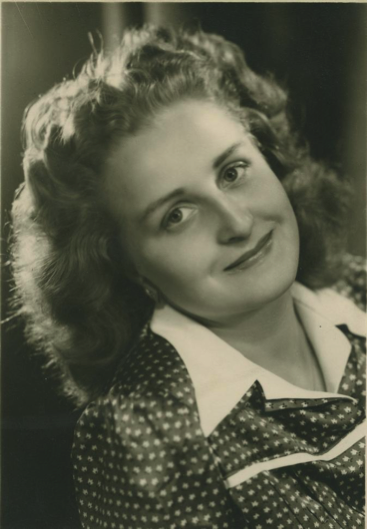
Ida ROSENBERG (married name AJZENBERG)
January 30, 1924, Metz – September 26, 1999, Caluire-et-Cuire
Ida Rosenberg, ©Shoah Memorial, Paris, Sylvia Kesbi collection.
Family and childhood
Ida Rosenberg was born into a Jewish family on January 30, 1924 in Metz, in the Moselle department of France. Her parents were Golda Chaïa Herszbaum and Zeilik Rosenberg.
Her mother, Golda Rosenberg, was born on May 18, 1901 in Poland, which was under Russian rule at the time. The sixth of seven children, she came from Bałuty, a working class district in Lodz, which had a predominantly Jewish population. Many years later, in 1940, it became a ghetto. Her father, Chaim Herszbaum (Heszbajn or Herszbein), who was born in 1867, was a mill worker. Her mother, Czarna Pulvermacher (who was born in 1868 in Lutomiersk), moved to France to be with her six children after her husband died.
Zeilik Rosenberg, Ida’s father, was either born in December 1897 or on January 12, 1898, in Grojec, a town south of Warsaw, in Poland. His parents were Abraham Rosenberg, who was a tailor in Lodz, and Faïga Braitmann. During the First World War, in 1915, he was taken prisoner but was released in 1917. He later emigrated to France , where he worked in a factory in Hagondange, just outside Metz. It is not known when he returned home to Poland, but his first daughter with Golda Herszbaum was born in 1918 in Konstantynów, a suburb of Lodz.
In 1919, Golda and Zeilik Rosenberg left Poland and set up home in the Marais district of Paris. From there, they moved to the Roquette neighborhood, near the Bastille, with their eldest daughter, Faïga, known as Fanny. Their second daughter, Rosa (known as Rosette), was born in the 12th district of Paris on September 22, 1920. Soon afterwards, in March 1921, they moved to Metz, in eastern France.
The family was still living in Metz, which had been home to a sizeable Jewish community for several hundred years, when Ida was born at 41 Rue Chambière in Pontiffroy, the Jewish quarter of the city. Depending on the source, Zeilik was either a tailor or a traveling salesman.
The Rosenbergs were married in a civil ceremony in Metz on January 3, 1924 (their previous religious marriage was recognized as legally valid in Poland, whereas in France, it was not). Zeilik had already lost both his parents by then. Golda’s father was living in Metz and her mother lived in in Constantinople, in Turkey.
On December 18, 1926, Zeilik appeared before the justice of the peace in Metz and declared Ida to be a French national, thereby making her a French citizen[1]. At the same time, he applied to have himself, his wife, their eldest daughter born in Poland, and Rosa, who was born in Paris, naturalized as well; their applications were officially approved on October 24, 1928.
Zeilik gave up his original first name and adopted a French name, Georges, instead[2].
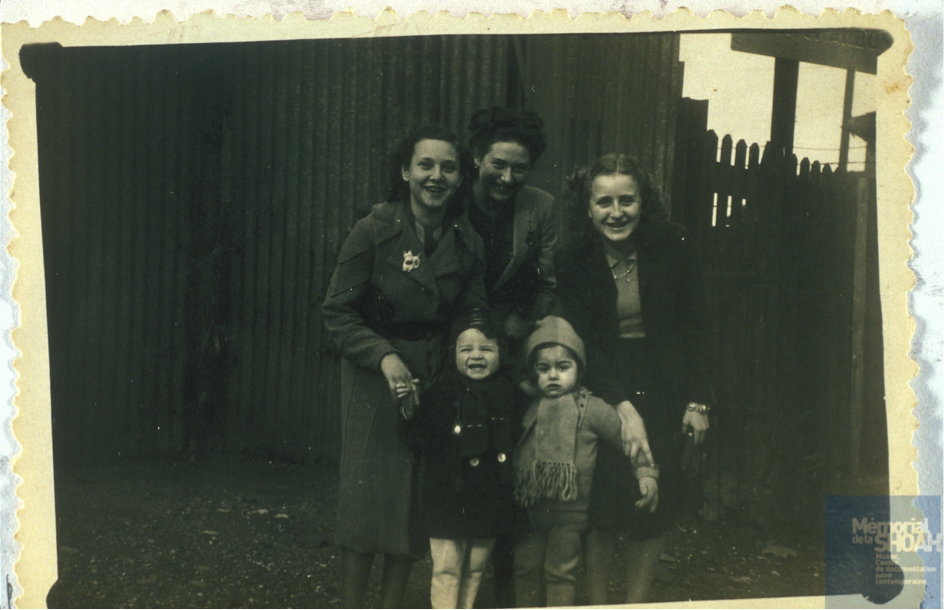
Ida Rosenberg © Shoah Memorial, Paris, Sylvia Kesbi collection
Ida grew up in Metz and, according the testimony she gave in 1995 in Caluire, had a “happy childhood”. She went to a local, state-run school and, in June 1936, passed the Certificate of Education at the girls’ preparatory school on Rue Poncelet, with “good” grades. In July 1938, a girl by the name of Rose Rosenberg also passed the certificate with “good” grades[3] at the Jewish school in Metz-Paixhans; this may have been Ida’s younger sister.
Ida continued her education at the well-known French university, the École normale, where she trained to be a French teacher. Her sister Fanny trained as a stenographer and took shorthand classes so she could “start work sooner”.
We do not know if Ida was a member of any Jewish youth movements, sports clubs, or cultural organizations, but several of her cousins and maternal uncles were successful sportsmen in the Jewish clubs in Metz.
Her older sister Fanny Rosenberg, married Léon Lerner, an accountant, in Metz on October 22, 1938. In 1941, they lived in a borrowed apartment in the 20th district of Paris for a short time, after which they moved to Lyon, in the Rhone department of France.
Lyon, the war, the Occupation, the anti-Jewish measures and the Resistance
In September 1939, Ida’s father, Zeilik Rosenberg, was drafted into the army. Like many others in Metz, the family fled ahead of the German invasion and took refuge in Châtelaillon, near La Rochelle in Charente-Maritime department, where seaside vacation homes were requisitioned to house refugees. In the end, Zeilik was demobilized, as he was the father of three children and facing financial difficulties.
Living in exile
After the Germans occupied France, the family moved to a small two room apartment in Poitiers, in the Vienne department. Zeilik opened a tailor’s shop there, and, in order to comply with the first German decree of September 27, 1940, had to post a notice on his storefront saying “Jewish business”. In 1941, they managed to cross into the Free Zone, with the help of a peasant farmer who they paid to get them across the demarcation line near Châtellerault.
Meanwhile, in 1942, Ida’s younger sister Rosa, known as Rosette, went to Angoulême, in the Charente department and, with the help of a friend, Francine Merlin, who had borrowed her parents’ family record book, managed to smuggle her cousin Rodolphe Ellert out of hospital. Rodolphe, whose parents had been arrested, went to live in hiding with some friends, the Chevallier family, on their farm in Saint-Sauveur, in the Saône-et-Loire department.
The same family took in Fanny Lerner, Ida’s older sister, when she was six months pregnant with her second child: sadly, the baby did not survive.
Ida and Rosette, together with their parents and their grandmother, moved on to Lyon.
Lyon
In Lyon, where the family eventually sought refuge, life was less difficult to begin with that it had been in the Occupied Zone. Although the Jews there, as everywhere else in France, had to comply with the discriminatory policies set out in the two decrees on the Status of the Jews, passed in 1940 and 1941 by the Vichy regime and enforced to varying degrees by the French authorities, they were not obliged to wear the yellow star (which was made compulsory in the Occupied Zone in May 1942). This made it somewhat easier for them to move around, despite the checkpoints throughout the city.
Ida’s parents moved to 29 chemin Saint-Eusèbe, in the 3rd district of Lyon. Ida found a job with a firm called Delle, a major metallurgical plant in nearby Villeurbanne, where she worked as a technical assistant. However, after she was arrested, her job was listed as short-hand typist.
THE DECREES ON THE STATUS OF THE JEWS (October 3 1940 and June 2, 1941)
The first decree on the Status of the Jews, October 3, 1940.
The Vichy government, headed by Philippe Pétain, enacted the decree on its own initiative, i.e. not at the behest of the Germans. It was published in the French Official Gazette on October 18, 1940.
- It defined Jews as a “racial” group: “A Jew is defined as: any person with three grandparents of the Jewish race, or two grandparents of the Jewish race if their spouse is also Jewish.” This definition was based on genetic/“racial” criteria, rather than religious beliefs, as it referred to a person’s Jewish ancestry rather than whether they practiced the Jewish faith.
- It introduced employment restrictions. Anyone deemed to be a “Jew” was banned from holding public office (civil service, justice system, military etc.), teaching (elementary schools, high schools, universities), and working in the media and entertainment industry (press, radio, film, theater etc.). The objective was to eliminate Jews from both public and intellectual life.
- It established the identification and monitoring of Jews by making lists and carrying out a census within government departments and certain professions.
The second decree on the Status of the Jews, June 2, 1941
This decree, enacted once again without German involvement, extended the first by broadening the definition of the term “Jew” and adding more categories of professions from which Jews were excluded.
- This decree introduced a new definition of who counted as Jewish: “A person is deemed to be a Jew if they have three Jewish grandparents, or two Jewish grandparents if
they practice the Jewish faith.” It eliminated certain “exceptions” that were included in the 1940 decree. - The scope of employment restrictions was expanded. Jews were prohibited
from working in almost all professional fields: civil service, education, the military, the judiciary, the independent professions (doctors, lawyers, architects, journalists), commerce, industry, skilled trades, and corporate management.
The goal was to render Jews invisible and financially vulnerable.. - It put in place the CGCU (Commissariat général aux Questions Juives, or General Commissariat for Jewish Affairs), a French administrative body, under legislation passed on March 29, 1941. The CGQJ was initially headed by Xavier Vallat (March 1941–March 1942), then by Louis Darquier de Pellepoix (May 1942–February 1944), and lastly by Charles Mercier du Paty de Clam (February–May 1944). Its role was to keep a registry of Jews, enforce exclusion measures, and, through the SCAP, organize and oversee “Aryanization” of Jewish businesses, essentially the confiscation of their property. The CGQJ oversaw the seizure and forced sale of Jewish-owned assets, including businesses, real estate, stores, works of art, musical instruments, and even sewing machines. These assets were “Aryanized” by , transferring them to “Aryans” (non-Jewish French citizens) at reduced prices or even for free. The aim was to eliminate Jews from French society.
On October 19, 1941, the Vichy government issued a decree that founded the PQJ (Police aux Questions juives, or “Police for Jewish Affairs”).
In Lyon, as of January 1942, there was an active branch of the CGQJ, led by Mr. Carrel-Billard, which worked in close cooperation with the local anti-Jewish police. It later became the Investigation and Monitoring unit.
THE YELLOW STAR
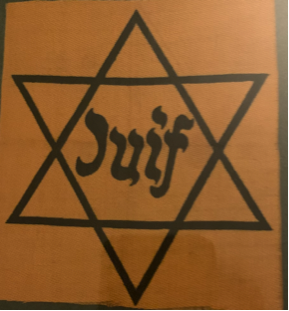
It was the German authorities, rather than the Vichy government, that introduced the requirement for Jews to wear the yellow star. It was brought in by a decree dated May 29, 1942, which came into effect on June 7, 1942.
The decree only applied within the Occupied Zone (in the northern half of France, including Paris). In the southern part of France (known as the Free Zone), which was still governed by the Vichy regime, the yellow star was never made obligatory, even after the Germans took over on November 11, 1942. The German authorities, even the Gestapo, deemed it unnecessary because the Vichy regime’s “Jewish files” were already sufficient to identify, locate and arrest Jews, and roundups carried out in collaboration with the French police had already proved effective. The Vichy authorities were also afraid that the public would not go along with it, as several protests had taken place in Paris when the German decree was first introduced.
Rosa’s death
On May 29, 1944, Rosa, the youngest member of the family, who lived on Plais Jules-Guesde in the 7th district of Lyon and worked at the Printemps department store, was killed. Her death certificate, dated October 2, 1947, includes the words “Died for France.” The exact circumstances of her death, whether as a result of bombing, arrest or shooting, are unknown. However, on May 26, 1944, an Allied (U.S. Air Force) bombing raid aimed at destroying the Perrache train station, the Lyon-Mouche rail yard, the Lyon-Vaise rail yard and the Gestapo headquarters based in the military medical school claimed almost 1,000 lives and left more than 1,100 civilians wounded.
During this period, Lyon became the headquarters of the Resistance, even after the German army crossed the demarcation line and occupied the city in November 1942.
Ida’s involvement in the Resistance
THE RESISTANCE IN LYON
After France was defeated in 1940, the country was divided into two zones:
- The Occupied Zone, which included the northern part of the country and the coast, which was under German control.
- The Free Zone in the southern part of the country, which was governed by the Vichy regime.
Lyon, which was in the Free zone, soon became a stronghold of the Resistance movement. This was because Lyon:
- Was near to the demarcation line between the two zones,
- Had good railway links,
- Had an urban and academic population
- An unusual urban landscape. The city, famous for its “traboules”, or passageways between buildings, had a large number of buildings with multiple entrances and a network of interconnected alleyways, which made it easier for people to move around discreetly.
- Until November 1942, the Germans kept a lighter watch over Lyon, which allowed large numbers of Resistance members to seek refuge there and develop their networks.
Several major groups were operating there as of 1940–1941
- Combat (founded by Henri Frenay),
- Franc-Tireur, originally called France Liberté, founded in 1940 in opposition to the armistice,. Jean-Pierre Lévy expanded its influence nationwide, in
particular through the publication of an underground newspaper, Franc-Tireur - Libération-Sud (founded by Emmanuel d’Astier de La Vigerie).
These groups distributed clandestine newsletters such as Combat, Libération, and Franc-Tireur, which provided information about anti-Semitic legislation and the advance of the Allied and Free French forces, condemned the Vichy regime and called on the population to resist.
Jean Moulin and Lyon: Jean Moulin played an key role in the Resistance movement. A former prefect of the Eure-et-Loir department, who was tasked by Charles de Gaulle with organizing resistance within France, he arrived in Lyon in January 1942. In 1943, he founded the CNR (Conseil National de la Résistance, or National Council of the Resistance) and brought together resistance movements, political parties, and labor unions. His efforts helped make Lyon the “capital of the Resistance.” He was arrested by the Gestapo in Caluire-et-Cuire on June 21,1943, held in Montluc prison, said nothing despite being tortured by the notorious Klaus Barbie, and died on July 8, 1943 on the train in which he was being deported to Germany.
Ida joined the Jewish Resistance movement, the UJRE (Union des Juifs pour la Résistance et l’Entraide, or (Jewish Union for Resistance and Mutual Aid), in which she worked as a liaison officer. Her brother-in-law, Léon Lerner, Fanny’s husband, was a member of the Gaullist network Gallia-RPA, which specialized in rescuing and helping downed Allied airmen escape by providing hiding places, false identity papers, and escape routes to the Free Zone or Switzerland.
THE JEWISH RESISTANCE MOVEMENT IN FRANCE (1940-1944)
- Background: The decrees on the Status of the Jews in 1940-1941 required Jews to take part in a census, stripped them of their assets (through a process known as “Aryanization”), and banned them working in a wide range of professions.
Then, in 1942, a German order required them to wear the yellow star. Jews were effectively excluded from public life and systematically persecuted. In 1941, the roundups began: these included the “Green Ticket Roundup,” the “Roundup of the Notables,” the Paris roundups in August 1941, the Vel d’Hiv Roundup on July 16 and 17, 1942, and roundups elsewhere in France in the summer of 1942. After that, they were hunted down and arrested in their homes and on the streets. - Main activities: finding hiding places and providing protection for Jews being hunted down (not only children but entire families), circulating information, publishing underground newspapers, taking part in armed resistance and sabotage, and assisting people attempting to escape to the Free Zone, Switzerland, and Spain.
- Major networks: AJ (Armée Juive, or Jewish army): an underground, armed, Jewish organization; the EIF (Éclaireurs Israélites de France – also known as la Sixième, the Jewish Scouts in France), which was involved in protecting and rescuing Jewish children; the UJRE (Union des Juifs pour la Résistance et l’Entraide, Union of Jews for Resistance and Mutual Aid).
In addition, many key members of other networks were Jewish, such as the aforementioned Jean-Pierre Lévy, and Serge Ravanel (Serge Ascher), a former student at the École Polytechnique, a Companion of the Liberation, national leader of the Groupes francs, and colonel in the FFI (Forces Françaises de l’Intérior or Free French Forces) who played a key role in the liberation of Toulouse at the age of 24.
It was as a result of Ida’s involvement in the Resistance that the Rosenberg family was arrested on June 22, 1944.
The statement that Ida gave after the war, along with a number of testimonies she gathered to verify her account of her arrest, provide a general outline of what happened[4].
It all began when one of Léon Lerner’s contacts was arrested. A young man from his network, who he had arranged to meet, was stopped by the French Militia. The man was tortured and eventually disclosed several names, including that of Léon Lerner, who lived at the same address as Ida’s parents and her grandmother, Czarna Hersbzein, née Pulvermacher. The militiamen went straight to their apartment 29 Chemin Saint-Eusèbe and arrested everyone they found there.
Ida was not at home when the Militia arrived. One of her neighbors, Sarah Mogenet née Kasriel, a baker, went to Ida’s workplace to warn her. Her immediate reaction was to run home, only to find the Militia waiting for her. In a statement made to the police on November 19, 1952, she recounted: “When I was arrested, the Militia had searched my home and found stamps for making identity cards and some leaflets.” This confirmed that she was actively involved in the Resistance.
After the war, several people testified to having witnessed the arrest, including a Mr. Wolmen, who lived at 29 Rue Eusèbe in Lyon, and Francine Sanchez, née Merlin, who lived at 26 Rue du Nord in Villeurbanne.
Francine Merlin, a member of the Jewish scouts, went to the Rosenberg’s apartment later on. On October 17, 1953, she gave a statement to the chief inspector at the Bourse-Bellecour police station in Lyon, in which she reported that Léon Lerner, whom she knew as “Pelletier,” had come to tell her about the arrest and asked her to go to the Rosenbergs’ apartment to try to retrieve some family photos and keepsakes. She stated that when she arrived, “everything had been looted.”
Léon Lerner died on November 5, 1944 during a Resistance operation in Villars-les-Dombes, north east of Lyon in the Ain department of France.
In 1954, Ida stated “After an initial interrogation by Francis André, a ruthless militiaman nicknamed “Bouche tordu” (Twisted Mouth), the Germans took us away to Fort Montluc”[5]. In fact, after they were arrested, the Militia handed Ida, her parents, and her grandmother over to the Gestapo on Place Bellecour who then took them to Montluc Prison. Ida, her mother, and her grandmother were held in the same cell, No. 13, and Zeilik was put in a cell with some other men.
This arrest illustrates the extent to which, in occupied France, the Vichy regime and the Militia collaborated closely with the Nazi authorities by handing Jews over to the Germans.
Prison life was extremely difficult and the sanitary conditions were appalling. The tiny cells were overcrowded; there wasn’t even enough room for prisoners to lie down. As for the “Jewish barracks,” men, women, and children of all ages were all crammed into it. This is where Ida first met several well-known Resistance fighters and deportees, including Régine Skorka[6] and Esther Minkowski (married name Majerowicz).
FORT MONTLUC
Built in the late 19th century to help defend Lyon, from 1942 onwards Fort Montluc played a central role in the repression that took place in the Occupied Zone. The Germans and the Gestapo used it to imprison:
- Resistance fighters: Montluc was used to hold anyone suspected of being involved in the underground resistance against the occupying forces, such as members of political factions, trade unions, or armed networks. They were interrogated with extreme brutality and tortured, and many ended up being transferred to other camps or executed without trial.
- Jews: Jews: A separate building, often called the “Jewish Barracks,” was used to hold Jewish people arrested during roundups. Conditions there were particularly hard (overcrowding, deprivation, humiliation etc.) and prisoners were then transferred to Drancy and subsequently to concentration and extermination camps such as Auschwitz.
The prisoners were interrogated to extract information from them about other Jews and Resistance members.
Fort Montluc has become a powerful symbol of the Nazi repression in France. It now houses a memorial museum that is open to the public.
DRANCY: A TRANSIT CAMP FOR PEOPLE WHO WERE TO BE DEPORTED
On June 30, 1944, the Rosenberg and Skorka families were both transferred by train from the Perrache station in Paris to Drancy transit camp.
When she arrived in Drancy, Ida, who was 19 years old, was confronted with a bleak and daunting reality: a complex of unfinished buildings built in a horseshoe shape, originally intended as low-income housing, surrounded by barbed wire and watchtowers and heavily guarded by German soldiers and SS officers.
Like all newly arrived prisoners, Ida Rosenberg was immediately booked in, searched and stripped of anything of value. She was then sent to a building where she was crammed together with other prisoners. During the search, Zeilik Rosenberg, who was assigned the registration number 24,744, had to hand over the family’s belongings: “1,160 francs, a men’s signet ring marked R.Z., two gold earrings with gemstones, two gold pendants, and two gold medallions”[7].
Once again, life in the camp was extremely tough. Ida and her family were held in overcrowded dormitories, with men kept apart from women. Ida was in a room with her mother, her grandmother, and her friend Ida. Every was crammed together, they were kept under constant surveillance, there was not enough food and the sanitary conditions in the camp were appalling. The internees in Drancy waited anxiously as their departure date drew ever closer.
Starting in 1943 and continuing through 1944, the frequency of convoys from Bobigny station increased in order to speed up the implementation of the “Final Solution” in France. Each convoy was made up of around 1,000 to 1,500 people, including men, women, and children. The travelling conditions aboard the train cars were extremely tough, as they were overcrowded, there was little or no food or water and it was often either unbearably hot or freezing cold.
Even after the Normandy Landings on June 6, 1944, and in the knowledge that the Allies were advancing towards Paris, the man charge of Drancy camp, SS officer Aloïs Brunner, was determined to deport as many Jews as possible before time ran out. The fact that he did so highlights not only the Nazis’ determination to press ahead with the “Final Solution,” despite their impending defeat, but also their systematic and relentless approach to deporting Jews from occupied France.
Ida Rosenberg’s name is on one of the many lists that the Nazi authorities compiled with the cooperation of the French authorities. A few days before July 31, Ida and her family were officially notified that they were to be deported. They were then transferred to a separate building, well away from the remaining prisoners, and families were held together in the same room. On the very last night before they were due to leave, husbands, wives, and families were able to be together one last time.
The following day, July 31, 1944, they were loaded onto buses and taken to the nearby Bobigny station. Convoy 77 set off at around noon. It arrived at Auschwitz during the night of August 3–4, 1944, which means that the journey took 3 days. There were 1,306 people on board the train, including 324 children. Crammed into cattle cars, they travelled in appalling conditions: severe overcrowding, little or food or water, intense heat, and no sanitary facilities. Many people died along the way, while others lost their minds.
THE SELECTION – AUSCHWITZ
In the early hours of August 4, 1944, Ida Rosenberg and her family arrived at the Auschwitz-Birkenau camp. Her grandmother, despite the appalling travelling conditions, had somehow managed to survive the journey.
When they arrived, the deportees had to leave their bags, which were often the only reminders of their old lives, behind. Families were separated immediately. SS guards separated men from women and sorted people according to their physical appearance and their apparent ability to work. The children, senior citizens, and sick and infirm prisoners were almost always sent straight to the gas chambers. Golda and Rosa’s grandmother were sent to a line of waiting trucks bound for the gas chambers and the crematoria.
On the ramp in Birkenau, as soon as the convoy arrived, one of the internees who was responsible for unloading the deportees’ bags and taking them to “Canada”, the Nazi storage facility for looted property, warned Régine Skorka to stay away from the children and the older people, as they were being sent straight to the gas chambers. Régine pulled Ida toward a group of young women. Ida and Régine thus survived the first selection and were sent into the camp, where they became part of the exhausting world of forced labor at Birkenau. They never left each other’s side again; their friendship became a lifeline in the horrors of the camp.
As for Zeilik, he too was selected to work in the camp, but died soon afterwards. According to a testimonial given after the war by Esther Majerowicz, who was deported at the same time as Ida, Zeilik was not killed in the gas chambers when he arrived at Birkenau, as he was spotted in the camp about a month later. He was officially declared dead on September 20, 1944.
THE KRATZAU CAMP
In October 1944, as the Soviet army was advancing westward, the Nazis began reorganizing the camps. They needed a labor force to make weapons for the army, so they sent able-bodied men and women to various different camps and “Kommandos.”
Ida Rosenberg was transferred from Birkenau to a subcamp of the Gross-Rosen camp in Kratzau, in what was then Czechoslovakia (now the Czech Republic), which was occupied by the German Reich. Kratzau was a camp for Jewish women. She was sent there together with her friend Régine Skorka and more than a hundred other “French” women (women who were deported from France, rather than French citizens).
There, the prisoners were assigned to manufacturing aircraft engines for BMW at a nearby factory, effectively supporting the German war effort. The work was grueling and dangerous: the deportees, often weak as a result of malnutrition and abuse, were forced to meet high production quotas and operate machinery without any safety equipment. Health and safety standards were virtually nonexistent, and accidents were commonplace. This type of work was typical of how the Nazi regime exploited deportees to support its arms industry, using men and women as forced labor, exhausted and at constant risk of death.
Despite the exhaustion, the hunger, the cold, and the ever-present threat of being beaten, Ida and her fellow prisoners proved to be remarkably resilient. In Kratzau, unlike at Auschwitz, tat least there were no “selections”, during which the weakest prisoners were sent to the gas chambers.
The mutual support between the women, and particularly between Ida and Régine, was essential to their survival during their ordeal.
Ida remained in Kratzau until the war ended on May 8, 1945, when she and the other women were finally liberated. The camp guards fled and soon after that, the Russian army arrived.
THE LIBERATION OF THE CAMP AND IDA’S RETURN TO FRANCE
Ida Rosenberg was liberated on May 8, 1945, although it was not until June 30 that she finally returned home to France.
Her experience in the camps, which included forced labor, extreme deprivation, and living in constant fear of death, echoes that of millions of Jews who were persecuted and deported under the Nazi regime.
The liberation of the camps
In March 1945, the Allies launched their final offensive against Nazi Germany. British, American, and French troops advanced eastward, while Soviet forces continued to move westward, despite the Wehrmacht’s last attempts to stand their ground. As they advanced, the Allied forces liberated the concentration camps, exposing a truly shocking situation: gaunt, emaciated prisoners were still clinging to life, surrounded by dead bodies.
Repatriation depended on the availability of various means of transport, what the Allies deemed a priority, and the deportees’ state of health: those in the best physical condition were repatriated as of April 1945, while the weaker ones remained where they were until their health improved enough for them to travel. Sadly, however, many of them did not survive long enough to return to their home countries.
The French Ministry of Prisoners, Deportees, and Refugees, headed by Henri Frenay, the founder of the Combat movement, coordinated the repatriation process. Paris thus became the main hub for people returning home: most arrived at the Orsay train station, but high-profile figures and those who were seriously ill arrived by plane at Le Bourget Airport.
The deportees were taken to the Lutetia Hotel, which had been requisitioned by the Nazis in 1940 but was later taken over by the provisional French government to accommodate people who had just returned from concentration camps.
Of the 1306 people who were deported on Convoy 77, only 251 survived and were able to return to France.
IDA HAD TO REBUILD HER LIFE
When she returned from the camps, Ida Rosenberg was deemed to be in “good” physical condition. However, in common with many of the women who survived the camps, she continued to suffer from lasting physical effects: she had stopped menstruating and had serious dental problems, according to the medical report issued after an (undated) examination carried out before she was cleared to be repatriated to France by train.
In order to regain her strength and begin to readjust to “normal” life, she was sent to a center for deported women in Foncine-le-Bas, in the Jura department of France, where she met other survivors and was given the medical treatment and psychological support she needed.
In 1946, Ida Rosenberg decided to move permanently to the Lyon area, where she lived first at 56 rue de Cuire and then at 5 rue de la Poulaillerie in Lyon. In 1954, she was living and running a business at 109 avenue de Saxe. She then moved to 9 allée Maryse-Bastié in Caluire-et-Cuire, north of Lyon.
Ida married Anatole (known as Tony) Ajzenberg and went on to have two sons: Georges, the French version of her father’s first name, and Patrick.
Ida and Fanny applied for their parents to be officially recognized as “Political Deportees”[8]. Their deportee cards were issued on October 19, 1953 (in January 1967, Ida reported that she had lost both her own and her parents’ cards).
She also applied on her own behalf, and in October 1953, was officially recognized as a “Political Deportee.” Her activities in the Resistance were not taken into account, however, even though a distinction was made between the so-called “racial” deportees, a term that was later replaced by that of “political” deportees, and Deported Resistance Fighters. This was despite the fact that she had been arrested, under French law, in connection with a Resistance-related matter. At that time, however, the efforts of networks that provided assistance to persecuted Jews were not fully recognized as acts of resistance, even though the Jewish Scout movement (IEF), with which she was affiliated, had joined the Resistance in order to carry out activities that went beyond saving Jews.
On March 22, 1954, Ida received the victims’ “compensation” payment of 14,400 (old) French francs.
None of Ida and Fanny’s maternal uncles and aunts survived. Most of their cousins also died. Little Rodolphe, who was saved by Rosette, was adopted by an American family after the war; he died in 2015[9].
Chevallier and Francine Merlin, née Sanchez, who took Rudolphe in and kept him hidden during the war, were awarded the title of “Righteous Among the Nations” on February 28, 1993 by Yad Vashem in Jerusalem[10].
IDA’S COMMITMENT TO REMEMBRANCE
Ida Rosenberg devoted the rest of her life to keeping alive the memory of Holocaust victims, in particular those who were deported from France. Her personal experience of deportation motivated her to focus on the roundups in Paris, the deportation of French Jews, and the tragic fate of the convoys of deportees sent to Nazi extermination camps.
Over the years, she held onto her memories of the deportation and sought to pass on the stories of the people who never came home. She worked with a number of memorial organizations and institutions, such as the Shoah Memorial in Paris and the Holocaust Memorial Museum in Washington, and helped collect and preserve survivors’ testimonies.
Ida also became involved in education, by speaking at schools and universities and sharing the history of the Holocaust in order to raise awareness among younger generations of the need to keep the memory of the Holocaust alive and combat antisemitism.
Ida died on September 26, 1999, at her home in Caluire-et-Cuire. She was 75 years old.
To this day, Ida’s testimony and life story live on, establishing her as a lasting symbol of courage and remembrance.
Ida Rosenberg’s story offers a real-life example of the Nazis’ persecution policy. As a Jewish woman, she was arrested, deported, and imprisoned in camps solely on the basis of her so-called “race.” She survived, but at the cost of profound suffering, both physical and psychological, that no medical record can ever truly quantify. Her story serves as a reminder that Nazism is not an abstract concept: it destroyed real lives, shattered families, and wiped out so many promising futures. Through Ida, we hear the voices of all Holocaust victims. To remember her life story is to refuse to allow crimes such as these to happen again and to remain ever vigilant in the face of hatred, racism, and antisemitism.
Notes & references
[1] The naturalization record is registered under number 22368 x 26.
[2] As stated in a document from the file on Ida Rosenberg held by the French Ministry of Defense Historical Service dossier ref. 21 P 696 182, and Zeilik’s own file, ref. 21 P 532 708.
[3] From the French Jewish newspaper La Tribune juive, July 8, 1938.
[4] French Ministry of Defense Historical Service in Caen, ref. 21 P 696 182
[5] French Ministry of Defense Historical Service in Caen, file on Zeilik Rosenberg, ref. 21 P 532 708.
[6] Régine Skorka-Jacubert’s book Fringale de vie contre usine à mort, published by Le Manuscrit, 2009.
[7] Shoah Memorial, Paris, Zeilik Rosenberg, July 4, 1944.
[8] French Ministry of Defense Historical Service in Caen, file on Zelik (sic) Rosenberg, ref. 21 P 532 708 and file on Golda Rosenberg née Herszbaum, ref. 21 P 532 668.
[9] Cf. CPRD Landes, Mont-de-Marsan, op. cit cprd-landes.org
[10] Francine Merlin née Sanchez was named Just Among the Nations in 1993 at Yad Vashem in Jerusalem. She was the woman who helped to save the life of Ida and Rosa’s cousin Rodolphe. According to the Yad Vashem website: “Francine Sanchez, née Merlin, in 1942, ‘borrowed’ her parents’ family record book. This enabled Miss Rosette Rosenberg to cross into the Occupied Zone to take her cousin Rodolphe out of hospital in Angouleme, where he was being monitored by the SS, who had recently deported his parents. The family record book included not only the name of a young girl but also that of a 6-year-old boy, and this enabled Miss Rosenberg to cross back into the Free Zone after she had ‘kidnapped’ the child”. yadvashem-france.org