Français
 Polski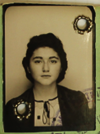
Micaëla SAVU, née SEGALL
(Bucarest 1924 – Clichy 2005)
A Convoy 77 survivor
Photo of Micaëla Segall at the age of 15. From her foreigner’s identity card, issued by the prefecture in Versailles in 1939.
Source: © Victims of Contemporary Conflicts Archives Division of the French Ministry of Defense Historical Service, in Caen, dossier 21 P 670.903
Born in Romania to a well-to-do Jewish family
Micaëla Simona Segall came into the world on December 19 1924 in Bucharest, Romania. She was born into a well-educated, middle-class Jewish family in the country’s capital.
Her father was Ilie (Eli), known as Isidore, Segall, who later became known as Isidore Savu[1], who was born on March 23, 1899 in Burdujeni[2] in Moldavia, which at the time was part of Romania. His parents were Midel (or Michel) Segall and Anna Nadler.
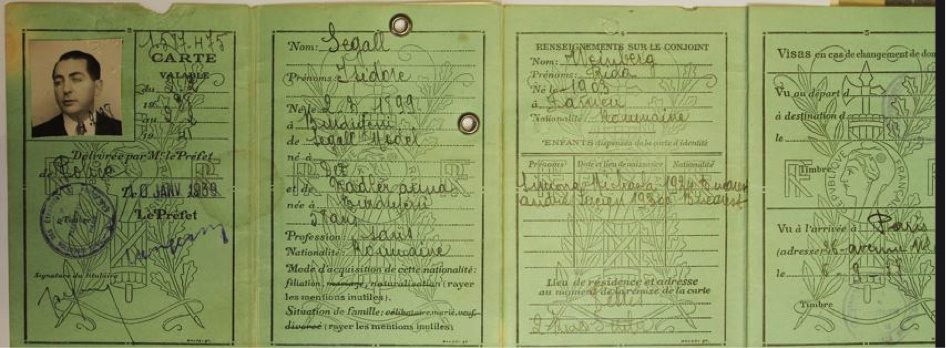
Isidore Segall’s Non-Working Foreigner’s identity card
©French Ministry of Defense Historical Service
Micaëla’s mother, Frida Weinberg, was born in 1903 and was a Roman Catholic[3]. Micaëla had a younger brother, André Lucien, who was born in 1930, also in Bucharest.
Her father, about whom she often spoke to her fellow deportees, was a man of high social standing. Régine Skorka-Jacubert, with whom she spent time in the Kratzau camp, described him as an “oil magnate”[4]. Régine also recalled that “her brother had supposedly studied at the same school as the Prince of Romania,” which, while it cannot be confirmed through French archives, nevertheless suggests that her family was well integrated into Romanian financial and intellectual circles between the wars.
The information provided by French government archives and subsequent testimonies reveal a family whose values focused on education, multilingualism, and a positive outlook toward Europe.
With a Catholic mother and a Jewish father, Micaëla inherited a multifaceted identity that combined different religious and cultural traditions. This was not an uncommon situation in major European cities, but from the 1930s onward, it made such people particularly vulnerable. Régine Jacubert later referred to Micaëla’s privileged childhood and emphasized the contrast between her pre-war life and those of the other young woman in Birkenau. She described Micaëla as “a tall, elegant girl who spoke several languages”, accustomed to a cultured environment and financial security. She had also had a German governess—a point we shall come back to later on. These details, based on a subjective account, should perhaps be viewed with caution, but they nevertheless highlight the severe impact of the social upheaval brought about by the war and persecution.
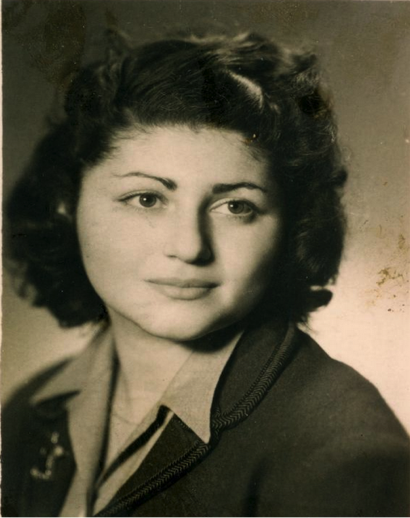
©Shoah Memorial archives. Régine Jacubert collection.
According to her fellow survivor Régine Skorka-Jacubert, “Mica” was a “stunning girl; even when she was very thin, even with her head shaved, she stood out from the other girls—tall, with eyes as brown as velvet and a face sprinkled with freckles.” And when her hair began to grow back, it was auburn red and tightly curled.” The photo (at the top of this biography), which was taken when she arrived in France, also reveals that she had a small, well-defined chin.
Arrival in France… and the outbreak of war
In late August 1938, according to La Gazette de Bayonne, Isidore Segall was staying at the luxurious Miramar Hotel in Biarritz, on the south west coast of France. On September 6, he arrived in Paris. As the result of a vote in February 1938, Romania had ceased to be a parliamentary democracy. Was this what prompted Micaëla’s father to decide to relocate to France? He set up home at 26 Avenue Marceau, a prestigious building near the Champs-Élysées, in the 8th district of Paris[5]. On January 10, 1939, he and his wife were issued foreigner’s identity cards (children under the age of majority were exempt). He declared that he was not working. By the time he received his card, he was living at 2 rue des Saules, in the 18th district, in the heart of old Montmartre in the north of Paris.
On April 22, 1939, Frida, Micaëla’s mother, set off for Bucharest. She arrived back in Paris on August 5[6]. On August 25, she moved to Le Chesnay, near Versailles, a town to the west of the capital, which is where Micaëla’s non-working foreigner’s identity card was issued.
Micaëla may have left Romania to continue her education in France or, perhaps due to the rise in international friction in the summer of 1939, to flee the impending war. She may have travelled with her mother, when she went home after her trip to Bucharest, as her repatriation card states that she had been in France since 1939[7].
A few days after Frida moved to Chesnay, France declared was on Germany. We do not know what the Segall family did after that. Did they too leave Paris? Was Isidore interned in a camp for foreigners? When the first anti-Semitic legislation was passed in October 1940, did they themselves as Jews? Although some Romanian Jews were rounded up and sent to Drancy in September 1941, the German authorities decided not pursue them during the large-scale roundups in the summer of 1942, as Romania had allied itself with Hitler and joined the fight against USSR in the wake of Operation Barbarossa on June 22, 1941. This meant that people who could afford it, and had somewhere to go, were able to go into hiding.
Micaëla, however, was still living in Paris in 1943, having moved alone to a private boarding house at 85 Rue de la Pompe in the 16th district[8], an elegant four-story townhouse in a neighborhood that was home to a large number of foreigners.
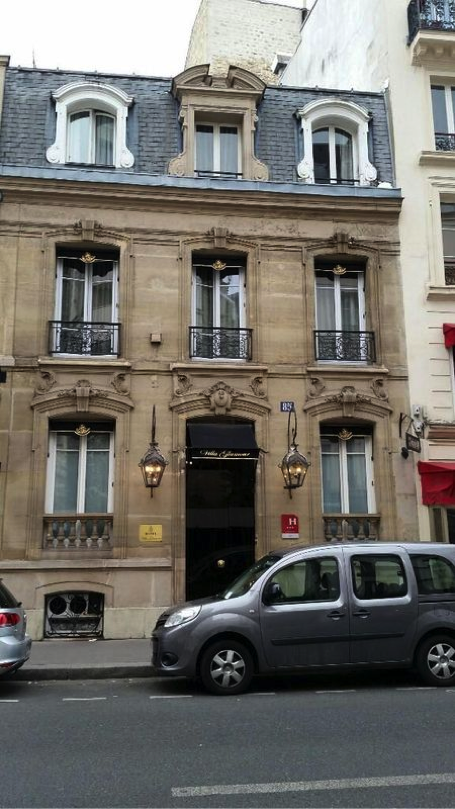
The building in which Micaëla was living when she was arrested; 85 rue de la Pompe in the 16th district of Paris ©Wikipedia
Régine Skorka-Jacubert wrote that Micaëla said she was a student at the prestigious HEC business school in Paris[9]. Although this is impossible to verify, it seems quite likely, given her social and cultural background. However, the fact that she was a university student failed to protect her in the long run.
It appears that Micaëla did not abide by the various restrictions that applied to Jewish citizens in the capital. This may have been because, as we noted earlier, Romanian Jews were still rarely targeted for deportation. In addition, according to her friend Régine, “Mica” did not think of herself as Jewish. Nevertheless, in 1943, she was listed in the Paris police records for the first time. A report dated June 2, 1943, states that she was arrested on Rue de Passy, not far from her home, by a French police unit[10]. The report states unequivocally: “must be taken to the station to determine her racial identity.” This type of bureaucratic language, typical of law enforcement collaboration during the Occupation, reveals a shift from identity checks to persecution based on ethnic categories defined by the Nazi occupiers and endorsed by the French authorities. The report makes no mention of her having committed any offence: the arrest was based solely on her supposed ethnicity. After this was verified, she was released. After that, did Micaëla feel she was under surveillance and therefore more vulnerable? Or did she just think she had proved that she was a Romanian citizen, and that would be the end of it?
Arrest, internment in Drancy camp and deportation
Things took a sudden turn for the worse for Micaëla in the summer of 1944. On July 18, 1944, while Paris was still under German occupation but already buzzing with the news that the Allies were advancing toward the city, she was arrested for the second time. The SS burst into “the private boarding house” at 85 Rue de la Pompe in the middle of the night and took her away[11]. The Paris police headquarters archives and the Drancy camp records both confirm the date. Did someone turn her in, or had she been under surveillance since the previous time she was arrested? Was anyone else arrested along with her that night? She never mentioned this, and we were unable to find any record of the actual arrest in the Paris police headquarters archives. Did the SS perhaps take her straight to Drancy?
Régine Skorka-Jacubert, in her testimony, referred to the arrest and noted that even in Birkenau, Micaëla did not seem to think of herself as Jewish and implied that she had been arrested “in error”: “During a raid, the Germans rounded her up and took her to Drancy. The Romanian consulate approached the German authorities in an attempt to have her released on the basis that she was not Jewish, but given her surname, Segall, there was nothing they could do, and she ended up in the same boat as the rest of us[12].”
We also found some indirect evidence that Micaëla officially “denied” that she was Jewish in a 1974 case review, which reveals that she “said she was not Jewish”[13]. In any case, after she was arrested on July 18, 1944, she was immediately interned in Drancy camp, where she registered as prisoner number 25,230. The fact that she denied being Jewish even while interned at Drancy is confirmed by a handwritten note on her registration form, which reads: “se dit n.j.”, meaning “says she is not Jewish.” During the “search, when she first arrived at the camp, she handed over 2,490 francs in cash, which was a great deal of money for any 19-year-old girl, but especially for one who was not working.
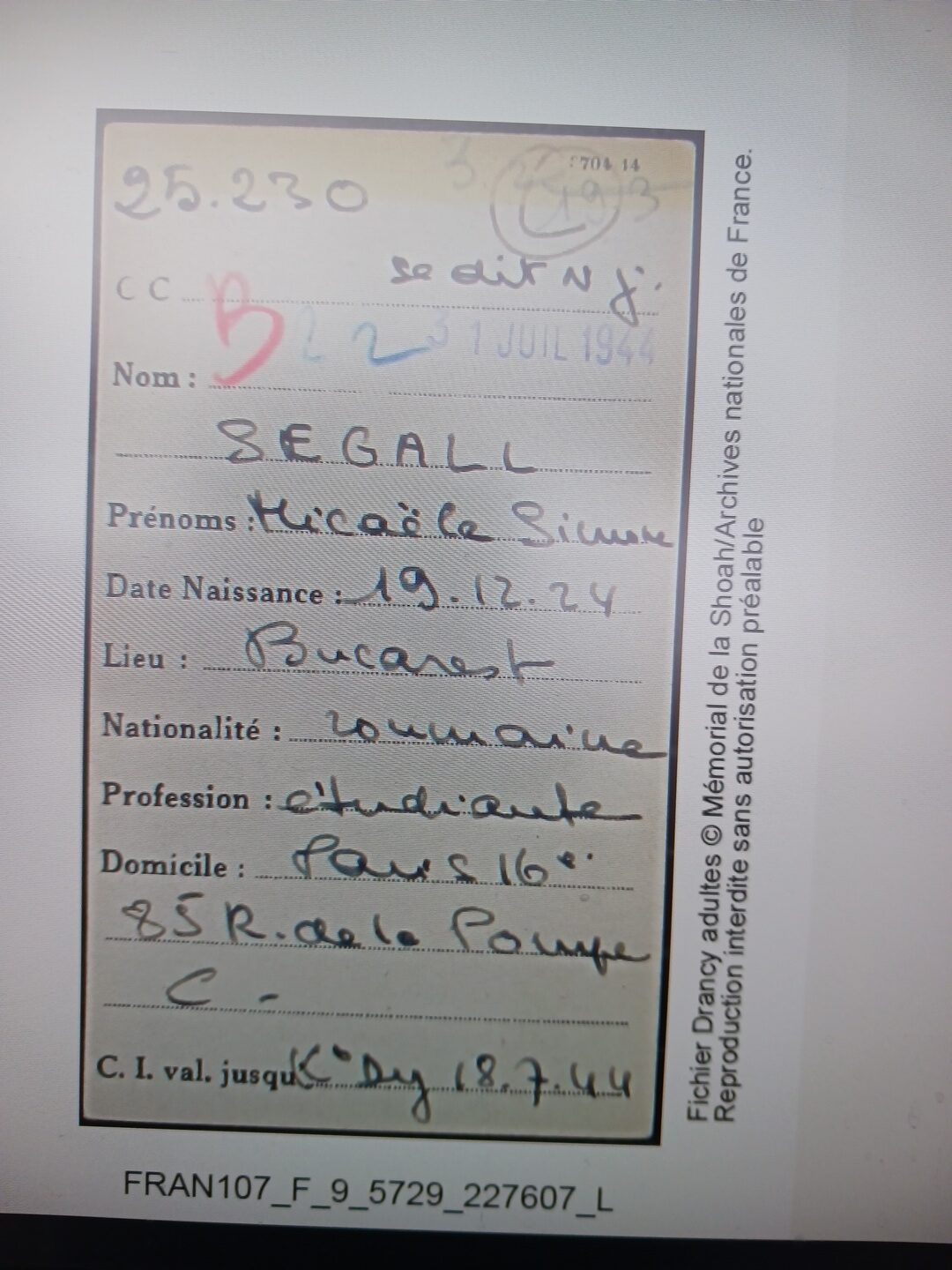
Drancy camp registration form
Shoah Memorial/French National Archives
On July 25, Micaëla, along with numerous other internees, was transferred to a building for prisoners who were “leaving”, in other words those who were to be deported on the next convoy. Once they were all in this section of the camp, to the right of the buildings that formed a horseshoe shape in and unfinished housing project called the Cité de la Muette, they watched as the Germans put up barbed wire fences. This meant they could no longer move freely in and out of the rest of the camp. It also meant that families who had until then been split up were all together; husbands were reunited with their wives and children.
Micaëla had no family in the camp; she was alone when she was arrested. She must have been aware, as were the other prisoners, that the Americans were not far away, and no doubt hoped they would arrive in time to prevent the convoy from leaving. She must have witnessed the arrival of the children and teenagers who had been rounded up in the children’s homes run by the U.G.I.F. (Union Générale des Israélites de France, or General Union of French Jews) by Aloïs Brunner, the SS officer who was in charge of the camp. She must also have been heartbroken to hear them cry and watch them spend their days wandering around, lost, dirty and half-starved. And then, before daybreak on July 31, along with all the other internees due to leave that day, she stood in the fenced-in courtyard with her half-loaf of bread and her few belongings, waiting for a bus from the Paris transport company to take her to Bobigny train station. There, with Red Cross nurses looking on, German soldiers with dogs loaded her into a cattle car. Once she and 59 other people of all ages and walks of life were all crammed in, the doors were locked.
On July 31, 1944, Micaëla was thus deported on the last major convoy from Drancy to Auschwitz-Birkenau. This transport, which later became known as Convoy 77, comprised 1,306 people, including a large number of women and 323 children. The youngest, Alain Blumberg, who was born in the camp, was just 15 days old; the oldest, Benoît Lévy, was 87.
Régine Skorka-Jacubert, who was deported on the same convoy, is one of a number of survivors who shared their experiences of the horrific journey. They include overcrowding, straw on the floor, insufficient water and fresh air, lack of space to sit down, poor sanitation (only one toilet bucket per car), deportees of all ages crammed together, lack of privacy, some folks suffering mental breakdowns, constant fear of death, people dying and bodies left lying in the cars for the remainder of the journey. Particularly noteworthy is her account of the violent response to an escape attempt organized by the Drancy camp resistance network, which highlights the sheer brutality of the concentration camp system.
Auschwitz and Kratzau
When the train arrived at Auschwitz-Birkenau on the night of August 3-4, 1944, the selection was carried out immediately. Régine Skorka-Jacubert described the scene: SS officers everywhere, dogs barking, people shouting and screaming, a stick used to tell people to go to the right or to the left, women and children lined up on one side, men on the other, followed by the deportees being selected to enter the camp to work or to be sent to the gas chambers, and the gradual realization that “those who went off in one direction were never going to come back.”
Micaëla was selected to carry out forced labor and sent to the women’s section of the camp, in Birkenau. She was shorn and shaved (including her private parts) by German female prisoners, tattooed by other female deportees (although we do not have her prisoner number, as it is not listed on any surviving records, but it would have begun with A 16), and stripped of her clothes and her identity. This marked a profound anthropological turning point: the young student from Paris became a mere number in an extermination camp. At least Micaëla spoke fluent German, so could easily understand the tedious twice-daily roll call and immediately call out her registration number in the Nazis’ own language, which some of her less fortunate French peers struggled with. All the “French” women (i.e. those who had been deported from France) were housed in the same “bloc”, or barracks? The walls lined were with three-tiered bunks beds in which the women had to sleep on bare wooden boards, with no blankets. Ten of them slept on each level.
The women from Convoy 77 were held in the Zigeunerlager or Tzigoïner Lager (again, according to Régine Skorka-Jacubert), the section of Birkenau previously used to hold gypsy families, who were murdered en masse on August 2 and 3, 1944, just before Convoy 77 arrived. It was the smell of their burning flesh that greeted Micaëla and the other deportees as soon as they got off the train.
Micaëla had to endure extreme overcrowding, chronic hunger, endless selections, delousing, and having to look at the smoke rising from the crematoria every day. Régine Skorka-Jacubert made particular mention of how there was a constant smell of burning flesh, how the weakest prisoners were selected for the gas chambers, how the women were beaten for no reason, and how she had to learn the unspoken rules of how to survive: standing up straight during roll call, not drawing attention to herself, sticking close to a group, etc.
When the women first arrived in Birkenau they were confined to barracks for a “quarantine” period, which was aimed at ensuring that they were not carrying any infectious diseases. When it was over, they were put to work, which was both hard and usually futile.
A crucial turning point came on October 28, 1944, when the Germans, aware that the Soviet army was advancing towards Auschwitz, decided to begin evacuating the camp. That day, shortly after the Sonderkommando had blown up the third crematorium, some of the deportees were moved out. Régine Skorka-Jacubert remembers being woken up at dawn, waiting for a long time in the roll call area, and then being forced to set off on a long, exhausting march. The SS officers in charge of the women were violent, they beat anyone who fell down, and if anyone could not go on, they left them behind. At long last, they came to a place where a train was waiting for them. Men in trucks threw their bread rations at them: this was the first thing they had to eat all day. All the “French” women were then crammed into cattle cars.
Micaëla was one of a group of women who were sent to the Kratzau camp, in the Sudetenland region of Czechoslovakia. Although they had been transferred out of the extermination camp, this by no means brought an end to the abuse and violence.
Life in Kratzau was no easier than in Auschwitz: women shared beds, there was no water for them to wash themselves, and they all had body lice. There was still abuse, albeit less overt, and there was still not enough food, and what little there was often spoiled. The women were only there to work, at a time when the Germans were focused on the war effort. But at there were no further “selections”.
As they become increasingly exhausted from work and lack of food, the “older” women did their best to take care of the young girls, who were between the ages of 13 and 15, most of whom had come from the U.G.I.F. children’s home on rue Vauquelin. Régine Skorka-Jacubert tells the story of how one night, she, “Mica” and another friend, whose eyesight was terrible, set out on a “potato raid”, which risked going seriously wrong. The girls were afraid if they were caught, they would be sent to Gross-Rosen, the main camp to which Kratzau was attached, and where they would once again be subjected to regular “selections”.
Micaëla was assigned to the kommando that worked in an arms factory. Régine Skorka-Jacubert wrote about their work in the Schpritzerei, where they painted grenades using machines that ran continuously for twelve hours, and sometimes even at night if there was a nacht schicht, or night shift. “We had to hold a grenade between our fingertips, one side with our right hand and the other with our left, and turn it as the machine the machine poured yellow paint onto it,” recalls Régine. The work was grueling and dangerous, but at least the factory environment was slightly less strict than it was back in the camp. For their friend Ida, who was very nearsighted (and had somehow managed to not let it show in Birkenau, as otherwise she would have been selected for the gas chambers immediately), having Mica and Régine around was what kept her alive. She relied on the solidarity and support of her friends: they shared food, hid her inability to see much, and helped each other out in everyday life.
It was in this grim camp that an absolutely extraordinary event took place: a chance encounter with a French civilian worker from the Lorraine region of France. Regine had known this man, who was not Jewish, before she was deported. Jules Lucien Trompette was smitten with the tall, beautiful young Romanian woman and agreed to act as a messenger for her. With his help, Micaëla got in touch with her old German governess, who had moved back to Berlin. A package then arrived at the camp, containing, among other things, some sugar and salt. Régine Skorka-Jacubert was quick to point out that Micaëla shared these with her friends: “We shared the salt and sugar; that was how life was in the camp”. This story illustrates not so much Micaëla’s coming to the rescue of one individual girl, but rather an incident that laid the foundation for a sense of sisterhood that would last their entire lives. It also goes to show how fond the governess was of young Micaëla, as she must have gone to great lengths to find these supplies, which were becoming increasingly scarce as Germany was on the brink of collapse.
Mica subsequently received a beautiful sweater, knitted by her devoted nanny, which, of course, she had never worn. That would have made her stand out, especially compared to the other deportees, who were dressed in rags and odd shoes. But the nanny was not content with just sending packages: she also wanted to actually see Mica, so she made the long journey from Berlin to Kratzau. Mica’s two friends came up with a plan so that, very briefly, in a dark tunnel leading to the factory, Mica and her governess were able to meet and speak to one another. Those few minutes, when time stood still, were a welcome respite from harsh reality. Sadly, it was just a fleeting moment…
Liberation from Kratzau and repatriation to France
The spring of 1945 was the beginning of a chaotic period. The SS officers vacillated between resorting to violence and attempting to flee. The women heard contradictory rumors: some claimed the Nazis had booby-trapped the camp; others warned of an impending massacre. The Allies seemed to take forever to arrive… Régine Skorka-Jacubert later described the night of May 8–9, 1945 as having been punctuated by shouting and gunfire, culminating in the SS officers’ sudden departure, after which the internees woke to find themselves alone in the camp. The women were still not safe, however: they were still at risk of sexual abuse by Russian “liberators”[14] and disease (dysentery in particular). The Russians also found and hanged the female SS commander. Some women died of shock, overcome with the emotion of being set free. Others died after eating too much food too soon, when their bodies were no longer used to it. Micaëla, who was never very strong to begin with, struggled on but was very weak, physically. Her friend, Ida nearly succumbed to dysentery, and her friends did everything they could to help her.
Mica, Régine and Ida then left Kratzau and set off into the unknown, heading for home. Their journey included much walking, waiting and negotiation. They initially made their way towards Görlitz, a city on the Polish border.
Micaëla, who spoke several languages, played a key role in acquiring travel passes and finding transportation, and eventually managed to reach an American-controlled zone. The fact that she and Régine got split up and only met up again several decades later illustrates how difficult it was to return home: the women’s struggle to survive did not come to an end when the camps were liberated: it was just the start of long process of rebuilding their lives.
Micaëla finally made it back to France on June 29, 1945. She arrived at the repatriation center in the Hôtel Lutetia in Paris, where she underwent a brief medical exam and was given a few items of clothing (a coat, a dress, a pair of panties, a pair of stockings, and a pair of shoes)[15]. On July 18, 1945, she was given a food ration card and a temporary repatriated person’s card. Her medical report describes her as being in “fair condition” with visible edema, but there is no mention of her weight or height[16]. She got back to France around two months after she left Kratzau; she most likely had the opportunity to regain some strength and put on a little weight along the way, but we do not know exactly what she did between early May and late June. Was she able to send a telegram to her family to let them know she was on her way home, as did another deportee, Fanny Azenstarck[17]?
Did she get back together with her parents? If so, was it right away? We know that her father, at least, survived, as he used the surname Savu (a Romanian name) after the war. His daughter assumed the same name, but we do not know, when she first began to use it or whether it was ever officially changed on her birth record.
Returning home did not mark the end of the suffering for Micaëla, however: she had to rebuild her life and regain her physical and mental health, in a country that was barely able to comprehend the impact of deportation.
Micaëla soon decided to leave France, and in 1946[18] she moved back to Bucharest, in Romania where, on June 4, 1947, she married Sergiu Alexandru Ioanid[19]. The couple had no children and after just under 20 years in Romania, Micaëla returned to France for good. She arrived on March 26, 1963 and set up home at 110 quai Louis-Blériot, in the 16th district of Paris. She worked as a production manager in the publishing industry. A few months later, on June 23, 1964, in the Seine district court, she and Sergiu Ioanid were divorced.
In November 1966, Micaëla finally filed an application for the status of Political Deportee in which she stated that she had been “deported on racial grounds”.
Micaëla was granted French citizenship by decree on April 14, 1970[20], and her first French identity card was issued on May 22, 1970[21]. The French government gradually acknowledged what she had been through. It was not until November 21, 1975, after a long bureaucratic process, that she was granted the status of “Political Deportee”. She was notified of the decision on January 27, 1976[22]. She was officially acknowledged as having been interned from July 18 to 30, 1944 (although she had inadvertently written “June” on her application, a mistake that was spotted by the person tasked with verifying that the information she gave matched the records held in the police and Drancy archives). The dates taken into account for the time during which she was deported were from July 31, 1944, to June 28, 1945. We do not know how much “compensation” she received, if any.
EPILOGUE
Micaëla Segall Savu died in Clichy, in the Hauts-de-Seine department of France, on May 30, 2005[23]. Almost ten years later, on December 5, 2014, the French National Office for Veterans and War Victims issued a death certificate stating that “Micaele Segall”, born on December 19, 1924, died in Auschwitz on August 5, 1944. Quite clearly, she did not!
Notes & references
[1] For reasons unknown, Isidore Segall changed his surname to Savu. A note in Micaëla’s file (see below) from 1974 states that he changed his surname “during the last war” and that he “kept it until the conflict ended” However, on her repatriation card, Micaëla gave her father’s name as “Isidore Segall”. Perhaps she was not aware that he had changed his name.
[2] This small town in northeastern Romania had been home to some members of the Jewish community since it was founded in the late 18th century. It later became part of the city of Suceava. During the war, all the Jews in Burdujeni were deported to Transnistria. Only half of them survived. In the 1970s, there were still 20 Jewish families living in Burdujeni, but by 2004, there were none at all, according to the JBAT Archival Survey jbat.lbi.org
[3] According to conversations she had with Régine Skorka-Jacubert while they were prisoners in Kratzau. Digital version of Régine Skorka-Jacubert’s typescript, “Ma vie verbatim,” March 24, 1985, kindly provided by her son Serge Jacubert.
[4] Ibid.
[5] In 1938, according to the census records, there were 756,930 Jews in Romania. Romania had the third-largest Jewish population in Europe, after Poland and the Soviet Union. To read more in French about the Jewish population in Romania prior to 1938, see “Le statut légal des Juifs en Roumanie jusqu’en 1938”, in La Roumanie et la Shoah, (The Legal Status of Jews in Romania until 1938,” in Romania and the Holocaust), pp. 23–41, by Radu Ioanid (CNRS Editions; new expanded edition in 2023). It is worth noting that, when she moved back to Romania, Micaëla Segall married Sergui Ioanid.
[6] Identification card for a non-working foreign national belonging to Isidore Segall; individual deportation file on Micaela Savu (née Segall), French Ministry of Defense Historical Service in Caen, dossier 21 P 670 903.
[7] Micaela Segall’s repatriation card (June 26, 1945), ibid.
[8] Application for Political Deportee Status, ibid., French Ministry of Defense Historical Service in Caen. It is now a high-end hotel.
[9] On November 17, 1939, the HEC was relocated to Caen, in the Normandy region of France, and the enrolled students stayed in a hotel. The school moved back to Paris in 1940–1941. HEC students, who had demonstrated at the Arc de Triomphe on November 11, 1940, were obliged by the occupying authorities to report to the police station every day. In January 1941, the school’s only Jewish teacher was dismissed but then made an honorary professor. hecstories.fr
[10] Report dated June 2, 1943, from the 3rd Section of General Intelligence and Operations, Paris Police Headquarters Archives. The 3rd Section, known as the “Jewish Affairs unit,” was made up of French police officers and led by Louis Sadosky. It became a political police unit in late 1940 and was responsible for “monitoring” (i.e. tracking down) Jews, by means of surveillance, “investigations,” searches, following up on tip-offs, and carrying out identity checks in public places (on the street, in the subway, at train stations, in restaurants, cafés, etc.) in addition to carrying out roundups. “1,028 people, including 723 of Jewish descent, were thus detained and their identification documents meticulously checked,” boasts a handwritten report dated June 12, 1943. In effect, 4,733 Jewish people were listed in one way or another in the French register, of whom 2,365 were ultimately deported. In July 1943, just after Micaëla was arrested, the unit’s duties were limited to checking identity cards. See. APP, at Pré Saint-Gervais and this excellent paper in French by Nicolas Coiffait: “Dans les archives du Rayon Juif”, in Sur nos traces, a French Jewish geneology blog, surnostraces.org 2025.
[11] Application for political deportee status filed by Micaela Savu (ex-Segall) (November 21, 1975); individual deportation file on Micaela Savu (ex-Segall), French Ministry of Defense Historical Service in Caen, dossier, 21 P 670 903.
[12] Digital version of Régine Jacubert’s type-written memoir, “Ma vie – verbatim”, dated March 24, 1985, provided by her son Serge Jacubert. See the published version: Fringale de vie contre usine à mort, published by Le Manuscrit, 2009, available as an e-book.
[13] Review completed by the Paris Police Headquarters (July 17, 1974), individual deportation file on Micaela Savu (ex-Segall), ibid. This report contains the statements Micaëla made when she was arrested in 1944, and may be based on attempts she may have made in Drancy to declare that she was not Jewish, as described by Régine Skorka-Jacubert. Desperate individuals may have attempted this, but it very rarely led to them being released.
[14] See the biography of Fanny Azenstarck-Garraud and her testimony on the website paroles-de-liberes.ens-lyon.fr. She describes cases of rape and other violent abuse perpetrated by Soviet soldiers who were extremely drunk.
[15] Micaëla Savu ex-Segal’s repatriation card (June 29, 1945). French Ministry of Defense Historical Service in Caen, dossier, 21 P 670 903.
[16] Micaela Savu ex-Segall’s medical report, following an examination when she returned from the camps (s.d). ibid.
[17] ©USC Shoah Foundation http://paroles-de-liberes.ens-lyon.fr/premiers-contacts-avec-les-allies/fanny-garreaud
[18] File on Micaela Savu ex-Segall from the Foreigners’ Department, dated September 6, 1974,held in the Paris Police Headquarters Archives.
[19] Report by Police Inspector Michel Sirurguet to Police Commissioner Laffite, head of the 1st section of the 6th Office of Judicial Delegations, regarding the request for a political deportee certificate by Micaela Savu (June 4, 1975), ibid. We have no information about her husband, although his surname suggests he was a member of the Jewish community.
[20] Report by the Paris Criminal Affairs Sub-Directorate, 5th Section B, on the application for the status of political deportee filed by Micaela Savu (née Segall) (July 10, 1975), ibid., French Ministry of Defense Historical Service in Caen. Naturalization decree published in the French Official Gazette on April 19, 1970. 6238 x 69.
[21] Report by Police Inspector Michel Sirurguet to Police Commissioner Laffite, head of the 1st section of the 6th Office of Judicial Delegations, regarding the request for a political deportee certificate by Micaela Savu (June 4, 1975), ibid., French Ministry of Defense Historical Service in Caen
[22] Notification of the granting of Political Deportee status (January 27, 1976), ibid., French Ministry of Defense Historical Service in Caen.
[23] We note that Chantal Segall, born on October 22, 1943, in Versailles, passed away in Clichy in 2022. She lived in Le Chesnay, the same town where Micaëla lived when she first arrived in France. Might they have been related?