Français
 Polski
Faïga EISNER (1898-1944)
1. Introduction to the remembrance workshop
We are a group of 9th grade students who volunteered to take part in the remembrance workshop, “Understanding, Describing, and Retracing the Journey of Deportation Victims”, at the Gilbert-Dru middle school in Lyon, in the Rhône department of France. As part of the Convoi 77 International Project and in partnership with the Montluc Prison French National Memorial Museum in Lyon, the objective was to explore and share a part of the history of the Holocaust in a different way. The focus in this case was on retracing the story of Maurice and Faïga Eisner, a couple from Lyon who were Holocaust victims during the Second World War.
Given the high numbers of students who wanted to participate in this program, we each wrote a personal statement explaining why were interested in it, and thus we were able to take part. Ms. Foselle, our HGEMC (history, geography, ethics and civil education) teacher, introduced the program for the first time this year (2024). It took place from 12:45 p.m. to 1:30 p.m. every Thursday.
During the first session, Ms. Muriel Némoz, a member of the Families and Friends of the Deportees of Convoy 77 nonprofit organization, came to speak to us in detail about their work. During the next few sessions, we expanded on what we had learned in class about the history of the Jews during the Second World War. We then explored the work involved in being a historian. In fact, our teacher, along with a facilitator from the Montluc Prison Memorial, Museum provided us with the source material they had gathered in order to piece together the Faïga and Maurice Eisner’s life stories. These records came from Yad Vashem (the World Holocaust Remembreance center in Israel ), the Shoah Memorial in Paris, the French Ministry of Defense Historical Service in Caen, Normandy, and the Rhône departmental archives.
As we went through the archives, we filled in a questionnaire about Faïga and Maurice Eisner. We then split into groups and sorted the records into those relating to Faiga and others relating to Maurice. This process allowed us not only to gradually piece together the couple’s story—their births, their professions, where they lived and when and where they were arrested and deported—but also to learn about all the efforts their daughter Rosa made in their memory after the war.
We then pooled our responses to retrace their journey from birth to death, and chart the administrative procedures Rosa carried out post-1945.
In order to write the biography in as much detail as possible, we spent several sessions analyzing the records, cross-referencing documents and checking information in order ensure our sources were accurate. This gave us a better understanding of how historians work. We also went on field trips to the C.H.R.D. (Centre Historique de la Résistance, or Lyon Historical Center for the Resistance and Deportation) and the Jewish Cultural Institute in Lyon, which helped us gain a better understanding of the what happened to Jews and deportees and how much they suffered during the Holocaust. We also learned more about the Second World War in general.
Using the information found in the archives, we were then able to begin writing Faiga and Maurice’s biographies.
2. Birth and family (by Satine)
Faïga, Fajga, or Fanny, (the French version of her name) Marmersztajn was born on December 20, 1898 in Przedborg (Przedbórz), in the Radomsko district of Poland. There had been a Jewish community living in the town since the Renaissance, and prior to 1939, it made up between 60 and 75 percent of the total population. The surname Marmersztajn occurs frequently in the genealogical records relating to the town and the surrounding area (see CRARG).
Faïga parents were Chaïm Marmersztajn, who died before his daughter got married (in 1924) and Hannah Marmersztajn, née Dytman. We found very little information about Faïga’s life prior to the war. We do not know why she emigrated from Poland or when she arrived in France.
We know that in the early 1920s, she was living in Lyon, in the Rhône department of France, and that she married her husband, Maurice Isaac Eisner on May 31, 1924, in the town hall of the 2nd district of Lyon. They were living at 16 rue Bellecordière in Lyon at the time. Did she meet him in France? We found no information about a religious marriage ceremony, or if it was held at their home or in a synagogue.
The couple had three children, two daughters and one son. On April 13, 1930, Faïga gave birth to their daughter Rosa Eisner, who went on to marry Abraham Vogel in the synagogue in Lyon on June 8,1948.
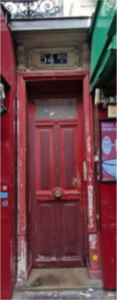
Before the war, Maurice worked as a plumber, an electrician and a mechanic. We do not know if Faïga worked or not, or what she did. During the war, she and her husband lived with their daugther Rosa at 13 Quai Tilsitt in Lyon, in the city’s main synagogue, where they worked as caretakers.
3. Faïga and Maurice Eisner, janitors at the Great Synagogue of Lyon: the attack and their arrest (by Margot et Lola)
The Great Synagogue of Lyon is at 13 quai Tilsitt, in the 2nd district of the city, on the banks of the river Saône. It was the first synagogue in Lyon, built between 1863 and 1864 on the site of an old salt warehouse, and has been listed as a historic landmark since December 1984. It blends discreetly into the surrounding architecture and is not particularly striking.
Maurice and Faïga’s duties as janitors included cleaning the building, opening and locking the doors, ensuring that all the equipment was in good working order, and overseeing various community events.
In 1941, the U.G.I.F. (Union Générale des Israélites de France, or General Union of French Jews)[1] had its headquarters in the synagogue, before they were moved to the Montée des Carmélites, a very old street in the 1st district of the city.
Following the German invasion of the “Free Zone”, in the southern part of France, on November 11, 1942, Jews living in Lyon came under increasing pressure due to the anti-Jewish policies put in place by the German occupiers and Marshal Pétain’s collaborationist government, the Vichy Regime. Roundups and arrests grew more frequent. The Great Synagogue of Lyon also fell victim to the campaign. The Chief Rabbi of Lyon, Bernard Schonberg, was arrested on May 26, 1943, and subsequently deported to Auschwitz.
Later that year, the synagogue was attacked. On Friday, December 10, just after the service began, the congregation began singing and turned toward the main door of the synagogue, as is customary to mark the start of Shabbat. At that very moment, someone threw two grenades into the synagogue and then sped away in a car. Before they entered the sacred building, two men had gone into the janitors’ lodge. Maurice’s wife, Faïga, and two of their children, Rosa and her brother, were inside. The militiamen pinned them up against the wall and ripped out the telephone cable.
8 people were injured in the grenade attack, including Maurice Eisner. According to her daughter Rosa, Faïga went to the police station the following day to give a statement.
The perpetrators were never identified, but the attack was later attributed to the local militia, led by Paul Touvier[2].
On Friday December 17, 1943, a week after the attack, Rabbi Kaplan gave a sermon in the bloodstained synagogue. He told the congregation: “The attackers had planned the attack meticulously; every move they made bears witness to that. They closed the main entrance gate; some of them went into the janitor’s lodge, held the people inside at gunpoint, and then cut the telephone lines; others took up their positions in the courtyard; their main priority was to prevent anyone inside the synagogue from raising the alarm. Now try to picture the man moving forward with his grenades. He was clearly intending to throw them at the most crowded areas. He knew he could go about his business undisturbed because no one would be paying attention; no one would suspect there was any kind of threat. He opened the door. He was completely taken aback. The entire congregation was facing him, staring at him, as if they had been waiting for him, showing no hint of fear. This unexpected sight upset him, frightened him even. He was desperate not to be seen, afraid that he might be recognized someday, so he had only one thought in his mind: to get rid of his grenades. He threw them hurriedly, randomly, quite close to the door, where there were very few people. He only needed a minute. A minute earlier, or a minute later, we would have been praying as usual, facing the Holy Ark, and just think how many of us would have been lost![3]”
As he spoke about the people in the caretaker’s lodge, Rabbi Kaplan mentioned Faïga and her children, as well as a few people warming themselves by the stove, as the synagogue was also used as a shelter for homeless Jews.
On June 13, 1944, the French Militia returned to the synagogue. This time, they burst into the ground floor of the building and arrested everyone they found there: a cleaning lady, a young man, the secretary of the consistory, the rabbi, Benjamin Dreyfus, and Faiga and Maurice Eisner. In a statement she made to a police officer in 1950, Rosa recounted that she had gone out about half an hour before the Gestapo arrived. Afterwards, she went to stay with her sister, Omar Issé, who lived in the Perrache neighborhood in Lyon[4].
Many years later, Rosa Eisner testiifed at Yad Vashem in support of Marie-Louise Hugonnet, a Righteous Among the Nations and a member of the Chief Rabbi’s household staff, who saved his five-year-old grandson, Henri Wallach, by taking him by the hand and whisking the “little blond boy with blue eyes” out of the house “right under the noses of the militiamen[5].”
Shortly after the arrests, the synagogue was looted, vandalised and became a place for the militiamen to drink and gamble. It was then abandoned. After Lyon was liberated on September 3, 1944, it once again became a place of worship.
4. Internment and deportation (by Isyan, Valentin et Maelle)
After they were arrested, Faïga and Maurice Eisner were initially taken to to the Militia headquarters on place Bellecour, then held in the Montluc prison in Lyon until the end of June, 1944.
Built in 1921 as a military prison, Montluc was requisitioned by the German army on February 17, 1943. They and the French Militia used it from then until August 24, 1944. During that time, around 10,000 people were held there because they were Resistance members, Jews, or in some cases both. The prison had 127 cells, 122 of which were only 43 square feet (4m2) and soon became overcrowded. Other buildings were then used as cells for groups.
Men and women were held separately in Montluc, so when Faïga and Maurice Eisner there, they were split up. However, we have no details about which cells they were held in.
In early July, 1944, Faiga and Maurice were told to “pack their bags”—a phrase German soldiers used to mean that they were soon going to leave the prison. They and a number of other internees were then transferred by train to Drancy transit camp, north of Paris. When they arrived, they were each assigned a serial number. Faïga’s was 24,826. There too, men and women were held in separate dormitories. While Faïga had no money or jewelry on her, Maurice had to hand over 9,455 francs during the search, according to his receipt from Drancy, which is held in the French National Archives.
Faïga and her husband remained in Drancy from July 4 through July 31, 1944, when they and 1304 other people were deported on Convoy 77 to Auschwitz-Birkenau. They arrived during the night of August 3-4, after a horrific journey, with barely any food or water, packed into unventilated cattle in the sweltering summer heat and with no sanitation. Some of the deportees perished along the way.
As there is nothing to prove that Faïga Eisner was sent into the Birkenau camp to carry out forced labor, she was most likely sent to the gas chambers and murdered as soon as she arrived. She was later declared to have died on August 5, 1944, two days after she arrived in Auschwitz-Birkenau and five days after she left Drancy.
Her husband, Maurice, according to a doctor from Lyon who knew him in Auschwitz, was killed in the gas chambers following another “selection” in September 1944. This means that when he first arrived, he must have been selected to enter the camp to work.
5. Official recognition of Faïga’s death – administrative procedures and searches (by Emma)
When the war was over, Rosa Eisner-Vogel, one of Faïga and Maurice’s children, searched for her parents among the deportees who made it back to France. She sent requests to the National Movement Against Racism for the Lyon region, which sent them on for further investigation. Her request is dated March 13[6]. It includes information she already knew or had managed to find out:
- Arrested on June 13, 1944
- Interned in Montluc
- Transferred to Drancy
- Deported on July 31, 1944 to Auschwitz on grounds that they were Jewish.
A few months later, when there was still no sign of them, Rosa, who was living with a Mrs. Dumarky at 11 rue de Crimée, in the 4th district of Lyon, set about completing the necessary paperwork to prove that they had been deported and died in the camps.
On March 25, 1948[7], Rosa submitted a request to the Ministry of Veterans Affairs. She asked that her parents’ civil status be updated to that of “non-returned person” On May 4, 1948, the Ministry issued a certificate confirming that Faïga Eisner had not returned to France. This document enabled the applicant to seek a court ruling declaring the person missing, which could subsequently be amended to a ruling declaring the person deceased if he or she was a foreign national and had still not returned after five years (counting from the exact date on which they were deported), or a death certificate, if he or she was a French national.
On May 11, 1949, the Ministry of Veterans’ Affairs and Victims of War stated that they had no further information about what had happened to Faïga Eisner other than that she had spent time in Lyon, then in Drancy, and had arrived in Auschwitz. Given this lack of information, and as it was necessary to determine a date of death, the authorities estimated that the journey from Drancy to Auschwitz took approximately five days. This same method was used to determine the date of death of all deportees who were under 14 or over 55 years old and who never returned home, as it was highly unlikely that they would have been selected to work in the Auschwitz concentration camp. As a result, based on a court ruling dated June 21, 1949, Faïga Eisner’s death certificate states that she died on August 5, 1944, in Auschwitz-Birkenau. Heere death was registered at Lyon City Hall on August 1949[8]. However, survivors later testified that in reality, the people who were sent to the gas chambers were exterminated as soon as they arrived in Auschwitz, i.e., August 3, 1944.
6. Application to have Faïga recognized as having “Died during deportation” and “Died for France” (by Sirine, Ritedj, Melek)
Rosa Eisner, whose married name was Rosa Vogel, worked tirelessly to ensure that her deported parents were never forgotten. She sought to have them officially granted the status of “Died during deportation”. On March 13, 1957, she requested missing persons’ certificates for them. This was part of a broader effort to seek compensation from the Federal Republic of Germany, as concentration camp survivors and relatives of those who died in the camps were entitled to claim damages under war reparations legislation. Rosa had to put together an application to submit to the German consulate in France, which was responsible for processing such claims. Applicants who provided the necessary proof were entitled to a fixed lump-sum payment.
On the same date, March 13, 1957, Rosa asked how to apply for “Political Deportee” status for her parents. Although she received a detailed response from the head of the department for Deportees and Miscellaneous Victims, it appears the she never followed up on this. At the time of writing, the Victims of Contemporary Conflicts Archives Division of the French Ministry of Defense Historical Service holds no record of any such application.
Nevertheless, after she received official confirmation of her mother’s death, Rosa Vogel began another procedure, this time to have her parents officially acknowledged as having “Died for France.” On January 6, 1961, she wrote a formal letter to the Ministry of Veterans Affairs to request this. This move was part of her ongoing efforts to ensure that her parents were formally recognized as victims of the Second World War.
Her request, however was rejected soon afterwards. The French authorities explained their decision by referring to certain official criteria. “Died for France” status was only granted to a person whose death was a direct result of the war.
Only people who were born in France or had been naturalized as French citizens were eligible. Exceptions were made after the Second World War, however, when it was extended to include foreign nationals, both Jewish and non-Jewish, who had resisted the enemy and could prove it, either because they already held “Deported Resistance fighter” status or by providing a certificate from an officially recognized Resistance network leader. At the time, however, this did not include Jewish Resistance networks.
As Faïga and Maurice Eisner were neither arrested for resisting the enemy, nor had they become French citizens, even though their children were born in France and held French nationality, they were not eligible for “Died for France” status, which was more than just an honorary title, as it had certain advantages for their descendants.
On May 15, 1985, the then French President François Mitterrand signed into law Act 85-528, which stipulates that “any person who was deported and died during World War II, shall have the words ‘Died during deportation’ noted on their death certificate.” Rosa therefore began the process of having these words added to her parents’ death certificates. She submitted a file containing all the necessary documentation to the Secretary of State for Veterans Affairs, along with a cover letter requesting that parents be recognized as having “Died during deportation.” After a protracted bureaucratic process, the application was approved and the decision published in the French Official Gazette on August 12, 1987. The town hall in the 2nd district of Lyon was officially notified on November 29, 1988, and the words “Died during deportation were finally added to Faïga’s death certificate on December 21, 1988.
Meanwhile, on December 29, 1974, Rosa Vogel traveled Jerusalem in Israel to visit Yad Vashem, the World Holocaust Remembrance Center, where she filled out testimonial forms in memory of her parents. This gesture bears witness to the fact that Faïga Eisner was a victim of genocide and, in a way, restores her lost identity.
By contrast, Rosa Vogel’s attempts to bring charges in 1973 as part of a class-action lawsuit against Paul Touvier, the regional head of the Second Division of the French Militia in Lyon, were unsuccessful. Her memory of events, given that she was 14 years old at the time, was deemed to be unreliable!9 Rosa also joined the 1987 class action lawsuit against Klaus Barbie, during which she was represented by an attorney by the name of Cohendy.
Faïga Eisner’s name is inscribed on the Wall of Names in the Jewish cemetery in Gerland, in Lyon.
Notes & references
[1] The U.G.I.F., which was founded by the Vichy government on November 29, 1941, was supposed to provide help and support to Jews in France, all of whom were required to join the organization. It took over the assets of all other Jewish associations, which had been closed down. The managers, who were Jewish, were appointed by the C.G.Q.J. (Commissariat général aux Questions juives, or General Commissariat for Jewish Affairs), which liaised with the Nazis on behalf of the French authorities. Its role was controversial, and after the war it was accused by some of having helped to implement the government’s anti-Semitic policies. Almost all of the children cared for by the U.G.I.F. in the Paris area were rounded up and deported on Convoy 77, as were Faïga and Maurice.
[2] Rosa Eisner, Maurice and Faiga’s daugher, who witnessed the event, was one of the people who filed a complaint against Paul Touvier in 1973. She described how the two men forced their way into the janitor’s lodge one of whom was “a blond man with such a cruel look.” In a letter to the public prosecutor, she stated that she had recognized him in a photo published in “La Tribune juive” newspaper; the letter was reprinted with the headline “New Complaint Against Paul Touvier” in the magazine “Notre volonté” in October 1973, p. 2. On December 13, 1979, as reported in Le Monde on December 17, Rosa was interviewed by the chief investigating judge in Paris as part of the investigation into Paul Touvier. The Paris Court of Appeal decided not to charge Paul Touvier with crimes against humanity, and called Rosa’s evidence into question because she was only 14 years old at the time of the events and had got the names of some well-known Jewish leaders mixed up. The Supreme Court upheld that ruling in November 1992. Paul Touvier was then retried, but only in connection with the murder of “seven people of Jewish origin in Rillieux-la-Pape on June 28 and 29, 1944.”
[3] judaisme-alsalor.fr. This sermon was included Chief Rabbi Kaplan’s book Les temps d’épreuve, published by de Minuit in 1952.
[4] From the file on Maurice Isaac Eisner held by the Victims of Contemporary Conflicts Archives Division of the French Ministry of Defense Historical Service, in Caen, ref. 21 P 447 185.
[6] From the file on Faiga Eisner née Marmersztajn held by the Victims of Contemporary Conflicts Archives Division of the French Ministry of Defense Historical Service, in Caen, ref. 21 P 447184.
[7] Rosa Vogel’s application to have her parents civil status updated to that of missing persons, submitted to the Ministry of Veterans and War Victims on March 25, 1948 © From the file on Faiga Eisner née Marmersztajn held by the Victims of Contemporary Conflicts Archives Division of the French Ministry of Defense Historical Service, in Caen, ref. 21 P 447184.
[8] From the file on Faiga Eisner née Marmersztajn held by the Victims of Contemporary Conflicts Archives Division of the French Ministry of Defense Historical Service, in Caen, ref. 21 P 447184.