

 Français
 Polski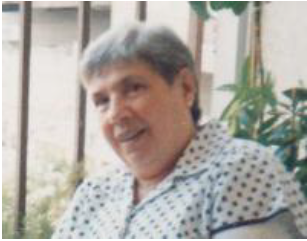
Liliane TIANO (1925-2010)
Photo of Liliane Tiano, married name Lajtenbenrg, taken in Holon, Israël, in 1993.
Norbert Czarny’s private collection.
Liliane Tiano was born on January 15, 1925, at the Rothschild hospital in the 12th district of Paris. She was born into a Jewish family of Greek and Polish descent, although her parents had become French citizens.
She was the third of six sisters, all of whom, like her, had French first names: Yvonne (born October 25, 1921), Adèle (born March 30, 1923, in the 11th district of Paris), Olga Gisèle (born September 13, 1926, in the 11th district of Paris), Jeanine (born November 12, 1928), and Lucienne (born January 19, 1934, in the 12th district of Paris).
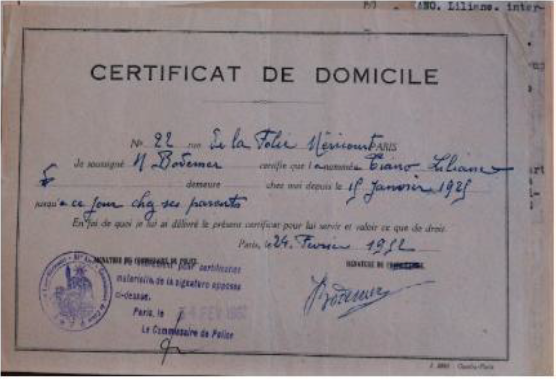
Liliane Tiano’s residence certificate, signed by the police commissioner. Source: File on Liliane Tiano © Victims of Contemporary Conflicts Archives Division of the French Ministry of Defense Historical Service, in Caen, ref. 21-P-682-543-20
Her father, Pinkas Tiano, was born on April 21, 1891, in Thessaloniki, Greece (which was then in the Ottoman Empire. His parents were Avram Tiano and Benouta Capouano. When Yvonne was born in 1921, he was a merchant; he later became a shoemaker, and by 1936, he was a warehouse worker..
Her mother, Palomba Tiano (née Jacob), who was born on February 14, 1901, was also originally from Thessaloniki.
There were numerous Tianos from Thessaloniki living in Paris at the time. No doubt some of them were Pinkas’s relatives. His mother, at least, was certainly living in Paris by then.
Palomba and Pinkas set up home in Paris before their daughters were born. They lived at 22 Rue de Folie-Méricourt in the 11th district, in a small three-room apartment that was part of a larger housing complex (it was home to 103 households in 1936). The majority of the residents were born in France, although a few came from Poland and Italy. According to the 1926 census, Bénouta, Pinkas’ mother, who was born in 1857, was living with them, but she was no longer there in 1931: she was probably in a home or in hospital by then. She died on January 30, 1934, and was buried in the Jewish section of the Pantin Cemetery in Paris on February 2.
In 1936, another Tiano family, originally from Greece, was living in the same building, most likely on the same floor: (Avram) Nathan (who was on the electoral roll in 1934), Doudoun, Albert, Elvire, and Maurice. Yvonne, who by that time was 15, was an apprentice. Liliane must still have been going to the local school.
Pinkas was naturalized as a French citizen in 1929, and from then on became known as Pierre. By 1930, he had registered to vote in his home district of Saint Ambroise. According to Liliane’s nephew, Norbert Czarný, the father ruled over his six daughters like an old-fashioned patriarch. Inspired by his strong sense of patriotism, Pinkas/Pierre fought for France in World War II. (Source: Norbert Czarny)
Liliane was raised in a working-class neighborhood that was home to a large Jewish community, mainly made up of people originally from Turkey and Greece. It was not far from the Marais district, where Ashkenazi Jews ran numerous food stores (bakeries, butcher shops, etc.). Increasing numbers of immigrants settled in this area around that time due to the surge in anti-Semitism in Germany, Austria, Poland and elsewhere.
Liliane went to the la République school, where she learned all about the history of France; she loved reading (source: Norbert Czarny sitaudis.fr).
Liliane enjoyed a peaceful childhood prior to the war, but her life was changed forever by the horror she experienced during the Holocaust.
There is no record of Liliane’s life during the Occupation, a period when the antisemitic laws made life incredibly difficult for Jews in France. They were banned from working in numerous professions and from going to various public places such as parks, movie theaters, and theaters. They were at risk of being rounded up or arrested in their homes at any moment, simply because they were Jewish. Did Liliane continue to go to school, wearing the yellow star? Did she go out to work? Did she and her family flee the city as the German troops were advancing in 1940? Did she live through the bombing? One thing is certain: she was well aware of the risks her family faced because they were Jewish.
Her neighbor, Doudoun Tiano, who was probably related to her father, was arrested and deported on Convoy 44 on November 9, 1942. Among the small number of Jewish families living at 22 Rue de la Folie Méricourt, two other neighbors, one Polish and the other Turkish, were deported following the Vel d’Hiv roundup. Over time, on her street, dozens of people were arrested.
However, even the war and all the suffering it brought with it did not stop Liliane falling in love. Madly in love in fact…
Liliane in love
On July 21, 1944, amid the excitement sweeping through France after the Allies landed in Normandy on June 6, Liliane was arrested on rue des Saussaies, in the 8th district of Paris. According to her nephew, Norbert Czarny, Liliane was out looking for her boyfriend, who had been arrested during a roundup and, her courage buoyed up by her love for him, she became careless. The Gestapo spotted her and arrested her too, “on grounds of her race”, after which she was interned in Drancy camp. Her sweetheart, whose name we do not know, is thought to have met the same fate. Were they deported together?
From 1940 through 1944, the Nazis used a building at 11 Rue des Saussaies, near Place Beauvau, as the headquarters of the Sipo (Security Police) – SD (Security Service), which included Section IV, better known as the Gestapo. SS-Obersturmbannführer Kurt LIschka, who was one of the key organizers of the roundups and deportations in France prior to April 1943, had turned the building into a place of sheer terror. Numerous interrogations and torture sessions took place there, targeting in particular Resistance fighters and Jews, and of course Jewish Resistance fighters. Was Liliane held there before she was taken to Drancy? We do not know.
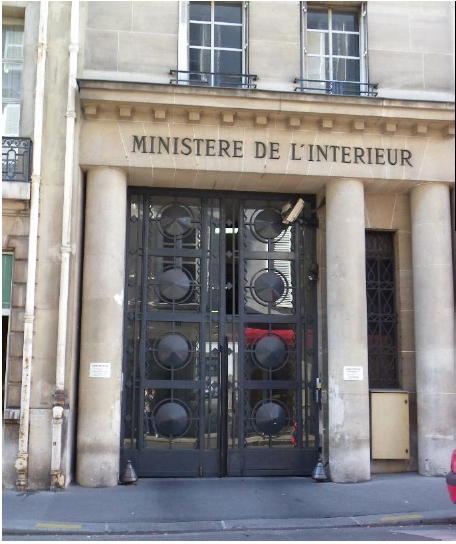
Photo of the former Gestapo headquarters at 11, rue des Saussaies, near place Beauvau in the 8th district of Paris. Liliane may have been detained there for a short time before she was transferred to Drancy. Once the headquarters of the French National Security Agency, prior to the arrival of the Germans, it is now occupied by various departments of the French Ministry of Internal Affairs Source: Wikipedia
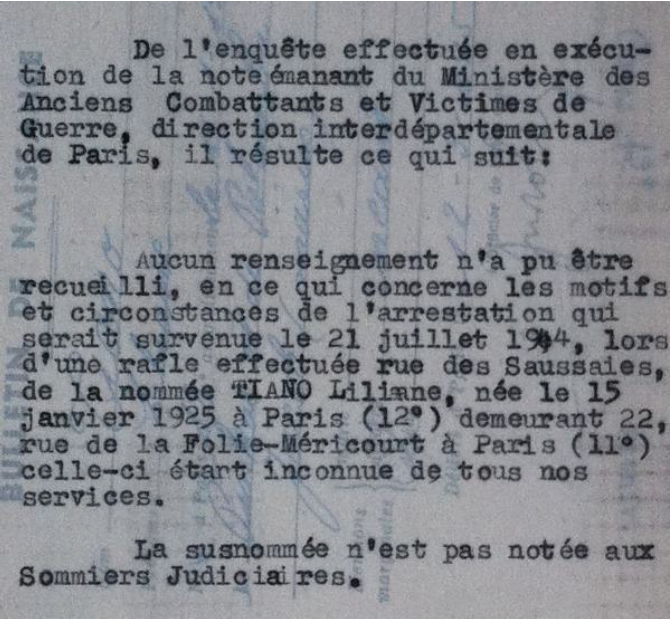
Report on Liliane Tiano’s arrest
Source: File on Liliane Tiano © Victims of Contemporary Conflicts Archives Division of the French Ministry of Defense Historical Service, in Caen, ref. 21-P-682-543-17
Auschwitz
Liliane was interned at the Drancy transit camp north of Paris, in what is now the Seine-Saint-Denis department of France (then the Seine department) on July 21, 1944. When she arrived, she was assigned the serial number 25,336. She only had 35 francs on her, a very small sum of money at the time, which she had to hand over to the authorities. She was 19 and a half years old.
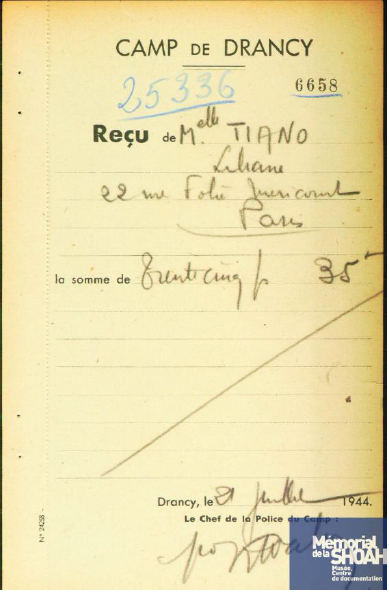
Liliane Tiano’s search receipt from Drancy camp
Source: Shoah Memorial
On July 31, 1944, after ten days spent in appalling conditions in the “antechamber to Auschwitz”, which was run by the infamous Nazi Aloïs Brunner, Liliane and 1,305 other prisoners were deported on Convoy 77, bound for Auschwitz-Birkenau in Poland.
The train arrived during the night of August 3-4, 1944. As soon as the prisoners got out of the cattle cars onto a platform known as the ramp, deep inside the camp, Liliane and around 180 women were selected to enter the Birkenau camp to work. The dehumanization process began immediately: first she was humiliated by being forced to strip naked and having her hair shorn and her body hair shaved. Then, on the third day, she was tattooed with a registration number that was aimed at stripping her of her identity by reducing her to a mere number: A 16 819, which she had to learn by heart in German. She was beaten and left with nothing of her own, but instead made to wear tattered clothes taken from women who had been put to death in the gas chambers. Forced to work like a slave and destined to die, still Liliane managed to survive.
Kratzau
After another “selection” in the camp on October 27 or 28 (the 27th according to Yvette Levy née Dreyfuss, the 28th according to Suzanne Boukobza née Barman and Régine Skorka), which was carried out by SS doctors, possibly including Dr Mengele himself (according to the testimony of Yvette Dreyfuss), Liliane and around 120 of her fellow Convoy 77 deportees were sent to work in another camp. They were transported by train, more than a hundred of them all crammed in together, to Kratzau, a subcamp of the huge Gross Rosen camp in the Sudetenland in Czechoslovakia. Liliane was assigned a new prisoner number: 84,164.
Liliane and the other women in her barracks, who were French and Dutch, were assigned to work in a munitions factory about two and a half miles from the camp. They had to walk there in the morning and back again in the evening, after a 12-hour shift. The working conditions were extremely tough; the kapos, the SS commander, and her assistants were ruthless, and typhus was rampant. Despite all this, Liliane managed to hold out until she was liberated. On the morning of May 9, 1945, the deportees woke up to find themselves alone. The German soldiers and the SS had fled during the night. A short time later, a Soviet tank rolled into the camp.

Liliane Tiano’s persecution record, from July 31, 1944, until she was liberated. When she arrived in the sauna at Birkenau, Liliane had the number A 16819 tattooed on her arm.
Source: File on Liliane Tiano © Victims of Contemporary Conflicts Archives Division of the French Ministry of Defense Historical Service, in Caen, ref. 21-P-682-543-6
Liliane’s return to France
The war was finally over (source: testimony of Suzanne Boukobza née Barman, Convoy 77 website), or almost: Liliane and her campmates still had to get back to France, and the Red Army, which had liberated the whole area, had made no plans to help the deportees. The fact that there was no food meant that the women had to fend for themselves, which put them at constant risk of being raped and abused by the very men who had liberated them. Some took to the roads on foot, travelling in small groups, as recounted by the Bloch sisters, among others.
At long last, Liliane arrived at a reception center in Longuyon, France, and from there she was sent by train to Paris, where she arrived on May 30, 1945. She was one of only 157 women who were deported from Drancy on July 31, 1944, to survive the hell of the concentration camps. She was extremely weak, having lost nearly 18 pounds, and, like most of her fellow internees, suffered from gynecological complications. Her body and overall health were profoundly and permanently damaged by the months of violence and starvation.
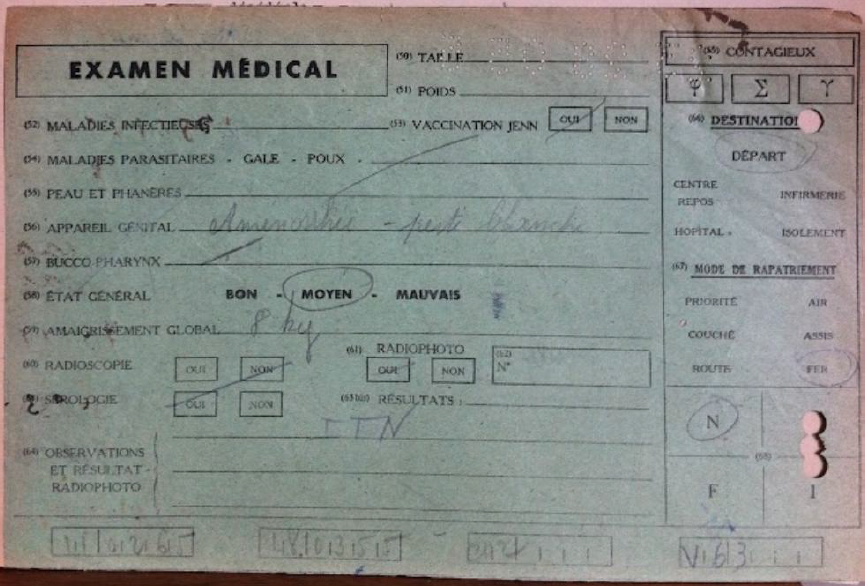
The results of Liliane’s medical exam, carried out when she returned to France
Source: File on Liliane Tiano © Victims of Contemporary Conflicts Archives Division of the French Ministry of Defense Historical Service, in Caen, ref. 21-P-682-543-11
Liliane was then taken in by the SSJ (Social Service des Jeunes, or Youth Social Service), a Jewish young people’s resistance movement that later became a mutual aid organization that helped deportees readjust to civilian life after the trauma they had experienced in the camps.
After the war, soon after she turned twenty-on, Liliane became a seamstress in a clothing factory. It was then that she met Szlamek Lajtenberg.
Marriage
Szlamek (Chaïm, Schlomo, Henri) Lajtenberg was born on July 16, 1919 in Sosnowiec in Poland, the same town in which Liliane’s mother, Palomba, was born. He had managed to flee to the Middle East when the Nazis invaded Poland. None of his brothers and sisters, who stayed behind in Poland, survived. His brother Dawid died in Warsaw in 1944 while fighting with the Polish army.
Liliane and Szlamek were married in the town hall of the 11th district of Paris on June 11, 1959. They then moved in with Liliane’s mother in the family apartment on Rue de la Folie Méricourt. Liliane’s father had died in October 1958 and was buried in the Pantin Cemetery. Liliane and her husband, with his handsome blue eyes and “devastating sense of humor” (according to Norbert Czarny), worked from home as dressmakers. Szlamek later worked in the stockroom in the famous Galeries Lafayette department store in Paris. In the late 1950s, Liliane fell into a deep depression, brought about by her time in the camps during the war.
Liliane and Szlamek were unable to have children, as Liliane’s health was permanently affected by her struggle to survive in the camps. She therefore focused her love and attention on her nephews and their children. To take her mind off the suffering and anxiety that tormented her constantly, she played piano – in particular her favorite piece, “Letter to Elise” – listened to Beethoven, and spent her time reading (including works by Victor Hugo and Roger Martin du Gard).
She and her husband also attended events organized by the Sosnowiec Society. Jewish mutual aid societies, most of which were founded in the 1910s and 1920s, experienced a resurgence in the aftermath of the Holocaust. Many families were decimated; some simply ceased to exist. Elderly parents never saw their deported children again, while widows and widowers sought to rebuild their lives and families and in some cases remarry. The mutual aid societies sought to bring survivors together, to support them, and to encourage solidarity between the members. They held various social events, including meals, provided financial support and helped compile books of remembrance called Yizkor Bikher (a Yiddish term). They collected photos to remind the community of people who had perished and to preserve memories of places that had been erased by the Holocaust. They also celebrated religious holidays and supported youth programs and places of worship, among other things.
Liliane was also a member of the Amicale d’Auschwitz, (Auschwitz Friendly Society), which was founded in June 1945 in order to bring camp survivors together during regular meetings and for an annual get-together. It was a way for them to keep bad memories at bay and, most importantly, to enjoy some happier times together. (source: Norbert Czarny)
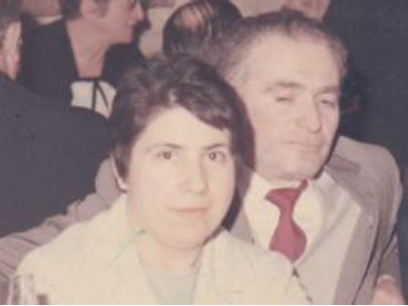
Liliane and Szlamek (Chaïm) at the Amicale d’Auschwitz annual ball in 1968
Norbert Czarny’s private collection
Liliane, who had suffered terrible hardship in the camps, understood the value of a sliver of bread and the importance of solidarity in getting through hard times—she never forgot that. She gave freely and generously to folk in need, according to her nephew.
Liliane spent the rest of her life between Paris and Holon, near Tel Aviv in Israel, together with her husband, Szlamek. She died in the 12th district of Paris on November 7, 2010 at the age of 85., Her husband died two years later, on April 26, 2012, also in the 12th district of Paris. They are buried in the Bagneux cemetery in Paris, in a communal grave belonging to the Sosnowiec Society, with the women on one side and the men on the other, in accordance with Jewish tradition.
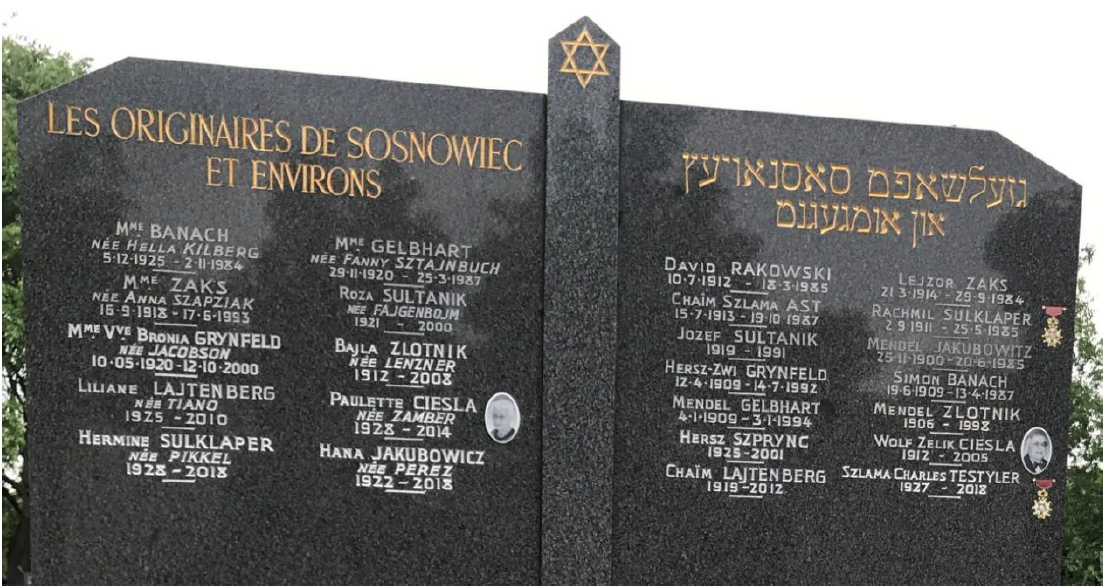
The gravestone at the Bagneux Cemetery in Paris, which bears the names of Liliane and Szlamek (Chaïm) Lajtenberg. Source: Geneanet
Liliane’s sister Adèle also passed away in 2012. Gisèle and Yvonne (married name Allaman) died in 2021, Jeannine in 1923 and Lucienne in 2025, all of them in France.
Liliane Tiano’s name is inscribed on the Wall of Names at the Shoah Memorial in Paris.
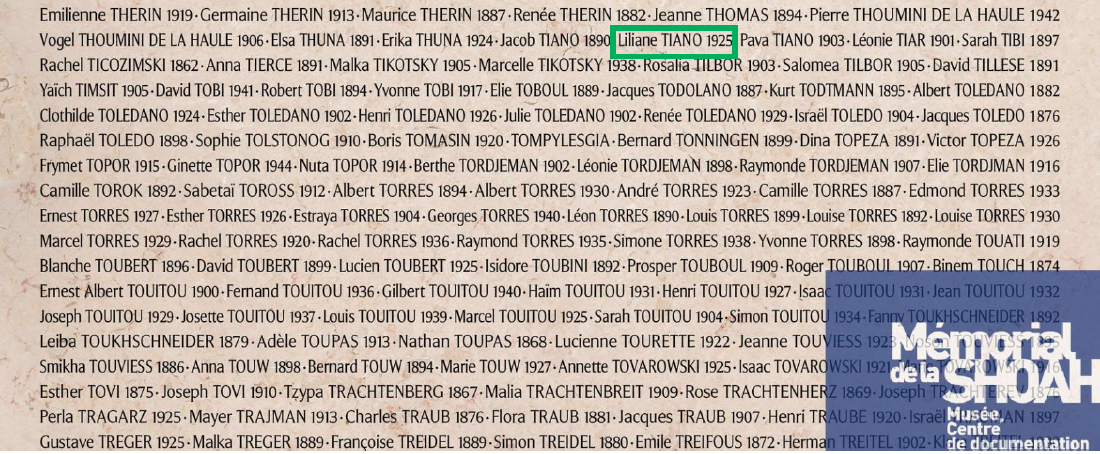
Liliane Tiano’s name on the Wall of Names at the Shoah Memorial in Paris
Source: Shoah Memorial
The story of the persecution of Liliane Tiano was retraced by Jade, Eloan, Maïmouna, Logan, Maïa, Lanceline, Malone, Flora, and Anthony, 12th grade students from classes A and G at the Jacques-Cartier High School in Saint-Malo, in the Ille-et-Vilaine department of France, with the guidance of their history teacher, Stéphane Autret.
We would like to extend our heartfelt thanks to Mr. Norbert Czarny, a writer and literary critic who was very close to Liliane and who kindly shared some personal information with us, as well as his treasured photo collection. He also wrote a wonderful piece about Liliane, which you can read (in French only) at sitaudis.fr
In addition to the family archives, we supplemented our research with Liliane’s application for political refugee status. It is held by the Victims of Contemporary Conflicts Archives Division of the French Ministry of Defense Historical Service, in Caen, Normandy, under reference number 21 P 682 543. Birth and death certificates, census records, and burial registers are available on the Paris City Archives online website or, for some depending on the dates, at the local town halls (11th and 12th districts of Paris).
Lastly, we recommend Régine Skorka-Jacubert’s book Fringale de vie contre usine à mort, published by Le Manuscrit (2009), and the online testimonies of Yvette Levy Dreyfuss and others, as mentioned in the biography, about being deported on Convoy 77, their time in the camps, and their return to France.


