

 Français
 Polski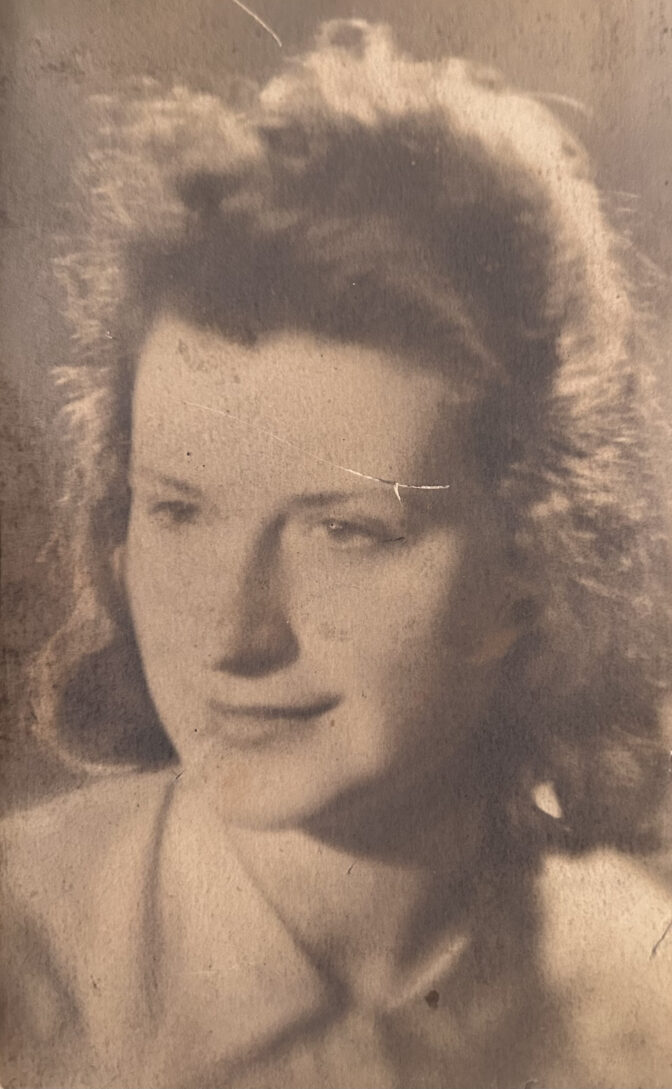
Thérèse MEISTELMAN (née BRODSKY)
Photograph of Thérèse Meistelman, undated © Michel Brodsky’s personal collection
The “En …quête d’histoire” (“In search of history”) workshop at the Fosse aux Dames secondary school in Les Clayes-sous-Bois, in the Yvelines department of France, carried out another historical investigation this year. With the guidance of their teachers, Marie Hurtevent and Géraldine Kerserho, students Joanna Barbosa, Loris Bocquet, Léonie Boitrelle Gaechter, Milla Boulanger-Daleau, Emma Braz-Rente-Moitron, Lina Cuccina-Beucher, Zoé Granjou, Rebecca Karlin Perrier, Mathis Opresco, Perrine Ragazzini, Tea Sheremeti and Manel Turmeau, set out to retrace the steps of a young Jewish woman, Thérèse Meistelman, and her husband, Isaac Meistelman.
There are few immediate traces of Thérèse Brodsky-Meistelman in the archives. Piecing together her journey leading up to her deportation involved widening the search to include her father’s family, the Brodskys, and her mother’s family, the Gorskys. The students managed to track down some of Thérèse’s distant cousins, who live in the United States and New Zealand. We contacted them by email, and they told us about someone who had first-hand knowledge of Thérèse’s latter years: her nephew, Michel Brodsky. The students wrote him a “message in a bottle” type letter and sent it to his last known address in Paris.
They enclosed a photograph of a little boy sitting on Thérèse’s lap: “We found a photo of Thérèse with her nephew, Michel. Do you recognize this boy? Are you perhaps the Michel we are looking for? If so, do you have any information about Thérèse, Isaac, and their families, and please would you be willing to help us with our research? We would be delighted to discuss our project with you. You can contact us by mail or by phone.” And so it was, with much emotion, that Marie Hurtevent received a phone call from Michel Brodsky, the first in a series of conversations, which culminated in a visit to his home last June.
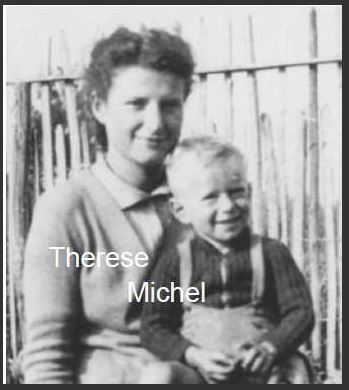
Photo of Thérèse and her nephew Michel © Ancestry
In search of the Brodsky family…
Thanks to the genealogy website, Ancestry, we were able to piece together the Brodsky family tree. Thérèse Brodsky came from a Jewish family originally from the Russian Empire. Her parents were Leiba Brodsky and Luba Gorsky.
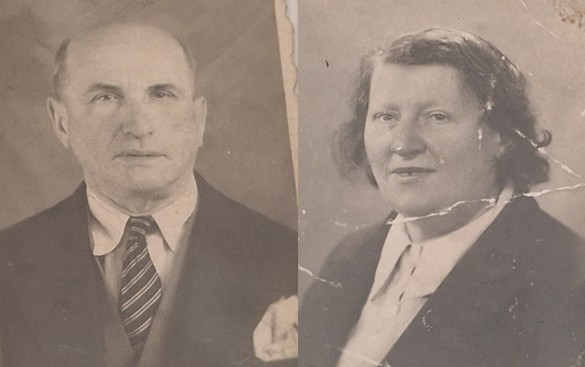
Leiba and Luba Brodsky, undated © Michel Brodsky’s personal collection
The Brodsky family originally came from Tiraspol in the Russian Empire (now in Moldova). We were able to identify Thérèse’s paternal grandparents from the family tree that her American cousins had made on Ancestry: Hersh Brodsky and Hava (or Eva) Brick. The grandfather, Hersh, had apparently died in Russia before the rest of the family emigrated to France. It was therefore Hava, who was born in 1859[1], who fled Russia with her four children in 1905 or 1906. The eldest son, Moïse, set up home in France with his wife, Hava, and their three children (two of whom died shortly after moving to Paris). As for Hava, she and her other three children, Salomon, 19, Rebecca, 18, and Leiba, 13, (Thérèse’s father), moved into an apartment at 47 rue Championnet in the 18th district of Paris.
Thanks to their American relatives, we were thus able to trace the life stories of the various branches of the Brodsky family
Moïse Brodsky, who was born in 1878, married Hava Poustilnikov (1880-1946). They had five children, two of whom died when they were young. Moïse lived in Paris and died in 1933. His wife and their other three children, Esther (1905-1967), Samuel (1908-1997) and Louise (1907-1998), all survived the war. During our investigation, we also discovered that her daughter Esther Brodsky (who later became Esther Serf) was the mother of the well-known French singer, Barbara. Barbara was therefore Thérèse Brodsky’s second cousin.
Salomon Brodsky, who was born in 1886, got married in Paris in 1909. He had his first child in France, but his wife died soon afterwards. He then moved to Manchester, in England, leaving his daughter Louise behind in Paris. He married his second wife, Minnie Goldberg in 1914. The couple had seven children, some of whom emigrated to the United States. He died in London in 1964.
Rebecca Brodsky, who was born in 1887, was married twice. Her second husband was Benjamin Goldstein, and they had two children: Jacques (1913-1979) and Thérèse Goldstein (1919-1989). Rebecca died in Paris in 1955.
… and the Gorsky family
Luba Gorsky’s parents were Boris Gorsky and Rachel Jaïfa. When Luba got married in 1913[2], she declared that both of them were dead. This was not actually the case, however, since we found some records relating to Rachel Jaïfa (married name Gorsky), who died in Paris and was buried in the Bagneux cemetery.
Luba was born in Nageisk, in the Russian Empire, on January 16, 1892. We have not been able to pinpoint where this place is. However, based on the birthplaces of other members of the Gorsky family, we know that the family was originally from Crimea, which belonged to the Russian Empire at the time but is now in Ukraine. Luba most likely moved to France with her mother in or around 1906. Two of her brothers also made their home in Paris: Abraham (known as Albert, 1880-1938) and Salomon Gorsky (1891-?). They were witnesses at Luba’s wedding, and signed the marriage certificate. Both are described as merchants.
We do not know what prompted Luba Gorsky to emigrate to France. The various family members appear to have settled in Paris shortly after they arrived in the country. As far as her grandson remembers, Luba could neither read nor write French, but spoke it reasonably well. The same was true of her husband, Leiba,
Thérèse, the youngest daughter of a family of second-hand clothes dealers
On June 24, 1913, Leiba Brodsky married Luba Gorsky in the town hall of the 18th district of Paris. There were both living at the same address: 47 rue Championnet, also in the 18th district. Were they already living together, or were they renting different apartments in the same building? This remains a mystery. Leiba’s older brother, Moïse Brodsky, and Luba’s brothers, Albert and Salomon Gorsky, were witnesses at the wedding.
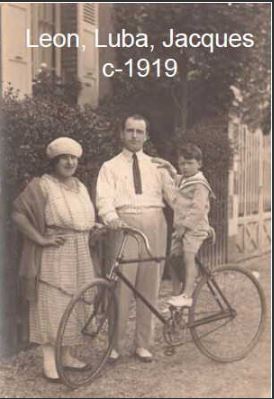
Photo taken in Deauville, a seaside town in northwest France: Leiba, Luba and Jacques
© Ancestry
The couple went on to have three children:
Jacques was born on September 1, 1914, at 2 Rue de Candie in the 11th district of Paris. The family was living at 9 Rue Neuve-des-Boulets at the time[3].
Thérèse was born on June 1, 1920 in the Lariboisière hospital on rue Ambroise-Paré in the 10th district of Paris. By that time, the family was living at 67 rue Marcadet in the 18th district[4].
Claire was born at 8pm on January 12, 1925 at the Rothschild hospital at 15 rue de Santerre, in the 12th district of Paris. The family was still living at 67 rue Marcadet[5].
These addresses provide at least a partial record of where the Brodsky family lived between 1913 and 1940. They moved around a lot over the years, sometimes living in the city of Paris and sometimes in the suburbs.
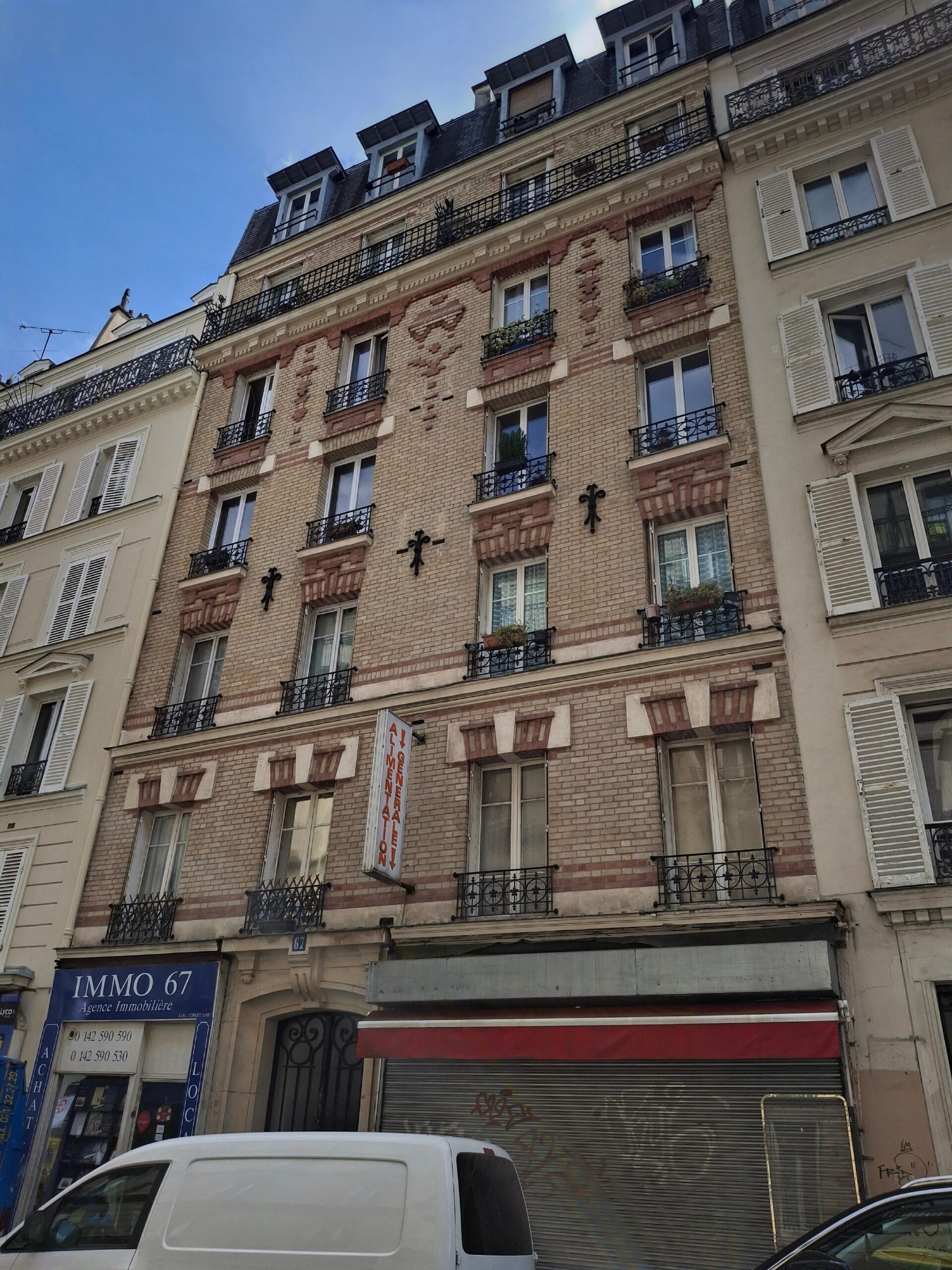
Recent photo of 67 rue Marcadet
© Marie Hurtevent
In 1920, the Brodsky family was living at 67 Rue Marcadet, in the 18th district of Paris. They had probably been there for some time. The 1926 census[6] reveals that by that time, they had a housemaid called Raymonde Gallois. This suggests the they were fairly well off, likely due to Leiba’s clothing business. He had been a secondhand clothes dealer for several years. A police report dated March 24, 1921, sheds some light on the Brodsky brothers’ business ventures[7]: “At the start of hostilities, [Salomon] and his brother Leiba, born on May 1, 1892, in Tiraspol, Russia[8], living at 67 Rue Marcadet, began manufacturing military apparel in a premises located at 27 Rue de la Folie-Méricourt, but they gave up this business shortly afterwards.” After this initial venture, Leiba opened a second-hand clothing store at 5 rue Dupuis[9], in the 3rd district of Paris, with an annex at 9 rue de la Corderie. This business appears to have been very successful. We found references to it in the 1926 and 1930 Didot-Bottin directories[10], which are available on the French National Library website, Gallica. We also found a company letterhead, which describes the business as follows: “Léon BRODSKY. General store for the purchase and sale of all goods not listed on the stock exchange.”[11]
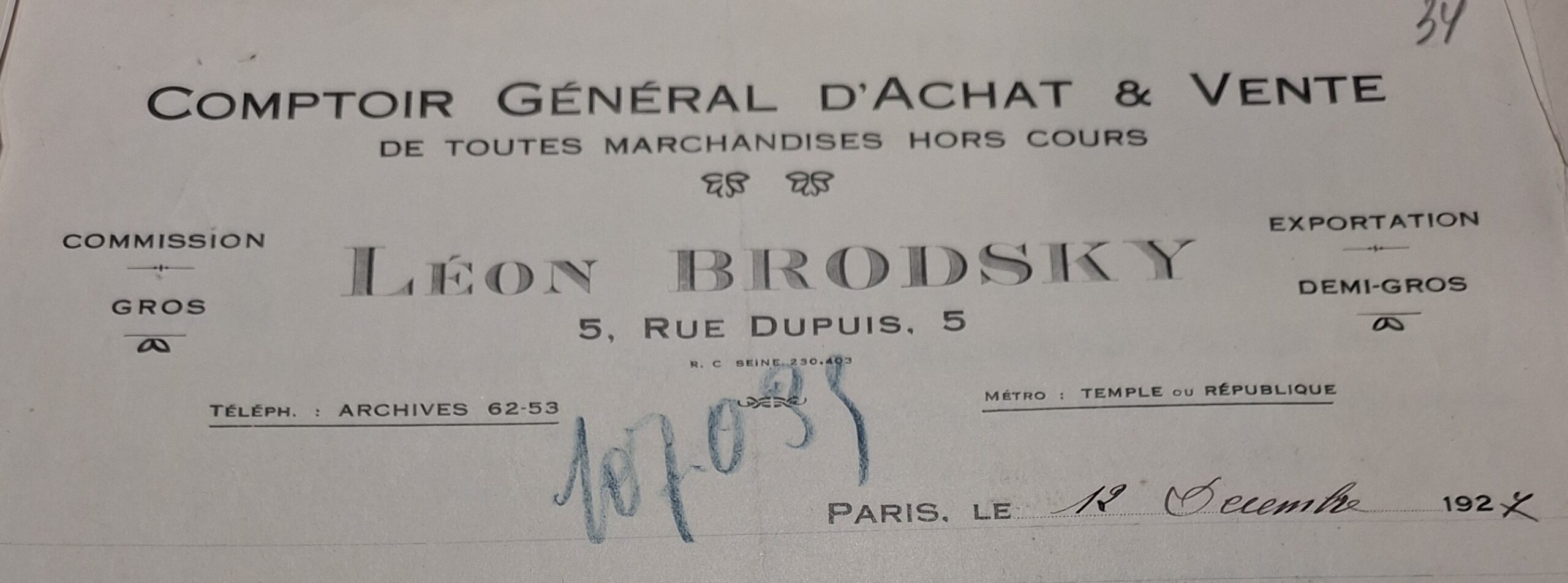
Leiba Brodsky’s company letterhead, from the file on Peretz Gorsky
© French National Archives, Database of the National Security Agency, ref. 19940448/336
In 1926, Leiba began the process of applying for French citizenship for his entire family. For the three children, he applied for naturalization by declaration, given that Jacques, Thérèse, and Claire had been born in France. They thus became French citizens in May 1926[12]. In August that year, he filed a request for naturalization for his wife Luba and himself, based on ”his long period of residence in France and as his three children are French.”[13]. He stated that his annual turnover was between 75,000 and 80,000 francs, which proved that his business was doing well. Leiba and Luba were granted French citizenship in 1927.
In 1928, Leiba had to complete a period of military service. His army service record[14] states that he was assigned to a horse-drawn transport unit. Due to his “obesity” and “sciatica,” and because he was the father of three children, he was assigned to the auxiliary service.
We know very little about Thérèse’s relationship with the rest of the Gorsky and Brodsky families. However, we gleaned from certain records that Leiba and Luba helped out their siblings in times of need. For example, they took in one of Luba’s brothers, Peretz Gorsky[15] and his wife when they first arrived in France in the fall of 1927.
That same year, on July 8, Thérèse’s maternal grandmother, Rachel Gorsky (née Jaffe or Yoffa) died in Paris at the age of 73[16]. It appears that she had been living alone in the 18th district of Paris. She was buried three days later in a communal grave in the Bagneux cemetery, paid for by a charity, the Carreau du Temple friendly society.
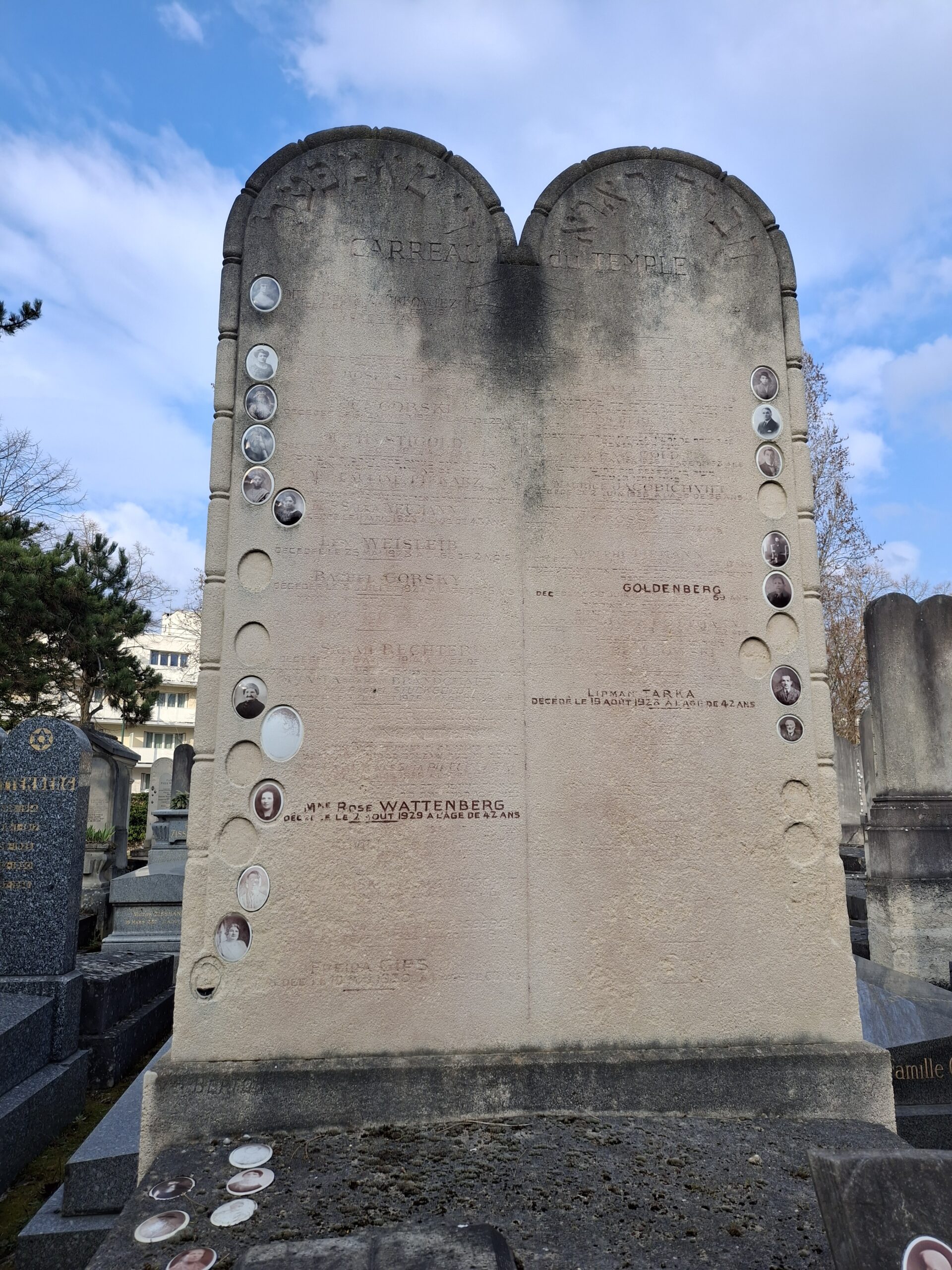
Rachel Jaffa Gorsky’s tomb in the Bagneux cemetery
© Marie Hurtevent
Several times during the 1920s, the Brodsky family went to the Normandy coast on vacation. A handful of family photos offer a glimpse into Thérèse’s carefree childhood, during which she was lucky enough to go to the beach with her family quite often.
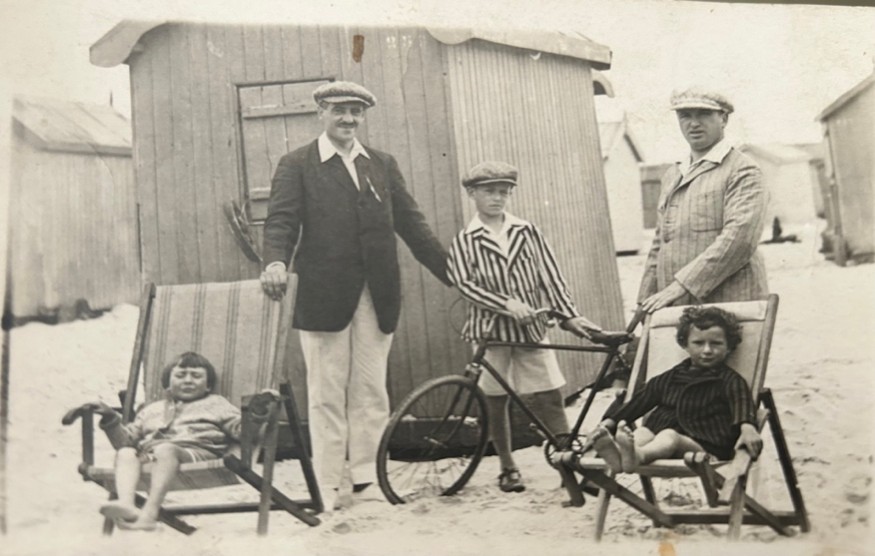
Photo taken on vacation, date unknown. On the right-hand side, Jacques holding a bicycle, Thérèse sitting in a deckchair and Leiba standing behind her © Michel Brodsky’s personal collection
In July 1928, the family left the city and moved to 10 rue Poyer in Clichy, in the Hauts-de-Seine department. The 1931 census listing[17] again includes a housemaid, Juliette Delrot (born in 1909 in Belgique) living in the Brodsky family. home. The family clearly lived in a house, albeit possibly a small one, as there is only one household listed at number 10. The neighborhood has changed since then, however, and the house that stands there now is far too new to be the one in which Thérèse once lived.
We found no record of Thérèse Brodsky having been enrolled in any of the nursery or elementary schools in the vicinity of 67 rue Marcadet, although she must have gone to school somewhere. When the family moved to Clichy, she would have had to change schools, but there are no records for that municipality for that period in the departmental archives.
On April 20, 1931, when Thérèse was 11 years old, her paternal grandmother, Hava Brodsky, died at the age of 72 in the Tenon hospital in Paris[18]. She was buried in the Bagneux cemetery in what later became the Brodsky family vault. Hava was buried in the Bagneux cemetery in what later became the Brodsky family vault. As there is no one still alive who knew them, we do not know how close a relationship Thérèse had with her grandmother.
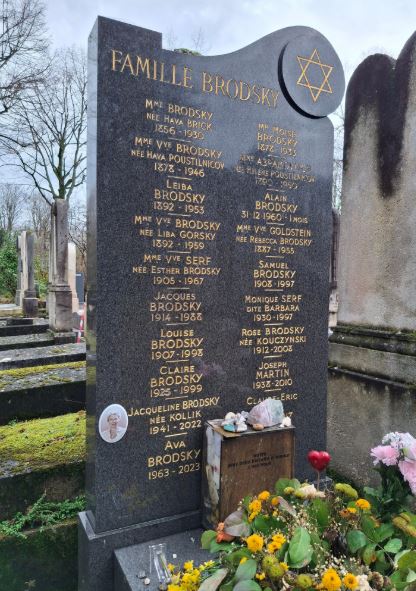
The Brodsky family vault in the Bagneux cemetery
© Marie Hurtevent
In March 1933, Thérèse and her family moved back into the city, to 14 Rue du Ruisseau, once again in the 18th district. By 1936, there was no maid listed in the census[19]. It therefore appears that the family’s financial circumstances had taken a turn for the worse. The fact that Leiba’s secondhand clothing store went bankrupt at the end of 1932 would seem to confirm this.
The family’s move back to Paris enabled us to identify one of the schools that Thérèse went to: it was a girls’ elementary school at 65 Rue Damrémont, in the 18th district of Paris. Thérèse was enrolled there from October 1932 through July 1934[20]. She was in 5th grade from October 1932 through July 1933, then probably continued in remedial classes in the 1933-1934 school year. We found no record of her having passed her elementary school certificate, however, and the register does not include a final assessment when she left.
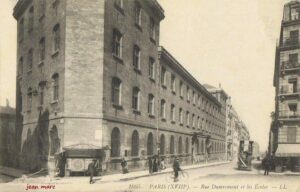
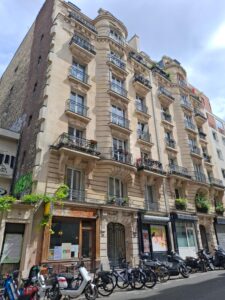
Photo 1: Old postcard of the schools on rue Damrémont © www.cartorum.fr
Photo 2: Recent photo of 14 rue du Ruisseau © Marie Hurtevent
Thérèse was not the only one who started school that year; her sister, Claire, started first grade. She stayed there for all of her compulsory education, and left in October 1939. Her end-of-school report reveals that she found the work challenging[21].
Leiba is listed in the 1936 census as a secondhand goods dealer[22]. We do not know who he was working for, but his grandson explained that he was barred from starting a new business since he had previously gone bankrupt. We believe that his son, Jacques, must have started the business where his father worked. It appears to have been another secondhand clothing store.
On June 16, 1938, in the town hall of the 18th district of Paris, Jacques Brodsky married a young dressmaker called Rose Kouczynski, who was born on April 18, 1912, in the 10th district. Her parents were Arié Kouczynski and Meita Smilovici, both of whom were tailors and were naturalized French citizens. The witnesses to the marriage were Jacques’s first cousin, Jacques Goldstein, and Rose’s mother, both of whom signed the marriage certificate[23]. Jacques left the family apartment on Rue du Ruisseau and moved to 6 Rue Montcalm, just a short distance away. The following year, 1939, Jacques and Rose had a son, Michel. This is the same Michel we met, and who kindly shared photos and information about his paternal family with us.
In 1940, the family began a new chapter on its entrepreneurial journey. According to Les Annonces de la Seine dated April 29, 1940, Jacques Brodsky founded a limited liability company in partnership with his mother, Luba. It was called Jacques Brodsky et Compagnie and specialized in wholesale second-hand clothing sales. Each of them put in 25,000 francs, which shows that they were relatively well-off at the time. Luba Brodsky put in 20,000 francs and a Citroën car worth an estimated 5,000 francs, while Jacques bought out a wholesale second-hand clothing business that had been operating since 1937, including its customer list, with an estimated value of 25,000 francs.
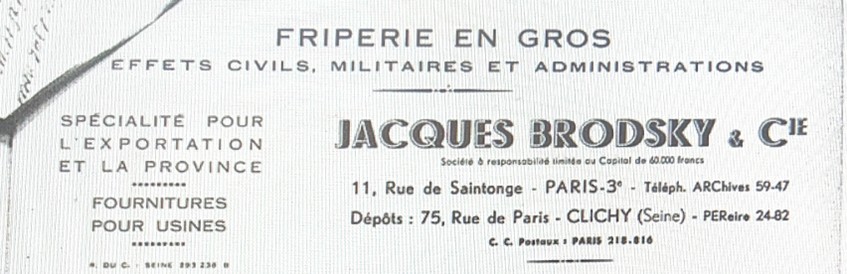
The Jacques Brodsky company letterhead. Spoilation file
© French National archives, ref. AJ38/1586, file no. 5650
Leiba Brodsky was appointed manager of the firm, but was not allowed to own shares in it due to having gone bankrupt in 1932. There were 50 shares in total, of which Jacques and Luba held 25 each. The business was based in Jacques’ existing premises at 11 rue de Saintonge in the 3rd district of Paris, which it rented from him for 3,500 francs a year, and an apartment at the same address, which it rented for 1,200 francs a year. As of April 1939, Jacques had also been renting a warehouse at 75 rue de Paris in Clichy for 5,200 francs a year[25].
This happened at around the same time that Leiba and Luba Brodsky and their daughters moved to 84 Damrémont Street in Clichy, just across the street from the Thérèse and Claire’s old school. Thérèse, who was 20 in 1940, continued to live there throughout most of the German occupation.
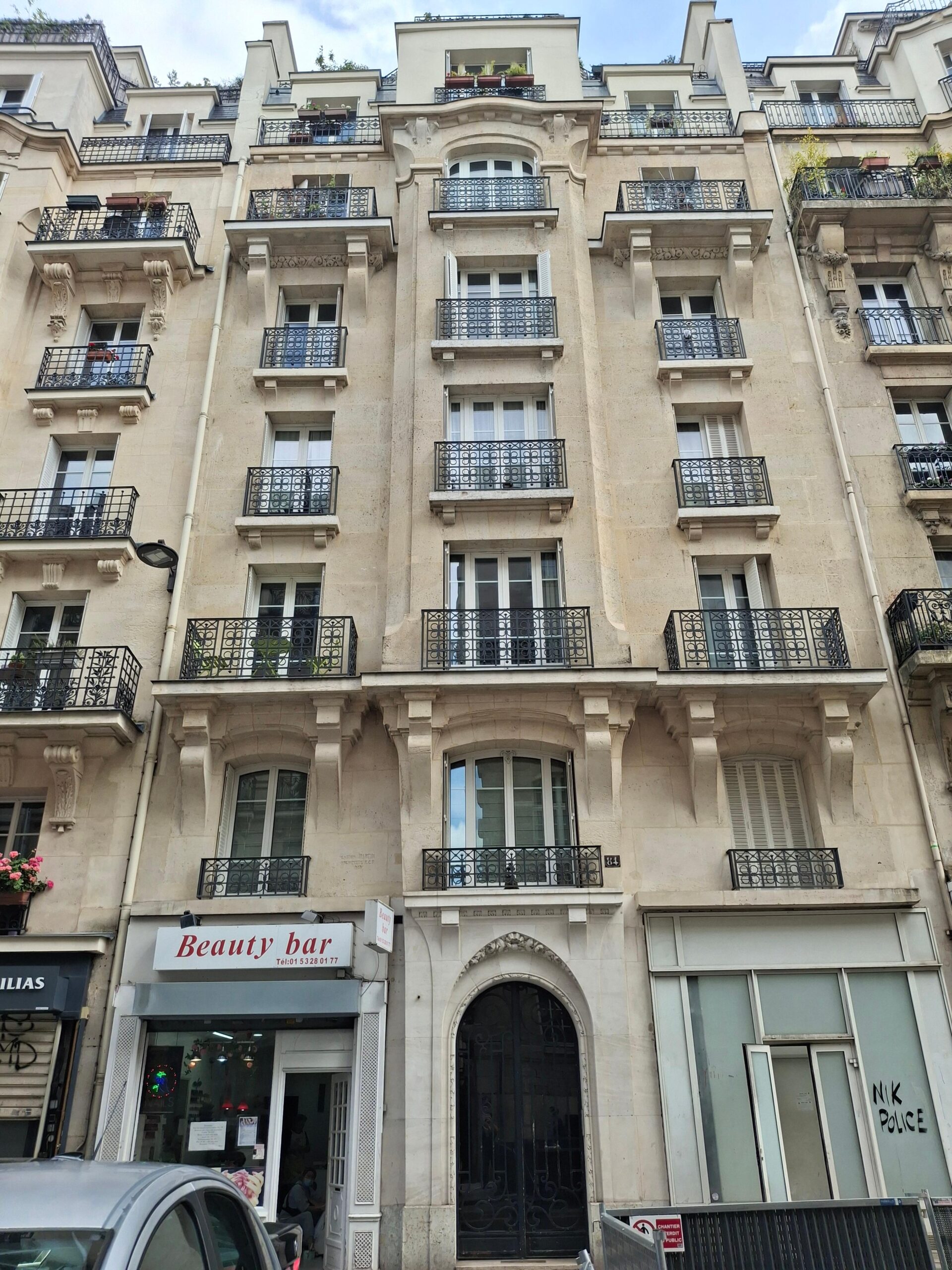
Recent photo of 84 rue Damrémont © Marie Hurtevent
Thérèse, a young Parisian woman hit hard during the Occupation and by the anti-Semitic legislation
During one of our conversations, Michel Brodsky told us that, towards the end of May or in early June 1940, he and his parents hastily left Paris in order to escape before the Germans arrived. As he recalls, his grandparents and two aunts travelled with them. They took refuge in Saint-Palais-sur-Mer, in the Charente-Maritime department, where the authorities found them a house. However, after the armistice was signed on June 22, 1940, the family felt it was safe enough to head back to Paris.
We know very little about what Thérèse’s life was like during the Nazi occupation. We do know, however, thanks to Michel, that some of the Brodsky family tried to escape to the “free” zone, in the southern part of the country: “During the occupation, according to what I’ve been told, our family wanted to get out of Paris. We hired a van and a people smuggler, but we were pulled over near Arpajon and robbed. After that, we told the driver to take us back to Paris. We made it through that time.”
On October 3, 1940, the French government passed a decree that required all Jews had to take part in a census, which involved registering with their local prefecture. We were unable to find the census records for all of the family members, but the family must have adhered to the legislation, and at least one of them went to the police station in the 18th district in 1940 and 1941. This is confirmed by U.G.I.F. membership records. The French government founded the U.G.I.F. (Union Générale des Israélites de France, or General Union of French Jews) in November 1941, at the behest of the Germans. It replaced all other Jewish associations in the country. It was responsible for administering welfare benefits for Jews and for acting as the sole point of contact with the French and German authorities. All Jews were obliged to join it. On December 14, 1941, the German authorities levied a collective fine of a billion francs on the Jews living in the occupied zone in retaliation for attacks on German soldiers. The U.G.I.F. had to pay this sum, which was financed by a compulsory contribution from each of its members. In order to keep track of the contributions, the U.G.I.F. compiled a register of all members over the age of 15 who lived in the occupied zone. Each person’s record included their U.G.I.F. membership number, personal details, identity card number, the place where they registered (in accordance with the 1941 decree), and check boxes for recording the dates on which their payments were made.
We found the digitized records for the entire Brodsky family. Thérèse’s entry, numbered 3940[26], is the first. Her brother Jacques’s is the last entry in the series, at number 3946[27]. These records confirm that the family did indeed register themselves as Jews and that they all paid their membership fees on August 17, 1943, and again on February 18, 1944.
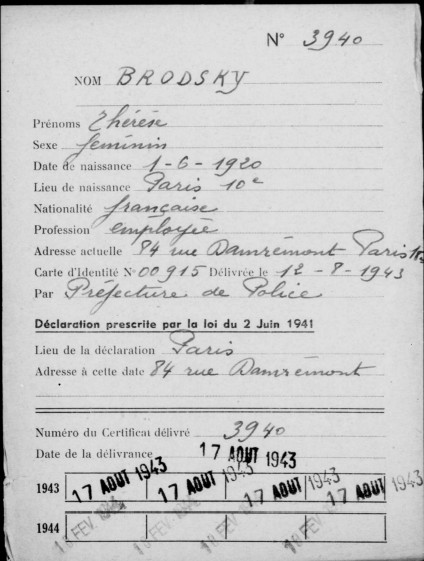
Thérèse Brodsky’s U.G.I.F. membership form © YIVO Institute for Jewish research.
Register of U.G.I.F. members in the occupied zone (1943-1944), file no. 22.3.1
A few notes have been added to Thérèse’s birth certificate, some of which relate to events that took place during the Occupation[28]. The note ”CA. XVIIIe” refers to the fact that Thérèse obtained a food ration card from the town hall of the 18th district. Thérèse also renewed her identity card on August 7, 1943, as evidenced by the note “C.I. 7.8.43.” Her new card was stamped in red with the word “Jew,” as required by a French law passed on December 11, 1942.
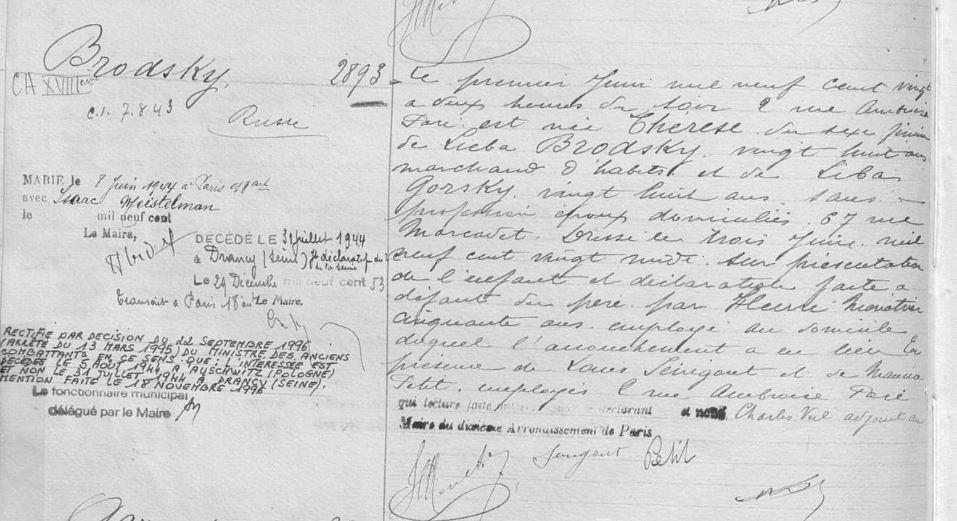
Thérèse Brodsky’s birth certificate © Paris city archives, civil register for the 10th district for the year 1920.
The Brodsky family, whose property was confiscated but who managed to outwit the authorities
As it was registered as a Jewish-owned business, the Jacques Brodsky & Co firm could not escape being taken over by the French authorities. We were able to view the Aryanization case file[29] at the French Center for Contemporary Jewish Documentation. The first temporary administrator, a Mr. Maille, appears to have been appointed in the spring of 1941. He set in motion the initial confiscation procedures, the details of which he outlined in a letter dated May 26, 1941: “As soon as I was appointed, I took all the necessary action: I blocked the bank accounts, cash accounts, and postal orders, and assigned an Aryan employee to oversee the firm.”
Later that year, Mr. Maille was replaced by a Mr. Masson. He wrote a report dated February 15, 1942, from which we learned a great deal about the firm. We discovered that Thérèse had worked there as a billing clerk, at least until February 1942. Leiba was still managing the firm at that point. Jacques Brodsky worked as a sorter, a job that involved sorting the various items of clothing that had been collected. The firm also employed one of Thérèse’s first cousins, Jacques Goldstein, Rebecca Brodsky’s son, as well as his half-brother, Isidore Goldstein. Mr. Masson ended his report as follows: “This business is viable, but at first glance it appears that it will be hard to find a buyer given the level of technical expertise required to run it. I therefore suggest that we simply file for liquidation if neither Mr. Brodsky nor I are able to find a buyer within a reasonable period of time.”
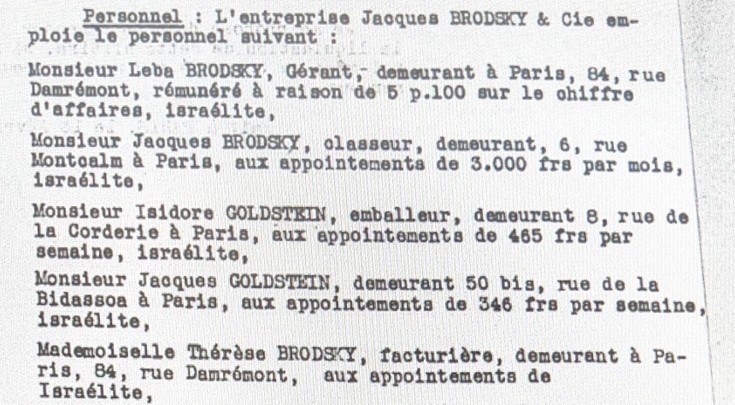
List of staff in 1942. Spoliation file
© French National archives. AJ38/1586, file no. 5650
Thérèse appears to have stopped working for the firm in 1942, as she is no longer on the staff list in the records in the spoilation file. The General Commissariat for Jewish Questions had issued orders on several occasions that Jewish employees be dismissed: this would explain why Thérèse’s name disappeared from the staff list.
In late 1942, the temporary administrator received an offer to purchase the company from two men, Henri Dumont and Théodore Bunoust. Mr. Dumont, who was a sales agent for a secondhand clothing company based in Algeria, appears to have been in involved in business with Jacques Brodsky before the war. Mr. Bunoust was an accountant, whom the temporary administrator had appointed to run the company earlier in 1942. The sale was finalized by a notary on October 25, 1943, at a price of 50,000 francs, after both buyers had been certified as “Aryan.” Jacques Brodsky continued to work for the company until early 1944.
The last record in the spoliation file is a letter from Jacques Brodsky. Dated February 1946, it offers some insight into the clever strategy the Brodskys came up with in order to reclaim their business after the Liberation. In fact, the buyers were friends of Jacques, and in late 1944 they agreed between themselves that they would return the business to him at some point. Michel Brodsky, who knew one of the buyers, Mr. Bunoust, quite well, also remembers this. Mr. Bunoust had been his father’s accountant for many years.
As well as having their family business confiscated, the Brodsky family was hit hard by the new anti-Semitic legislation introduced in occupied France, particularly in 1942. Starting in February, they were subject to a curfew between 8 p.m. and 6 a.m., and then as of June 7, 1942, they were required to wear the yellow star. We have no photos of Thérèse (or indeed any of the Brodsky family) actually wearing the star, but Michel Brodsky told us that all of them did.
Thérèse, a young woman who fell in love
It was most likely during the Occupation that Thérèse met a young Frenchman, three years older than her: Isaac Meistelman. Isaac lived with his mother and sister at 20 Rue Labat, in the 18th district of Paris. His father had died in 1935.
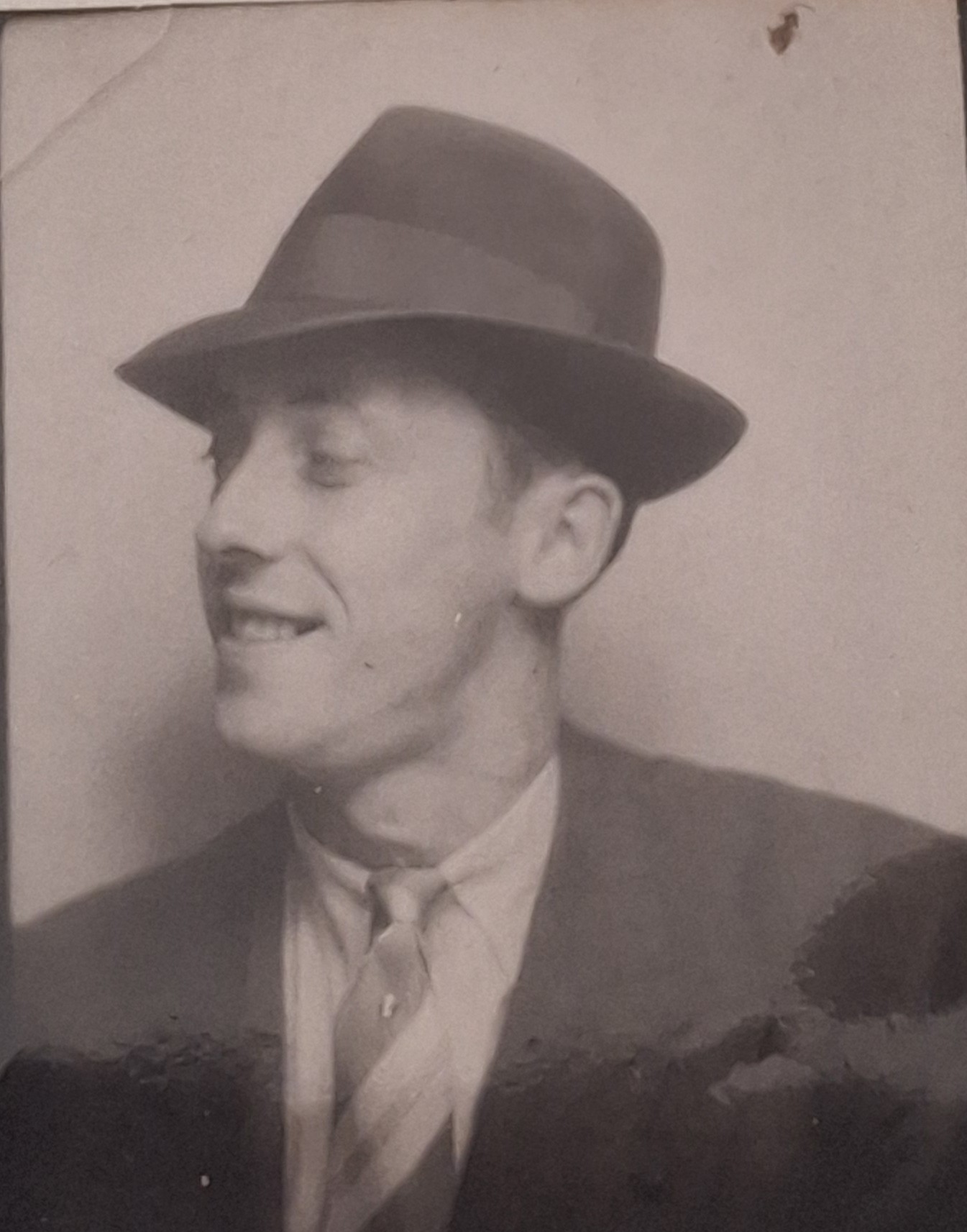
Undated photo of Isaac Meistelman
© Michel Brodsky’s personal collection
We do not know how Isaac and Thérèse met: did they perhaps have friends in common, was it a chance encounter in the street, or maybe it was at work, when Isaac occasionally worked as a packer for Jacques Brodsky? Michel Brodsky knows nothing about this. Anyway, regardless of how or when they met, Isaac must surely have told Thérèse that his sister Rosa was arrested on July 16, 1942, during the Vel d’Hiv roundup, and that his mother was suffering from a mental illness, which prompted him to ask that she be admitted to a psychiatric hospital in late October 1942. Thérèse must therefore have been aware of Isaac’s mother Berthe Meistelman’s failing health. She died on October 9, 1943, in the Maison Blanche psychiatric hospital in Neuilly-sur-Marne, in the Hauts-de-Seine department of France[30].
Given how generous they were with their own families, Leiba and Luba probably took Isaac, who was living alone in the apartment at 20 Rue Labat, under their wing. We arrived at this conclusion after analyzing the U.G.I.F. membership records, as Isaac’s membership number, (3944)[31], falls between Leiba Brodsky’s number(3943)[32] and that of Rose Brodsky, Jacques Brodsky’s wife(3945)[33].
Not only did the anti-Jewish legislation limit where Thérèse and her family could go and what they could do, but they also had to be careful not to attract attention for fear of being arrested. Nevertheless, they often went for day trips to some land that either Leiba or Jacques owned in Montigny-Beauchamp, which is now the Val d’Oise department of France, but was then two separate towns: Montigny-lès-Cormeilles and Beauchamp. They bought a second-hand cabin, so they could all eat and enjoy leisure time together in the countryside.
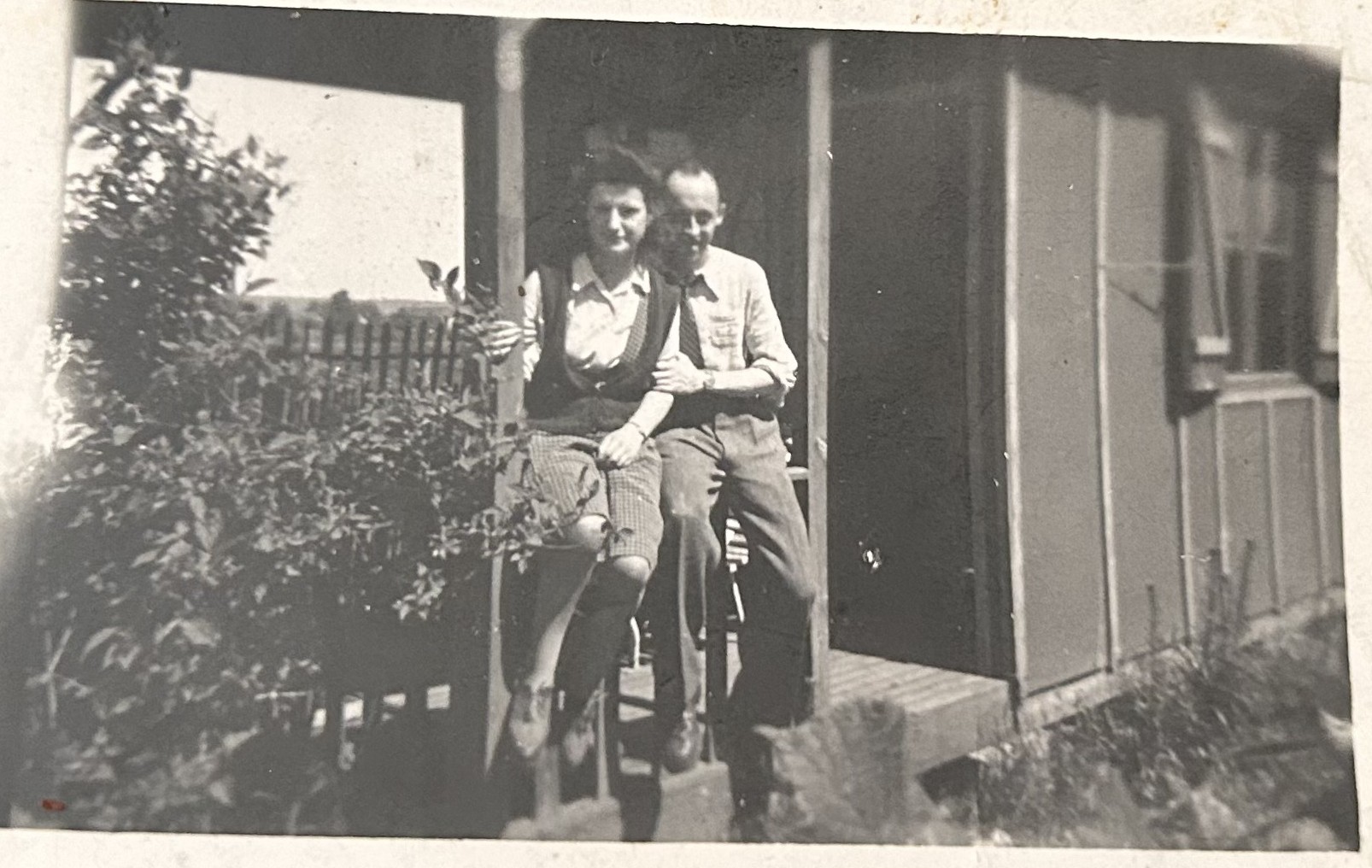
Thérèse and Isaac, Montigny-Beauchamp, 1943
© Michel Brodsky’s personal collection
It was in there that they took a series of photos of Thérèse, Thérèse with Isaac, and Thérèse with Michel Brodsky. These black-and-white snapshots are a testament to a happy, close-knit family, and we found them really quite moving when we visited Michel last June.
Most of these photographs date from spring 1943, and it is clear that Thérèse and Isaac were already seeing each other by then. The Brodsky family must have been happy enough with their relationship, given that Isaac was invited to join them.
Thérèse and Isaac, Montigny-Beauchamp, May 1943
© Michel Brodsky’s personal collection
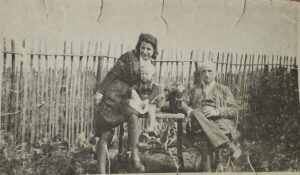
Thérèse, Michel and Leiba Brodsky at Montigny-Beauchamps, May 23, 1943
© Michel Brodsky’s personal collection
Thérèse and Isaac, newlyweds caught in the wheels of the deportation machine
On June 8, 1944, 10:20 a.m., Thérèse Brodsky married Isaac Meistelman in the town hall of the 18th district of Paris[34], following in the footsteps of her parents, who were married there in 1913, and also her brother, in 1938.
The marriage certificate states that Isaac was working as a packer at the time, while Thérèse was unemployed. There is no mention of a marriage contract. Their witnesses were Théodore Bunoust, an accountant, and Henri Dumont, a shipping clerk. We did not know who these men were when we began our investigation, but subsequently managed to identify them through the Aryanization file for Jaques Brodsky’s business: they were the two “Aryans” who bought the family firm and who agreed to allow Jacques to resume ownership of his business after the Liberation.
Why did Thérèse and Isaac’s choose them as witnesses to the wedding? Both spouses had several family members who could have signed the marriage certificate. Did they feel it was too risky to have Jewish people attend the ceremony? Did Thérèse’s parents, at least, escort her to the town hall?
Michel has no memory of his aunt’s wedding. He thinks that the ceremony at the town hall must have been followed by a meal on Rue Damrémont. Nevertheless, he sent us a much-cherished wedding photo, dated June 8, 1944. We can see the joy and light in their eyes, despite the cloud of war hanging over them.
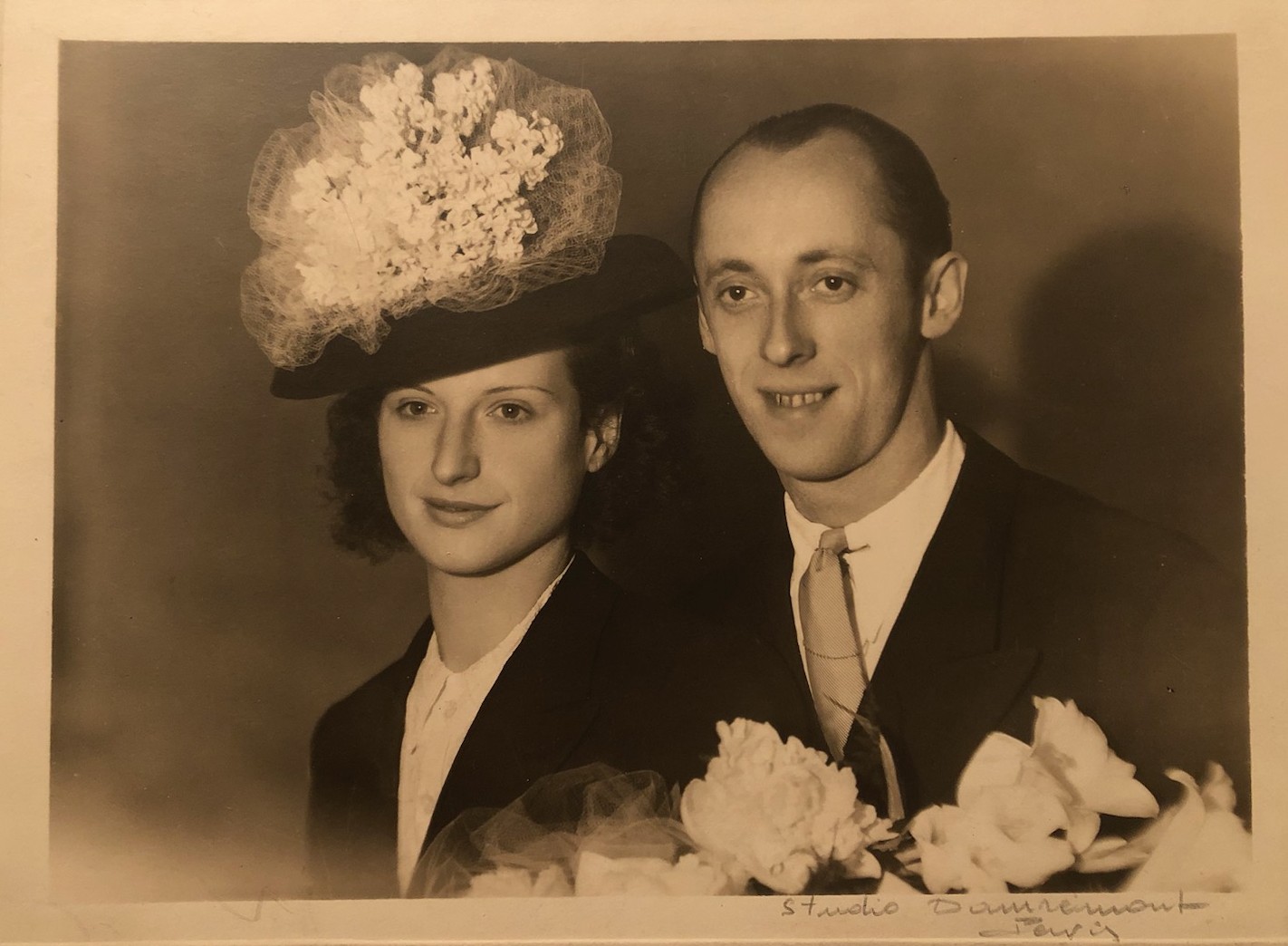
Thérèse and Isaac’s wedding photo, dated June 8, 1944
© Michel Brodsky’s personal collection
Soon after they were married, Thérèse moved in with Isaac at 20 rue Labat. Michel, who was five years old at the time, visited them often with his mother Rose, who was very close to Thérèse. His parents told him that he adored his aunt and often stayed the night in her apartment, first on Rue Damrémont and then, after she got married, on Rue Labat, but sad to say, he has no memory of her at all.
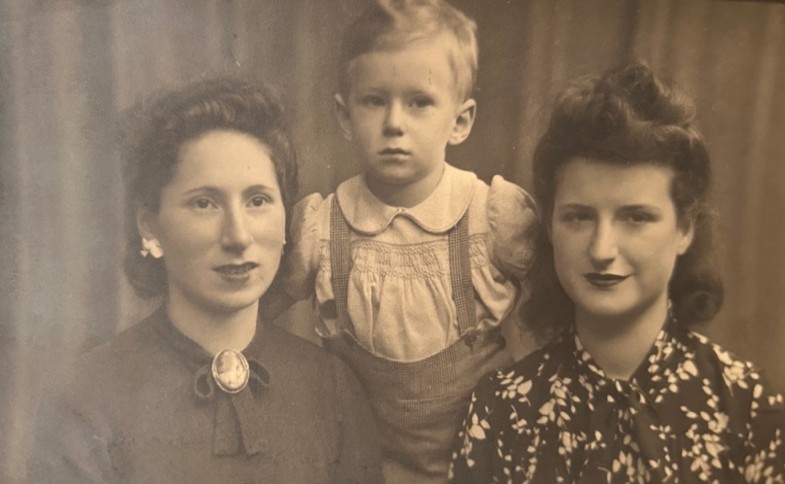
Rose, Michel and Thérèse Brodsky, date unknown
© Michel Brodsky’s personal collection
During the month of June, the newlyweds got a taste of the simple pleasures of married life. Their happiness was short-lived, however, as it came to an abrupt end on the evening of June 30, 1944. That fateful evening, the evening on which their lives were turned upside down, Michel was due to spend the night at their house, but he was sick so he stayed at home. That seemingly insignificant turn of events saved his life!
According to the testimony of the concierge at 20 rue Labat, a Mrs. T.[35], at around 12:40 a.m. on July 1, 1944, the Gestapo arrested at Thérèse and Isaac Meistelman in their apartment. They were not the only people in the building to be arrested that night. The Germans also arrested an elderly couple, Guita and Léon Greitzer, who must have known Isaac as a child, as well as Sura Glattleider and her daughter Adèle, Sarah Bouaniche, her presumed sister Haia Nejman and their father Abraham Samter and also a single woman by the name of Cyvia Scherman.
Later that morning, Thérèse, Isaac, and the eight other unfortunate souls were taken to Drancy internment camp. The Drancy transfer log lists all the internees from 20 rue Labat as having come from “K. Drancy”[36]. This most likely stands for “Kommando Drancy,” a group of Jewish prisoners who collaborated with the SS. Our research suggests that this Kommando was responsible for a number of Jews in Paris in return for assurances that they and their families would not be deported[37]. It is therefore possible that the Drancy Kommando was responsible for the arrest of Thérèse, Isaac, and the other people in their building as well as some others who lived on Rue Labat, including Youssef Choichet, his sons Michel and Maurice, and Juliette Drucker.

An entry in the Drancy arrivals log © French National archives, ref. F/95787/0142/L. Serge Klarsfeld, in his book Calendar of the Deportation, refers to “K Drancy” as Kommando Drancy.
We know from the Drancy search log records that when Isaac arrived in the camp on July 1, he was assigned the serial number 24660 and that he handed over the 130 francs in cash that he had on him at the time[38]. His internment card[39] includes his serial number, the note “+61”, which linked him to Thérèse (her number was 24661), and the letter B, in red, which meant that he could be deported immediately. On the top right of the card there are notes about where he stayed: 19.4, 7.3, and lastly 7.1. The first number denotes the stairwell, the second the floor number. The last note is written in blue. We therefore know that Isaac was initially interned on the fourth floor on staircase 19, was then moved to the third floor on staircase 7, and from there to the first floor on staircase 7. His route through the camp culminated in what was to be his final journey, to Auschwitz.
The note “F.decl,” indicates that he had become a French citizen by declaration. The letter “M” beneath the address “20 rue Labat” means that he was married. The abbreviation “SE” stands for “sans enfant” (no children). The figures at the bottom of the card, 1.7.44, refer to the date on which he entered the camp, July 1, 1944. On the back, in blue, is the number 1083: this refers to his place on the deportation list. Lastly, the words “cert. remis à sa belle-mère” (certificate given to his mother-in-law) mean that an internment certificate was issued to Luba Brodsky on March 6, 1945.
Thérèse’s internment record [40] reveals similar details. She was assigned the serial number 24661. The note “+60” refers back to Isaac’s record. She too could be deported immediately, as indicated by the letter B. Thérèse was initially separated from her husband, as she was put on the third floor on staircase 19. She later joined him and remained with him until they were sent to the extermination camp, first on the third floor of staircase 7, then on the first floor. The date stamped on the card, although not entirely legible, is the date on which the transport left Drancy, July 31, 1944. The inscription “F. decl” means that Thérèse had become a French citizen by declaration Like Isaac, Thérèse is recorded as married and with no children. On the back of the internment card, the number “1084”, written in blue , shows that Thérèse was listed right below her husband on the deportation list.
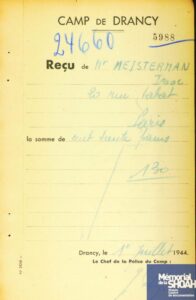
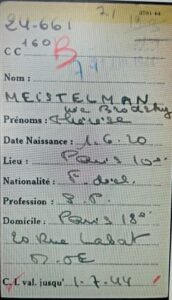
Isaac’s search receipt © CDJC, Drancy search logbook and Thérèse’s internment record © French National archives, ref. F/9/5715/193574/L
The couple remained in Drancy camp for thirty days, after which they were deported on Convoy 77 to Auschwitz-Birkenau. The convoy left Bobigny station on July 31, 1944. It passed through the gates of hell and arrived during the night of August 2-3, 1944. As soon as they got off the train, Thérèse and Isaac were separated once more: Isaac was sent to line up with the men, while Thérèse was sent to the women’s line.
Thérèse and Isaac, never to be seen again…
The rest of Thérèse and Isaac’s story is unclear. It is based on research undertaken by Thérèse’s parents, the Brodskys, beginning in 1945, and referred to in the file on Thérèse held by the French Ministry of Defense Historical Service in Caen, Normandy.
After Paris was liberated, Thérèse’s parents tried desperately hard to find out what had happened to their daughter and son-in-law. Luba managed to obtain an internment certificate for Isaac in March 1945[41], which proved that he had been interned in Drancy. The family most likely also went to the reception center at the Lutetia Hotel in Paris when people who had survived the concentration and extermination camps arrived there, hoping against hope to spot Thérèse or Isaac themselves, or at least to find someone who might know what had happened to them.
Luba appears to have been able to collect statements from some witnesses who saw Isaac and Thérèse in Auschwitz-Birkenau sometime after the convoy arrived. This means that they must both have been selected to enter the camp to work. We therefore decided to study some of Convoy 77 survivors’ testimonies in order to find out what might have happened to Thérèse and Isaac.
After the selection, Thérèse would have been taken into a barrack within the camp where, along with all of the other women who had been selected to work, she would have had to get undressed and would then have been shaved, shorn, and disinfected. She would then have been tattooed with a number between A16676 and A16833. Luba Brodsky referred to a testimony from one of her daughter’s friends who survived and returned to France. She said in 1945 that she had seen Thérèse alive and well on October 27, 1944[42]. If this is true, the date is highly significant, because it coincides with several transfers of Jewish women from Birkenau to other camps, in particular Kratzau and Bergen-Belsen. We do not know the identity of Thérèse’s friend, nor do we know what became of Thérèse after she was last seen alive. The only thing we know for sure is that Thérèse never returned from the camps.
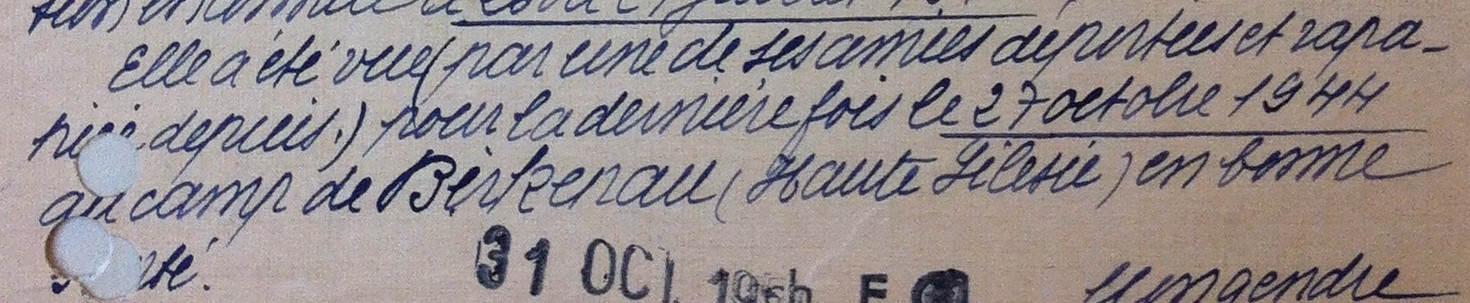
Luba Brodsky’s letter, dated November 12, 1945. File on Thérèse Meistelman
© Victims of Contemporary Conflicts Archives Division of the French Ministry of Defense Historical Service, in Caen, ref. 21P514 995
As for Isaac, he would have undergone a similar ordeal as his young wife: stripped naked, shaved all over, hair shorn and. disinfected. He would have been tattooed with a number between B3673 and B3963. Luba Brodsky managed to obtain another testimony that states that Isaac was still alive, albeit very sick, in September 1944[43]. Isaac most likely died in the camp, possibly after being selected for the gas chambers during one of the regular selections, possibly a particularly large selection that took place in October 1944. Once again, the only thing we know for sure is that he never made it back to France.
These testimonies were a source of great hope for Thérèse’s family. Michel says that his grandparents believed for a while that Thérèse may have been transferred to the USSR after the Soviet army liberated Auschwitz. Leiba and Luba thus set about the administrative process necessary to search for her. Luba began by writing to the Deputy Director of Documentation and Research, at 6, square du Bois de Boulogne, on November 12, 1945. In her letter, she requested that a search file be opened for both Isaac and Thérèse: “I am a grieving mother asking for your kindness and support in helping her find her children (her daughter and son-in-law), who disappeared during the turmoil and of whom she has had no news since July 1, 1944 (…) I would be immensely grateful if you would do everything possible to find out what has become of these poor children.” All she received in reply was a search request form to complete and send back.
Luba filled in the form and sent it off on December 27, 1945, together with a photograph of Thérèse and a note to say that her daughter had green eyes and chestnut brown hair. This physical description was the only information we had about Thérèse prior to seeing her nephew’s photos of her.
Almost a year later, on October 27, 1946, Luba received a letter from the Ministry of Veterans Affairs and War Victims: a missing person certificate had been issued in the name of Thérèse Meistelman.
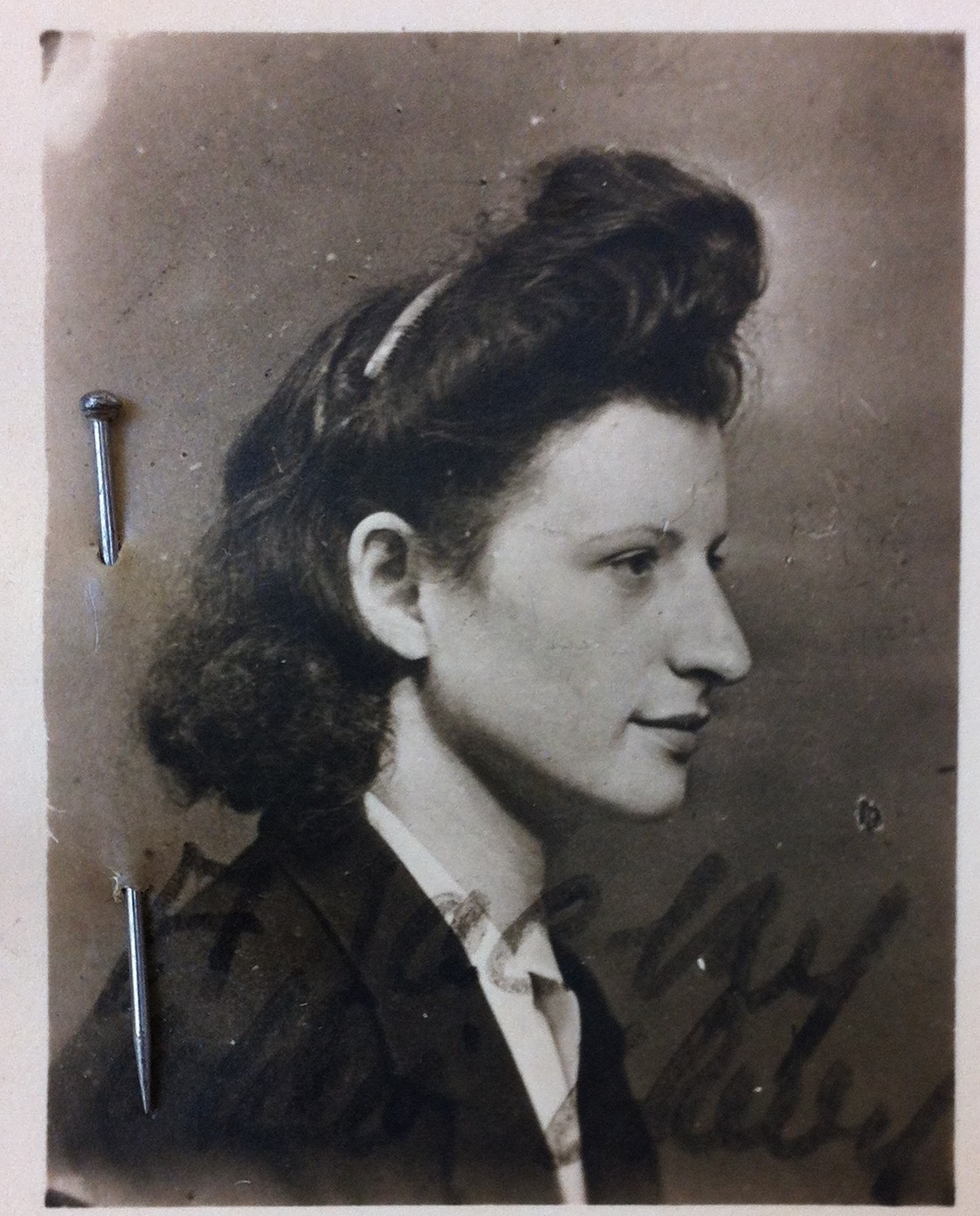
Photo of Thérèse © Victims of Contemporary Conflicts Archives Division of the French Ministry of Defense Historical Service, in Caen, ref. 21P514 995
It was not until October 9, 1953, that a court issued a ruling that declared Thérèse officially dead. After so many years of waiting and much paperwork, the justice system finally put an end to the lack of any official response. Leiba too was involved in the quest to find his daughter, but sadly died before the procedure was completed. He passed away on January 5, 1953, at his home on Rue Damrémont[44].
Following the judgment, Thérèse’s death was recorded in the civil registry of the 18th district of Paris and a note was written in the margin of her birth certificate[45]. In accordance with legislation passed in 1946, Thérèse was declared to have died in Drancy on July 31, 1944. At that point, the French authorities used the place and date of departure of the convoy as the date and place of death. It was not until a ministerial decree was issued in 1995 that Thérèse was officially deemed to have died on August 5, 1944, in Auschwitz.
The Brodsky family did not apply to have Thérèse officially granted the status of “political deportee” (meaning that she was deported on political grounds, i.e. because she was Jewish). This was most likely because Luba Brodsky died on March 11, 1959, at her home on Rue Damrémont[46]. Her grandson told us that his grandparents were deeply upset by the loss of their daughter and eventually stopped talking about her. He is the last witness to have known Thérèse while she was alive. The photograph of his aunt and uncle still takes pride of place in his Paris apartment…
Thérèse and Isaac will remain in our memories forever, and their story has become part of our own. Their names are engraved on the Wall of Names at the Shoah Memorial in Paris, alongside those of so many others whose lives were cut short by the Nazi barbarity.

The Wall of Names at the Shoah Memorial in Paris © Manel Turmeau
A number of people were kind enough to help us as we were writing Thérèse and Isaac’s biographies. We would like to extend our heartfelt thanks to Michel Brodsky for welcoming us into his home and sharing his family’s treasured memories with us. Without him, we would never have seen Thérèse and Isaac’s happy faces.
Thanks also to Martin Brody, the cousin in the United States, and Barbara Miller, the cousin in New Zealand, for their willingness to share their stories.
We would also like to thank all the archivists whose assistance was invaluable in helping us locate and view the documentation that chronicles Thérèse’s life: Claire Stanislawski Birencwajg and Laura Paoli at the Shoah Memorial and the staff at the Paris Police Prefecture Archives, the Paris Archives, and the French National Archives.
Lastly, we would like thank the Convoy 77 project team, Claire Podetti and Laurence Klejman in particular, for their help and support throughout our investigation.
Students’ comments
“This year’s workshop was truly fascinating. It was easy to carry out the research because we had plenty of documentation to work with. Thank you to Michel Brodsky for welcoming us and for the photographs.” – Rebecca
“The workshop, organized by Convoy 77, was a welcome surprise. I did not think we would come this far.” – Loris
“It has been really amazing to work on this project and to retrace Thérèse and Isaac’s life stories” – Léonie
“I particularly enjoyed the investigative work. The extensive research we undertook was educational and exciting. Thank you to our teachers for putting together this wonderful workshop! And thank you to the Brodsky family for helping us in our historical quest.” – Emma
Notes & references
Brick Hava’s death certificate (1931) © Paris archives. Civil registry of the 10th district of Paris.
[2] Brodsky – Gorsky marriage certificate © Paris archives. Civil registry of the 18th district of Paris.
[3] Jacques Brodsky’s birth certificate © Paris archives. Civil registry of the 11th district of Paris.
[4] Thérèse Brodsky’s birth certificate © Paris archives. Civil registry of the 10th district of Paris.
[5] Claire Brodsky’s birth certificate © Paris archives. Civil registry of the 12th district of Paris.
[6] 1926 census of the 18th district of Paris. Quartier Clignancourt. 67 rue Marcadet © Paris archives.
[7] File on Salomon Brodsky © French National archives, National Security Agency central file, ref.19940434/620, dossier 51894.
[8] Now in Moldavia.
[9] This street is located not far from the Carré du Temple, a major hub for Parisian secondhand clothing merchants, mainly Jews from Eastern and Central Europe.
[10] Didot-Bottin gazette for the year 1926 et 1930 © French National Library, Gallica.
[11] File on Peretz Gorsky © French National archives, National Security Agency central file, 19940448/336.
[12] The Brodsky children’s naturalization file © French National archives, ref. BB/11/9221 4124X26.
[13] Leiba Brodsky’s naturalization file © French National archives, ref. BB/11/9725 1508X27
[14] Leiba Brodsky © Paris archives. D3R1 311. File serial number (1928).
[15] File on Peretz Gorsky © French National archives, National Security Agency central file, 19940448/336.
[16] Yoffa Rachel’s death certificate (1927) © Paris archives. Civil registry of the 10th district of Paris.
[17] 1931 census of Clichy-sous-Bois (1931) © Hauts-de-Seine departmental archives
[18] Brick Hava’s death certificate (1931) © Paris archives. Civil registry of the 20th district of Paris.
[19] 1931 census of the 18th district of Paris. Quartier Clignancourt. 14 rue du Ruisseau © Paris archives.
[20] Enrollment register for the girls’ school at 65 rue Damrémont (1930-1937) © Paris archives, 2817W8.
[21] Enrollment register for the girls’ school at 65 rue Damrémont (1930-1937) © Paris archives, 2817W8.
[22] 1936 census of the 18th district of Paris Quartier Grandes Carrières. 84 rue Damrémont © Paris archives.
[23] Brodsky – Kouczynski marriage certificate © Paris archives. Civil registry of the 18th district of Paris.
[24] Les Annonces de la Seine. April 29, 1940 © French National Library, Gallica.
[25] Jacques Brodsky company spoilation file © French National archives. AJ38-/1586, dossier 5650.
[26] Thérèse Brodsky © YIVO Institute for Jewish research. U.G.I.F. membership register for the occupied zone (1943-1944), dossier 22.3.1.
[27] Jacques Brodsky © YIVO Institute for Jewish research. U.G.I.F. membership register for the occupied zone (1943-1944), dossier 22.3.1.
[28] Thérèse Brodsky’s birth certificate © Paris archives. Civil registry of the 10th district of Paris.
[29] Jacques Brodsky company Aryanization file © French National archives. AJ38/1586, dossier 5650.
[30] Berthe Meistelman’s death certificate (1943) © AD 93, Neuilly-sur-Marne civil register.
[31] Isaac Meistelman © YIVO Institute for Jewish research. U.G.I.F. membership register for the occupied zone (1943-1944), dossier 22.3.1.
[32] Leiba Brodsky © YIVO Institute for Jewish research. U.G.I.F. membership register for the occupied zone (1943-1944), dossier 22.3.1.
[33] Rose Brodsky © YIVO Institute for Jewish research. U.G.I.F. membership register for the occupied zone (1943-1944), dossier 22.3.1.
[34] Meistelman – Brodsky marriage certificate © Paris archives. Civil registry of the 18th district of Paris.
[35] File on Thérèse Meistelman © Victims of Contemporary Conflicts Archives Division of the French Ministry of Defense Historical Service, in Caen, ref. 21P514 995.
[36] Drancy camp transfer log © French National archives. F/95787/0142/L.
[37] Annette Wieviorka, Michel Lafitte, A l’intérieur du camp de Drancy (Inside Drancy camp), Paris, Perrin, 2012.
[38] Isaac Meistelman © CJDC (French Center for Contemporary Jewish Documentation). Drancy search logbook.
[39] Isaac Meistelman © French National archives. F/9/5715/193575/L
[40] Thérèse Meistelman © French National archives. F/9/5715/193574/L.
[41] Isaac Meistelman © French Defense Historical Service, National deportee register.
[42] Thérèse Meistelman © Victims of Contemporary Conflicts Archives Division of the French Ministry of Defense Historical Service, in Caen, ref. 21P514 995.
[43] Thérèse Meistelman © Victims of Contemporary Conflicts Archives Division of the French Ministry of Defense Historical Service, in Caen, ref. 21P514 995.
[44] Leiba Brodsky’s death certificate (1953) © Paris archives. Civil registry of the 18th district of Paris.
[45] Thérèse Brodsky’s birth certificate (notes in the margin) © Paris archives. Civil registry of the 10th district of Paris.
[46] Luba Gorsky’s death certificate (1959) © Paris archives. Civil registry of the 18th district of Paris.
Contributor(s)
The biography was written by the students who took part in this year’s The “En …quête d’histoire” (“In search of history”) workshop at the Fosse aux Dames secondary school in Les Clayes-sous-Bois, in the Yvelines department of France, with the guidance of their teachers, Marie Hurtevent and Géraldine Kerserho. They were: Joanna Barbosa, Loris Bocquet, Léonie Boitrelle Gaechter, Milla Boulanger-Daleau, Emma Braz-Rente-Moitron, Lina Cuccina-Beucher, Zoé Granjou, Rebecca Karlin Perrier, Mathis Opresco, Perrine Ragazzini, Tea Sheremeti and Manel Turmeau.


