Français
 Polski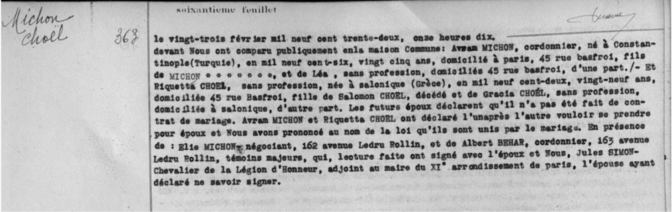
Riquetta MICHON née CHOËL (1902-1944)
Riquetta’s marriage certificate.
This biography was written by the students of classes TG3 and TG6 at the Victor Louis high school in Talence, in the Gironde department of France, as part of an annual project carried out in Ethics and Civic classes, under the guidance of their teachers, Ms. Baudot (Literature), Ms. Boutet and Ms. Tanty (History-Geography, Ethics and Civic Education, History-Geography, Social Sciences, and Political Science), and Mr. Legeron, during the 2024-2025 school year.
It is one of a three-part series:
- This biography of Riquetta Michon, née Choël
- The biography of Avram Michon, her husband
- A podcast, in French
The students presented this joint French-Greek project, including the biographies of Avram and Riquetta Michon, at the French Consulate in Thessaloniki, Greece, on March 17, 2025. Their trip to Thessaloniki was funded by grants from Erasmus+, the French Fund for the Memory of the Holocaust, and the French government’s 80th Anniversary of the Liberation campaign.
Riquetta Choël was born either in 1902[1] or on May 10, 1907[2], in Salonika (now Thessaloniki), in Greece.
Her parents were Salomon Choël (who died sometime before 1932, when Riquetta and Avram got married) and Gracia Choël (known as Béatrice), who was still living in Salonika in 1932[3].
Riquetta arrived in France in 1929. We do not know why she chose to emigrate to France, nor whether she did so alone. Nor do we know whether she had had any family elsewhere in France previously or whether she travelled directly to Paris. According to a certificate from the Paris Police Headquarters dated March 1957, which states that she was born in 1907, the Foreigners’ Department at the Seine Police Headquarters also held a file in the name of Riquetta Choël (although we were unable to locate it, unfortunately). We know nothing about her early life in Greece.
MARRIAGE AND FAMILY LIFE
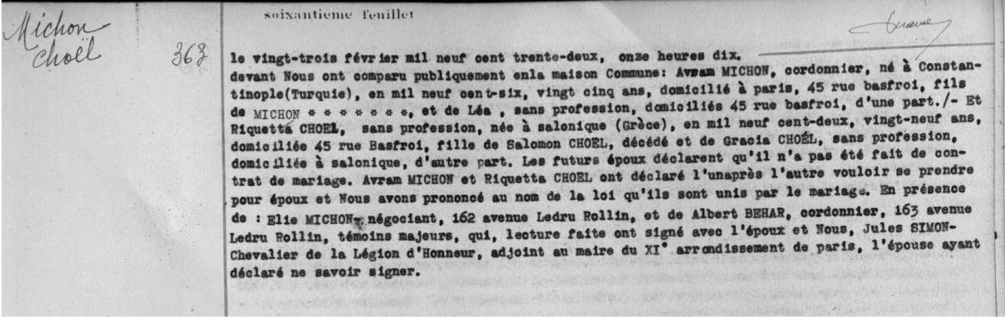
Riquetta and Avram’s marriage certificate ©Paris City archives
On February 23, 1932, Riquetta married Avram Michon in the town hall of the 11th district of Paris.
Avram was born on June 11, 1906 in Istanbul, Turkey. He was a cobbler at the time (but subsequently became a street vendor, according to the 1936 census).
In 1931, Avram was living alone, at 31 rue Basfroi, in the 11th district of Paris. By 1932, when they got married, they were both living at 45 rue Basfroi, but we do not know if they were living together or simply in the same building.
The witnesses at the wedding were Élie Michon (one of Avram’s relatives perhaps?) a merchant who lived at 162 avenue Ledru-Rollin, in the 11th district, and Albert Béhar, a Turkish cobbler who lived at 163 avenue Ledru-Rollin, just a stone’s throw from rue Basfroi.
There was no prenup contract. The marriage certificate says that Riquetta was unable to sign her name and was not working at the time. It appears that both of Avram’s parents lived at 45 rue Basfroi (but they are not listed as living there in the 1931 census). We found no record of them also getting married in a temple or synagogue, but that does not rule out the possibility of a religious wedding, as such a ceremony could have taken place at home.
By marrying Avram, Riquetta would, in theory, have become a Turkish citizen. However, as Avram noted in March 1957 when he applied for Riquetta to be granted the status of “Political Deportee,” her Turkish citizenship was “not recognized”.
The couple went on to have four children:
- Lucienne Ruben, born January 1, 1933 (in the 12th district of Paris), died January 5, 2020 on Gargenville (in the Yvelines department of France)
- Maurice Ruben, born April 9, 1937 (in the 12th district of Paris), died April 17, 1938 (in the Pitié-Salpêtrière hospital in the 13th district of Paris)
- Béatrice Ruben, born February 9, 1939 (in the 12th district of Paris)
- Jacqueline, born May 27, 1941 (in the Rothschild hospital in the 12th district of Paris)[4].
The family’s addresses were all in the 11th district of Paris. Known as “Little Turkey”, this neighborhood was home to a large number of Sephardic Jewish families (mainly from Turkey and Greece), who continued to speak their native languages. There were numerous shops and cafés run by Jews from the former Ottoman Empire. From when they got married in February 1932 until July 1, 1937, the couple lived at 45 Rue Basfroi, along with Avram’s mother (Léa Ruben, born in 1880, a widow) and Lucien Michon (born in 1925 in Turkey), listed as a “son” in the 1936 census (although we know nothing more about him[5]). It is worth noting that there were few families from Turkey living in this building at the time. The About family had been living there since 1931.
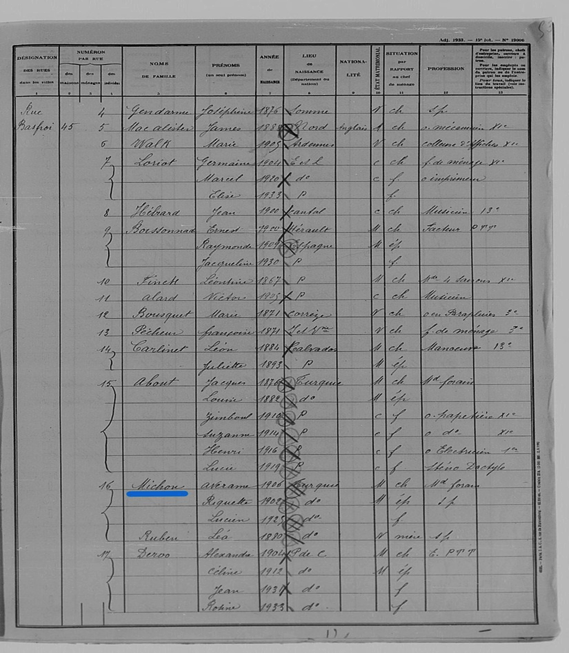
Listing for 45, rue Basfroi, in the 11th district of Paris. ©Paris City archives
On July 1, 1937, the family moved a short distance away to 44 rue Sedaine[6]. They were still living there when they were arrested, and Avram moved back there after the war.
THE WAR AND THE ARREST
When war was declared in 1939, Riquetta had a 6-year-old girl and an 8-month-old baby. The family appears to have been in Trouville-sur-Mer, in the Calvados department of France, possibly on vacation, and the war may have caught them by surprise. Avram enlisted in the French army in nearby Caen, but was never actually called up. The were still in Trouville on May 22, 1940, a month after France surrendered, and it was there that Avram declared little Béatrice a French citizen. The Seine court registered the declaration on October 5, 1940, which meant that Béatrice became a French national just two days after the first anti-Jewish legislation was introduced.
Riquetta and her husband complied with the anti-Jewish decrees passed by the Vichy government on October 3, 1940, and June 2, 1941[7], and thus went to their local police station to register as as “Jews”. They and their children were then entered into the Police Headquarters’ register of Jews. The October 3 decree on, “the Status of Jews,” set out the Nazi criteria for determining who counted as Jewish: anyone with three grandparents of the “Jewish race” or two Jewish grandparents if the person’s spouse was also Jewish. In addition, Jews were banned from working in the civil service and many other professional fields.
Avram Michon was not initially affected by this, as a street vendor. However, as of late October he was required to put up a sign on his stall which read, in both French and German: “Jewish Business.” He then had to stop trading altogether, as Jews were no longer allowed to run businesses or transport goods. How did the growing family make ends meet after that? In May 1941, Riquetta gave birth to a third daughter in the Rothschild Hospital, which by then was controlled by the Germans. Avram once again declared his daughter a French national. He then appeared before the Justice of the Peace in the 11th district on July 21, 1941, but this time, the application was not registered until March 13, 1945. This meant that Jacqueline, unlike her sisters, was not a French citizen during the Occupation.
Did Avram and Riquetta wear the yellow star when it became obligatory in June 1942? Turkish Jews were exempt, as Turkey was a neutral country, but it is not clear whether Avram, and in particular Riquetta, qualified as Turkish or not.
On July 10, 1944, Riquetta, her husband and her mother-in-law were arrested in their apartment. The children were not arrested however, as according to Avram’s post-war naturalization application records, they “were taken in by some kind French people.” Avram also said that they were arrested by both French and German police, and that the reason given was that they were “Israélite”, i.e. Jewish. After the war, two neighbors and the building supervisor testified to having witnessed the arrest.
The Jewish Affairs police took Riquetta, Avram and Léa Ruben[8] to the Paris Police Headquarters depot, where they were booked in at midnight. At 2:30 p.m. the following day, they were “escorted” to Drancy camp, north of Paris[9].
Riquetta was interned in Drancy on July 11, 1944. She was assigned prisoner number 25,017, after which she and her mother-in-law were sent to a room on a women-only staircase. This meant that she was separated from her husband.
At dawn on July 31, 1944, after having been moved to a separate building, along with the other people scheduled to be deported on the next convoy, Riquetta was told to go down to a fenced-off courtyard. She was then loaded onto one of the buses that were shuttling back and forth between Drancy camp and the nearby Bobigny train station.
Riquetta, along with her husband and her mother-in-law, were deported to Auschwitz on July 31, 1944, on what later became known as Convoy 77.
THE DEPORTATION
Another couple, Joseph and Dora Brodsky, were also aboard the train. The wife, Dora Brodsky, née Choël, who was born in 1916, was likely one of Riquetta’s relatives. They had been arrested on July 7, he in Paris and she at their home in Saint-Cloud, and were taken to the Paris Police Headquarters at 11:30 p.m. on July 8, two days before the Michon family.
They were sent to Drancy at 3 p.m. on July 10 [10] Avram Michon testified to the deportation of Joseph Brodsky at the police station in la Roquette on March 23, 1948[11]. Dora survived her time in the camps and returned to France.
After a grueling three-day train journey from Bobigny to Auschwitz-Birkenau, the 1,306 people aboard Convoy 77 arrived at the camp in the middle of the night. They were transported in cattle cars, crammed in 60 to a car, with no space to move around, very little water, no fresh air, and barely any food.
Families usually travelled together, so Riquetta, Avram and his mother, Léa (who was 64) may well have been in the same car. Avram said in a testimony after the war that he had not seen his wife since July 10, but he may have mixed up the date on which they arrived in Drancy with the date they arrived in Auschwitz.
After they climbed down onto the platform at the Auschwitz, they were separated immediately. Men who were deemed fit to work were lined up on one side, women on the other. Older folk (such as Léa), sick and disabled people and the 300 or so children, as well as anyone unwilling to leave children or elderly relatives behind, were loaded into waiting trucks They were then driven straight to the gas chambers, where they were murdered, after which their bodies were burned in the crematoria.
Riquetta was among women selected to enter the Birkenau-Auschwitz camp to work. a fellow deportee and neighbor from 44 Rue Sedaine in Paris, testified in November 1948 that Riquetta had died in Auschwitz in November 1944, even though Rachel herself had left Auschwitz before then. She said they both stayed in Block 9 at Birkenau, but she did not witness Riquetta’s death. We do not know Riquetta’s Auschwitz registration number, nor do we know what happened to her during those four months in hell.
AFTER THE WAR
Avram survived his time in the camps and returned to France in April 1945. He soon met up with his oldest daughter, Lucienne, who was 12 years old by then. His younger daughters, who were 6 and 4, had been kept hidden during the war, but we do not know where. Avram then began the process of having his wife’s death in Auschwitz legally recognized, and then requesting that she be granted the status of Political Deportee, according to French law 48-1404 passed on September 9, 1948 and decree 50-325 dated March 1, 1950.
Riquetta’s husband’s efforts to have her death in the camps officially acknowledged.
– December 28, 1945: Avram Michon requested that his wife’s death be recorded in the civil register.
– March 12, 1946: Avram submitted a request for information, in which he stated that his wife had been arrested by the French police on July 4, 1944. He subsequently gave this same date in his own application for Political Deportee status . However, the three members of the Michon family arrived at the Paris Police Headquarters detention center at midnight on July 10th. Had they been arrested six days earlier? This is highly unlikely, but not out of the question.
– April 16, 1946: The National Office for Research on Political Internees and Deportees issued a certificate stating that Riquetta had not been repatriated.
– September 23, 1948: He applied to have Riquetta’s civil status update to that of a “non-returned person: reason: deported on racial grounds”.
– November 5, 1948: The clerk of the court certified a statement on “plain paper” stating that Riquetta was “presumed dead.
– November 5, 1948: Rachel Lévy (née Hasson) wrote a handwritten declaration affirming that Riquetta died in November 1944 in Auschwitz.
– March 10, 1949: Rachel Levy gave a detailed statement about Riquetta’s death.
– August 23, 1949: The French Ministry of Veterans and War Victims officially acknowledged that Riquetta was missing, but not that she was dead, despite Rachel Levy’s testimony to that effect. Rachel Levy had provided a written statement affirming that Riquetta had been “incinerated” in November 1944 in Birkenau. However, the ministry did not take her testimony into account because it lacked sufficient detail, according to the provisions of a decree dated October 30, 1945. This was compounded by the fact that Rachel had been transferred to the Kratzau camp in occupied Czechoslovakia in October.
– March 26, 1957: Avram applied to have Riquetta declared a “Political Deportee” and included a reference to an accompanying document: a certificate issued by the Chief of Police attesting that Riquetta’s arrival in France in 1929 had been recorded in the foreign nationals’ registry. To be eligible for the status of “Political Deportee”, meaning that the person had been arrested on grounds of their “race”, proof was needed that the foreign national in question (the Michons had never been naturalized) had been living in France prior to the declaration of war on September 3, 1939. To be eligible for “Died for France” status, one had to be a French citizen.
– June 23, 1958: The French Ministry of Veterans and War Victims officially declared Riquetta to have been a Political Deportee and sent Avram a Political Deportee card in her name. The dates taken into account were:
– Internment in France, in Drancy camp: July 14 -July 30, 1944 (the date of July 14 is a mistake, perhaps they meant July 4?)
– Deportation: July 31 – August 5, 1944 (Note that this does not include the time she was detained in Auschwitz, even though she was legally declared to have died there on November 30!)
– November 3, 1958: Avram received a “compensation” payment of 12,000 francs, to which heirs of political deportees were entitled if the person had died in detention or while deported.
– February 12, 1965: The Seine Court issued a ruling declaring that Riquetta died on November 30, 1944, and noted that the death should be entered in the civil register.
– May 5, 1965: the court ruling declaring Riquetta deceased was entered into the civil register of the 11th district of Paris.
As a widower with three daughters, Avram eventually met a young widow who also had a daughter. They moved in together and raised their daughters as sisters. They were finally able to get married in 1965, when Riquetta’s death was, at long last, duly registered.
Sources
- Victims of Contemporary Conflicts Archives Division of the French Ministry of Defense Historical Service, in Caen, dossiers 21 P 516 479 and 21 P 265 431 in the name of Riquetta Michon née Choël.
- Paris Police Headquarters archives, ref. APP CC2-8.
- Paris City archives, 1936 census, Maurice’s death certificate, Avram and Riquetta’s marriage certificate from 1932.
Contributor(s): Pascale Boutet, Nathalie Tanty
Notes & references
[1] From the civil register of the Seine department, attached to the marriage certificate: this document, dated December 15, 1931, from the Chief Rabbi of Thessaloniki certifies that Riquetta was born in 1902, but specifies neither the day nor the month.
[2] In French government records, and in the form her husband filled out in 1948 to have her civil status updated.
[3] According to the aforementioned civil register entry.
[4] Family civil status record, from the Victims of Contemporary Conflicts Archives Division of the French Ministry of Defense Historical Service, in Caen, dossiers SHD 21 P 516 479 and 21 P 265 431.
[5] Research could be carried out in the local school registers.
[6] Residence certificate issued by Roger Baronnet, the building administrator, on December 27, 1945. Victims of Contemporary Conflicts Archives Division of the French Ministry of Defense Historical Service, in Caen, dossiers 21 P 516 479 and 21 P 265 431.
[7] Published in the French Official Gazette on June 14, 1941, p. 2476.
[8] Lea Ruben, née Cohen; cf. Victims of Contemporary Conflicts Archives Division of the French Ministry of Defense Historical Service, in Caen, dossier 21 P 270 708.
[9] List of individuals held at the Paris Police Headquarters, ref APP CC2-8.
[10] Idem
[11] File on Joseph Brodsky, Victims of Contemporary Conflicts Archives Division of the French Ministry of Defense Historical Service, in Caen, dossier 21 P 430 843.