Français
 Polski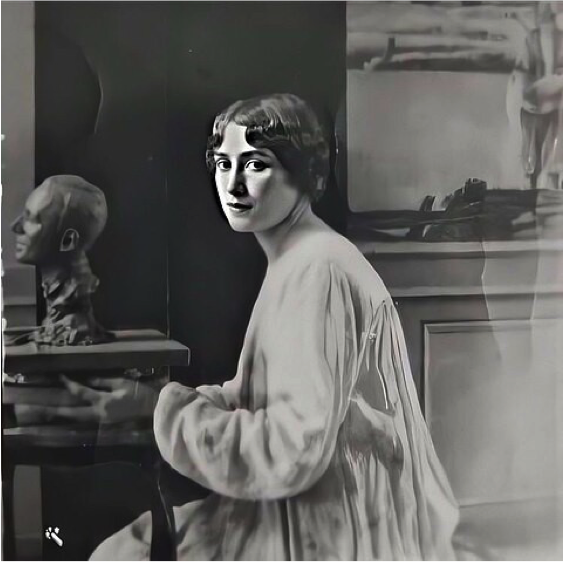
Louise OCHSÉ
My name is Léa Coucke. I am a music teacher at Jean de la Varende secondary school in Mont Saint Aignan, in the Normandy region of France. For several years now, I have been teaching my ninth-grade students about the role that music played during the two world wars.
In April 2024, I went to Poland with Raphaël Gottfarstein and Sophie Nahum. It turned out to be the most important trip of my life.
It soon became clear to me that I wanted to devote at least part of the rest of my career to passing on the memory of the Holocaust to my students.
The Convoy 77 project echoes my commitment to education, and the slogan “teaching the Holocaust in a different way” struck a particularly deep chord with me as a music teacher.
How could I possibly convey this legacy to my students other than in history classes? How could I bring victims’ faces, life stories, and destinies to life through anything other than written or filmed testimonies?
That is exactly what have I tried to do here, together with my students, by telling Fernand and Louise Ochsé life stories in podcasts, interspersed with pieces of music that they loved, listened to, sang or even composed (Fernand was a composer, among other things).
Now that these first two biographies are finished, I’m already working on the next one, which tells the story of a friend’s great-aunt: Thérèse Cahen.
A huge thank you to the Convoy 77 team, in particular Claire Podetti, for their help and support. I would also like to thank Agnès Klingenberg, who kindly shared with me some of the scores composed by Fernand Ochsé. Working with my students was a wonderful, enriching experience, but above all, I am proud to have served, in my own way and as sincerely as possible, as a “passer-on of memory.”
Translator’s note: For English speakers who do not wish to listen to the spoken parts of podcasts in French, but would simply like to hear the music, the times in minutes are included after the title of each piece of music.
 EPISODE 1 : PRELUDE
Listen to episode 1 of the podcast
MUSIC: LE CHANT DES MARAIS (the Song of the Marais/Marshes, also known as the Song of the Peat Bog Soldiers)
This episode of the podcast begins with Le chant des Marais by Rudy Goguel, was composed in 1933 while he was in the Nazi concentration camp at Börgemoor, Germany.
With Hélios Azoulay on the piano, Marielle Rubens sings a version by Aleksander Kulisiewicz, who was nicknamed “the singer from hell”. Having survived his time in the Sachsenhausen concentration camp, he dedicated his life to transcribing the songs and tunes he heard during his imprisonment.
This version of the Chant des marais, initially written in German, was then sung in German, Polish, Czech, French, Italian and English. These days, it is also known as the “Chant des déportés” (the Deportees Song).
Translator’s note: You can listen to an English version of this song by searching for “The Song of the Peat Bog Soldiers”. Here are the lyrics, translated into English:
Far and wide as the eye can wander,
Heath and bog are everywhere.
Not a bird sings out to cheer us.
Oaks are standing gaunt and bare.
We are the peat bog soldiers,
Marching with our spades to the moor.
We are the peat bog soldiers,
Marching with our spades to the moor.
Up and down the guards are marching,
No one, no one can get through.
Flight would mean a sure death facing,
Guns and barbed wire block our view.
We are the peat bog soldiers,
Marching with our spades to the moor.
We are the peat bog soldiers,
Marching with our spades to the moor.
But for us there is no complaining,
Winter will in time be past.
One day we shall rise rejoicing.
Homeland, dear, you’re mine at last.
No more the peat bog soldiers
Will march with our spades to the moor.
No more the peat bog soldiers
Will march with our spades to the moor
We are Alec, Amina, Nathan, and Lily, 9th grade students from two different classes at the Jean-de-la-Varende middle school in Mont-Saint-Aignan, in the Normandy region of France, and here is our summary of the Convoy 77 project.
The Convoy 77 nonprofit association, founded by Georges Mayer, who is still the president, offers middle and high school students the opportunity to write the biographies of people who were deported on Convoy 77.
When it left Bobigny train station on July 31, 1944, Convoy 77 was the last transport to the Auschwitz-Birkenau concentration and extermination camp in Poland. Packed into the cattle cars were 1,306 deportees, including 323 children, 124 of whom were under the age of ten.
As soon as the train arrived, 847 deportees were sent to the gas chambers and murdered, while 291 men and 183 women were selected to enter the camp to carry out forced labor.
By the time the camp was liberated in January 1945, only 251 people were still alive.
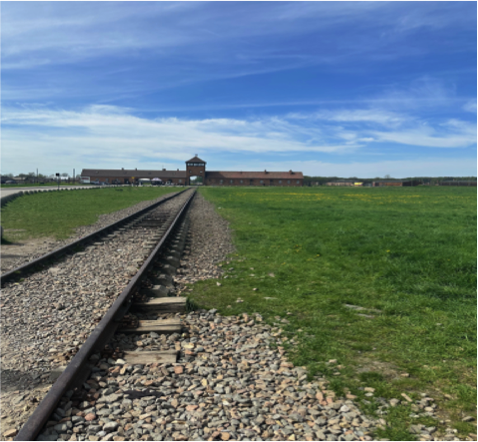
Photo taken by Léa Coucke
Our goal as we worked on the project was not only to document the tragic experiences of people who were deported, but also to tell the story of Fernand and Louise Ochsé.
The Convoy 77 project also explores different ways of teaching the history of the Holocaust. For us, this involved learning through music, and more specifically through music and songs composed and performed in concentration camps.
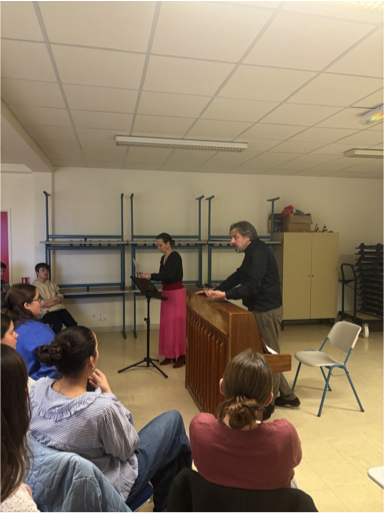
On January 27, 2025, to mark the 80th anniversary of the liberation of Auschwitz, Hélios Azoulay and Marielle Rubens visited our school to explain how, despite the horrific conditions in the concentration camps, some of the music composed in them has been preserved and passed down to us today.
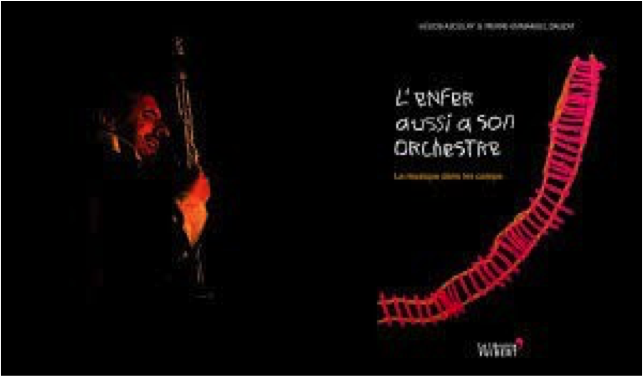
Hélios Azoulay is a composer, clarinet player and the author of several books, including L’Enfer aussi a son orchestre (Hell too has its orchestra). For the past fifteen years or so, he has devoted most of his work to spreading awareness of music composed in concentration camps, which he performs with the group of musicians he leads.
His partner, Marielle Rubens, sings in the group and has appeared on three albums entitled Même à Auschwitz (Even in Auschwitz), Sauvée des cendres (Saved from the Ashes), and Orchestration in the Ashes.
MUSIC: BYLA SOBIE RAZ ELZUNIA (starts at 6:25)
Byla sobie raz elzunia [1] (composer unknown) is sung by Marielle Rubens, with Pablo Schatzman on the violon and Hélios Azoulay on piano.
Hélios says of Marielle: “When she sings, the music speaks from deep within…you’re right there with her.”[2]
We studied World War II in our history curriculum, but when it came the Holocaust, the focus was on music. Our music teacher opted to explain the Holocaust to us through the personal stories of people who were deported and survived, including Albert Veissid, a musician in the Auschwitz Men’s Orchestra, who shared his story with Sophie Nahum[3], and Violette Jacquet Silberstein, whose story Hélios Azoulay tells when he speaks in schools[4].
Each piece of music we listened to in class tells a historical story. Every note resonates, not only with the suffering these people endured, but also with their hopes and dreams—the hopes of souls immersed in such horror that we must never forget. How else can we explain their willingness to exchange a morsel of bread for a scrap of paper so they could jot down a few notes, if it wasn’t to somehow bring us closer to them?
MUSIC: ALLEGRO FROM A TRIO FOR VIOLON, VIOLA AND CELLO (starts at 8:48)
The first movement from the trio for violin, viola, and cello by Gidéon Klein[5], with violon par Pablo Schatzman on violin, Patrick Dussard on viola and Maja Bogdanovic on cello. It was composed by Gidéon Klein, a Czech composer who was sent to the ghetto in Theresienstadt in 1941. In 1944 (just 9 days after he finished the piece) to the Fürstengrube camp, an Auschwitz satellite camp where he worked in a mine and died on January 27, 1945, at the age of 25, most likely shot by the SS shortly before the Soviet army arrived.
Why are we telling you about Fernand and Louise Ochsé?
Why did this couple capture the imagination of our music teacher, who signed us up for this project?
How did she go about teaching us about the Holocaust in a different way?
We will explain all of this in the podcasts, but before we move on, allow us to introduce you to Fernand and Louise…
Fernand and Louise were both artists.
Fernand was a composer, painter, stage designer, and costume designer. Louise was a sculptor.
Fernand was born in Paris, France, in 1879[6]
Louise was born in Forest, Belgium, in 1884[7] They got married in Paris in 1938[8]
How did they meet?
Where did they come from?
What happened in their lives?
We aim to answer all these questions in the podcasts.
We end this episode with a piece called Petit roseau (Little Reed), the first excerpt from the collection titled Odelettes, which Fernand composed in Paris in 1902 and dedicated to his friend and mentor.[9]
Next we come to episode 2, Le temps de l’innocence (the Age of Innocence) in which we look back on Fernand and Louise’s younger years.
MUSIQUE: PETIT ROSEAU (starts at 13:00)
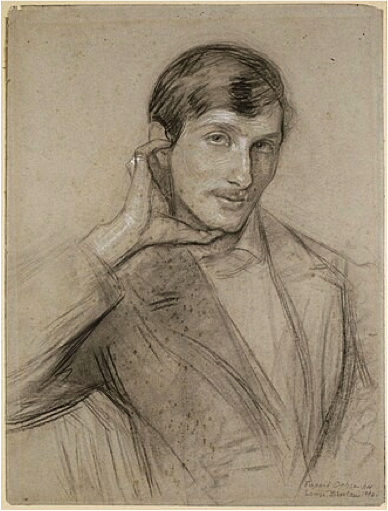
Portrait of Fernand Ochsé drawn by Catherine Bresleau in 1898.
Source: Wikipedia
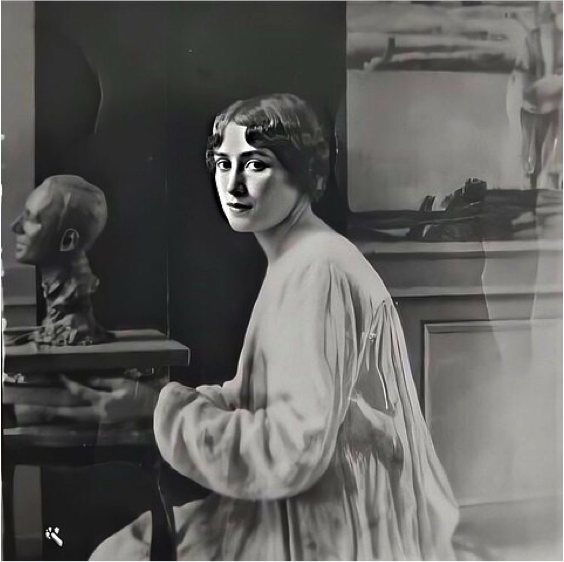
Portrait de Louise Ochsé in her studio, sculpting a bust of Maurice Ravel.
Source: Wikipedia
EPISODE 2 : THE AGE OF INNOCENCE
Listen to episode 2 of the podcast
MUSIC: PRÉLUDE À L’APRÈS-MIDI D’UN FAUNE (at the beginning of the podcast)
Prelude to the afternoon of a faun composed between 1892 and 1894 by Claude Debussy, performed by the Montreal Symphony Orchestra conducted by Charles Dutoit.
The second episode of our series entitled The Age of Innocence focuses on Fernand and Louise Ochsé’s childhood and youth. It is brought to you by Israa, Louna, Elouann, and Evan.
Louise Esther Mayer was born on June 13, 1884 in Forest, Belgium.
Her father, Lucien Georges Hyppolyte Mayer, was born in Brussels in 1848 and worked as a trader in the industrial sector.
Her mother, Myriam Esther Eglé Astruc, was born in Paris in 1860. Her father, Élie Aristide Astruc, was the Chief Rabbi of Brussels and became the Chief Rabbi of Bayonne, in France, in 1887.
She had an older brother, Marcel David Mayer, born two years before her in 1882, also in Brussels. He went on to become an arts and manufacturing engineer, married Sarah Astruc, and had a son called Jean-Pierre[10].
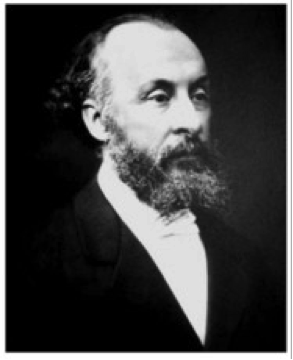
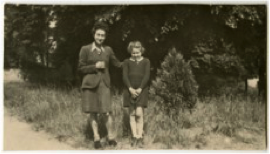
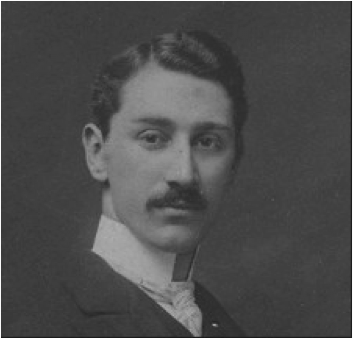
Élie Astruc (her grandfather) / Myriam Astruc (her mother, on the left of the photo) / Marcel Astruc (her brother)
Source: Geneanet.org (family tree compiled by Anand Descotte)
Louise was born into a wealthy Belgian Jewish family. Her uncle, Gabriel Astruc, founded the Champs Élysées Theater in Paris. The theater is on Avenue Montaigne in the fashionable 8th district of Paris and is known as one of the earliest examples of Art Deco architecture. It remains a performing arts venue to this day.
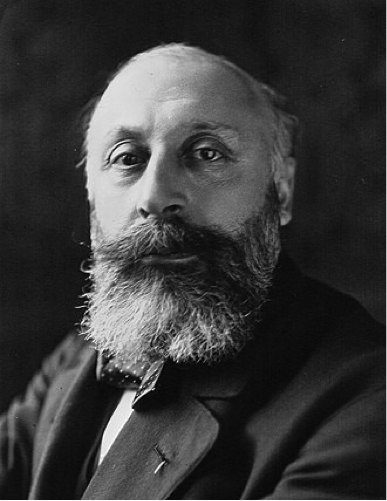
Gabriel Astruc (Louise Mayer Ochsé’s uncle, who was the first manager of the Champs-Élysées Theater in Paris)
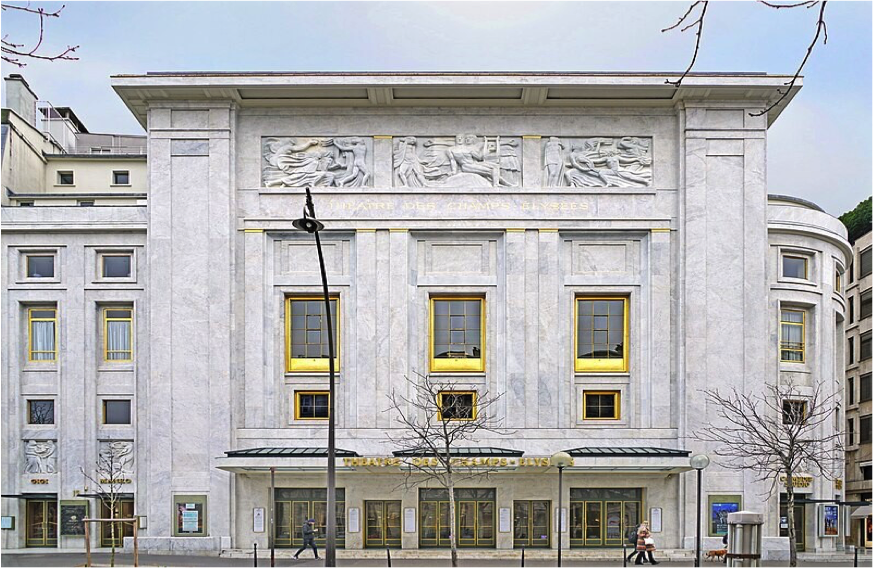
The Champs Élysées theatre in the 8th district of Paris. Source: Wikipedia
Fernand Émile Didier Ochsé was born on January 11, 1879, at his parents’ home on rue des Marais in the 10th district of Paris. His father, Albert Ochsé, was born in 1839 in Neuss, Germany. He was a merchant who dealt in ivory, mother-of-pearl, flowers, feathers, and hat decorations. He was also a member of the French Union for the Rescue of Children between 1901 and 1908[11].
His mother, Alice Dreyfuss, was born in Paris in 1849. Fernand was the fourth of six children.
Marianne, the eldest, died at the age of three. He had two older brothers, Robert and Julien, who 7 and 5 years old respectively when Fernand was born, and two younger sisters, Julie-Marie, born in 1886 and Jacqueline, born in 1888).
La famille Ochsé family lived at 29 avenue de Montaigne in the 8th district of Paris[12].
MUSIC: NAMOUNA (starts at 5:33)
The Serenade, from Namouna, was composed by Édouard Lalo in 1882. The work is a two-act ballet commissioned by the Paris Opera House, choreographed by Lucien Petipa, and performed by the Royal Philharmonic Orchestra, conducted by Yondanj Butt.
We know nothing of Louise’s childhood.
We can safely assume she spent a happy childhood, raised in a well-to-do family that appreciated the arts. Fernand, on the other hand, grew up in a sibling group who were very close but also rather eccentric.
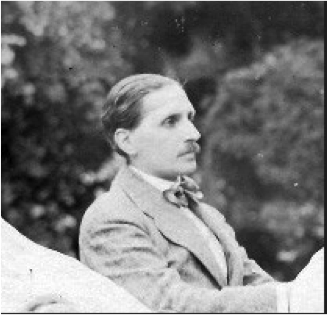
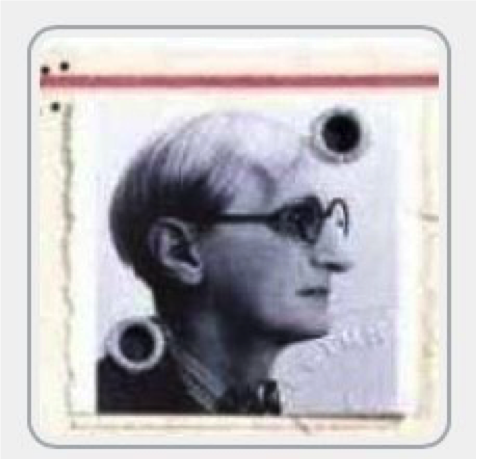
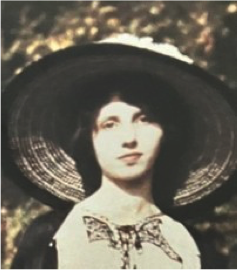
Source Geneastar: the Ochsé family
(Left to right: Julien, Robert, Julie-Marie)
In his book La Mort de Fernand Ochsé [The Death of Fernand Ochsé] (published by Fayard, 2018), Benoît Duteurtre wrote of his family home:
“The word ‘hotel’ might have seemed a touch grandiose when referring to this imposing bourgeois house that stood between the courtyard and the garden at 43 Rue de Villiers, on the outskirts of Levallois-Perret. This was a far cry from the palaces of the Plaine Monceau… But that was precisely what made receiving guests at the Ochsés’ home so intriguing—they were known to be Jewish, said to be wildly eccentric, and they staged their gatherings as if the house were a theater and the entire family, along with their servants, were a cast of actors and extras.”[13]
The poet Henri de Régnier described their family home in Neuilly as follows: “This strange Ochsé house feels like something out of a fairy tale.”
During a reception hosted by the family on February 14, 1908, some of the guests described the Ochsé family as “colorful”.
We can just imagine how Fernand’s early years must have been very exciting, light-hearted and whimsical.
MUSIC: LE BOEUF SUR LE TOIT (starts at 9:55)
An extract from Bœuf sur le toit, (Ox on the roof) composed by Darius Milhaud in 1920 for the Champs Élysées comedy theater, played by the Radio France philharmonic orchestra conducted by Frank Mikko.
Louise Mayer studied painting and sculpture with the Belgian artist Constantin Meunier, a master of realist and social art, closely associated with naturalism, whose work depicted working-class life and industrial growth, primarily in Belgium. He taught Louise the basics of sculpture and advised her to steer clear of more formal, academic courses.[14]
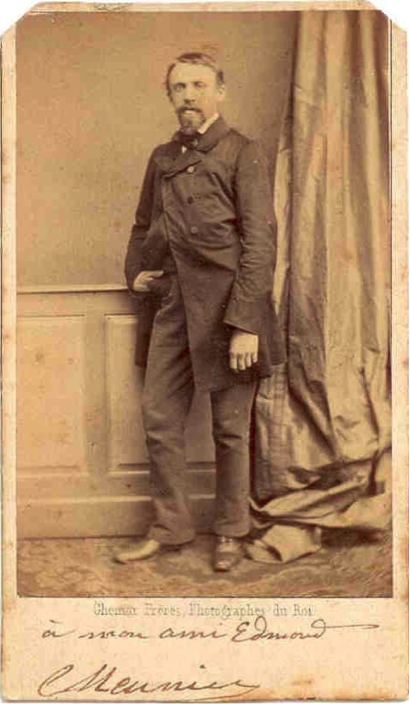
Constantin Meunier, taken in around 1860 by the Ghémar brothers. Source: Wikipedia,
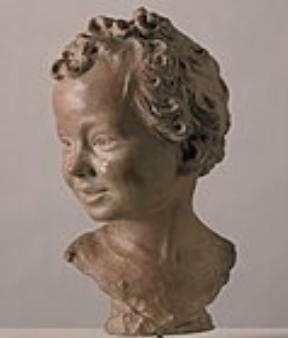
Louise’s sculpture of a child’s head, 1918. Source: Anand Descotte
In the early 20th century, Louise moved to Paris and exhibited her work at the National Society of Fine Arts exhibition, the Freedom of Aesthetics exhibition, and the Boutet de Monvel Gallery. As for Fernand, he grew up in a family described as quirky, which doubtless influenced his development as a well-rounded artist—a true romantic figure of the early 20th century. He was a painter, musician, composer, set designer, and art collector all in one.…
His mother, Alice, once said of him: “My son Fernand is the ultimate expert on the Second Empire. He spends his days at the antique dealers’, where he spends enormous sums of money.”[15]
His older brother, Robert, played the cello (sometimes while naked in the garden!), and his younger brother, Julien, wrote poetry. Fernand grew up in an artistic environment and followed not only his brothers’ example but also that of various other family members.
On February 14, 1908, at a reception at the Ochsé family home, Madame de Saint Marceaux, an influential woman and patron of the arts, described the evening using language laced with anti-Semitic contempt: “A bizarre time at the Ochsés’. Pretty young women, an elderly Jewish mother dressed up and dripping with jewels, pretty little knick-knacks all over the house, and a meticulous attention to detail. Everyone in this family puts on a show. No invitations, nothing but mystery and bluff. High society flocks eagerly to this residence, spellbound, much to the astonishment of these rather vulgar people, who folk scrutinize as if they were some sort of exotic creature. On a tiny stage, the pretty Ochsé girls look rather like a living painting. With no real singing voices, and in a naive sort of way, they sing, and it’s charming. One member of the Ochsé family writes poems, another recites them.”[16]
MUSIC: L’ÎLE DU RÊVE (starts at 14:26)
The duet “Restons ensemble,” (Let’s Stay Together) from L’Ile du rêve (The Island of Dreams), composed by Reynaldo Hahn and performed by France Duval and Bruno Laplante.
Fernand and his then-sister-in-law, Louise, sang it at the infamous reception described above, in February 1908[17].
Louise became a member of the Ochsé family on June 5, 1906, when she married Fernand’s younger brother, Julien.
In Episode 3 of our podcast, entitled “Parisian Life” and dedicated to Jacques Offenbach, the focus is on this period of artistic fulfillment and carefree living.
If you listened to the podcast, thank you. We end with an excerpt from Claude Debussy’s Nocturnes, composed between 1897 and 1899, and entitled “Nuages” (Clouds), performed by the Radio France Philharmonic Orchestra conducted by Frank Mikko.
MUSIC: NUAGES (starts at 17:49)
EPISODE 3 : THE PARISIAN LIFESTYLE
Listen to episode 3 of the podcast
MUSIC: OUVERTURE DE LA VIE PARISIENNE (at the beginning of the podcast)
This is an extract from the opening of la Vie parisienne (Parisian Life) an operetta composed by Jacques Offenbach in 1866 and played by the London Festival orchestra.
In episode 3 of our podcast, Amina, Emma, Yanis and Rilès speak of the happiest time of Fernand and Louise’s life: the years of artistic success and carefree living in their lighthearted, open-minded social circle in Paris.
In the run up to the First World War, life seemed uncomplicated and joyful. Louise married Julien Ochsé in 1906 and began exhibiting her work in Parisian art salons. In 1912, during her exhibition at the Boutet de Monvel Gallery, the poet and writer Guillaume Apollinaire spoke highly of her work. Among the pieces on display was a bust of Maurice Ravel, which is currently on view at the Maurice Ravel Museum in Montfort-l’Amaury, in the Yvelines department of France.
Apollinaire reviewed Louise’s work in one of the journals of the French Academic Association, in an article published under the title “Apollinaire the Art Critic: Sculpture in Question,” in which he wrote:
“At a time when people are beginning to question whether the depiction of the human body is the ultimate artistic objective, as if the art of the nude had not been the greatest art form until now, it is comforting to see that sculptors, at least, are appreciative of beauty.”
Louise socialized extensively with artists, musicians, and writers.
From the early 1900s onward, Fernand followed not only in the footsteps of his brothers, Robert and Julien, but also those of a young man named Reynaldo Hahn, who was five years his senior. Reynaldo Hahn was a source of inspiration for the young Fernand. In 1906, Reynaldo Hahn composed a piece based on a poem by Jean Moréas called “Quand reviendra l’automne avec ses feuilles mortes” (“When Autumn Returns with Its Fallen Leaves”). He dedicated it to Fernand.[19]
MUSIC: QUAND REVIENDRA L’AUTOMNE AVEC SES FEUILLES MORTES (starts at 4:37)
This piece of music, Quand reviendra l’automne avec ses feuilles morts (When will autumn arrive again, with its fallen leaves), composed by Reynaldo Hahn and dedicated to Fernand, is played by Tassis Christonyannis and Jeff Cohen.
In 1907, Fernand followed suit by setting poems by Henri de Régnier to music in a collection titled Odelettes, which is now available at the French National Library in Paris.
Our music teacher was lucky enough to read these scores and shared of them with us.
MUSIC: CHANTE SI DOUCEMENT (starts at 6:29)
An excerpt from the Odelettes collection called “Chante si doucement”(Sing so softly), composed by Fernand Ochsé in 1907.[20]
In Benoît Duteurtre’s book, he describes Fernand as “a wealthy young man, curious about everything, who lived for art and fantasy; in the early 20th century, he personified the kind of mentality that even World War I could only dampen temporarily.”[21]
Louise, meanwhile, had to contend with her husband Julien’s drug addiction; he was becoming increasingly hooked on opium, which he smoked.
At around the same time, she became acquainted with Henri de Régnier, whose poems Fernand had written music for. She began working on a bust of him, which is now on display at the National Museum of Modern Art in Paris.
She also appeared on the cover of the May 15, 1912, issue of the magazine La Vie Heureuse, (the Happy Life) in an illustration by her brother-in-law Adrien Désiré Etienne, who was known professionally as Drian (he was married to Jacqueline Ochsé, Louise’s youngest sister). In it, she was dressed as a sultana, flanked by two busts she had produced: one of Drian himself and one of Ramon Fernandez, a writer and critic who wrote for La Nouvelle Revue française (The New French Review).[22]
In 1918, she produced several versions of a death mask of Claude Debussy, each made from a different material. A terracotta mask on display at the Museum of Fine Arts in Grenoble, a sandstone mask at the Museum of Aquitaine in Bordeaux, a plaster cast in a private collection, and lastly a single bronze casting made using the lost-wax method at the Terrades Gallery, near the Tuileries Garden in Paris.[23]
When war was declared in August 1914, Fernand, who was 35 years old by then, was deemed unfit for active duty due to chronic bronchitis. He had previously been exempted from national service for the same reason. It was around this time that he bought an apartment near the Panthéon in Paris, which the well-known French conductor Manuel Rosenthal described as follows: “He lived in a huge, magnificent apartment behind the Panthéon. An apartment filled with automatons… every one of them worth a fortune.”[24]
He also began spending time with a young man by the name of Arthur Honegger, whom he took under his wing. Some said the two men were lovers, but this is purely speculation.
This was also when Fernand began designing costumes and sets for the Le Vieux Colombier theater. Arthur Honegger made a name for himself there, and the two young men performed together, with Arthur on piano and Fernand singing, the Six Poèmes composed by Arthur Honegger based on Guillaume Apollinaire’s collection of poems Alcools (Alcohols), first published in 1913.
MUSIC: LES CLOCHES (starts at 10:50)
Les Cloches (The Bells), an excerpt from Six Poèmes, performed by Simon Wallfish and Edward Rushton, composed by Arthur Honegger in 1917.
Shortly after the First World War, Fernand began to concentrate mainly on operettas and also became involved in costume and set design. He also reconnected with his close friend Reynaldo Hahn. He composed an operetta called Choucoune, but it was never performed as such, and the score appears to have been lost.[25]
The music from Choucoune was played only once, as a concert, in the summer of 1929. The scores of two of his songs still exist as part of a collection that Arthur Honegger’s daughter donated to the French National Library in 1997.
MUSIC: CHOUCOUNE (starts at 13:28)
The piece titled Choucoune in the podcast is not the one not composed by Fernand, but rather an operetta-like piece of the same name. An instrumental version of a late 19th-century Haitian-style song composed by Michel Mauleart Monton, it was based on a poem by Oswald Durand. Fernand’s operetta was set in Haiti and included Caribbean rhythms.
Fernand and Louise reached their artistic peak during the Roaring Twenties. Both moved in intellectual and creative circles. They were well-known and widely respected, socialized with the biggest names in the art world, and played an active role in the French artistic renaissance. Louise was a talented sculptor, while Fernand composed music, designed costumes and sets, and painted.
In 1936, Julien, Louise’s husband and Fernand’s brother died, apparently of an overdose. Julien, Fernand and Louise had been living together since at least 1926, at 5-7 rue de l’Estrapade in the 5th district of Paris. When Julien died, Louise stayed on in the house and two years later, on April 12, 1938, she married Fernand.[26]
There could be various reasons behind this rather unlikely marriage. The first is that Fernand, who was said to be gay, found a safe haven in a marriage of convenience while also taking care of Louise, his beloved brother’s widow. The second stems from respect for Jewish custom: The Law of Levirate Marriage is an ancient biblical concept that required a man whose brother had died without a son to marry his widowed sister-in-law.
Fernand was 59 years old by then, and Louise 54. The witnesses to the wedding were the famous French conductor Henri Casadesus and Louise’s cousin, Lucienne Astruc.
In the build-up to the Second World War, Fernand and Louise failed to grasp the significance of the political situation in Germany and remained focused on their lives as society artists. Fernand even invented a new approach to set design. In 1938, his sets and costumes for the production of Faust earned widespread praise.
In 1940, Marshal Pétain criticized this “frivolous France that preferred to enjoy and delude itself rather than prepare for hard times ahead.”[27]
MUSIC: OUVERTURE DE FAUST (starts at 18:11)
You have just listened to the opening of Faust, an opera in five acts composed by Charles Gounod in 1859 and played by the Radio France orchestra conducted by Frank Mikko. In Episode 4 of our podcast, “From Living in Hiding to Inconceivable Oblivion,” we recount Fernand and Louise’s final years.[28]
EPISODE 4 : FROM LIVING IN HIDING TO INCONCEIVABLE OBLIVION
Listen to episode 4 of the podcast
MUSIC: TERREUR (at the beginning of the podcast)
Episode 4 of our podcast starts with the second movement of the Terezin suite for piano, “Terreur” (Terror), composed by Karel Berman in 1944 while he was imprisoned at the Theresienstadt concentration camp. It is one of the few musical works composed in situ, and depicts the horror of the camps with stark realism. It is performed by Laurent Wagshal on piano.
This part of Fernand and Louise Ochré’s story, “From living in hiding to inconceivable oblivion” is recounted by Éléah, Romane, Ambre and Amel.
In 1939, during a dinner party hosted by Fernand and Louise shortly before war was declared, the couple’s friends appear to have been oblivious to the gravity of the situation. In May 1939, Fernand recorded one of his songs: C’était hier (It was yesterday).
In September 1939, just as Germany was invading Poland, Maurice Chevalier sang: Paris sera toujours Paris (Paris will always be Paris).
MUSIC: PARIS SERA TOUJOURS PARIS (starts at 3:50)
Little by little, France was drawn into the “Phoney War,” and a divide began to emerge between the German-occupied zone in the northern part of France and the Free zone in the south.
The passing of a decree on the “Status of the Jews” marked a turning point for Louise and Fernand, and prompted them flee to the South of France in 1940.
It appears that the couple spent some time in Marseille and then Toulon before eventually deciding to stay at Le Splendid Hotel in Cannes, a converted palace on the French Riviera.
A large number of Jews took refuge in Cannes.
Fernand and Louise may have chosen the resort because Reynaldo Hahn, a close friend of Fernand’s, frequently stayed there and was well-regarded in local artistic circles.
In 1942, Fernand designed the cover for the opera season program at the Cannes Casino. In March 1942, he wrote to his friend Arthur Honegger: “Nothing much has changed here; I’m looking increasingly washed out, in part due to the food shortage, which is getting worse. I’ve aged terribly, physically. Mentally, I’m doing just about okay; I’m working and listening to a fair bit of music.”[29]
On November 11, 1942, the German army invaded the Free Zone, and their refuge in Cannes became increasingly unsafe. Jews were hunted down relentlessly. In late 1943, Fernand and Louise left the Splendid Hotel and sought refuge in the Montmorency Clinic, at 9 Route de Fréjus, which was a healthcare facility and convalescent home.[30]
The couple remained in hiding there and were reasonably safe until July 1944. When the Allies landed in Normandy in June 1944, there was a glimmer of hope: the war was coming to an end, and the German army was in turmoil.
However, on July 3, 1944, the German police descended on the clinic in search of a family by the name of Delporto, who someone had reported as Jews.[31]
The Germans were not, it seems, looking aware that Fernand and Louise were there.
Two witnesses, Marcel Delannoy in his book on Arthur Honegger and Henri Casadesus, as recounted by his daughter Gisèle in her memoirs, described what happened during the arrest.
According to the first account, Fernand, who spoke German, reportedly overheard what was happening in the Delports’ room next door, panicked, and emerged from his hiding place to identify himself. According to the second account, however, it was Louise who panicked and turned herself in out of concern for her husband, who had just been arrested.[32]
It is quite possible that Fernand and Louise, weary from spending so long living in hiding and deprived of so much that was important to them, had given up the will to stay hidden.
Several people family with the arrest but who did not witness it first hand, however, reported that when Louise was arrested, she said, “If you’ve come for my husband, take me as well.” They were apparently arrested by chance, as there is no mention of them in any official records.[33]
Fernand and Louise were thus arrested and imprisoned, but had to wait a few days before they were transferred to Paris because they first had to pay a fee for their “evacuation”! They arrived in Drancy internment camp, north of Paris, in mid-July 1944. There they stayed until July 31, when Convoy 77, last convoy from Drancy to Auschwitz-Birkenau, in occupied Poland, set off. They had no idea where they were headed.[34]
In Benoît Duteurtre’s book, Daniel Urbejtel, who was arrested in a U.G.I.F. (Union Générale des Israélites de France, or General Union of French Jews) children’s home, was deported on Convoy 77 and survived, despite being only 13 years old in 1944, described the journey as follows: “I caught a glimpse of the Ochsés, lined up with the others, struggling to climb up into the train before they saw the squalid, dark space where they were to be crammed in together with eighty other people. At one end were two containers, one full of water, the other empty. The only hatch was partially blocked off. It was July. It was extremely hot, and the journey would last three days. Babies were crying; elderly people were moaning. The train made endless stops.”[35]
MUSIC: WIEGALA (starts at 11:25)
Wiegala, by Ilse Weber, is sung by Marielle Rubens . We chose this song as a tribute to the 323 children, 124 of who were under 10 years old, who were deported on Convoy 77 and sent to their deaths in the gas chambers. Some were deported with their families and others with their friends from the U.G.I.F. children’s homes, who had been rounded up a few days earlier on the orders of the Nazi commandant of Drancy camp, SS officer Aloïs Brunner.
Wiegala was written as a lullaby. Ilse Weber was the head nurse in the children’s ward at the Theresienstadt camp. She was transferred to Auschwitz on October 6, 1944. As she went into the gas chamber, she sang this lullaby to reassure the little children she was taking care of.[36]
Hélios Azoulay, in his book L’Enfer aussi a son orchestre (Hell too has its orchestra) wrote about this subject: “The lullaby has its own special moment. It unfolds between the person who sings it and the listener who drifts off to sleep as its gentle breeze whispers past.”[37]
We cannot say for certain exactly when or how Fernand and Louise died.
Did they die during the journey? Did they have to endure the gruesome selection process?
They were later officially declared to have died on August 5, 1944, a date stipulated by the French government after the war.
The law states: “When it has been confirmed that a person was aboard a deportation convoy and there has been no news of that person since the date on which the convoy departed, the person is presumed to have died on the fifth day thereafter and at the final destination of the convoy.”[38]
Of the Ochsé siblings, only Robert survived. He died in Paris on January 29, 1952.
We have no information on what happened to the couple’s assets—were they “divided up”? Were they “looted” by the Germans? What became of the spacious Parisian apartment near the Panthéon and the art collections? Why has Fernand’s life’s work been largely forgotten, reduced today to just a few musical scores? We cannot answer any of these questions with any certainty… All that remains today Edgard Degas’s famous 1879 painting, “Le souper au bal,” (Dinner at the Ball), which Germany purchased in 1942 for the Karlsruhe Museum and which France recovered in 1950. It is now on display in the Musée d’Orsay in Paris.
We now come to the end of our story.
This project, which goes further than the Convoy 77 organization, sheds light on two artists who have been unjustly forgotten.
We hope that you have found the story of Fernand and Louise as fascinating as we have, and that we have raised your awareness not only of the sad fate of the people deported on Convoy 77, but also of that of all of the other deportees. We conclude this episode of the podcast with a piece composed by Arthur Honegger in 1946, a posthumous tribute to Fernand: Mimaamaquim, Psalm 130 in Hebrew, choral music.
MUSIC: MIMAAMAQUIM (starts at 15:50)
Episode 5
Listen to episode 5 of the podcast (conversation in French, no music)
We conclude with episode 5 of the podcast, a conversation with Séverine Potel-Kebe (a French teacher at our school) Léa Coucke (our music teacher) and Hélios Azoulay, during which they reply to our questions about the importance of music in remembrance and the role that music played in the concentration camps.
Thank you for tuning in. We hope you have enjoyed listening to Radio Campus
REFERENCES AND OTHER SOURCES
[1] Byla sobe raz elzunia; Audio clip No. 1 from L’Enfer aussi a son orchestre. La musique dans les camps (Hell too has its own orchestra: Music in the Camps) by Hélios Azoulay and Pierre-Emmanuel Dauzat, published by Librairie Vuibert, 2015
[2] For the past fifteen years or so, Hélios and Marielle have been performing music and songs composed in concentration camps. To date, approximately 7,000 scores have been recovered, ranging from lullabies to operas.
[3] From Les Derniers, by Sophie Nahum, published by Alisio (also available on lesderniers.org): Sophie Nahum is a documentary filmmaker who devotes all her time and energy to this independent project, which captures the stories of the last Holocaust survivors in the form of books, web series, and podcasts.
[4] Presentations in schools through the ADAGE platform with the heading: “Music in Concentration Camps.”
[5] Audio clip N°16 L’Enfer aussi à son orchestre. La musique dans les camps (Hell too has its own orchestra: Music in the Camps), Allegro from the string trio for violin, viola, and cello by Gidéon Klein (also see P.32 and 33)
[6] Victims of Contemporary Conflicts Archives Division of the French Ministry of Defense Historical Service, in Caen, dossier no. 21 P 521 301
[7] Victims of Contemporary Conflicts Archives Division of the French Ministry of Defense Historical Service, in Caen, dossier no. 21 P 521 300
[8] Victims of Contemporary Conflicts Archives Division of the French Ministry of Defense Historical Service, in Caen, dossier no. 21 P 521 300
[9] French National Library, ref. 410 527 09, music Vmg 48,538 Odelettes, poems by Henri de Régnier, music by Fernand Ochsé, published by Heugel
[10] Victims of Contemporary Conflicts Archives Division of the French Ministry of Defense Historical Service, in Caen, dossier no. 21 P 521 301
[11] Geneastar website (family tree made by Anand Descotte)
[12] The Ochsé family lived at:
95 rue des Marais, in the 10th district of Paris, from 1872 through 1886
29 avenue Montaigne, in the 8th district of Paris, from 1886 through 1901 ( or 1903?)
2, rue Franklin, in the 16th district of Paris, as Fernand appeared before the Seine Draft board
43 rue de Villiers, in Neuilly-sur-Seine
[13] From Benoît Duteutre’s book, La Mort de Fernand Ochsé (The death of Fernand Ochsé), published by Fayard, 2018, p. 33.
[14] Terrades Gallery website. Bibliography: A. Rivière, “Sculpture’elle: les sculpteurs femmes du 18ème siècle à nos jours” (Sculpture’elle: Women sculptors from the 18th century to the present day)
[15] From Benoît Duteutre’s book, p. 37
[16] From Benoît Duteutre’s book, p. 44
[17] From Benoît Duteutre’s book, p. 42
[18] Terrades Gallery website
[19] Reference on p.49/50 of Benoît Duteurtre’s book.
[20] The two audio clips (Petit Roseau and Chante si doucement) were produced using scores loaned by the French National Library, ref. 410 527 09 from the Odelettes collection and digitized by Stan Testenev (a master’s student doing an internship in music education at the Jean-de-la-Varende middle school. Supervisor: Léa Coucke)
[21] From Benoît Duteutre’s book, p. 83
[22] French National Library, Literature and Art department, ref. 4-Z-1640
[23] Terrades Gallery website
[24] From Benoît Duteutre’s book, p.105
[25] www.youtube.com/@haitienpoesie5410 joined in July 28, 2020
[26] Victims of Contemporary Conflicts Archives Division of the French Ministry of Defense Historical Service, in Caen, dossier no. dossier 21 P 521 300
[27] From Benoît Duteutre’s book, p. 209
[28] From Benoît Duteutre’s book, p. 269/270
[29] From Benoît Duteutre’s book, p. 229
[30] Source: Wikipedia
[31] From Benoît Duteutre’s book, p. 246
[32] From Benoît Duteutre’s book, p. 246/247
[33] From Benoît Duteutre’s book, p. 248
[34] Victims of Contemporary Conflicts Archives Division of the French Ministry of Defense Historical Service, in Caen, dossier no. 21 P 521 300
[35] From Benoît Duteutre’s book, p. 249, Victims of Contemporary Conflicts Archives Division of the French Ministry of Defense Historical Service, in Caen, dossier no. 21 P 521 300
[36] From Benoît Duteutre’s book, p.255. There were closer to 60 than 80 deportees in the cattle cars, standing or sitting directly on the floor, but that was still far too many for everyone to be able to sit down.
[37] From Hélios Azoulay’s book, L’Enfer aussi a son orchestre. La musique dans les camps (Hell too has its own orchestra: Music in the Camps, p.71/72/73
[38] From Hélios Azoulay’s book, L’Enfer aussi a son orchestre. La musique dans les camps (Hell too has its own orchestra: Music in the Camps, p.71/72/73
[39] Victims of Contemporary Conflicts Archives Division of the French Ministry of Defense Historical Service, in Caen, dossier no. 21 P 521 300
ADDITIONAL INFORMATION FROM LÉA COUCKE
All the pieces of music used in the podcasts were chosen according to various criteria:
First of all, Benoît Duteurtre’s book helped us understand more about Fernand Ochsé himself, the artists he mixed with, and those he worked with.
This influenced the selection of composers such as Reynaldo Hahn, Arthur Honegger, Claude Debussy, Jacques Offenbach, Darius Milhaud, Charles Gounod, and Édouard Lalo. Of course, this list is by no means exhaustive.
Secondly, since the biographies were explored from a musical perspective, it seemed appropriate to include pieces that the students had studied in class and had heard performed by Hélios and Marielle.
Lastly, I was extremely happy to locate some scores written in Fernand’s own hand and to be able to share them—albeit not in ideal circumstances, given that they were digitized.
I would also like to point out that without Benoît Duteurtre’s excellent book, writing Fernand and Louise’s biographies would have been so much more difficult.
LÉA COUCKE WOULD LIKE TO THANK
- Claire Podetti from the Convoy 77 team for her support and invaluable advice
- Valentin Ambourg (Radio Campus president)
- Corantin Lefeaux (Radio Campus treasurer)
- Pierre Nour (civic service worker at Radio Campus)
- Agnès Klingenberg (editor at WiseMusic Group), thanks to whom I was able to gain access to several scores composed by Fernand Ochsé.
- The French National library
- Stan Testeneve (a master’s student interning in music education), who digitized the two scores from Odelettes, thus enabling us to listen to them.
- Séverine Potel-Kebe, (French teacher at the school).
- Hélios Azoulay and Marielle Rubens , for their work with the two 9th grade classes who worked on the project.
- Florence Benard (the school principal), who approved the project on the ADAGE website.