Français
 Polski
Hélène GOLDFARB (1940-1944)
A fictional account of Helene Goldfarb’s story, as if written by Hélène herself
My name is Hélène, Hélène Goldfarb[1].
But am I, or am I not, Hélène Goldfarb?
I’m very hot[2].
And thirsty too.
But the worst thing of all? I need to pee. But I don’t dare say anything.
We’re all standing up. We can’t sit down. I’d love to, but my Maman (that’s what we French girls call our Mom) keeps saying we have to leave room for the old folk to sit down… or sick people… or pregnant women.. or women holding babies.
I’m not a baby. It’s my birthday this week. I’m going to be four.
So anyway, we’re all standing up, and we can’t sit down. I’ll have to wait to pee!
All standing up, all squashed together. There’s nothing to hold on to.
I’m lucky though, I’m clinging on to Maman. She’s holding her hands like a bridge over my head: I’m tucked between her legs, with one arm around each leg. I’m giving her a big long hug.
I’m still too hot.
I’m happy enough though, here with Maman. Holding on to her like this, it feels like we’re on the subway, swinging from side to side, slowing down and then speeding up again.
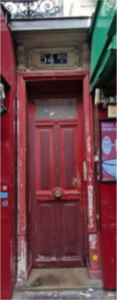
The subway? Oh yes, I know it well! We call it the metro in Paris, where I live. I even know my address: it’s 54 bis rue Ordener, in the 18th district[3]! Maman and Papa always said I had to know my address by heart! Just in case…
I don’t know what the word éaukazoué means… My babushkas (grandmothers)[4] and dziadeks (grandfathers)[5] sometimes use words I don’t understand, especially when they’re talking to each other[6] or with my parents.
I’m hungry too.
I can’t remember when they last gave us something to eat…it may have been yesterday, or perhaps it was the day before. It was only soup anyway, not much and not very often[7].
Before we got on the bus that brought us to the train station[8], we had to wait on staircase 19 all night long[9]. I slept on Maman’s lap. There were loads of other folks there. People were moaning and praying (I think). I didn’t cry though.
Before they told us to wait on the staircase, we stayed in a big dormitory on the fourth floor. It really stank in there. I wonder if I smell bad too? I haven’t changed my clothes since at least…umm.. There are no seats here in the cattle car, just a bit of straw on the floor. There’s a bucket though. And it’s full. Full of poop and pee – yuck! It keeps sloshing around, and then overflowing.
Oh, I’m so hot.
Luckily, we’re pretty close to the only ventilation slot. At least we can get some air. Not much, but a little.
A man looked at me a while ago: he smiled sadly at me, so I waved at him. But then he quickly turned away.
I’m starting to forget what our life was like before. My brothers’ faces are becoming blurry. But worst of all is my Papa. Maman says he’s gone away to work[10]. I’m still hoping he’ll come home soon.
Last time I went out, it was with Maman. We went to the lavoir. That’s a big wash-house, where people go to do their laundry[11]. I love going to the lavoir. At least I used to… I think. Anyway, that evening, Maman told me I mustn’t make any noise because we weren’t allowed to be there: it was against the law[12]. We never went out much. Claude and Georges had gone off to play hide-and-seek[13]. First Papa was gone, and now my brothers were gone as well. Maman said I was too young to play a big game of hide-and-seek. Maman and I played it too, but just the two of us.
Late that night, Maman said, “Be quiet, and stay close to me—we’re going to the washhouse.” Out we went, in the dark, wearing our yellow stars[14]. The streets were deserted, but there were a few shadowy figures keeping close to the walls. We did the same.
I’m a big girl. I understand why. There are bad guys out on the street.
And then they caught us. Right there on the square. Just as we came out of the washhouse. There was a lot of shouting. They shoved us around. They even hit us. They were yelling, but I didn’t understand the words. Maman held me close and wrapped her skirts around me. She wouldn’t let me see what was happening, but I could hear everything. Then I felt Maman shaking: she couldn’t stop. I was very scared: she was my rock, and it felt like she was crumbling.
There were no roundups that night[15]. Later on, when we were in the police station[16], Maman whispered to me that someone might have turned us in. That’s what happened to my grandma Feiga’s friend Moschek[17], when the big game of hide-and-seek first started.
We had to sleep the night on the floor at the Paris police headquarters. We were in a kind of cage, behind bars. I was so sleepy. I was so hungry. I was so hot. I can’t even remember if I was frightened.
The next day, they made us get on a bus with some policemen and drove us right across Paris: I kept looking out the window, but no one even noticed us. “Not even a glance,” Maman said, in a voice that nearly broke my heart. We arrived in Drancy in the afternoon and had to stay in our seats until the French police told us (shouted at us?) to get off. They walked us to the entrance gates and left us there. Then we went in and the “workforce”[18] assigned us to a dormitory and took all of Maman’s money away from her[19]!
She was so exhausted, she barely even glanced at those men. They were prisoners just like us, as dirty as us and as skinny as us too. She just signed the form and took me by the hand.
Drancy? Oh, I knew all about that place. Maman read and reread postcards that Papa sent her from there[20]. She kept them in a cookie tin. It was funny—the words smelled good, sweet like cake and cookies. Mom always had a little smile on her face whenever she read them out to us. And then they stopped coming. No more cards. No more smiles. Just waiting. But Papa never came back. Same with his father, my grandpa[21]. They both stayed here in Drancy too.
We waited and waited. We kept asking where Papa was. Then, one day, a French military policeman said to us, “Shoo, get out of here, go ask the UGIF[22], let us get on with our job!”
We never did get an answer.
The old lady sitting beside us has stopped moving.
An old man keeps moaning and saying he’s lost his eyeglasses.
My dress is soaked: the bucket is full. I’m not the only one. No one has managed to hold it in all this time, not even my own dear Maman.
She’s been crying a lot.
And praying a lot.
My tongue is swollen.
There are long periods of complete silence now.
Nothing but the sound of the wheels rolling on the tracks.
The train stops sometimes, but we’re never allowed to get off.
I’m thirsty, thirsty, so very thirsty!
My lips are bleeding. The inside of my mouth feels dry and sticky.
I have a sore throat.
I’m still clinging onto Maman.
Am I, or am I not, Hélène Goldfarb?
Suddenly, the train stops abruptly. The door of the cattle car swings open.
The bright light hurts our eyes. It hurts, hurts, hurts.
Men are shouting words I don’t understand.
Maman won’t let go of me. She’s never let go of me. She’s my Maman…
Dogs are barking, tugging on their leashes.
The bright light hurts, hurts, hurts.
Everyone gets off the train.
Or maybe not quite everyone?
I look back: I see old folk, women, and children. I couldn’t see them in the dark. I could hear them though…to begin with.
We put our hands over our eyes. It’s nighttime but the platform is all lit up.
It’s odd, there’s a platform, but we’re not in a station[23].
People are still flooding out of the cattle cars. There must be.. at least a thousand of us[24]!
When Mom used to tell my brothers and me, “I’m sending you a thousand goodnight kisses!” before we went to sleep, we knew that the last kiss would arrive just as they got up to go to school.
A thousand people, stumbling and staggering along, only just managing to keep going.
As for me, I just tripped over: I lost one of my shoes as I was getting off the train.
Maman is trying to pick me up to keep me out of reach of the dogs, but she no longer has the strength to lift me.
There are men wearing some kind of pajamas asking us to leave our luggage here. They say we’ll get them back later.
Maman’s suitcase is tiny. She found it at Drancy just before we left.
She wrote our names on it with a piece of chalk she found on the ground. Everyone took turns to write their name. As Grandpa Chaim used to say, “It’s an important thing, a name.”
The men in pajamas are picking everything up, and the men in uniform are pointing and yelling: the men have to stand in one line, the women, children, and old folks in another.
Mom’s hand, damp and clammy, still holding mine.
I look up, and see that it’s snowing. Black snow? Is this some strange land that no one has ever heard of? Does such a place even exist? The black snow is sticking to everything: it’s on my dress, and in my hair. It won’t melt, not even when I touch it with my fingers. I don’t like it. It smells bad too. It smells like something burning in the kitchen, and it catches my throat.
Not far from us there are two big buildings like factories, with tall chimneys billowing out smoke. But it’s dark – how come people are still working in the middle of the night?
They push us into a big changing room. One of the buildings with the big chimneys swallows us all up.
They tell us to get undressed. There are coat hooks for us to hang up our clothes.
What? Take all our clothes off? But…I’ve never seen Maman totally naked!
I cling to her leg. All the children are clinging to their mothers’ legs. Because a mother’s leg is always safe and secure. Even when a storm is brewing. Especially when a storm is brewing.
“It’s only a shower room,” the men in pajamas tell us.
The shower room is huge, but still we’re all squashed up together.
Squashed together?
To get washed?
Some of the mothers start screaming and picking up their children. Others plead to be let out and try to make their way back to the entrance.
Maman finally finds the strength to pick me up. She looks deep into my eyes. “I’m sending you a thousand kisses!” she whispers softly.
Little dots of light begin to whirl around our heads[25].
Am I, or am I not, Hélène Goldfarb ?
I was Hélène Goldfarb.
After the war, keeping Hélène’s spirit alive in the collective memory of the Holocaust
On September 16, 1946, Feiga Goldfarb filed a request to have Hélène’s civil status updated to that of a “missing person” . She stated that Hélène had been arrested in a “public place” on July 6, 1944.
Feiga was then living at 35 rue de la Briche in Saint-Denis, in the northern suburbs of Paris. After their parents died in the camps, Feiga was appointed as the legal guardian of Hélène’s older brothers, Georges (born in 1935) and Claude (born in 1938), both of whom survived.
An official certificate of disappearance was issued in Hélène’s name on April 19, 1947.
On January 12, 1955, Georges Goldfarb, who was living at 11 boulevard Gallieni in Villeneuve-Saint-Georges, was notified that the words “Died for France” were to be added to Hélène’s death certificate, which was issued in the 18th district of Paris.
Hélène Goldfarb’s name is inscribed on the Wall of Names at the Shoah Memorial in Paris, in the section for the year 1944, beside that of her mother, Berthe.
SOURCES
[1] Hélène Goldfarb, born on August 5, 1940, in the Bichat Hospital at 170 Boulevard Ney, in the 18th district of Paris.
[2] Deported on July 31, 1944, on Convoy 77. Victims of Contemporary Conflicts Archives Division of the French Ministry of Defense Historical Service, in Caen, dossier 21 P 33.647
[3] In 1944, Hélène and her family were living at 54 bis rue Ordener, in the 18th district of Paris, dossier loc. cit.
[4] Hélène’s grandmothers were Feiga Goldfarb, née Markovsky, and Marie Perkan, née Movckovitch / Moschovitz / Moskovitz / Moscovitz, who was born in Bessarabia.
[5] Hélène’s grandfathers were Chaïm Goldfarb and Maurice (Moschek) Perkan, who was born in Odessa and died in the 18th district of Paris in 1942 at the age of 62 (Source: Paris city archives). He was an antique dealer and, in 1936, was living on Rue Frédéric Schneider in the 18th district of Paris, not far from Berthe and Maurice Goldfarb (Source: Paris civil registry and Filiae website).
[6] Feiga was born in Poland, Marie in Russia (in what is now Ukraine). Chaïm and Maurice were born in Poland and Russia (now Ukraine) respectively.
[7] Living conditions in Drancy: Shoah Memorial, Paris.
[8] Bobigny station.
[9] Living conditions in Drancy: Shoah Memorial, Paris. Living conditions in the camp changed between 1942 and the summer of 1943, when Aloïs Brunner took over as camp commander. The U.G.I.F. was responsible for feeding and providing clothing for the detainees. Medical care, albeit inadequate, was undertaken by Jewish doctors, themselves internees.
[10] Arrested on August 23, 1941. Interned in Drancy, then deported to Auschwitz on June 5, 1942, on Convoy No. 2.
[11] Victims of Contemporary Conflicts Archives Division of the French Ministry of Defense Historical Service, in Caen. Hélène and her mother were arrested on July 6, 1944, for coming out of the washhouse during an air raid alert.
[12] 1940 laws that restricted the rights and freedom of anyone of the Jewish faith.
[13] During the war, Georges and Claude were “hidden children”, according to the family.
[14] Wearing of the yellow star was made compulsory by law on May 29, 1942.
[15] The Gestapo (SD/Sipo). The SSAJ (Special Service for Jewish Affairs, known as the “Permilleux Brigade”): a judicial police brigade founded by René Bousquet to track down Jews on behalf of the Gestapo, which by August 1944 had arrested more than 5,000 people. Tips passed on to the Gestapo or the RG (French Security Service), led to targeted arrests. Nighttime identity checks were conducted by jointly-staffed teams of French and German officers. The Milice (Militia), often referred to as the “French Gestapo,” also played a significant supporting role.
[16] The following police stations are located in the 18th district: The 18th district’s central police station was at 79 rue de Clignancourt, 75018 Paris; the local police station was at 32 rue de l’Évangile (Hébert Police Station), in the north of the district . The German military police then took Berthe and Hélène to the Paris Police Headquarters depot.
[17] Moschek Goldfarb was born in Parysow, Poland on February 25, 1898, according to the family.
[18] Aloïs Brunner put in place a new German-speaking management team, including Robert-Félix Blum, Georges Schmitt, and Emmanuel Langberg. In practice, it was designated Jewish internees, known as the “workforce” who dealt with registration procedures.
[19] French National Archives / Shoah Memorial: Search record dated July 7, 1944 in the name of Berthe Goldfarb. She handed over 91 francs when she arrived in Drancy, which is the equivalent of just a few dollars today.
[20] In 1941–42, prisoners were allowed to send postcards to their families to ask for clothes and other necessities. These were sent via the French Red Cross approximately every 15 days. Source: our own research. See also (in French only) “C’est demain que nous partons” (“We’re leaving tomorrow.”), Letters from Internees, from the Vel d’Hiv roundup to Auschwitz, March 2022 exhibition at the Shoah Memorial in Drancy: billetterie.memorialdelashoah.org
[21] Chaïm Goldfarb, Berthe’s father-in-law and Hélène’s grandfather, was born on September 9, 1879 in Parysow (Poland) and was deported to Sobibor on Convoy 53 on March 25, 1943. He too lived in the 18th district of Parsis at 17 rue Nicolet.
[22] The U.G.I.F., (Union Générale des Israélites de France, or General Union of French Jews), was founded by the French government at the behest of the German authorities. It replaced all existing pre-war Jewish associations and organizations, which were banned and shut down, and all Jews were required to join it. Its staff worked closely with the Germans. It was responsible for providing aid to people in need, helping with their dealings with the authorities and for managing children’s homes in Paris and elsewhere in France. Its close ties to the German authorities led to its leaders being brought before a jury after the Liberation. Many people criticized the organization, particularly for the roundups at the children’s homes on July 22 and 24, 1944. As a result, more than 250 children and teenagers were deported to Auschwitz on the same train as Berthe and Hélène – Convoy 77.
[23] In 1944, construction work was carried out at Auschwitz and the railroad tracks were extended inside the camp as far as Birkenau.
[24] There were1306 people aboard Convoy 77, from 2 weeks to 87 years old.
[25] The deadly Zyklon B gas was released from covered ducts near the ceiling. The shower room had to be heated in order for the gas to be effective.