Français
 Polski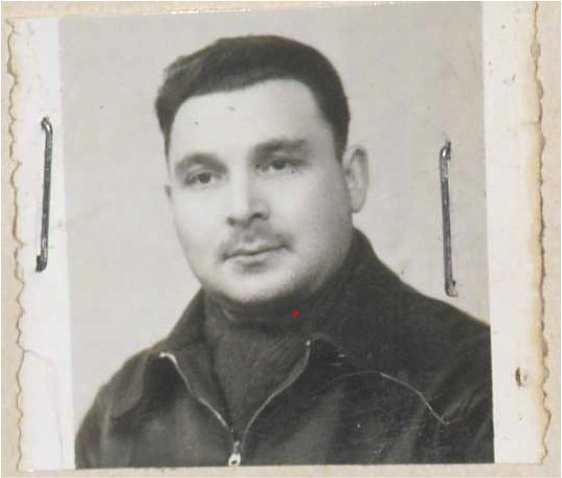
Avram MICHON (1906-1970)
Avram’s identity photo, from his 1948 application to be naturalized as a French citizen. He was 42 years old at the time. Naturalization application file ©French National Archives.
This biography is one of a three-part series:
- This biography of Avram Michon.
- The biography of Riquetta Michon, his wife.
- A podcast, in French
The students presented this joint French-Greek project, including the biographies of Avram and Riquetta Michon, at the French Consulate in Thessaloniki, Greece, on March 17, 2025. Their trip to Thessaloniki was funded by grants from Erasmus+, the French Fund for the Memory of the Holocaust, and the French government’s 80th Anniversary of the Liberation campaign.
Avram Michon was born on June 11, 1906 in Constantinople (now Istanbul), in Turkey. He is believed to have attended the city’s only Franco-Turkish school[1]. He had no formal qualifications, but he could write in Roman script, albeit with some difficulty. He lived in the Usküdar-Kuzguncuk neighborhood of Constantinople/Istanbul until 1921, possibly on Arnaodt Street. This neighborhood, which was home to a large Jewish community, was known locally as “Little Jerusalem.”
He was the only son of Léa Ruben, née Cohen, who was born in April 1880, and M. Michon, who was born in Stanboul.
It is unclear exactly when Avram arrived in France, as even he cited several different dates. For example, in his naturalization application, he stated that he arrived in France on September 9, 1926[2], but also that he left Turkey in 1921 for Italy, where he lived until 1930[3]. He may have arrived in Paris in December 1930, because he also said that he lived at 31 Rue Basfroi from December 27, 1930, to April 11, 1931. He is indeed listed as living alone at that address in the 1931 census. He then moved to number 45 of the same street, possibly with his parents, or at least with his mother. His wife, Riquetta, arrived in France in 1929.
Marriage
On February 23, 1932, Avram married[4] Riquetta Choël (cf. the biography of Riquetta Choël-Michon on the Convoy 77 website) in the town hall of the 11th district of Paris.
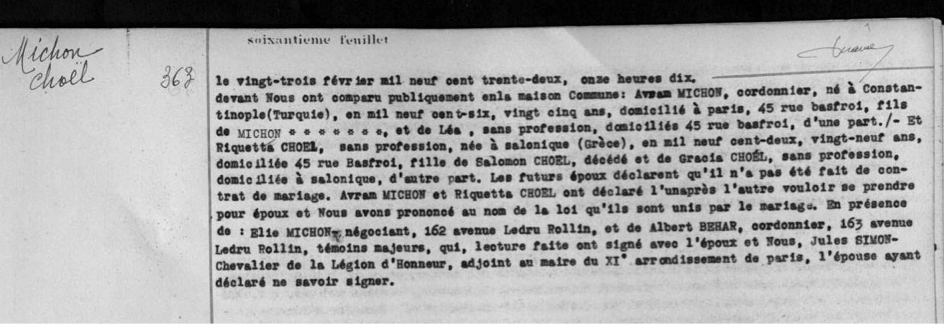
Avram Michon and Riquetta Choël’s marriage certificate
© Paris City archives
When they got married[5], Avram was living at the same address as Riquetta, at 45 rue Basfroi in the 11th district of Paris, but we do not know if they were living together or simply in the same building.
They were still living there in 1936, according to that year’s census, together with Avram’s mother and a boy called Lucien, who was born in Turkey in 1925, but we have been unable to determine if or how he was related to the family[6].
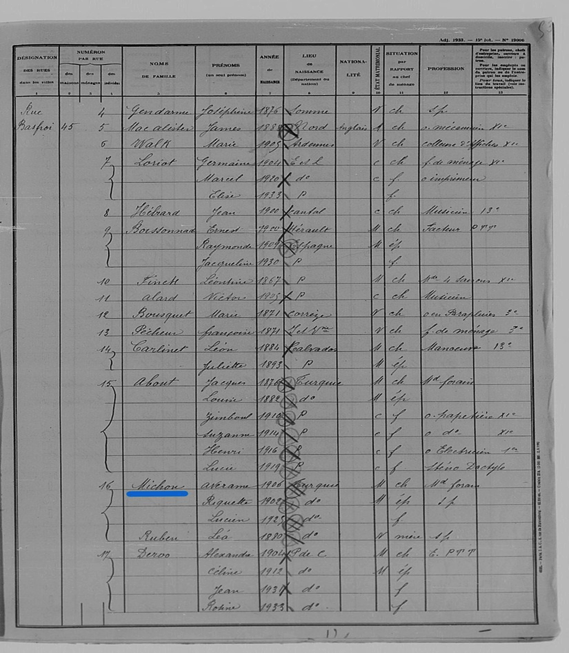
Page from the 1936 census of Paris for 45, rue Basfroi, in the 11th district
©Paris City archives
The couple went on to have four children:
- Lucienne Ruben, born January 1, 1933 (in the 12th district of Paris), died January 5, 2020 on Gargenville (in the Yvelines department of France)
- Maurice Ruben, born April 9, 1937 (in the 12th district of Paris), died April 17, 1938 (in the Pitié-Salpêtrière hospital in the 13th district of Paris)
- Béatrice Ruben, born February 9, 1939 (in the 12th district of Paris)
- Jacqueline, born May 27, 1941 (in the Rothschild hospital in the 12th district of Paris)[7]
A street vendor who sold knitwear and hosiery
When he got married in February 1932, Avram stated that he was a cobbler. However, that same year, he started a street trading business selling wool, knitwear and hosiery, which he registered with the chamber of commerce[8]. This is confirmed by the 1936 census listing, in which he described himself as a “street vendor”.
On July 1, 1937[9], Avram and Riquetta moved to 44 rue Sedaine, still in the 11th district of Paris, a neighborhood that had been home to large numbers of low-income Spanish-Jewish immigrants since the late 19th century. There were numerous Sephardic Jewish stores, cafés and synagogues, and also textile merchants, both wholesalers and, like Avram, “street vendors.” In 1948, he stated that he worked alone.
THE WAR, ARREST AND DEPORTATION
In 1939–1940, the couple were in Trouville-sur-mer, on the north coast of France near Caen, in the Calvados department. Avram, in common with numerous other foreign Jews, enlisted in the army as a volunteer immediately after war was declared. He registered at the recruitment office in Caen, in Normandy. A member of Class 26, he was assigned to the 22nd Regiment of the 2nd Armored Division, in 1940. He was then stationed in Caen but was not deployed to the front as “the war did not last long”[10].
Along with large numbers of other Parisians, Avram and Riquette may have fled the city early on in the war, or perhaps the declaration of war on September 3, 1939, caught them by surprise while they were on vacation in Trouville-sur-Mer[11]? Either way, Avram is listed as being from this town on the list of Nazi victims from Normandy. His wife, on the other hand, is not on the list. In addition, Avram’s naturalization application file includes a copy of a document issued by the Justice of the Peace in Trouville-sur-Mer, dated May 22, 1940, certifying that he had “received in his chambers” a man by the name of Avram Michon, who lived at 33 rue Georges-Clemenceau in Trouville and who stated that he wished his daughter “Béatrice Ruben, born on February 9, 1939, in the 12th district of Paris” to have “French nationality.” The documentation arrived at the Seine Court on October 5, 1940, and was entered into the public record. Béatrice therefore became a French citizen at the very last minute.
After the French were defeated and Marshal Pétain’s policy of collaboration with the Nazis came into effect, both Riquetta and her husband complied with the anti-Jewish decrees enacted in Vichy on October 3, 1940, and June 2, 1941 (known as the “Legislation on the Status of Jews”)[12], by registering themselves as “Jews”.
Avram continued to work as a street vendor until 1940, when he was forced to stop due to the Vichy regime’s racist legislation, which covered both the German-occupied zone in the northern part of the country and the unoccupied zone in the south[13].
From that point on, we have no further information about the couple’s life during the war, other than that they lived in a neighborhood where, although there was a strong sense of solidarity, roundups happened frequently, and that Jacqueline Ruben was born in the maternity ward of the Rothschild Hospital on May 27, 1941. Avram soon declared his baby daughter a French citizen. He appeared before the Justice of the Peace in the 11th district of Paris on July 21, 1941, but this time the declaration included an additional clause, which read: “of the Jewish faith.” Avram also had to confirm that he was “not subject to a deportation order or under house arrest.” The paperwork was not finalized until March 13, 1945, so little Jacqueline was not a French citizen during the Occupation.
On July 10, 1944, the “French and German police” arrested Avram, his wife Riquetta, and his mother, Léa Ruben, in their home. The children were not arrested but instead, according to the documentation in his naturalization application file, “were taken in by some kind French folk” [14].
They were arrested on “racial grounds” – in other words, because they were Jewish[15].
After the war, three people testified to having witnessed the arrest: a Mr. Armand, a Mrs. Régy and Mr. Pontillon, the building supervisor. All three lived at 44 rue Sedaine[16].
The Jewish Affairs police took Riquetta, Avram and Léa Ruben[17] to the Paris Police Headquarters depot, where they were booked in at midnight. At 2:30 p.m. the following day, they were “escorted” to Drancy camp, north of Paris[18].
When they arrived, they were searched and Avram handed over all the money the family had on them, which was just 257 francs[19]. He was then assigned prisoner number 25,016.
Avram was interned in Drancy transit camp from 11 through 31 July, 1944. He was sent to a room on a men-only staircase, so was separated from his wife and mother. He later said he “saw his wife for the last time on July 10, 1944”[20].
On July 31, 1944, 1,306 people of all ages were loaded onto buses and taken from Drancy to Bobigny station, where they were herded into cattle cars 60 at a time, with almost no food, very little water, and no sanitation. Aboard the train, which later became known as “Convoy 77”, were Avram, his wife Riquetta, and his mother Léa Ruben. They were ten people from Rue Sedaine on the train, including six who lived at No. 44: the Michon and Hasson families (see their biographies on this website).
One of Riquetta’s relatives, Dora Choël Brodsky, and her husband Joseph Brodsky were deported on the same convoy. They had been arrested, separately, on July 7.
Auschwitz, the death marches and Dachau
The train set off from Bobigny station around noon, bound for the Auschwitz-Birkenau extermination camp, where it arrived during the night of August 2–3. Avram was selected to enter the camp to work[21]. He was assigned the registration number B-3868[22], which was tattooed on his forearm and which he had to learn off by heart and say out loud in perfect German. He was held prisoner there until the Nazis evacuated the camp on January 18, 1945, just days before the Red Army marched in on January 27, 1945.
Avram thus set out on foot, alongside thousands of other deportees, on a six hundred mile death march to the Dachau camp. He arrived there in February 1945. According to his camp registration card, he was assigned prisoner number 138,986[23].
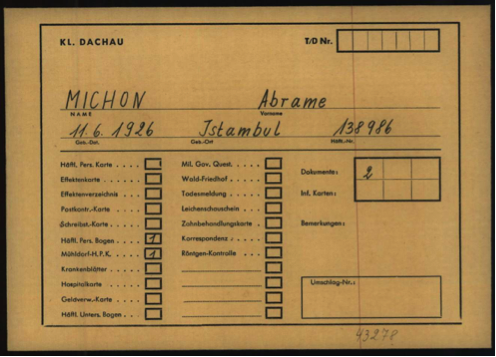
Registration card from Dachau camp, in the name of “Abrame Michon”
©International Tracing Service archives / Bad Arolsen
Then, on February 21, 1945, he was transferred to Mühldorf, one of the Dachau satellite camps.
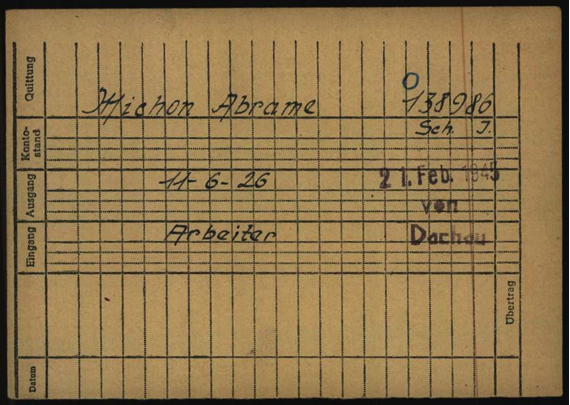
Registration card in the name of “Abrame Michon”, showing that he was transferred from Dachau on February 21, 1945
© International Tracing Service archives / Bad Arolsen
On May 1, 1945, Avram was liberated somewhere “near Munich” by the United States army. He was then repatriated to France, and arrived in Paris on May 16.
The return to France
Avram Michon arrived at the Lutetia Hotel reception center in Paris on May 16, 1945[24].
His daughter, presumably Lucienne, as she was the oldest (she was 12 and a half years old at the time), was issued with a deportation certificate in her father’s name on June 19, 1945[25].
That same day, June 19, Avram was interviewed by a Mr. Nathan from the “Ministry” (of Prisoners of War, Deportees, and Refugees). This time, he described himself as a street vendor, said he did not know what type of work he wanted to do next, and gave his Auschwitz registration number. He stated that he was arrested on July 4, 1944 (was it Avram who made the mistake, or was it the person questioning him? The same date was mentioned several times, including in connection with Riquetta).
He said he thought there were “1500 people, including 450 enfants” aboard the convoy on July 31. He gave details of the camps he was transferred to: “January 18, 1945: Dachau, Mühldorf, Gross-Rosen”.
The man wanted dates, figures and details. Avram, who been back barely a month after a series of unthinkable horrors, tried his best; he gave some numbers, although they were more like rough estimates. “4,000 prisoners on a transport. 120 per railcar to Dachau on January 23, 1945. Very few survived the journey,” he said.
“10,000 left Auschwitz on January 18, 1945; 4,500 arrived in Dachau on January 27, 1945.”
He said he was liberated on May 1 from Gross-Rosen, Plusberg (?) by “the Americans”.
“3,500 people on the train that left Mühldorf on March 27, 1945. Four days and four nights in the cars, he estimated. “Another convoy left Mühldorf the following day with 2,000 people on board,” he recalled. “Of those 2,000, only 500 were found alive when we were liberated on May 1, 1945, around 6 miles short of Plusberg (?)[26].” He gave no names of other deportees he encountered, neither those who died nor those who survived.
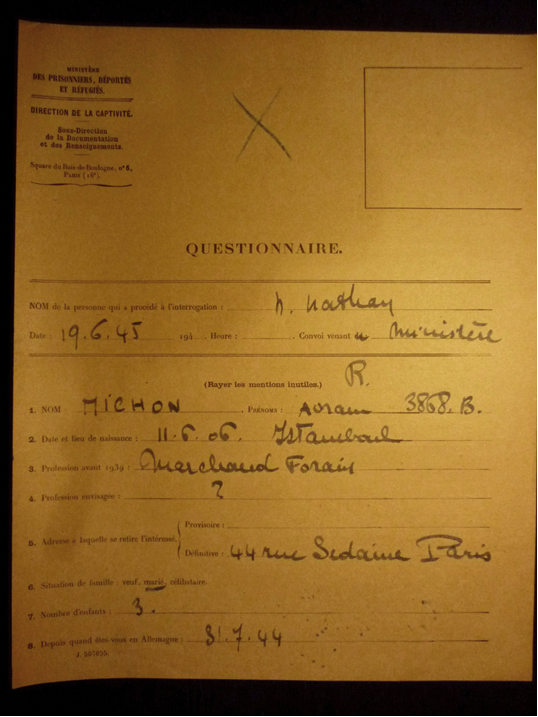
©French National Archives, ref. F9 5586.
Avram was finally reunited with his daughters and moved back into his apartment at 44 rue Sedaine[27].
Avram wasted no time in trying to get back to work. On August 7, 1945, the Paris Police Headquarters issued him a trader’s identity card, but it was not until February 1946 that he resumed working on the markets in and around Paris, mainly in Champigny-sur-Marne. He said he worked “on an irregular basis due to a shortage of merchandise”[28] and “lived a humble life” with three children to care for. The rent on the apartment, which was paid up to date, was 8000 francs a year. His naturalization application reveals that he held a “privileged resident card,” issued on May 29, 1947 (valid through May 1957), and a “special trader’s card granted on September 6, 1948, as a street vendor selling knitting yarn, knitwear and hosiery.” He made a profit in 1949, and earned enough to pay 52,800 francs in tax. He was a member of the craftsmen’s union.
On December 28, 1945, Avram began the process of seeking official recognition that his wife, Riquetta, had died in the Auschwitz-Birkenau camp. A neighbor and friend who lived in the same building, Rachel Hasson-Lévy, who had been deported along with Riquetta and survived, stated that Riquetta had died after three months in the camp. As they were separated immediately when the train arrived in Auschwitz, Avram did not even know that his wife had also been selected to enter the camp for forced labor.
In early 1949, Avram began living with a woman by the name of Sophie (Suzanne) Tzipkine, who was born in Paris in 1912, had been naturalized as a French citizen in 1929, and was a widow; her husband had died in 1940[29]. She had a daughter, Denise (Myriam ) Koupperman, who was born in Nanterre, a town northwest of Paris, on July 23, 1934. Avram and Sophie raised their daughters together but could not get married as Riquetta’s death had not yet been registered.
Application for French citizenship
On December 2, 1946, Avram applied to be naturalized as a French citizen; his application was deemed eligible by the Paris Police Headquarters on November 8, 1948.
According to investigations carried out by the prefecture in 1948 through 1950[30], Avram he “spoke French fairly well and was well integrated [into French society], but preferred to spend time with his fellow countrymen.” He was deemed to be “honest and reliable by those who knew him”; he “did not voice any criticism of French authorities or the government and took no part in political activities (…),worked on his own and lived a simple life.” None of the available records show the exact date on which he was naturalized.
Political Deportee status
On October 23, 1951, Avram submitted an application to be recognized as a political deportee (meaning that he was deported for political reasons, i.e. because he was Jewish). His request was approved on December 15, 1953. On May 4, 1956, he also received a lump-sum payment from the government amounting to 12,000 francs (roughly equivalent to 350 dollars in today’s money)[31].
On February 12, 1965, after twenty years of paperwork, the Seine District Court pronounced Riquetta dead and ordered the death to be recorded in the civil register, thereby officially confirming that Avram was a widower and was thus free to marry Sophie Tzipkine.
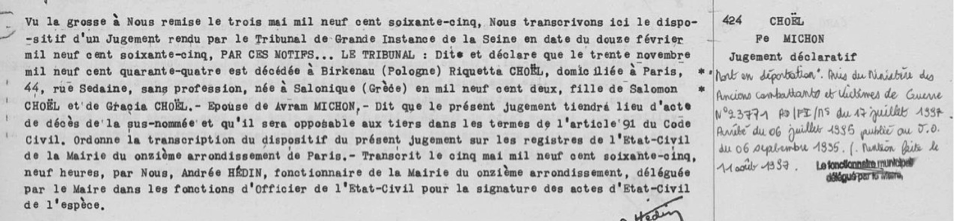
Riquetta’s death certificate © Paris City archives
They were married on July 26, 1965[32].
Avram died in the Saint-Louis hospital in the 10th district of Paris on November 12, 1970. He was 64 years old.
Sophie died on November 26, 1995, in the 12th district of Paris.

Avram Michon’s signature on his application for naturalization as a French citizen
SOURCES
- French National Archives
- Naturalization application 30788X48, probably BAB 242/22 or BAB 242/23
- Interviews with deported persons after they returned from the camps ref. F9 5586.
- Paris City archives, civil register and census records.
- Victims of Contemporary Conflicts Archives Division of the French Ministry of Defense Historical Service, in Caen, dossier 21 P 598 142.
- Paris Police Headquarters archives, ref. APP CC2-8.
- Geneanet and Filiae (French genealogy websites)
Notes & references
[1] Naturalization application file. The Alliance Israélite Universelle (Universal Jewish Alliance) invested heavily in the Mediterranean basin region to promote the “emancipation of the Jews” in Muslim-dominated areas. It founded schools for both boys and girls, in which French was taught—was the “Franco-Turkish school” one of its schools? The Jewish community in Turkey, which spoke Ladino (a language derived from Old Spanish), was largely French-speaking.
[2] Naturalization application file. In fact, this is most likely the date when his parents arrived in France.
[3] Naturalization application file.
[4] We note that an Élie Michon, a merchant living at 162 Avenue Ledru-Rollin, was a witness at the wedding. Was he a family member?
[5] Had they previously been married in a religious ceremony, either in Turkey or in France? Was she a relative?
[6] Lucien was listed as a “son” in the census, but such information is not always reliable. It is worth noting that the couple’s first daughter was called Lucienne.
[7] The three girls became French citizens by declaration in 1933, 1940, and (in the case of the youngest) 1945; see the section on the war.
[8] Naturalization application file.
[9] Written statement by the owner of the building, made on October 30, 1953. Victims of Contemporary Conflicts Archives Division of the French Ministry of Defense Historical Service, in Caen, dossier 21 P 598 142.
[10] Naturalization application file ) certified copied of his repatriated person’s card.
[11] He is included on this French website on Victims of Nazism from Normandy
Dictionnaire biographique des victimes du nazisme en Normandie
[12] French Official Gazette, June 14, 1941, p.2476. These two “decrees” were both published in the Official Journal two weeks later, on October 18, 1940.
[13] Businesses had to put up a sign, in both German and French, that said, in capital letters, “JEWISH BUSINESS.”
[14] Avram said nothing specific on the matter. Did he have his children placed in hiding through Jewish rescue networks? Or were they simply being cared for by a foster family?
[15] As Turkey remained a “neutral” country until February 1945, the Turkish consulate in Paris provided protection to certain Turkish Jewish citizens in France during this period. The Michon family were not among them however; they may have failed to declare themselves as Turkish citizens to the consulate and had been stripped of their Turkish citizenship without their knowledge. In 1947, in his naturalization application, Avram stated that his nationality was “not recognized.” His “original nationality” was listed as Turkish.
[16] Application for Political Deportee status – Victims of Contemporary Conflicts Archives Division of the French Ministry of Defense Historical Service, in Caen, dossier 21 P 598 142.
[17] Née Cohen; Victims of Contemporary Conflicts Archives Division of the French Ministry of Defense Historical Service, in Caen, dossier 21 P 270 708. Avram’s children’s middle name was Ruben. Was the same true of Leah?
[18] Paris Police Headquarters archives, ref: APP CC2-8.
[19] Shoah Memorial website
[20] In Drancy transit camp—a group of buildings—men and women were placed on different staircases. They were, however, able to meet up outside in the courtyard, and on the evening before the July 31 convoy departed, families were gathered in another part of the camp, near the courtyard where the buses were to pick them up and take them to Bobigny station. In general, couples and families travelled together in the same cattle car. Did Avram get this mixed up with what happened when they arrived at Auschwitz, where men and women were separated on the platform? Either way, Avram and Riquetta were taken to Drancy camp together on July 11. And they never saw each other again after August 3, 1944.
[21] See Riquetta’s biography on this site. Given her age, if she survived the journey, Avram’s mother must have been put straight onto a truck bound for the gas chambers.
[22] Avram stated this in the application for Political Deportee status that he submitted on October 23, 1951, loc. cit.
[23] He is listed as a “cobbler” ( his original trade when he arrived in France). It is worth noting that his first name is spelled in various different ways in the deportation records, including Abram, Abrame, Averom, etc..
[24] On his medical record form, when he was examined after he came back from the camps, Avram’s name was written as “Abrame”; he stated that he was a cobbler by trade and that he had enlisted in the French army in 1940 in Caen—a fact he mentioned again in the letter he wrote in December 1946 as part of his application to be naturalized as a French citizen. The medical section of his form is missing from the file, unfortunately, so we have no way of telling what his physical condition was like at the time. Did he stay on in the Hôtel Lutetia for a few days, or even weeks, for medical treatment or to recover his strength? Tests and examinations carried out in June 1948 show that he was in good health by then. He must not therefore have suffered any serious lasting physical effects as a result of having been deported.
[25] Victims of Contemporary Conflicts Archives Division of the French Ministry of Defense Historical Service, in Caen, dossier 21 P 598 142.
[26] French National archives, ref. F9-5586.
[27] In 1946, Avram’s daughter Lucienne attended the girls’ school 13 de la rue Breguet, as did her sister, Béatrice. In 1948, she enrolled at the ORT vocational school in Neuilly-sur-Seine, a Jewish training center.
[28] In post-war France, where ration coupons were still in use, fabric was scarce.
[29] Bernardo Kouppermann died “during deportation”, according to Avram’s naturalization application, but the civil register in Colombes, in the Hauts-de-Seine department of France, states that he died there on February 7, 1942. He was a French citizen, born in Buenos Aires in Argentina in 1910 but almost certainly, probably of Ukrainian origin, and either a street vendor or a sales representative, depending on the source, and was 31 years old when he died.
[30] The investigation report states that he was living with his partner. While this could have been something that would disqualify him from naturalization on moral grounds, the investigator, in 1950, highlighted the fact that that his “illegitimate living arrangement is not viewed negatively by those around him,” given that he did not have all the necessary civil status documents (in particular, his wife’s death certificate, as she died while deported) but also because “the presence of a woman is pretty much essential in the household, as his eldest daughter is only 17 years old.”
[31] The French national statistics website, www.insee.fr
[32] Sophie Tzipkine, who was born in 1912 in the 12th district of Paris, was a saleswoman. She spoke Yiddish as well as her native French. Her family originally came from Ukraine.