Français
 Polski
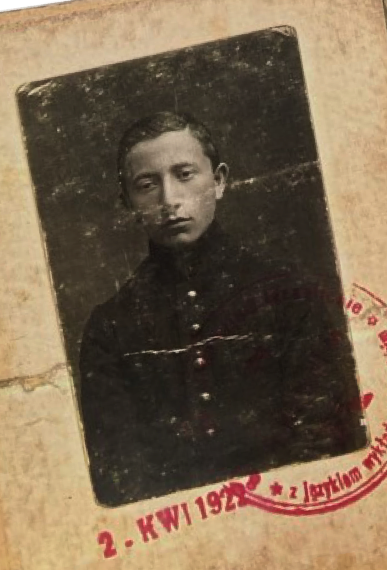
Joseph INSPEKTOR (1903-1944)
The 12th grade students (class TG1) at the Simone de Beauvoir high school in Gragnague, in the Haute-Garonne department of France, retraced Joseph Inspektor’s life story using the archives his descendants donated to the Shoah Memorial in Paris. They also studied his naturalization application and the police records held in the Paris Police Headquarters archives.
With the help of the Shoah Memorial in Paris and the Occitanie regional authorities, the students spent a day at Auschwitz-Birkenau in January 2025. In June 2025, they presented the results of their research to one of Joseph’s granddaughters and exhibited them in the school library. The images used in this biography were part of the exhibition.
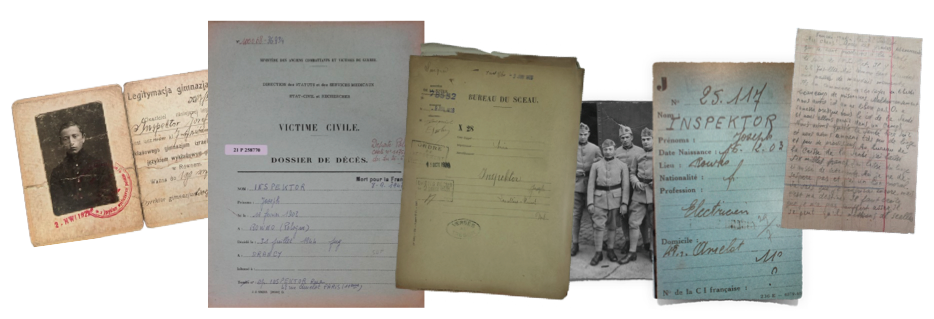
Joseph Inspektor was a Jewish man originally from Równe, a town which was in Russia when he was born in 1903, but is now called Rivne and is in Ukraine. More than 40% of the population was Jewish. In 1920, Poland regained control of the region, which it had lost in 1795, and Joseph thus became a Polish citizen.
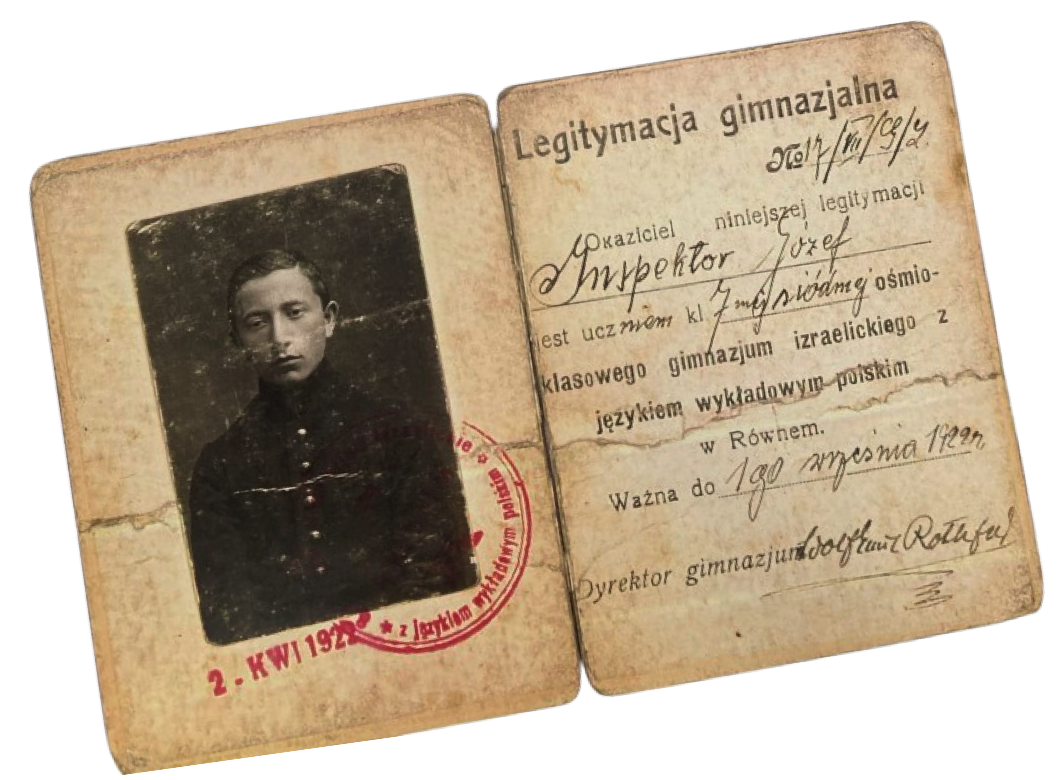
As the situation became less secure and the first pogroms took place, some of the town’s residents emigrated. Joseph Inspektor may have been among them. Little is known about his childhood other than a few brief school records. He went to a private Jewish secondary school, from which he graduated in 1922, and soon after that he emigrated to France alone.
Shoah Memorial – CMLXXV(4)_3 (Inspektor donation)
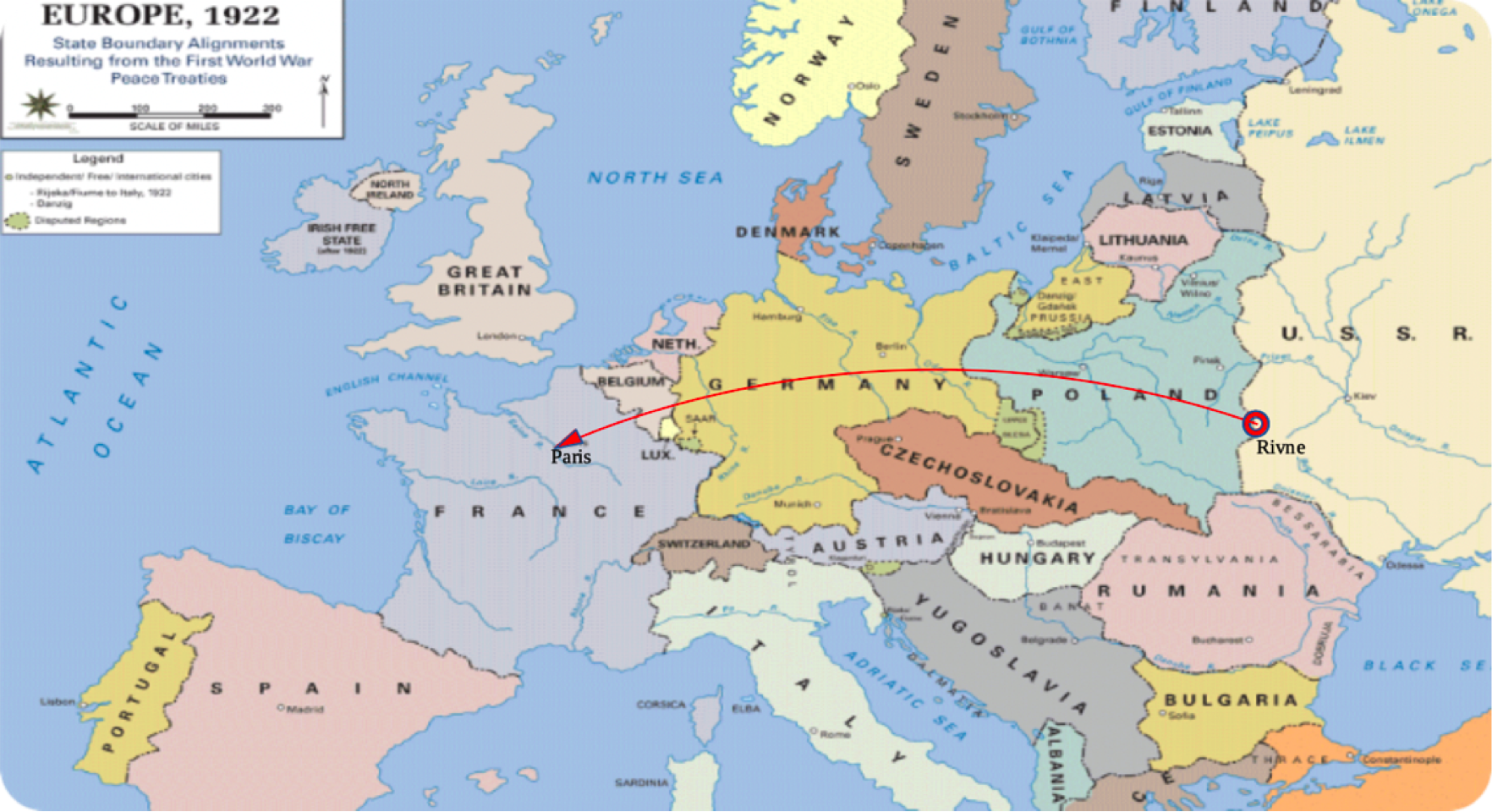
According to his naturalization application, Joseph arrived in France in September 1924, having left his family behind. His father, Moïse Gersz Inspektor, who was a shopkeeper, lived in Lodz with Joseph’s four brothers and three sisters. He was probably a widower: Joseph’s mother, Osbe Kitinski / Doba Kitcicka, was not mentioned in the application but was recorded as deceased when Joseph got married in 1931. A letter, written in Yiddish in 1939, reveals that Joseph stayed in touch with family he had left behind in Poland.
By 1927, Joseph spoke fluent French, was working for a “radiophony” company and was living at 24 rue Gide in Levallois-Perret, a suburb of Paris.
In an attempt to ensure that his application to be naturalized as a French citizen would be successful, Joseph asked to “enlist under the French colors.” Photos taken during his military service confirm that he served in 1929 in the 25th Artillery Workers Battalion, stationed in Mainz, as part of the army of occupation in the Ruhr, in Germany.
On January 13, 1929, the naturalization decree for Joseph Inspektor, a laborer living in Levallois-Perret, was published in the Journal officiel (the French official gazette).
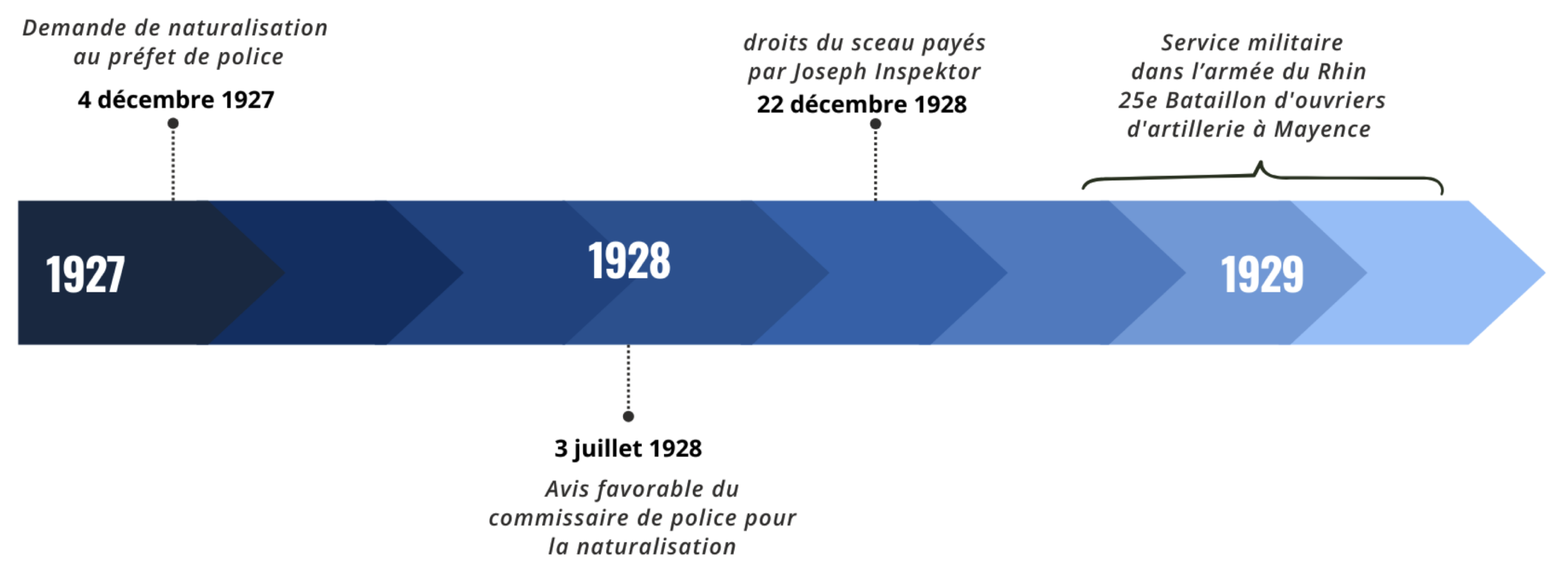
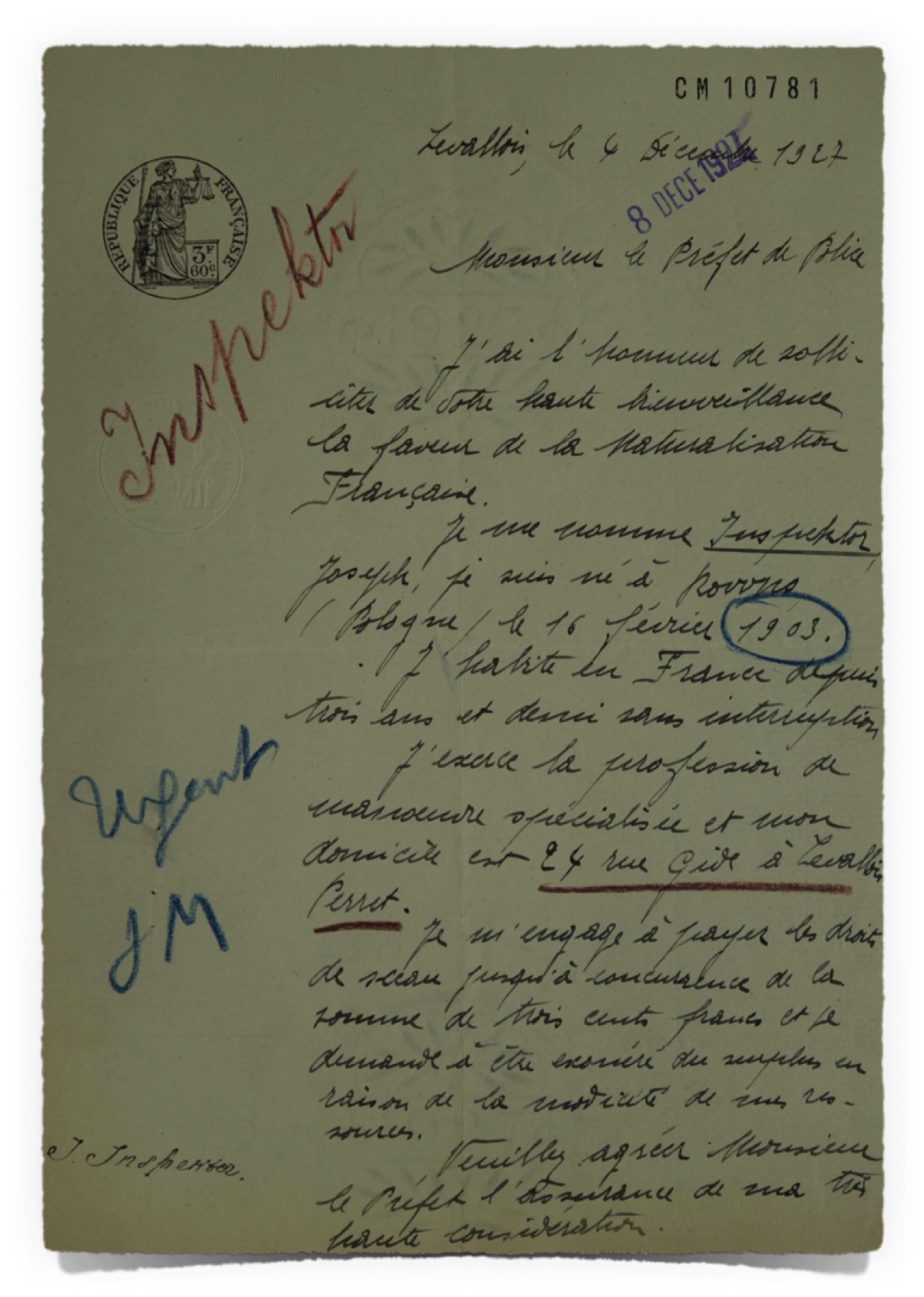
French National Archives, BB11 / 11285, naturalization record.
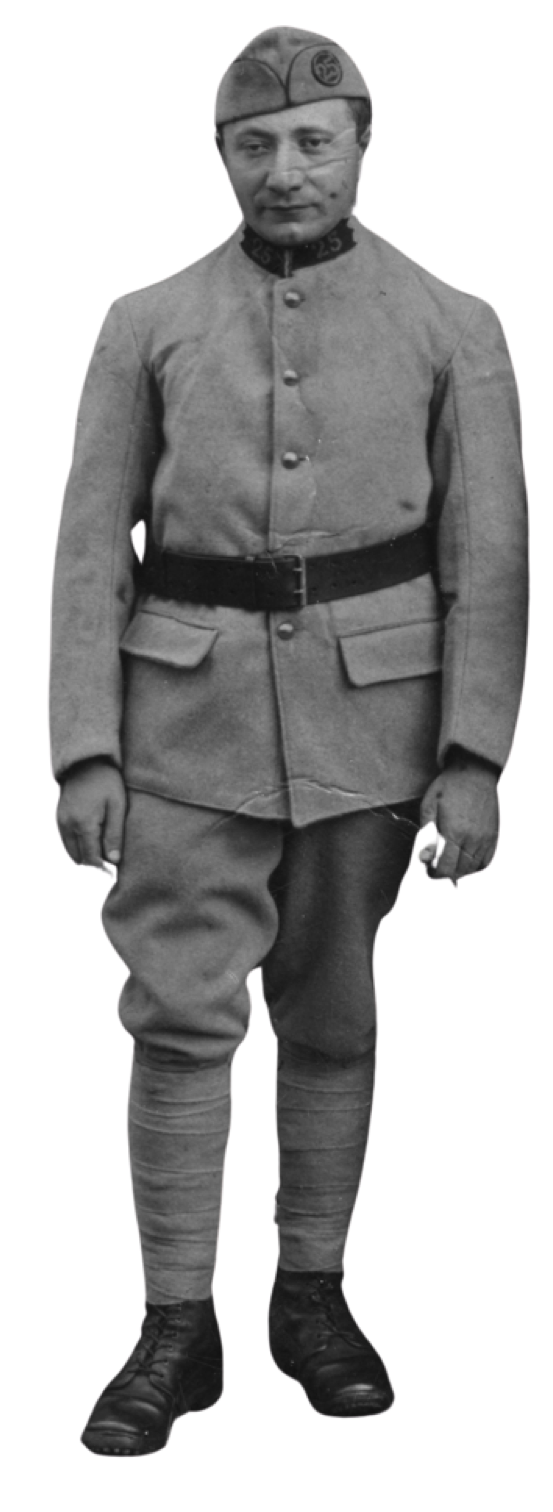
Shoah Memorial – MXII_1143
Joseph was therefore a French citizen when he married Rose Kessel in a Jewish wedding ceremony on Sunday, March 15, 1931, following a civil wedding at the town hall of the 3rd district of Paris on February 19, 1931. He was living at 33 rue Fouquet in Levallois-Perret at the time. Rose, a Jewish seamstress who was also born in Poland, was living with her parents at 157 rue Saint-Martin, also in the 3rd district. Rose’s sister Annette got married two days after Rose, on February 21, 1931.
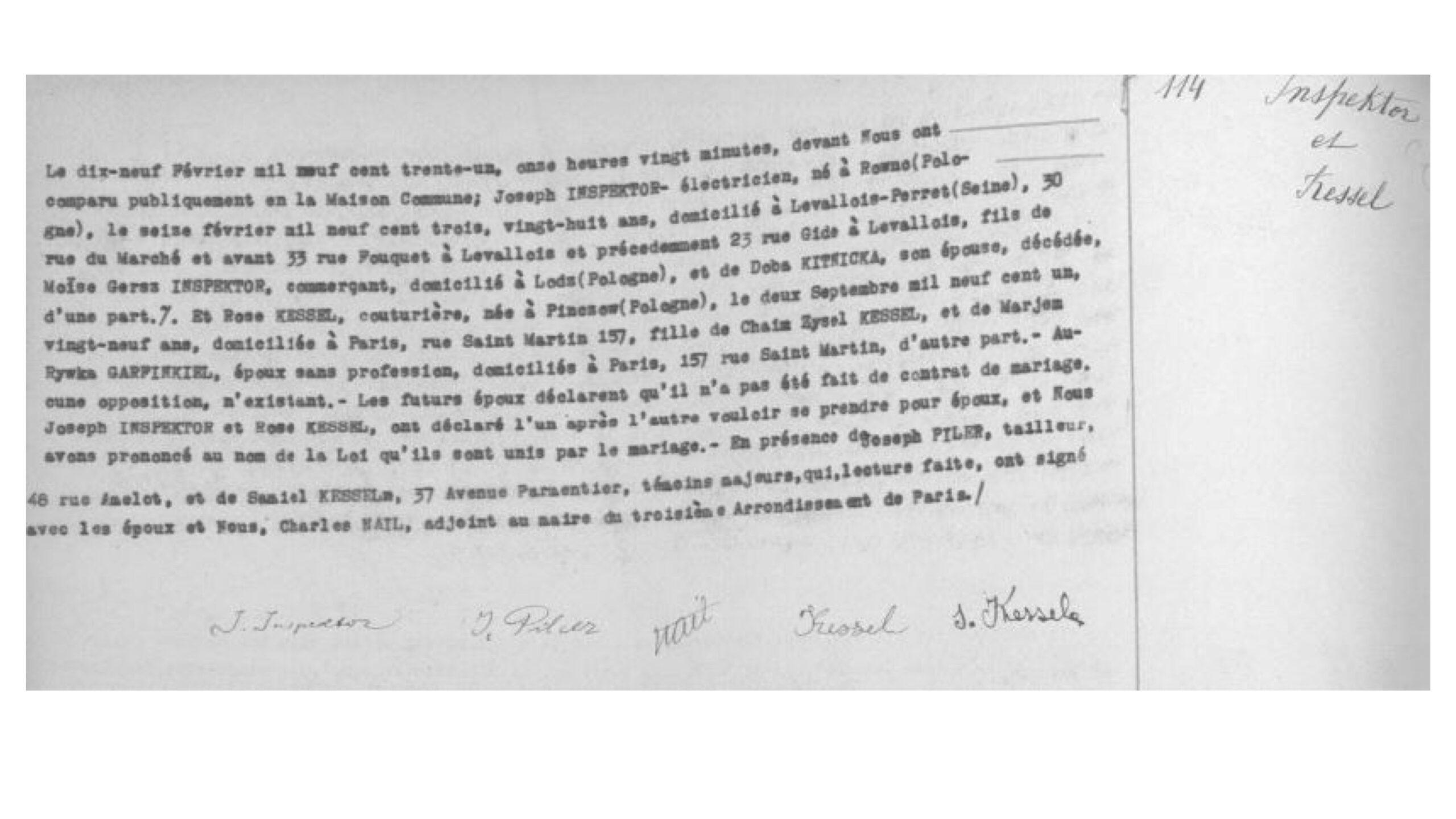
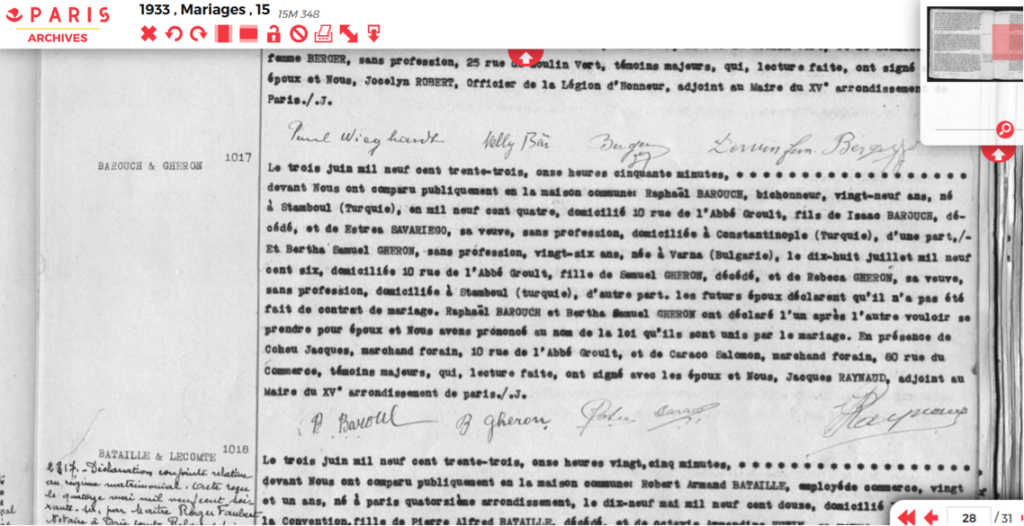
Joseph Inspektor and Rose Kessel’s marriage certificate, February 19, 1931
© digitized archives of Paris
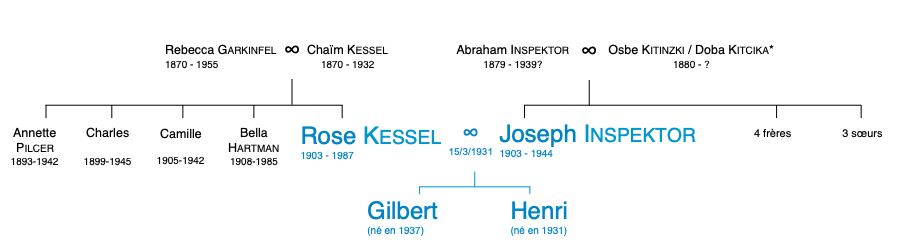
* The names differ depending on the source (naturalization record and death certificate)
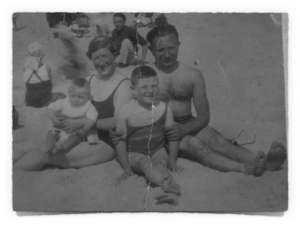
Shoah Memorial – MXII_1148
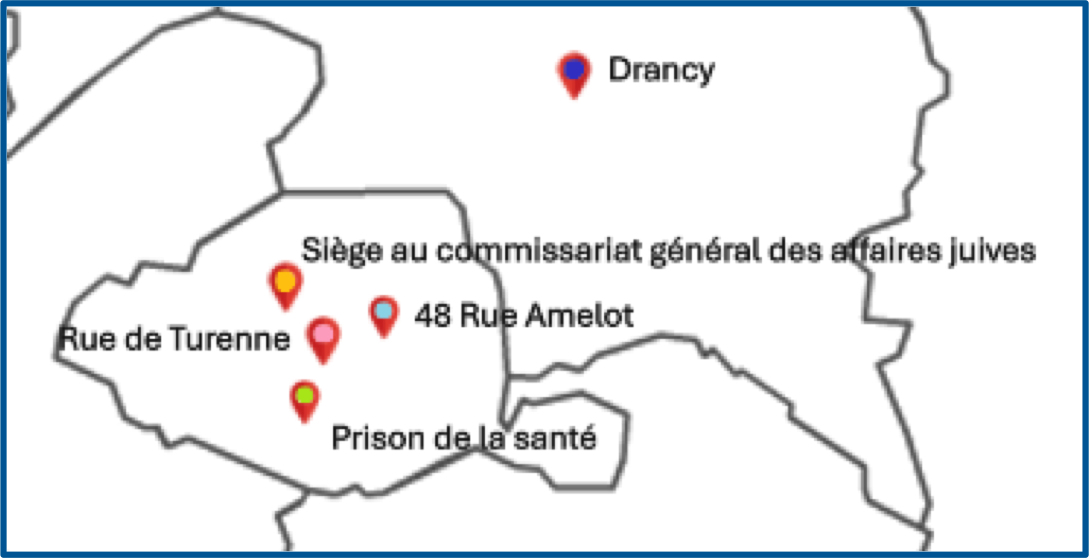
According to the wedding announcement and their son Henri, the couple moved into a small apartment at 48 rue Amelot, on the border of the Marais quarter in the 11th district of Paris, not far from Rose’s family. Rose worked in a dressmaking workshop owned by Joseph Pilcer, her sister (Chana) Annette’s husband, who was a witness at their wedding and also lived at 48 rue Amelot. The family expanded in 1931 when Henri was born, and again in 1937, when Gilbert was born. Rose lost her father in January 1932.
When war broke out, Joseph was called up and sent to Bar-le-Duc, in the then Lorraine region of France. His wife and two children were evacuated to Précy-sur-Cher, in line with the 1939 evacuation plan, under which residents of the 11th district of Paris were to be sent to towns in the Cher department. Henri remembers that their father took them to the station. After the armistice was signed, the family all moved back to Paris.
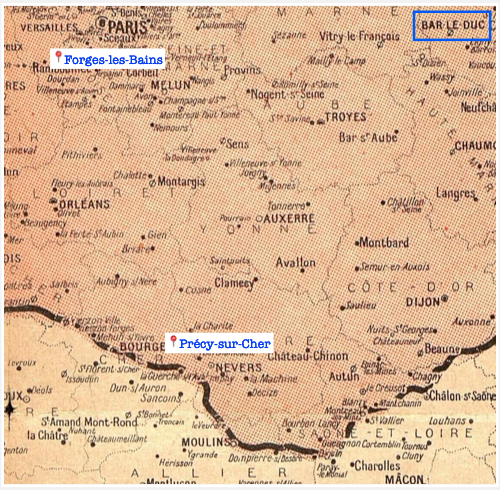
Map showing the demarcation line between the Occupied Zone and the Free Zone
(Somme Departmental Archives)
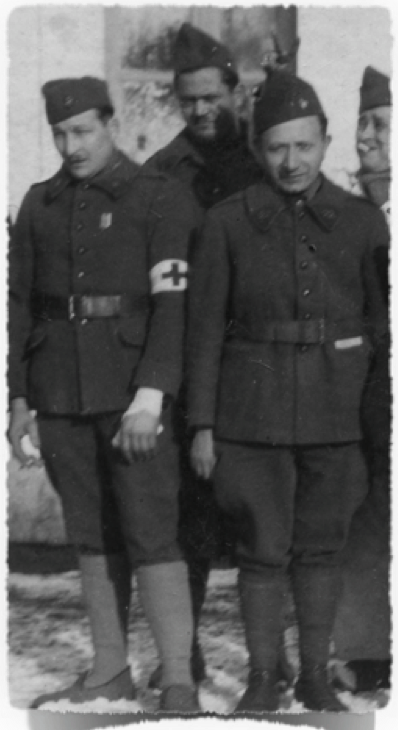
Bar-le-Duc hospital in February 1940
(family archives)
In July 1942 (although we do not know whether this was before or after the Vel’ d’Hiv roundup), Rose and the children went into hiding in the countryside, in the village of Forges-les-Bains, 20 miles (32 km) southwest of Paris (now in the Essonne department of France). Joseph stayed on in Paris, and Rose continued commuting to the city to work. According to Henri, none of them wore the yellow star during this period.
Rose’s family was hit hard during the Holocaust. Her brother Camille (Kelman) was arrested during the “green ticket” roundup on May 14, 1941, and deported on Convoy 8. Her older sister, Annette Pilcer, a Polish citizen, was arrested at her home at 46 rue Amelot during the Vel’ d’Hiv roundup and deported on Convoy 12 on July 29, 1942. Her husband Joseph (whose first given name was Israël) was also arrested, possibly in Quevauvillers, in the Somme department. He was deported on Convoy 49 on March 2, 1943.
Samuel Kessel[1], Rose’s brother, who had been a witness at her wedding, was arrested in the Cantal department and deported in November 1943. However, we do not know whether the family were told about these deportations at the time.
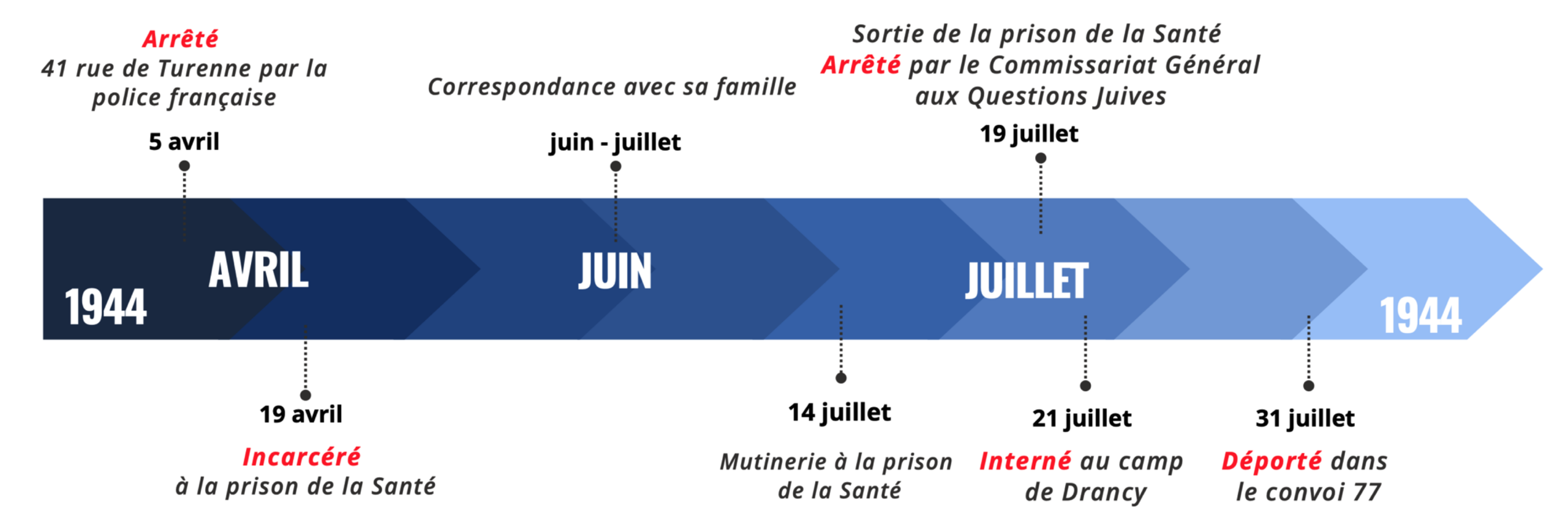
Due to the recently introduced anti-Jewish laws, Joseph could no longer earn a living openly and probably had to turn to the black market. His life took a dramatic turn, however, on April 5, 1944, when French police stopped him for an identity check in the 3rd district of Paris and then arrested him. The word “Jew” had been “washed” off his identity card, but, more importantly, the police accused him of illegally trading in ration coupons and handling stolen goods. According to an article by Johanna Lehr in the journal Les Annales (The Annals), 2021, Joseph may have exaggerated his criminal behavior so that his case would be dealt with by the French authorities rather than the Germans.
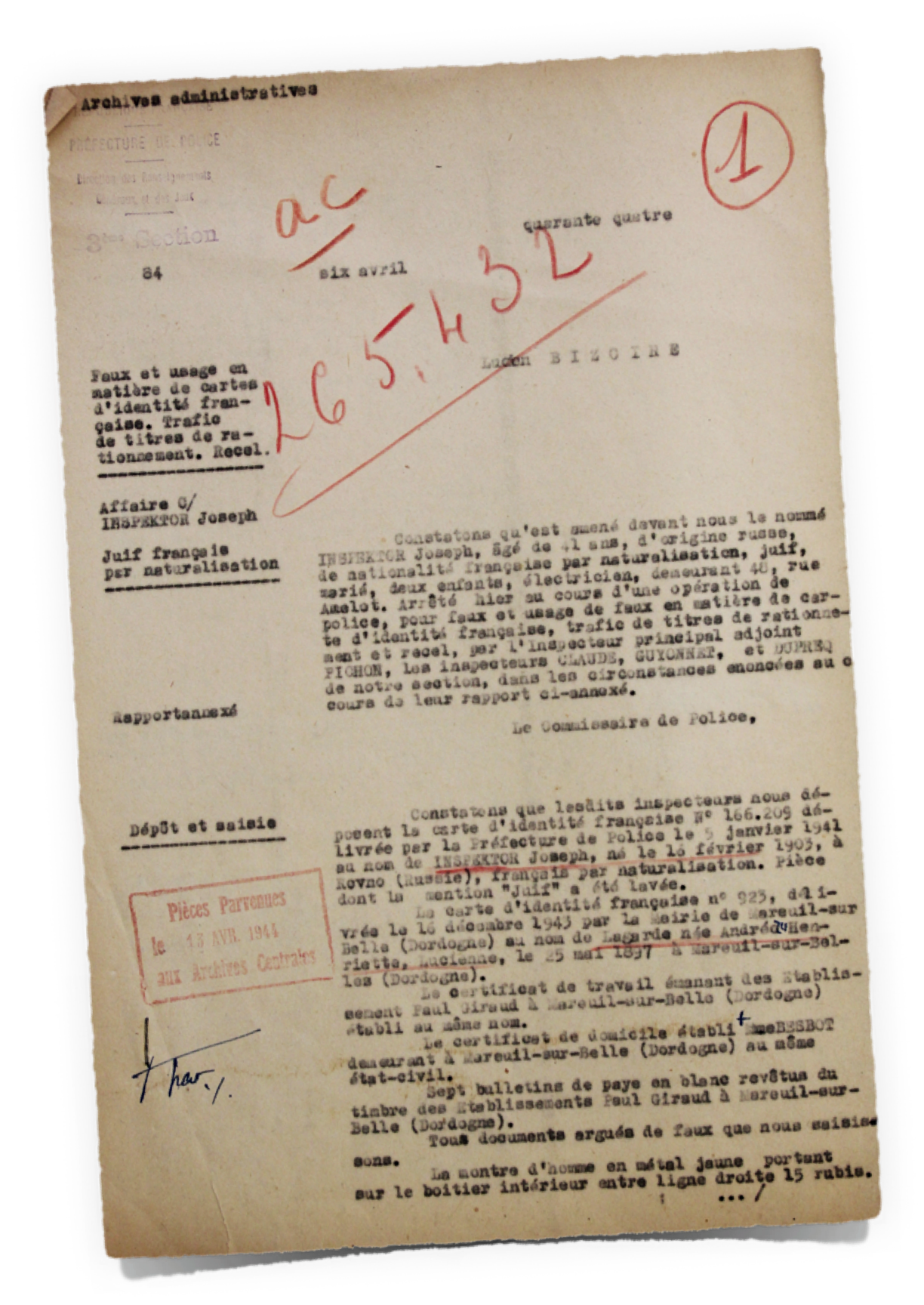
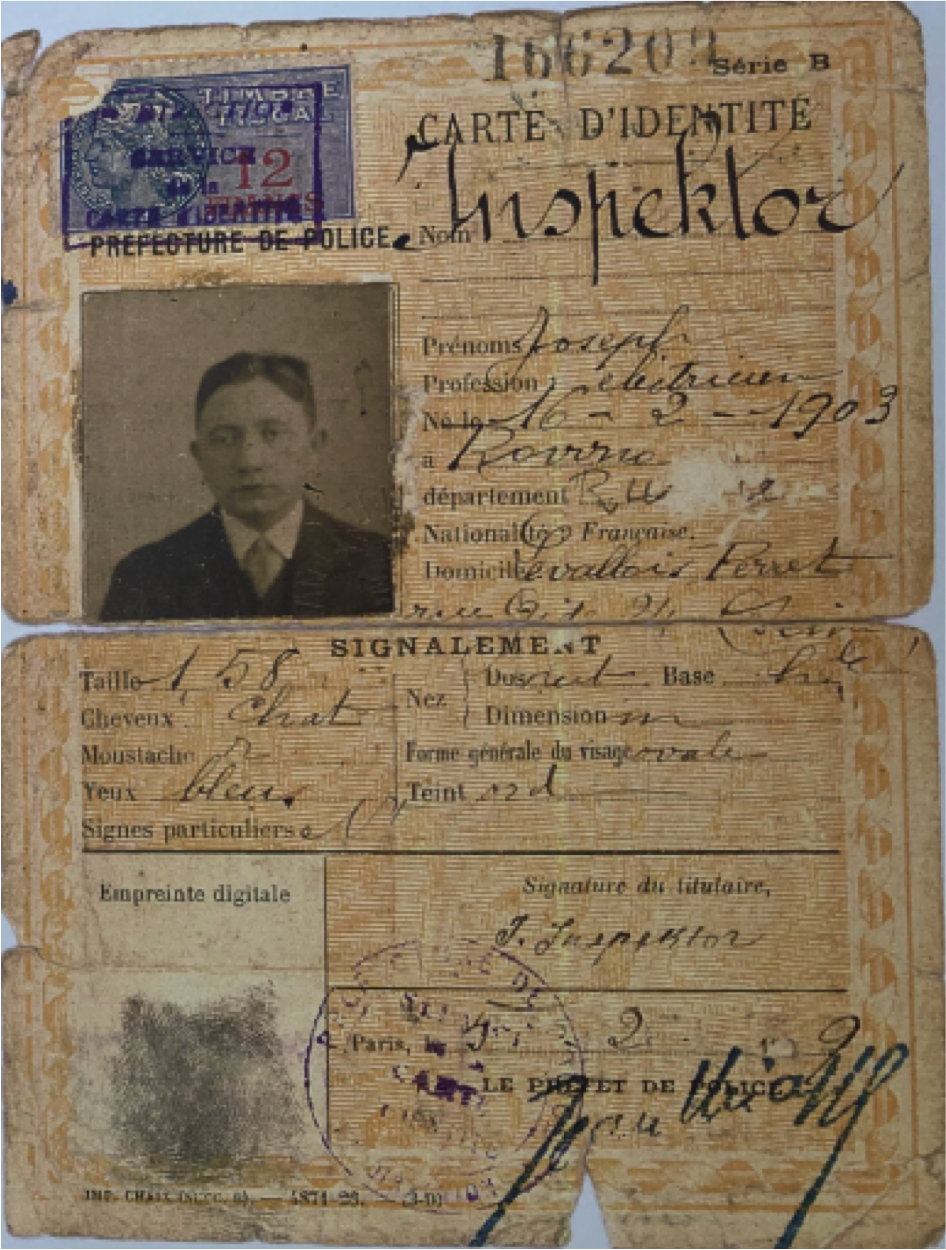
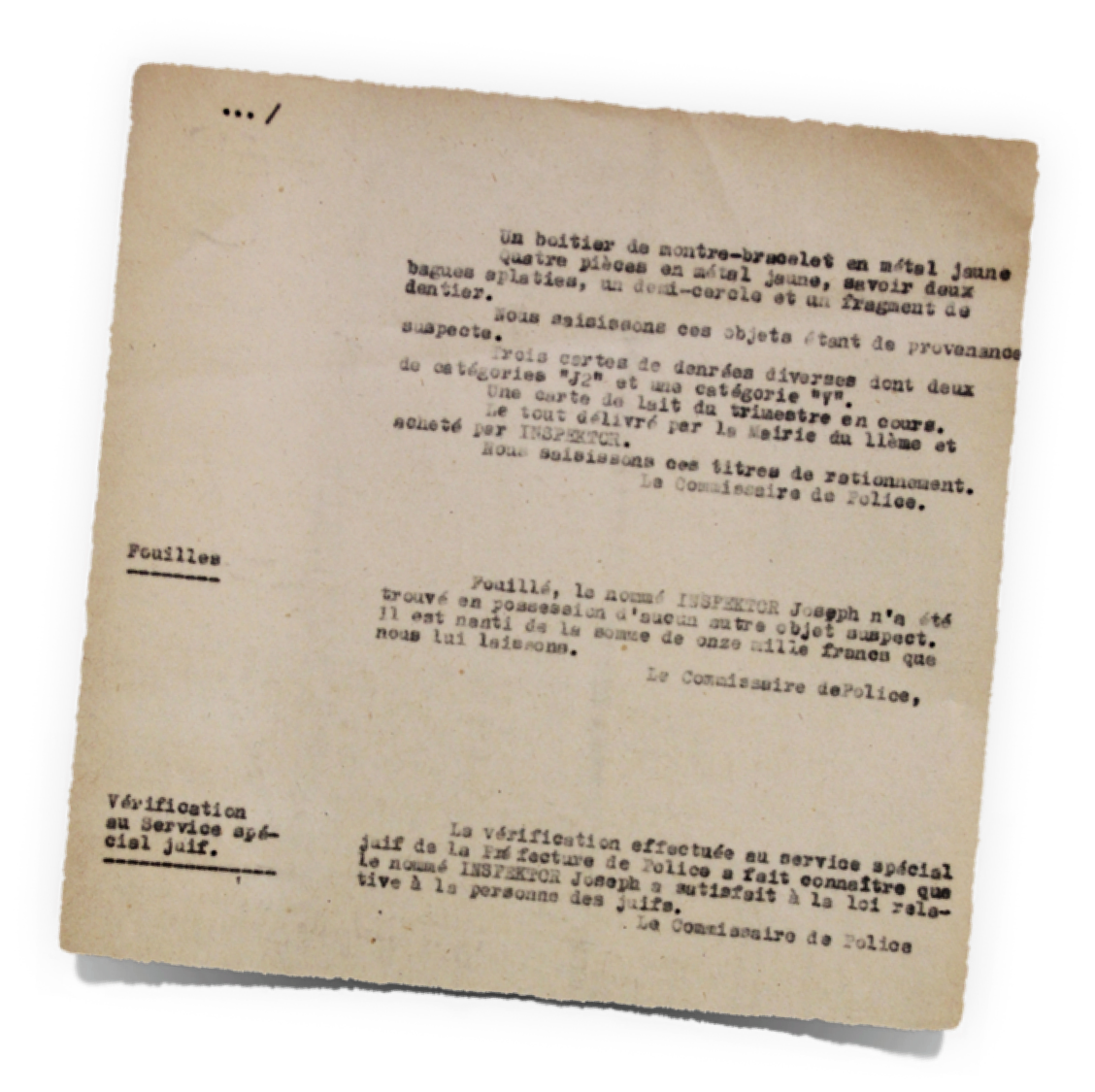
Archives of the Paris Police Headquarters, 77 W 815
(file in the name of Inspektor)
He was sent to prison for these offenses, which meant that, as a Jew, he avoided being sent to Drancy internment camp. He spent April 19 to July 19, 1944, in La Santé prison in Paris, along with 4,634 other inmates.
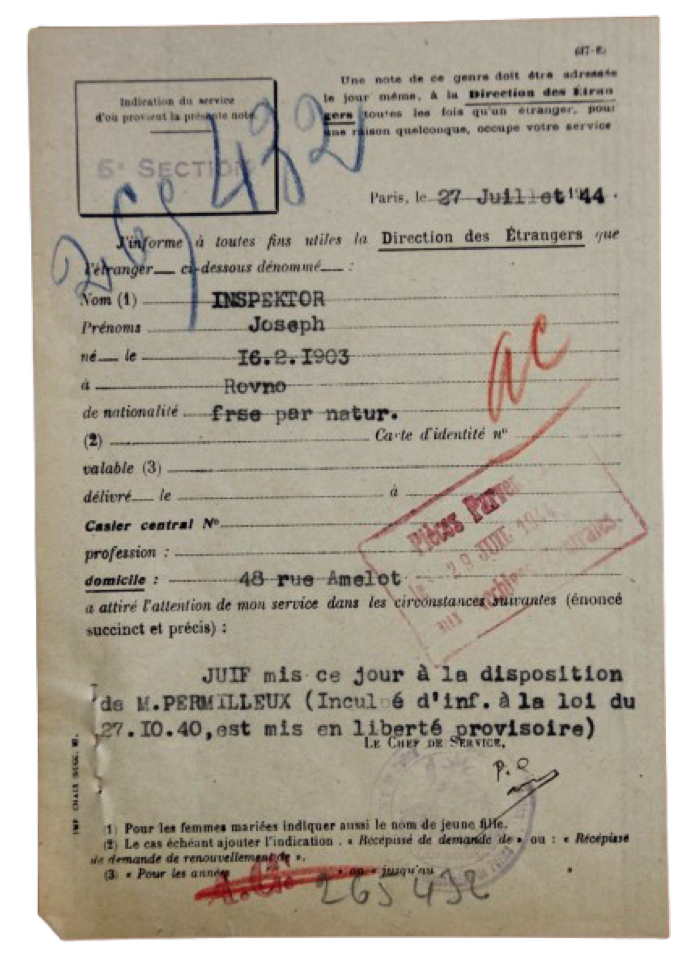
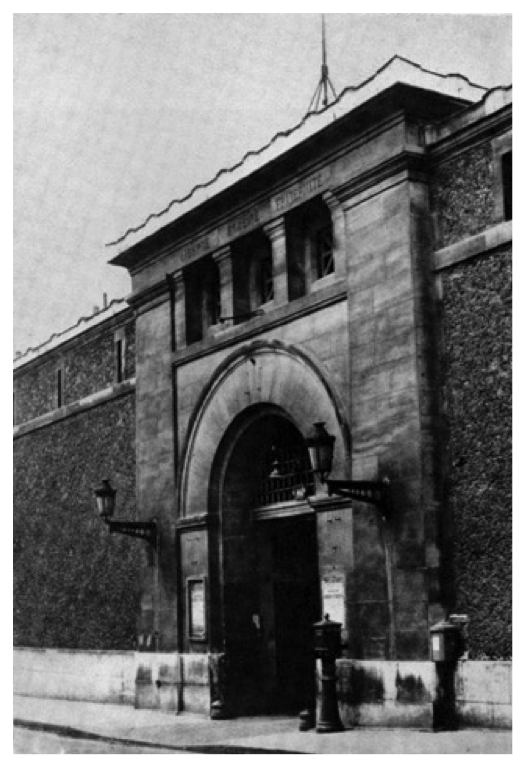
Archives of the Paris Police Headquarters, ref. 77 W 815.
His letters, which the family kept, and the report of his arrest, which Johanna Lehr[2] found in the Paris Police Headquarters archives, enable us to reconstruct the four months he spent there in detail. They give us a glimpse of his state of mind and his worries. He also received parcels of food, which supplemented his prison rations.
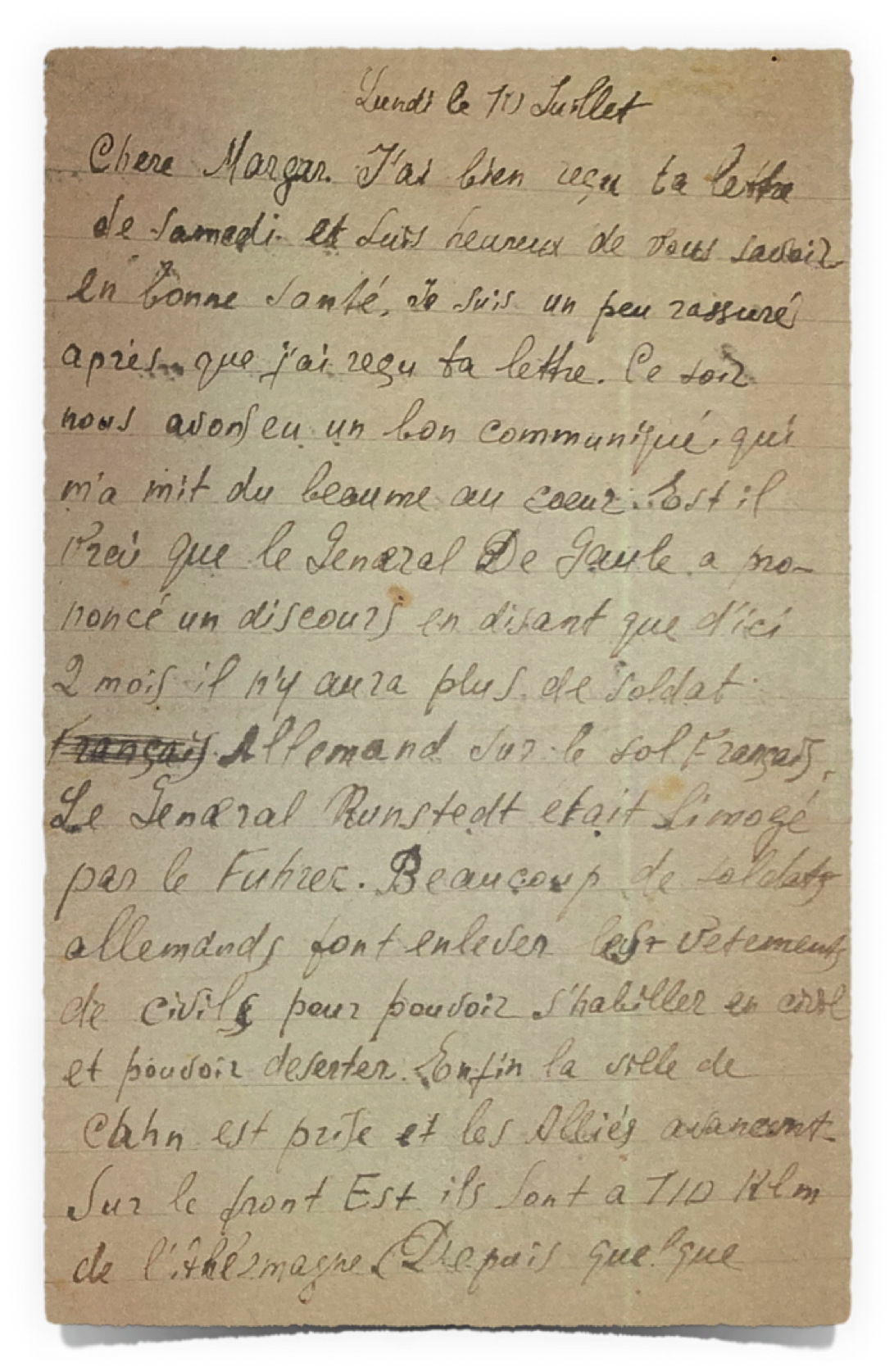
Letter from Joseph Inspektor
(Family archives / Shoah Memorial CMLXXV(4)-3
In his letters, Joseph said little about himself and never gave the real names of the people he mentioned. He used code words to help keep his loved ones safe. He asked how his children (“Riri” and “Gigi”) were doing. Above all, he gave his wife advice on where to get food and on whom she could turn to for help. He also worried about whether his food parcels would arrive, and sometimes he ran short of paper to write on. He described prison life and how news got around: he knew the Allies were advancing, and he helped make French flags for Bastille Day.
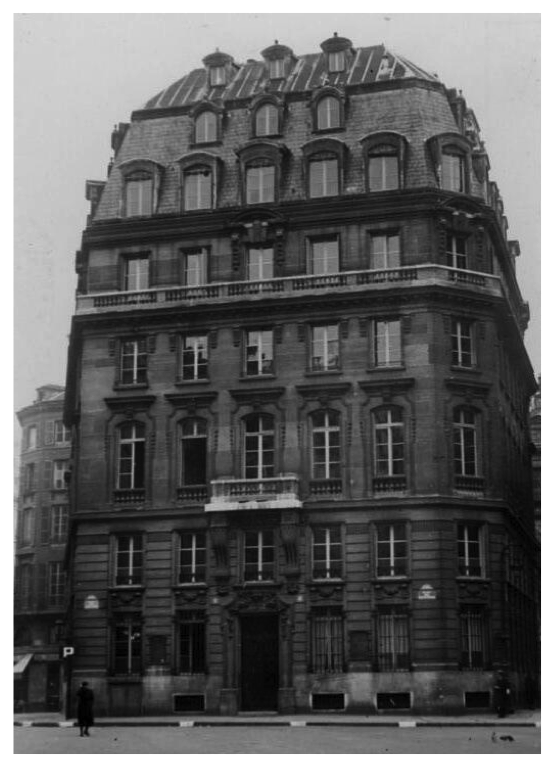
In one of his letters, Joseph wrote about the mutiny that broke out in the prison on July 14. The prison authorities, with the help of members of the French Militia and the Germans, crushed the revolt, which left 34 people dead. So many cells were no longer usable that over the following days the prison authorities decided to release many inmates held for ordinary crimes, Joseph Inspektor among them. The investigating judge, Raymond Charles, put him on the list of prisoners to be released on July 19, 1944. His lawyer stepped in at once, because this decision put her client in danger: as a Jew, he would be sent to the Paris Police Headquarters depot (the holding cells), according to standard procedure for Jews who were released from prison. The judge refused to change his mind however, and later that same day the police handed Joseph over to the 5th section of the General Intelligence service, in other words the Jewish Affairs department run by Superintendent Charles Permilleux[3], which was to rule on his “situation.” This meant he was at risk of being sent to Drancy. For ten days, his fate hung in the balance. His letters reveal that he went back and forth between the police depot and La Santé prison. He held out hope, because some of his fellow inmates had been sent back to prison. On July 27, police superintendent Jean Dides, who worked for the Commissariat for Jewish Affairs from 1942 to 1944, sealed his fate. As Joseph was of the “Jewish race,” Dides “placed him at the disposal of Charles Permilleux,” who ordered that he be transferred to Drancy internment camp. Joseph arrived there late in the day on July 29.
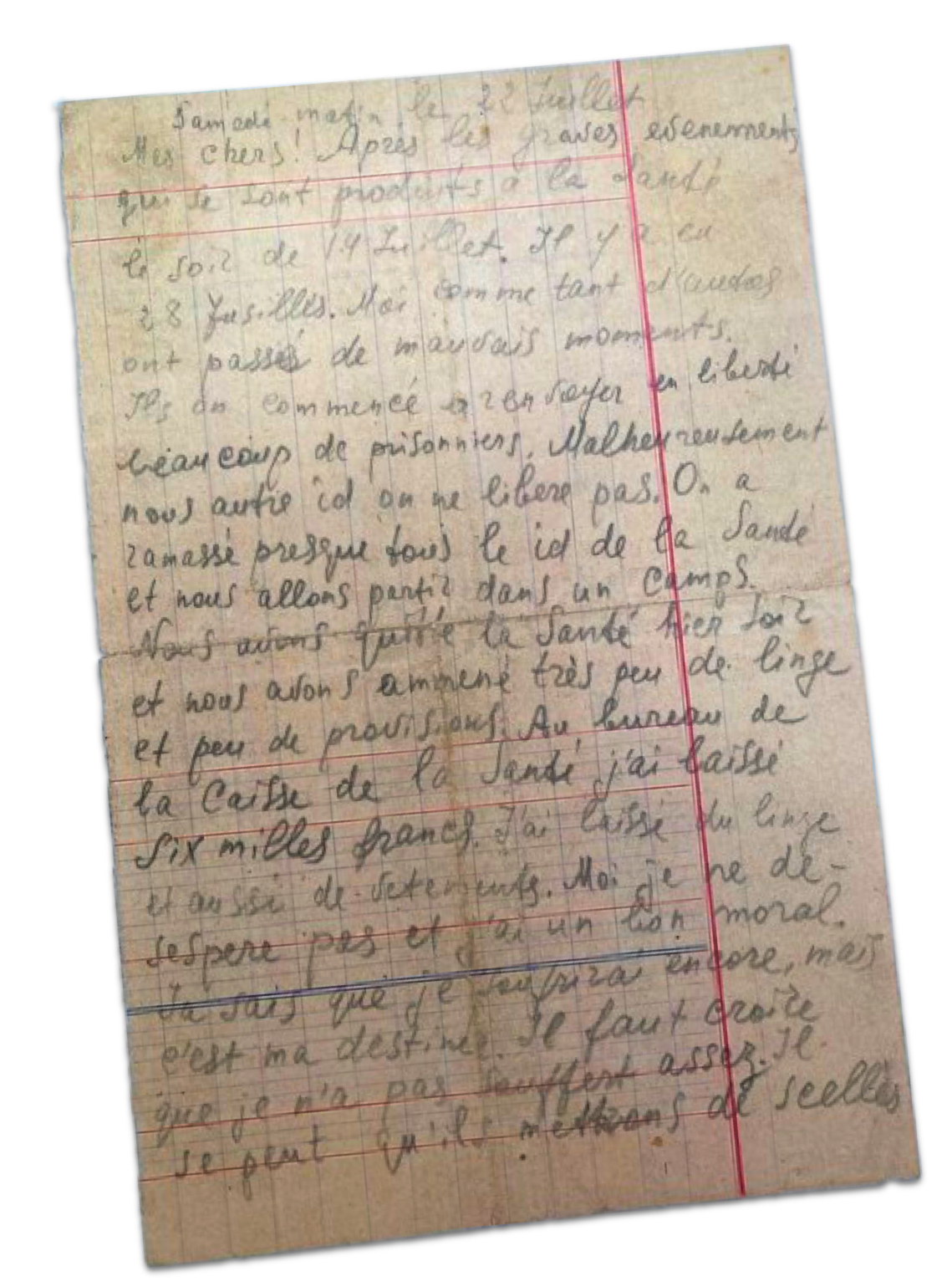
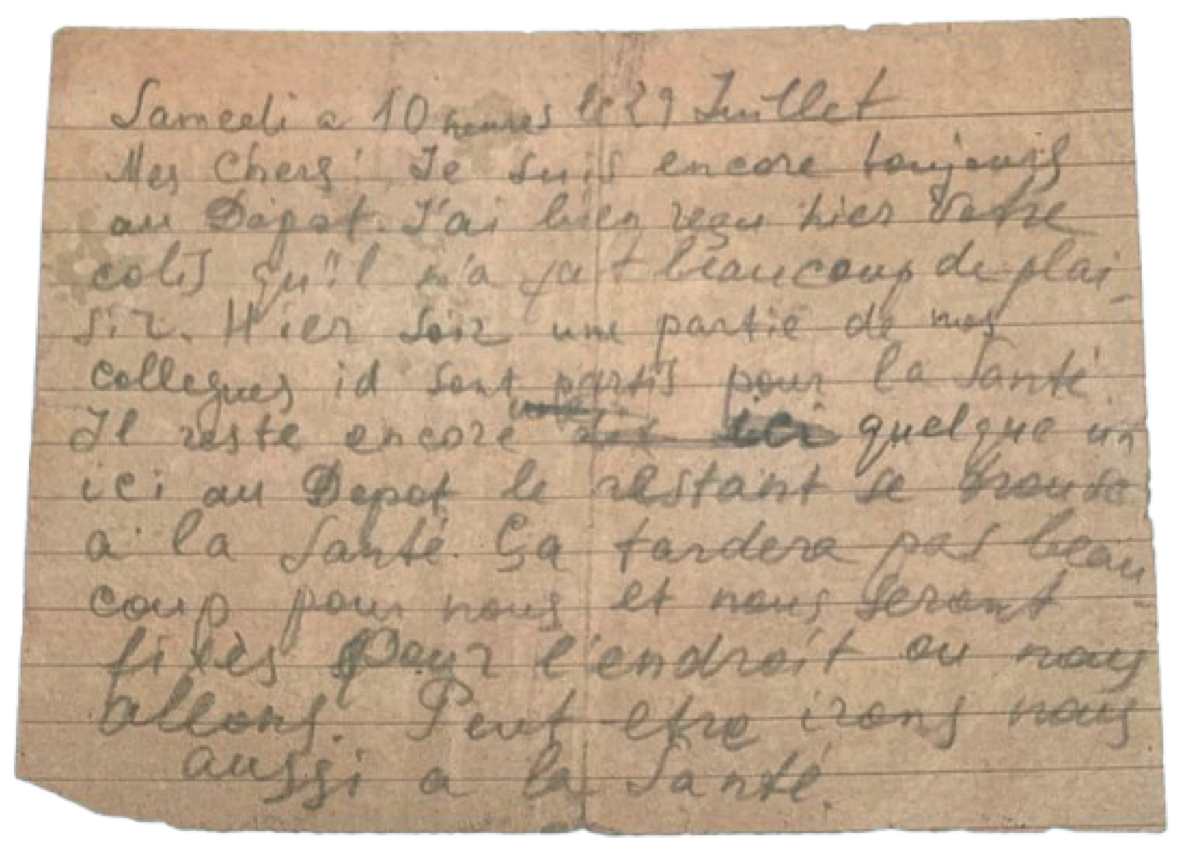
Letters from Joseph Inspektor
(Family archives / Shoah Memorial CMLXXV(4)-3
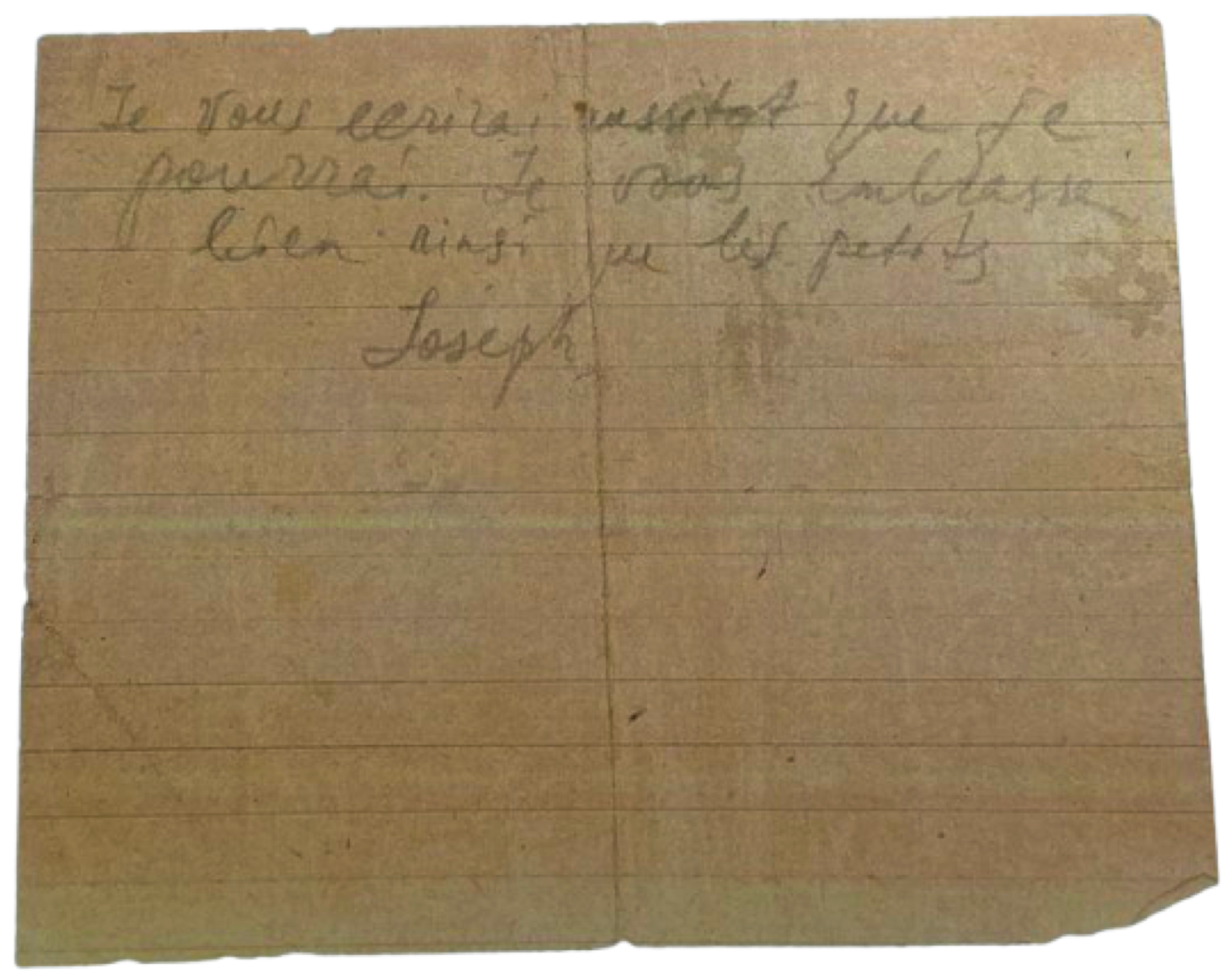
Joseph Inspektor’s last letter (July 29, 1944)
(Family archives / Shoah Memorial CMLXXV(4)-3
Joseph Inspektor only spent two days in Drancy camp, which, from 1942 to 1944, was used solely to hold Jews. On the morning of July 31, 1944, he was loaded onto a bus. He and 1,305 other people of all ages were taken to Bobigny station, where they were crammed into cattle cars. As he had no family with him, he was probably put in a car with other men travelling alone, a so-called “bachelors’ car”.
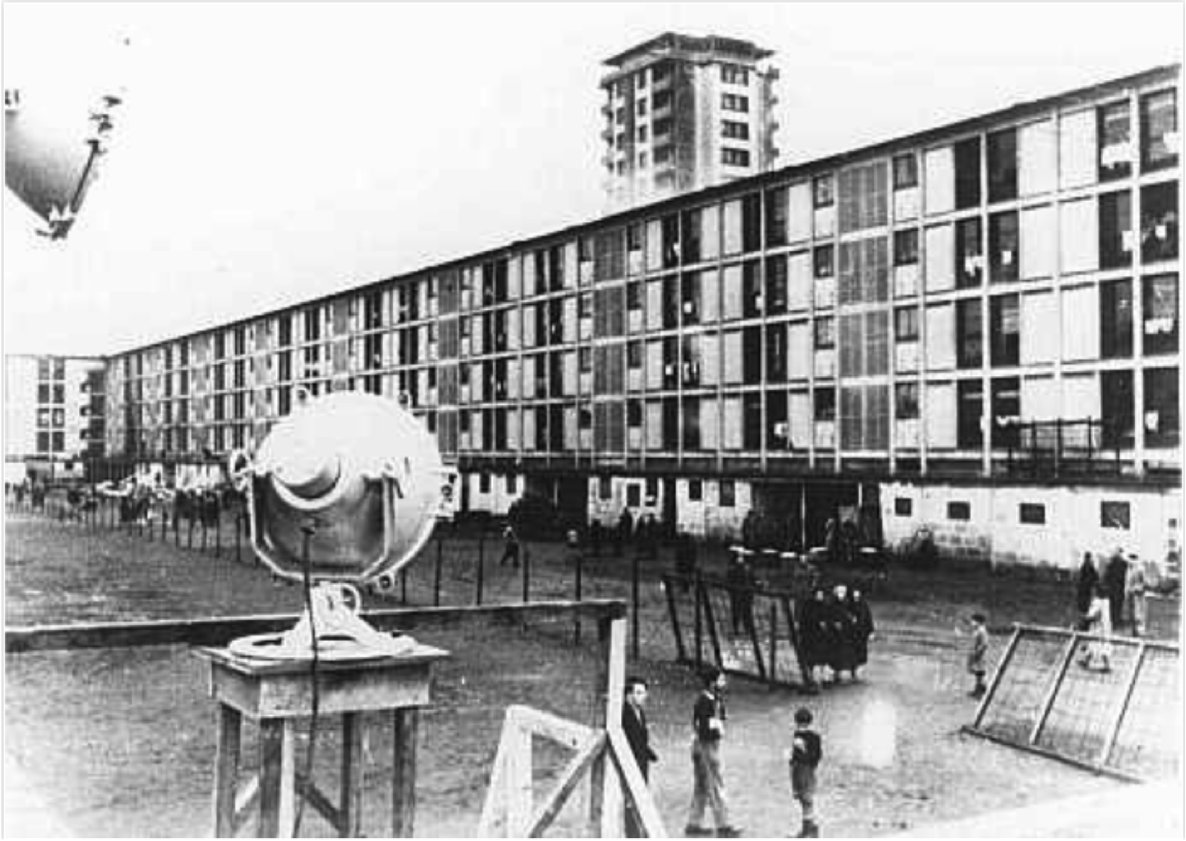
Jews interned in the Drancy camp between 1941 and 1944.
(encyclopedia.ushmm.org)
Joseph Inspektor was deported on Convoy 77, bound for the Auschwitz-Birkenau killing center.
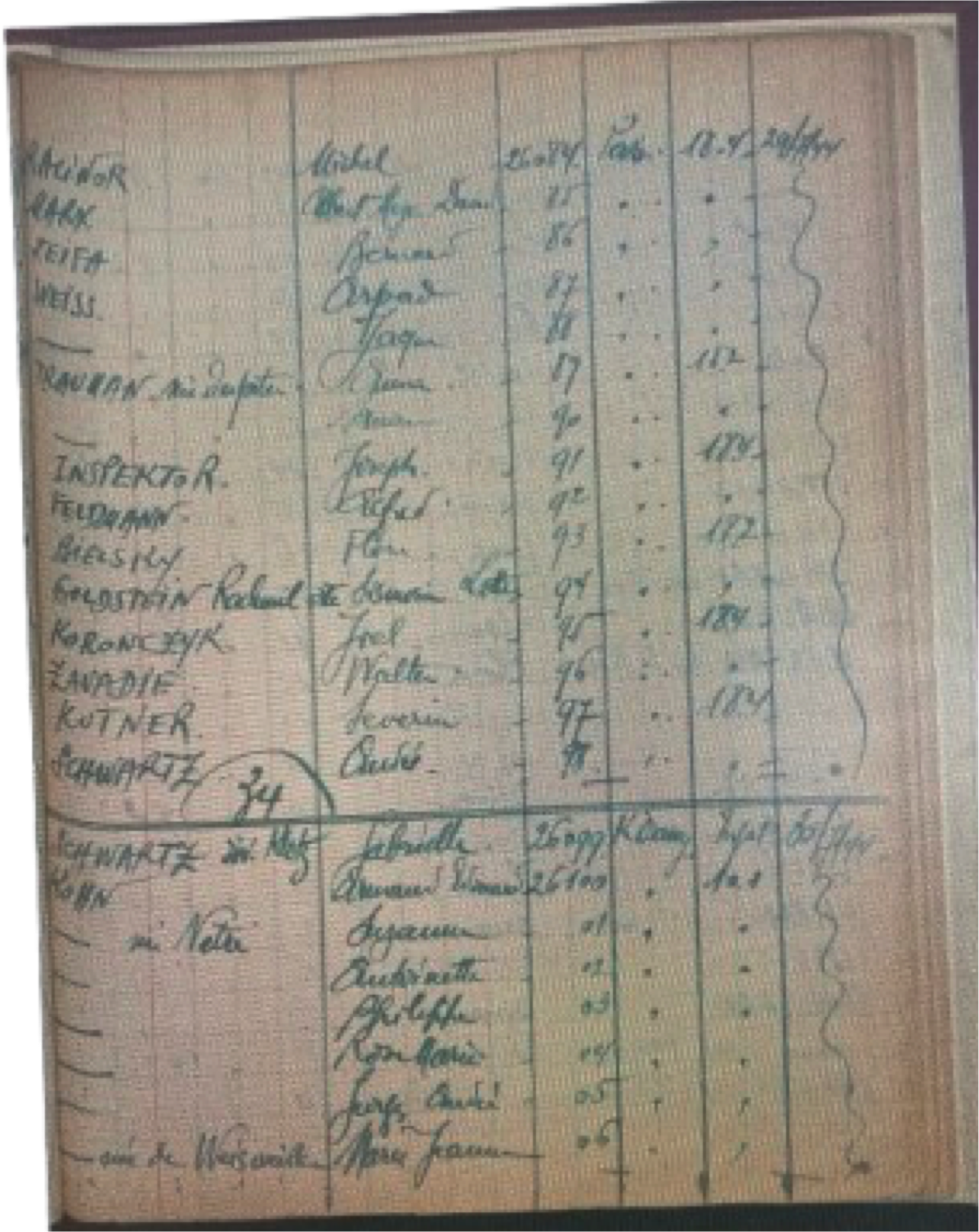
Drancy camp transfer register,
French National Archives – F9-5788
When he arrived in Auschwitz on August 3, 1944, he was not sent to the gas chambers but was selected to enter the camp to work.
Joseph Inspektor’s registration number (B-3803) enables us to trace, only very partially, what happened to him during his time in the concentration camp.
After he had been tattooed and spent time in “quarantine,” Joseph Inspektor was selected to work at the Monowitz-Buna camp (Auschwitz III). He was assigned to a synthetic rubber factory known as “Buna,” most likely because he was an electrician. There he came across not only other Jews, but also political prisoners and common criminals. Robert Waitz, a doctor who was himself a prisoner at Auschwitz III, referred to Monowitz as an “extermination camp” due to the grueling working conditions. Starving and beaten by the guards, Monowitz workers had a very short life expectancy, often only three to four months.
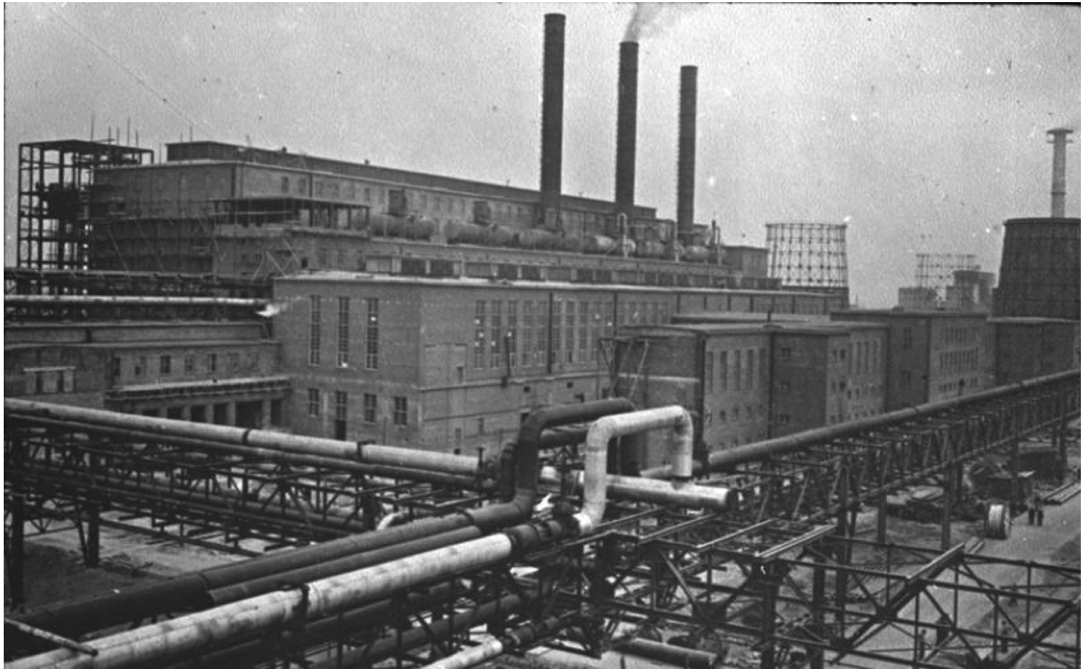
IG Farben factories at the Monowitz camp
(Creative Commons)
Joseph also fell victim to this violence. A month after he arrived in Auschwitz, his name was listed in the register of the camp infirmary, the “Revier.” He was admitted to the infirmary on September 16 with a broken jaw. Some other prisoners were admitted on the same day and for the same reason. His injury was probably the result of being beaten by the guards as punishment, which Primo Levi described in his book Si c’est un homme (If This Is a Man). A month later, on October 16, 1944, the register records that he left the infirmary. The camp infirmary was little more than a waiting room prior to death, and there is no further record of Joseph after that date.
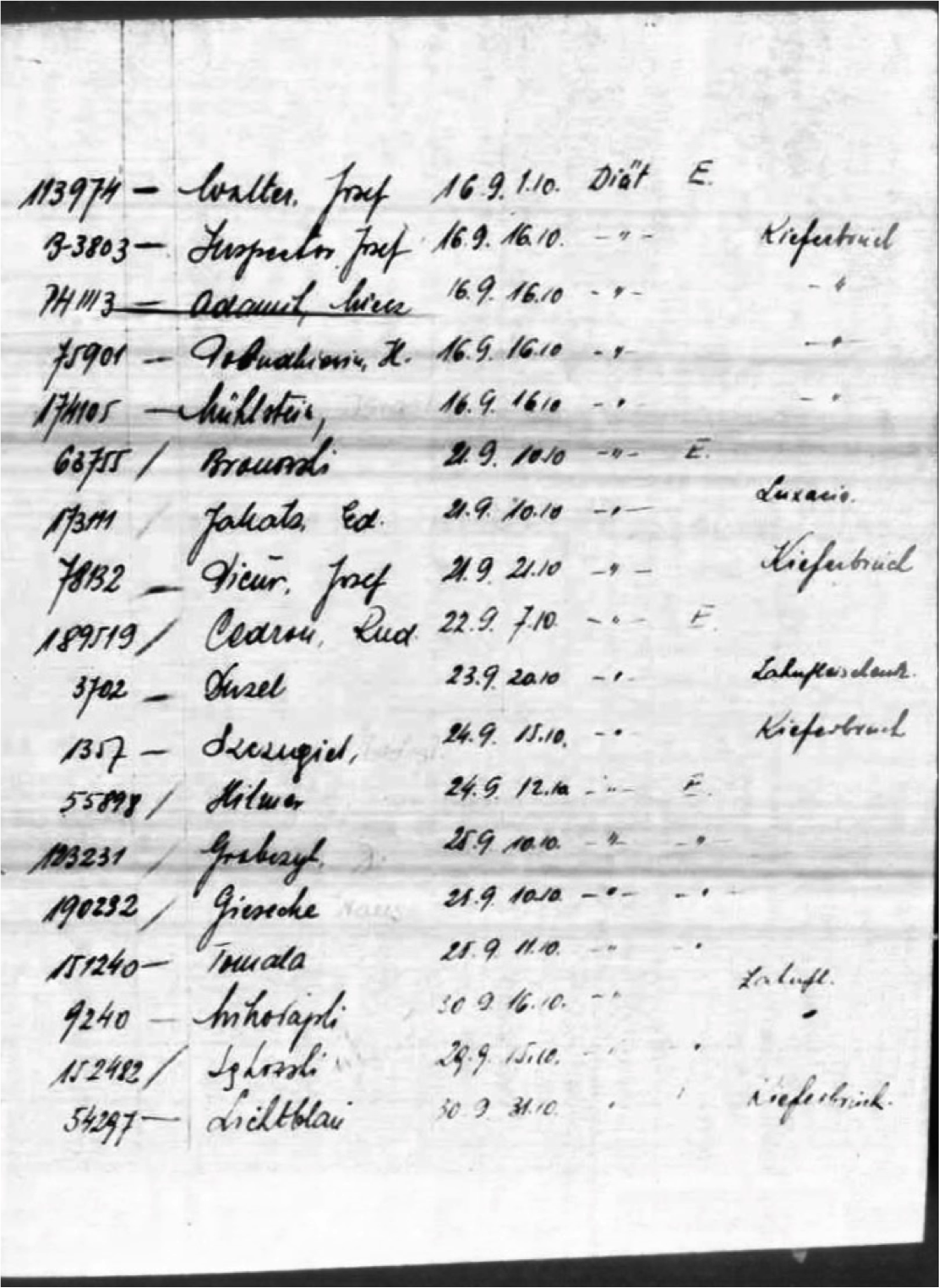
Entry for Joseph Inspektor in the prisoners’ infirmary register at KL Auschwitz-Monowitz.
Arolsen Archives / “Behandlungsbuch der Zahnstation des Häftlingskrankenhauses KL Auschwitz-Monowitz” (Treatment Book of the Dental Station of the KL Auschwitz-Monowitz Prisoners’ Hospital) (May 10, 1944 – January 12, 1945)
What happened to Joseph next?
He may have been transferred to another camp, as was the case for some of the other Convoy 77 deportees. On October 26, 1944, the Germans sent at least 75 men with registration numbers between B-3675 and B-3955 to the Stutthof concentration camp. Joseph’s number falls within this range, so he may have been transferred to another camp before he died. However, the Nazi camp system exploited human beings until it destroyed them, so the most likely explanation is that the SS deemed Joseph unfit for work and murdered him in the gas chambers. He may also have died on one of the “death marches.”
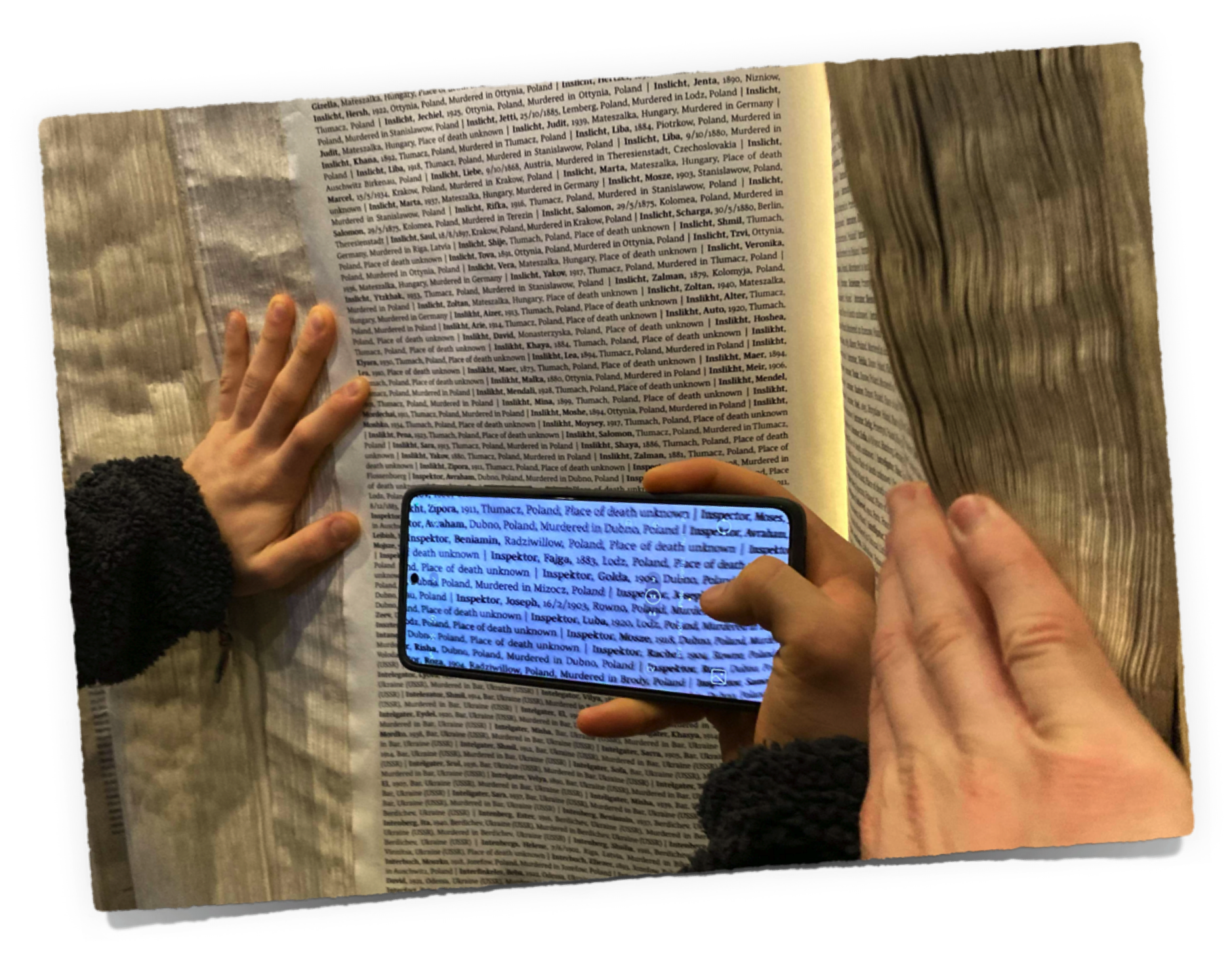
The students find Joseph Inspektor’s name in the Book of Names during their visit to Block 27 (Auschwitz Museum), January 2025. (Photo: V. Garrigues)
Notes & references
[1] Samuel’s daughter, Odette Pluskwa, who was hidden as a child during the war, gave testimony about her family to the Shoah Memorial. In both Poland and in France, the family shared socialist beliefs.
[2] Johanna Lehr, Au nom de la loi. La persécution quotidienne des Juifs à Paris sous l’occupation (In the Name of the Law: The Daily Persecution of Jews in Paris under the Occupation), Gallimard, 2024.
[3] Laurent Joly, Dénoncer les Juifs sous l’Occupation (Denouncing Jews under the Occupation), CNRS éditions, 2017; Maurice Rajsfus, La Police de Vichy (The Vichy Police), éditions du Détour, 1995.
Archives
- French Ministry of Defense Historical Service
AC 21P 258770 – Joseph Inspektor’s file as a civilian victim - French National Archives
Naturalization application
BB11_11285 – Joseph Inspektor’s file (1927) - Paris Police Headquarters archives
77 W 815 – file in the name of Inspektor
CC2 – register of persons provisionally held at the depot, July 1944 - Shoah Memorial
CMLXXXV (4)-3 – Inspektor collection
MXII_1129 to MXII_1151 Family photographs (some people are incorrectly identified in the online records) - Arolsen Archives
“Behandlungsbuch der Zahnstation des Häftlingskrankenhauses KL Auschwitz-Monowitz” (Treatment Book of the Dental Station of the KL Auschwitz-Monowitz Prisoners’ Hospital) (May 10, 1944 – January 12, 1945) - Inspektor family private archives