

 Français
 Polski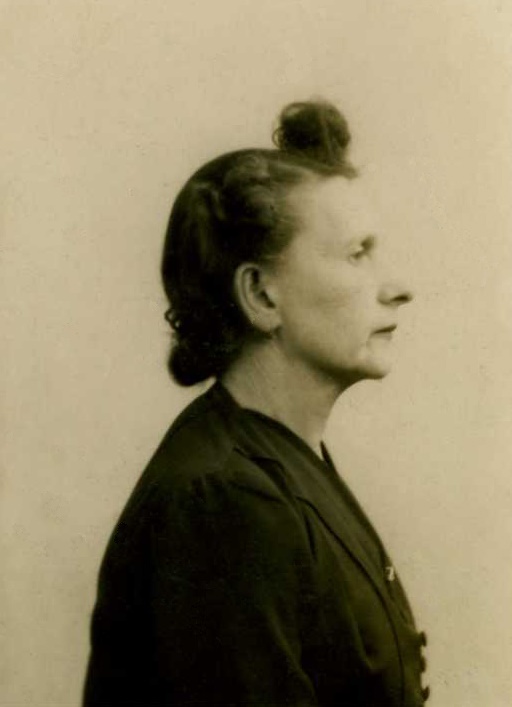
Rachel LAUFMAN, née BERENBAUM
Profile photo from Rachel Laufman’s identity card © Family archives
This biography was written by the 12th grade class 8 at the Charles-le-Chauve high school in Roissy-en-Brie, in the Seine-et-Marne department of France, under the guidance of their history teacher, Ms. Jessica Degrenne, and with the kind help and support of the Laufman family.
I / Rachel’s family background
Rachel Berembaum was born on September 5, 1891 in Warsaw, Poland[1].
Her parents were Ferriel Berembaum (born in 1860, in Makow, Poland, died in Paris in 1934[2]) and Rebecca Glotkovitch (or Zlotckovitch, born in 1862 in Pultusk, Poland).
She went on to marry Sroël Laufman, the father of her children. As far as we are aware, she did not work during the time she lived in Poland.
The archives tend to contain less information about women than they do about men, so it is mainly through the story of her husband, Sroël Laufman that we were able to find out what happened to Rachel.
We know that she and her husband Sroël emigrated to France, along with their young son, to escape the increasingly hostile environment in Poland. Poland had gained independence in 1918, just after the First World War. However, the political climate was highly unstable, as the new government had to try to bring together three separate regions. Meanwhile, the war between the USSR and Poland on one side, and Ukraine and Poland on the other, was still not over. Jews were then targeted in pogroms carried out by the various warring nations[3]. In Warsaw itself, the Polish military authorities later convicted the ringleaders of a pogrom perpetrated by some of their own soldiers.
Even though the 1921 Polish Constitution granted Jews the same rights as other citizens and promised religious freedom, the Laufmans had already decided to leave Poland. They officially arrived in France on January 20, 1921. Their descendants told us that it was one of Rachel’s brothers[4] who made all the arrangements for the family to move to Paris.
II / Marriage and children
Sroël Laufman and Rachel Berembaum (or Barenbaum) had already been married in a Jewish ceremony in Poland, but we have no documentary evidence of this. After they arrived in France, they got married again, officially this time, in the town hall of the 10th district of Paris, on March 11, 1926.
They had three sons. The oldest, Isaac/Icchok (the Hebrew version of the name)/Jacques (French version), was born on November 25, 1919 in Warsaw, Poland. Adolphe, the middle one, was born on March 25, 1922 in France and Georges, the youngest, was born on July 11, 1928, in Paris.
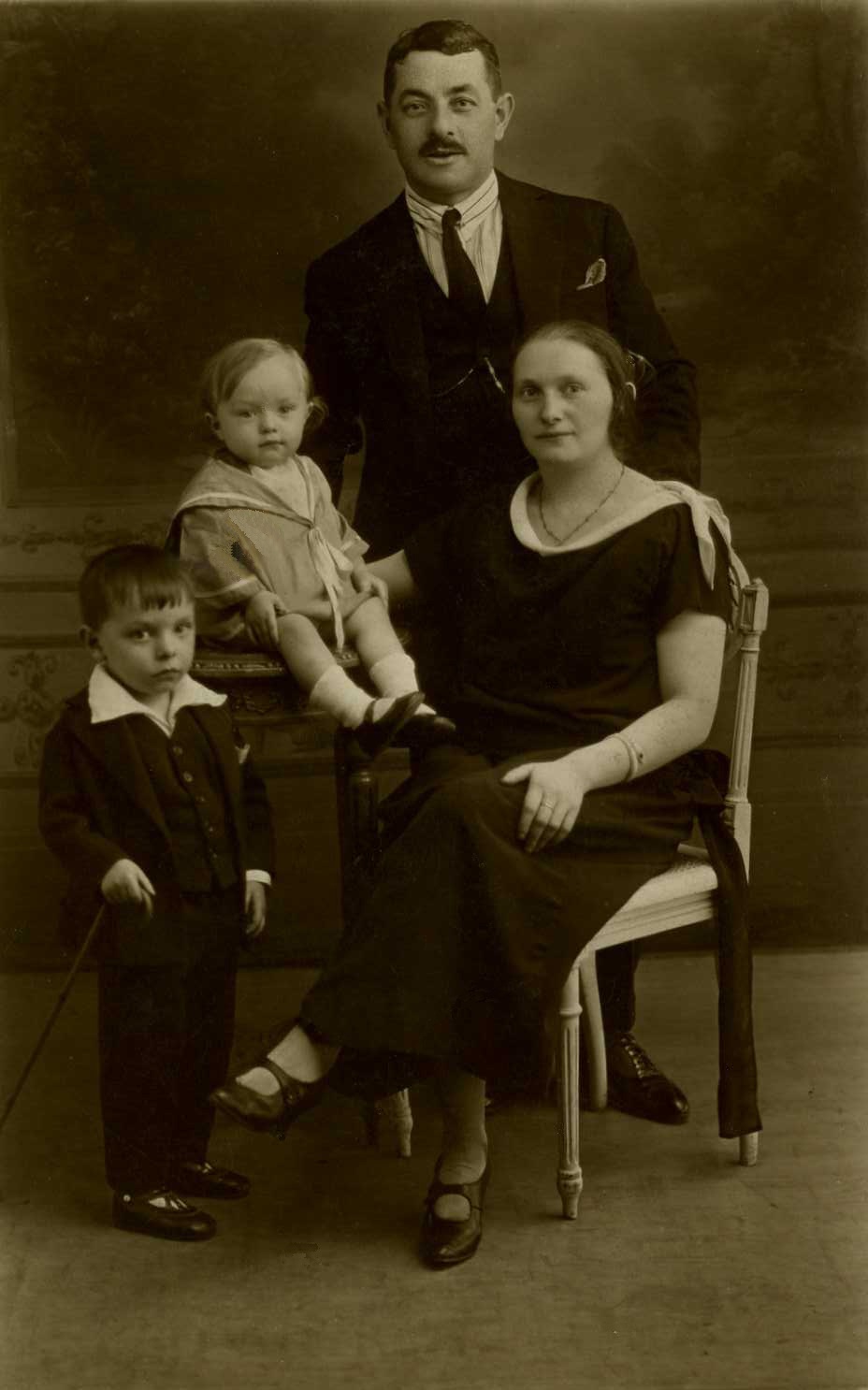
Sroël, Rachel, Jacques and Adolphe in 1923 © Family archives
III / Migration and naturalization
Since the 1920s, France had maintained close ties with Poland, particularly through bilateral agreements that facilitated the recruitment of Polish workers. After World War I, there was a labor shortage in France, while Poland, which had gained independence in 1918, was in the midst of a recession. This prompted hundreds of thousands of Polish people, many of whom were Jewish, to emigrate to France. Among them were Rachel and Sroël. Rachel was naturalized as a French citizen in 1928 under the French Nationality Act of August 10, 1927; this legislation made it easier to become a French citizen and was introduced in order to address the decline in the French population in the aftermath of the First World War.
IV / A new life in France
Rachel’s life in France began in 1921. After moving from Poland with her husband, Sroël Laufman, and her first son, Icchok/Jacques, she soon integrated into French society, even though, according to her son Georges, she hardly spoke the language and had a strong Polish accent. Her children, on the other hand, spoke French fluently[5].
She initially lived at 17 passage de l’Industrie, but then moved to 82 passage Brady in the 10th district of Paris, just off the Faubourg Saint-Denis, right in the heart of Paris[6]. He sister Chawa, known as Eva, married name Grynszpan, lived nearby and her parents lived close by too, at 21 boulevard de Strasbourg.
The neighborhood was home to a large Jewish community, many of whom worked in the clothing industry, or “shmatès,” in Yiddish, which was widely spoken by Jews from Central and Eastern Europe. Rachel worked as a concierge (building supervisor), for some of her time in France[7], she and her husband Sroël lived on her meagre salary and his income of 1,200 francs a month[8]. One of her descendants told us that she also worked as a nursing assistant.
The Laufmans lived in a rented apartment and as the rent was so high, (780 francs a month), they must have found it hard to make ends meet and led a fairly frugal life. Rachel probably did not go out work before she became a building superintendent; she likely stayed home to care for their home and raise their three children, as many women did back then.
Her children did fairly well at school[9] despite the widespread discrimination they encountered.
In 1933, Rachel lost her mother, and the year after that, her father died at home.
At the beginning of the Second World War, during what became known as “the exodus”, Rachel fled Paris with her youngest son and one of his aunts. They found refuge in Limoges, in the Haute Vienne department of France, but subsequently returned to the capital.
V/ The circumstances surrounding the arrest
Beginning in 1940, France entered a grim chapter in its history. The German occupation and the French government’s collaboration with the Third Reich cast a dark shadow over the country. When France was defeated in June 1940, Marshal Philippe Pétain came to power and established an authoritarian and anti-Semitic regime. Based in the town of Vichy, in the Allier department of France, it became known as the Vichy regime. In October 1940, the first discriminatory legislation was passed. Jews were banned from working in numerous professions and were obliged to take part in a special census. As of May 29, 1942, Jews living in the German-occupied zone were required to wear the yellow star, and by the summer of that year, the numbers of roundups increased all over France.
On July 16 and 17, 1942, the Vel’ d’Hiv roundup signaled a turning point: more than 13,000 Jews, including 4,115 children, were arrested in Paris, transferred to the camps in Drancy, Beaune-la-Rolande, or Pithiviers, in the Loiret department, and then deported. Several members of Rachel and Sroël’s family (Rachel’s sister Esther and her husband Majer Goldberg, along with their daughter Suzanne and their son Wolf) were arrested during this roundup. They were all deported, never to come home.
It was during this period of repression and relentless persecution that, according to the police register, Rachel Laufman was arrested together with her husband on the morning of Saturday, July 22, 1944, at their home at 82 passage Brady. The sole reason for her arrest was that she was Jewish[10].
She was taken to Drancy, where she remained until July 31, 1944. As there were no witnesses, the exact circumstances of the arrest are unknown, but Jews were often arrested in their homes. Sometimes such arrests took place during the night or at daybreak, and the victims were not even allowed to take any belongings with them. These sudden arrests often involved physical violence. In many cases, Jews had been reported by their neighbors.
Rachel and Sroël were the only members of the family to be arrested that day. Their two older sons no longer lived with them: Jacques, after being sent to work as a forced laborer in a factory in Berlin, had been allowed out on leave and was living in hiding with another family, and as for Adolphe, he had been deported to the island of Alderney, off the north coast of France. The youngest, Georges, was still living with his parents but, completely by chance, had been asked to work that Saturday morning.
Rachel Laufman was one of the numerous victims arrested in the last few terrible months leading up to the liberation of France.
VI / Drancy
Drancy camp was located in the northern suburbs of Paris. Founded by the Vichy regime in 1941, during the Nazi occupation, it was the main transit camp in France for Jews from 1941 to 1944. It was used as a gathering place for Jews arrested in roundups, such as the well-known Vel d’Hiv roundup, before they were deported to the Auschwitz concentration camp and killing center in Poland.
Living conditions in the camp had improved a little by 1944, but they remained extremely tough and totally inhumane. In total, around 67,000 people were deported from Drancy to Auschwitz.
VII / Disappeared without a trace
We know very little about what happened to Rachel after she was loaded onto a bus from Drancy to the nearby Bobigny station on July 31, 1944.
Forcibly crammed into cattle cars, the 1,306 people deported on Convoy 77 had to endure the most horrific journey.
There is no record of how or when Rachel and Sroël Laufman died, but given their age, they were likely killed in the gas chambers as soon as they arrived.
Jacques Laufman applied for his parents to be granted the status of “Political Deportee/Internee” on December 4, 1963. On May 6, 1966 he asked the Ministry of Veterans and War Victims for a statement confirming his parents’ deaths. Then, on October 12, 1966, a “deported or interned resistance fighter or political prisoner” card was issued posthumously to Rachel.
Among the documents in her case file is a letter from Georges Laufman, dated November 18, 1948, stating that his mother Rachel had “not returned.” He also stated that her children were not drawing any military pay or financial assistance.
As the French authorities did not know exactly when Sroël and Rachel died, they initially declared their date of death to be July 31, 1944, the date on which Convoy 77 left Drancy. They subsequently adopted a policy whereby the official date of death for “non-returned” deportees was deemed to be five days after they left Drancy. In the case of Convoy 77, the date was August 5. In reality, however the train arrived during the night of August 3–4. The deportees who were not selected to enter the camp to perform forced labor were sent to the gas chambers and murdered that same day; Rachel Laufman was most likely among them.
Drancy Camp and Bobigny Station
The camp, which was liberated on August 18, 1944, is now gone. After being used for a time to intern collaborators or individuals suspected of being collaborators, it was converted, and the buildings that made up the Cité de la Muette reverted to their original purpose, as intended before the war: they became a housing complex. However, the camp—where people died by suicide, from diseases, or as a result of violent beatings, rightly deserves its reputation as a “antechamber of death”, which and remains a deeply evocative term. The site is now a place of remembrance. A nearby Holocaust memorial, which was inaugurated in 2012, houses an exhibition that looks back on the camp’s history and serves as a tribute to the victims. A cattle car, typical of the cars used to transport more than 70,000 people to the death camps, stands as a reminder of their fate.
Drancy is now both a living space for local residents and a memorial to the deportees.
At Bobigny station, the departure point for Convoy 77, there is another memorial. Visitors can learn why the Nazis opted to use this small, out-of-the-way station to load thousands of people into cattle cars, surrounded by soldiers, SS officers, and dogs. The open-air site is freely accessible to the public.
In memory of Rachel and Sroël.
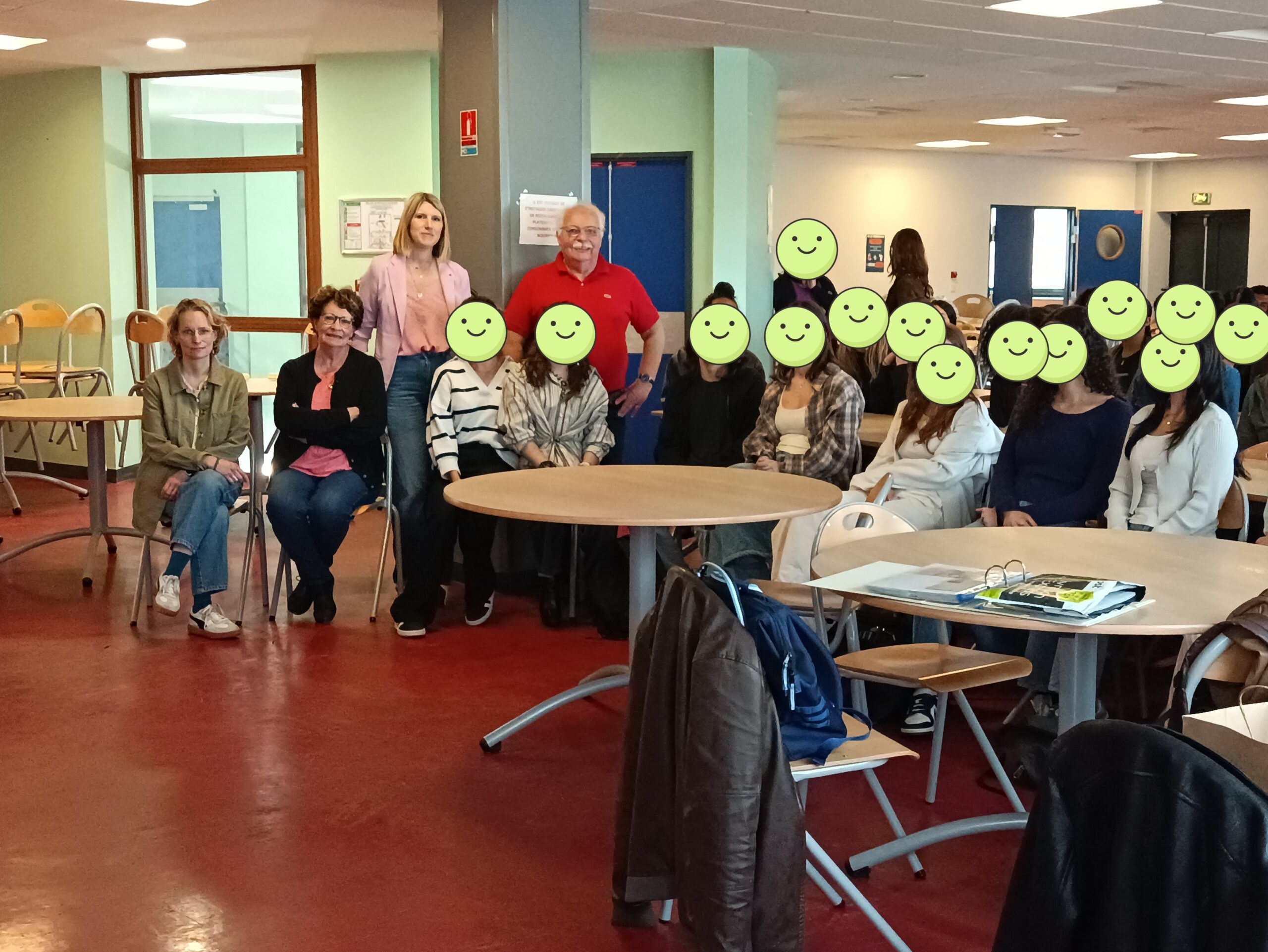
Our meeting with Gérard Laufman (Rachel and Sroël’s grandson), his wife Françoise and their daughter (Rachel and Sroël’s great-granddaughter).
A comment from one of the students who took part in the Convoy 77 project:
“This project made me even more aware of the genocide of the Jews during the Second World War. As we worked on this project, we were able to identify with the people who were deported to concentration camps through focusing on one family’s story; a story similar to so many others. The thing I enjoyed the most was meeting the family. Meeting their descendants was really powerful. It truly felt like the culmination of many hours of research and hard work. Memory helps keep history alive, and through this project, I felt that we were adding a new chapter to the story.”
We would like to thank the Laufman family’s descendants, who were kind enough to come to our school to speak with us. It was an experience we shall never forget.
Notes & references
[1] Death certificate from the file on Rachel Laufman née Berembaum, Victims of Contemporary Conflicts Archives Division of the French Ministry of Defense Historical Service, in Caen, dossier 21P 261 578
[2] He lived at 21 Boulevard de Strasbourg in the 10th district of Paris and died there on October 8, 1934. His wife had died the previous year.
[3] There were 125,000 Jewish victims in Ukraine and 25,000 in Belarus between 1918 and 1922, according to figures cited by Nicolas Werth and Lidia Miliakova in their book Le Livre des pogroms. Antichambre d’un génocide, Ukraine, Russie, Biélorussie (The Book of Pogroms. The Prelude to Genocide: Ukraine, Russia, Belarus, 1917–1922), Calmann Lévy, 2010.
[4] Rachel had two older brothers, Abraham, known as Adolphe Berenbaum (with an “n” before the “b”), who was born in 1886 and became a naturalized French citizen in 1924, and Isaac Berenbaum, born in 1887, three sisters, Beïla (known as Blanche, born in 1893), Eva (known as Chawa, born in 1895), and Esther (born in 1898), and a brother, Beinish (known as Bernard, born in 1899), who became a naturalized citizen in 1928. Esther died in 1942 after being deported to Auschwitz on Convoy 29; Isaac died in 1937. The others survived the Holocaust. All had migrated to France, as had Rachel’s parents.
[5] According to Georges, Rachel and Sroël’s son.
[6] Marriage certificate, Paris digital archives
[7] Census records, Paris digital archives
[8] File on Sroël Laufman, Victims of Contemporary Conflicts Archives Division of the French Ministry of Defense Historical Service, in Caen, dossier N°21 P 473.217
[9] Letter from Georges Laufman, family archives
[10] Paris Police Headquarters archives, CC2, register of persons temporarily held in the detention center


