

 Français
 Polski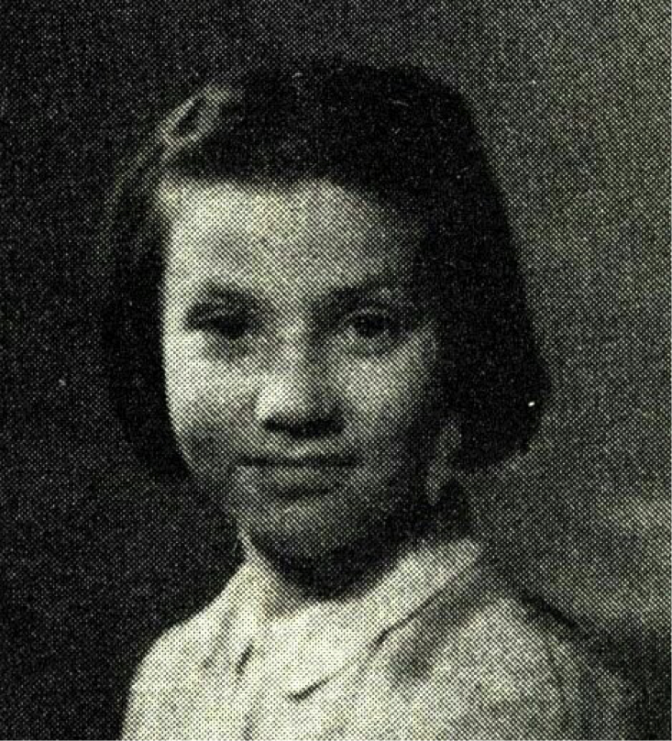
Ryfka BRAFF (Metz, January 2, 1934 – Auschwitz, August 5,1944)
Photo of Ryfka Braff: © Shoah Memorial, Paris
Ryfka’s parents
Abraham Abusch Braff was born in Nowy Wiśnicz, in Galicia, southern Poland, on July 25, 1900. There was a large Jewish community in the town at the time, which dated back to the 17th century. His parents were Simon Braff and Ryfka Zehnwirth.
Sara Schachne was born in Jasienica, Poland, on November 17, 1899. Her parents were Benzion Schachne and Scheindel Goldman.
Both families worked in the same line of business: they were merchants. Abraham Braff was a butcher.
In common with many other Polish Jewish families, they had to leave their homeland to escape anti-Semitism. In 1919–1920, there was a pogrom in Nowy Wiśnicz. They also hoped that life would be better elsewhere and thought of France as synonymous with freedom, as reflected in the Yiddish saying, “Men ist azoy wie Gott in Frankreich,” meaning “As happy as God in France.”
After a short stay in Frankfurt, in Germany, Abraham Braff arrived in Metz, in the Moselle department of France, in 1927.
Abraham and Sara got married in Metz on November 13, 1928. The marriage certificate reveals where the two families were living at the time: Before the wedding, Abraham lived at 10 rue Wilson and Sara at 18 rue de l’Arsenal, both in Metz[1].
The young couple lived there at least until their first child, Henri, was born[2], after which they set up home at 28 rue Vincentrue, where Adam also had his butcher shop.
We also know from the internment register for the Poitiers camp, in the Vienne department of France[3], that Sara became a seamstress after they were married. Was that her first job?
But why did they choose Metz ?
The Braff and Schachne families must have been aware that there was a well-established Jewish community in Metz. In 1912, Polish Jewish families initiated the building of a synagogue, which became known as the “Polish Synagogue.” This was surely one of the reasons behind the families’ choosing to settle there: to recapture a sense of their old lives in Poland. The synagogue is now on rue du Rabbin Élie-Bloch (formerly rue de l’Arsenal) in the Arsenal quarter of the city.
Jean Daltroff, a historian who specializes in Jewish history and culture in Alsace and Lorraine, wrote that between late November 1849 and December 1851 “the majority of Metz’s Jewish population still lived in the vicinity of rue de l’Arsenal (primarily rue de l’Arsenal itself, rue des Jardins, rue Saint-Ferroy, rue des Rochers, quai Saint-Pierre, rue Vincentrue, rue Saint-Georges, and rue du Pontiffroy).” He also stressed “the importance of traditional commercial activities and craftsmanship, including eight butchers…[4]” Abraham thus opened his butcher shop in a neighborhood with a long history of retail trade.
The Braff family
Abraham and Sara Braff had three children:
Henri (Hanoh Henoch), who was born on May 16, 1929, and died of an incurable illness on November 23, 1932.
Ryfka Chaya, who was born in Metz on January 2, 1934. She later became known as Régine.
Eva, who was born on January 28, 1938, also in Metz.
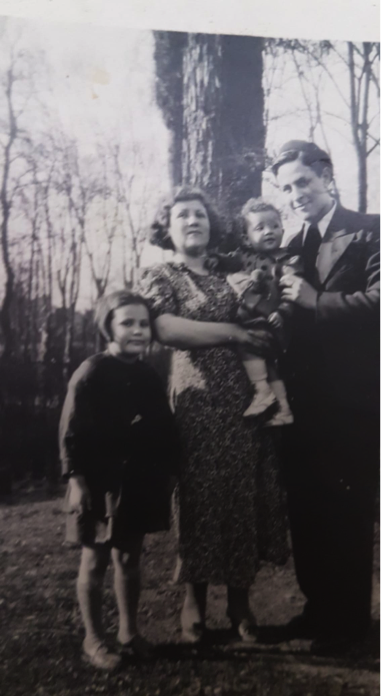
Family photo taken on the Ile du Soulcy in Metz on April 4, 1939. From left to right: Régine, her mother Sara holding Eva, Ado Reich, Sara’s nephew and Régine and Eva’s first cousin. ©Family archives.
Ryfka was five years old when the Second World War broke out, and her little sister Eva was only eighteen months. Their lives were suddenly turned upside down by the horrors of war.
The flight from Metz
The proximity of Metz to Germany and the memory of the two previous wars had prompted the city authorities to draw up an evacuation plan for local residents, which was put into practice between September 1939 and June 1940. A total of 303,000 people from the Moselle department were sent to the Charente, Charente-Inférieure, Vienne, and Haute-Vienne departments. The descendants of the Braff family believe, however, that they left Metz under their own steam, with the help of the Reich family (an aunt later wrote to them from Périgueux, in the Dordogne department).
When did they leave? The decree of September 27, 1940—which, among other things, mandated a census of people deemed to be Jewish—gives us our first clue. It was forbidden for anyone to leave the designated census area. We can therefore safely assume that Régine and her family had already left Metz by then[5] perhaps during the summer. Her father must have been hoping to protect his family from the newly introduced anti-Semitic measures. Régine and her family thus moved to Bordeaux.
While the Braff family was struggling to survive in their newfound home, anti-Semitic measures similar to those enacted in Germany were being adopted in France. The first decree on the “Status of the Jews”, enacted on October 3, 1940, banned Jewish people from working in a wide range of professions. Anti-Semitic measures and legislation continued to gather pace, in particular with the second decree on the “Status of the Jews” on June 2, 1941. Legislation dated Octobre 4, 1941 “on foreign nationals of the Jewish race,” led to nearly 40,000 people being interned in camps. Abraham Braff was among them.
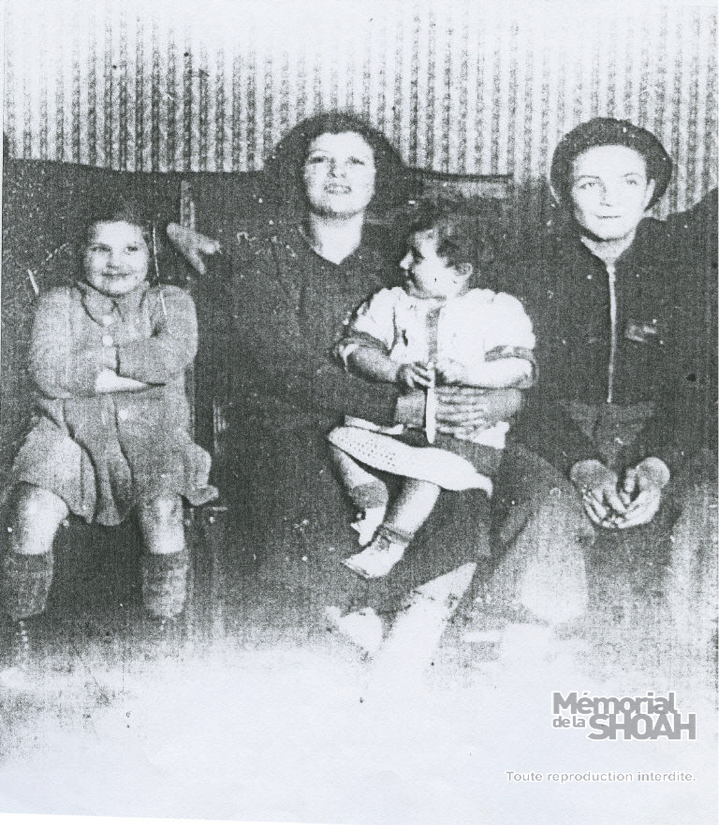
From left to right: Régine Braff, her mother Sara with Eva on her lap, and Marc Reich. ©C.D.J.C (the French Center for Contemporary Jewish Documentation) / M. Reich collection
Why did the family move to a city in the south west of France?
Régine’s family probably moved to the south-west of France as early as 1939. Many Jewish families relocated to the region, particularly to Bordeaux, as of 1939.
The family set up home at 5 rue Beubadat in Bordeaux (including Abraham at first, but then without him). However, the Vichy regime’s anti-Semitic collaborationist policies soon caught up with them. This led to all the women and girls being arrested in Bordeaux on December 1, 1940, and held in detention for three days.
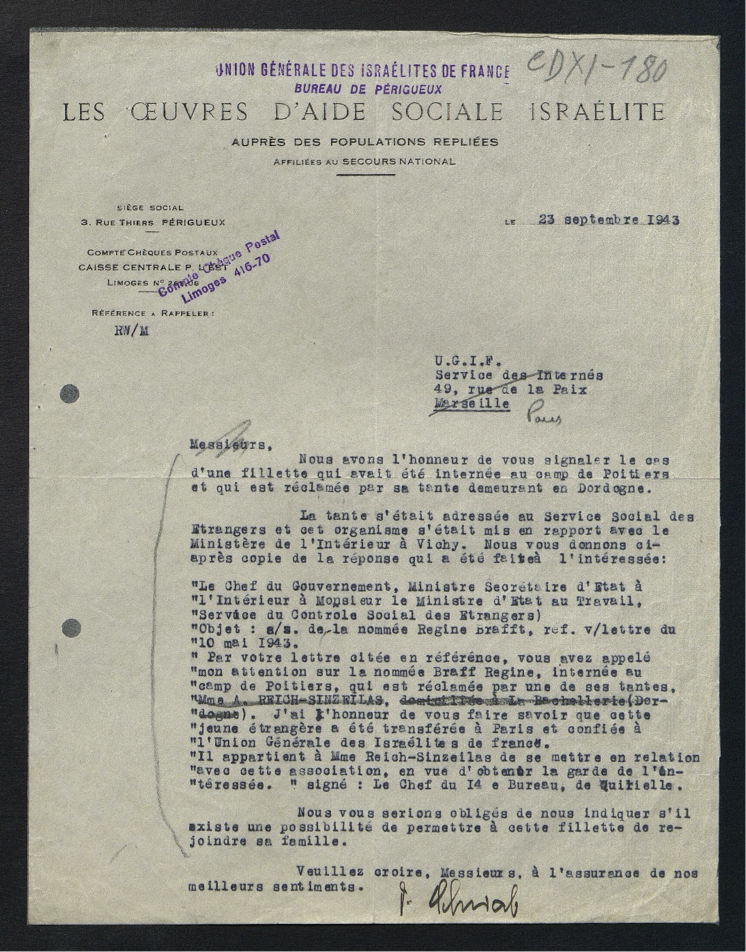
©Shoah Memorial, Paris, ref. CDXI- 180.
The Poitiers camp and the periods of house arrest
Between December 1, 1940, and July 15, 1941, the date on which the Poitiers camp register says that Régine, Sarah and Eva arrived there[6], where were they?
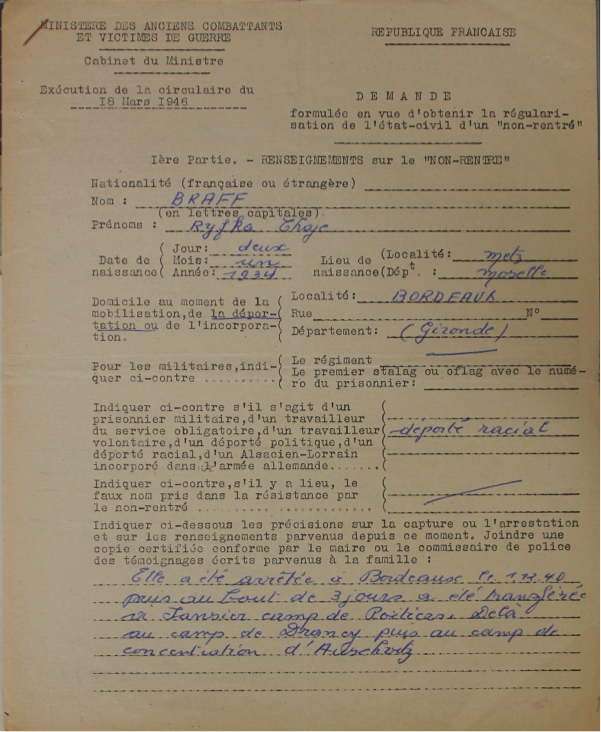
File on Ryfka Braff ©Victims of Contemporary Conflicts Archives Division of the French Ministry of Defense Historical Service, in Caen, dossier no. 21 P 248 116.
The column “place of residence prior to internment” lists the village of Berthegon in one record, and the village of Sanxay in another (which only includes Sara and Eva). Both of these villages are fairly close to Poitiers (about twenty miles away)[7].
They must therefore have been under house arrest, probably split between Berthegon and Sanxay.
The AJPN (Anonymes, Justes et persécutés durant la période nazie or Anonymous, Righteous, and Persecuted During the Nazi Era) website includes an account of the history of the Poitiers camp and describes the living conditions there:
“The camp on the Limoges Road, classified as a ‘Supervised Residence Facility’, was built in 1939 to house Spanish refugees (of whom there were 800 on February 2). The camp was evacuated when the Germans invaded. Following the armistice signed on June 22, 1940, the camp’s management remained under French control but was overseen by the German authorities. Beginning in late 1940, the French authorities, acting on German orders, carried out a census of gypsies and Jews. By December 1940, a large number of French and foreign gypsies were interned three. In total, more than 500 nomads were thus interned and kept in inhumane conditions: the clay soil turned into a veritable quagmire in winter; there was no proper heating; food was inadequate and nutritionally unbalanced; and there was a severe shortage of pots and pans, chairs, and tables. But the greatest hardship for these “traveling people” was clearly the loss of freedom. The French authorities carried out a census of the Jews in April and May 1941. The Germans gave orders for them to be arrested on July 15 and interned at the camp on the Limoges road. In mid-July, 151 adults and 158 children arrived to join the gypsies and share in their misery. The barracks set aside for the Jews there were also dilapidated and poorly maintained: the roofs were damaged and leaked, and there were no chairs, benches, or tables. In addition to this, mice and rats plagued the camp, devouring everything, and people regularly found their clothes—often the only ones they owned—gnawed and full of holes when they woke up in the morning. On December 1, 1941, the camp held 801 internees. There were 27 Spaniards, 452 gypsies and 322 Jews crammed into 15 barrack huts each measuring about 50 meters by 6 yards. Although they were separated from each other by a fence, they got along famously and were utterly devoted to one another[8].”
Among those 151 adults and 158 children who were arrested and taken to the camp on July 15, 1941, were the Braff family.
Sara was deported, followed by Eva and her grandmother
Sara Braff was deported from Angers, in the Maine-et-Loire department of France to Auschwitz on July 20, 1942 on Convoy 8. She was thus separated from her children and her mother, Scheindla Schachna, in the summer of 1942. She was subsequently transferred from Auschwitz to the Gross-Rosen camp, where she died on January 31, 1944.
This left Régine and little Eva alone with their grandmother in the appalling living conditions in Poitiers camp.
A note written after the war[9], states, presumably referring to Eva Braff, that “after she left on August 6, 1942, Eva was interned.” However, we know that Eva and her grandmother were deported together from Drancy on Convoy 36 on September 23, 1942.
This meant that as of early August 1942, Régine, who was eight years old by then, was left behind all alone in the Poitiers camp.
Rabbi Elie Bloch, who, like Régine, originally came from Metz, saved and sheltered many Jewish children from Poitiers and elsewhere. Sadly, he was arrested and deported on February 11, 1943.
He happened to meet Régine and arranged for her to be placed with two Jewish families: “Mrs. Braff, who managed to make her way to the Dordogne department with her sister, Mrs. Reich, asked the rabbi to send her two young granddaughters to stay with a friend in Bourbon-Lancy, in the Saône-et-Loire department[10].”
A letter from the U.G.I.F. (Union Générale des Israélites de France, or General Union of French Jews) dated September 23, 1943, which included a copy of a reply from a certain Mr. de Quirielle, head of the 14th Office for the Social Oversight of Foreigners, reveals that someone by the name of A. Reich-Sinzeilas, who was then living in La Bachellerie in the Dordogne department, was “reclaiming” his niece in order to have her released from the Poitiers internment camp[11].
The Reich and Braff families must have known each other very well, as Elias Reich was one of the witnesses at Régine’s parents’ wedding. His wife, Malka, was Sara’s sister, so he was Sara’s brother-in-law. An undated record held by the Prefecture of the Vienne department, issued by the Office of Jewish Affairs states that Régine was placed with two Jewish families[12]: the Goldman family[13] from Ligugé (around 6 miles from Poitiers), and the Lazard family, who lived at 10, rue Lafayette in Châtellerault (around 25 miles away)[14].
The Shoah Memorial in Paris lists a couple called Maurice and Mélanie Lazard as having been interned in Drancy and then deported to Auschwitz on February 3 and 10, 1944. We also found references to a family named Goldmann in Ligugé: Josef and Neicha. They were deported to Auschwitz on Convoy 42 on November 6, 1942. Perhaps Régine stayed with them for a while[15]?
Jewish children (who did not have to wear the yellow star in the “free” zone in the southern half of the country) usually went to the local school in the villages where they were placed. This was no doubt true of Regine as well as a number of other children who Rabbi Bloch and a social worker, Marcelle Valensi, had arranged to have released from the Poitiers camp.
May 24, 1943
Or, On May 13, 1943, the Germans issued an order to have all the children placed with host families rounded up and transferred to U.G.I.F. shelters in and around Paris. Régine’s name is on their list of 70 children[16], all of whom were born in France. She was therefore arrested and, perhaps, like several other children, “held for one or two days at local police stations, including Châtellerault, before being sent on to the camp on the Limoges road[17].”
The order stipulated “round up all the children” and “ensure that none of them escape”. The operation, which took place on May 24, involved the use of force and, as the authorities instructed, had to be carried out “in the strictest secrecy.” It also said that the children should be rounded up “between five and six in the morning.” The children were then taken back to the Poitiers camp.
A group of gendarmes (French military police officers) were then stationed at Poitiers camp, and on May 26, 1944, 10 of them escorted the 70 children on the train to Austerlitz station in Paris. This was the 9th transport from Poitiers to Drancy[18]. There were another 44 internees on board, but they traveled in a separate car. A baby girl called Jacqueline Yahia, who was just three months old and had been born in the Poitiers camp, was also on the train, along with her mother and her “big sister,” Eugénie, who suffered the same fate as Régine[19].
May 27, 1943: The U.G.I.F.
The Shoah Memorial in Paris describes the U.G.I.F. as follows: “The General Union of French Jews was an organization founded as a result of a French law dated November 29, 1941. Its purpose was to represent Jews in their dealings with government authorities, especially with regard to issues of welfare, social security, and social reclassification. All Jews who lived in France were obliged to join it, while other Jewish organizations had been closed down and their assets transferred to the U.G.I.F. The role of the organization has been highly controversial, primarily due to the fact that it followed the law to the letter, which effectively turned its offices and children’s homes into dangerous traps, where victims were easy targets for Gestapo roundups.”
In Jean Laloum’s book, there is a summary of the chronology of the U.G.I.F. centers in which Régine stayed in Paris and the surrounding area:
- May 27 – June 6, 1943, rue Lamarck, 18th district of, Paris. All children placed with the U.G.I.F. were sent here at first.
- June 7 – August 1, the children’s home in Louveciennes. Out in the country, not far from Paris, this facility gave the children a chance to gain weight and benefit from the fresh air.
- August 2: Régine was transferred back to the Lamarck center, pending a decision on where to send her next. She was then moved to Montreuil-sous-Bois (Center 52, at 21 rue François-Debergue). This home was set up in late 1942 after the owner’s son-in-law, a Hungarian Jew, offered the house to the U.G.I.F. during the “Aryanization” process.
- January 1944: Régine began attending the Marcelin-Berthelot girls’ school in Montreuil[20]. The children staying in the U.G.I.F. homes went to local state schools or vocational schools. As they were in the German-occupied zone in the northern part of France, Jewish children aged six and over had to wear the yellow star. While in school, they wore their stars on their smocks.
We know very little about Régine’s everyday life. For example, a family member family told us that during a vigil, she recited a poem by Alfred de Vigny, entitled “La mort du loup” (“The death of the wolf”)[21]. There are also a few photographs of Régine, perhaps taken in the schoolyard in Montreuil.
Abraham Braff survived the war. When it was over, he moved back to Reims, and it was there, in 1948, that he submitted an application to have his two young daughters officially recognized as “Political Deportees.”
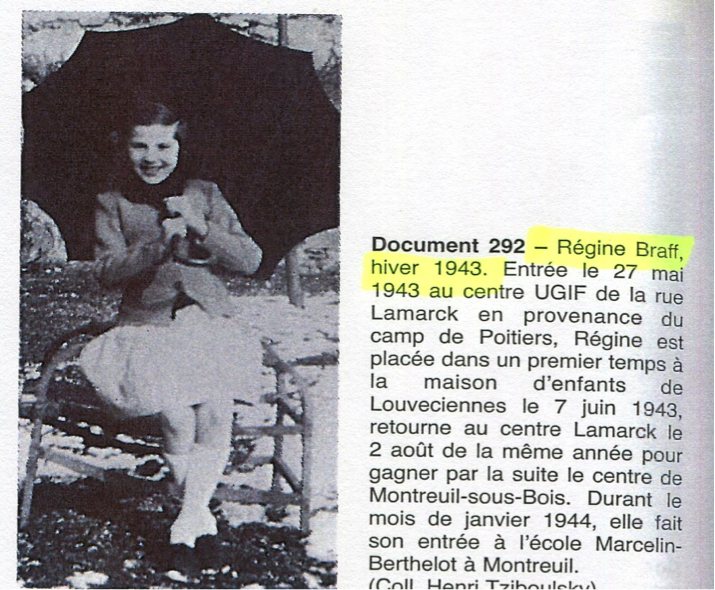
Photo from the Henri Tziboulsky collection. Taken from Jean Laloum’s book, “Les Juifs dans la banlieue parisienne des années 20 aux années 50” (The Jews in the suburban Paris from the 1920s to the 1950s)
July 21, 1944
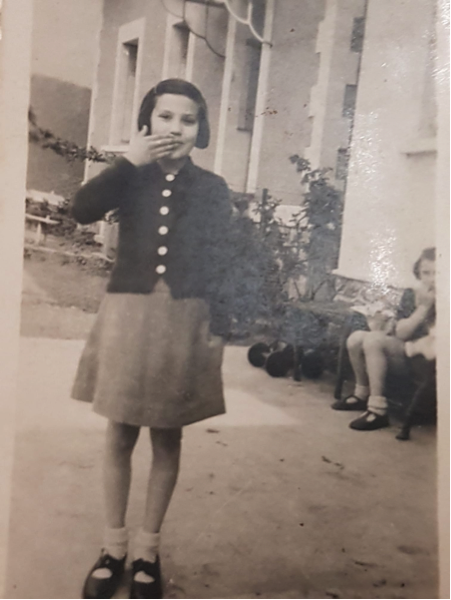
Régine Braff, Date and place unknown ©Family archives.
On July 21, the commandant of Drancy camp, SS officer Alois Brunner, issued orders for all the children staying in the U.G.I.F. children’s homes in and around Paris to be arrested.
In Montreuil, although the supervisors having been trained on how to help the children escape through a little door at the bottom of the garden in case of a roundup, and the children had practiced the evacuation drill many times, it proved to be of little help: 18 children and 4 supervisors were arrested and transferred to Drancy camp. Régine, who was 10 ½ years old by then, was among them.
July 31, 1944: from Bobigny station to Auschwitz
On July 25, the Germans decided that the next convoy from Drancy would leave on Monday, July 31.
On the morning of July 31, 1944, the internees were loaded onto buses and taken from Drancy camp to Bobigny train station. From there, the transport, which later became known as Convoy 77, set off for Auschwitz. There were 1,306 people on board, the youngest of whom was a two-week-old baby boy named Alain, who had been born in the camp
Régine, along with most of the other children who were rounded up in the U.G.I.F. shelters, was among the 836 deportees who were taken to the gas chambers and murdered as soon as the convoy arrived in Auschwitz, during the night of August 3-4, 1944.
Of the 70 children who left Poitiers on May 26, 1943, together with Régine, 43 were aboard Convoy 77, destined for the Auschwitz crematoria. Some other Jewish children from Metz were among them, including Cécile and Simon Dembicer, Rachel Eisenberg, Charlotte Schuhmann, Annette and Nathan Szklarz, the Tabak brothers, and the Wiertzniak sisters. Please take a moment to read their biographies too.
This biography was written by the 9th grade Defense Class at Thomas Pesquet Middle School in Castres, in the Tarn department of France during the 2024–2025 school year and expanded upon based on research by Jean-Philippe Audouy, their history and geography teacher. We would like to thank Bruno Mandaroux for his invaluable assistance.
We would also like to extend our heartfelt thanks to Ryfka Braff’s family: Déborah Meyer and her parents, Marco and Michèle Braff, for their support, assistance, and much-appreciated friendship.
This “Convoy 77” project was inspired by a seminar for French teachers on Holocaust education held at the International School at Yad Vashem in Jerusalem.
Coralie Rouquette, French teacher
Jean-Philippe Audouy, History and Geography teacher
Notes & references
[1] Metz municipal archives, ref. 1 ED 87
[2] The French newspaper Le Lorrain, dated May 25, 1929, “civil status” section.
[3] Deux-Sèvres and Vienne departmental archives, ref. 109 W 314 et 311.
[4] Jean Daltroff, “La communauté israélite de Metz et sa synagogue (1848-1950)” (“The Jewish Community of Metz and Its Synagogue (1848–1950)”, in Cahiers lorrains, n°2, June 2001.
[5] In 1936, 4,200 people registered themselves as Jewish in Metz, 2,500 of whom were foreigners or stateless persons, according to Jacques Walter’s “Antisémitisme et bataille médiatique à Metz (1938-1939) : de La Rafale à La Tempête en passant par L’Alerte” (“Antisemitism and the Media Battle in Metz (1938–1939): From The Gust to The Hurricane via The Alert,”( published in Approaches politiques et culturelles de la France et de la Lorraine (Political and Cultural Perspectives on France and Lorraine). Essays in Honor of Jean ElGammal/ edited by Jérôme Pozzi, Published by the University of Lorraine, 2024.
[6] Vienne departmental archives, ref. 109 W 314.
[7] Vienne departmental archives, ref. 109 W311 et 314.
[9] Deux-Sèvres and Vienne departmental archives, ref. 109 W 53.
[10] Paul Lévy’s “Être juif sous l’Occupation: le rabbin Elie Bloch” (“Being a Jew during the Occupation: Rabbi Elie Bloch”), page 222, published by Geste, 1999.
[11] U.G.I.F. records collection, CDXI-180, Letter from the Social Welfare Office, U.G.I.F. office in Périgueux, dated September 23, 1943, to the Internment Services in Paris, held at the Shoah Memorial in Paris. His wife, Malka, was Sara’s sister. He was therefore Sara and Abraham’s brother-in-law.
[12] Jewish children had to be placed with Jewish families, which were becoming increasingly few and far between due to ongoing arrests and deportations. A few Catholic families, through Father Fleury, also decided to take the risk of hiding Jewish children.
[13] Goldman was the maiden name of Sara’s mother and Eva and Rifka’s grandmother. Were they from the same family, or is this just a coincidence? The couple, who were in their 40s, came from Czechoslovakia.
[14] Vienne departmental archives, ref. 109 W4 p 110 and 109W5 and 53.
[15] Deux-Sèvres and Vienne departmental archives, ref. 109 W 5 and 53.
[16] Deux-Sèvres and Vienne departmental archives, ref. 104W38.
[17] Paul Lévy, “La tragique odyssée des enfants de Poitiers” (The Tragic Odyssey of the Children from Poitiers), French Center for Contemporary Jewish documentation, n°156, 1996. https://shs.cairn.info
[18] Another transfer of children and adolescents took place in August 1943.
[19] See her biography on this website.
[20] Jean Laloum, Les Juifs dans la banlieue parisienne des années 20 aux années 50, Paris, CNRS Éditions, 1998.


