Français
 Polski
Berthe GOLDFARB (1910-1944)
This is biography of Berthe Goldfarb. We opted to blend fiction with reality in order to make our work more accessible to students. We simply could not bring ourselves to stick to facts alone…
My name was Berthe Goldfarb
“It’s nighttime. There’s barely any light at all filtering through the little windows with metal bars, high up in the wall. It’s nighttime, and I’m terrified.
My name is Berthe. Berthe Goldfarb. Goldfarb is my married name: my maiden name was Berthe Perkan.
I’m only in here because I’m Jewish. I’ve never done anyone any harm. I’ve never done anything wrong. I’m not dangerous or violent, and I’ve always obeyed the law. But… I’m Jewish.
I never expected to amount to much in life. I had a fairly quiet, happy childhood. That was thanks to my parents, who fled the pogroms in Odessa in what was then Russia (but is now in Ukraine). I have six brothers and sisters: Rebecca, Samuel-Roger, Charles, Raymond, Abraham, and Sophie. I would have had eight if Bernard and Rosalie hadn’t died when they were babies. The two oldest, Rebecca and Samuel-Roger, were born in Odessa.
Then came the pogroms, in particular the one in 1905, which is what prompted my parents to leave Russia. They came to seek refuge in Paris, France, which is where I was born in 1910. According to the 1936 census, my father was a second-hand goods dealer.
My parents even became French citizens in 1923. That means I’m French, too, because I was born in our adopted country. Although these days, our adopted country hates us.
The one day Maurice came along. He made hats and clothes and sold them on the markets. He was handsome. Very handsome. Of course, I ended up falling in love with him, and we got married in 1934. It was one of the best days of my life—I was so happy. We had a Jewish wedding ceremony in the synagogue on Rue Notre-Dame-de-Nazareth, in the 3rd district of Paris on Sunday, January 24. It was a long way from where we lived in the 18th district. But it’s such a beautiful synagogue! We set up home at 54 bis Rue Ordener, in the 18th district, in the neighborhood near the Porte de Clignancourt, which was home to a large number of Jews who had fled Russia.
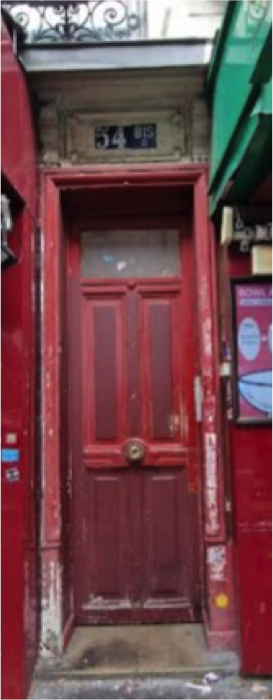
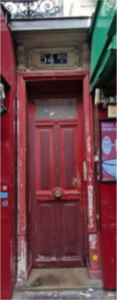
The front entrance of 54 bis rue Ordener, in the 18th district of Paris.
Our own photo
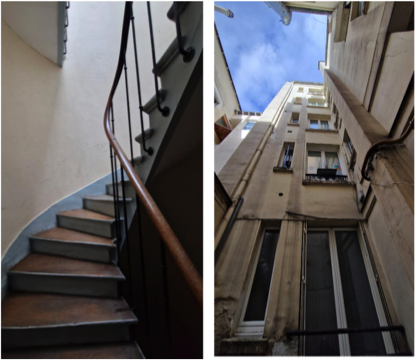
The interior staircase and courtyard at 54 bis Rue Ordener, in the 18th district of Paris
Our own photo
And then we had children. Georges came first, in 1935, followed by Claude, in 1938.
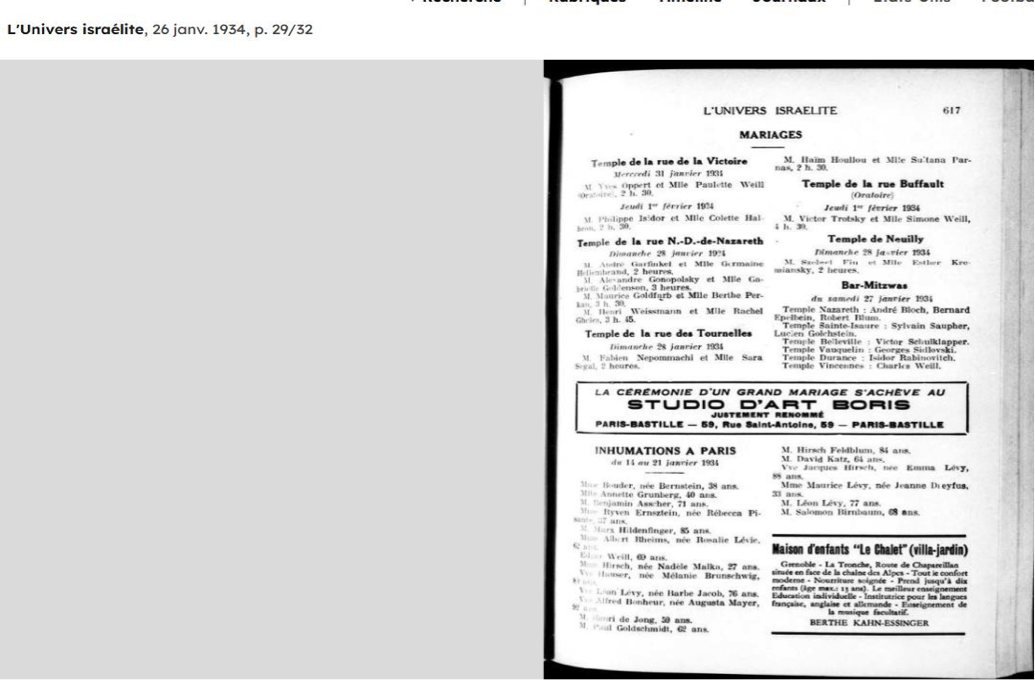
Maurice and Berthe’s wedding announcement, dated January 26, 1934
The boys went to the school on rue Ferdinand-Flocon: Georges started in spring 1939, just before the war began, and Claude in 1942.
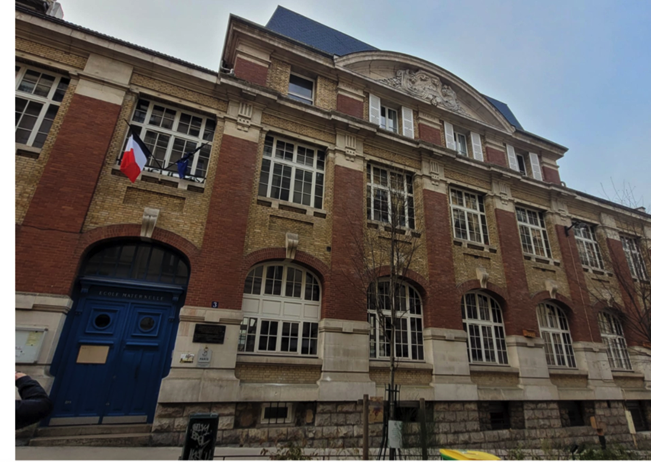
The nursery school and elementary school on rue Ferdinand-Flocon, in the 18th district of Paris
Our own photo
I had always wanted a daughter, and at last my wish came true. Hélène was born in 1940. She’s just so cute, with her pretty little curls and mischievous eyes. I couldn’t enroll her in school like the boys because on April 21, 1944, the Allies bombed our neighborhood, so the school had to close down.
Children often play in the little courtyard in our apartment building after school. When it gets very hot in the summer, they like splashing around in the fountain at the end of the courtyard.
She’s here with me now, my little girl. I can feel her hands gripping my legs. I can tell she’s wondering what’s happening to us. She doesn’t understand what we’re doing here in this dimly lit train car.
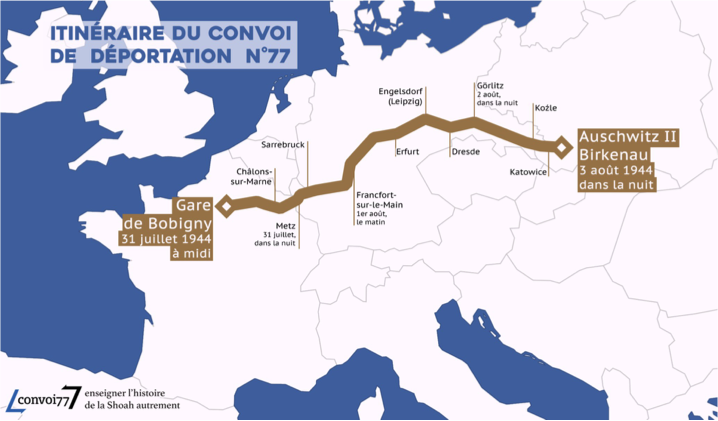
It’s hot. Unbearably hot. Some of the old folks are already sitting down and starting to feel weak. And we only left Drancy yesterday. Everyone is wondering the same thing: where are they taking us?
Despite the intense heat, I feel cold. Cold and shivery. But I’m trying to hide it from Hélène; I don’t want her to be afraid. I’ve put my hands over her had like a bridge, so she won’t be crushed by the passengers swaying back and forth with the movement of the train.
A cattle car. They loaded us into a filthy cattle car, as if we were nothing but animals, or something worth even less than animals. I know Hélène is trying to hold it in, and so am I, but at some point we’ll have to relieve ourselves right here, in the middle of all these people. Is this what happens to the animals? I’m really not sure.
The train stops from time to time, and then folks peek out of the little opening at the very top of the car. As for me, I don’t dare move – I’m too afraid that Hélène and I will lose our spot. But when people catch a glimpse of the names of the stations, they call them out: first Châlons, then Metz, and now here we are in Saarbrücken, in Germany. How far east are they going to take us?
Hélène and I were arrested in early July. July 6, to be exact. I thought we had taken all the necessary precautions when we set out that night, but apparently not. We were on our way home from the washhouse. There was an air raid warning at the time. The police came up to us and asked for our identity papers. I was wearing my yellow star on my chest and my ID card was stamped with the word “Jew”, so of course, they took us straight to the police station. After that they turned us over to the German military police. We arrived at the Paris Police Headquarters depot at 11:30 p.m.. Two or three other people wearing yellow stars were handed over to the French police at the same time. When we first arrived, were held alongside thieves, criminals, and men and women brought in by the “Mondaine,” the vice squad…
Claude and Georges were not with us, fortunately. After their father disappeared, I sent them away to live in hiding.
At 3 p.m. the following day, a French policeman took Hélène and I, along with some other folks wearing yellow stars, to Drancy camp.
La Cité de la Muette is a huge unfinished housing complex north of Paris. I remember the noise and the overcrowding. When they searched us, they took every last cent I had on me: just 91 francs. We were assigned to room 3 on staircase 19, then they just left us there to rot.
Hélène asked me why the police arrested us. I didn’t know what to tell her; I couldn’t bring myself to tell her that the only thing we were accused of was following our religion. She doesn’t even understand what a religion is yet. She’s just a child. She isn’t even old enough to start school, and yet she’s been held in police custody. Oh, the irony!
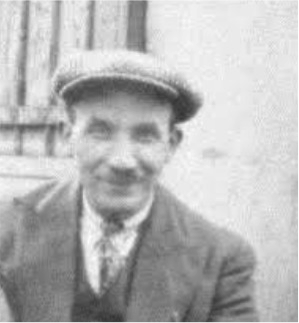
Moschek Goldfarb.
Source: Family archives
I decided to tell her that the police had some news about her father. Maurice was arrested. It was a long time ago, on August 20, 1941. It feels like an eternity. There was a huge roundup in eastern Paris, but they only arrested men that time. Hélène had just started walking. I knocked on so many doors trying to find out whatever I could I could by any means possible. I finally managed to find out what happened from Sarah Goldfarb, Moschek’s wife. Sarah knows Maurice’s mother, Feidja Markowsky.
Moschek Goldfarb was rounded up at the same time as my Maurice. His daughter, Madeleine, saw it all happen. He was so terrified that he locked himself in the bathroom. Sarah sent Madeleine upstairs so she wouldn’t see the police taking her father away. The took him to Drancy. Moschek wrote to Sarah from time to time, and told her all about the living conditions in the camp. They were appalling, far worse than they are now, although they’re still nowhere near acceptable.
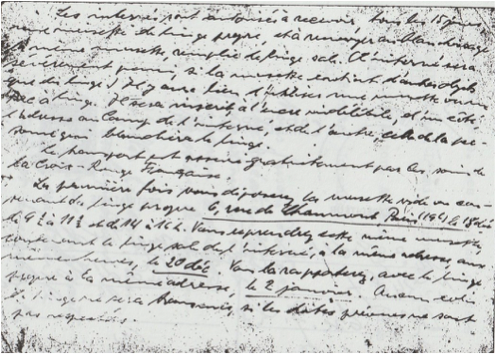
A letter from Moschek Goldfarb to his wife Sarah, written in Drancy camp.
Source: family archives
It was thanks to Sarah that I found out that Maurice had also been taken to Drancy, and then, on April 29, 1942, transferred to the Royallieu camp in Compiègne. The last time I heard from him was June 4, 1942. Nothing since then. The silence has dragged on for two years now—it seems endless. I’ve no idea what has become of him.
Anyway, I told Hélène that the police were helping us find him. That seemed to reassure her. I envy her for being so naive.
But I know. I know we’re headed to wherever they took him, and I know that once we get there, to that faraway place out east, he won’t be there. It’s been three years since they took him away from me. Three whole years. That’s far too long for anyone to survive there, in “Pitchipoï,” as the children call it. Why? Because Pitchipoï, or “Pétaouchnok”, isn’t just some out-of-the-way place. No, some say that Pitchipoï means camps where prisoners are forced to work. Rumor has it that the work is so hard that no one survives more than three months. If that’s true, then I’ll never see Maurice again. I’m devastated, but I take comfort in knowing that at least I’ll be able to weep at his grave and mourn him properly.
I can’t help wondering though… If Pitchipoï is a forced labor camp, what are they going to do with Hélène? She’s not even four yet. I can’t imagine what kind of work she’ll be able to do there…
Perhaps there are kindergartens, to keep the little ones occupied while their parents are working. I do hope so. Then again, given the aggressive behavior of some of the police officers and those German soldiers with their dogs; and these travelling conditions; not to mention the rumors going around in Drancy and here in this cattle car—I don’t hold out much hope. I can’t bring myself to believe that what they’re saying is true.
It’s the morning of our second day on this train and it’s a little cooler today. We’re getting even closer to Poland. We’ve just left Görlitz. The rumors are running wild now. They say we’re headed for Poland!
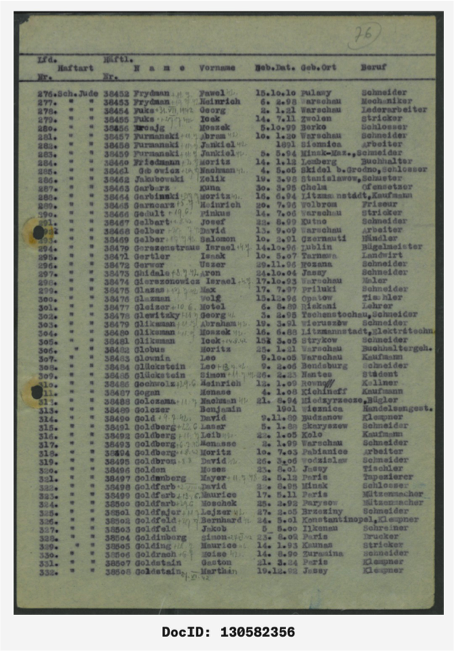
Excerpt from the deportation list, including the names of Moschek Goldfarb and Maurice Goldfarb. © International Tracing Service, Bad Arolsen.
I’m frightened now. Not for me. No, I’m afraid for Hélène. I’m afraid she’ll never have the chance to grow up. I’m afraid she’ll never experience falling in love, never have her heart broken, and never know the joy of having a child of her own. I’m afraid for Claude and Georges. What will become of them without their mother and father?
We arrived a short while ago. The soldiers shouted at us and they made us all line up. It was dark, and the lights were so bright, we were dazzled. I held on tight to Hélène’s hand. Then they made us walk to the end of the railroad tracks. We had to go into a big building and down into a changing room in the basement. I was so embarrassed getting undressed in front of Hélène and all those people I didn’t know. Then we came into this enormous room with no windows. We’re supposed to take our shower, but there’s no water. No, but there’s a faint smell of bitter almonds that’s catching my throat. They lied to us… These aren’t normal showers! I lift up Hélène and hold her close. I’m going to die. We’re both going to die. Just like Maurice, just like Moschek, just like all these other folk trapped in here with us. Simply because we’re Jewish. And I’m afraid for this world of ours, this world gone mad.”
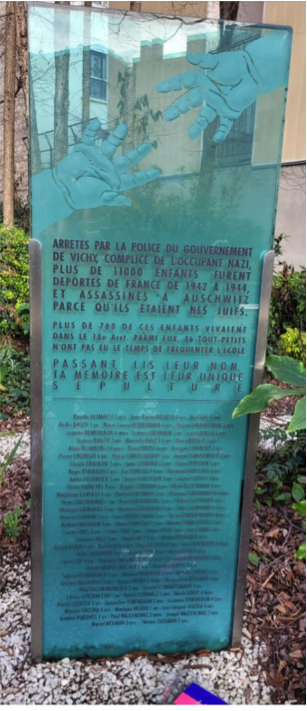
Memorial dedicated to deported Jewish children, Square Serpolet, 18th district of Paris
Hélène Goldfarb ‘s name is inscribed on it. Our own photo.
SOURCES
- Paris civil register (birth, marriage and death certificates)
- French Ministry of Defense Historical Service archives (files on Berthe and Hélène Goldfarb)
- French National Archives, naturalization decrees
- Shoah Memorial archives
- International Tracing Service, Arolsen archives, Bad Arolsen, Germany
- Family archives and oral testimonies given by Moschek’s descendants
- Our own photos, taken during our field trip to Paris in February 2026
The students and their teacher would like to extend their heartfelt thanks to Berthe and Hélène’s family, who kindly granted us access to their family archives and shared their invaluable insights..