

 Français
 Polski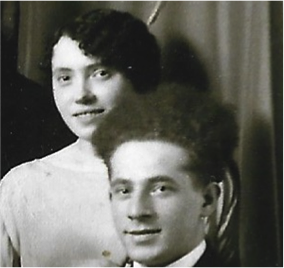
Esther REGENMAN, née FREIMOWITZ (1909-1944)
A photograph believed to be of Esther Regenman (née Freimowitz) and her husband Chaim at Blanche Regenman and David Ways’ wedding.
From personal archives belonging to Laurence Benbassat, a descendant of Chaim’s brother, Isaac Israel Regenman.
Esther Regenman, née Freimowitz, was born on March 11, 1909, and was the mother of one son. She was deported on Convoy 77: here is her story.
The history of Convoy 77
Convoy 77, which left France on July 31, 1944, was the last large transport of Jews to leave Drancy internment camp, north of Paris. It departed from the nearby Bobigny station bound for the Auschwitz-II-Birkenau killing center.
The Allies had landed in Normandy on June 6, 1944, and were advancing toward Paris, which was a major strategic objective in regaining control of mainland France. The Nazi regime had been shaken by a series of military setbacks in both Western and Eastern Europe, particularly following the Soviet Union’s massive “Operation Bagration”, which began on June 22. On July 20, Hitler was the target of an assassination attempt (“Operation Valkyrie”), followed by an attempted coup. As a result, a number of high-ranking Nazis who were believed to have betrayed the Reich were arrested. This was followed by a major purge at every level of the hierarchy responsible for implementing the “Final Solution to the Jewish Question.” These events had a major impact on the deportation of Jews. When the Nazis realized that they would be unable to win the war against the Allies, they decided to focus on their vision of racial utopia through stepping up and trying to win the “war against the Jews.”
SS officer Aloïs Brunner, the commandant of Drancy camp, took advantage of the confusion to continue and intensify his murderous frenzy. With this in mind, he focused particularly on deporting the children who were staying in homes run by the U.G.I.F. (Union Générale des Israélites de France, or General Union of French Jews) in and around Paris. Many of the staff and supervisors were also arrested. These roundups condemned hundreds of children, many of whom were only a few years old, to death[1]. Sadly, this is one of the defining features of Convoy 77.
Around half of the victims rounded up in Paris, Lyon, and Saint-Mandé – in France, the so-called land of human rights – were foreigners (Polish, Romanian, Turkish, Greek, Bulgarian, German, Russian, Czech, Egyptian, and other nationalities) and the other half were French. They were taken to Drancy camp north of Paris, where they were interned before being deported to Auschwitz-Birkenau.
Living conditions in the camp were incredibly tough for the children—the overcrowding, the deprivation, the violence, and the waiting; endless waiting. What would the Germans do with all these unfortunate people? And what would become of all the children?
On July 31, 1944, Convoy 77 set off from Drancy transit camp to Bobigny station, where the 1,306 victims were loaded into cattle cars bound for the Auschwitz-Birkenau extermination camp. After a harrowing journey that lasted three days and three nights, they eventually reached their final destination.
Convoy 77 pulled into Auschwitz, in Poland, during the night of August 3-4, 1944. The deportees had no idea what was happening; some even thought they had arrived in Germany and would soon be reunited with their families.
After being hastily herded out of the train amid a cacophony of orders shouted in German, dogs barking, and with SS guards raining blows down on them, the deportees who had survived the journey were made to line up on the platform, known as the ramp, blinded by searchlights. They could barely see and had no idea where they were. There was an acrid, unbearable stench. It was coming from the camp crematorium, where the bodies of some Roma families, who had been interned in the camp and executed the previous day, August 2, were being burned.
The SS lined up the men on one side and the women and children on the other. Next came the “selection”, during which SS officers and doctors divided the deportees into those who were deemed “fit for work” and those who were “unfit” (older adults, people who were sick or disabled, children, and mothers). The first group were sent into the concentration camp, where they were registered, shaved, shorn and tattooed; from that moment on, they became slave laborers for the Nazis. A few of managed to survive. The other group, unaware of what awaited them, were sent to the gas chambers just a few hundred yards from where they got off the train. The children, apart from a few who looked older than their years, were all sent straight to their deaths in the gas chambers.
The French authorities later declared that the 847 deportees who were not taken into the camp, and who therefore must have died during the journey or been killed soon after they arrived in Auschwitz, died on August 5, 1944. In reality, the vast majority of them, who the Germans considered “unfit” or “useless” (depending on the camp’s and the kommandos’ need for slave labor), were murdered during the night of August 3-4.
Beginning on May 9, 1945, the 251 deportees who had managed to survive the forced labor, abuse, medical experiments, and starvation were at last repatriated to France. However, there was no trace of Esther Regenman, a 35-year-old French Jewish woman, among the survivors. We therefore began an investigation to try to piece together as accurately as possible what had happened to her at the hands of the Nazis.
Esther, a young French woman whose life was shattered by persecution
Esther Regenman, whose maiden name was Freimowitz, was born on March 11, 1909, at her parents’ home at 8 Rue Faidherbe in the 11th district of Paris.
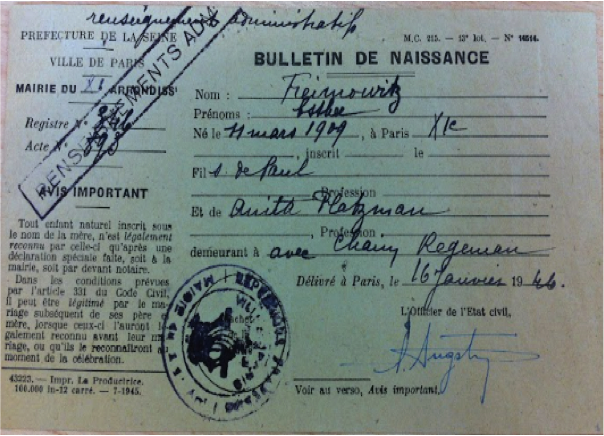
Esther Freimowitz’s birth certificate
File on Esther Regenman © Victims of Contemporary Conflicts Archives Division of the French Ministry of Defense Historical Service, in Caen, dossier no. 21-P-529-845-7
Esther’s parents were Paul Freimowitz, a sculptor born in Jerusalem, Israel, on November 15 1880, who later became a wood sculptor and trader, and Aneta (Anita) Platzman, a seamstress born in Bucharest, Romania, on March 2, 1887. They were married on June 8, 1907, in the town hall of the 11th district of Paris. Anita’s mother, Caroline Lacks, attended the wedding but her father, Neumann Platzman, who was a tailor, did not, as he was in Bucharest at the time. Paul’s mother, Blima, was also there. None of the parents were able to sign their name. Three of the witnesses were cabinetmakers, which hints at the social circles in which Esther’s father moved. They also had a religious wedding ceremony at the Tournelles synagogue in Paris on Sunday, September 1. The couple initially lived on Rue de la Roquette, then moved to 8 Rue Faidherbe in the 11th district of Paris. They subsequently relocated to Neuilly-sur-Seine. Esther was naturalized as a French citizen at the same time as her parents, on November 5, 1927. Paul started a fabric store in Neuilly, but went bankrupt in November 1934. He then moved to 29 rue de Chaligny in the 12th district of Paris.
Esther’s paternal grandparents, Beril/Bur /Bernard (born in Jerusalem, then in the Ottoman Empire, in 1852) and Blima Weinberg (Wumberg) lived in Paris, as did her aunts and uncles, but Esther never knew her grandfather as he died before she was born. In 1926, she lost her aunt Rebecca, and then in 1928, her grandmother Blima. They are both buried in the Jewish section of the Pantin cemetery in Paris.
Esther’s wedding to Chaïm/Charles Regenman
On July 7, 1932, in Neuilly-sur-Seine (in the Hauts-de-Seine department) Esther married Chaïm (later known as Charles) Regenman, who was born on September 17, 1905, in Warsaw, Poland. They then had a religious wedding ceremony at the synagogue in Neuilly on Sunday, July 10.
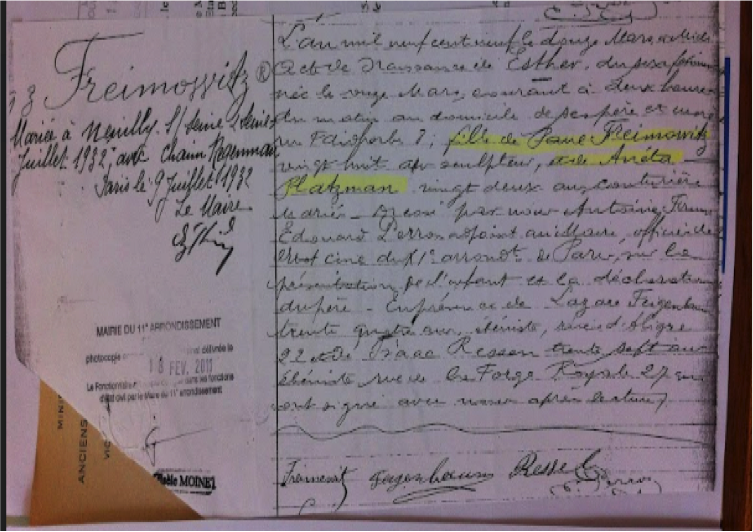
Esther Freimowitz and Charles (Chaïm) Regenman’s marriage certificate.
File on Esther Regenman © Victims of Contemporary Conflicts Archives Division of the French Ministry of Defense Historical Service, in Caen, Dossier n°21-P-269-291-4
We do not know where or how they met. They went on to have one son, Alain Albert, who was born on May 12, 1933, in Courbevoie, in the Hauts-de-Seine department of France.
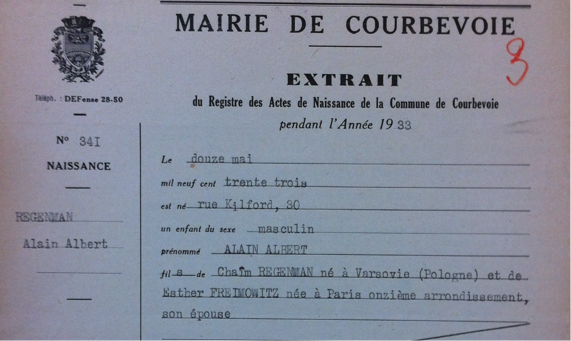
Esther and Chaïm’s son Alain Albert Regenman’s birth certificate,
File on Esther Regenman © Victims of Contemporary Conflicts Archives Division of the French Ministry of Defense Historical Service, in Caen, Dossier n°21-P-529-845-37
Esther’s husband, Chaïm Regenman, was one of eight children. His family members arrived I France one by one.
His father, Abraham, the “patriarch”, was born in Warsaw, Poland in 1862 and died in Paris in 1928, while his mother, Sophie Dua was born in Warsaw in 1865 and died in Paris in 1927. They had four boys and four girls: Fratia, born in Warsaw in 1885, deported from Paris in 1942; Liba, born in Warsaw in 1886, died in Néris-Les-Bains (France) in 1964; Dobrouchka/Debrouchka, born in Warsaw on December 15, 1890, a dressmaker who lived at 36, rue de Belleyme in the 3rd district of Paris. She was arrested, interned in Drancy, where she was assigned the prisoner number 16. 429 and then deported on April 29, 1944 on Convoy 72. She and her husband, Joseph Bernholc, a tailor and furrier born in Siedlitz (now Siedlice) in Poland on April 14, 1889, were deported together. They were most likely murdered as soon as they arrived in Birkenau; Elie, born in Warsaw on December 21, 1893, transferred from Drancy to Compiègne then deported to Auschwitz on Convoy 2 on June 5, 1942; Israël-Isaac known as Itché, born in Warsaw in 1896 and married to Syma Frydman in 1918, with whom he had a daughter, Haya (later known as Hélène), in 1920. Itché arrived in Paris before his wife and daughter. He worked as a seat-maker in the Renault factory. Three years later, he brought his family to join him in France. In 1928, the couple had another daughter, Suzanne. He then ran a Jewish grocery store on Rue des Amandiers in the 20th district of Paris and subsequently bought a larger one nearby on rue d’Avron in 1935. In September 1939, Itché was called up for military service but was discharged in December of the same year on account of his age. The Regenmans were naturalized as French citizens[2] in 1933, but nevertheless, along with all other Jews in France, they fell victim to anti-Jewish persecution as of 1940. This included the “Aryanization” of their business. Then in 1941, the number of roundups increased, which cost the three brothers their freedom and, ultimately, their lives. They managed to flee to the unoccupied “Free Zone” and hid in a convent in Rocamadour until September 1944. By the time they returned to Paris, a police officer was living in their apartment. They got it back ten months later. The couple then returned to their grocery business and went on to become caterers. Itché Regenman died in Paris in 1972. Mosche/Moszek, who was born in Warsaw on February 7, 1898, and lived at 4, rue Louis Bonnet, was deported from Drancy on Convoy 1, as was his younger brother, Chaïm, on March 27, 1942. Blanche, who was born in Warsaw in 1902, married David Ways in Paris and died in Paris in 1971. Lastly, the baby of the family, Chaïm, was born in Warsaw in 1905 and married Esther.
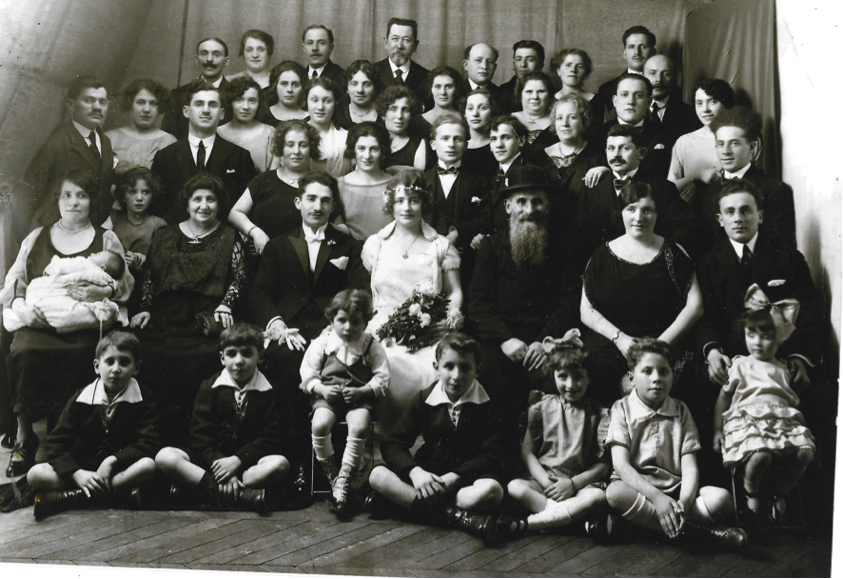
Blanche Regenman and David Ways wedding photo, from Ms. Laurence Benbassat’s personal collection. Abraham Regenman, the “patriarch”, is beside his daughter, Blanche, the bride. Ms. Benbassat recognizes Esther, with her hand on Chaïm’s shoulder, on the top right of the photo.
On October 1, 1938, Esther, Chaïm and Alain moved from 30, rue Kilford in Courbevoie to 24, rue Oberkampf, in the 11th district of Paris.
The war and the roundup that took place on August 20, 1941
Chaïm Regenman, Esther’s husband, was a sales representative.
He lost no time in joining the French army in 1940, not long after the beginning of the war[3]. As soon as he came home, he was caught during a roundup on August 20, 1941. Jewish men in the 11th district were the main target of this operation. A total of 4,232 foreign and French Jewish men were arrested by the Paris municipal police acting on behalf of the Gestapo’s Jewish Affairs Division (Sipo SD). The men, who were all between 18 and 50 years old, were arrested in their homes or on the street. The entire area had been cordoned off since 5:30 a.m.[4], so there was no escape.
Chaïm was arrested and then interned in Drancy camp, where he arrived on August 21,1941 (his brother, Moszek/Moche, may have arrived at the same time). He was assigned to block IV staircase 4, room 8. He was deported to Auschwitz along with 1,111 other unfortunate souls on the first transport of Jews from France. Special train number 767, made up of 3rd class cars, left Le Bourget station near Drancy on March 27, 1942 with 565 men aboard; it made a short stop at the Royallieu camp near Compiègne, where another 547 men were loaded onto the train. Most of them were French Jewish men who had been arrested in Paris during the “roundup of the notables on December 12, 1941. Convoy 1 arrived in Auschwitz on May 9, 1942. Neither Chaïm nor Moszek were among the 19 men who survived after having been deported on this convoy[5].
Esther, a brave mother and dedicated supervisor
After her husband was arrested in 1941, Esther had to raise her son Alain on her own.
Although she had trained as a steno-typist (a person able to transcribe spoken speech in real time using a typewriter-like machine called a stenotype), she worked as an educational supervisor at the Secrétan Center, a shelter run by the UGIF (Union Générale des Israélites de France, or General Union of French Jews).
The UGIF was founded to support the Jewish community in France, in particular to take care of Jewish children whose parents had been deported or who could no longer care for them. Founded at the behest of the Germans, its activities were overseen by the CGQJ (Commissariat General aux Questions juives, or General Commission for Jewish Affairs). This meant that both the staff and the children living in UGIF shelters were effectively under Nazi control.
In 1944, Esther lost her mother, Anéta Platzman-Freimowitz. She was buried in the Pantin cemetery in Paris, in a vault sponsored by a Jewish charity, Le Progrès Mutualiste, although she may not have been a member of the organization. In fact, during the war, in order to bury a Jewish person, people had to prove that they already had a plot reserved at the cemetery. Mutual aid societies therefore provided the UGIF with fake certificates to that effect.
Esther’s arrest
Between July 20 and 24, 1944, Aloïs Brunner orchestrated a series of roundups in the UGIF children’s homes in and around Paris. The children, their supervisors and in some cases the staff were all arrested.
One of these raids took place at dawn on July 22, 1944 at 70 avenue Secrétan, the Lucien-de-Hirsch school and UGIF center in the 19th district of Paris[6]. The school was overcrowded, having taken in more people that it was designed for. In fact, on April 20, 1944, the area where another UGIF home, the Lamarck center, was based had been bombed, and the 125 children and 52 supervisors who were staying there had all been transferred to the Lucien-de-Hirsch center. The SS rounded up the 107 children who were there on July 22, along with their supervisors, including Esther. Her son Alain was not arrested with her. She had no doubt made sure that he was kept hidden somewhere safe.
Drancy
They were all taken to Drancy camp, the “antechamber of Auschwitz” and interned there. Esther was assigned prisoner number 25,446. She was searched on arrival and had to hand over the 198 francs she had on her. She was then sent to a room on the 4th floor on staircase 6[7].
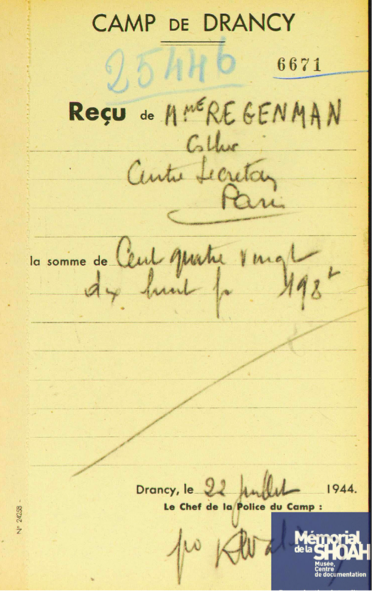
Esther Regenman’s search receipt from Drancy camp, showing her registration number, 25,446
Source: Shoah Memorial, Paris
No doubt, as always, she tried to help and comfort the children in the camp as best she could. The living conditions, which were filthy and unsanitary, and the malnutrition were truly terrible, especially for the little ones. They waited for their turn to set off for “Pitchipoï”, a Yiddish word that means some unknown place far away.
On July 31, 1944, after nine days spent in the hell that was Drancy, 1.306 internees, including 324 children under 16 were taken by bus to the nearby Bobigny station. There, they were herded into cattle cars. It is easy to imagine how Esther cared for the children, including some babies and toddlers, during the unbearable journey (in the sweltering heat, thirsty, hungry, crammed together, in the midst of chaos and corpses…) toward certain death. During the night of August 3–4, the convoy finally arrived at Auschwitz. The selection took place as soon as they got off the train.
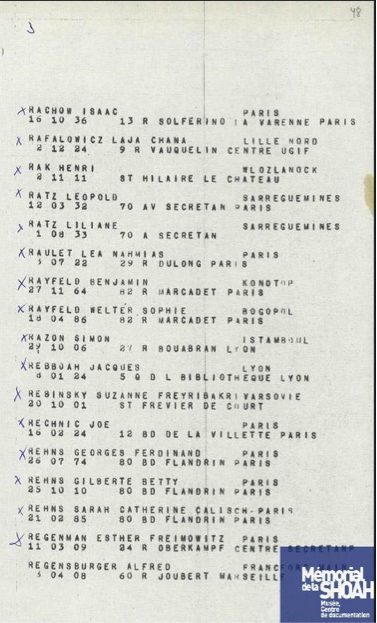
A page from the Convoy 77 deportation list, including the name Esther Regenman. Source: Shoah Memorial, Paris
Esther may have been “selected” to stay in the camp to work, and perhaps to have survived for some time, but we have no way of knowing. She most likely would have wanted to stay with the children and, unknowingly, went with them to the gas chambers, where they were murdered on August 4, 1944. She was just 35 years old.
After the war
When the war finally came to an end, Alain Albert Regenman found himself alone, his mother gone forever. He was 12 years old at the time. He then went to live with his grandfather, Paul Freimowitz, at 56, rue de la Roquette in the 11th district of Paris. A short time later, in shaky handwriting, Paul Freimowitz wrote a statement confirming that his daughter and son-in-law had not come home. He wrote that his daughter had disappeared on July 22. That is also the date listed in official records as the date on which she was arrested.
Paul Freimowitz continued to try to find out what had happened to his daughter, and put out missing person notices. It was all in vain. Esther would never come home. Alain was an orphan. On April 30, 1948, after a Family Council meeting, Alain’s maternal uncle Paul Freimowitz, Esther’s brother, became his legal guardian. The Family Council members included, on his father’s side: Jacques Regenman, his uncle, of 1 bis rue de la Réunion; Bruchla Ways née Regneman, his aunt; Alexandre Nebehole, his cousin, of 96 bd Richard-Lenoir. On the maternal side of the family were: Paul, Esther’s brother; Elise Breitman, his great-aunt, of 24 rue de Ménilmontant; Renée Fischer, his cousin, of 15 rue d’Arcole.
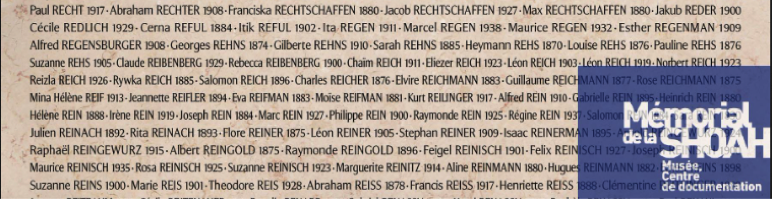
Esther Regenman, who was granted “Political Deportee” status in 1955 and declared to have “Died during deportation” (in 2012), is listed on the Wall of Names at the Shoah Memorial in Paris. Source: Shoah Memorial, Paris
Esther and Chaïm’s only child, Alain Albert Regenman, died at the age of 58 on January 7, 1992 in Bagnolet, in the Seine-Saint-Denis department of France. We have no further information about his life after the war.
Sources:
- L’Univers israélite
- Paris city archives, marriages and deaths
- Généanet, burial records
- Victims of Contemporary Conflicts Archives Division of the French Ministry of Defense Historical Service, in Caen, dossier refs. 21 P 269 291 and 21 P 529 845
- Shoah Memorial, Paris, interment records from Drancy
The story of Esther Regenman (née Freimowitz)’s persecution and extermination was researched and written by Emmie, Fortune, Maia, Lucie, Maël, Margaux, Louna, Loann, Mathilde, Jeanne, and Lia, 12th grade students from classes A and G at the Jacques Cartier high school in Saint-Malo, in the Ille-et-Vilaine department of France, with the guidance of their History and Geography teacher, Stéphane Autret
Our sincere thanks to Ms. Laurence Benbassat for the invaluable information and resources she shared with us, and to Laurence Klejman for reviewing the text and providing additional input.
Notes & references
[3] His brother Isaac Israël was called up in 1939, but due to his age, was demobilized in December of that year. Source: Laurence Benbassat.
[4] https://www.memorialdelashoah.org/20-aout-1941-rafle-de-paris.html
[5] Shoah Memorial, Paris: https://ressources.memorialdelashoah.org. And DLX-V, list from “Convoi de Drancy 27/03/1942”; See also Pierre-Oscar Lévy’s 1991 documentary Premier Convoi, in which 12 of the 30 survivors testify.
[6] The Lucien-de-Hirsch school in Paris was the oldest Jewish school in France. It was founded in 1901.
[7] From her Drancy search record, available at the Shoah Memorial in Paris.


