Français
 Polski
Minna BARGEBOER (1867-1944)
Minna Bargeboer, née Kirchheimer, was a German-born Jewish woman who later became a Dutch citizen. She lived through the horrors of the Second World War and was ultimately arrested in France and deported to Auschwitz, where she died, in 1944. Her story is typical of the tragic fate of countless other Holocaust victims.
Minna was born on October 7, 1867, in Nieheim, in North Rhine-Westphalia, Germany. Her parents were Sandel Kirchheimer (1831–1909), a butcher, and Jetta (Julie Gelle) Grünewald (1839–1922). She had four sisters and four brothers. Only a few of them survived the war.
On May 3, 1893, she married Abraham Bargeboer, in Nieheim, in Germany. He was a cattle dealer who was born on August 9, 1868, in Winschoten, in the Netherlands[1].
Minna and Abraham initially lived in Germany before relocating to France. In 1927, they settled permanently in Nice, on the Cote d’Azur, where they lived peacefully until the Germans occupied the region.
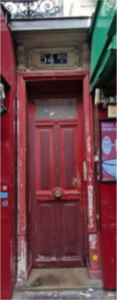
In 1939, when the war broke out, they remained their apartment at 53 Boulevard Victor-Hugo in Nice, but it was not long before they fell victim to Nazi persecution.
On January 23, 1944, the Gestapo stormed into Minna and Abraham Bargeboer’s apartment in Nice and arrested them. They were separated and taken away in two different cars.
According to one account, Abraham Bargeboer attempted to escape on the way to prison but was shot dead in a burst of machine-gun fire. Another version has it that he was found hanged in prison (his death was officially recorded as a suicide, although he may have died as a result of torture[2]). He is buried in the Orry-la-Ville cemetery, in the Oise department in northern France, in a section dedicated to Dutch people who lost their lives in France during the Second World War[3].
Mina, meanwhile, was taken elsewhere, never to be seen again by her her family and friends.
Soon after she was arrested, Minna transferred to Drancy camp, north of Paris, where Jews were interned before they were deported to Auschwitz.
On July 31, 1944, she was loaded onto a transport bound for the Auschwitz-Birkenau concentration camp and killing center. Did she survive the arduous journey (the stifling heat, lack of water, crammed into a cattle car on straw with 59 of her fellow prisoners)? Many elderly or sick people perished along the way. Given her age, 76, even if she was still alive when the convoy arrived at the Auschwitz-Birkenau extermination camp during the night of August 3–4, she would have been sent straight to a waiting truck that took her to her death in the gas chambers. Her body was then burned in the camp crematorium.
Her date of death was later declared to have been August 5, 1944. This was the case for everyone deported on Convoy 77, if there was no further news of them after the war.
The couple’s assets were seized, including a mid-17th-century painting by an anonymous artist of the Dutch school entitled “Boats on a rough sea near a rocky coast,” which is listed in “Box No. 5 of assets seized by agents of the ERR Südfrankreich as part of an operation called Aktion Nizza carried out on the French Riviera” [4], according to th French Ministry of Culture https://pop.culture.gouv.fr/notice/mnr/MNR00645
The description continues: “During the German retreat, the painting was transferred to Kögl Castle as item number 32. On March 15, 1946, it was taken to the Central Collecting Point in Munich, registered under number 21031/2, and issued a Property Card. The painting was returned to France on a convoy from Munich on September 25, 1947, bound for the headquarters of the Art Recovery Commission. During the sixth meeting of the committee for the recovery of artworks on 29 May 1951, the painting was kept until, later that year, the Office of Private Property and Interests assigned it to the Louvre Museum (Paintings Department).
It was held in the French National Collection from 1959 to 1976. It was scheduled to be transferred to the Dieppe Castle Museum in 1980, but in the end was only sent there in June 1983, where it remained until 1989. A new decree was then issued to extend the agreement..
The Commission for the Compensation of Victims of Spoliation recommended that it be returned to its rightful owner on November 4, 2021.
In 2022, Le Quotidien de l’Art (a French art publication) reported that the painting was to be returned to the Bargeboer family.
Notes & references
[1] https://www.jacob-pins.de/?article_id=475&clang=0
[2] Maitron des Fusillés, guillotinés, exécutés, massacrés, 1940-1944 (Register of people shot, guillotined, executed, and massacred, 1940–1944). Maitron website, in French only, here: https://fusilles-40-44.maitron.fr/bargeboer-abraham
[3] Find a Grave website: https://findagrave.com/cemetery/2633839/orry-la-ville-netherlands-field-of-honour
[4] Bundesarchiv (Coblence), BAK B323/562, B323/673, B323/698, B323/314 et B323/624: “Property Card”, on which he owner’s name is misspelled as “Bergebauer” rather than “Bargeboer.” See also the U.S. archives: www.fold3.com/image/293340618 and AN AJ/38/1323: Records relating to the economic “Aryanization” of the Nice region, sorted by address; AN RF/9/5678: Drancy camp records; AN AJ/38/3988: Directorate of the CGQJ (French General Commission for Jewish Affairs) for the Nice region archives; AN 19940508/0151: Moscow Collection, French National Security Service archives.