Français
 Polski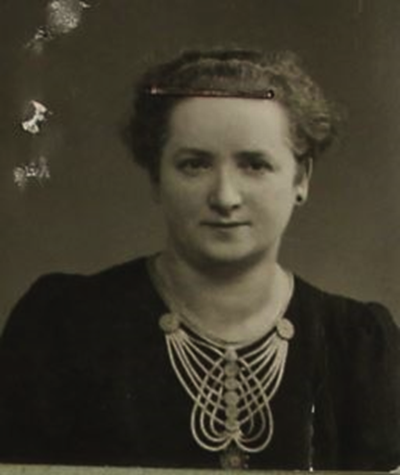
Reghina FLAMM (born Friedmann), 1898-1944
Regina Friedmann Flamm ©SHD Caen 21 P 450 448
A Childhood in the Heart of Maramureș
Regina Friedmann was born on 10 February 1898 into a family deeply rooted in Jewish traditions.
A Hungarian national, she was born in the small village of Copalnic, near Cluj-Napoca in Transylvania, then part of the Austro-Hungarian Empire. After the First World War, the Empire collapsed, and in 1918 Copalnic became part of Romania.
Her father, Mór (or Mauritiu) Friedmann, was a cattle dealer originally from Bükkösfalva (now in Slovakia). Her mother, a housewife, appears in the archives under several different names, including Göbel Záli, Lolti Srobel, and Sröbel Lále. These variations are most likely the result of handwritten civil records and the coexistence of several languages in this part of Central Europe.
Regina’s birth certificate also records the names Rifke Lea, reflecting her Jewish heritage.
These differences remind us that reconstructing a person’s life from historical records often requires comparing documents written in different languages and using different spellings.
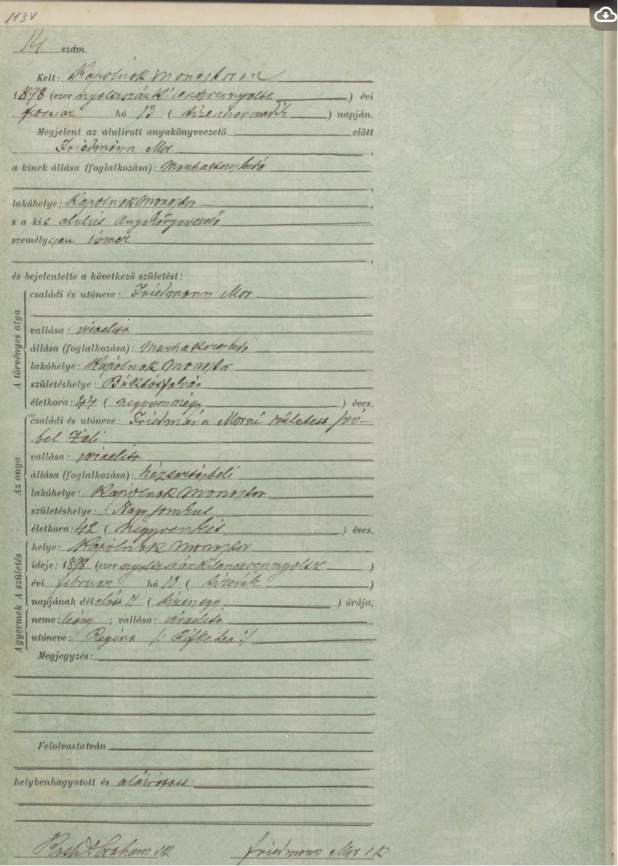
Birth certificate
National Archives of Romania
Why leave Her Homeland for Paris?
The first Jewish families settled in Copalnic-Mănăștur at the beginning of the nineteenth century after arriving from Galicia. The community’s first synagogue was built in 1867. By the 1930 census, around 350 Jews lived there, out of a total population of about 1,200. Most spoke Yiddish as their mother tongue and earned their living through farming, cattle trading, or small businesses.
In 1944, this thriving community was almost completely destroyed. Its members were deported, and most were murdered during the Holocaust. Today, only the old Jewish cemetery bears witness to their presence.
https://www.facebook.com/groups/299090977346058/posts/786516538603497/
The drawing of new borders after the First World War divided Maramureș County between Romania (to the south) and Czechoslovakia (to the north). The division of the county, however, caused a series of difficulties in the lives of the inhabitants, as many of them ran businesses.
The hard life in the villages after the First World War meant that parents preferred their children to help with household chores, despite their schooling.
Those who once were… The image of Jews in Maramureș between the wars, in the journal ‘Vatra Chioreană’, p.17
We do not know why Regina left her homeland for France. Was she hoping for better opportunities? Did she follow relatives who had already settled in Paris? The surviving records do not answer these questions.
At that time, France was home to a large Jewish population from Central and Eastern Europe. By 1940, nearly 300,000 Jews lived in France, about half of whom were foreign nationals, most of them living in the Paris region.
Building a Life in the Shadow of Growing Threats
On 9 September 1939, only a few days after France declared war on Germany, Regina married Ladislas Flamm, who was originally from Hungary. Born on 28 February 1902 in Egyek, he worked in the clothing industry, most likely as a tailor.
Their wedding took place at the town hall of Paris’s 2nd arrondissement, where they were already living.
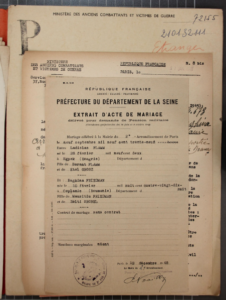
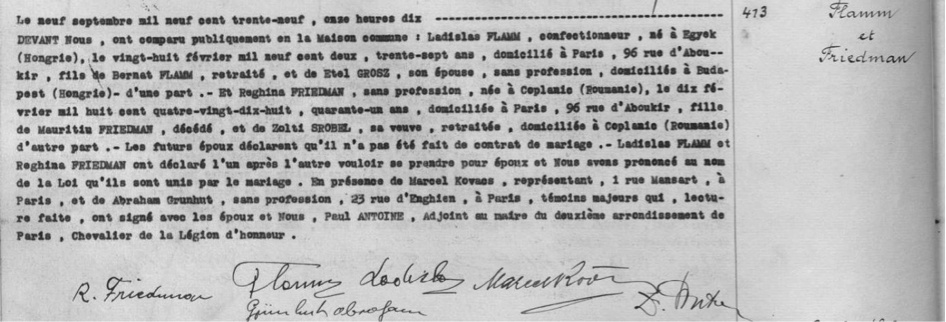
Wedding at the town hall in the 2nd arrondissement © City of Paris Archives
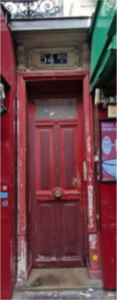
Census records show that by 1936 they were sharing an apartment at 96 Rue d’Aboukir, in the Bonne-Nouvelle district. Regina worked as a seamstress, while Ladislas was employed in the garment trade. They were the only foreign residents in their building.

1936 Paris 2 census, 96 Rue d’Aboukir ©Paris City Archives.
Their marriage certificate reveals that Regina’s father had already died, while her mother was still living in Copalnic.
As part of our research, we wondered about the circumstances surrounding their marriage. Did Ladislas volunteer to serve in the French Army? Did marrying him allow Regina to benefit from the legal status of a soldier’s wife? The available documents do not allow us to answer these questions.
The couple had no children.
From 1940 onwards, their lives changed dramatically. Under the German Occupation, anti-Jewish measures imposed by the German authorities were enforced in France by the Vichy regime. Jews were required to register, their rights were progressively restricted, and arrests became increasingly frequent. In accordance with these measures, Regina and Ladislas were officially registered as foreign Jews.
In 1943, an administrative list still recorded them at Rue d’Aboukir. However, beside Ladislas’s name appears the note “departed without leaving an address.”
Had he gone into hiding to escape persecution? Had the couple separated? Once again, the archives provide no definitive answer.
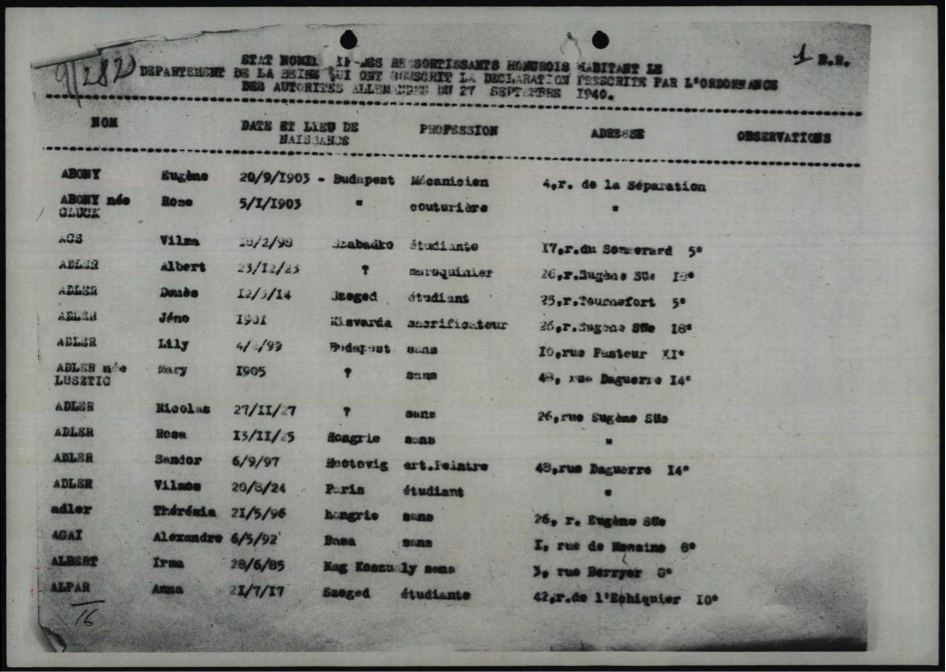
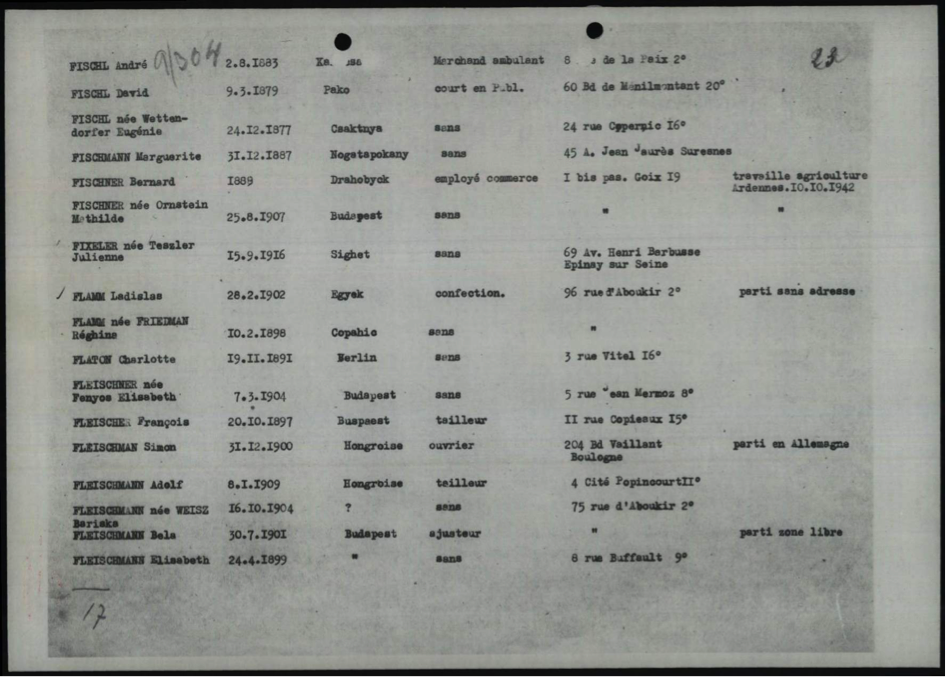
© Bad Arolsen Archives, ITS
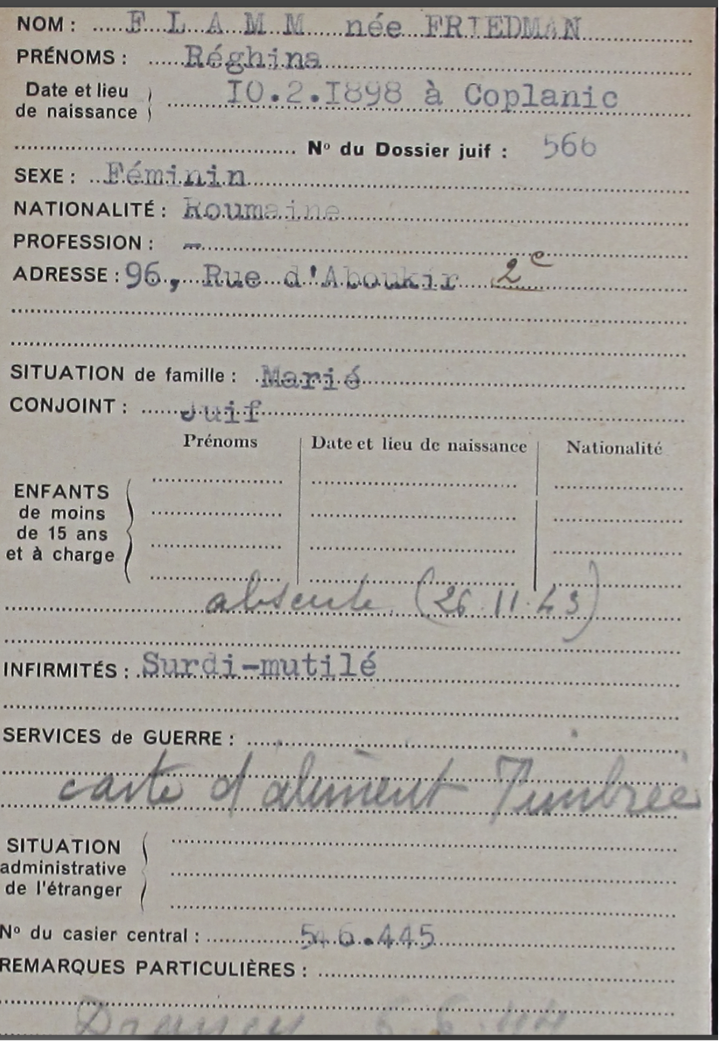
Information sheet from the Prefecture, provided by the National Archives
A record preserved by the Paris Police Prefecture also indicates that Regina was deaf. Although this information appears in very few documents, this likely came with difficulties in oral communication. This disability, already challenging in daily life, may have further increased her vulnerability during the roundups and deportation.
The Last Days of Freedom
In June 1944, Paris was still under German occupation.
Jews lived in constant fear of arrest.
A handwritten note states that Regina was arrested on Rue du Faubourg-Saint-Denis on 6 June 1944. However, the records of the Paris Police Prefecture tell a different story.
They show that she arrived at the Police Headquarters Detention Centre (the Dépôt) in the early hours of 4 June, having most likely been brought there from the police station of the 10th arrondissement.
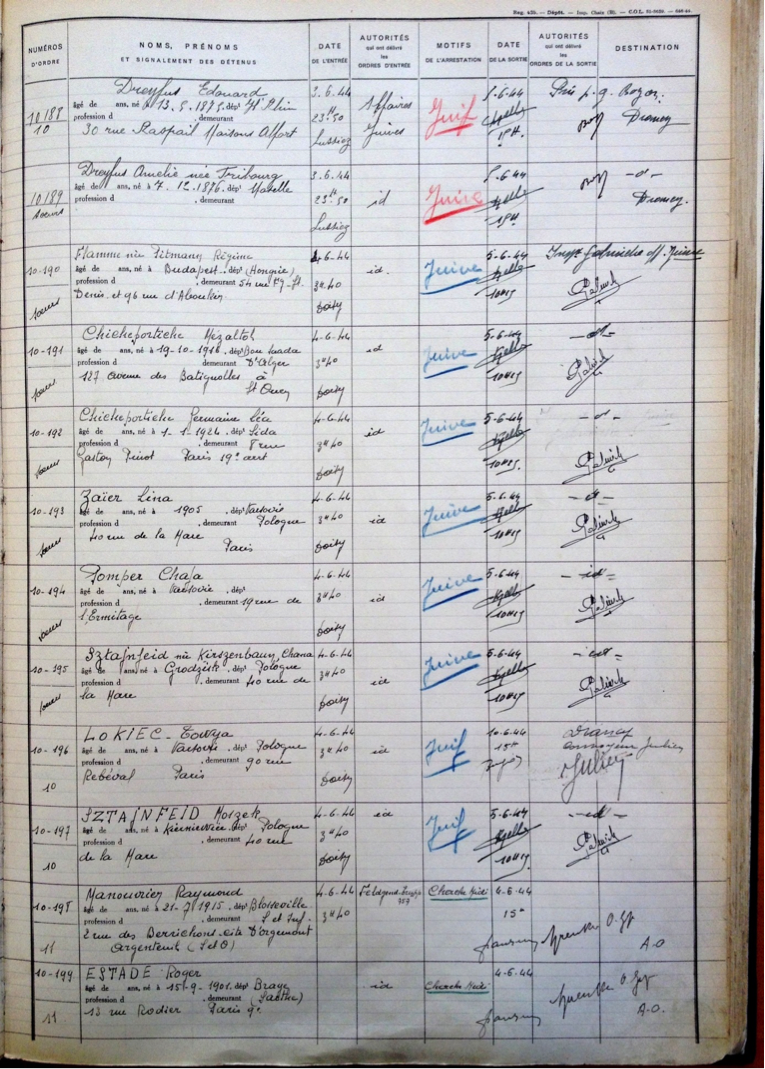
Records of arrivals and departures at the Paris Police Headquarters Detention Centre, 4 June
1944 © APP CC 2
The following morning, she was transferred to the Jewish Affairs Office, before being taken back to the Dépôt later that evening. On 5 June, she was finally transferred, together with several other arrested Jews, to the transit camp of Drancy.
Why was she taken to the Jewish Affairs Office? Was it because she was of Hungarian nationality? The surviving records do not allow us to say with certainty.
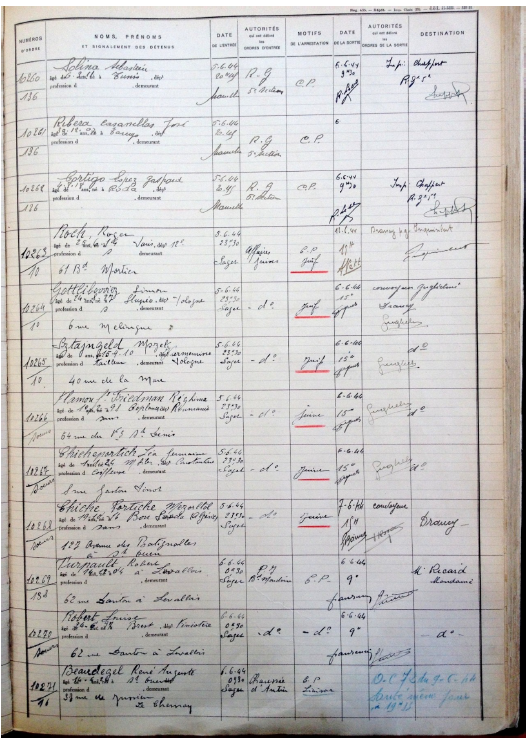
Records of arrivals and departures at the Paris Police Headquarters Detention Centre, 4 June 1944
© APP CC 2
At the time of her arrest, two addresses appear in her file: 96 Rue d’Aboukir and 54 Rue du Faubourg-Saint-Denis.
Was she hiding at this second address? Under the anti-Jewish regulations, Jews were not allowed to change their place of residence without official permission. This question remains unanswered.
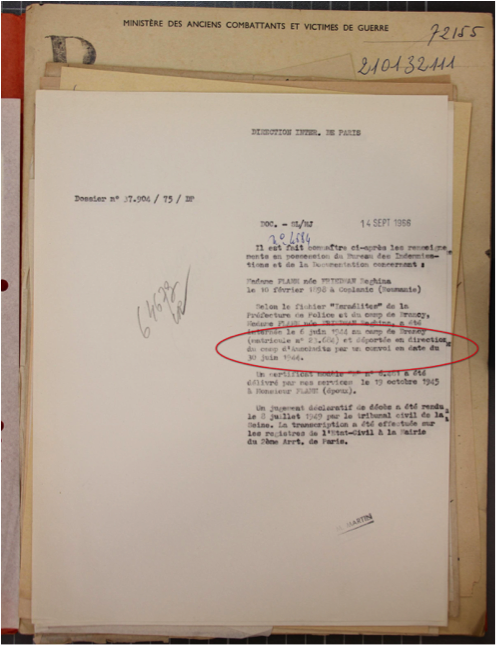
At Drancy, Regina was assigned prisoner number 23,684.
At the time, the Drancy camp was commanded by Aloïs Brunner, an SS officer and close associate of the Nazi party since 1931 and of the SS since 1938. He directed the camp from July 1943 to August 1944. Under his authority, approximately 24,000 Jewish people were deported from Drancy to the Nazi death camps – nearly one third of all Jewish people deported from France. After the war, he evaded justice and found refuge in Syria, where he lived under the protection of the regime until his presumed death around 2010.
Even after the Allied landings in Normandy on 6 June 1944 and the beginning of France’s liberation, the deportations continued. Convoy 77 was one of the last deportation trains to leave France before the Liberation of Paris on 25 August 1944.
Convoy 77: The Journey of No Return
On 31 July 1944, Regina was deported to Auschwitz on Convoy 77. This convoy carried 1,306 deportees, including more than 300 children, and was one of the last major deportation convoys to leave France before the Liberation of Paris.
She arrived at Auschwitz during the night of 3 August 1944.
For many years, however, several administrative records mistakenly associated her with Convoy 76, which had left Drancy on 30 June 1944. This date appears in several documents concerning Regina.
Research carried out by the Convoy 77 Association has since confirmed that she was in fact deported on Convoy 77. This discrepancy is probably linked to the many difficulties encountered when reconstructing administrative records after the war, although no definitive evidence has yet been found to explain it.
At the age of forty-six, Regina had already endured several weeks of imprisonment. Within the Nazi concentration camp system, her age and physical condition greatly reduced her chances of survival. Yet she escaped immediate selection upon arrival and was admitted to the women’s camp at Birkenau.
She was assigned to Block 13. Like the other women imprisoned there, she faced extreme living conditions. Hunger, disease, overcrowding, forced labour, daily violence, and exhaustion became part of her everyday existence.
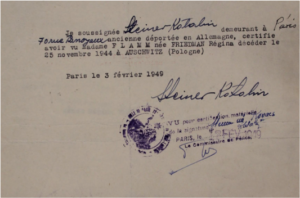
In February 1949, Katalin Steiner, an Auschwitz survivor, testified that she had shared Block 13 with Regina. She stated that Regina died on 25 November 1944, overcome by exhaustion and extreme fatigue. Another survivor, Irène Slukberg (also recorded as Glukzelig), confirmed this testimony.
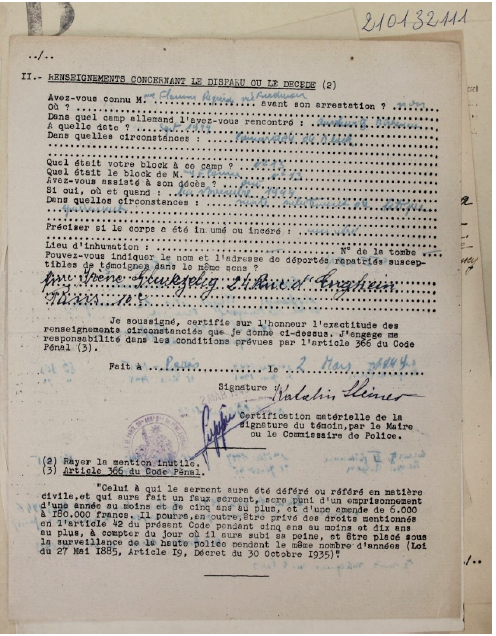
Memory Preserved by the Survivors
After the war, Ladislas Flamm remained in Paris and undertook lengthy legal and administrative procedures to obtain official recognition of his wife’s disappearance and death. We then concluded they were not separated at the time of Regina’s arrest.
Thanks to the records preserved by the French Ministry for Veterans and War Victims, Regina was officially declared dead and was granted the status of political deportee.
The testimonies of survivors such as Katalin Steiner continue to preserve and transmit her story today.
Regina Flamm lived only forty-six years, yet her fate reflects that of thousands of Jews who became victims of the Holocaust. Behind the administrative records and deportation lists emerges the story of a woman whose life was shattered by Nazi persecution and deportation.
Beyond the official archives, it is also the testimony of survivors that restores Regina Flamm to history. Her name also stands for an entire Jewish community in Transylvania that was almost completely destroyed during the Holocaust. Thanks to the documents that have been preserved and to the research carried out this year, her story continues to be told.
Continuing the Search, Keeping the Memory Alive
For many years, Regina Flamm was little more than a name on a list of deportees. As we retraced her life, we discovered a woman born in a small village in Transylvania who became a seamstress in Paris, was arrested because she was Jewish, and was ultimately deported to Auschwitz on Convoy 77.
We also became aware of the limits of our investigation.
We still do not know why she left her homeland, exactly when she arrived in France, whether she was in hiding at the time of her arrest, why Ladislas had left their home, or why some archival records contradict one another.
These uncertainties do not make her story any less important. On the contrary, they remind us that reconstructing the life of a Holocaust victim requires comparing many different sources, accepting that some questions may remain unanswered, and carefully distinguishing established facts from informed hypotheses.
This biography is the result of research carried out by students from France (Collège Le Plantaurel – Cazères), Germany (St-Ursula Realschule – Attendorn), Ukraine (Kamianka School “Intelect” – Zaporizhzhia) and Romania (Colegiul Național Pedagogic – Constantin Brătescu, Constanța) as part of the European eTwinning project – Memory Keepers.
By bringing together archival records preserved in several countries, we sought to restore the identity and life story of a woman whom the Nazis had tried to reduce to nothing more than a number.
Writing Regina’s story today is a reminder that behind every name recorded on a deportation list was a real person—with a family, a profession, hopes for the future, and a life brutally cut short.
As long as her name is read, her story is told, and her memory is passed on, Regina Flamm will not be forgotten.

AUTHENTICATED SOURCES
The information comes from the following sources
- Official and administrative sources
- Convoi77 website
- Arhivele Nationale Ale Romaniei (Romanian National Archive)
- https://arhivelenationale.ro
- Ministre des Anciens Combattants et Victimes de Guerre
- France Archives – Victimes de la répression – Lettre F (AC21P)
- https://francearchives.gouv.fr
- DAVCC Testimony Katalin Steiner
- Yad Vashem data base
- Book of Names (Auschwitz)
- Concentration camp sources
- Bad Arolsen Archives (ITS – International Tracing Service): name and first name under
various spellings (Regina Flamm / Regina Flamm born Friedmann). - List materials Drancy – Auschwitz
- Archives of the Mémorial de la Shoah (Paris)
Notes & references
1. In 1926, according to the Paris census, Ladislas Flamm was living with Alexandre Flamm, born in
Hungary in 1903, at 6 Rue Grégoire de Tours, in the 6th arrondissement. Ladislas was then a ‘fitter
and machinist’ and Alexandre was a chemist. He is a relative (brother?). The building was a hotel
where almost all the guests were Hungarian or Romanian.
In 1931, Ladislas is listed as a ‘friend’ at Ladislas Zabo’s address, not far away at 9 Rue Grégoire de
Tours. They are all listed as students, and they were probably living in a hotel. Almost all the
residents were foreigners, including many Poles, Romanians and Hungarians; see: Archives of the
City of Paris archives.paris.fr/archives-numerisees
2. In dossier SHD – Ministere des Anciens Combattants et Victimes de Guerre, Direction du Contentieux et des Recherches, Bureau des Fichiers et de l` Etat -Civil Déportés, 210132111.