

 Français
 Polski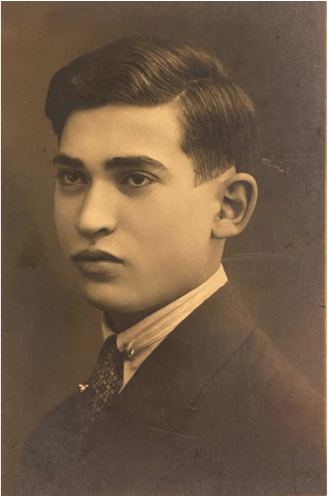
Maurice WAGNER (Paris, France 1910 – 1944, Auschwitz, Pologne)
Photo: Maurice Wagner at the age of 15
Photo belonging to Sylvia Wagner
Maurice Wagner
Birth, childhood and young adulthood (1910-1939)
Maurice Nathan Wagner was born on October 27, 1910 in the maternity ward of the Rothschild hospital at 76, rue de Picpus in the 12th district of Paris. At the time, his parents were living at 12 Rue de la Fontaine-du-But, one of the steepest streets on the hill leading up to Montmartre, in the 18th district of Paris. In 1909, Cirla Wagner, Hirsh’s younger sister, and her husband Léon Tark were living at the same address. Léon is listed as a witness on Maurice’s brother Isidore’s birth certificate. This illustrates the important role the families played in each other’s lives.
His father, Hirsch Leib Wagner, who was 41 years old when Maurice was born, was born in Warsaw, Poland and his mother, Perle Wagner née Safir, who was born in Bucharest, Romania, was 27.
When their eldest son, Isidore, was born on June 1,1909, at 28 rue Hermel, Hirsh and Perle had moved from the Marais neighborhood in central Paris to the 18th district, a working class area that was home to a significant Jewish population. They then living at 28 rue Montcalm, in an apartment building that was demolished sometime prior to 1932.
In 1911, the two brothers, Isidore and Maurice, were staying with the Foucher family in Les Lièvres, near Santranges, in the Cher department of France. It was not unusual in those days to send children to spend time in the countryside to build up their strength, especially if their home environment was less than ideal or if their mother was busy working or had health issues. According to his granddaughter, Jacques, Maurice’s third brother, was also sent to live with a foster family for a time.
The boys went to the local state schools. According to school registers in the Paris online archives, Maurice went to nursery school on Rue Saint-Luc and then to elementary school on Rue Damrémont, both in the 18th district of Paris. We know from his brother Jacques’ birth certificate, dated 1915, that the family was then living at 159 rue Marcadet. His two brothers, Isidore and Jacques, are also listed in the school registers. All three of them left the Damrémont school in 1917. We assume therefor that this was when the family moved to Aulnay-sous-Bois, which was then in the Seine-et-Oise department of France. In 1930, when he was 20 years old, Maurice was living with his parents at 15 avenue Loewel in Aulnay-sous-Bois. According to a registration form filled out when he appeared before the military service board, also in 1930, he worked in a bank.
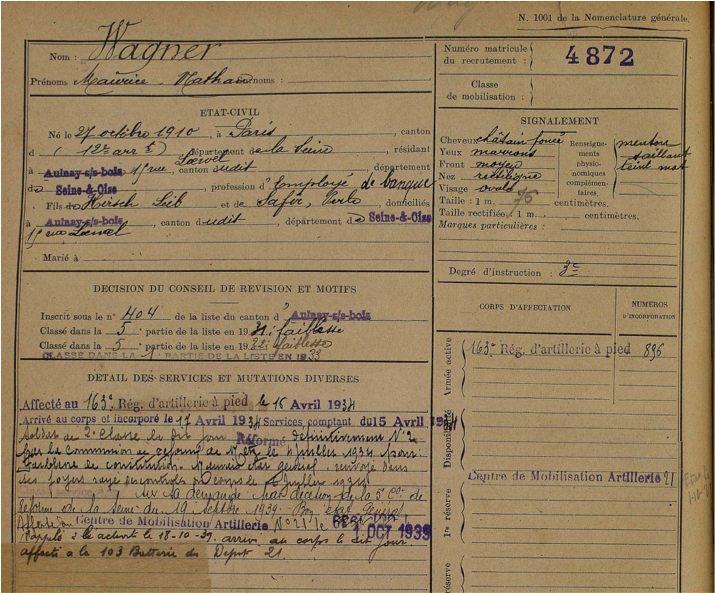
Maurice Nathan Wagner’s military service record, class of 1930 – service number 4872
Yvelines departmental archives
According to the Wagner family’s descendants, the three brothers were very close, in particular Maurice and Isidore (who adopted the name Henri after the war). They often went on vacation, mainly to Arcachon (a seaside town near Bordeaux, in southwestern France), or to spend time in the country, and went skiing in winter. Maurice was therefore raised in a close-knit family. His mother, Perle Safir Wagner, when she asked the authorities if they had any news of him after he was deported, described him as “slim, with a dull complexion, brown hair, and brown eyes.” His military service record, meanwhile, says that he had: “a prominent chin,” “an average forehead,” “an oval face,” and “a straight nose.” In 1934, he was 5’10” tall.
In 1930, when Maurice was 20 years old, he had to appear before the military service review board of the 6th office of the Seine department. According to his military record, his educational attainment was rated at “level 3” (the highest). It also states that Maurice was of “weak constitution” and in “poor overall condition.” He was “sent home and crossed off the draft list on July 6, 1931.”
On April 16, 1934, after several other review board appearances during which his military service was postponed due to “poor health,” he was finally assigned to the 163rd Foot Artillery Regiment. He reported for duty on April 17, but was permanently discharged on July 4, 1934, by the military service discharge board in Metz. He then returned home. However, as the war had just begun, he was reinstated “at his own request” on September 19, 1939. This time, he was reported to be in “good general health.” Based on his military record, along with a statement from the owner of the building, we know that in 1939, Maurice and his family moved into an apartment overlooking the street at 135 Rue Ordener in the 18th district of Paris.
The early days of the war (1939-1940)
Maurice was called up on October 18, 1939, to serve in the 21st Artillery Division in Charenton-le-Pont (then in the Seine department, now in Val-de-Marne), in the 103rd Battery, depot 21. His military recruitment office was in Versailles, west of Paris. His service number was 4872, and was a “servant.” In military terminology, this meant he was assigned to serve in a combined arms unit. He held the rank of private second class. After the signature of the armistice on June 21, 1940, Maurice was demobilized in Grenoble, in the Isère department of France, on July 28, 1940, after which he relocated to Sauvagnat-Sainte-Marthe, in the Puy-de-Dôme department, which was in the “Free Zone” as of June 25, 1940. On his demobilization papers, which his great niece, Natacha Thirard, kindly shared with us, Maurice’s address was still listed as 135 Rue Ordener in the 18th district of Paris.
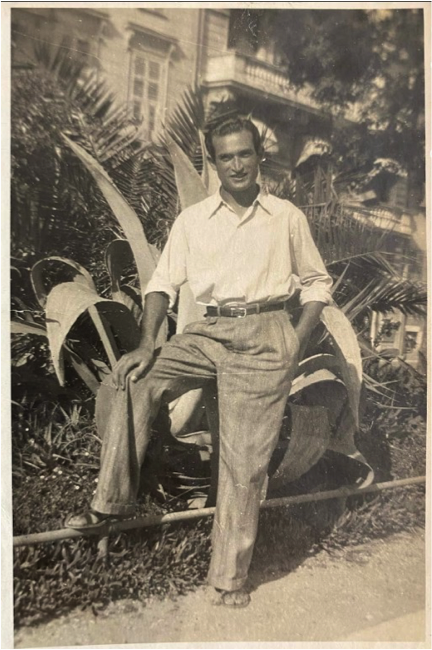
Maurice Wagner, place unknown, 1943
Photo belonging to Natacha Thirard
Although Maurice was demobilized, his brother Isidore, who was a second-class private assigned to the 13th Railway Regiment, is listed on an official prisoner-of-war list published on August 29, 1940, by the National Information Center on Prisoners of War. On June 22, the German army was holding 1,800,000 French prisoners.
As for Jacques, he was wounded twice, awarded a medal, and reportedly escaped from a prisoner-of-war camp in France.
The German Occupation and the Vichy regime
We do not know how Maurice reacted to anti-Semitic legislation, such as the first decree on the “Status of the Jews” which the Vichy regime enacted on October 3, 1940, nor whether he declared himself as a Jew at the local town hall during the compulsory census in the Free Zone, as required by legislation passed on June 2, 1941.
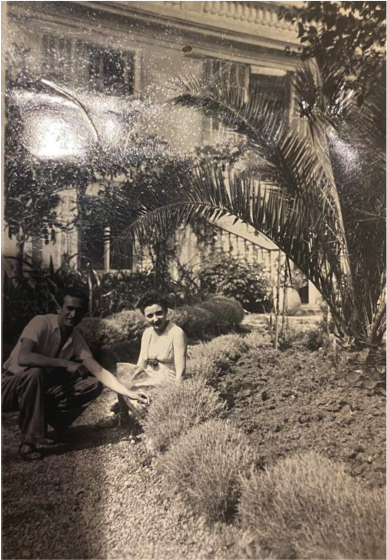
Maurice and Marthe in Cros-de-Cagnes, 1942
Photo belonging to Sylvia Wagner
Maurice’s family kindly sent us some photographs of him, complete with descriptions. In one of them, taken in 1942, is pictured with his sister-in-law Marthe, Isidore’s second wife, in Cagnes-sur-Mer on the French Riviera. At the time, he was living on Chemin des Roses in the Cros neighborhood of Cagnes-sur-Mer, which was still in the unoccupied Free Zone, where life for Jews was easier than for those in Paris and the Occupied Zone in the northern part of France. Maurice was keeping Marthe company, as she was pregnant with his nephew Christian, Isidore (Henri)’s first child, in September 1942. In fact, according to Sylvia Wagner Guez, Isidore (Henri), was in trouble with the police at the time, but it is not known why. It was therefore Maurice who was there when the baby was born and acted as a witness when the birth was registered. We do not know when Isidore was able to return home to his wife and son.
Another photo, taken in 1943, was taken in Bois d’Oingt, in the Beaujolais region, at his brother Isidore’s (Henri) parents-in-law’s house.
We understand that Maurice stayed in a number of different places, including these, after he was demobilized. He also spent some time with his other brother, Jacques, and his wife, Jacqueline, in Saint-Cloud, west of Paris in the Hauts-de-Seine department.
His mother, Perle, later said in a letter that he returned to Paris in August 1943 and stayed there from then on.
Maurice therefore travelled back and forth between various places, which was strictly forbidden for Jews, who were not supposed to leave their homes. He must also have managed to cross the demarcation line several times.
A false identity card
In 1943, according to his identity card, kindly provided by Natacha Wagner, Jacques Wagner’s granddaughter, Maurice was officially registered as living in Mornay-sur-Allier, in the Cher department of France. We contacted the staff at the Mornay-sur-Allier town hall, who told us that Jean-Baptiste Bernadat was mayor of the town between 1943 and 1952. Mr. Bernadat is said to have issued a genuine identity card for Maurice, but with false details. He carried out various acts of resistance during the Occupation and helped a number of other Jews as well as Maurice. Some he helped to cross into the Free Zone, as the town was located on the demarcation line. He is also said to have taken in and cared for a number of Jewish children. Unfortunately, Mr. Bernadat was later forced to reveal everything he knew about the very people he had tried to protect. On his ID card, Maurice is listed as a “agricultural worker,” an unlikely occupation given that he grew up in the city.
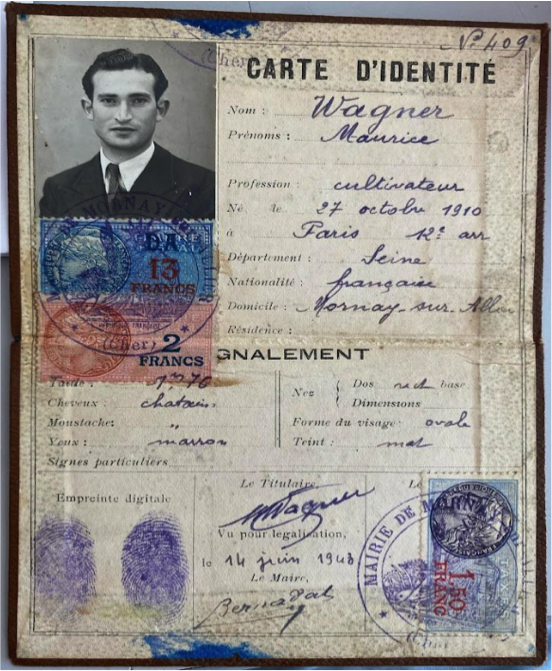
Maurice Wagner’s identity card, issued in June 1943
Document belonging to Natacha Thirard
As for his occupation, according to his military service record, Maurice worked in a bank in 1942; but his false identity card, issued in 1943, states that he was an agricultural worker. In the application his mother submitted in 1952 to have him officially recognized as a Political Deportee, she stated that he was a “stockbroker.” She was probably referring to the fact that, like his brother Isidore(Henri), Maurice had once worked on the Paris Stock Exchange.
In fact, it is unclear how he made his living during the war. And although he returned to Paris in August 1943 and kept in close contact with his family—in particular his mother and one of his brothers—he never stayed in the same place for long and, as Perle later put it, always made sure that no one knew his exact address. Might he have been a member of the Resistance? According to Sylvia, he was, and his codename was “Wartel” or “Wattel” (this from the request she submitted to the Ministry of Veterans Affairs to have him declared a “non-returned” person). Unfortunately, we were unable to find any documentation attesting to his involvement in the Resistance. Of course, he may also have taken precautions because he knew that as a Jew, he was a wanted man.
Did Maurice have a child?
In the early days of the war, Maurice is said to have had a relationship with a young woman. His niece, Sylvia Guez Wagner, told us that, as a high school student in the 1960s, she once took part in an educational program that brought together students from a number of different high schools. She was sitting next to a boy, and although she did not know how or why, she had the feeling that they were related in some way. She told him they were cousins. It turned out that he was Maurice’s son’s stepbrother.
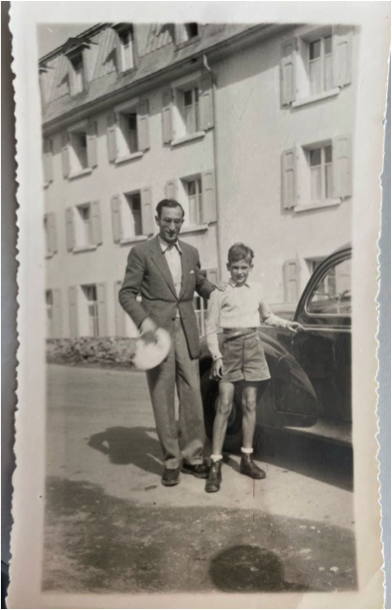
Jacques Wagner with a boy who may have been Maurice Wagner’s son
According to Sylvia, Maurice had a child out of wedlock, conceived during an affair. Maurice never officially recognized the child as his, however. We do not know the mother’s name, unfortunately, but we do know that the child was a boy named Maurice, after his father. Also according to Sylvia, he was most likely born in 1941 or 1942. We believe that he is the boy in the photo, taken in 1951 outside the home of Perle Safir Wagner at 30 Rue Simplon in the 18th district of Paris. Sylvia told us that Isidore (Henri) and Jacques took great care of him when he was a child. He also often visited Perle Safir Wagner, his paternal grandmother. Sylvia could not say whether Maurice was aware of his background or that of his family. At the time of writing, we are still trying to locate him.
Arrest and deportation
On July 23, 1944, the French Militia arrested Maurice for “political reasons” (this according to a postwar record based on a family member’s testimony) in the Strasbourg-St Denis subway station or on rue Saint-Denis in Paris. This information came from Angèle Bonheure, and was relayed by Sylvia Wagner. Again according to his niece Sylvia, it was said that Maurice had been reported. However, if he was arrested in the subway station or on the street, it was more likely to have happened during a roundup, which the militia carried out almost daily, in particular as the Allies were advancing towards Paris. If he really was turned in, the family never found out who did it. Other records related to his deportation later refer his having been ”deported on racial grounds.” It was possible for someone to be arrested as for working with the Resistance, and even found guilty of that, yet still be deported as a Jew. The Nazis saw this a means of humiliating Jewish Resistance fighters. People could also be reported as Jews if they did not wear the yellow star, which was compulsory.
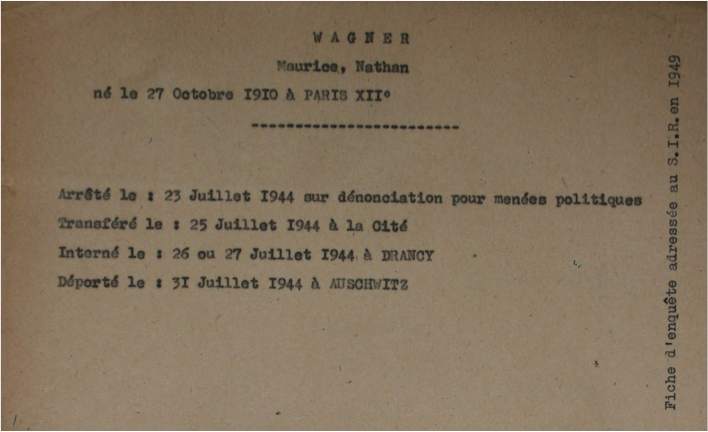
Investigation form submitted to the S.I.R. (Service International de Recherches, or International Tracing Service, in Bad Arolsen in 1949
Maurice arrived at the Paris Police Headquarters holding depot at 7 p.m. on July 24, having been brought there from the “Jewish Affairs” department. On the morning of the 25th, he was taken back to the Jewish Affairs department on Avenue Foch (the headquarters of the SIPO/SD, the Sicherheitspolizei, the “security police” ), and then at 7 p.m. that evening was returned to the holding depot, where he was locked up in a shared cell. The Police Headquarters register lists the word “Jew” as the reason for his arrest. On July 26 at 3 p.m., Police Officer Julien took him to Drancy transit camp, where he was assigned the serial number 25,968.
On the journey from Paris to Drancy, Maurice travelled with a group of men and women who, like him, were subsequently deported on July 31, 1944, on Convoy 77.
The train, which set off from Bobigny station at around noon on Monday, July 31, was made up of cattle cars and one armored car. On board were 1,306 people of all ages, social backgrounds, and nationalities. They had only one thing in common: they were all “Jews”.
A letter from Perle, written in 1946, says that Maurice managed to write to her to let her know that he had been arrested and interned in Drancy. She also said that she saw Maurice “at least three times a week.” In the letter, she added that Maurice had been living at various addresses but had never shared them with her “as a precaution.” Perle mentioned that a certain Mr. Banvens, an individual affiliated with the Paris Police Headquarters (at post 824) on the Île de la Cité, had agreed to do Maurice several favors despite “the difficulties of the time,” in particular by contacting one of his brothers to notify his family that he had been arrested. However, our research in the Paris Police Headquarters archives revealed no trace of a Mr. Banvens.
Sylvia Wagner claims that Maurice threw a letter from the train, addressed to Angèle Bonheure. Unfortunately, this letter, which was supposedly then given to Jacques, has never been found. After the war, Maurice was officially declared to have died on August 5, 1944, in the Auschwitz-Birkenau extermination camp.
Given his age and physical condition, Maurice would normally have been selected to enter the camp to work when the train arrived at Auschwitz during the night of 3–4 August 1944. Having been deported alone, without his family, he would have been put in what the surviving deportees later referred to as “bachelors’ cars”. The men (60 of them, all crammed together) in two of these cars were involved in escape attempts, which had been planned prior to departure in coordination with the Resistance group in Drancy camp. The German guards became suspicious of one group along the way (or perhaps someone had reported them?) and the men were then chained up, totally naked, and put in a prison car at the front of the train with no food or water for the rest of the journey to Poland. They were all murdered in the gas chambers as soon as the train arrived in Auschwitz. Was Maurice among them?
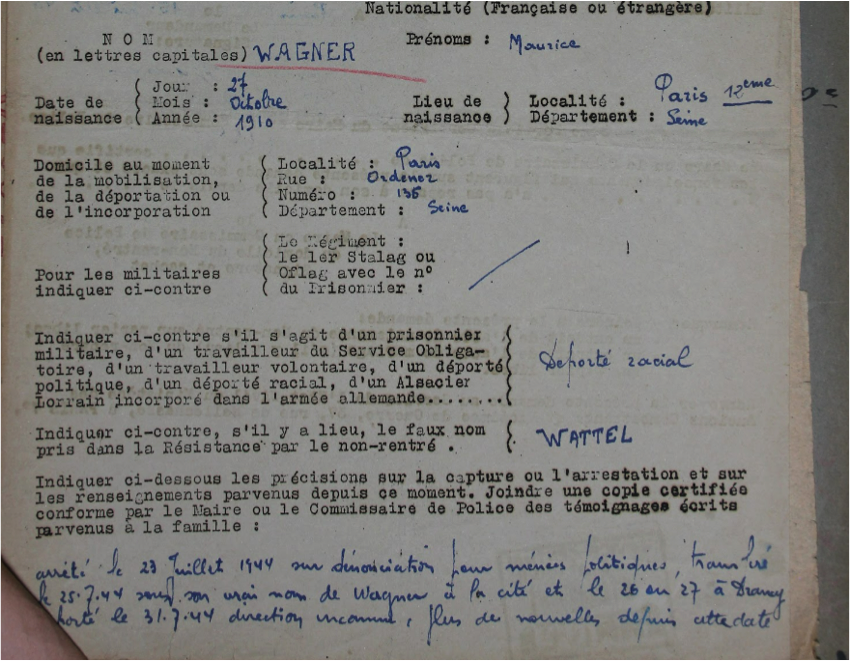
Request to have Maurice declared a “non-returned” person, 1952
The search for Maurice
Just over two weeks after the train that took Maurice to his death set off for Auschwitz, the SS officer in charge of Drancy camp, Aloïs Brunner and his Nazi henchmen fled, taking with them some fifty prisoners as “hostages”, including Marcel Bloch/Dassault. The prisoners who were left behind were, in effect, free. After fierce fighting from August 19 through 25, 1944, the Allies and the French Resistance liberated Paris. However, for the deportees’ families, and indeed for the people who had not been murdered when they first arrived in the camps, the anguish was far from over.
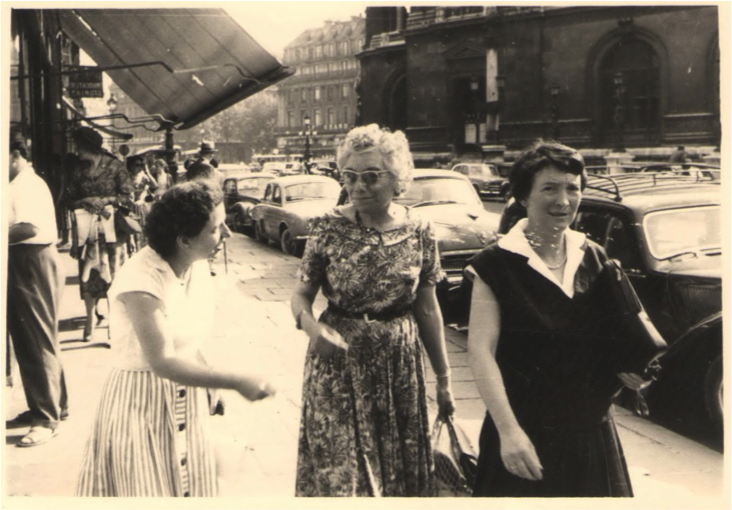
Angèle Bonheure (in the center) with some friends in Paris after the war
Photo belonging to Patrick Le Fèvre
The Wagner family searched desperately for Maurice. They contacted various organizations, such as the Polish Red Cross and other relevant bodies, including the International Tracing Service in Bad Arolsen, Germany, in the hope of finding out what had become of him. They were not alone: the file on Maurice held at the French Defense Historical service archives in Caen contains a letter from a mysterious “S. Bonheur,” who claimed to be a “relative”, asking for information about him. In her letter, Ms. Bonheur said that when Maurice was arrested, he was living with her at 30 Rue des Acacias in the 17th district of Paris. Maurice himself, however, had told the authorities that he lived at 15 Rue Véron in the 18th district.
Angèle Bonheure, a girlfriend
We were able to track down Angèle S. Bonheure thanks to Sylvia Wagner Guez. First of all, we discovered from the 1946 census listing for Maurice’s brother Isidore (Henri) Wagner that he had two children: Christian (born in 1942) and Sylvia (born in 1945). We were thus able to request Sylvia’s birth certificate, and discovered that she had been married twice, the second time to Mr. Ange Guez. After researching further, we found that during the 1990s, Sylvia had run a company based in the 16th district of Paris. This enabled us to leave a letter for her with the concierge of the building. Sylvia Wagner Guez then got back in touch with us and said she would be happy to meet us. We were delighted, and during our meeting, she kindly shared some important details about the lives of both Maurice and Angèle Bonheure.
Angèle Bonheure was an elementary school teacher, and great friends with the three Wagner brothers. She was reportedly madly in love with Maurice, but according to Sylvia, they never had a romantic relationship. Angèle was Sylvia’s godmother. Sylvia says that after the war, Angèle did everything she could to find out what had happened to Maurice. She often went to the Hôtel Lutetia in Paris, where deportees first arrived when they returned from the camps, in the hope of finding him there.
After she retired, Angèle Bonheure moved to Saint-Tropez, in the Var department on the south coast of France. Through a post on a Saint-Tropez Facebook group, we were able to get in touch with Patrick Le Fevre, her great-nephew and godson. He told us a little more about her and how she met Maurice:
Angèle Bonheure […] was born in Saint-Tropez on March 6, 1900. Her parents, Louis Allègre and Augusta Rosa (née Giudicé) owned a hotel just outside Saint-Tropez.[…] On August 16, 1923, Angèle married a man from Paris, Louis Bonheure. […] Unfortunately, sometime around 1936, while her husband was replacing the batteries on a boat, he lost his balance on the walkway and fell into the water while carrying a heavy battery, which struck a rock and shattered, causing the acid inside to spill out. He reportedly swallowed a mixture of seawater and acid, which burned his throat and part of his esophagus. Angèle acted as his nurse and took great care of him, but as his condition worsened, the doctor sent him to a convalescent center in Bar-sur-Loup in the Alpes-Maritimes department, where wounded army officers were also being treated. So that she could be closer to Louis, Angèle rented a room nearby and went to see him several times a day. It was there that she met Jacques Wagner, who was convalescing at the time […]. Both keen readers and concerned about the political situation in France at the time, they became friends and discovered they had many interests in common. […] Louis died in 1939 and was buried in Saint-Tropez. At around the same time, Louis’s sister, Auréa, lost her husband, and Angèle moved back to Paris to help her raise her two children (Bernard and my father, Claude Le Fevre). in Paris, she remained in contact with Jacques Wagner’s family […]. I cannot say exactly what kind of relationship she had with Maurice Wagner, but I believe she corresponded with him and was deeply concerned about the political situation at the time. […] After the war, Angèle remained close friends with Jacques, and as a child, I spent several vacations with Jacques and his daughter Fabienne.
Maurice’s parents: Hirsch Leib Wagner and Perle Safir
Maurice’s father, Hirsch Leib Wagner, was a tailor. He was born in Warsaw in Poland (then under Russian rule) on 18, 1869 and died on October 15, 1947 in the 15th district of Paris. His parents were Isaac Wagner and Sarah Ida Thenebon (spelled Tennenbaum on her daughter Cyla’s marriage certificate). According to his 1913 application for naturalization as a French citizen, (from the French National archives in Pierrefitte-sur-Seine) Hirsch Leib Wagner arrived in France as a child, in 1881.
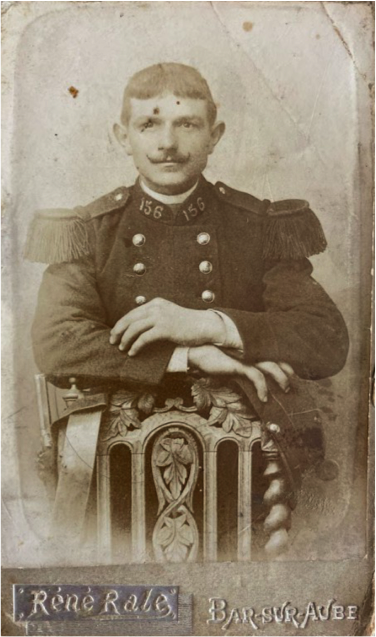
Hirsch Wagner, date unknown
Photo belonging to Natacha Thirard
Hirsch was a tailor, and when they got married on December 8, 1908, at the town hall in the 4th district of Paris, Perle was a decorator and was living with her parents at 45 Rue Vieille du Temple, in the Jewish quarter of the Marais district of Paris.
Hirsh, who had lost both his parents by the time he married Perle (they died sometime prior 1904, when his younger sister Cirla/Céline got married), had been a widower since March 16, 1908, following the death of his first wife, Chaïa Léa Maller, who was born in Warsaw on December 19, 1869. The first time he got married, in February 1896, was at this same town hall, but at that time he lived at 42 rue du Commerce, in the 15th district. This time, he was living at 25 rue des Rosiers, not far from where Perle lived. En 1908, when his first wife died at home, he was living at 100 rue du Théâtre (as we mentioned earlier, this was the address of Hermann Wagner, a tailor who was a witness at Cirla’s wedding and at the birth of her son Maurice in 1908).
Now we turn to Maurice’s mother, Perle Safir. On her 1908 marriage certificate and on her children’s birth certificates her occupation is listed as “tapestry decorator”, then in 1910 as a “housewife”. In 1913, she was working as a day laborer for 1 franc an hour. She was born in Bucharest, Romania, on April 9, 1883. Her parents were Chayé Safir and Sarah Fourmon. When their daughter got married they were living at 45 rue Vieille du Temple in the Marais district of Paris and declared that they were living on investment income. Perle adopted the name Berthe, which is the name listed first, beside a photo of her, on the shared grave in which she is buried in the Bagneux Cemetery. Her body was brought back to Paris from the Gironde department, and she was buried on March 24, 1967. A Berthe Zucker, née Safir, who was born in Bucharest, Romania, was a witness to the birth of Maurice Tark, Cirla’s son.
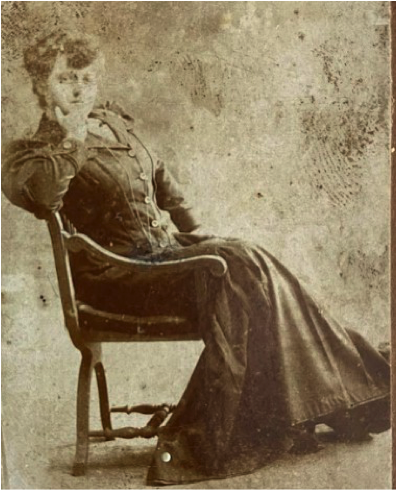
Perle Safir, date unknown
Photo belonging to Natacha Thirard
Perle had a sister, Rose, who, according to Sylvia Wagner Guez emigrated to the USA at the beginning of the 20th century. She is said to have made her home in California and to be related to the family of the famous American filmmaker, Robert Altman.
Maurice’s political deportee card was later issued to Perle. We were lucky enough to get to see the Hirsch and Perle Wagner’s naturalization application and the decree by which they were French citizenship at the French National Archives in Pierrefitte-sur-Seine. Hirsch submitted the application for naturalization in 1913 and included his wife in it as well. We thus discovered that Hirsch was earning 7 francs a day as a tailor while Perle earned 1 franc a day as a casual laborer. They paid an annual rent of 480 francs for their apartment at 159 Rue Marcadet in the 18th district of Paris. The application was approved on August 19, 1914, and also secured French citizenship for their two children.
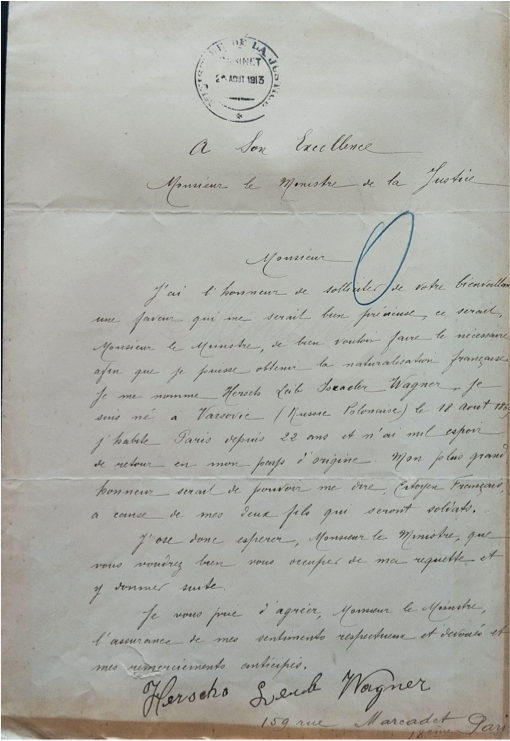
A letter handwritten by Hirsch Wagner as part of his application to be naturalized as a French citizen in 1913
French National Archives in Pierrefitte-sur-Seine
Hirsch said he had ”lost all hope of returning to his home country” and ”would like to stay in France forever.” According to the report, he had no known political affiliations and had not done his national service in his home country. He also had no previous criminal convictions.
We also discovered that Hirsch had two sisters: Cirla (Céline) Tark, was born in 1885, worked as a day laborer, and lived in Aubervilliers (Maisons-Alfort in 1911), on the outskirts of Paris. She had two sons: Isidore (born in 1906) and Maurice (born in 1908). She died a widow in October 1959. One of the witnesses at Cirla’s wedding in 1904 was a Théophilie Maller, who bore the same surname as Hirsh’s first wife. Another witness was Hermann Wagner, a 35-year-old tailor who lived at 100 Rue du Théâtre—the very same address where Hirsh and his first wife later lived.
At that time, Hirsh’s other sister, Rachel Hirschenon, was 46 years old and living in Warsaw, Poland.
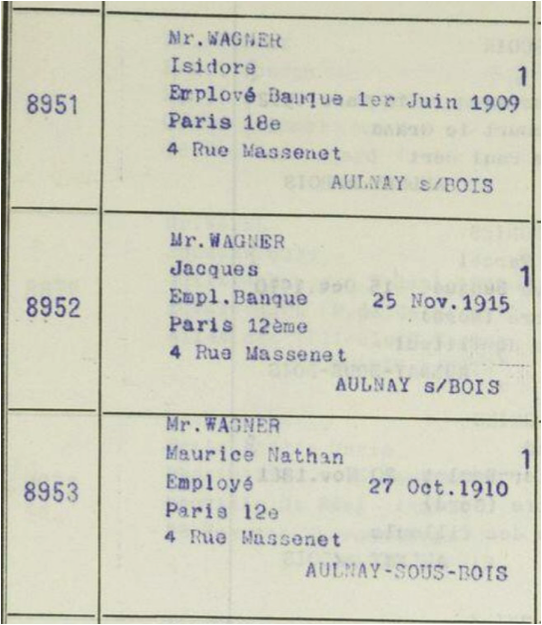
The Wagner brothers’ names on the electoral list in Aulnay-sur-Bois, 1931
Aulnay-Sous-Bois online archives
The photo of Hirsch in uniform, taken at Bar-sur-Aube, shows that soon after he became a French citizen in 1914, he was called up to serve for France.
In 1930, Hirsch registered to vote in Aulnay-sous-Bois in the Seine-Saint-Denis department, and gave his address as 15 avenue Loewel. According to the 1931 census, all the Wagner family members lived at that address. In 1938, according to their voter registration cards, they were all living at 4 Rue Massenet, also in Aulnay-sous-Bois.
In 1946, Hirsch and Safir Wagner, as well as Isidore, his wife and their children were still living at 135 rue Ordener, in the 18th district of Paris. Interestingly, the census listing still includes Maurice. This suggests that the family were unsure of what had happened to him; in 1946, they must still have had no concrete information and were likely living in the hope that he would come home someday.
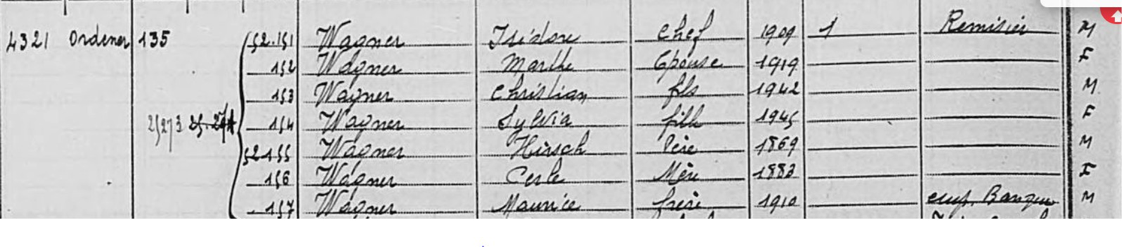
1946 census listing for 135 rue Ordener in the 18th district of Paris
Paris online archives
On June 20, 1952, Perle submitted an application to have her son Maurice officially recognized as a “Political Deportee”. In 1955, she also applied for a compensation payment, which was calculated according to the length of time he had been interned. This amounted to 10,800 francs (taking into account currency devaluation due to inflation, the purchasing power of 10,800.00 old French francs in 1955 equates to approximately $325 or €278 nowadays).
Perle stated in the application that she was living at 30 Rue du Simplon in the 18th district of Paris at the time. She died on March 22, 1967, in Saint-Jacques, in the Gironde department of France, but, according to her death certificate, was still officially registered as living at 30 Rue du Simplon.
According to her granddaughter, Sylvia Wagner Guez, Perle wore the yellow star during the war. We assume that she registered herself as a “Jew” in the early days of the Occupation. Sylvia does not know whether her grandfather Hirsch and his sons also wore the yellow star. She also states that her grandmother had great difficulty accepting the fact that her two sons married young Catholic women. We therefore assume that Maurice was raised in accordance with Jewish traditions.
Isidore (Henri) Wagner, Maurice’s eldest brother
Isidore Wagner was born on June 2, 1909 at a birthing house in the 18th district of Paris. His parents were living at 58 rue Montcalm, also in the 18th district. According to the Damrémont elementary school records, Isidore started school there in October 1915. There is a note stating that he made “little progress” and that he “stayed only two years. Left for good in March 1917.” We do not know if the family moved out of Paris during the First World War.
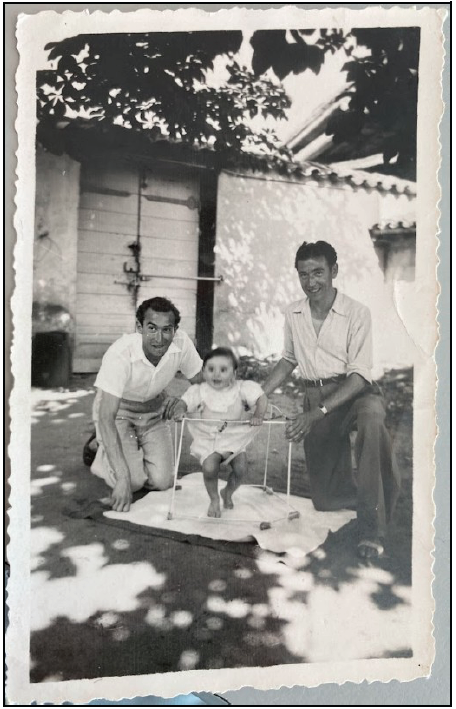
Jacques and Isidore Wagner with Christian Wagner, July 1943, at Bois d’Ouingt
Photo belonging to Natacha Thirard
Isidore did his military service in 1929 and in 1931, he was working in a bank. He got married for the first time in Aulnay-sous-Bois on September 1, 1932. His first wife was Jeanne Victorine Criner, who was born on August 26, 1909, in Viareggio, Italy. Her parents were Gustave Criner, a glassmaker, and Marie Destruel. The couple signed a prenuptial agreement and Maurice was one of the witnesses at the wedding. They then had a religious ceremony at the synagogue on Rue Notre-Dame-de-Nazareth on Sunday, September 4. The wedding notice in the Jewish newspaper L’Univers israélite said that Isidore married “Jeanne-Rachel.” They got divorced at some point, but we have so far been unable to locate the divorce decree so we do not know when. Jeanne died in Courbevoie in 2000.
Isidore got married for the second time in the 4th district of Lyon, in the Rhône department of France, on May 9, 1942. He married Marthe Joséphine Françoise Auprot, an elementary school teacher who was born on September 1, 1919 in the 2nd district of Lyon. She lived in the nearby town of Dardilly and had been a ward of the court since January 10, 1920. Her parents were Marius Auprot, a rural police officer, and Joséphine Laurence Muguet, who did not work outside the home. As for Isidore, he was living at 14 rue Jacquart at the time, having previously lived at 118 montée de la Grande Côte in Lyon. He was an insurance agent, even though, according to the legislation on the status of the Jews, he was forbidden to work in any profession that involved direct contact with clients. This time, there was no prenuptial agreement. Isadore and Marthe went on to have two children. The first, Christian Paul Wagner, was born on September 14 1942 in Cros-de-Cagnes in the Alpes-Maritimes department of France. It was Maurice, his uncle, who declared his birth at the town hall in nearby Cagnes-sur-Mer. The second was a daughter, Sylvia Françoise Wagner, who was born on October 8, 1945 in Boulogne-Billancourt in the Hauts-de-Seine department of France. She is the person we met.
In the 1946 census record for Rue Ordener, Isidore is listed as a “broker,” meaning that he worked on behalf of clients on the Paris Stock Exchange. After the war, he began to use the name Henri Wagner. The former concierge at 135 Rue Ordener, Mrs. Esturillo, told us that Isidore and Marthe had a third child, Maurice Gérard Wagner, born on December 10, 1947, in the 18th district of Paris. At the time, according to his birth certificate Isidore (Henri) was a journalist and his wife was not working. Marthe died on February 27, 1990, in the 18th district of Paris and Isidore died on May 31, 2004, in the 16th district.
THE WAGNER FAMILY’S DESCENDANTS
Maurice Wagner’s nephews and nieces (Isidore’s children)
Sylvia Wagner married Gilbert Paul Dufaux on May 26, 1967, in the 18th district of Paris. He was born on August 1, 1939, in Boulogne-Billancourt, in the Hauts-de-Seine department. They were divorced on February 28, 1974. Gilbert Dufaux died on February 21, 2022, in Bry-sur-Marne, in the Val-de-Marne department. Sylvia got married again two years later, this time to Ange Guez, on May 5, 1976. We tracked her down by searching for her under her married name, Sylvia Guez.
Maurice Wagner did his national service in 1974. On October 7, 1989 he married Françoise Simone Paul Richard in the 18th district of Paris. The marriage ended in divorce on December 17, 1991. According to local residents, Maurice Wagner was a doctor at 20 Rue Achille-Martinet in the 18th district of Paris but left the neighborhood in the 2000s.
Christian Wagner was a newspaper editor in 1997.
Jacques Wagner, Maurice’s younger brother
According to his granddaughter, Natacha Thirard, Jacques was raised not by his parents but by a nanny. Based on his military service record, held in the Yvelines departmental archives, Jacques was shot and wounded on November 2, 1939, after “bravely moving ahead of his group to scout for an enemy patrol”. He was awarded the French War Cross and the Bronze Star “for this mission.” According to Natacha Thirard, he was wounded again in 1940, likely while escaping from a prisoner-of-war camp. His abdomen was reportedly ripped open during a bombing raid. On 7 March 1942, in the 18th district of Paris, he married Jacqueline Marie Graillot, who was born on 11 August 1916 in Saint-Cloud. Her parents were Louis Graillot, a roofer, who was 36 years old when she was born, and Célestine Aimée Leconte, a day laborer, who was 35. Jacqueline was the daughter of the woman with whom Jacques took refuge after he “escaped” in 1940.
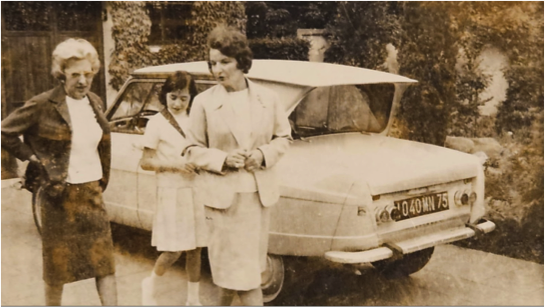
Angèle Bonheure, Fabienne Wagner and Jacqueline Wagner, date unknown
Photo belonging to Natacha Thirard
Jacques was an insurance agent and Jacqueline worked as a bobbin winder. Jacques later became a director of the Gras Savoye insurance group. The couple had one daughter, Fabienne Elisabeth Marie-Aimée Wagner, who was born on July 16, 1953, in Mulhouse, now in the Haut-Rhin department of France . Fabienne was a physiotherapist in Ledeuix, in the Pyrénées-Atlantiques department. She divorced her first husband, Xavier André Marcel Thirard, on December 1, 1997. She died on January 8, 2005. The couple had three children:
- Natacha, Jacqueline, Denyse Thirard, born on February 4, 1979, at La Celle-Saint-Cloud, in the Yvelines department of France. She was a nurse in an oncology and palliative care unit, and has two children.
- David, Jacques, Roger Thirard, born on April 28, 1980 in Chesnay, also in the Yvelines department.
- Christophe, Pierre, Philippe Thirard, born on November 1, 1981 in Oloron-Sainte-Marie, in the Pyrénées-Atlantiques department.
Jacques and Jacqueline Wagner moved to Ledeuix, just outside Oloron-Sainte-Marie, in the Pyrénées-Atlantiques department, on September 14, 1984. Jacqueline died on March 21, 1997, in Oloron-Sainte-Marie, and Jacques died on September 15, 1998, in the 2nd district of Paris. It was Natacha, his granddaughter, who was a student in Paris at the time, who reported his death. We managed to track her down via the internet. We then contacted her and she agreed to come to our school, together with her brother David, to meet us.
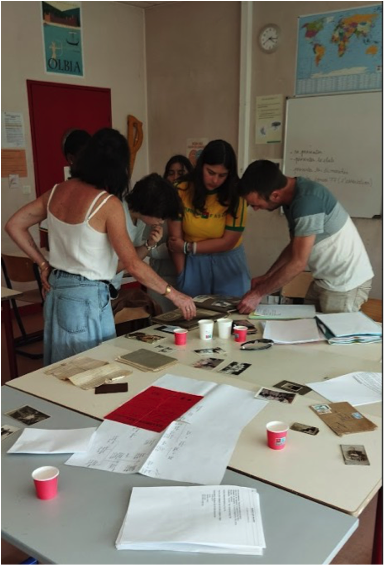
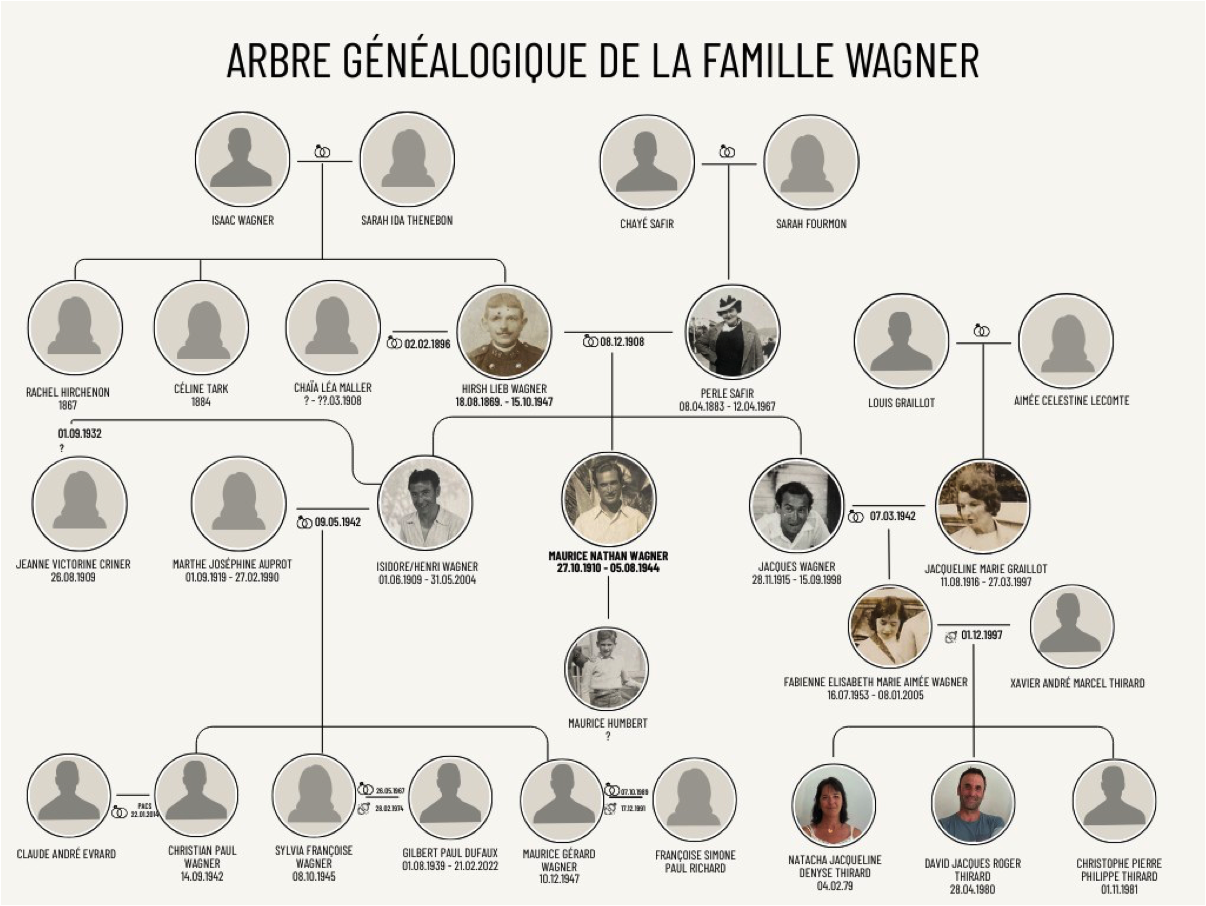
The Wagner family tree
ACKNOWLEDGMENTS
We would like to extend our heartfelt thanks to Natacha and David Thirard, who traveled all the way from the Pyrénées-Atlantiques department to our school in Seine-Saint-Denis to spend time with the students and share their family’s story. Their kindness, willingness to help, and their fascinating stories were invaluable, as were the photos they kindly shared with us.
Our sincere thanks also to Sylvia Wagner, with whom we had a long and very enjoyable conversation. She too was extremely kind and shared some fascinating and highly informative insights with us.
ADDRESSES AT WHICH THE WAGNER FAMILY LIVED
- 42 rue du Commerce, 15th district of Paris (1896 Hirsch Leib Wagner)
- 100 rue du Théâtre (1908 Hirsch and his first wife, and also Hermann Wagner)
- 25 rue des Rosiers, 4th district of Paris (1908 Hirsch Leib Wagner)
- 45 rue Vieille du temple, 3rd/4th district of Paris (1908 Safir family)
- 58 rue Montcalm, 18th district of Paris (1909, when Isidore was born)
- 12 rue de la Fontaine du But, 18th district of Paris (1910 when Maurice was born until 1913 at the latest; 1904 Cirla Wagner and her husband Léon Tark)
- 159 rue Marcadet, 18th district of Paris (1913 when the naturalization application was made and 1915 when Jacques was born, probably until 1917, when the boys left the local elementary school)
- 15 avenue Loewel, Aulnay-sous-Bois (At least as of 1930 when Hirsch registered to vote and the whole family was listed in the 1931 census)
- 4 rue Massenet, Aulnay-sous-Bois ( 1938 when the Wagner sons are on the electoral list)
- 14 rue Jacquard in Lyon, and previously 118 montée de la Grande Côte in Lyon (1942 Isidore)
- 15 rue Véron, 18th district of Paris (the address Maurice gave when he was arrested in 1944)
- 135 rue Ordener, 18th district of Paris (since 1942 (possibly 1939?), the whole family listed in the 1946 census, until at least 1955 in Perle’s case, after which Isidore lived there until the late 1990s)
- 30 rue des Acacias, 17th district of Paris (where Maurice may have stayed with Ms. S. Bonheur/Angèle Bonheure, from 1944 until at least 1946)
- 30 rue Simplon, 18th district of Paris (as of 1955 for Perle, until she died 1967)
- 20 rue Achille-Martinet, 18th district of Paris (Maurice Wagner’s doctor’s office, 1990s until around 2010)
We also found 15 rue Hermel for the Safir family (in particular Alexis/Aliais, a mechanic, in 1923 and 1927, and/or Léon, born on April 28, 1916, who registered to vote in 1938)
It appears that the Wagner and Safir family members all lived very close to their families, whether in the 4th, 15th, or 18th districts of Paris, and no doubt shared apartments, which they passed on to their siblings and/or cousins. This suggests that there was great solidarity within the family.
WAGNER FAMILY TIMELINE
- Birth of Hirsch Leib Wagner, August 18, 1869
- Birth of Perle Safir, April 12, 1883
- Hirsch Leib’s arrival in France, 1891
- Hirsch’s first marriage, to Chaïa Léa Maller, February 25, 1896
- Chaïa died, March 16, 1908 (buried March 17, 1908)
- Hirsch married Perle, December 8, 1908,
- Birth of Isidore, June 2, 1909, his uncle Léon Tark acted as the witness.
- Birth of Maurice, October 27, 1910
- Maurice and Isidore cared for by a nanny, 1911.
- Hirsch’s naturalization application, September 4, 1913
- Hirsch and Perle officially naturalized by decree, August 19, 1914
- Hirsch drafted into the army during the war, 1914
- Birth of Jacques, November 28, 1915
- The Wagner boys went to the Damrémont elementary school until March 1917
- Isidore began his national service (6th recruitment office of the Seine department) 1929
- Revision board meeting for Maurice (6th recruitment office of the Seine department), 1930
- Hirsch registered to vote in Aulnay-sous-Bois, 1930
- The whole Wagner family listed as living in Aulnay-sous-Bois, 1931 census
- Isidore’s first marriage, to Jeanne, in Aulnay-sous-Bois, September 1, 1932
- Isidore divorced Jeanne, between 1932 and 1942
- Maurice was called up for national service but sent home again immediately, 1934
- The Wagner brothers were all on the electoral list in Aulnay-sous-Bois, 1938
- The Wagner family moved to 135 rue Ordener, 1939
- War was declared, September 3, 1939
- Maurice insisted on joining the army, Charenton office, Val-de-Marne department, October 18, 1939
- Isidore was drafted into the army, 1939
- Maurice was demobilized in Grenoble and took refuge in Sauvagnat-Sainte-Marthe, Puy-de-Dôme department, July 28, 1940
- Isidore was listed as a prisoner of war, 1940
- Jacques married Jacqueline, March 7, 1942
- Isadore’s second marriage, to Marthe, May 9, 1942
- Birth of Christian, Isidore’s son, in Cagnes-sur-Mer, September 14, 1942
- Isidore and Maurice were both living in Cagnes-sur-Mer, September 14, 1942
- Isidore and Jacques had their photo taken in Bois d’Oingt (in the Beaujolais area, near Lyon), possibly with Christian(?), June 1943
- Maurice was issued an identity card with false information, Mornay-sur-Allier, June 14, 1943
- Maurice returned to Paris (cf. letter from Perle), August 1943
- Maurice was arrested on rue Saint-Denis in Paris, July 23, 1944
- Maurice was transferred to the Paris Police Headquarters holding depot, July 25, 1944
- Maurice was interned in Drancy camp, July 25, 1944
- Maurice was deported on Convoy 77, July 31, 1944
- Maurice’s official date of death in Auschwitz-Birkenau, August 5, 1944
- Perle’s request for information about Maurice, May 15, 1945
- Birth of Sylvia, Isidore’s daughter, in Boulogne-Billancourt, October 8, 1945
- Perle’s letter asking for news of her son, 1946
- Hirsch died, October 15, 1947
- Birth of Maurice Gérard Wagner, December 10, 1947
- Perle’s request to have Maurice recognized as a political deportee, June 20, 1952
- Birth of Fabienne, Jacques’ daughter, in Mulhouse, July 16, 1953
- Perle’s request for compensation payment, 1955
- Perle died, March 22, 1967
- Sylvia, Isidore’s daughter, married Gilbert Dufaux, May 26,1967
- Sylvia and Gilbert were divorced, February 28, 1974
- Sylvia married Ange Guez, May 5, 1976
- Birth of Natacha, Jacques’ granddaughter, February 4, 1979
- Birth of David, Jacques’ grandson, April 28, 1980
- Birth of Christophe, Jacques’ grandson, November 1, 1981
- Jaques and Jacqueline bought a plot of land in Oloron-Sainte-Marie, September 14, 1984
- Maurice Gérard Wagner married Françoise Richard, 1987
- Maurice Gérard Wagner and Françoise Richard were divorced, 1991
- Marthe died, February 27, 1990
- Jacqueline died, March 21, 1997
- Fabienne and Xavier André Marcel Thirard were divorced, December 1, 1997
- Jacques died, September 15, 1998
- Isidore died, May 31, 2004
- Fabienne died, January 8, 2005
- Ange Guez died, December 22, 2016


