Français
 Polski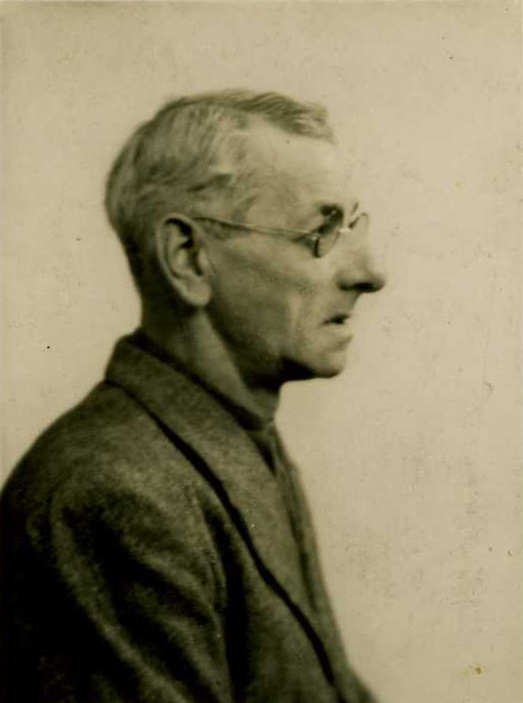
Sroël Scholka Charles LAUFMAN (1888 – 1944)
Profil photo from Sroël Laufman’s identity card, issued in 1943, © Family archives
This biography was written by the 12th grade general baccalaureate class at the Charles-le-Chauve high school in Roissy-en-Brie, under the guidance of their history teacher, Ms. Jessica Degrenne, and with the kind help and support of the Laufman family.
I / Sroël’s background
Scholka, known as Sroël[1] Laufman was born on May 26, or August 12, 1888, in Siedlce[2], in eastern Poland, according to the city synagogue register[3].
His parents were Hersh Isaac Laufman (born in 1870 in Siedlce) and Sarah Dogodny (Goldstein ?) (born in 1873). Both of them died sometime before 1926.
The Jewish community made up about 50% of the population of his hometown, until it was hit by anti-Semitic attacks. In September 1906, around 30 Jews were killed during a pogrom.
Poland was under the control of several different countries at the time. The people living in the region were mainly Russian, German, or Austro-Hungarian citizens. During the First World War, more than three million men were mobilized from the area that would later become the Second Polish Republic, and they fought in three separate armies. Bloody battles took place between the German, Russian, and Austro-Hungarian armies on Polish territory.
During the First World War, Sroël (using the first name Choilik) served as a corporal in the Second Radio-Telegraph Division of the Russian Army. He was living in Warsaw at the time. According to the archives, he was admitted to the Jewish hospital in Odessa (now in Ukraine) suffering from tonsillitis. He was discharged on January 12, 1918, with anemia resulting from “a triple war wound,” after which he was placed on twelve months’ leave[4].
In the late 19th and early 20th centuries, large numbers of Polish Jews, and indeed Polish people in general, opted to emigrate to other countries in the hope of securing a better standard of living. Sroël chose to relocate to France, where several members of his girlfriend Rachel Berenbaum’s family were already living, including her brother Abraham, also known as Adolphe[5].
They left Warsaw for Paris at the very end of the 1920s[6]. We do not know what route they took or whereabouts in France they stayed when they first arrived. However, Scholka’s application to be naturalized as a French citizen[7] reveals that in winter 1921, he was living at 17 passage de l’Industrie, in the 10th district of Paris.
II / Every family has a story
Scholka Laufman who was also known as Sroël, and later by the French version of the name, Charles, arrived in France in 1920 along with this partner, Rachel Berenbaum, and their first son, Isaac/Icchok (Jacques in French), who was born on November 25, 1919 in Warsaw.
They gave their second son, who was born in Paris on March 25, 1922, a French name from birth: they called him Adolphe.
The couple, who may well have already been married in a Jewish ceremony before they left Poland, were officially married in France on March 11, 1926, in the town hall of the 10th district of Paris[8]. The name Sroël is listed on the marriage certificate.
Georges, their last child, was born two years later, on July 11, 1928.
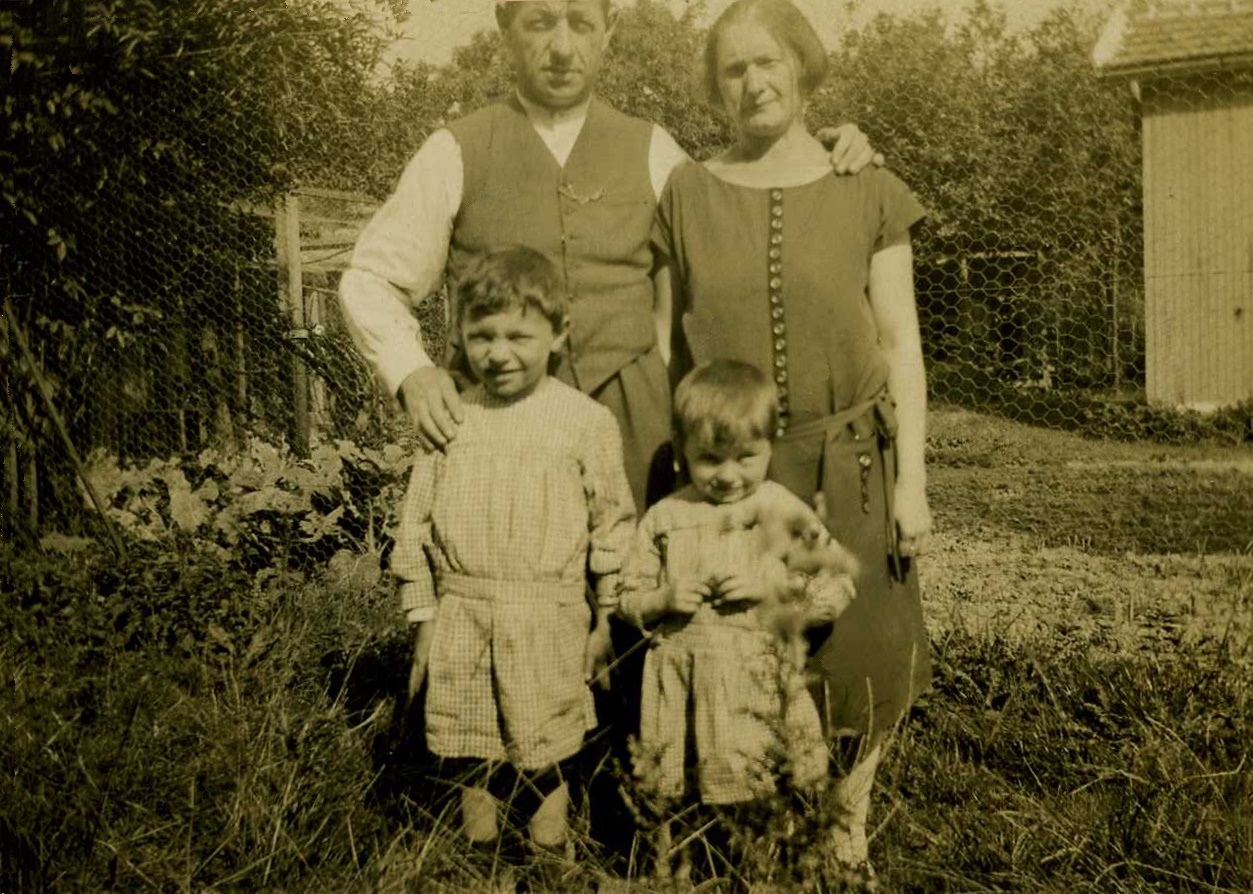
Sroël, Rachel, Jacques and Adolphe in 1924 © Family archives
The first year, they lived at 41 Rue Chapon in the Marais, in the 3rd district of Paris[9], and from there they moved to the 10th district, in which they stayed even when they subsequently moved to a different street. This means that during all their time in France, they always lived in a neighborhood that was home to a large number of Jews from Eastern Europe.
When he first arrived in France, Sroël worked as a cobbler, but he changed jobs in 1926 and began working in a store, where he stocked the shelves. Then, sometime before 1931[10], he became a cutter, a role for which he earned 1,200 francs a month.
He was officially registered as an immigrant, having been listed in the foreign residents’ registry on February 8, 1921. He and his wife renewed their foreign resident identity cards on December 31, 1925.
III / Immigration and naturalization paperwork
In common with countless other Jews who viewed France as a land of freedom and equality, where Jews enjoyed the same rights as the rest of the population, Sroël Laufman decided to move to France when anti-Semitic unrest became more pronounced in his native Poland. He probably also felt it would be easier to find work in France. However, he wanted something more than that: he hoped to put down permanent roots in France and become a French citizen.
On December 1, 1926, Sroël submitted an application to the Paris Police Headquarters in order to become naturalized as a French citizen[11]. In the aftermath of the First World war, France was keen to attract foreign workers and build up its armed forces, so introduced a policy that encouraged naturalization.
Nevertheless, throughout the 1920s, the naturalization process was still relatively strict, and involved background checks on applicants’ personal integrity and financial standing. Missak Manouchian, for example, applied for French citizenship but failed to obtain it. Foreigners who had served in the French army were given preferential treatment. The fact that Sroël had been a corporal in the Russian army, one of France’s allies during the First World War, probably contributed to his success.
With a steady income of 1,200 francs a month, two sons likely to make excellent soldiers, a respectable occupation and significant military experience, Sroël Laufman was thus a promising candidate. His “conduct and character” report noted that he had not drawn attention to himself and was “well-regarded by others”. He did not appear to hold any particular political convictions.
Then again, a handwritten note from the local police commissioner who led the investigation noted that “Mr. Laufman speaks hardly any French” and that he “does not seem to have integrated.” This meant that he was called in for interview. The skeptical police officer then recommended that his naturalization application should be deferred. According to him, Sroël only wanted to become a French citizen because “he lives in our country,” and “had he lived elsewhere, he would have wanted to become a citizen of that country instead[12]. Sroël, however, made a point of emphasizing how much he “loved France” and had no intention of returning to his home country.
However, the Paris police chief ignored the district commissioner’s recommendation and, on November 17, 1927, approved the application. The intelligence on Sroël was satisfactory, and by December 1927, he was described as “fairly well-integrated” and “speaking French pretty well”. The final report also highlighted the fact that he and his wife were expecting their third child.
By opting not to go back to Poland, Sroël’s was typical of many other migrants who cut ties with their homeland and set their sights on becoming fully established in their adopted country.
Sroël eventually became a citizen of the French Republic by decree, which was published in the French Official Gazette on February 12, 1928 (page 1796). His son Jacques was naturalized along with his parents; Adolphe had already become a French citizen by declaration[13] and Georges was born French, as by that time, both of his parents were already French citizens.
French folks just like everyone else?
When he left 17 passage de l’Industrie[14], Sroël moved to rue du Faubourg Saint-Denis, then 82 passage Brady, where he is listed in both the 1931 and 1936 censuses. In 1936, Rachel’s occupation was given as “concierge”, while Sroël, listed under the name “Charles”, was a cutter.
“My parents were Polish immigrants. We were Jewish, but we were naturalized as French citizens, so we saw ourselves as totally French until the start of the Occupation,” recalled Georges Laufman, the youngest member of the family. He also said that he spoke “both languages”. His said that his first language was French, but he did not say whether Yiddish or Polish was the second.
The couple’s children presumably went to the elementary school on Rue du Faubourg-Saint-Denis or the one on Rue du Faubourg-Saint-Martin.
The Laufman family encountered racism even prior to the war. Even though they were French citizens, they had only recently become so, and felt the stigma of being perceived as outsiders. According to Georges’ testimony, they noticed the increase in anti-Semitism, especially in school. “We could already feel the rise in anti-Semitism, especially in school, among the other kids. They would taunt us by calling us names, the same words that are still used nowadays. I always felt inferior. I didn’t react to the insults because I’m not a violent person. As I was pretty shy, I avoided conflict. My parents, who had arrived in France from Poland in 1920, still had a Polish accent. They didn’t speak French very well, so at school, where of course kids know everything about each other, I felt different; I never felt at ease[15]”, he recalled “Personally, I felt embarrassed. We weren’t completely left out when it came to playground games, but we were called ‘dirty Jews’,” he said, and then added: “I can’t explain what it feels like to experience anti-Semitism, you just feel it. But what can you do to protect yourself from it?”
Little Georges didn’t dare talk to his parents about it. Would Sroël have done anything about it, anyway? “I wasn’t the only one in that situation; there were lots of us. You know, it’s hard when you’re the son of immigrants,” he explained.
According to Georges, his two older brothers, who were a fair bit older than him, “got involved with the political scene and were actively involved until war was declared; after that, they continued their efforts in the Resistance.”
THE WAR AND THE OCCUPATION
In September 1939, the Second World War broke out.
In late spring 1940, when the “Phony War” came to an end and the German army invaded France and began advancing towards the capital, three quarters of the Parisian population hastily fled the city.
The Laufman family was living at 82 Passage Brady at the time. Georges says that Sroël stayed in Paris because he had been called up to serve in the civil defense forces, but he and his mother left as part of the what known as “the exodus”. They walked as far as Étampes, south west of Paris in the Essonne department of France, where they managed to get on a freight train that dropped them off in Limoges, in the Haute Vienne department.
In June 1940, having been defeated by Hitler’s army, the French government signed the Armistice. The German army occupied parts of the country and Marshal Pétain formed a government that collaborated with Nazi Germany, referred to as the “Vichy regime.”
Foreign Jews were interned in camps in France. “No one had told me anything at all about the Germans,” Georges explained, “I just knew that some family members had been arrested and sent to the Gurs camp[16]. They were being held with some Spanish refugees.”
When the German army occupied Paris, Sroël went to join his wife and his youngest son, as well as the boy’s aunt, who had gone with them when they left the city. His other two sons were not in Paris either. One had moved his business out of the capital during the exodus, and the other “was with his regiment in a youth camp in Villard-de-Lans, in the southern zone.”
A few weeks after the Germans took over Paris and the collaborationist government took office in Vichy, the first anti-Semitic laws were passed. Jews were forbidden from working in various professions, such as the civil service, the media, and management positions. Jews in the northern zone were required to register themselves as such and were not allowed to leave the German-occupied zone.
Sroël obeyed the Occupation Authorities’ orders and went to register himself as a Jew. In June 1942, he went to pick up the “insignia” for himself, his wife, and his young son. Jews aged six and older were obliged to wear yellow stars, and three stars per person were issued in exchange for one textile point on their ration card.
“I wore the yellow star—a direct result of anti-Semitism. We never felt comfortable wearing them, but the Germans had made it mandatory. We’d try to disguise them as best we could so they wouldn’t be noticeable. When we traveled on the subway, we weren’t allowed in just any car—only the last one, which was only for Jews. Sometimes we hid our stars by covering them with something, such as an item of clothing or a package. When you’re a kid, you can get away with things like that, but adults couldn’t because the stakes were too high—for example, they were at risk of being arrested, with all the potential consequences that entailed,” Georges explained in 2006. Sroël was clearly not willing to risk it.
Then came the roundups. Jews were arrested and deported to Poland, which had been occupied by Germany since 1939. In 1942, in line with Hitler’s genocidal policy of exterminating all the Jews in Europe (the “Final Solution”), the hunt for Jews gained momentum, first in the occupied zone and then, very soon after that, in the “free” zone as well.
Thanks to Georges’s testimony, given in 2006, we know that his aunt and three of his cousins (girls aged 4, 14, and 16) were arrested during the Vél’ d’Hiv’ roundup on July 15 and 16, 1942[17]. Many of their neighbors on Passage Brady were also arrested over the next few months, no doubt including some of Georges’s schoolmates.
Georges provided a poignant insight into how the Jews felt in those days: it was as if they were being hunted down. “I was not subjected to violence, strictly speaking, but sometimes the Germans would stop people at random on the street. Anyone at all! We had no idea why! They’d make them get into the trucks and drive off with them. I guess such things happen in wartime. It makes its mark on you. It stays with you forever… That constant, gnawing feeling of fear in the pit of your stomach! That urge to run and hide every time you saw the trucks coming.”
As Georges lived his life in constant fear, the noose began to tighten around Sroël and Rachel’s necks. Both of their older sons were arrested. In 1942, Adolphe was interned in the La Santé Prison in Paris for six months, then sent to the Pithiviers camp, where, according to Georges, he was held for six to eight months. He was then sent to work in a factory in Berlin, Germany, in 1943. He managed to get permission to go out on leave at some point, and went into hiding with a family by the name of Ducarme, whose daughter, Alice Alexandrine, he subsequently married[18].
Jacques was arrested during a roundup at the St. Lazare train station. On October 11, 1943, he was “deported to the Isle of Alderney” and interned in the Norderney forced labor camp, which was known for being one of the toughest in France[19].
IV / The circumstances surrounding the arrest
The French police arrested Sroël and Rachel at their home on passage Brady on the morning of Saturday, July 22, 1940. The reason given for the arrest in the Paris Police Headquarters detention register was: “Jew.” The couple were home alone at the time. Georges, who was 16 by then and was a typesetter on Rue du Faubourg Saint-Denis, happened to be at work that day. He rarely worked Saturdays, but the fact that he did that particular week was what saved his life. As he was heading home after work, a number of sales assistants from the clothing stores on passage Brady warned him not to go back to the apartment.
V / Internment in Drancy camp
After spending a short time at the Paris Police Headquarters detention center, Sroël and his wife arrived in Drancy transit camp on July 22, 1944. We know his serial number (25,593) and the number of his search log record (158), for which he was given a receipt (number 6695). He handed over 750 francs (on behalf of himself and his wife). The first name listed on his record card is “Scholka.”
The Drancy camp arrival and transfer log states that when Sroël first arrived, he was assigned to a men-only room on the 5th floor on staircase 18 . As was the case for all prisoners who were scheduled to be deported on a convoy, he was subsequently transferred to a staircase closer to the courtyard, where everyone about be deported was assembled out of sight of the other prisoners. On the morning of July 31, 1944, buses came from Paris to pick up the prisoners and take them to Bobigny station.
The convoy set off from Bobigny headed for Auschwitz. He most likely traveled together with his wife, in appalling conditions, crammed 60 to a cattle car, with straw on the floor, almost nothing to eat or drink, and no sanitation.
Given his age (he was 56 by then), he was most likely sent to the gas chambers and murdered as soon as he arrived, as deportees aged over 50 were almost never selected for forced labor in the Auschwitz camp.
His son Georges said that he remembered waiting at the Gare de l’Est station in Paris every day for weeks after the war ended, hoping his parents would come back: “I continued to think for almost a year that I would find my parents there. I kept hoping. I lived near the Gare de l’Est train station, so I went there every day to see if I could spot anyone I knew, mainly my parents of course. Then, a few months later, a woman came up to me and told me that my parents had been burned in the crematoria”. Georges also mentioned that in the final days of the war, in August 1944, he was involved in the uprising against the Germans in Paris.
Just before they were deported, or on Convoy 77, did the Laufman’s bump bump into their neighbor, Rose Rosenzweig[20], who also lived at 82 Passage Brady, but was arrested in the Rouen area, and whose father had been deported in September 1942?
Might Rose have been the person who, having survived both the Auschwitz and Kratzau camps, told Georges what had become of his parents?
VI / Disappeared without a trace…
The Laufman children never found out if their parents were arrested during a roundup or because someone had reported them to the authorities.
“When my parents were arrested, I didn’t know they were going to be deported. I thought they were going to come back! I always believed they would come home! When the police came to take them away, no one said, ‘We’re going to send you to extermination camps’,” said Georges[21], after which he stressed the fact that his parents were arrested and deported only “three weeks before the liberation of Paris.”
Sroël and Rachel’s children made every effort to find out what had happened to them after they were deported, in particular their son Jacques. As a result, shortly after the end of the war, the French authorities issued a “non-returned person” certificate. This was followed by a missing person certificate and a deportation certificate, both bearing the French form of Sroël’s first name: Charles Laufman.
In 1963, Jacques requested that his father be granted “Political Deportee” status[22], confirming that he had been deported on political grounds, i.e. because he was Jewish.
It was not until 1966 that a death certificate was issued. It stated that he died on July 31, 1944, and, because he was a French citizen, Sroël was officially recognized as having “Died for France.”
Despite all this, the circumstances surrounding his death and the exact date on which he died remain unknown. His original death certificate lists his date of death as July 31, which was the date on which he left Drancy camp. This was later amended to August 5, 1944, according to a standard formula that the French authorities used in cases where people disappeared without a trace. They assumed that it took five days from the date of departure for the train to arrive in Auschwitz and the person to be murdered.
Having said that, survivors’ testimonies state that the train known as “Convoy 77,” which left Bobigny on July 31, 1944, arrived during the night of August 3–4, and that the deportees who were not selected to enter the camp to work were sent straight to the gas chambers and died later the same day[23].
To this day, we can still pay our respects to Sroël by finding his name on the Wall of Names at the Shoah Memorial in Paris. It is on row 13 on slab 23. Year: 1944.
We would just like to add that Jacques was appointed guardian of his younger brother, Georges, who was still legally a child at the end of the war.
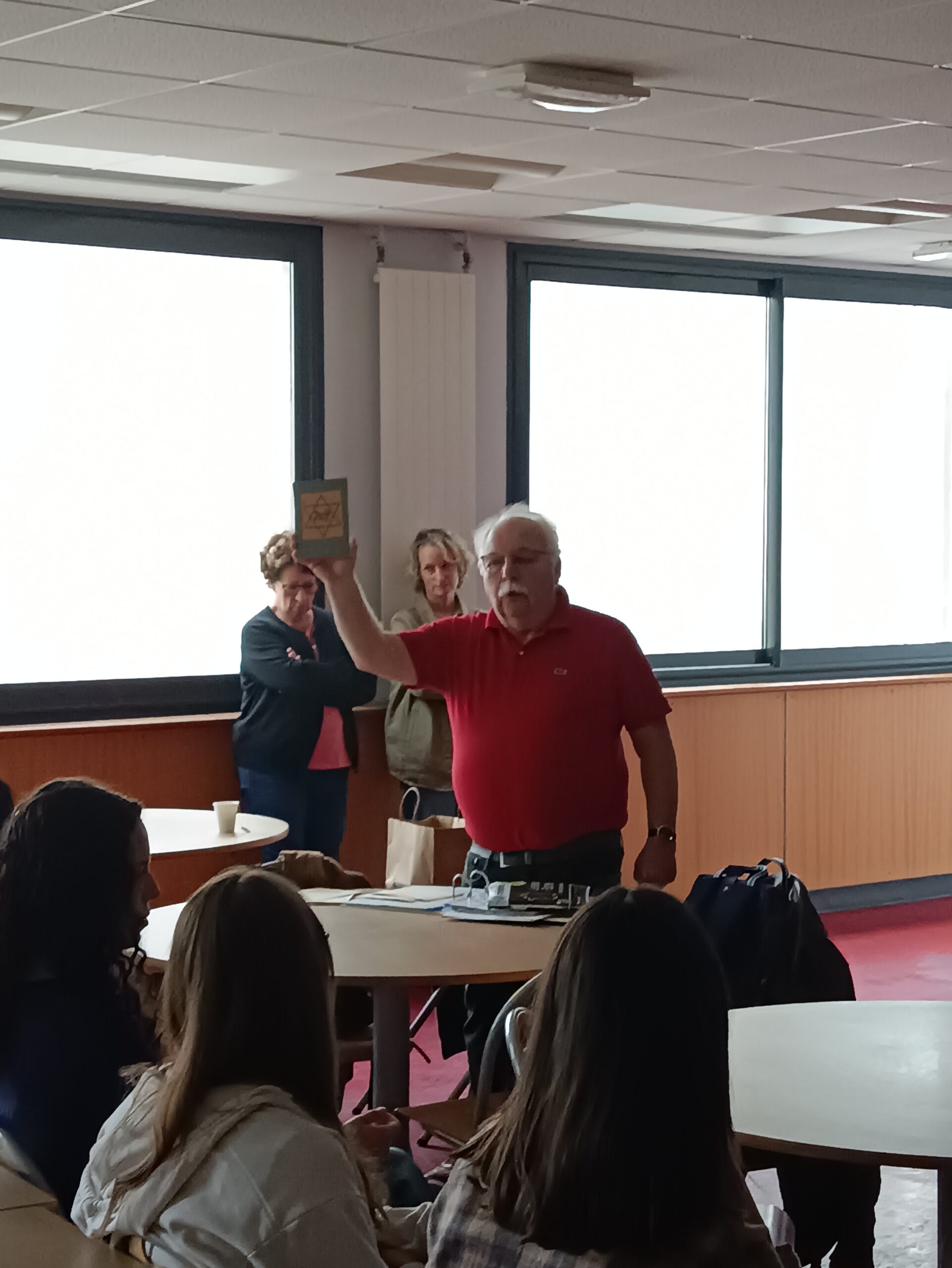
Gérard Laufman speaking to the students
We would like to thank the Laufman family’s descendants, who were kind enough to come to our school to speak with us. It was an experience we shall never forget.
In memory of Rachel and Sroël.
Notes & references
[1] Sroël’s first names vary according to the source. On his birth certificate, his first name is listed as Saul, a name that is never mentioned again. On his marriage certificate, he is listed as Sroël. On various other paperwork, including his naturalization application, he used the name Scholka and entered Charles as the French variant. A curious name, Choilik, is listed on a Russian military hospital record. His date of birth is also unclear. While he always stated that he was born in 1888 in Sedlitz (Siedlce), his birth certificate (officially translated into French) lists his date of birth as May 26, but in his naturalization application he, (or someone writing on his behalf), stated that he was born on August 12.
[2] The Jewish community accounted for around 50% of the population of his hometown, but it was hit by anti-Semitic attacks. In September 1906, around 30 Jews were killed in a pogrom.
[3] Record from the civil status register included in Scholka Laufman’s application for naturalization. French National archives, ref. BB11 10530-4076×27
[4] Translation of the record from the Odessa Jewish Hospital included in Scholka Laufman’s naturalization application.
[5] His brother Isaac, who died in Paris in 1937, also immigrated, as did his sisters Beila, Esther, and Eva. The youngest of the family, Beinish (known as Bernard), became a naturalized French citizen in 1928. It appears that their father, Faivel, died in Paris in 1934, but the relationship between the siblings and their parentage remain to be confirmed. The other brothers and sisters are scattered across the New World and the old continent. Bour, who was 40 years old in 1926, and Yochel, who was 50, crossed the Atlantic to the United States! Bour lived in Chicago, where he worked as a butcher, while Yochel moved to in San Francisco, and was a shoemaker. Marie, who was 42 years old and did not have a job, lived in Odessa. Haïm, was 44 years old, worked as a fruit vendor, and was the only one who stayed behind in Poland, and lived in Warsaw.
[6] File on Sroël Laufman, Victims of Contemporary Conflicts Archives Division of the French Ministry of Defense Historical Service, in Caen, ref. 21 P 473 217
[7] The birth certificate (translated from Polish) of Isaac, Scholka’s eldest son, lists an address in Warsaw: 45-24 Muranowska Street / 2 2.274 E, a street in the “Old Town,” on the edge of what later became the ghetto. The original certificate, which was authenticated by the Polish consulate in Paris on July 11, 1922, lists Scholka’s first name as Saul.
[8] City of Paris digital archives, civil registry.
[9] From the first page of his naturalization application, submitted in December 1926.
[10] This occupation is listed in the 1931 census for 82, passage Brady, 10th district of Paris.
[11] Scholka Laufman, French National archives, ref BB11-10530 40764 x 27
[12] Handwritten note in the naturalization application, loc. cit.
[13] Information included in the naturalization application, ref. 12.176 x 26.
[14] In 1931, Faivel, Ryvka, and Isaac “Berembaum”, all of whom were “Russian”, were living together at 17 Passage de l’Industrie. Did the Laufmans leave the apartment to them? Faivel died in 1934.
[15] Georges Laufman, testimony collected by Frédéric Praud in 2006; everything we have quoted is taken from this testimony: https://parolesdhommesetdefemmes.fr
[16] From March 15 through April 25, 1939, Édouard Daladier’s government used the Gurs camp, which was near Oloron-Sainte-Marie, in the Basses-Pyrénées department (now the Pyrénées-Atlantiques), to intern people who had fled Spain (Spanish Republicans and members of the International Brigade) after General Franco’s coup d’état. After June 22, 1940, the camp was used as a mixed internment camp for Jews of all nationalities except French who had been captured and deported by the Nazi regime. This camp served as an assembly point before they were transferred to Drancy camp and subsequently deported to Auschwitz.
[17] This most likely refers to Esther Berenbaum, née Goldberg, who was arrested along with her three children: Suzanne, born in 1925; Wolf, born in 1928; and Régine, born in 1937. The children were deported shortly after their mother, on Convoy 27. She and her family lived at 17 passage de l’Industrie in the 10th district of Paris, where Sroël and his family had previously lived, followed by Rachel and Esther’s father: https://ressources.memorialdelashoah.org
[18] Adolphe opened a restaurant. He died in 1989.
[19] He was transferred to Boulogne-sur-Mer on May 7, 1944, and was then taken to Neuengamme by the Germans on June 24, but managed to escape from the train as it passed through Belgium. He arrived home at passage Brady in Paris in October 1944. He went on to become president of the Aurigny friendship society. He died in February 1992: https://gw.geneanet.org
[20] Rose Rosenzweig https://ressources.memorialdelashoah.org
[21] Georges Laufman, who shared his moving testimony in 2006, continued working in the printing industry. He went on to have two daughters. He died in September 2015.
[22] Request for the status of “Political Deportee”, file on Sroël Laufman, Victims of Contemporary Conflicts Archives Division of the French Ministry of Defense Historical Service, in Caen, dossier 21 P 473.217.