Français
 Polski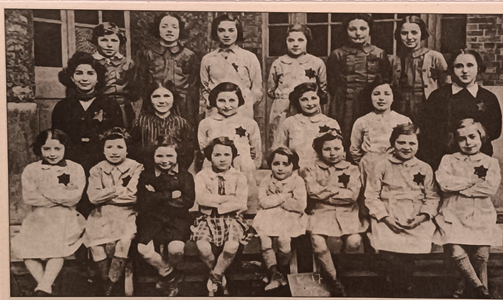
Renée KANE (1932-1944)
Renée Kane was just twelve years old when she was deported from Drancy to Auschwitz on Convoy 77 on July 31, 1944.
Her father, Abram Kane, was born in Czarnków, Poland on January 25, 1903.
Her mother, Golda Siapsiowicz, was born in Warsaw, also in Poland, on December 9, 1906. She and Abram Kane were married, and their first child, Leib, was born on February 2, 1929 in Lodz, Poland.
In 1932[1], they decided to emigrate to France, first to Dambach, in the Alsace region, which is where Renée was born on March 20, 1932. They then moved to 40 rue des Glatiniers in Saint-Quentin, in the Aisne department of France, where Renée’s younger brother André, was born in October 1939.
Did they relocate to France in order to escape the widespread poverty and pogroms in Poland, where Jewish villages were pillaged and the residents massacred? Or coud it have been due to the Great Depression that hit the textile manufacturing city of Lodz in the 1930s?
Renée’s father was a hosier[2] and street vendor (he sold his wares on the markets), and her mother was a housewife.
The family, which was made up of the parents and their three children, Leib (also known by the French form of his name, Léon), Renée, and André, lived at 40 Rue des Glatiniers. Golda’s brother, Aron Siapsioviez or Siapsiovicz, who had been living in France for several years and had become a French citizen, moved in with them in 1942.
Why did they choose Saint-Quentin?
Saint-Quentin is in the Aisne department, in the Hauts-de-France region of France. There had been a Jewish community there since the Middle Ages, although Jews were banned from the town periodically. When it increased in size in the 19th century, the Jews were granted permission to build a synagogue.
The Association culturelle Israélite (Jewish Religious Society) was founded in 1906 and officially recognized in 1931. Much of the city was destroyed by bombing during World War I but was rebuilt between the wars. The synagogue, which was also destroyed, was rebuilt on another street, funded by charitable donations, and inaugurated in 1934.
Between the wars, immigrants from Turkey, Poland, Russia, and then Germany further expanded the Jewish community in Saint-Quentin.
The Kane family, who are not listed in the 1935 census[3], may have decided to move to Saint-Quentin because there was a thriving Jewish community there and rents were affordable. It was also an industrial town specializing in textiles, home to many small businesses. This opened up job prospects for Renée’s father, who was a hosiery manufacturer (stockings, underwear, etc.).
When war was declared in 1939, almost all of the 70 Jewish families in Saint-Quentin were members of a mutual aid society. Although social divisions existed there as they did elsewhere, Jewish communities transcended these barriers. Most of the Jewish families lived in the center of Saint-Quentin.
THE WAR AND THE VICHY GOVERNMENT’S ANTISEMITIC POLICIES
The Second World War began on September 1, 1939, when Germany invaded Poland. On September 3, France and Great Britain, united by a joint defense treaty, declared war on Germany.
After a period during which there was little fighting between the armies (known as the “phony war”), the Germans invaded northern France in May 1940. Some families fled at that point, on the advice of the police and the prefecture in Saint-Quentin: this became known as the exodus. We do not know if the Kane family left or not, but even if they did, they returned home following the signature of the armistice in June.
Following the establishment of the Vichy regime, discriminatory anti-Semitic legislation was introduced, including a census of the Jewish population[4]. On October 3, 1940, the first decree on the status of the Jews was announced. The following day, October 4, 1940, the Vichy regime enacted a decree that targeted “foreign nationals of the Jewish race“. This was an ”emergency” measure that provided for immediate internment of foreign Jews.
Next came the first anti-Jewish financial measures: Jewish-owned businesses were “Aryanized,” which meant they had to be turned over to someone who was not Jewish. Hundreds of traders and business owners were stripped of their assets, powerless to do anything about it.
As of the 8th German order, issued on May 29, 1942, Jews living in the occupied zone were required to wear the yellow star. In addition, antisemitic propaganda was encouraged in newspapers and movie theaters.
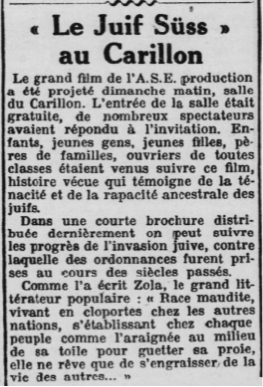
Antisemitic propaganda in “Le Grand écho de l’Aisne” newspaper on July 3, 1942
@ https://gallica.bnf.fr
For the first few days after the order was issued, Jews in Paris reacted by writing on their stars or wearing several stars at once. They were interned in “Jewish camps,” according to the newspaper Le Grand Écho de l’Aisne, which also reported on the solidarity shown by some folk who wore the star even though they were not Jewish (they too were interned for a short time in Drancy) . Meanwhile, the families of the Jewish community in Saint Quentin remained united as the anti-Semitism increased.
In January 1942, during the Wannsee Conference, the Nazis discussed the “Final Solution to the Jewish Question” in Europe. Deportations from France began soon afterwards.
The roundups in Saint-Quentin
On May 17, 1941, the sub-prefect in Saint-Quentin notified the prefect of the Aisne department of an investigation launched on May 12 into “foreign Jews” with regard to whom “the decree of October 4, 1940 is considered applicable.” The Kane family was named on the list. It reveals that Abram was seriously unwell and unable to work. Golda was therefore working as a “street vendor, earning around 2,000 francs a month.” According to the person who wrote the report, “their attitudes towards politics and national issues are good.” In other words, they were not communists[5]. On June 7, 1941, a letter from the police commissioner assured the sub-prefect that all the Jews listed had indeed had the word “Jew” stamped on their identity cards. The fact that the goods sold by the market traders were of little value meant that there was no need to appoint a managing commissioner to “liquidate” their businesses. Golda alone, and not Abram, is named on this list of “street vendors”. The sub-prefect then wrote to the prefect that the four traders in question had all been notified that they had to cease “their commercial activity in accordance with German order on restrictions on Jews”.
In July 1942, a major roundup took place in Paris. Known as the Vel d’hiv roundup, it was carried out using lists of Jews drawn up in 1941. Soon afterwards, foreign Jews in Saint-Quentin, along with all the others in the Picardy region, were also arrested, interned, deported, and, in most cases, exterminated in Auschwitz-Birkenau.
At dawn on July 18, the French police, acting a request from the SD-Sipo in Saint-Quentin to the regional prefect of Picardy, a Mr. Pelletier, began knocking on the doors of Jewish people’s houses and apartments and making the first arrests. Jews were arrested in their homes, often in front of their children. During these roundups, each person was allowed to take only the bare minimum of belongings with them (a pair of sturdy work shoes, one suitcase, food, a rolled-up blanket, a cup, and a spoon)[6].
According to a police report, eleven arrests were made, but four people could not be taken into custody, including Golda Kane, who was bedridden. Two other people were not arrested because they were sick or infirm[7]. Although they were temporarily exempt from arrest, the German instructions stated that “Jews who have not been arrested for one reason or another must be arrested as soon as their health improves”.
According to the legislation that set out the criteria for the arrest, children under the age of sixteen had to be handed over to the “Compulsory Jewish Organization” (i.e. the U.G.I.F. – more about this later). But since there was no U.G.I.F.[8]. branch in Saint-Quentin, Golda’s brother, Aron Siapsioviez, took care of the three Kane children. He had been naturalized as a French citizen and, as we mentioned earlier seen, was also living at 40 rue des Glatiniers at the time[9]. This was, needless to say, reported to the prefect, who had forbidden the French Red Cross from getting involved. Based on lists compiled by the Aisne prefecture in 1942, it appears that only one Jew had been naturalized as a French citizen and that he had fled to the free zone. That person was not Aron, however, as he normally lived in Paris, so was not registered in the Aisne department[10].
Although a few individuals managed to escape and were not recaptured, the roundup had a devastating impact: 65 of the 79 people targeted, including 13 from Saint-Quentin who were detained in Laon, were transferred to Drancy camp, north of Paris, in two special train cars, escorted by the French military police. The Drancy internment records confirm this, as 10 of them were first registered there on July 21, 1942. They did not in Drancy for very long: eight days later, on July 29, 1942, the first ten internees were deported on convoy No. 12 to Auschwitz. Abram Kane, who was 39 years old at the time, was among them, as were Jakob and Chaja Apel. Their children, Gisèle and Joseph, were also taken in by the U.G.I.F. and later deported at the same time as Renée and André.
Only Golda Kane and one other person arrived in Drancy later than the others, due to being bedridden when they were first arrested. The French military police picked them up on August 25, 1942 and took them to the train station in Tergnier[11], They were interned in Drancy later that day.
Golda Kane was 35 years old when she was deported on Convoy 26 on August 31, 1942.
When we looked at the departure dates of the convoys, we saw that over the course of a month, 15 convoys set off from Drancy bound for Auschwitz. Clearly, the Vichy regime was actively collaborating with the Germans to implement the “Final Solution”.
When they arrived at the camp, neither of Renée’s parents were selected to enter the camp to work. They were not very old, however: could it be that they were not selected because they appeared too frail?
The Nazis were far from done with the Jews of Saint-Quentin. On October 16, 1942, the German authorities released a new list of foreign Jews to be arrested in Saint-Quentin, and this time, even the young children were included.
The day before the next roundup, the Saint-Quentin military police were given a list of 14 names, including eight children (aged between 3 and 14). According to a list compiled on October 16, 1942, a total of 12 children were arrested on October 8 and 9. At 10:45 a.m., the 12 children were handed over to the French military police, who were responsible for taking them to the Saint-Quentin train station and then on to Drancy. The list euphemistically refers to this as an “evacuation”.
When the Kane children arrived in Drancy, the siblings were promptly separated: the eldest, Leib, was handed over to the German authorities and deported on November 4 on Convoy 40 to Auschwitz. Sadly, he never returned: children were never selected for forced labor, and Leib was only 13 years old.
The two youngest children, Renée and André, both of whom were born in France, were placed with the U.G.I.F. Children whose parents had been deported were often placed in U.G.I.F. shelters in and around Paris, but were nevertheless under German control. From one day to the next, such children suddenly found themselves alone, in an unfamiliar environment, often with no family, friends, or other points of reference.
In Drancy, the sanitary conditions were deplorable, as tens of thousands of people from all backgrounds rubbed shoulders until it was their turn to be deported. The children were utterly lost, with no one to care for them and very little to eat.
According to their internment records, Renée Kane, aged 10, and André Kane, aged 3, were transferred from Drancy to the Claude-Bernard hospital on November 1, 1942, for medical reasons. They were “liberated”[12] from the hospital on November 25, 1942, and placed in the care of the U.G.I.F.. On November 23, U.G.I.F. staff member Léon Israëlowich had written to the Paris police headquarters requesting that they be released.
The U.G.I.F.
The U.G.I.F. (Union Générale des Israélites de France, or General Union of French Jews) was an organization founded by the Vichy government, at the request of the Nazis, to represent the Jewish population in their dealings with the French authorities and the occupying forces. All existing Jewish organizations were merged into this organization, which was controlled exclusively by the Commissariat Général aux Questions Juives (General Commission for Jewish Affairs) and the Gestapo. It maintained a liaison with the Gestapo’s Bureau for Jewish Affairs. All Jews were required to join it (which was a way of keeping track of them if they had not registered themselves with the police or their local town hall), but many refused to do so. The U.G.I.F. was also responsible for providing assistance to Jews in need, whose numbers increased as restrictions on their right to work were extended and they were deported in ever greater numbers. It therefore became a vital lifeline for those living in extreme poverty, even those who were interned at Drancy (at least before Alois Brunner took charge of the camp).
The U.G.I.F. was also responsible for caring for orphaned children or those whose families were no longer able to care for them. Properties belonging to Jewish organizations that had been confiscated were used as “children’s homes.” As the number of children in need rose over time, more such homes were set up. It should be noted that, throughout this period, Jewish children continued to be deported.
Jewish resistance groups and child rescue organizations called into question the conduct of the U.G.I.F. both during the Occupation and after the war. Its staff (many of whom were themselves deported in the end) were criticized for failing to safeguard the children but in fact facilitating their deportation by monitoring their movements and passing the information to the Nazis.
Thanks to the U.G.I.F., several children were rescued, evacuated, or sent to live in hiding between 1942 and 1944, but many were saved only through the efforts of individuals working within the organization but acting independently.
Another important detail: children placed with the U.G.I.F. were divided into two categories. Some were known as “free children,” meaning they had never been interned and were there because their families had chosen to place them with the U.G.I.F. for one reason or another. These children were not on any of the Drancy lists and were therefore easier to “save.” The others, referred to as “blocked children,” had previously been interned in Drancy or other camps, and their parents had been deported or were interned (for example, if one of the parents was married to a non-Jewish person, or if the father was a prisoner of war and the mother was interned in Drancy). They were listed as having been “liberated” from Drancy, but the fact that they were “blocked” meant that they were effectively prisoners in the U.G.I.F. homes.
In the case of the Kane children, all the U.G.I.F. could do was to delay their deportation (if the U.G.I.F. had been able to keep them just 18 days longer, their lives would have been saved!)
Renée’s little brother, André, was readmitted to Claude-Bernard Hospital with whooping cough for three months until February 25,1944, according to correspondence between the U.G.I.F. and the hospital[13]. He appears to have been isolated for much of his time in the hospital.
From one U.G.I.F. home to another
Renée was initially sent to the U.G.I.F. center on rue Lamark, in the 18th district of Paris. All of the children sent to the U.G.I.F. were assessed there before being sent on to other shelters. This happened mainly after 1943, when additional U.G.I.F. homes were set up in eastern Paris.
When Renée and her brother first arrived at the U.G.I.F. they had no food ration cards. A card was issued to Renée on December 22, following a request made by the manager of the Lamarck center to the “head of supplies for the 18th [district]” on November 20 (had she already been discharged from hospital by then?).
Renée Kane fell into category J2. Her brother was categorized as J1. Orphans were only entitled to a certain amount of food per child, depending on their age. There was also a J3 category, which included a little wine. On the application for the Renée’s card, her nationality was entered as “French.” Renée was indeed born in France, but did her parents ever file a declaration so that she would be recognized as a French citizen? We have yet to verify this.
Renée was first sent on to Center 30, at 9 Rue Guy-Patin. There is a record of her being there on February 16[14]. Renée was first sent on to Center 30, at 9 Rue Guy-Patin. There is a record of her being there on February 16. A few days earlier, on February 10, at the request of Heinz Röthke[15] the French police had rounded up eleven children from the home and taken them to Drancy. The children (and indeed the adults) who were left behind in the building, which was previously used by the Toit Familial charity, were traumatized. A large-scale roundup was carried out in the Paris area on that and the following day. Thirty-one other children were rounded up in other U.G.I.F. centers, including the Rothschild orphanage.
On April 16, 1943, Renée and several other girls were “transferred” back to the Lamarck center. They were only there while “in transit” to another facility. Later that day, Renée arrived in a home in the eastern suburbs of Paris, near the Bois de Vincennes.
The home was at 5 rue Grandville in Saint-Mandé, in what was then the Seine department of France, but is now in the Val-de-Marne department. On June 1, there were twelve girls living there, all born between 1930 and 1933. On the registration list, Renée’s nationality was left blank, with a question mark. Eight of the girls were French, two were Belgian, and one was Polish. As they all spoke French, they were able to go to school in Saint-Mandé.
As for André, he was sent to the Zysman boarding house, also known as “the happy children’s home” in La Varenne. The siblings were thus living fairly close to each other.
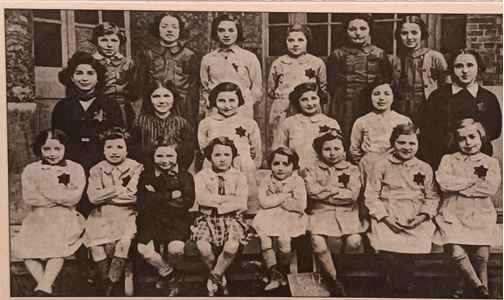
Photo with Renée Kane in the back row, second from the right. From Serge Klarsfeld’s exhibition at the Camp des Milles Memorial, Aix-en-Provence
Life in the orphanage was not easy for the children. With the country under German occupation, restrictions on Jews and food rationing, there was never enough to eat. Jewish people were only allowed to go to grocery stores between 3 p.m. and 4 p.m., so by the time they arrived, the shelves were almost empty.
During the week, the children went to school. On Sundays, as was common in boarding schools, they were allowed out to spend time with local families. Known as “correspondents” in the U.G.I.F. records, volunteer families would invite children from the orphanages to spend Sundays with them, in an effort to give the ones who had lost their parents a chance to experience family life. The volunteers wanted the children to enjoy themselves and also gave them snacks. However, as Jews were banned from public parks, it was not easy for the children to play outside. The restrictions did not stop there either: movie theaters, museums, theaters, and even puppet shows were also off-limits, as were other types of entertainment and leisure activities.
Renée and her little brother were sometimes fortunate enough to spend time together during such Sunday visits.
The children went to visit the following people:
On January 10, 1943, André and Renée went to visit Simone Fournier, who lived at 22 rue de la République, and Jacques Fournier, who lived at 12 allée de Charmes.
On January 24, 1943, André visited Mr. or Mrs. Lamire, at 38 boulevard Barbès. The U.G.I.F. records note that these were “outings with family members.” Did the Kane and Lamire families know each other beforehand? We found no trace of anyone called Lamire living on Boulevard Barbès in the 1936 census records.
On February 21, the same person took Renée out.
On March 21, it was a Mrs. Weil, who lived at 43 rue Vital, who took her out.
On April 5, it was Mrs. Cazzanica-Hubeau, whose address was 14 rue Santeuil, in the 5th district of Paris.
On May 2, Mrs. Weil took out Renée and another 11-year-old girl, Juliette Saporta.
On May 30, Renée went out with Mrs. Hubhau.
On Sunday, June 13 and Sunday 25, 1943, she went out with Mrs. Cazzanica.
We know that the Kane children were sometimes able to meet up, thanks in particular to the Cazzanica family. This happened five times in total.
We found no records of any outings between August 1943 and July 1944.
Besides these Sunday outings, Renée went to the hospital for a checkup on June 1, 1943, along with 12 children. They probably needed some kind of medical treatment or had to go for a follow-up visit.
THE ROUNDUP ON JULY 22, 1944
Renée spent two years in these children’s homes, where staff tried to care for the children, who had already been through so much trauma, and keep them occupied. At school, Renée got to know girls who were not Jewish. Life would have felt almost normal. But then, in July 1944, just as the Allies were advancing towards Paris and the city was soon to be liberated, SS officer Alois Brunner, who was in charge of Drancy camp, launched one final major roundup.
During the night, between July 21 and July 25, 1944, the Germans (with the help of some of internees from Drancy) arrested 250 children in the U.G.I.F. homes in and around Paris. They were all taken to Drancy. The Kane siblings, along with 28 children from La Varenne and 19 from Saint-Mandé, were among the victims.
In the early hours of Saturday, July 22, Renée and the other children at the home were taken away, as were their supervisors and management staff. According to Jean Laloum, “The camp commander, SS Hauptsturmführer Aloïs Brunner, dressed in uniform and flanked by members of the “Jewish police”, who had been requisitioned from the camp, personally supervised the operation”[16].
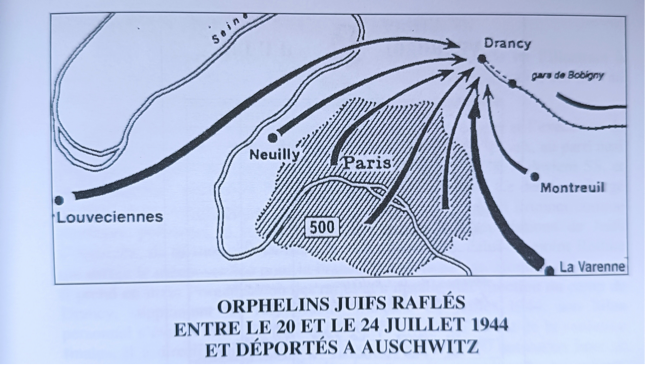
Map of U.G.I.F. orphanages and shelters in Paris and its suburbs. All children and caregivers are sent to the Drancy camp. From Jean Laloum’s,” Les Orphelins de La Varenne 1940-44” (The Orphans of La Varenne 1940-1944)[17]
The children arrived in Drancy in groups, according to the dates on which they were arrested in the U.G.I.F. homes. They were all held in the same building, and siblings who had previously been separated were reunited.
On July 29, the older girls (notably the teenage girls from the shelter on Rue Vauquelin) found out that they were all going to be deported to an “unknown destination”.
On July 31, 1944, Convoy 77 set off for Auschwitz with 1306 people aboard, including more than 300 children and babies.
The train arrived Auschwitz-Birkenau during the night of August 3 – 4, 1944. The journey had taken three days and three nights in the most appalling travelling conditions, and as soon as they arrived, almost all of the children were exterminated in the gas chambers at Birkenau – an act of the utmost injustice. Only 291 men and 183 women were selected to enter the camp to work: a truly hellish ordeal.
Memorials
At the time, there was little or no reaction to the “roundups” from the local population or in the press, because so few people witnessed them, as they all took place in the middle of the night or just before dawn, before the curfew ended. Nowadays, however, the memory of these children is kept alive thanks to various organizations that have built memorials in Saint-Quentin and put up plaques, in some cases bearing their names, at the places where they were arrested or went to school.
Renée’s name is inscribed on the plaque that was unveiled in May 2023 at the Paul-Bert school in Saint-Mandé, where she used to go to school. 41 Jewish children who went to this school were deported and exterminated.
In addition, a Léonia Kane is listed on the war memorial in Saint-Quentin cemetery. We were unable to determine whether she was a member of the same family. Perhaps the name is simply a double entry for Léon? A Hélène Kane is also listed on the memorial but her name is not in the Shoah Memorial database.
We, Jemima, Eva, Raphaël, Vibishan and Malo, are a group of students from the Les Blés D’Or middle school. We wrote this biography during our EPI (Interdisciplinary Practical Education) class, “Convoy 77”, led by our French and history teachers, as part of our duty to remember and to pay tribute to Renée Kane. We chose to focus on a child because we noticed that many of their biographies have yet to be written, and children were among the early victims of the Holocaust.
We would like to thank Mr. Bressolles and his students who had previously worked on the history of the Jews in Saint-Quentin. Thanks to their research and written work, we were better able to understand the environment in which the Kane children were raised.
We also based our work on our field trip to the Camp des Milles, near Aix-en-Provence in the Bouches-de-Rhone department of France, where we were surprised to finally find a photo of Renée among a group of girls at Saint-Mandé.
SOURCES
- U.G.I.F. archives, YIVO collection, available at the Shoah Memorial in Paris
- Aisne departmental archives
- Shoah Memorial
- Damien Bressolles and his students from the Jean-Bouin high school in Saint-Quentin, (since 2023) “La persécution des Juifs de Saint Quentin” (The persecution of the Jews in Saint-Quentin): https://drive.google.com/file/d/1XBTQQ1egNGXqkOFB0U60sCrFq8_7Rlfg/view
- Stéphane Amelineau’s “80 ans : La première rafle des Juifs de Picardie, 18-21 juillet 1942”, (“80 years: The first roundup of Jews in Picardy, July 18-21, 1942,”) published in July 2022, itinerairesdememoire.com
- Jean Laloum, “Les maisons d’enfants de l’U.G.I.F.: le centre de Saint-Mandé” (“The U.G.I.F. children’s homes: the Saint-Mandé center”), published in Le Monde juif, 1995/3 N°155, p 58 to 109.
Further reading
Frank d’Almeyda and Frédéric Viey, Histoire des Communautés juives du Nord et de Picardie, available online (in French only) on the Somme departmental archives website.
Notes & references
[1]Aisne departmental archives, letter dated October 28, 1943 from the mayor of Saint-Quentin to the Commissariat Général aux Questions Juives, (General Commission for Jewish Affairs) sent to us by Damien Bressolles in October 2025.
[2] Aisne departmental archives in Laon, record dated July 21, 1942. “Liste des Juifs du département de l’Aisne” (arrêtés pour déportation), (“List of Jews in the Aisne department” (arrested for deportation) Cf. Stéphane Amelineau itinerairesdememoire.com
[3] Clarification from Damien Bressolles, who focuses on the Jews of Saint-Quentin and who, together with his 12th grade students, wrote “ Ici non plus, on n’oublie pas… Histoire de la communauté juive de Saint-Quentin sous l’Occupation.” (Here, we do not forget – history of the Jewish Community in Saint-Quentin during the Occupation).
[4] See the list of Jews cited in Damien Bressolles https://drive.google.com/file/d/1XBTQQ1egNGXqkOFB0U60sCrFq8_7Rlfg/view
[5] Ibid, documents provided by Damien Bressolles.
[6] Cited in Damien Bressolles https://drive.google.com/file/d/1XBTQQ1egNGXqkOFB0U60sCrFq8_7Rlfg/view
[7] Cited in Damien Bressolles https://drive.google.com/file/d/1XBTQQ1egNGXqkOFB0U60sCrFq8_7Rlfg/view
[8] See below for more information about the U.G.I.F.
[9] French National Gendarmerie (military police), August 25, 1942. Report from XXX., military police officer based at Saint-Quentin. He went to the home of Kane, née Siapsioviz (sic), a Jewish woman, and brought her back to the barracks “pending her transfer to Targnier to be sent on to Drancy (Seine department).” The “transfer” took place the same day. “The three children of this Jewish woman” were left in the care of her brother, who was living at the same address. Aisne departmental archives, ref. 984 W 139.
[10] Aisne departmental archives, ref. 984 W 139, cited in Damien Bressolles op. cit.
[11] Cited in Damien Bressolles ibid.
[12] See the definition of a “blocked child”.
[13] Yivo archives, ref. RG 210-59, Microfilm 490-43
[14] Service 30 Guy-Patin, “Liste des enfants hébergés à notre centre à la date du 16 février au matin”, (“List of children staying at our center as of the morning of February 16,”) YIVO archives, ref. RG 210, available at the Shoah Memorial.
[15] Heinz Röthke was with Theodor Dannecker, one of the main people responsible for the deportation of Jews from France from 1940 to 1944. He was in charge of Drancy camp from July 16, 1942 to July 2, 1943.
[16] Jean Laloum, “Les maisons d’enfants de l’U.G.I.F.: le centre de Saint-Mandé” (“The U.G.I.F. children’s homes: the Saint-Mandé center”), published in Le Monde juif, 1995/3 N°155, p 58 à 109.
[17] “Les Orphelins de La Varenne 1940-44” (The orphans of La Varenne 1940-1944), written by le Groupe Saint-Maurien contre l’oubli (a remembrance organization in Saint-Maur), published by l’Harmattan, 2004.