

 Français
 Polski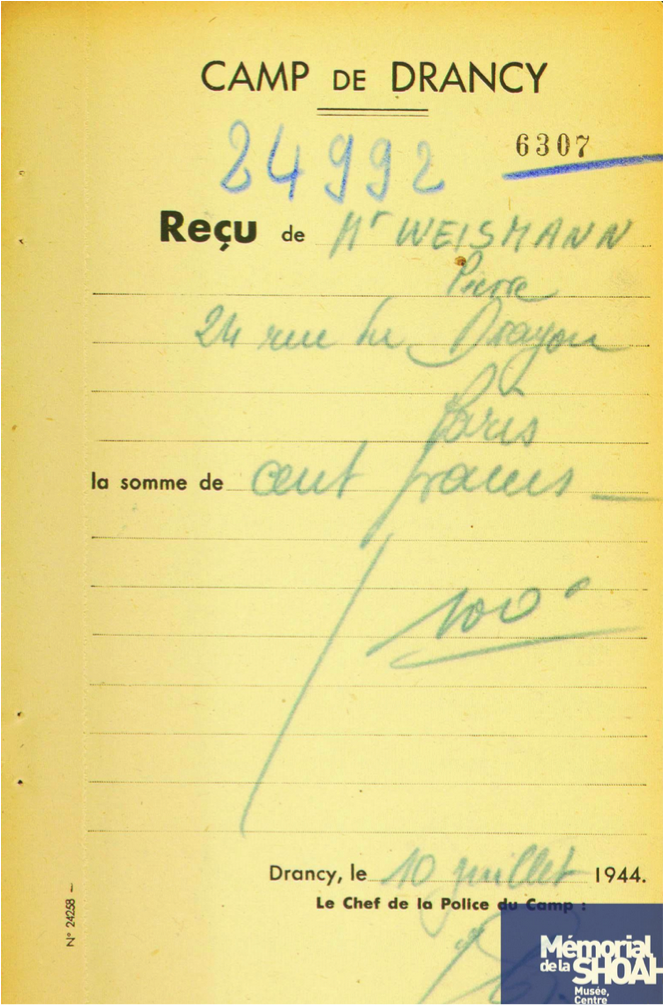
Pierre WEISMANN (Paris, 1898 – Auschwitz, 1944)
The years leading up to the Second World War
A boy from a wealthy family, whose father was a doctor
Pierre Jean Weismann was born on August 10, 1898, at his mother’s home at 141 boulevard Magenta, in the 10th district of Paris[1]. As his parents were not married, his surname was registered as Jovy, which was his mother’s maiden name.
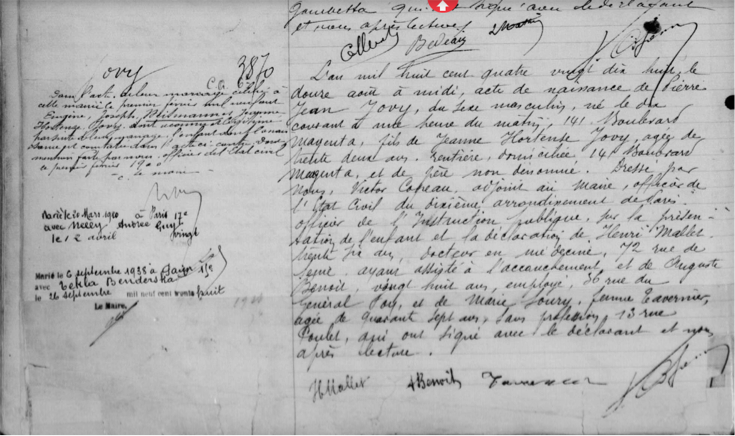
Pierre Jean Weismann’s birth certificate. He was born on August 10, 1898 in the 10th district of Paris and was registered in his mother’s maiden name, “Jovy”, since his parents were not married. His rather officially recognized Pierre as his son two years later. Paris departmental archives
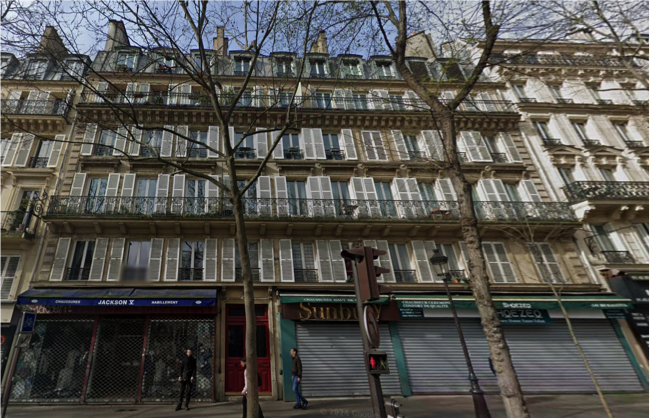
141 boulevard Magenta, in the 10th district of Paris, where Pierre Weismann was born. Google Maps
His parents were Jeanne Hortense Jovy, a woman of independent means, who was born on July 3, 1866, in Cambrai, in the Nord department of France, and Eugène Joseph Weismann, a pharmacist and surgeon, who was born on May 17, 1860, in Chatou, in the Seine-et-Oise department[2]. Eugène qualified as a doctor of medicine on May 4, 1893, and worked on Boulevard de Courcelles. In 1897, he had his own practice at 36 Rue du Général-Foy, according to the Paris Police Headquarters’ register of physicians in Paris[3].
Pierre was the third of five children. Andrée Jeanne Weismann was born in 1894, followed by Eugène Edmé Weismann in 1896. Jean Marcel and Jeanne Esther Weismann, who were twins, were born a year after Pierre, on December 5, 1899, also in the 10th district of Paris.
Eugène and Jeanne were married in the town hall of the 10th district of Paris on February 1, 1900. As a result, all their children became legitimate.
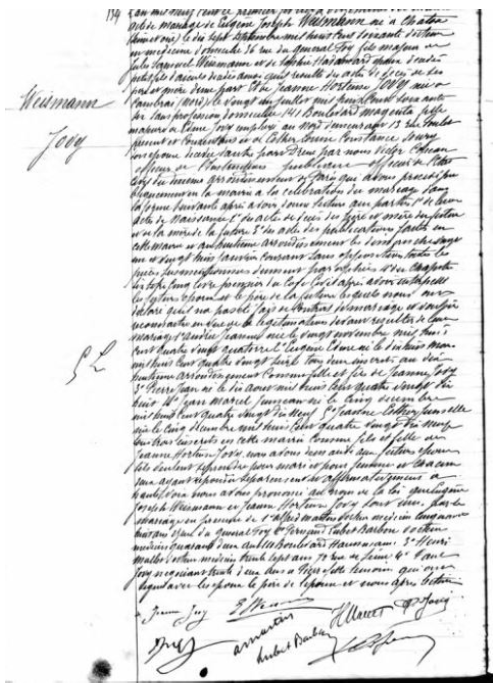
Eugène Joseph Weisman and Jeanne Hortense Jovy’s marriage certificate, issued on September 1, 1900, at the town hall of the 10th district of Paris. ©Paris city archives
In 1903, Eugène was among a group of creditors (to the tune of 100,000 francs) in the Humbert insolvency case[4], which was one of the biggest financial scams of the time in France and was widely reported in the newspapers. Georges Weismann, one of Eugène’s brothers, also lost money. Eugène was living at 91 Rue Saint-Lazare at the time, so we can assume that Pierre was living there too[5].
Despite this setback, the family continued to live a carefree and affluent life. In July 1914, it was reported that Pierre, Jean, Eugène, and Jeanne competed in the Cabourg garden tennis tournament[6]. Eugène won the men’s final. According to a description given by a family friend in 1945, Pierre was tall, with blond hair and blue eyes, which is consistent with the description given in his military service record.
In 1914, however, when the First World War broke out, the family’s life, along with the lives of everyone else in France, was turned upside down.
The First World War
In September 1914, Pierre’s brother Eugène, who was 18 years old, had just graduated from high school, and was working as a bank clerk, joined the army. Although he was seriously wounded in the legs and had to have one of his feet amputated [7], he refused to be discharged on medical grounds and managed to get transferred to the Air Force. He then became a “flying ace,” and was credited with having downed seven enemy aircraft.
In late 1916, soon after he turned 18, Pierre too was called up for military service. Over the next three years, he took part in several campaigns against Germany and was enrolled as a cadet on March 25, 1918. His military record states that he was a student. He was 5’10” tall, with blue eyes and brown hair. He was promoted to the rank of corporal in August 1918, and then to sergeant a month later. He was demobilized on November 10, 1919.
Pierre was away on business in Tunisia at the time, staying at the Palace Hotel in Tunis. He returned to France in April 1920 and moved back in with to his parents. He was awarded the Victory Medal and the Great War Commemorative Medal.
In December 1918, his father, a renowned physician in Paris and president of the French Society of Otorhinolaryngology, was awarded the Legion of Honor for outstanding service during the war[8].
Marriage, children and divorce
On March 20, 1920, Pierre married Nelly Andrée Guy in the town hall of the 17th district of Paris. They were 21 and 19 years old respectively.
Nelly was born on January 14 1901, in Bone, in the Constantine region of Algeria, where she lived with her parents, who were winegrowers. Perhaps Pierre met her during his time in northern Africa in late 1919? At the time, she was living off an income from her parents’ estate, and her father was a colonial official. As for Pierre, he was working on the Paris Stock Exchange and living with his parents and siblings at 72 Boulevard de Courcelles in the 17th district of Paris. The witnesses at the wedding were Andrée and Eugène Weismann, who was described as an “aviation officer, recipient of the Legion of Honor, a military medal, and the French War Cross.”
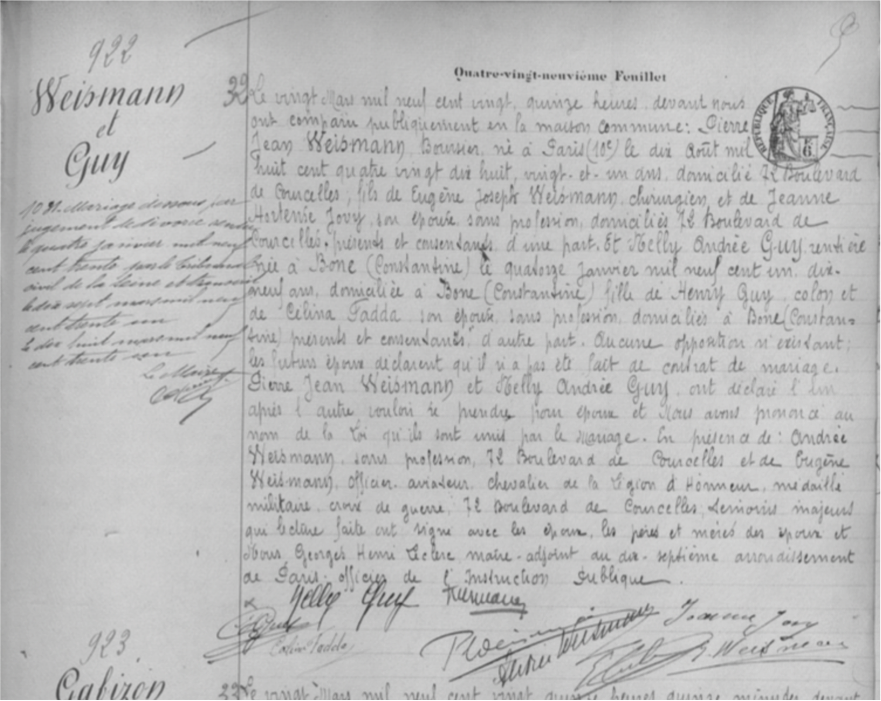
Pierre Weismann and Nelly Guy’s marriage certificate, issued at the town hall of the 17th district of Paris on March 20, 1920. ©Paris city archives
The couple moved in with the Weismann family and had their first child, Jean Claude Weismann, less than a year later, on February 24, 1921[9]. By the time their next child, Liliane Andrée Weismann, was born on November 2, 1923, the family had moved to boulevard de Villiers in Neuilly-sur-Seine, west of Paris.
A correction to his military service record states that Pierre became a car salesman at some point. In the 1920s, his brother Eugène founded a firm in the Paris area that specialized in importing American cars[10]. It appears that he hired his brothers to work with him, at least occasionally.
In 1926, Pierre notified the military authorities that he was living at 1 Rue Mizon, in the 15th district of Paris. Was his marriage to Nelly already in trouble by then? In any case, the marriage ended on January 4, 1930, with a divorce ruling in the Seine court.
Nelly, who was an opera singer, got married again on July 25, 1936, and Pierre’s sister, Jeanne Esther Weismann, was one of the witnesses at the wedding.
Enlistment in the French Foreign Legion
On January 5, 1931, Pierre enlisted in the French Foreign Legion. He gave his real name but declared himself to be a Belgian citizen, although the reason for this remains unknown. Was he able to attend his mother’s funeral? It seems unlikely. She died on October 14, 1931, and was buried in the Saint-Ouen Cemetery in Paris. He was first sent to Algeria, then to Morocco, and then back to Algeria to take part in various military campaigns. He served in various Zouave light infantry regiments, and subsequently in a number of colonial infantry regiments. He was finally “discharged from service” and “removed from the army rolls” on January 5, 1936, after having been promoted to corporal in March 1933. He was awarded a certificate of good conduct. A note on his military service record, which states that he claimed to be a Belgian national, explains that according to a ministerial decision dated April 22, 1936, his service in the Foreign Legion was to be attributed to his ”true civil identity”[11].
When he returned to Paris in June 1936, Pierre moved to 9 Rue Barye in the 17th district, in the Plaine-Monceau neighborhood. This was the same address at which his mother died. He later went on to live with his two children at 129 Avenue de Villiers, in the same neighborhood. According to that year’s census records, he was working as a publicist.
A second marriage and the birth of a daughter, Annie
Pierre Weismann got married for the second time two years later, on September 6, 1938 in the town hall of the 15th district of Paris. His wife was Tekla Benderska, who was 26 years old and originally came from Warsaw in Poland, where her mother still lived. She was living at 25 rue des Petits-Champs in the 2nd district of Paris, and was not working at the time. As for Pierre, he was living at 30 rue des Morillons in the 15th district. On September 2, 1939, the day on which Great Britain gave Hitler an ultimatum, he gave his address to French army as 46 rue Saint-Louis-en-l’Isle.
In September 1940, they had a baby girl, who they called Annie.
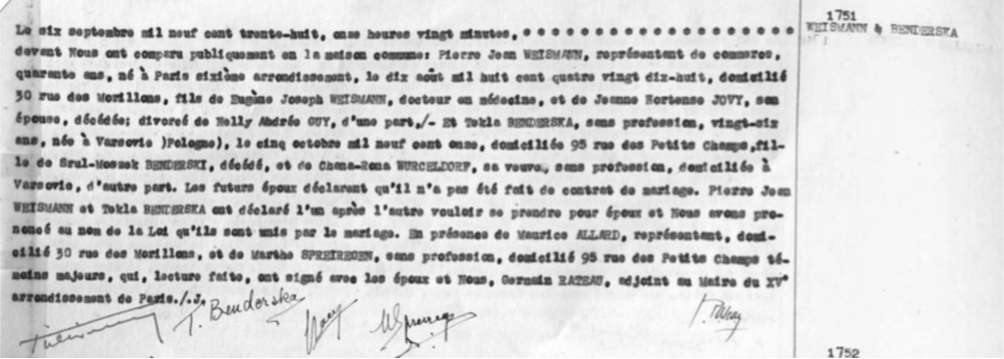
Pierre Weismann and Tekla Benderska’s marriage certificate, dated September 6, 1938 issued by the town hall of the 15th district of Paris. Paris departmental archives
The Second World War and the Occupation
Pierre, who was 41 years old and the father of three children when the war began, does not appear to have been called up, but his military service record includes a reference dated May 8, 1940, to a “special unit.” His brother Jean Marcel was sent to the front on January 24, 1940, and his other brother, Eugène Weismann, a World War I hero and president of the National Federation of Volunteer Combatants, was flying instructor for a while at the start of the war.
Resistance activities and time spent in Germany
The German army had been occupying much of France since June 1940, when the French were defeated and the armistice was signed, and in 1941, Pierre was still in Paris. On September that year, he set off[13] to work for six months as a volunteer at the Kriegsmarinewerft (naval shipyard) in Kiel, Germany. Located in northern Germany and the capital of Schleswig-Holstein, Kiel was one of the country’s main naval ports. Pierre worked there as an inspector, and part of his salary was sent straight to his wife, who had stayed behind in France[14]. According to records held by the French Ministry of Defense Historical Service in Caen, Normandy, Pierre went back to Germany in July 1942. In fact, it was around this time that he applied for a French passport so he could work in Germany. The German authorities granted him the passport, which was issued to him in Kiel on November 11, 1942 which was, somewhat ironically, the very same day on which Hitler’s army occupied the so-called “Free Zone” in the southern part of France.
In October 1942, the Paris Police Headquarters notified the German commander for the Greater Paris region that Pierre had been convicted on four counts of breach of trust (fraud) between 1933 and 1942. In 1938, Pierre had been sentenced to eight months in prison and fined 50 francs as a result[15].
However, a short time later, Pierre was working for the “manpower service”[16] (most likely the General Secretariat for Manpower) on rue de Vaugirard. According to witness statements, he also got involved in resistance activities by running the risk of helping a number of men to evade conscription and/or forging their identity documents so as to prevent them from being sent to work in Germany[17]. As of February 16, 1943, legislation on the STO (Service de Travail Obligatoire, or Compulsory Labor Service) required all young men born between January 1, 1920, and December 31, 1922, to be conscripted to replace workers in Germany who had been sent to fight at the front[18].
Arrest and deportation
On May 25, 1944, the Gestapo arrested Pierre while he was at work. A few days earlier, some German police officers had questioned him in a bar on the boulevard Saint-Germain. The Weismann family was living a short distance away at the time, at 6 rue du Dragon. Jean Labourdette, a bartender, recounted the incident in testimony after the war. He stated that Pierre had managed to escape by playing a trick on them[19]. He had probably been reported for falsifying documents, and although he escaped the first time, he could not evade the Reich police a few days later[20].
According to his wife, officers “thought to be from the French Police” took Pierre to rue des Saussaies, in the 8th district of Paris. “Rue des Saussaies” referred to the headquarters of the German Security Police (SIPO-SD), Section IV of which was the Gestapo[21]. Given the reason for his arrest, it is highly likely that Pierre was indeed taken there.
He was initially sent to the Fresnes prison in Paris, and then on July 10 was transferred to Drancy camp[22] where he was assigned prisoner number 24,992. He was also searched and had to hand over 100 francs, for which he was given a receipt. He was sent to a 4th floor room on staircase 19, where he stayed until before he was deported, when he was moved to the 3rd floor on staircase 2.
Pierre was deported to Auschwitz on Convoy 77 on July 31, 1944. As he was arrested alone, so was not travelling with family, he would have been loaded into a cattle car with other single men (these were referred to as “bachelors’’ cars” in Drancy). We know that at least two of these cars were carrying men (including some Resistance fighters who had just been released from prison in Fresnes or Lyon) who had been given some tools by the Resistance group in Drancy so that they could try to escape. According to Jérôme Skorka[23], a Resistance fighter from Lyon who was on board one of these two cars, and as confirmed by a number of other survivors, the Germans found out about the plan for one of the cars, and the 60 men in it were stripped naked, chained up, and shut in a prison car with no food or water until the convoy arrived at the Auschwitz extermination camp. They were taken to the gas chambers and killed as soon as they arrived. Was Pierre Weismann among the unfortunate men in that “escapees’ car”? Quite possibly. The resistance fighters in Jérôme Skorka’s car, on the other hand, had time to fill in the holes they had managed to dig just before a German soldier came to check. The survivors always felt that someone from Drancy reported them, but this has never been proven.
While there is no record of Pierre Weisman having been in that car, it is almost certain that he was, given that was not selected to enter the camp for forced labor. There is no record of his arrival at Auschwitz in the Bad Arolsen archives, where researchers trace deportees’ movements based on historical records, nor are there any testimonies from survivors who were deported on Convoy 77 or on other convoys.
The quest for recognition after the war
In early 1945, a letter from a Mademoiselle G. Fauquet, a girlfriend of his, reveals how concerned Pierre’s family and friends were about his disappearance. She gave a description of him, explaining that at the time of his arrest he was of “heavy build,” “with a receding hairline, a round face, and still had all his teeth.” He also had a “scar on his right cheek”. She was also the person who believed that Pierre had been reported for forging documents. “Mr. Weismann was denounced because he had helped several young people avoid being sent to Germany. Mr. Weismann is Jewish[24].”
By late 1945, when nearly all the deportees who had survived had either returned home or been located, it became increasingly unlikely that Pierre was ever coming back. It then had to be confirmed that he had indeed deported in the first place, after which he had disappeared. A death certificate could only be issued five years after all the necessary formalities had been completed. This meant that his wife, Tekla, had to compile a case file, including witness statements.
Forged identity documents for people who resisted conscription
In 1947, René and Lucien Maugis, who lived next door to Tekla Weismann in Gentilly, testified that Pierre had been arrested on charges of “providing false papers to those who refused to be conscripted[25].” The documentation was sent to the Ministry of Veterans and War Victims, based at 83 Avenue Foch in Paris, so that a file could be opened on Pierre. A missing person’s certificate was issued on January 19, 1948, and on October 14, 1955, the Civil Court of the Seine ruled that he had died on July 31, 1944. (this was common practice at the time, in cases where a person had been deported and it was not known what had happened to them). The court ruling was then entered into the civil registry at the town hall of the 6th district of Paris on December 29, 1955. However, the “Deaths during Deportation” database of the French Ministry of Defense’s Historical Service lists his date of death as August 5, 1944, in Auschwitz[26]. This date is no more accurate than the first though, as the convoy arrived at the Auschwitz concentration and extermination camp during the night of August 3–4, and many people were taken to the gas chambers immediately. However, in order to simplify the formalities after the war, deportees were deemed to have died five days after the convoy set off from France.
In a letter to Tekla Weismann dated September 7, 1949, Jean Labourdette testified to Pierre’s covert activity: “I know that he did the same for many young people, and in doing so, put himself at great risk [27]”, he wrote. An information sheet compiled by the Ministry of Veterans and War Victims also refers to “forgery of Jewish identity papers”.
In 1956, Tekla Weismann submitted an application to the Interdepartmental Commission of the Seine, a division of the Ministry of Veterans and War Victims, requesting that Pierre be granted the status of political deportee. On February 6, 1958, the ministry reached a decision: the application for the status of political deportee was refused on the grounds that Pierre Weismann had asked for payment for forging documents. According to the official response, he had not acted out of patriotism, but out of a desire for personal gain[28].
On the other hand, Pierre’s file at the Victims of Contemporary Conflicts archives division includes testimonials from several people who expressed their admiration for Pierre’s courage. In a letter dated May 2, 1949, Lucien Maugis described his “invaluable service:” “Thanks to the documentation he found for me, I was able to remain in France and continue living in my own home without hindrance, thus avoiding being deported from February 1944 until the Liberation[29].”
On July 29 of that year, a Mr. Dupuis, one of the Weismann’s neighbors on rue du Dragon, also wrote to Tekla: “I have fond memories of you both, and Mr. Weismann in particular. He was a charming man, and I will always be grateful to him for saving me – and indeed my son-in-law – from being sent to Germany to work in the STO, for which we had been called-up[30].”
The application to have Pierre officially recognized as a Political Deportee – meaning that he was deported for political reasons i.e. because he was Jewish – was resubmitted to the ministry on August 2, 1949.
Even now, many years after Pierre went missing, there are still some grey areas in his life story: given that he was Jewish, how was he able to work for the General Secretariat of Labor, an organization that was part of the Vichy regime? Why did he go to work in Germany voluntarily between 1941 and 1942? Had he forged documents for himself and his family so they could continue living in Paris during the Occupation without fear of persecution? What happened to him after he set off on Convoy 77? Did he die along the way, was he in the “escapees’ car,” or, during the selection, was he deemed unfit for work and murdered as soon as he arrived, even though he was only 46 years old?
So many questions which, for us as well as his family and friends, still remain unanswered to this day.
Notes & references
[1] The doctor who delivered Pierre was a witness at his parents’ wedding. Another of the witnesses worked at the same place as Pierre’s father, at 36 Rue du Général-Foy. His father’s name is not on the birth certificate because his parents were not married at the time.
[2] Eugène’s father, Judas (known as Jules) Samuel, was born in Mainz in 1824 and died in 1886. His mother, Sophie Hadamard, was born in Paris in 1834 and lived there until her death in 1885.
[3] In his request to be awarded the Legion of Honor in 1918, Eugène-Joseph Weismann stated that, aside from his position as a consulting physician for the Post and Telegraph Office and the Ring Railway, he was joint director of a free clinic for laryngeal and ear diseases. He was made a Knight of the Legion of Honor according to a decree dated December 30, 1918, issued by the Ministry of War.
[4] Le Matin, November 18, 1903.
[5] We were unable to determine which schools he attended.
[6] Les Nouvelles, July 23,1914.
[7] It was his own father who amputated his foot, at the Saint-Lambert hospital in Paris.
[8] A distinction that became particularly poignant when the anti-Semitic legislation was enacted in 1940 and 1941.
[9] He died in 1957, at the age of 36.
[10] David Méchin, The WWI French Aces Encyclopedia, vol. 8 : Santelli to Wertheimer, Aeronaut Books, 2021, 298 p. (ISBN 978-1-953201-37-9), p. 186-191 (source Wikipedia)
[11] Pierre Weismann’s military service record, 6th recruitment office, army number 2217, Paris archives, ref. D4R1 2146.
[12] Tekla (sometimes spelled Tecla) was born on October 5, 1911, in Warsaw, Poland. According to a register in the “Moscow File” held at the French National Archives, the National Security Service kept a file on her (1937–1938), reference number: 19940434/226 File 18746. Her mother’s name was Chena-Rona (Anna) Wurceldorf, and she lived in Warsaw. Her father, Srul-Moszek (Raoul Michel) Benderski, had already passed away by the time she got married in 1938.
[13] We have no information about how Pierre reacted to the rise of anti-Semitism and the anti-Jewish measures taken by the Germans and the Vichy government. It is unlikely that he registered himself as Jewish. His mother was likely non-Jewish, which would have made him a “half-Jew,” but still required him to register. His father, who was still alive and had been awarded the Legion of Honor for military service, was among the Jews who were granted an exemption allowing them to continue practicing as a physician (he died in 1943, and an obituary was published in the national press). It is highly likely that Pierre wanted to go into hiding and succeeded in concealing the fact that he was Jewish so went to the place where he was least likely to be suspected: Germany. It is also likely that his wife was Jewish, and that as a result, his young daughter was also considered “Jewish” under the l legislation at the time. His brother Eugène Weismann joined a resistance network in Neuilly. He took part in the liberation of Paris at the Les Forces françaises de l’intérieur (Free French forces of the interior) headquarters in western Paris. In September 1944, he volunteered to return to service and was appointed a liaison officer, but in 1945 he flew reconnaissance missions over Germany.
[14] Uberweisungsshein (receipt) n°5, dated September 12, 1941, cf. File on Pierre Weismann, Victims of Contemporary Conflicts Archives Division of the French Ministry of Defense Historical Service, ref. 21 P 275 746.
[15] Note from the Paris Police Headquarters to the German commander of Greater Paris, dated October 12, 1942. It was registered on October 23, ibid.
[16] As stated Tekla Weismann’s 1947 request to update the civil status of a “non-returned person”, cf. ibid.
[17] See the section about the post-war years.
[19] Interview with Jean Labourdette on October 27, 1956, conducted by Jack Zirnhelt as part of the application for the status of political deportee. File on Pierre Weismann, Victims of Contemporary Conflicts Archives Division of the French Ministry of Defense Historical Service, ref. 21 P 275 746.
[20] File on Pierre Weismann, Victims of Contemporary Conflicts Archives Division of the French Ministry of Defense Historical Service, ref. 21 P 275 746.
[21] The German Gestapo was backed up by the “French Gestapo,” also known as “La Carlingue,” whose offices were based at 93 Rue Lauriston in the 16th district of Paris.
[22] The Drancy transit camp was used to hold Jews of all ages and backgrounds who were scheduled for deportation. It was run by SS officer Aloïs Brunner. Shoah Memorial Archives.
[23] Jérôme Skorka / Scorin, L’Itinéraire d’un adolescent juif de 1939 à 1945, self-published.
[24] Letter from Miss G. Fauquet to an unknown person. File on Pierre Weismann, Victims of Contemporary Conflicts Archives Division of the French Ministry of Defense Historical Service, ref. 21 P 275 746.
[25] Signed statement by Lucien Maugis dated February 22, 1946. File on Pierre Weismann, Victims of Contemporary Conflicts Archives Division of the French Ministry of Defense Historical Service, ref. 21 P 275 746.
[26] memoiredeshommes.sga.defense.gouv.fr
[27] Letter from Jean Labourdette to Tekla Weismann dated September 7, 1947. File on Pierre Weismann, Victims of Contemporary Conflicts Archives Division of the French Ministry of Defense Historical Service, ref. 21 P 275 746
[28] Decision of the Ministry of Veterans and War Victims, Seine Departmental Commission, dated April 2, 1957, and notified to Tekla Weismann on February 6, 1958. File on Pierre Weismann, Victims of Contemporary Conflicts Archives Division of the French Ministry of Defense Historical Service, ref. 21 P 275 746.
[29] Letter from Lucien Maugis to Tekla Weismann dated May 2, 1949. File on Pierre Weismann, Victims of Contemporary Conflicts Archives Division of the French Ministry of Defense Historical Service, ref. 21 P 275 746.
[30] Letter from Ghislain Dupuis to Tekla Weismann dated July 29, 1949. File on Pierre Weismann, Victims of Contemporary Conflicts Archives Division of the French Ministry of Defense Historical Service, ref. 21 P 275 746.


