Français
 Polski
Karl GUTMANN (1892–1944)
This biography was written by Sara, Yasmin, Mia, Anisa and Alina from the Goethe Gymnasium Germersheim in Germany, supervised by Philipp Steul, and the 9th grade students from the Servites de Marie school group – the Saint Louis middle school and the Blanche de Castille high school – in Villemonble, in the Seine-Saint-Denis department of France, with the guidance of Tiffany Lobjois.
Karl Gutmann was born on either December 12 or December 16, 1892, in Alzey, in the Rhineland-Palatinate region of Germany. He was a merchant.
Karl, who was Jewish, encountered the rising tide of Nazi-era anti-Semitism very early on. Before the Second World War, he lived in Lyon, in the Rhône department of France, but by the time he was arrested, in June 1944[1], he was living in the Reynold Hotel on avenue du parc Monceau in the 17th district of Paris.
Persecuted in Germany
Karl Gutman married his first wife, Rosalie Annie Koller, in the Charlottenburg quarter of Berlin, Germany, on March 20, 1923, when he was 30 years old[2].
On December 1, 1931, by which time he was 38, he married his second wife, Annelise Moser, who was born in Berlin on November, 1905[3]. They were married in Berlin-Wilmersdorf, which is where Karl was living.
When the persecution began in Germany, Karl Gutmann was soon identified as a Jew and interned in the Sachsenhausen labor camp from November 30, 1938, to January 18, 1939. There is a record of this in the Red Cross archives[4].
This type of internment was referred to as Schutzhaft (preventive detention)[5]. The Nazi regime used it as a way of controlling its opponents. The official reason was to prevent crime, but in reality, most of the people who were detained had done nothing illegal. They were simply people who were not wanted in Nazi society: Jews, political opponents, Sinti and Roma.
France, a safe haven?
In common with many other German Jews, Karl Gutmann believed that France would be a safe haven. By the time the Second World War broke out in September 1939, most German Jews who had not been interned in camps or deported had already fled to other countries. Between 1939 and 1941, Jews were stripped of their assets and, in many cases, had also lost their jobs. Life in Germany was becoming increasingly difficult for them. Then, in 1941, the government became even more extremist, and all Jews were obliged to wear the yellow star. The first deportations took place at around the same time.
There is no record of when Karl arrived in France or whether he did so legally, but the Paris Security Police kept a file on his wife, Anneliese, which dates back to 1937[6]. Might they have moved to France together?
Before the war, Karl lived at 5 Rue de la Fromagerie in Lyon, in the Rhone department of France, at least according to Marthe Kann, who was living in Cahors, in the Lot department, in January 1947. Karl’s mother, Babette Gutmann, née Kahn, who was then living in the United States, at 5405 Ingelside Avenue, Chicago, Illinois, asked Marthe Kahn to try to find out what had happened to her son. The last time she had heard from him was on September 14, 1942. In addition, a letter she sent him in August 1942 was returned to her in January 1943 with the words “opened by examiner” written on it. This goes to show how international mail was intercepted during the war. Marthe Kann’s letter says that after the Germans took over control of the “southern zone” from the Vichy government, Karl Gutmann sought refuge in Cannes, on the south coast of France. Marthe had heard that he had gotten sick and died. Other sources, however, suggest that he moved to Paris.
Karl’s wife, Anneliese Gutman[7] was deported on Convoy 34 on September 18, 1942. Her internment record from Drancy camp states lists her address as 14 Rue Buffet in Paris. Sadly, her name had been crossed off the deportation list at some point, but then the word “bon” (good) was added, which meant she was deported after all[8]. She was later officially declared to have died on September 23, 1944.
Karl’s last known address was 6 Avenue du Parc Monceau, which was an upmarket hotel, the Reynolds. He was arrested there in June 1944.
Arrest and deportation
After Karl was arrested, he was interned in Drancy camp on June 6, 1944. When he arrived in the camp, he was assigned prisoner number 23,680 and had to hand over a sizable sum of money, 56,421 francs, along with a rare stamp collection. He was alone at the time; the records make no mention of anyone else who might have been with him.
Drancy was a transit camp for prisoners who were to be sent to Auschwitz. Jews from all over France were transferred there, often by train, and held prisoner until they were deported. The camp was just north of near Paris, in an unfinished low rent housing development called La Cité de la Muette. Living conditions in the camp were appalling: there was not enough food, no medication and no proper sanitary facilities. The camp was also overcrowded, so disease spread quickly. Prisoners found it very tough, both physically and mentally. Drancy camp was liberated on August 18, 1944, but Karl Gutmann was no longer there to see it happen. He was deported on Convoy 77 to Auschwitz on July 31, 1944, just as the Allies were nearing the city.
Convoy 77 was the last large convoy to depart from the nearby Bobigny station. There were 1306 people aboard, including a two-week-old baby who had been born in the camp and many children and seniors, some of whom were over 80 years old. They had been brought in from all over the country and many of them had originally emigrated to France from elsewhere in Europe, Algeria and Turkey. They also included a large number of children and teenagers who had been rounded up in children’s homes in and around Paris, having been placed in the care of the U.G.I.F. (Union Générale des Israélites de France, or General Union of French Jews), an organization founded by the Nazis and the French collaborationist government led by Philippe Pétain. In addition, in order to make up the numbers for this last major “transport” of prisoners, a group of Resistance fighters were transferred out of Fresnes prison. Jewish Resistance members, other that some who were shot, were for the most part deported on grounds that they were Jewish, rather than for their involvement in the Resistance.
There is no further record of what happened to Karl Gutman after the train left Bobigny. As he was not travelling with family, the Nazis loaded him in one of the “bachelors’” cars, which they used to transport single men in order to monitor them more closely. Was Karl travelling in the car from which the men tried to escape? These men were most likely reported to the German guards, who identified them along the way. They were then stripped naked, moved to a “prison car” at the front of the train and locked in with no food or water until they arrived in Auschwitz, where they were sent straight to the gas chambers. Or, given his age, was Karl not selected to enter the Auschwitz camp to work but instead suffered the same fate as the men who had attempted to escape?
The search for Karl after the war
After the war, Karl’s mother tried to find out what had happened to him. Aside from the request for information made by Marthe Kann, who lived at 28 Boulevard Gambetta in Cahors and who was probably a relative, given that Karl’s mother’s maiden name was Kahn, Karl Gutmann is also named in a letter dating from 1956. It was from the United Restitution Organization, which was based at 19 rue de Téhéran in the 8th district of Paris and in Berlin-Wilmersdorf, and provided assistance to Nazi victims and their families after the war, in particular with regard to the restitution of looted property. F. Herzfelder of the URO carried out a search[9].
In January 1947, the Civil Status Office for Deportees in Paris sent Karl’s mother, Mrs. Babette Gutmann, who lived in Chicago, the following information: his date of birth, his last known address, and the date on which he was deported[10] but said nothing about his death.
Karl Gutmann’s fate, like that of so many other people, remains shrouded in mystery. However, it is a stark reminder of the brutal persecution inflicted on Jews in Europe during the Holocaust.
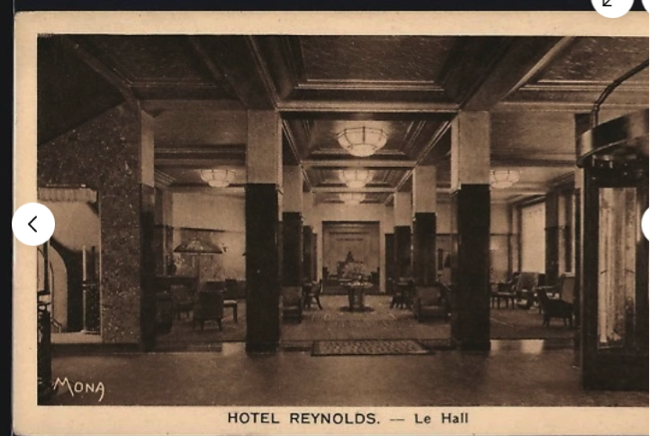
The Reynolds Hotel, Karl Gutmann’s last known address.
Copyright: All rights reserved
Notes & references
[1] File on Karl Gutmann, Victims of Contemporary Conflicts Archives Division of the French Ministry of Defense Historical Service, in Caen, dossier 21P 460710.
[2] tmp_1751021312589 (ancestry.de)
[3] tmp_1751021780596 (ancestry.de)
[4] IST. KLSachsenhausen 30-11-1938 – 18 -1 -1939. Lagger Orienburg.
[5] File on Karl Gutmann, Victims of Contemporary Conflicts Archives Division of the French Ministry of Defense Historical Service, in Caen, dossier 21P 460710.
[6] Moscow collection, French National Archives, ref: 19940462/526, dossier 51640.
[7] Anneliese Moser’s parents were Ernest Moser and Gertrude Moser née Hoffmann; she had a sister, Edith, born in 1907. She came from an upper-class Jewish background. https://collections.ushmm.org
[8] Shoah Memorial website, record relating to Aneliese Gutman (note, Aneliese with only one N)
[9] The surname Herzfelder is also listed as that of a Sonja, who was married to a Karl Max Gutmann, born in the Rhineland-Palatinate in 1897. Might they have been related to “our” Karl?
[10] File on Karl Gutmann, Victims of Contemporary Conflicts Archives Division of the French Ministry of Defense Historical Service, in Caen, dossier 21P 460710.