

 Français
 Polski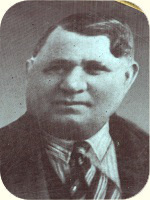
Schabse FANCHEL
Schabsé Fanchel and his family, 1880-1944, Convoy 77
Photo of Schabsé. Source: P. Deweerdt
This second version of the Fanchel family’s story was inspired by several new discoveries. Firstly, the application we filed with the C.I.V.S. (French Commission for the Compensation of Victims of Expropriation) in February 2025 is still under review. We needed to carry out further research and to provide additional details to the commission. Secondly, this research led to a series of meetings that expanded our knowledge of the Fanchel family. Lastly, the discovery of a particularly relevant archive box shed more light on their story.
Here, then, is a significantly revised version of Schabsé’s biography.
In the winter of 2004, 21 years ago, I asked Ida Grinspan to come and speak to my ninth-graders. At the time, I was a young history teacher at a suburban middle school.
During her visit, Ida spoke with one of my students, Andersen Nshimiye, a 19-year-old Tutsi miner who had lost his father, who was killed in Rwanda, and whose family had become scattered.
They talked at length, both survivors of contemporary genocide.
For several years now, as someone passionate about microhistory, I have carried out projects with my students—often in collaboration with my colleague Aurélie Trinkwell—focused on local history: initially on the First World War as part of its 100th anniversary, including, for example, the story of the last Brévannes war veteran and the link between family memory and the war. Next, we focused on the French Resistance in the town, as Brévannes and the Emile Roux Hospital were home to many resistance fighters and communists, some of whom have had streets named after them: Pierre and Angèle le Hen, Jean-Marie Prugnot, Marie le Naourès, Marius Dantz, and many others. While researching the Emile Roux Hospital, my husband and I compiled a database of people deported from Brévannes. More recently, we began working with Convoy 77 and the Fanchel family, which involved extensive research in various archive collections both in France and internationally. Our research into the Fanchel family gave us the opportunity to analyze data and explore specific issues using artificial intelligence powered by a “deep research” function[1], which we then cross-checked and compared with existing sources. This inevitably opened up new avenues of research and shed new light on various aspects of the Fanchel family’s story, particularly their migratory journey, as we gained access to Ukrainian records. We shall come back to this later on.
Between October 2024 and January 2025, the students from class 4eC worked on the biography of Schabsé Fanchel, a father of nine, who was deported on Convoy 77, the very same convoy that led to the death of Ida Grinspan’s father. I wanted to share with the class the results of several years of research, not only to help them become familiar with the methodology of searching for archived records, but also to engage with the history of their local area and see it in the context of migration on a global scale.
It was also, in a way, about preserving the history of the Fanchel family, as none of its members are still alive. Claire Podetti refers to this as “reverse restitution”, meaning piecing together the story of a family after all the family members have died.
The question the students were asked to address as part of the project was:
How might past and present migratory patterns and people’s individual journeys help us better understand our local area?
In 2019, the Convoy 77 project team sent me three names: Nathan Potzeha, Regina Potzeha and Schabsé Fanchel.
Nathan and Regina’s names[2]are inscribed on the local war memorial, with the words “who died as deportees in Auschwitz, ensuring that the memory of the crimes committed there will forever be condemned by future generations”.
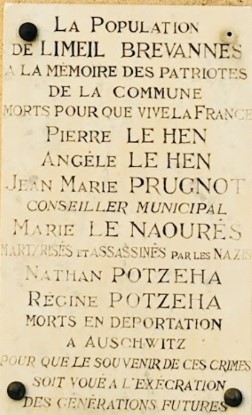
Source: Geneanet
Schabsé, however, is not listed.
His story, and that of his family, reflect the migratory journeys of many Ashkenazi families who were driven out of Eastern Europe due to anti-Semitism.
Schabsé: An immigrant who sought refuge from anti-Semitism
Schabsé Fanchel (the father of the family), was born on March 5, 1880 in Schornmans (or Schorniansk) in Bessarabia, in present-day Ukraine.
He arrived in France with his parents, Mathous Fanchel and Hona, or Anna, Tokar[3]. In 1936, his mother was living at 27, rue des Jardins Saint-Paul in Paris[4].

Source: 1936 census, Paris city archives
Hona (also known as Anna and Chana) spent her days living on Avenue Alery in Brévannes, where she died and was buried in the Bagneux Cemetery in late summer 1940.

Source: Paris city archives
Malak, Salimata and Malha’s comment:
The person referred to in the record is Chana Tokar. It states that she died. We learned that Chana was born in Russia and died in August 1940. She was Schabsé’s mother.
Schabsé’s dream of moving to America
Before he decided to settle permanently in France, Schabsé travelled to the United States with his brother Gabriel. They set off from Hamburg on a boat called the Batavia and arrived at Ellis Island on December 31, 1906[5]. The manifest states that Schabsé was 5’10” tall and had black hair and gray eyes. We do not think that Schabsé intended to settle permanently in the United States, as he was headed for New York, whereas Gabriel was going to Glendale, Pennsylvania. Schabsé gave the name of Seindel Jeldmann as a reference, while Gabriel gave Simael Teldmann, which is quite similar. The manifest is in poor condition and difficult to read.
Gabriel, his younger brother, was born around 1885, was 5’7″ tall. He was described as blond with blue eyes, and his face was scarred by smallpox. We still do not know what became of him.
When Schabsé came back to France, he settled in the Marais district of Paris, where he worked in various jobs: as a rubber worker, a fabric and scrap metal dealer, and a porter. He made another trip to the United States in 1912, at the age of 32. He boarded the Kronprinzessin Cecilie in Cherbourg on July 24, and the ship arrived at Ellis Island on July 30. The manifest for this voyage confirms that Schabsé could neither read nor write. He said that he was going to stay with a friend, Mr. Timberg, at 48 Lenox Avenue in New York City. The last time he had visited New York was in 1908.
While searching for Schabsé’s brothers in the passenger lists held at the US National Archives in Washington, D.C., we discovered that in 1962, Schabsé’s eldest daughter, Berthe Odette, also took a trip to the United States.
Pinshus H., one of Schabsé’s four brothers who was a painter, left Bremen on a boat called the Rhin on July 30, 1903, bound for Baltimore. He stated that he was married and was going to stay with his brother-in-law (Mr. Cohen) in Saint-Louis[6]. He was 32 years old at the time.
Back to France and setting up home in the Marais
Schabsé had his first child, Vincent, in 1911. Two years later, in 1913, he married a Polish woman, Rosa Kvartler or Kwartler, who was born in Austria on November 12, 1884.
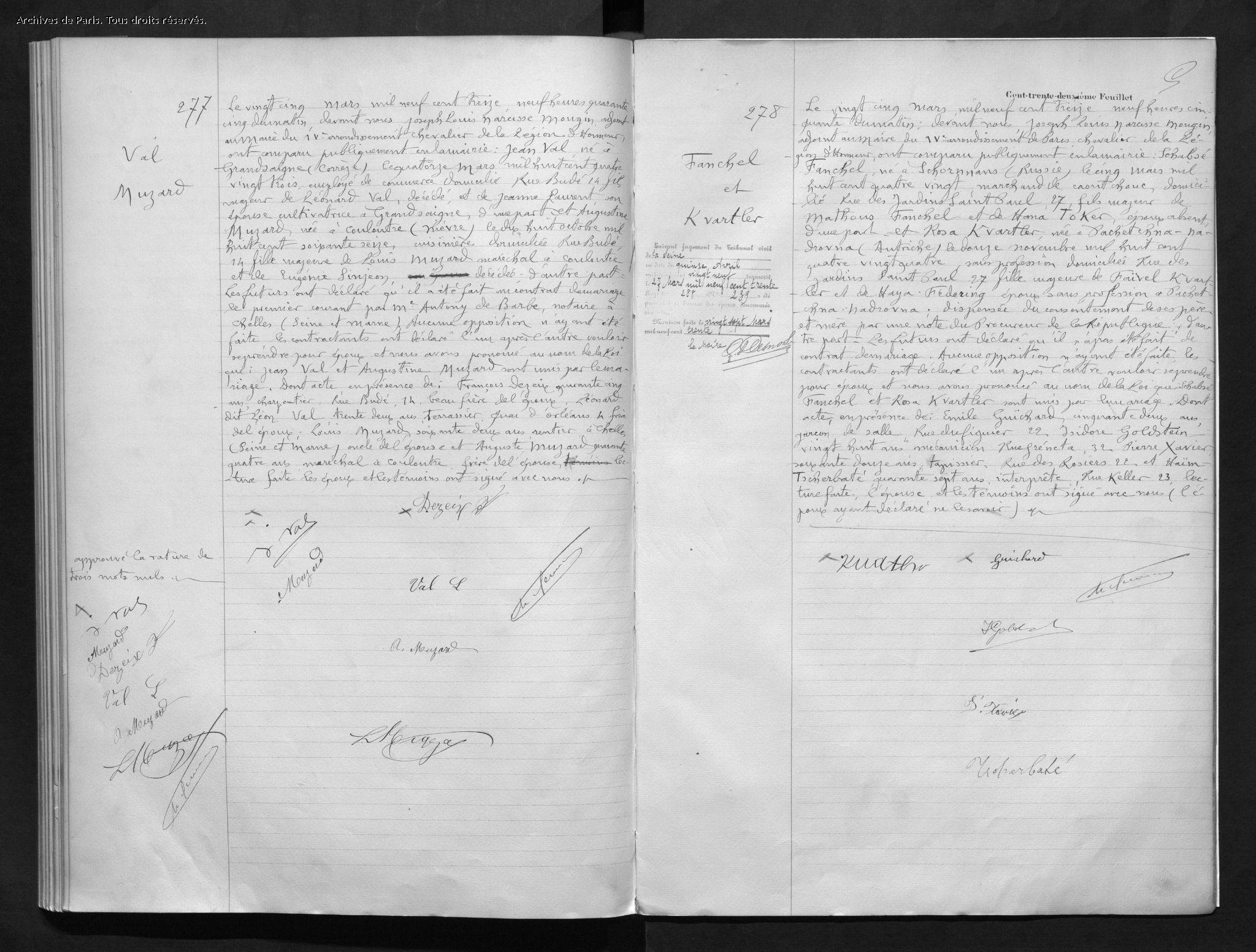
Source: Paris city archives, 1913.
He and his wife must have spoken Yiddish, given that an interpreter was present at their wedding.
Schabsé tried to enlist to fight for France in the First World War. He reported to the 3rd Paris Recruitment Office in August 1914, but was rejected. This fact was noted in his naturalization application file.
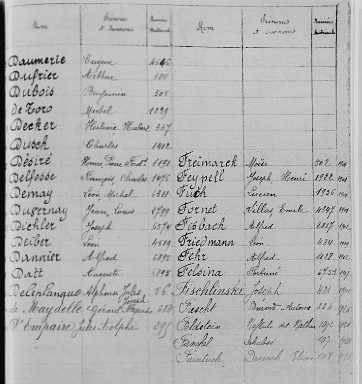
Source: Gallica
According to Esther Benbassa[7] in her book Histoire des juifs de France, (History of the Jews in France), published by Seuil (“Points. Histoire” collection), 1997, p. 251, cited by Anaëlle Riou; From Convoy 77, seven men of Jewish faith and foreign nationality voluntarily enlisted in the French Army or the Foreign Legion during World War I: Barouch Alazraki, Sol Ange, Sigismond Bloch, Joseph Brodsky, Nissim Cambi, Schabsé Fanchel and Maurice Marian.
Philippe-Efraïm Landau’s article on Les Juifs russes à Paris pendant la Grande Guerre, cibles de l’antisémitisme (Russian Jews in Paris during the Great War, targets of anti-Semitism, published in the review Archives juives (Jewish archives) in 2001, sheds light on this: “The mistrust, even underlying hostility, toward the 30,000 Jewish migrants from the Russian Empire living in Paris certainly did not begin with the war. It had been apparent since the previous decade, when they arrived in the capital in large numbers. Like other foreigners, simply registering with the police or the town hall, in accordance with the decree of October 2, 1888, allowed them to reside on French soil, look for work, and integrate...[…]
The Russian Jews, who fled the anti-Semitic policies and violence in the Tsarist Empire, settled in various areas of Paris. Over 60% of these migrants found work in small-scale clothing production—including caps, clothing, and fur—mainly concentrated in the Marais district and, to a lesser extent, in Montmartre. […] Any able-bodied man who was a subject of an Allied power had the choice of returning to his country to serve it, or enlisting in France. As a result, Russian battalions were founded, but although they were popular with the French public, very few Jews joined them. […] Unwilling, clearly, to join the Czarist army, even if only symbolically, they nevertheless expressed a strong desire to serve the country that had taken them in, because France still represented an ideal. Many of them saw the war as just and a means of liberation, and believed it would bring down Russian autocracy, as reflected in this rallying call in August: “We, Russian socialists, let us join the ranks of the French army. The defeat of Germany and Austria will inevitably be a triumph and will strengthen democracy.” […] Once the nation’s citizens had been mobilized, foreigners could sign up to serve voluntarily for the duration of the war by virtue of the decree of August 3. Starting on August 24, several thousand Jews signed up, accounting for approximately 8,500 of the total 31,000 foreigners who enlisted. On the first day, of the 1,560 enlistment requests, around 900 were submitted by Russian Jews. In the capital, 27 enlistment committees were established, each to deal with a particular minority group. Of the four Russian committees, two were set up by Jews. In the heart of the Saint-Gervais district, Amédée Rothstein, Jacques Schapiro, and Haïm Cherschevski founded the committee on Rue de Jarente, which recruited nearly 3,000 people, including 2,000 Russians.
Another article, by Philippe-Efraïm Landau and entitled Frères d’armes et de destin. Les volontaires juifs et arméniens dans la Légion étrangère (1914-1918) (Brothers in arms and in destiny. Jewish and Armenian volunteers in the Foreign Legion (1914-1918)), published in the review Archives juives (Jewish archives) in 2015, explains in more detail what happened to the Russian Jewish volunteers: It was thus on the basis of the war’s promise of emancipation and their deep respect for France that these migrants, despised and massacred in their homelands, rallied together and were prepared to sacrifice themselves for a nation that had treated them, according to Yechiel Kogan, “like its own sons”. As they marched around the Place de la Bastille and the Parisians cheered them on with cries of “Long live the Russians! Long live the Jews!“, several hundred people distributed leaflets in Yiddish and French, in which the enthusiastic crowd could read: “Brothers! Now is the time to pay tribute and show our gratitude to the country where we found spiritual freedom and material prosperity.” […]
In 1923, Schabsé and his wife spent their vacation at the Hôtel de Bagnoles in Tessé-la-Madeleine, a spa town in the Normandy department of France, which goes to show that he was quite well-off:
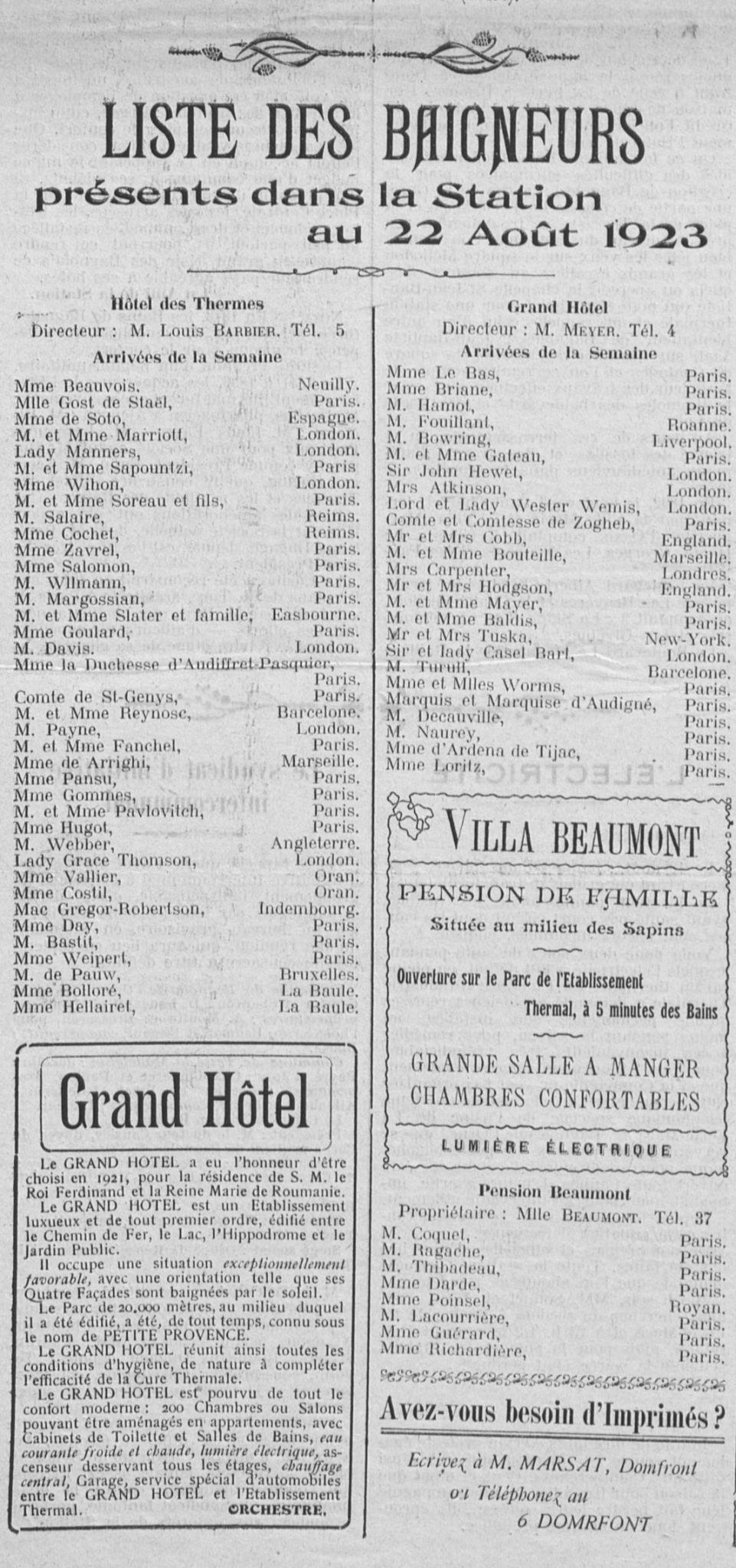
Source Paris city archives
Schabsé became a French citizen
Schabsé was naturalized as a French citizen in 1925, after his previous application was rejected in 1922.
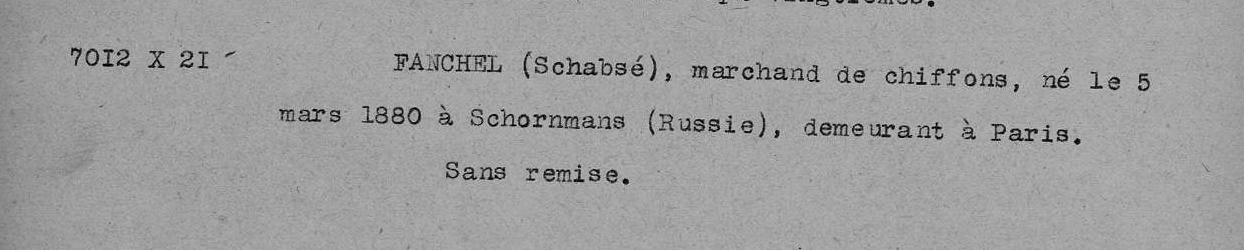
Source: Paris city archives,1925
Fanchel Schabsé, rag dealer, born on March 5, 1880, in Schornmans, Russia, residing in Paris. This confirms that he was naturalized as a French citizen. Source: Paris city archives,1925.
The naturalization application file provides us with a great deal of information: Schabsé and his wife both applied at the same time. Their first application, filed in late 1921, was rejected on the grounds that Schabsé was “of no use to our country.”
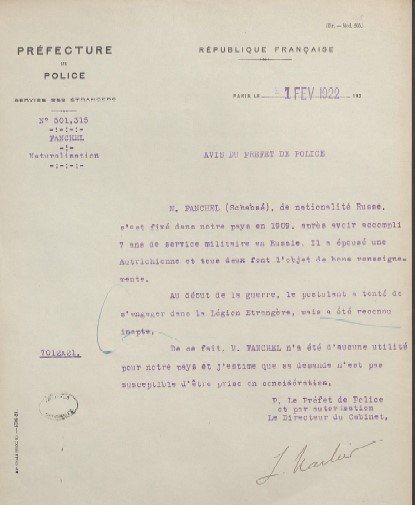
Source: French National archives
The second application, in late 1924, shows that Schabsé was determined to stay in France.
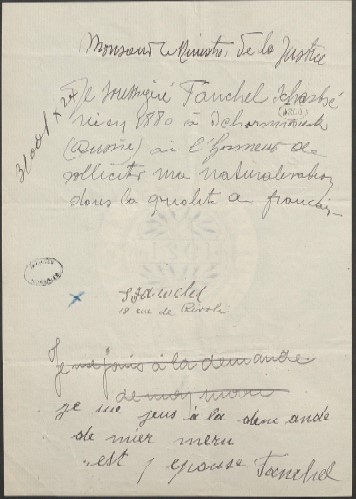
Source: French National archives
By 1924, he was doing well financially, as he paid the highest rate of stamp duty—twice the usual fee of 1,201 francs—and the information he provided about his moral and political views was deemed satisfactory. The financial sections of the two naturalization applications, shown below, illustrate how both his income and assets had increased.
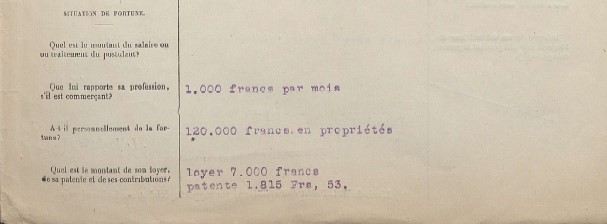
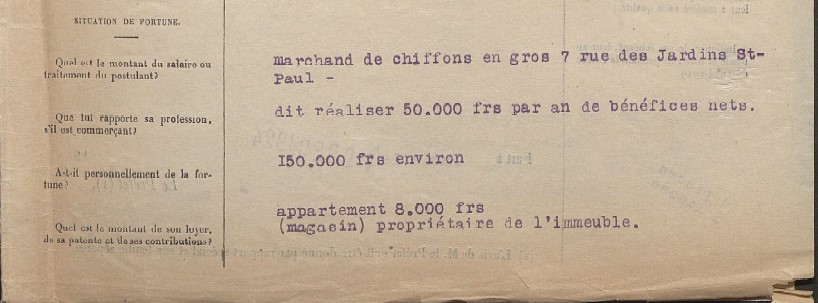
Source: French National archives
His application was therefore approved.
He employed a legal advisor to help him draft documents relating to his business.
After he became a French citizen, he was not required to do his national service. This was because he had been found unfit for duty when he volunteered for the French Foreign Legion at the start of World War I. However, although he was rejected in 1914, he served in the Russian army for seven years.
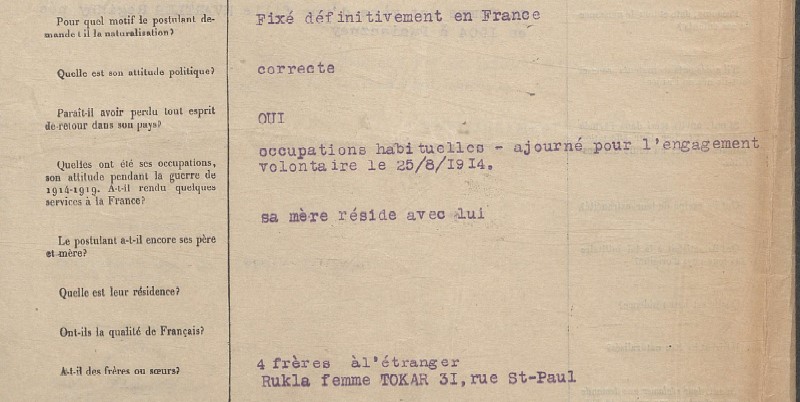
His sister Rachel or Rukla Tokar, who lived at 31 Saint-Paul Street, is also mentioned in the file; we will return to her later. His other sister, Sarah, had died in 1913. It is also noted that he had four brothers who lived overseas, including Manacher, who was a butcher in New York and reportedly fought for the United States during World War I. Manacher, or Menasches, was born around 1887 and boarded the ship Batavia in Hamburg on 22 June 1907, bound for Ellis Island. The manifest states that he was a tailor and was 5’73 tall. It also says that he was travelling to New York to see his brother Schabsé, which confirms that Schabsé was there at the time. We wrote about Gabriel and Pinshus earlier on in the biography.
A prominent figure
By 1926, Schabsé was living at 7, rue des Jardins Saint-Paul in Paris, as shown by an order form for a burial plot in the Bagneux cemetery[8]. He owned the building, as revealed in his naturalization application, and we confirmed this by looking at the land registry records.
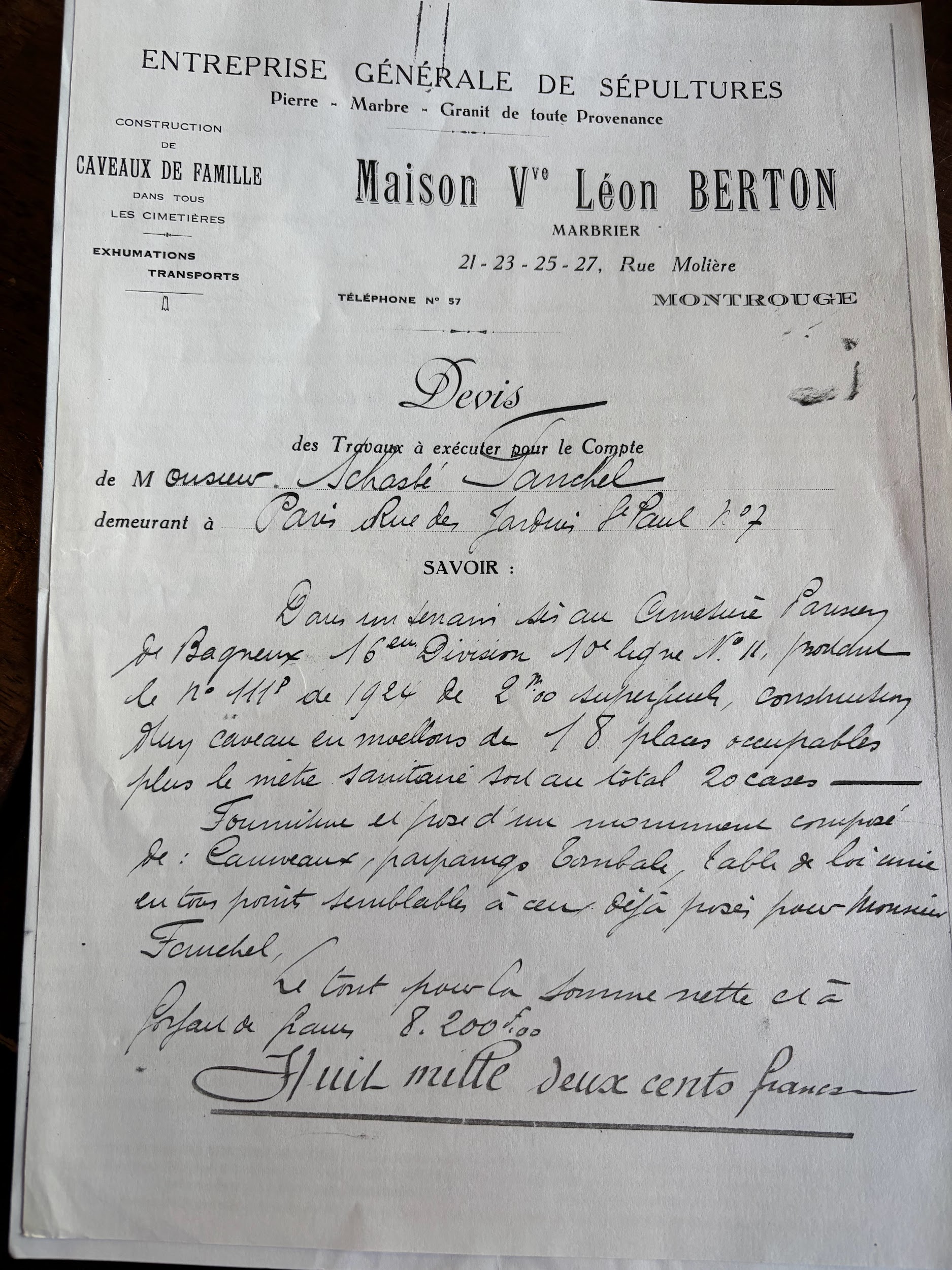
Source: Mr. Journo’s personal collection, published with his kind permission
This grave was most likely commissioned as a charitable project, given that none of his family members are buried in it. There is an inscription that reads “Fanchel vault” on the headstone, and the people who are buried there all died between 1924 and 1926[9].
The Fanchel family has five other plots in section 3 of the Bagneux Cemetery.
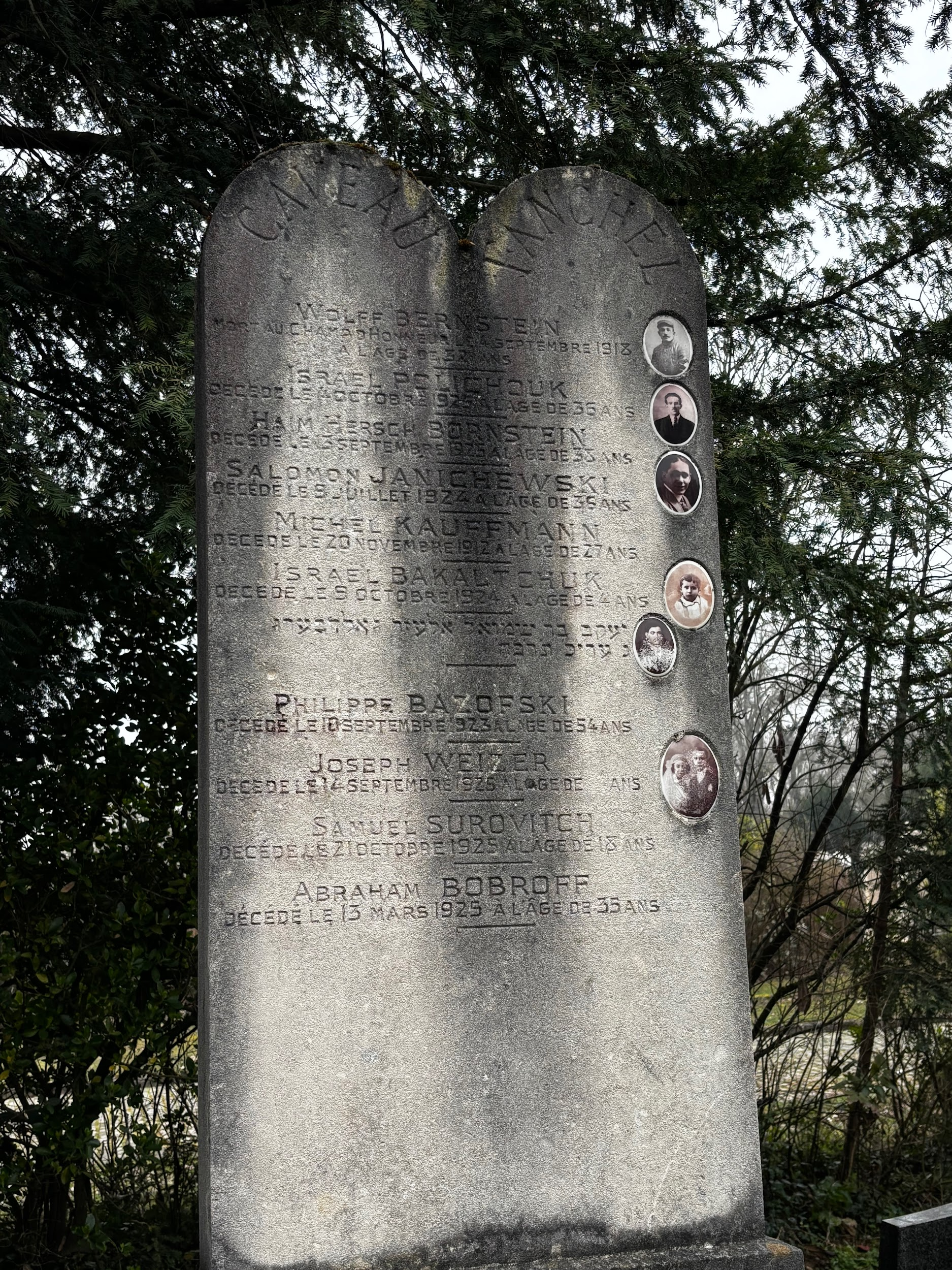
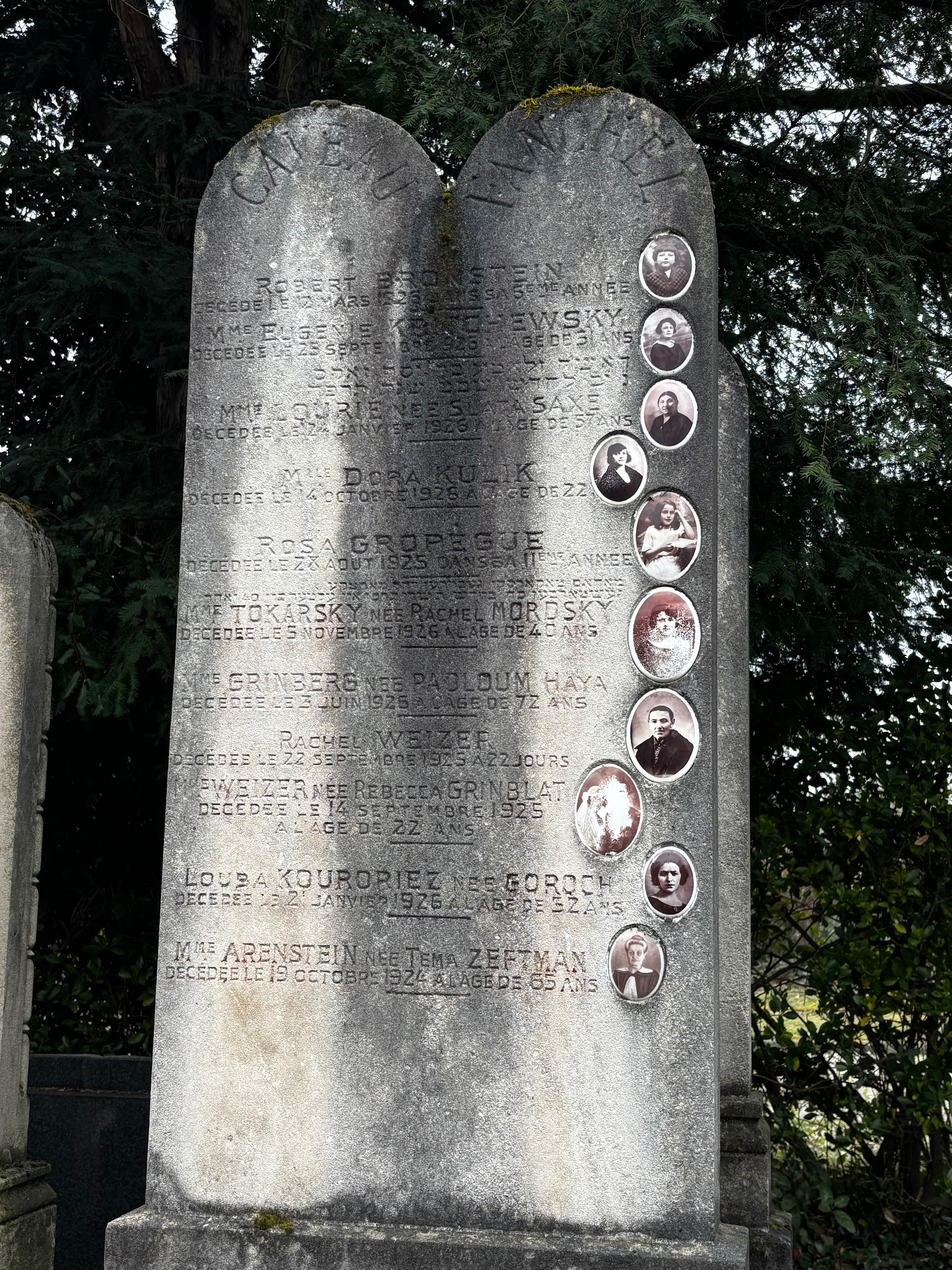
Source: M-A Deweerdt
A complicated marriage
Schabsé and his wife Rosa, lived at several addresses in Paris, and sometimes in more than one at the same time: 27, rue des Jardins Saint-Paul, where Rachel Fanchel and Hana Tokar also lived, then 18, Rue de Rivoli, a high-rent apartment.
His name is on the electoral roll for 1932, so he must have been eligible to vote. At that time, he was living at 43, rue d’Angoulême (now rue Jean-Pierre Timbaud).
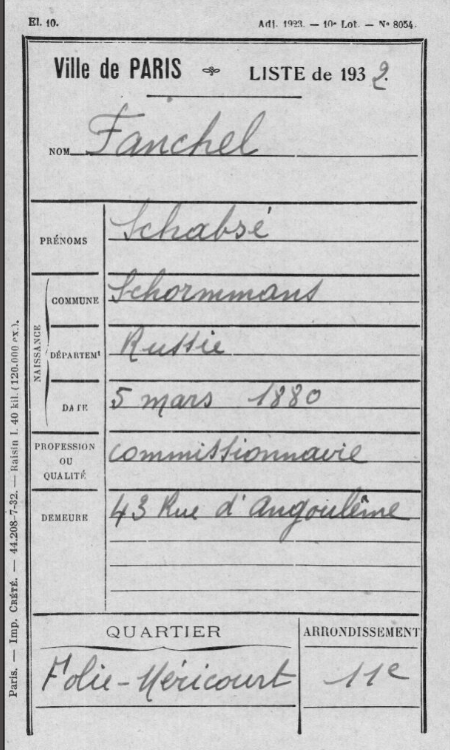
Source: Paris city archives.
Although they were comfortably off, Schabsé and Rosa lost several children: Vincent, Isaac, and a stillborn daughter who they did not name.
Schabsé’s naturalization application reveals that in 1904, his wife, Rosa, had a daughter named Reginy or Regina, and that the father’s identity was unknown.
Regina spent the 1920-1921 Christmas and New Year’s holidays in Paris, during which time Schabsé fell in love with her. Their relationship led to the birth of a baby girl, Berthe Odette on September 30, 1921, in the 4th district of Paris. Regina was just 17 years old at the time. As a result, the French National security agency opened a file on Regina Kwartler in 1922. It is held in the French National archives Moscow collection and includes a letter from her mother, Rosa:
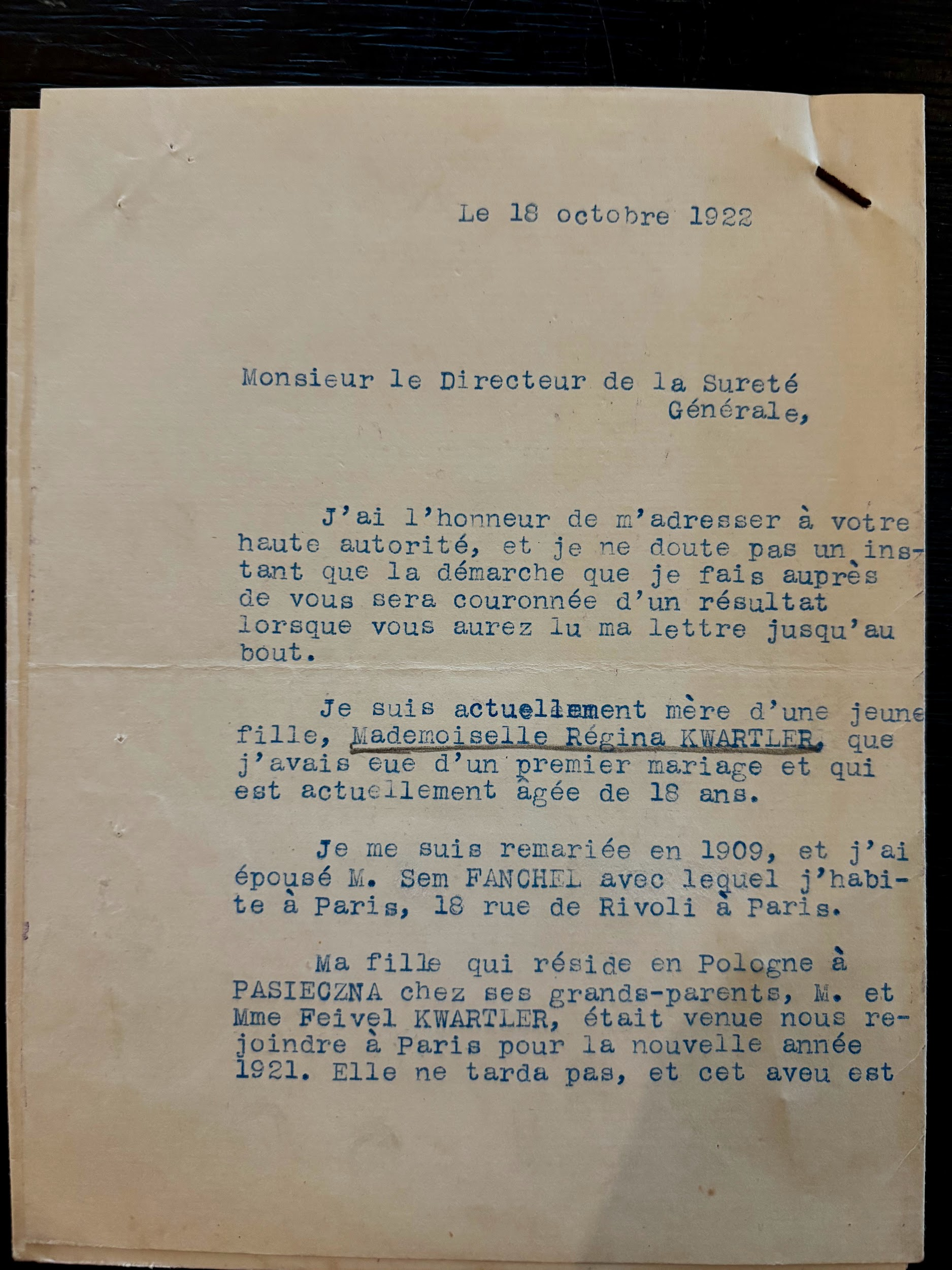
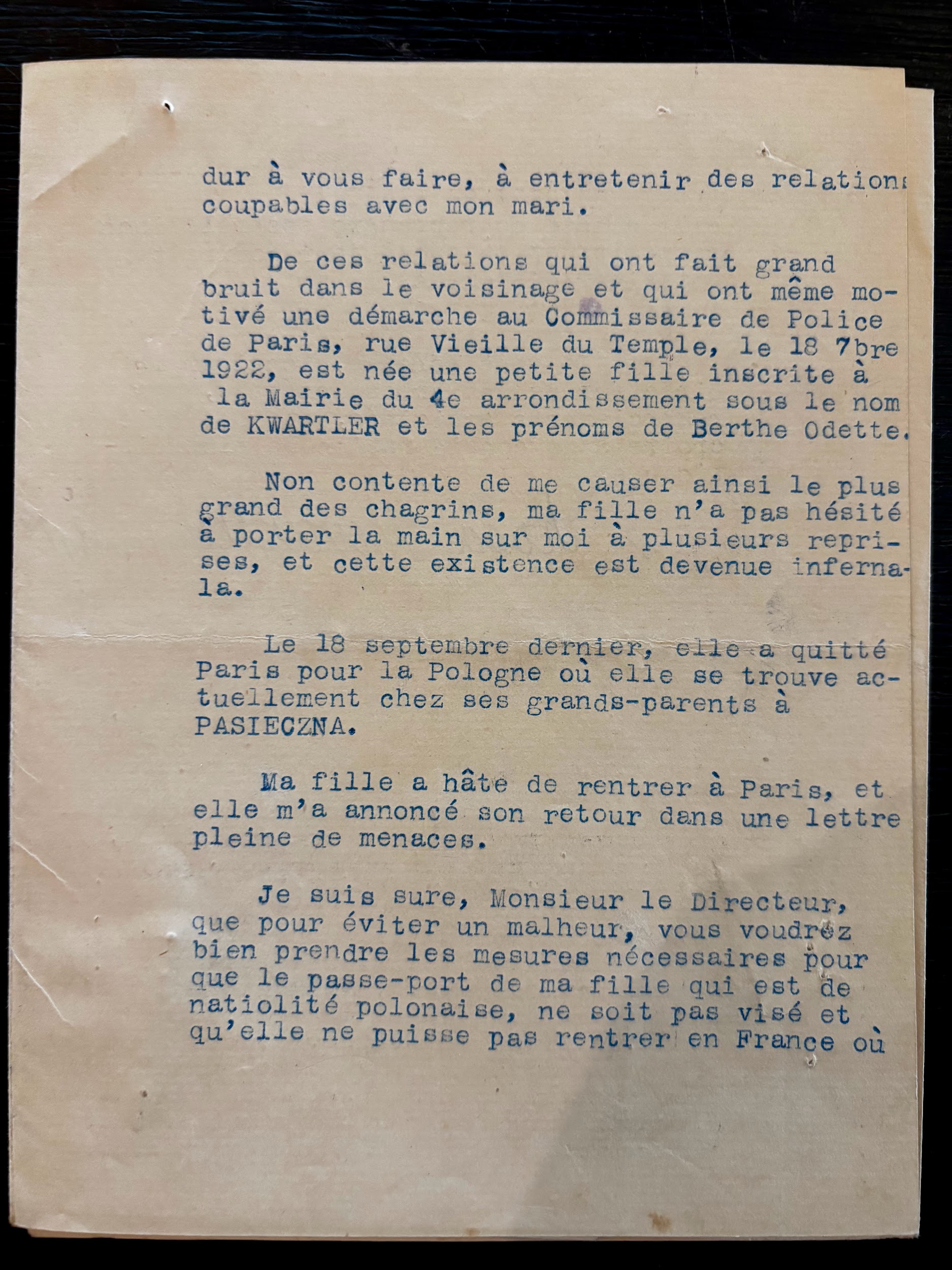
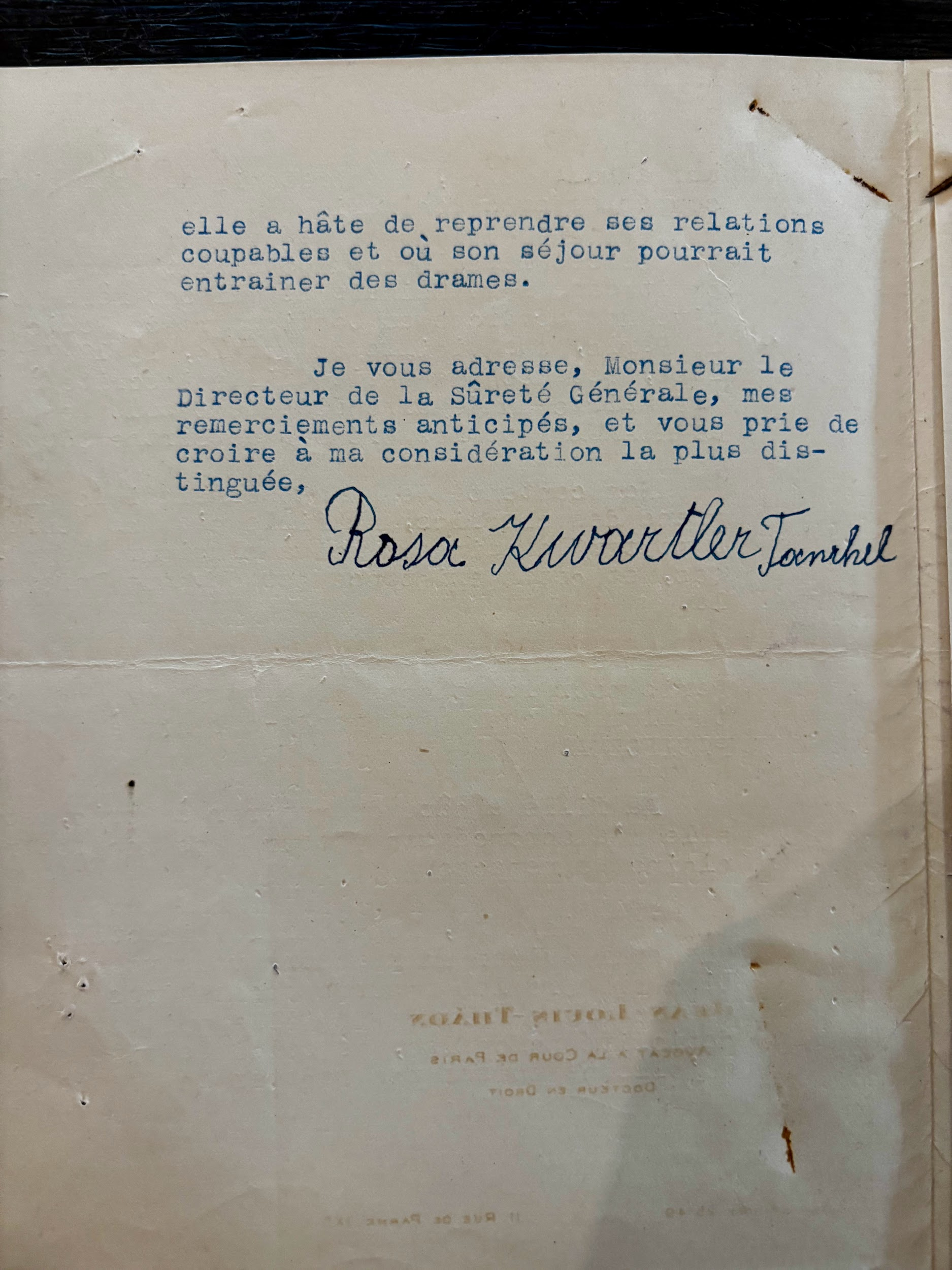
In short, Rosa explained the situation and asked the authorities not to issue Regina, who was living with her grandparents in Poland, a visa to return to France.
Clearly, the letter did not have the desired effect, as Schabsé went on to have six more children with Regina between 1925 and 1942: Claude, Suzy Clara, Maurice, Fernand, Roland, and little Raymonde.
Some of them were born in Paris and others in Brévannes, which again bears witness to the fact that the family had various different homes.
Ismaila and Mohamed’s comments:
This letter dates from 1922. It describes the relationship between a mother and her daughter, and mentions frequent threats. It asks authorities to take action and deny Regina a visa. Its message is that parents must respect their children, and vice versa.
Jo-Yie, Jaya and Gabriel’s comments:
In this letter, Rosa writes about her daughter, Regina. Rosa wanted to prevent her daughter from returning to France to avoid further upset. Her daughter had, in fact, had a child, Berthe, with Schabsé. This led to a visit to the Paris Police Department. The letter reveals that the mother of Schabsé’s seven children was not his wife Rosa, but Regina.
Lina and Maïssane’s comments:
This document explains that Régina was in Poland at the time and that she should not be allowed to return to France, as her presence would be detrimental to public order. Rosa said that in light of her bad behavior, she should be denied a visa.
This letter clarifies the relationship between Rosa and Regina, as well as the property settlement between Schabsé and Regina, followed by their divorce in 1929. Below is the court ruling on the property settlement, issued by default in Rosa’s favor:
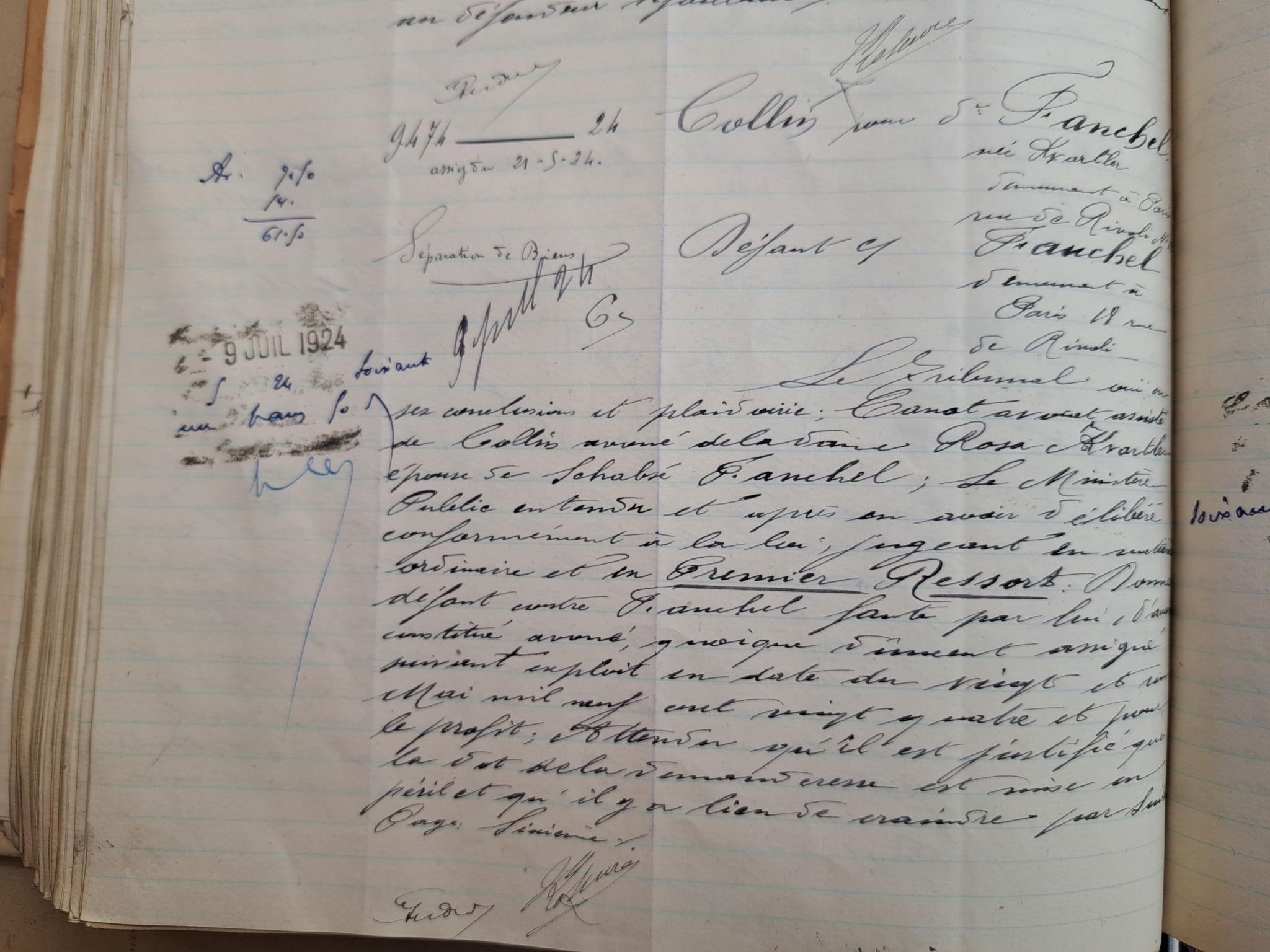
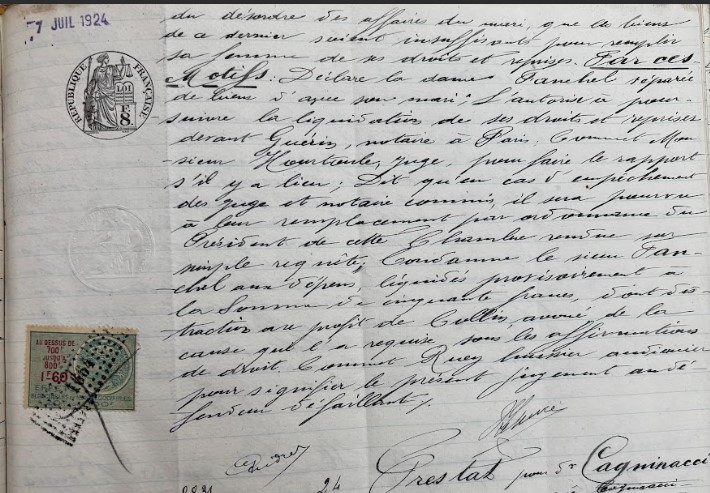
Source: P. Deweerdt
As we mentioned previously, Schabsé et Rosa lived with Schabsé’s mother, Onna or Hona[10], on rue de Rivoli:
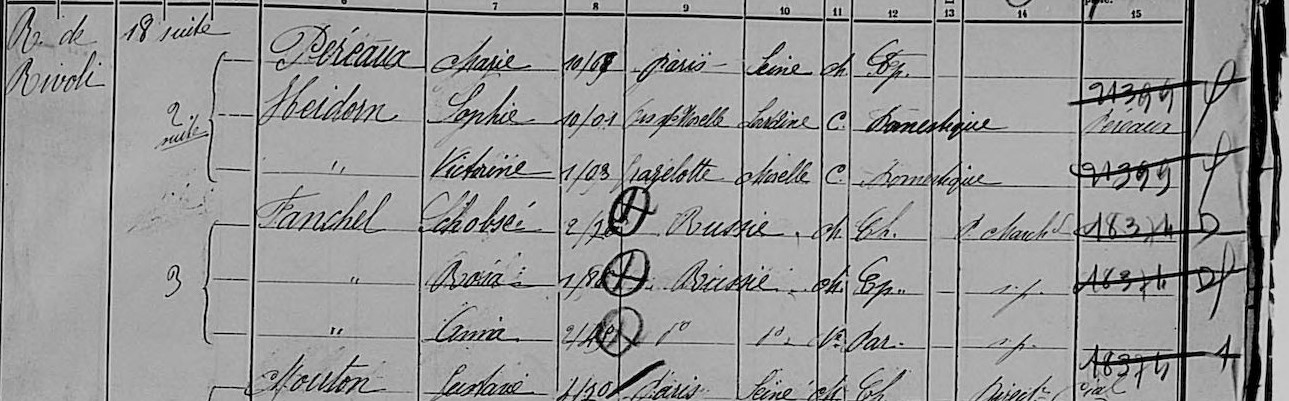
Source: 1926 census, Paris city archives
However, that same year, Schabsé was also listed at 43, rue d’Angoulème, but with Regina, Rosa’s daughter, and their first two children!
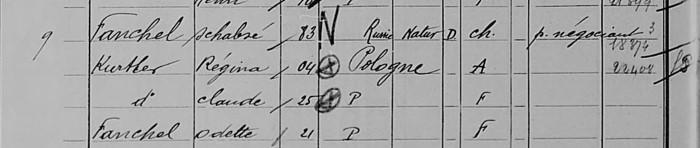
Source: 1926 census, Paris city archives
Schabsé and Rosa got divorced in 1929, after which he continued to live with Régina.
Schabsé suffered a reversal of fortune
Schabsé ran into serious financial difficulties after he and Rosa got divorced: this is evidenced by two bankruptcy filings and a debt-restructuring agreement.

Collection of Administrative Acts of the Prefecture of the Seine Department, 1927. Source: Gallica
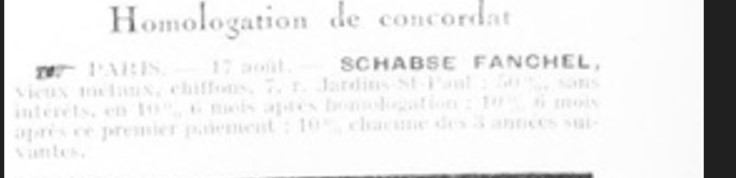
Collection of Administrative Acts of the Prefecture of the Seine Department, 1927. Source: Gallica
Translation: Paris, August 17, 1927: Schabsé Fanchel, scrap metal, rags, 7, rue des Jardins Saint-Paul, 50% without interest, 10% six months after approval, 10% 6 months after the first payment, 10% on each of the following three years.
Bankruptcy August 28, 1929
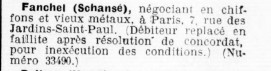
Collection of Administrative Acts of the Prefecture of the Seine Department, 1927. Source: Gallica
Jaya’s comment:
This 1929 record relates to the bankruptcy of S. Fanchel’s business. It explains that when businesses go bankrupt, there is a way to settle their debts. Mr. Fanchel was a dealer in rags and scrap metal on Rue des Jardins Saint-Paul in Paris (record from the French National Library, Gallica).
In 1929, Schabsé bought two lots 14, rue des Jardins Saint-Paul:
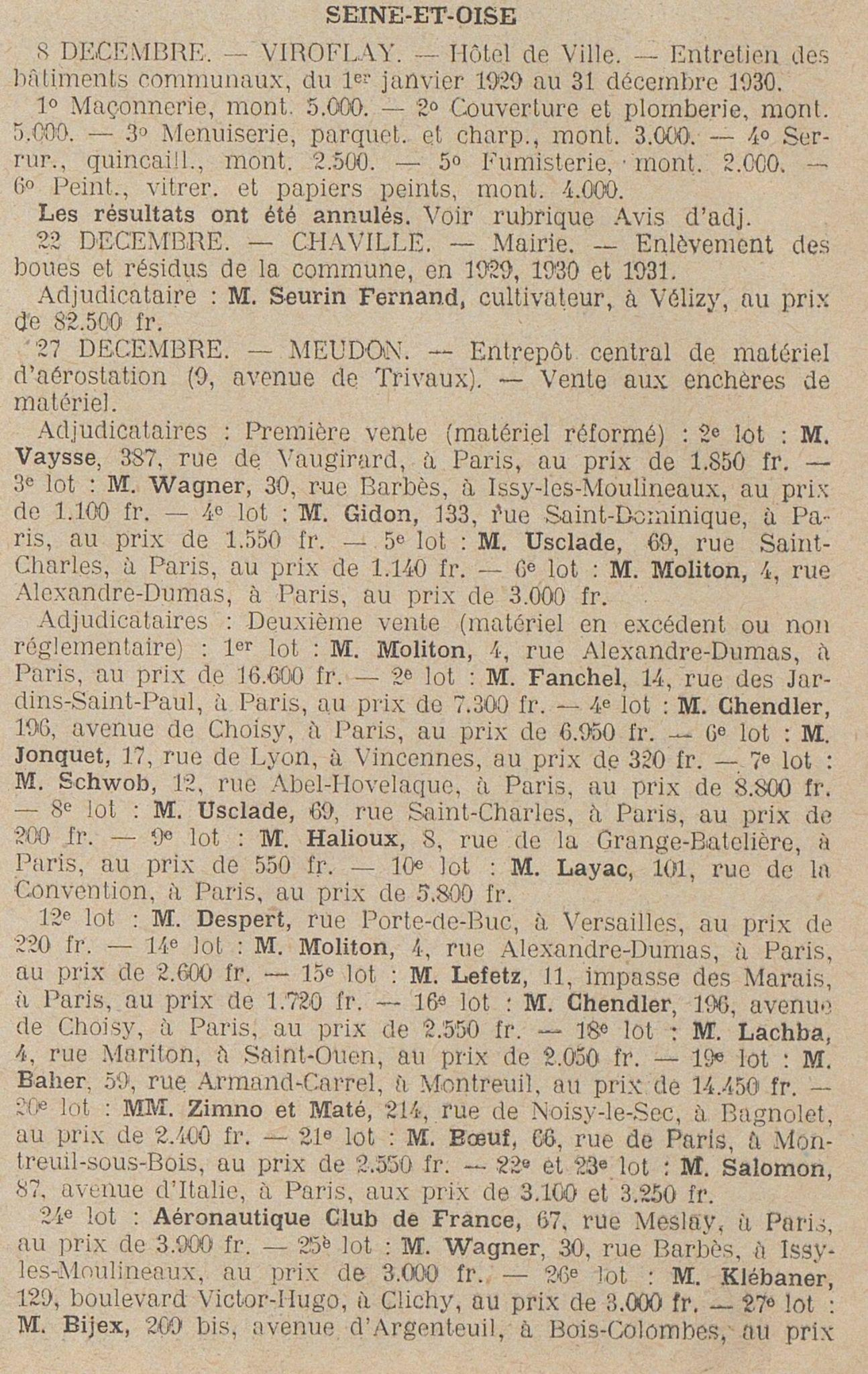
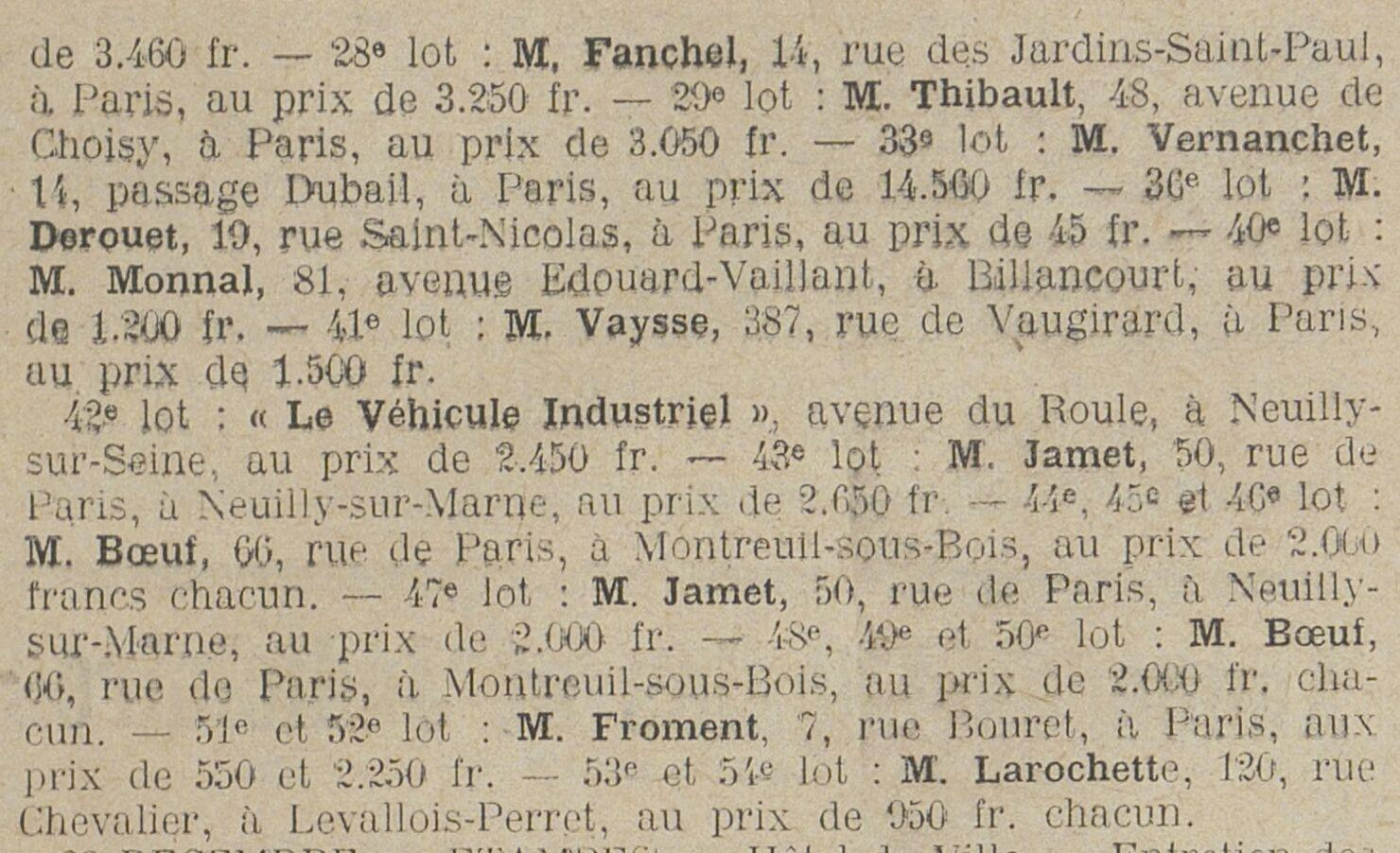
Collection of Administrative Acts of the Prefecture of the Seine Department, 1927. Source: Gallica
In 1928, he is listed in the business directory (Bottin Didot).
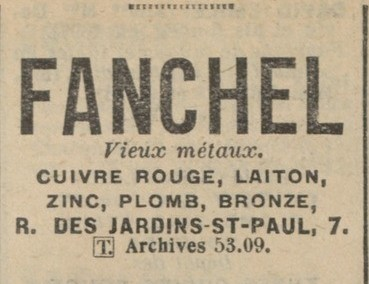
Source: Paris city archives
Seizure and confiscation of Schabsé’s assets
Schabsé’s business and the apartments at 7 and 9 Rue des Jardins Saint-Paul were seized, and he and Regina lost ownership of them. They were the legal owners of the property, but we do not know if they ever obtained any compensation.
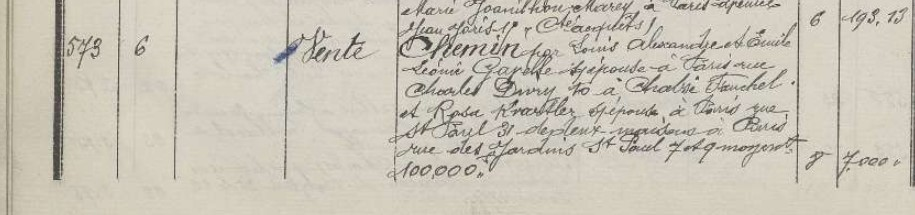
Source : Paris city archives
Elias, Amayas and Adam’s comments:
This record dates from 1919. It says that the two buildings were bought for 100,000 francs.
The apartments, which were in Block 16, were seized, after which Schabsé and Regina lost ownership of them. We believe that the family then moved to Brévannes. Isabelle Backouche, in her book “Paris transformé: le Marais 1900–1980” (Paris Transformed: The Marais 1900–1980), published by Créaphis Éditions, describes the redevelopment of Block 16 as a combination of public health and political policies aimed at both improving sanitation and stigmatizing Jewish families.
The buildings were seized in 1942:
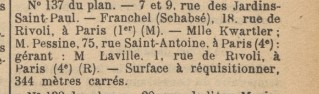
Collection of Administrative Acts of the Prefecture of the Seine Department, 1927. Source: Gallica
Schabsé and Rosa then lost ownership of them in 1943[11].
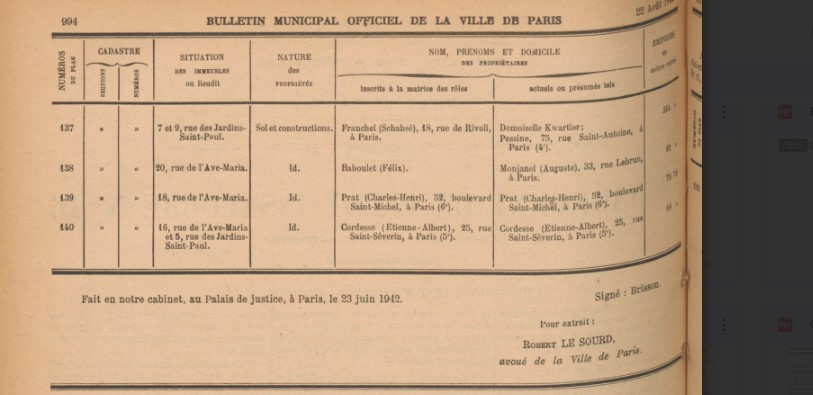
Collection of Administrative Acts of the Prefecture of the Seine Department, 1927. Source: Gallica
Kylian’s comment:
This record relates to the seizure of Schabsé and Regina’s property at 7 and 9 Rue des Jardins Saint Paul. It also lists two other addresses: 18 Rue de Rivoli for Schabsé and 75 Rue Saint Antoine for Regina. It dates from June 1942 and is held by the French National Library (BNF).
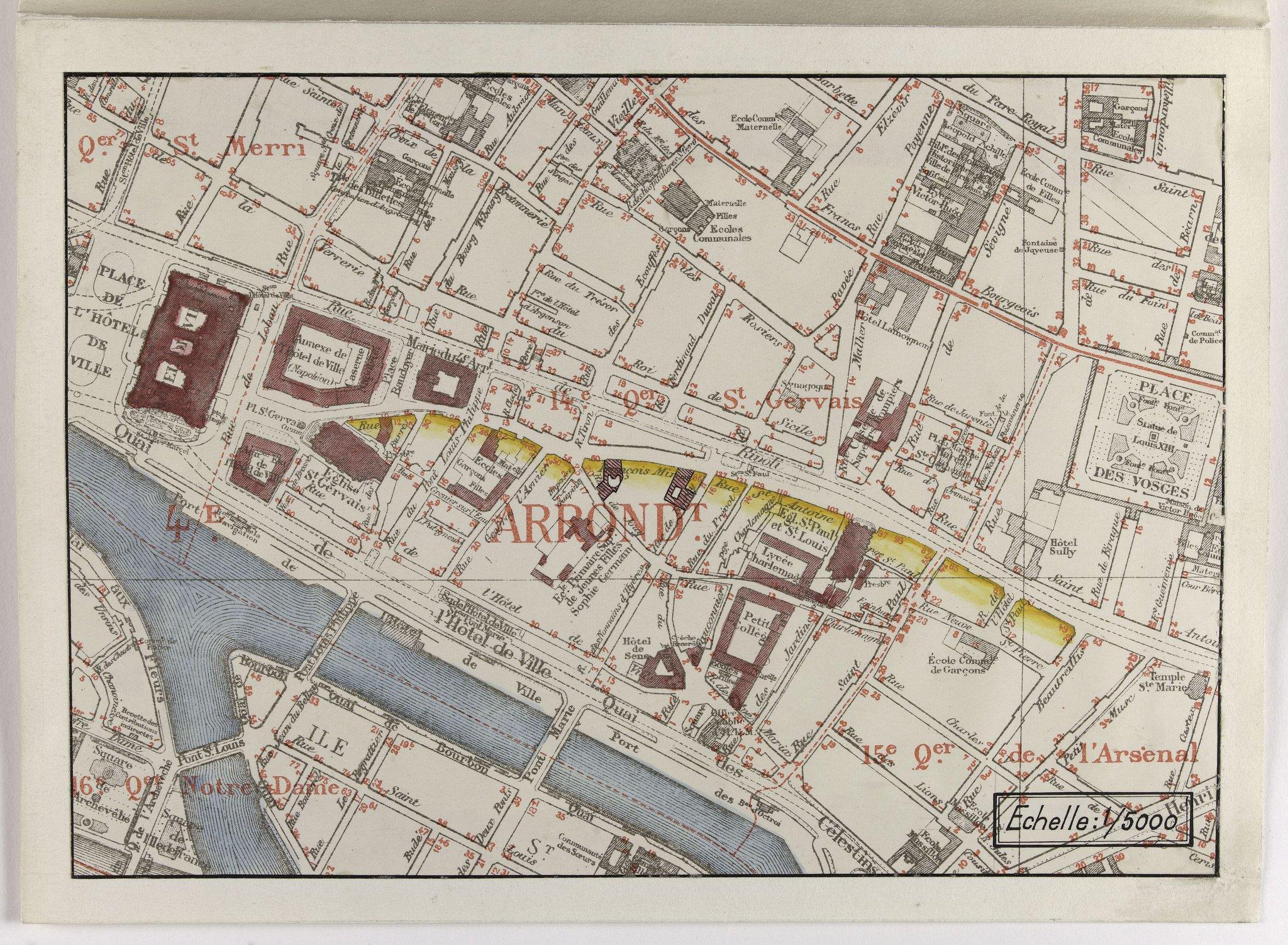
Source: Isabelle Backouche
Schabsé and Rosa: a marriage that did not last long
Rosa Kvartler, 1884-1940, who was married to Schabsé from 1913 to 1929
Rosa Kvarlter (Kwartler), whose parents, Faïvel Kvartler and Haya Fredering, were both Polish citizens, was born on November 11, 1884 in Pachetchna Nadrovna (now Pacziejna) in Austria.
When she married Schabsé, at 9.50 a.m. on March 25, 1913 in the town hall of the 4th district of Paris, she was living 27, rue des Jardins Saint Paul. She was not working at the time and was described as a “housewife”. A note from the prosecutor waived the requirement to obtain her parents’ consent.
The witnesses to the marriage were Emile Guichard, age 52, a waiter; Isidore Golstein, 28, a mechanic; Pierre Xavier, 72, an upholsterer and Haïm Tcherbaté, 47, an interpreter. Schabsé was unable to sign his name on the marriage certificate, but his wife signed hers.
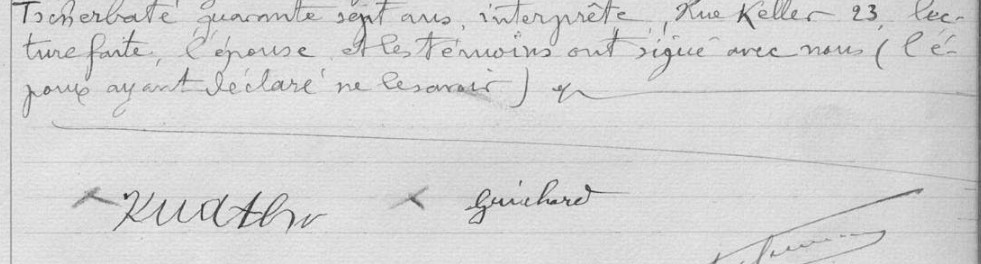
Source: Paris city archives
Rosa, who was furious with Schabsé about his inappropriate relationship with her daughter, wrote a letter to the Paris Police Headquarters requesting that Régina not be granted permission to come back from Poland; when this failed, she hired a very well-known lawyer, Jean-Louis Thàon, to represent her.
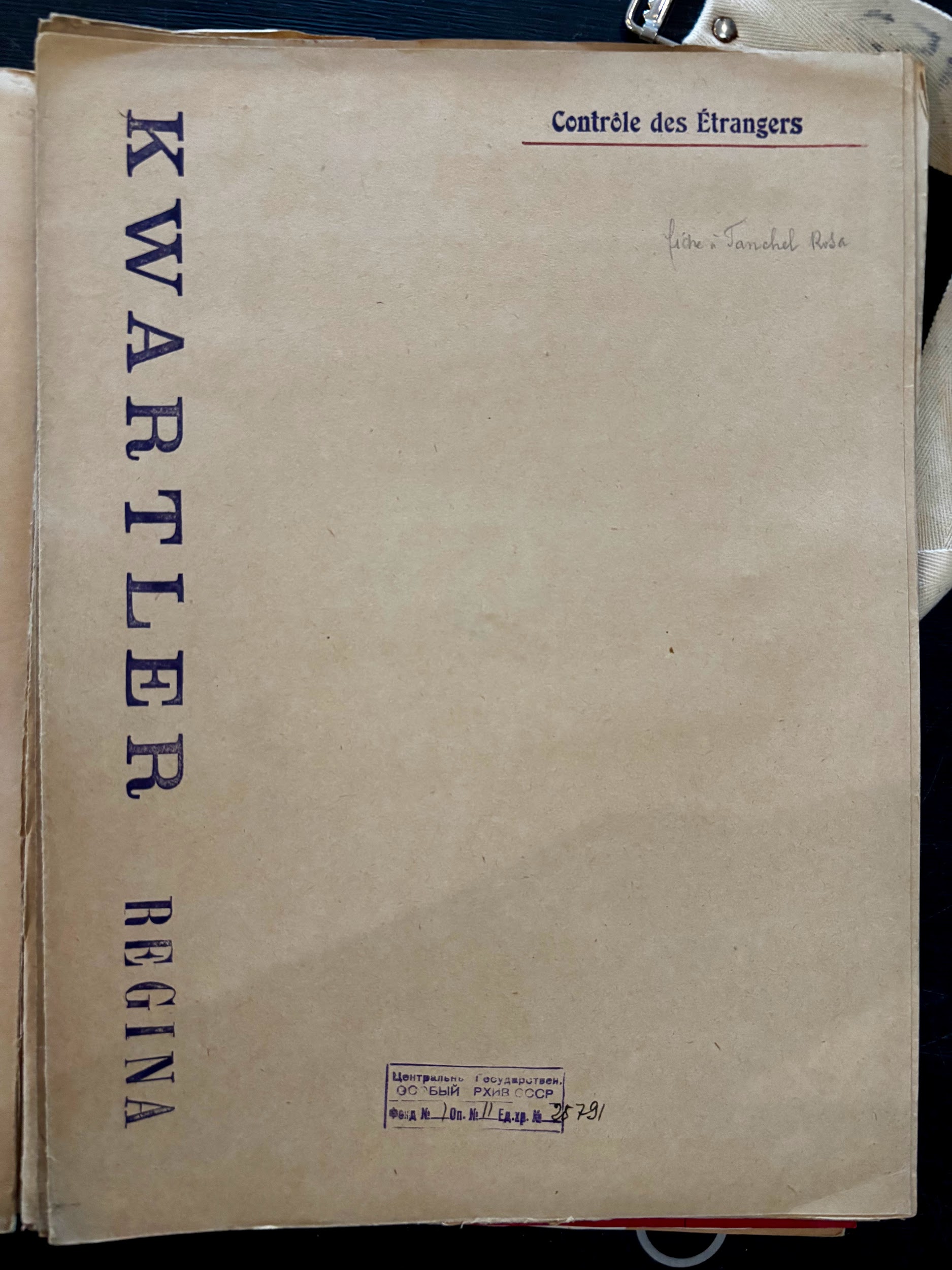
The head of the National Security agency backed the request made by Rosa and her lawyer.
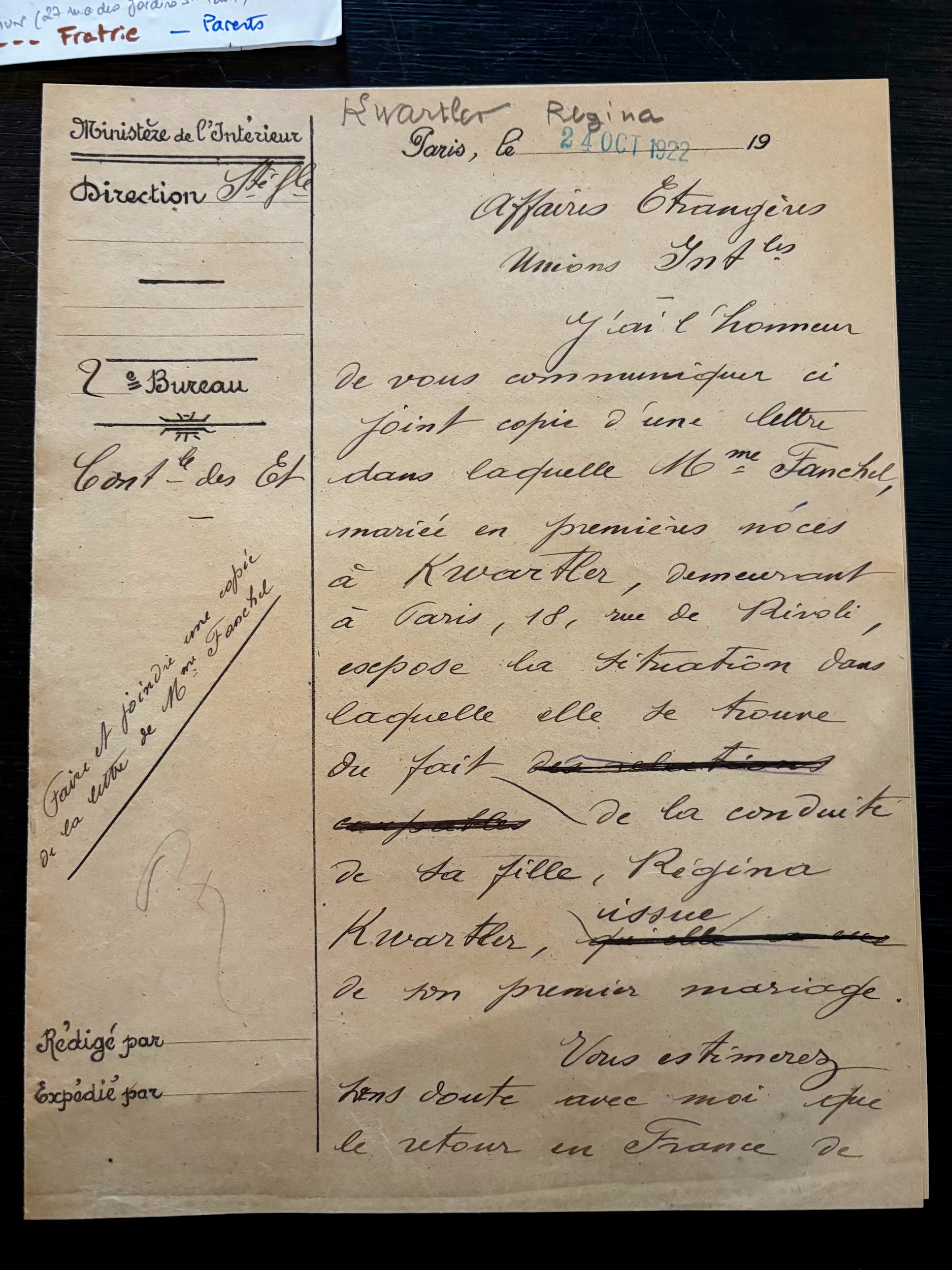
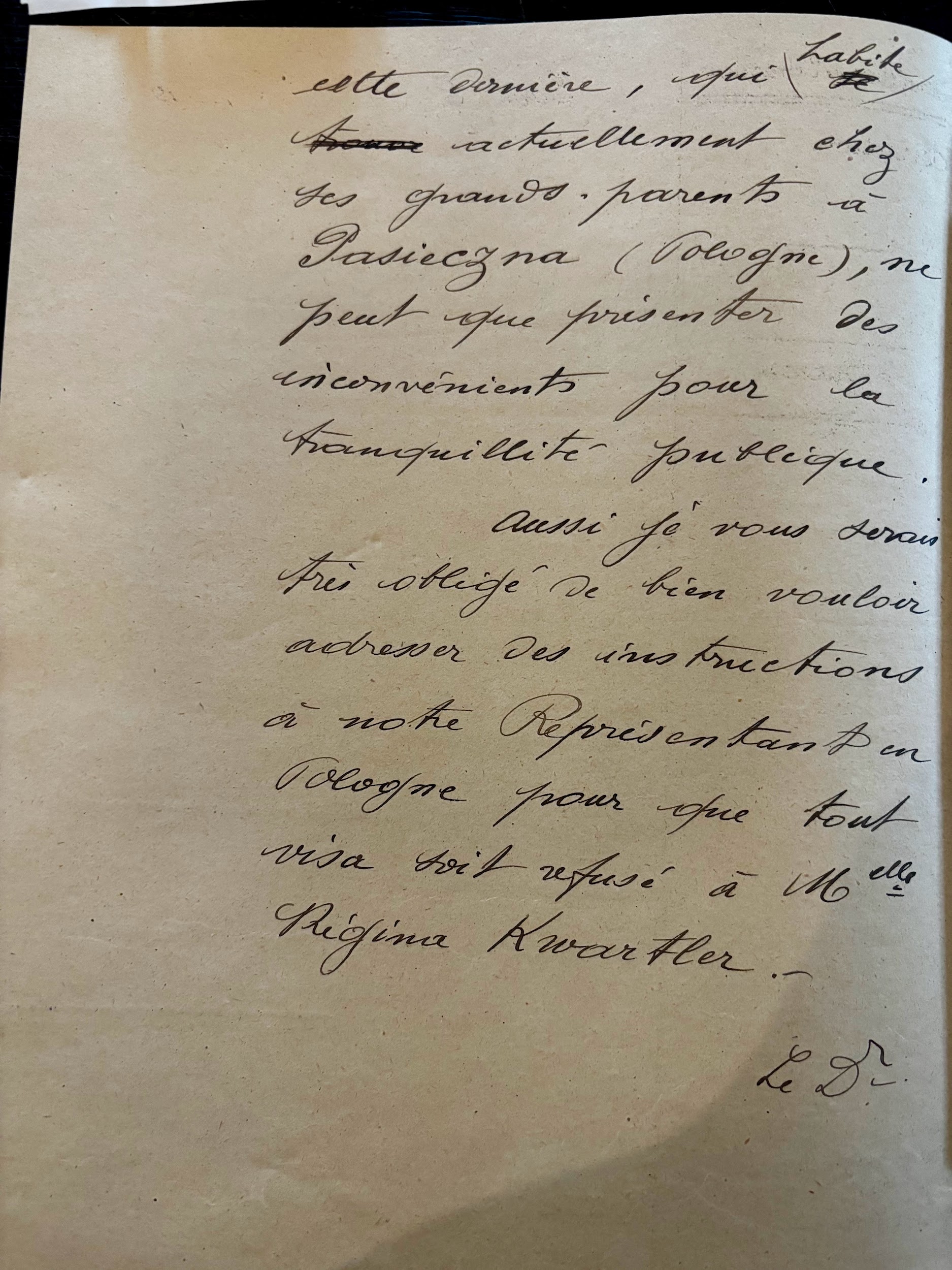
Source: French National Archives
Rosa and Schabsé signed a property separation agreement in 1924, following difficulties in their marriage. Rosa was represented by a lawyer and a notary, but Schabsé chose not to attend the hearings.
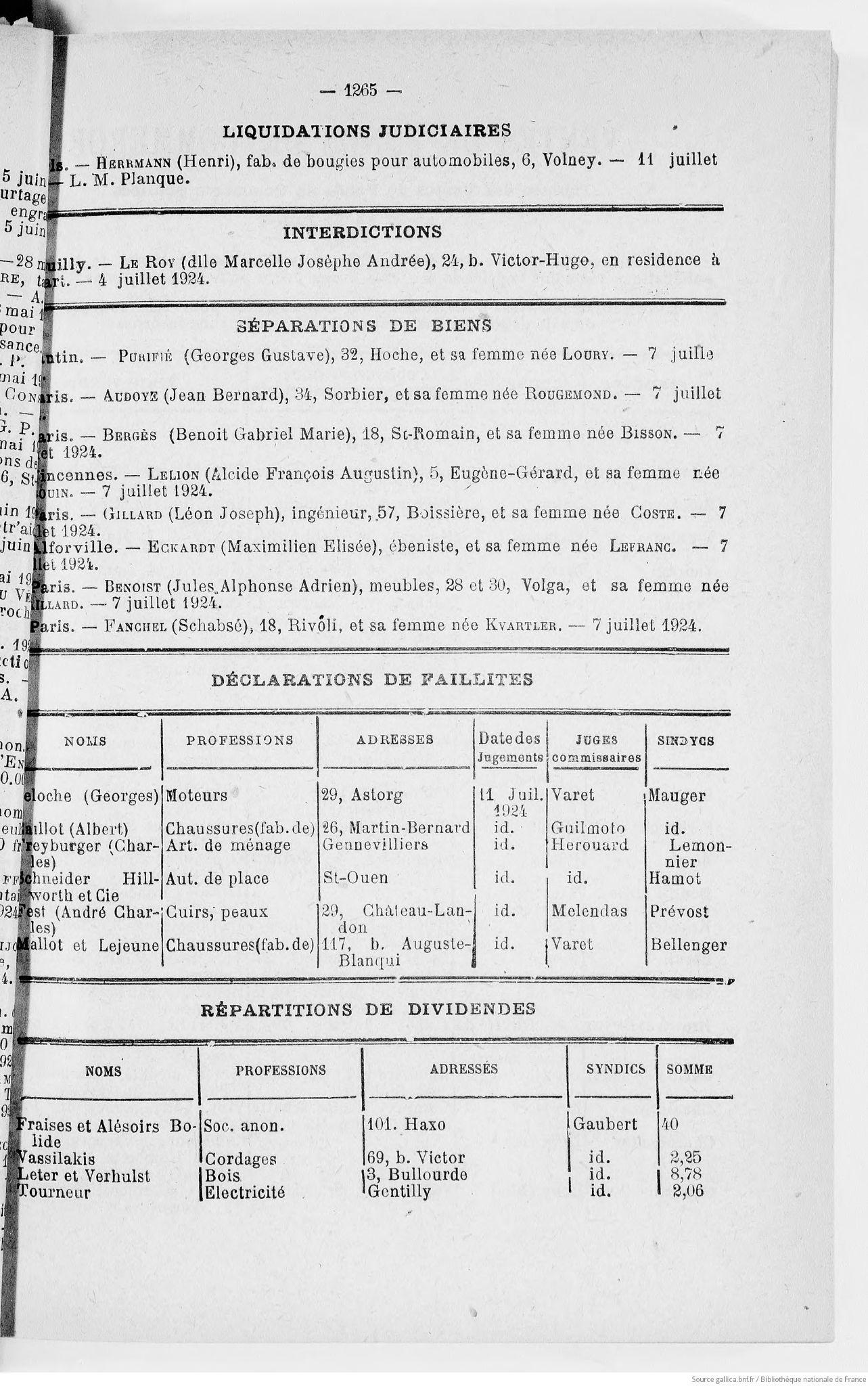
Source: Paris city archives.
Rosa was also naturalized on February 6, 1925, since in those days women were included in their husbands’ applications.

Source: Paris city archives
She appears to have lived a fairly affluent life, judging by this report in the newspaper L’Oeuvre on January 6, 1928, which says that she had her earrings and a valuable ring stolen by a man posing as an insurance salesman. According to census records, she also had a servant.
Rosa continued to live on Rue de Rivoli for several more years despite the high rent (8,000 francs). Recently published works by Isabelle Backouche, Sarah Gensburger, and Éric Le Bourhis on the confiscation of personal property are particularly interesting in this regard, as we have no information about the value of the Fanchel family’s assets. Isabelle Backouche, in response to my inquiry, said that she did not research the family’s addresses for her book.
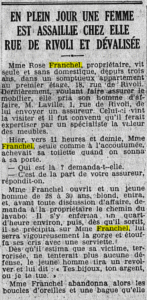
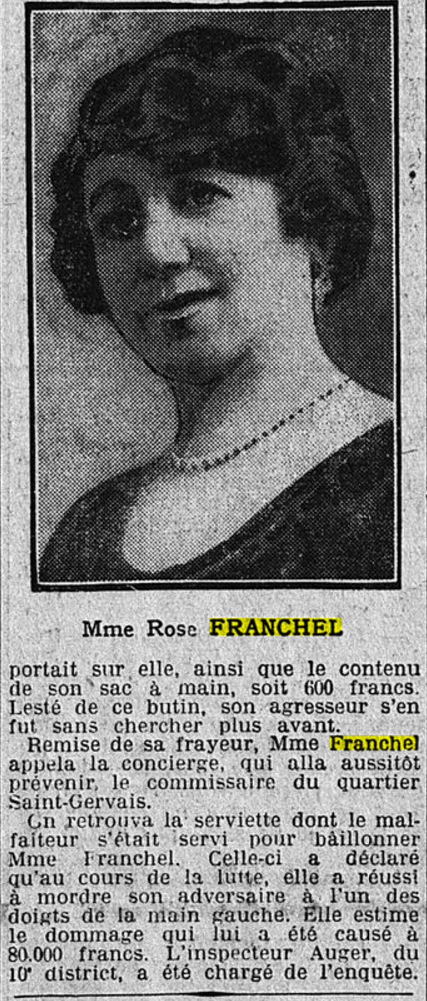
Source : Gallica.
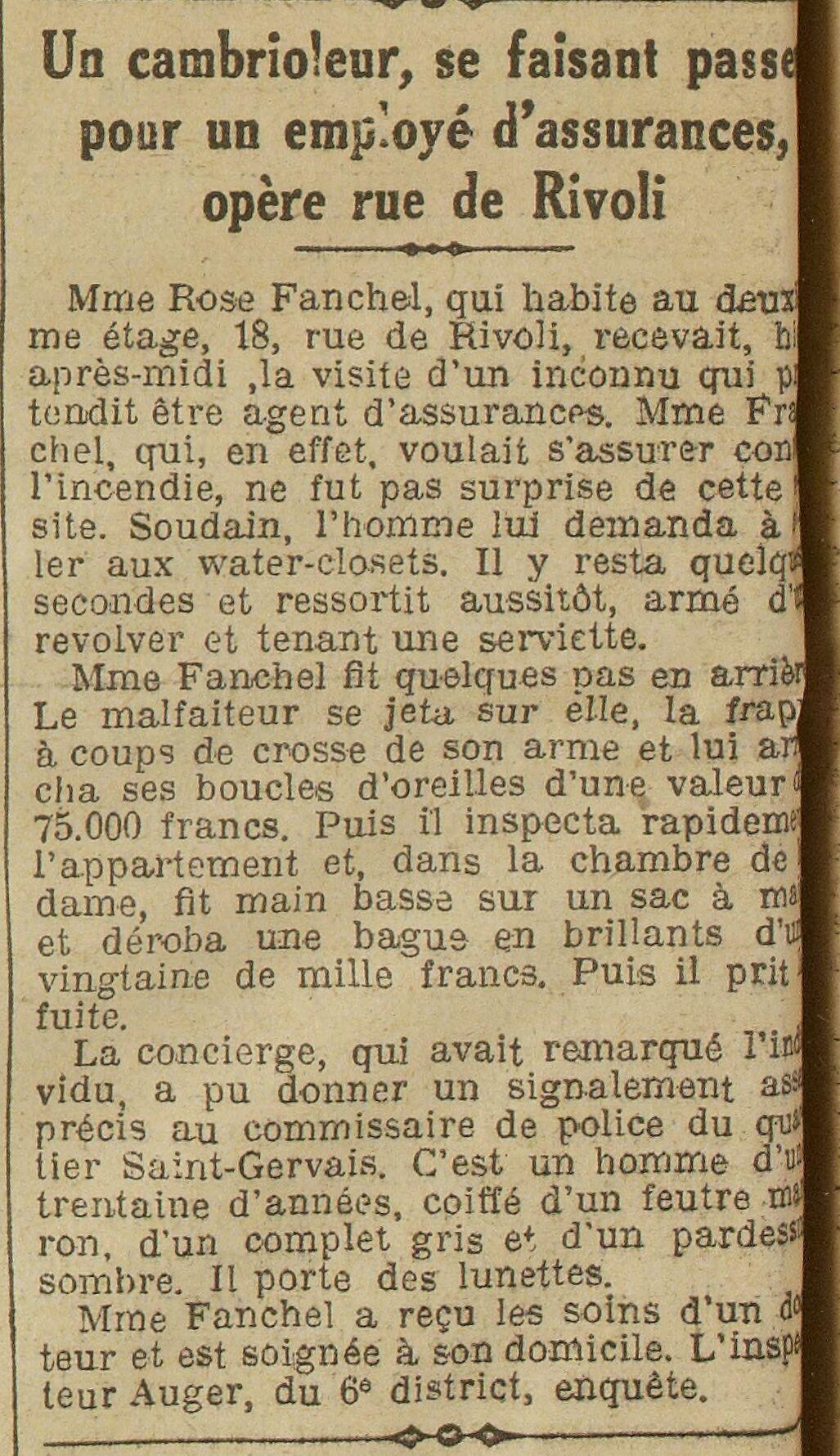
Source : Gallica.
On January 6, 1928, an article in Paris Midi looked back on the assault and Rosa’s marital problems in quite a humorous way. The article discusses the plight of single women and describes Rosa as a “plump, stocky little lady,” who opened up about her home life and talked about how her income was not that high, even though she had been robbed of some valuable jewelry.
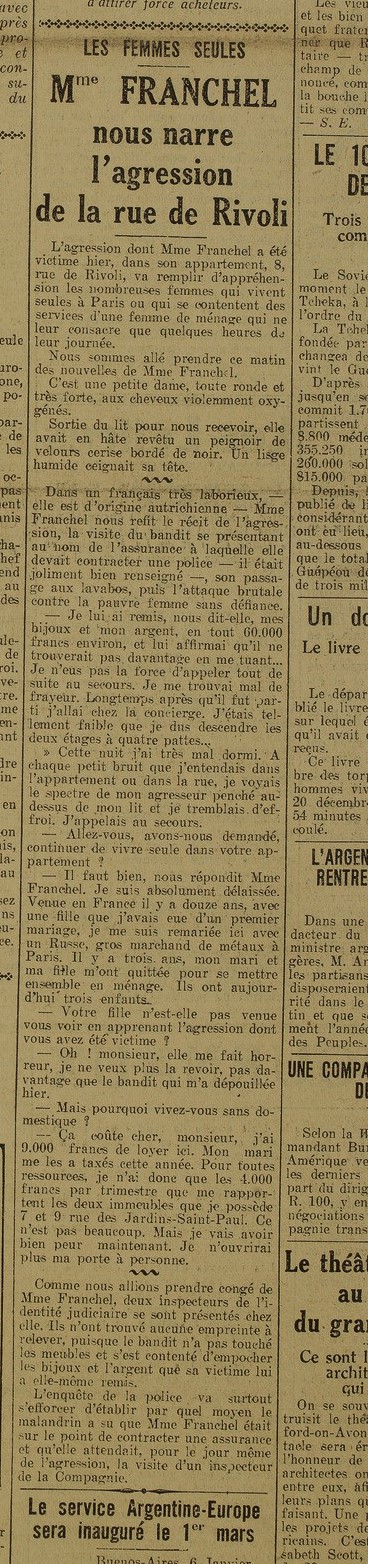
Source : Gallica.
In November 1928, she was injured in a road accident, as reported in the Le Petit Champenois: Republican daily newspaper:
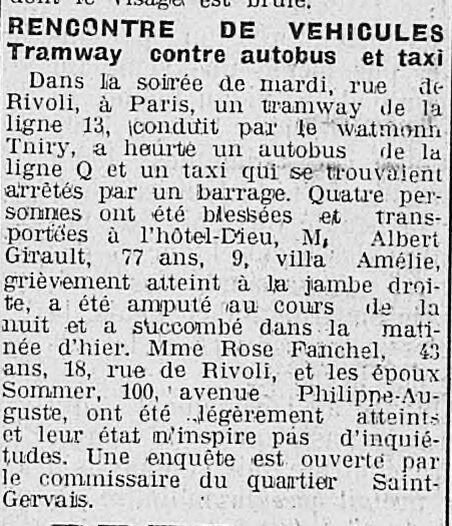
Source : Gallica.
She and Schabsé were divorced on April 15, 1929.
Rosa died in the Hôtel Dieu hospital in Paris on April 5, 1941. She was buried, alone, in the Bagneux cemetery[12]
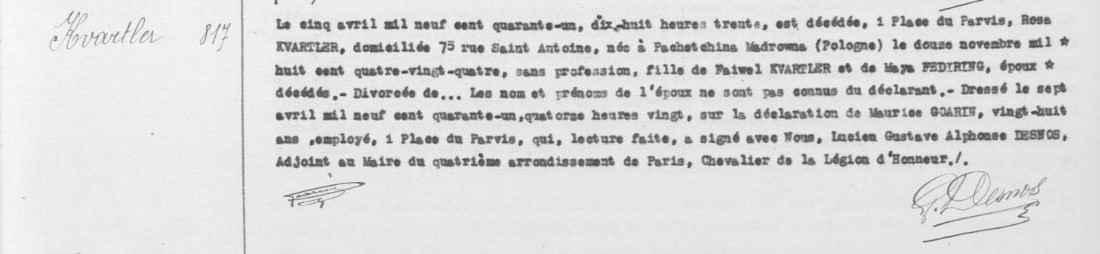
Source: Paris city archives
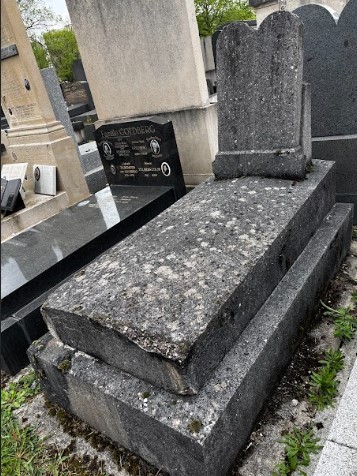
Source: M-A Deweerdt
Two sons, Vincent and Isaac, and a daughter, all of whom died.
Schabsé and Rosa had three children, none of whom survived.
Vincent Fanchel, July 21, 1911 – July 24, 1911[13]
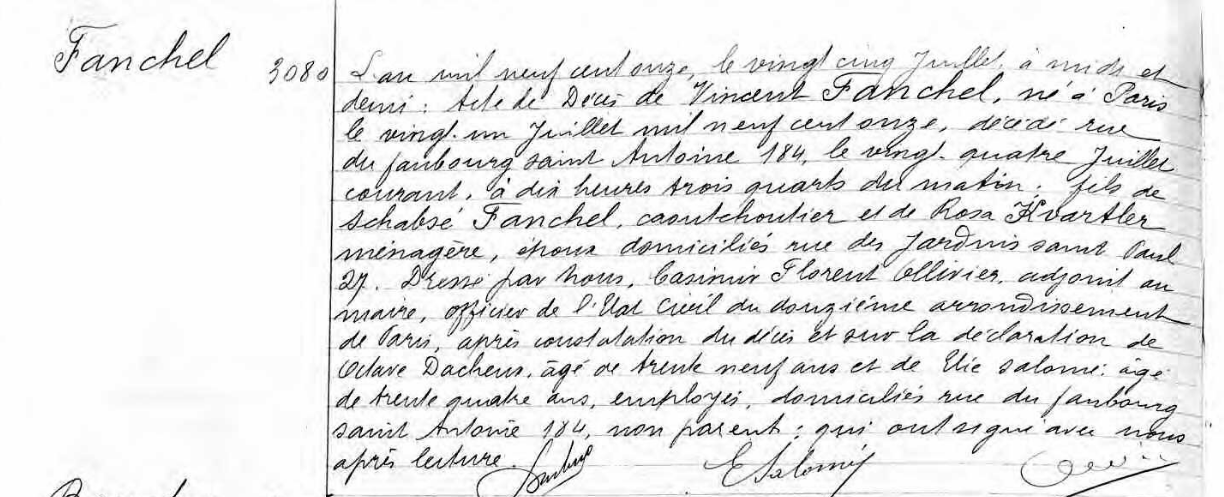
Source: Paris city archives.
There is no record of where he was buried.
Isaac Fanchel, September 27, 1914 – June 6, 1915
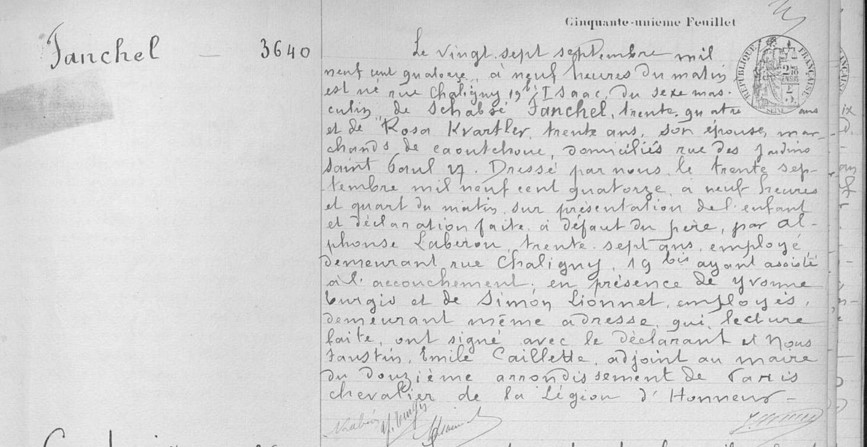
Source: Paris city archives
Isaac was buried in the Bagneux cemetery in Paris in 1926, when his father arranged for a family vault to be built.
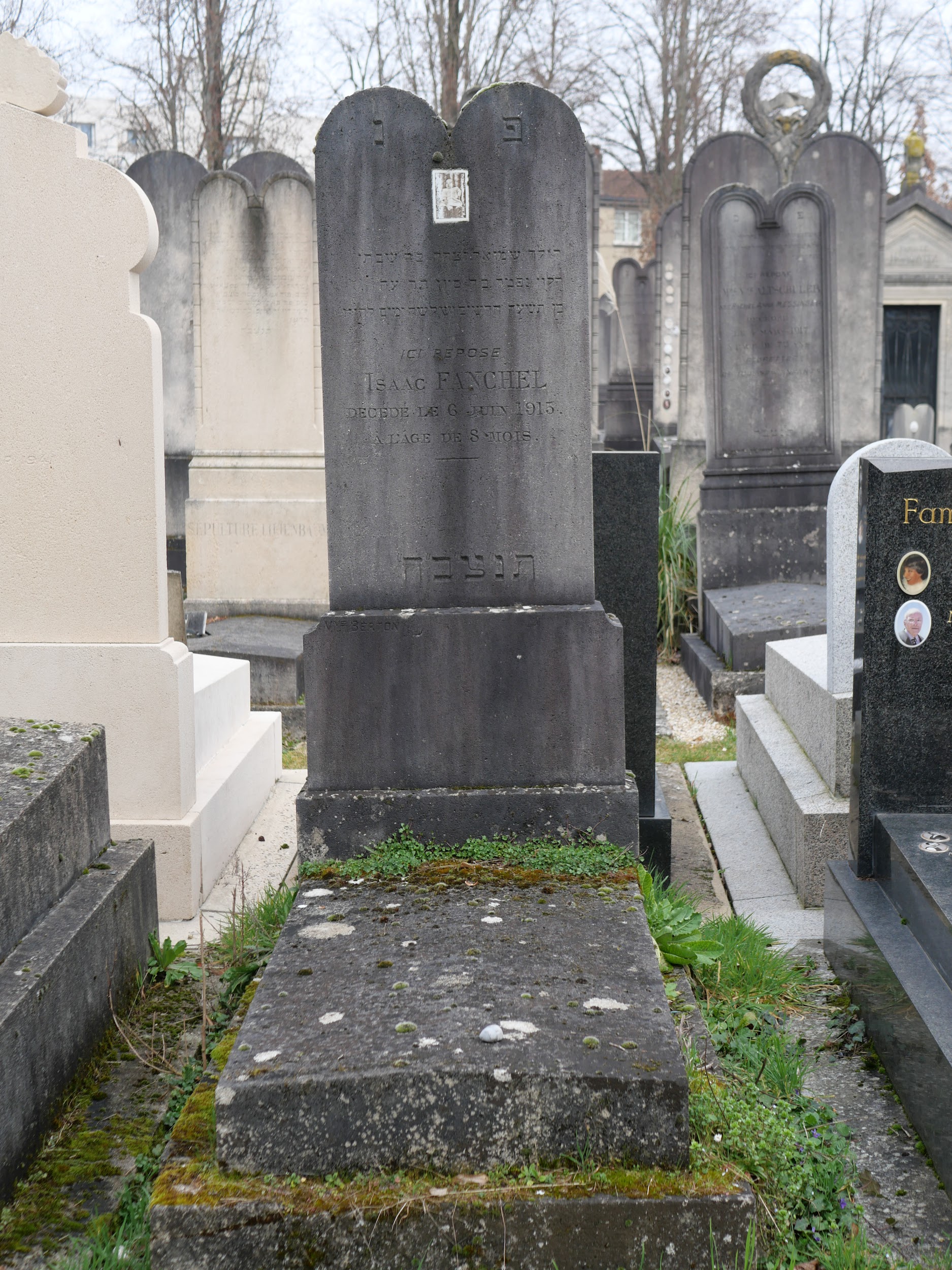
Source : P. Deweerdt
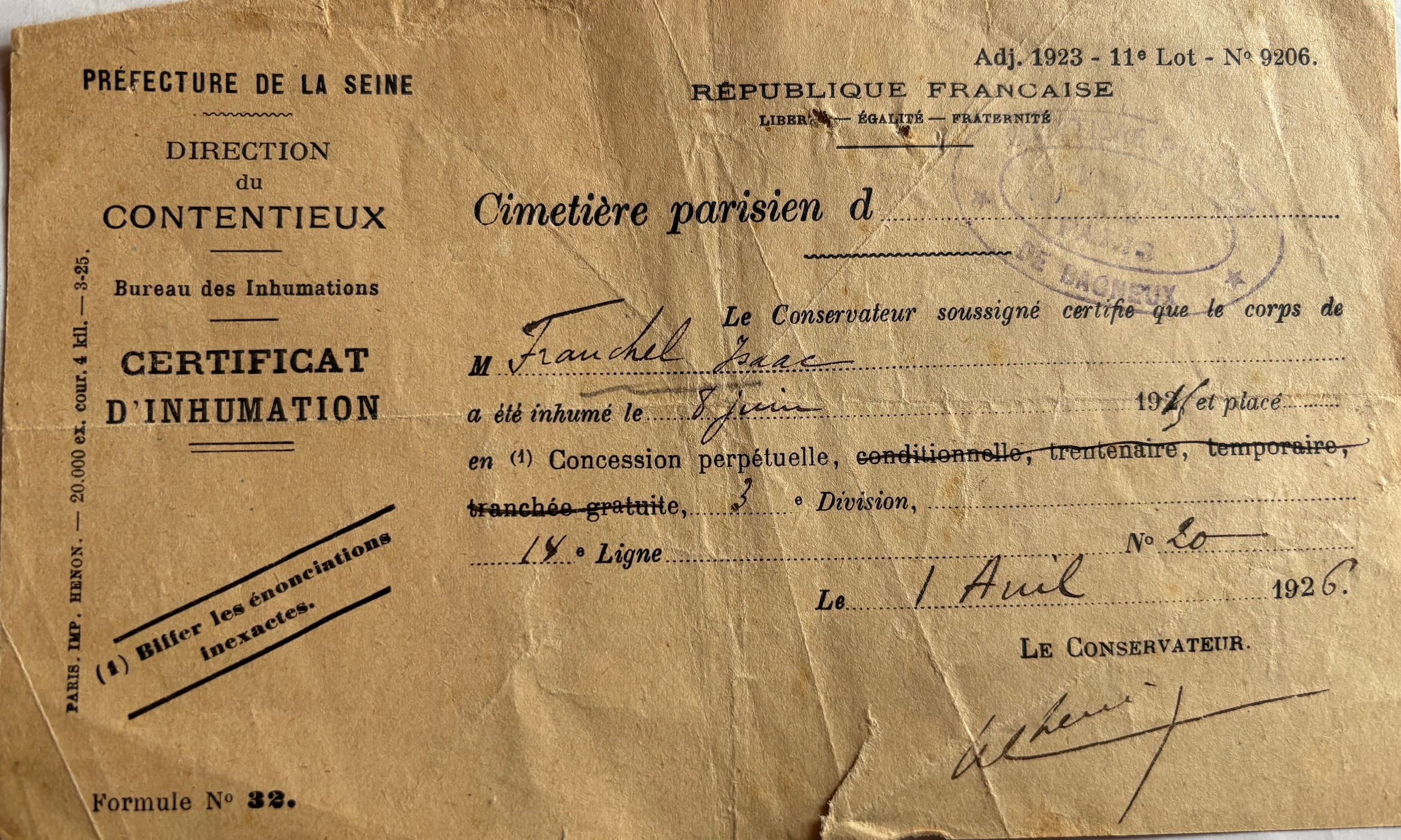
Source: Mr. Journo’s personal collection, published with his kind permission.
A stillborn baby born in 1917: They did not name their stillborn daughter. She was buried in the Bagneux cemetery, plot reference 102-8-14. When we visited the cemetery, the caretaker explained to us that this had been a temporary plot, paid for five years, so there is no way of finding out what happened to her remains.
Schabsé’s life with Régina
Régina Kwartler, deported on Convoy 47 on February 11, 1943
Regina or Reginy was born in February 1904 in Pasieczna, Poland.
As their names are so similar, we thought for a long time that Rosa and Regina were one and the same person, whereas in fact they were two distinct individuals: mother and daughter.
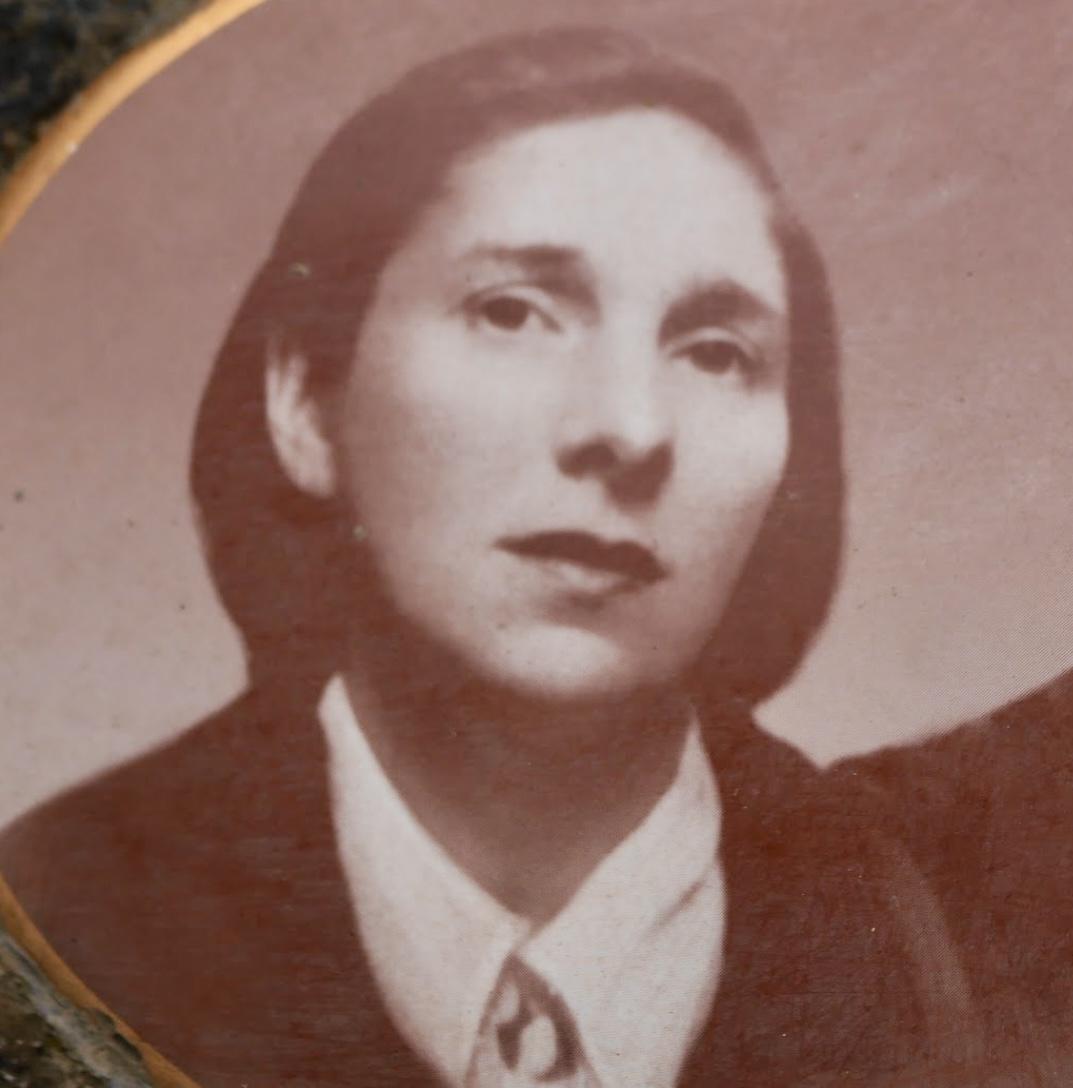
Source : P. Deweerdt
The French Defense Historical service in Caen, in the Normandy department of France, holds a file on Regina, under the reference AC 21 P 471 025[14]. Her father’s name was not recorded, so his identity remains unknown. She lived in Poland with her grandparents (Rosa’s parents). After she gave birth to Berthe-Odette, she moved back to Poland for a while. She then returned to France despite her mother’s efforts to stop her, and she and Schabsé set up home together.
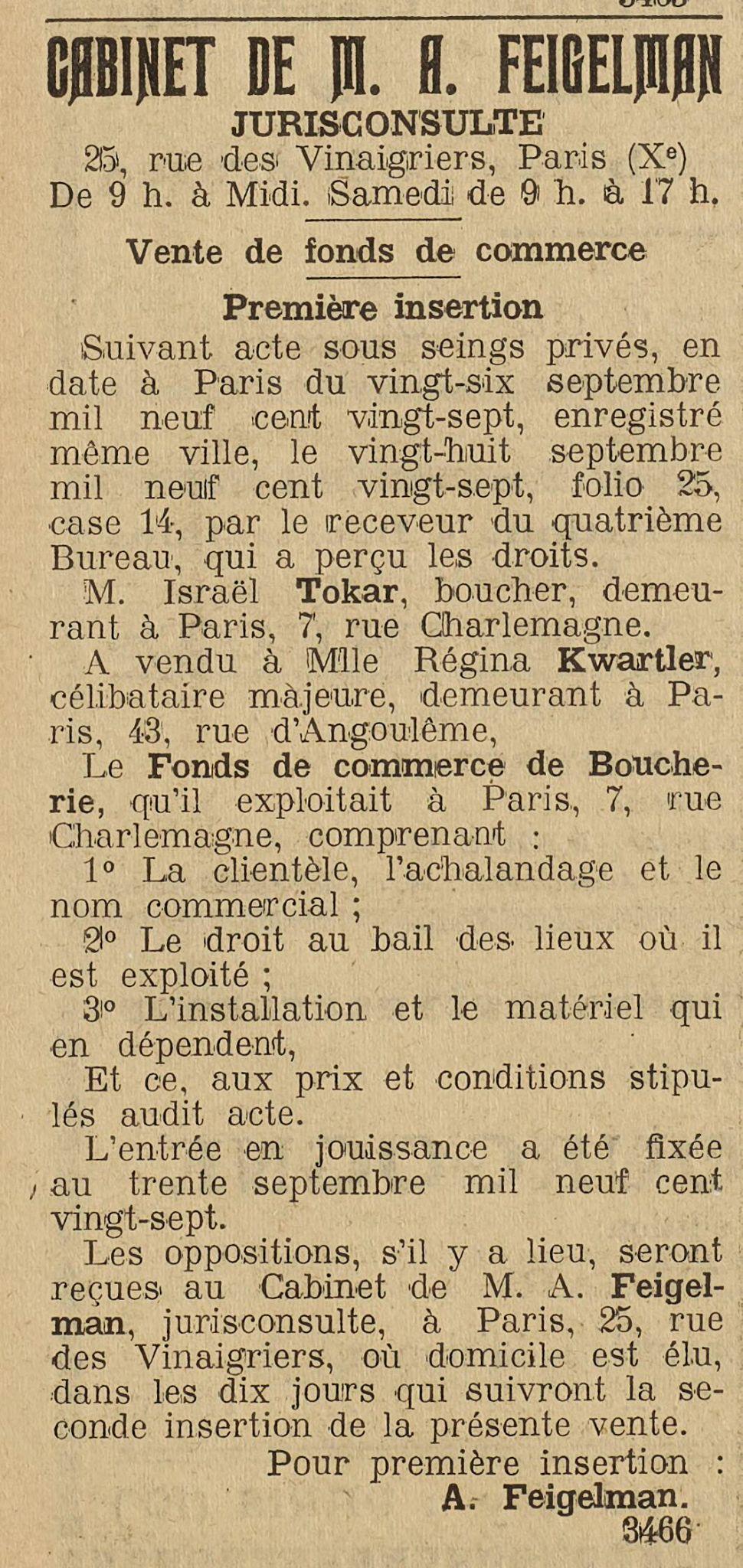
We know very little about Regina, other than that she was actively involved in the family business. In 1927, for example, she bought a butcher shop from the Tokar family:
Source: Paris city archives.
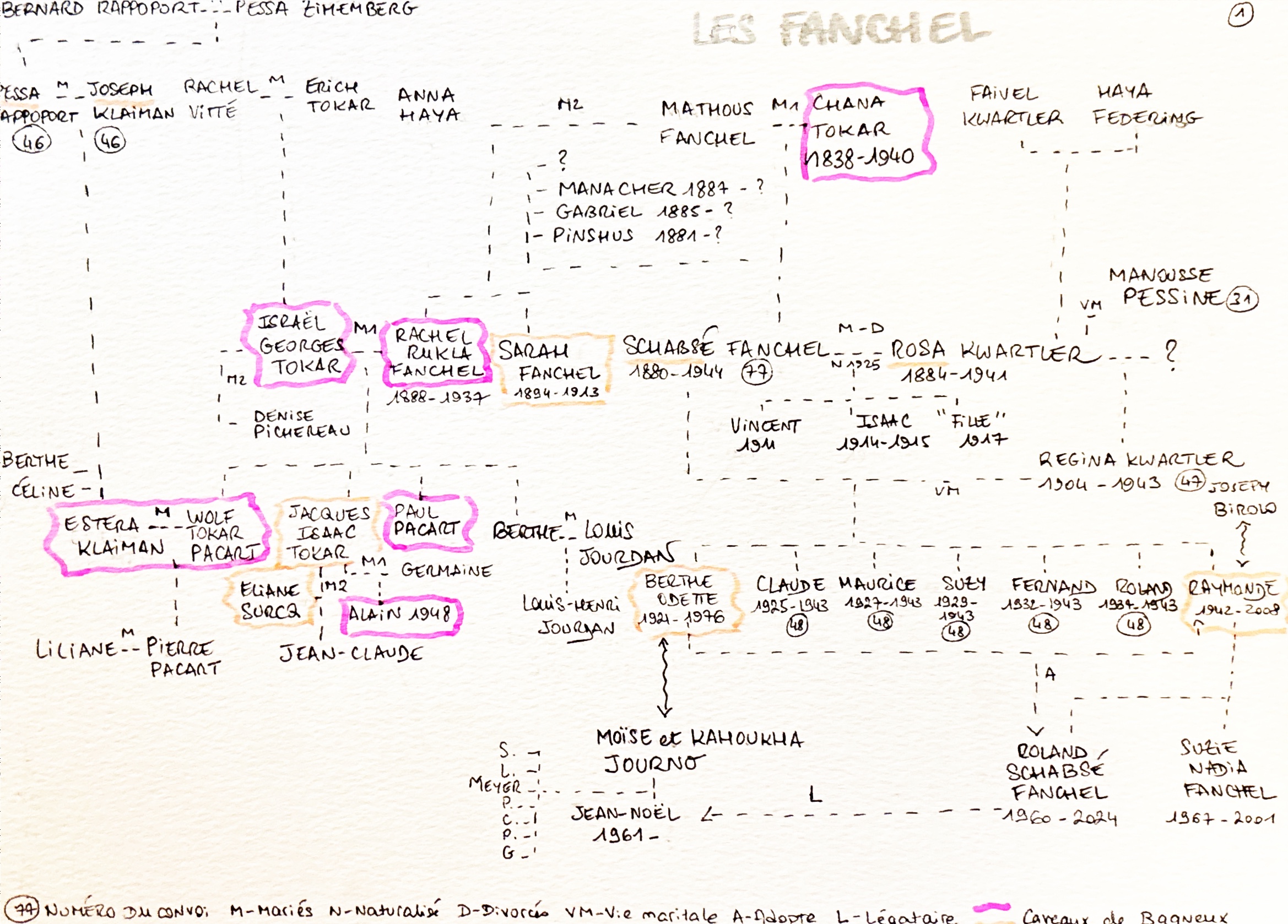
The surname Tokar often crops up in connection with the Fanchel family: we are almost certain that the link came about through the marriage of Israel Tokar and Rachel Fanchel, Schabsé’s sister or half-sister.
The Fanchel and the Tokar family members who were not deported were buried in adjacent graves in the Bagneux cemetery. During my research, I met with Israel Georges Tokar’s grandson, Pierre, and his wife, Liliane.
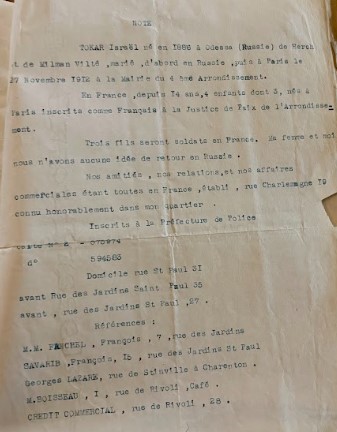
Source: French National archives, Moscow collection
Diego and Devan’s comment:
This record is included in the Tokar family’s naturalization application. It reveals that Israel gave the name of his brother-in-law, François, as a reference. This suggests that Israel’s wife may well have François/Schabsé’s sister.
In the 1931 and 1936 census records, Regina is listed as living on Rue Angouleme, along with the children she had with Schabsé:
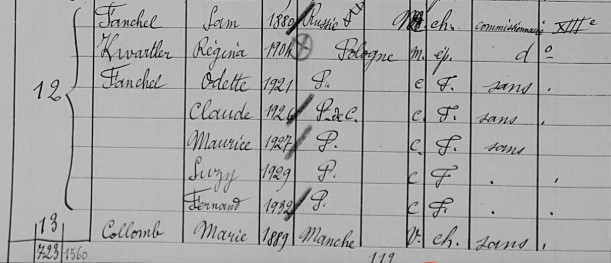
Source: Paris city archives
Régina also owned a house in Brévannes, at 9, avenue Allary, along with a vacant lot.
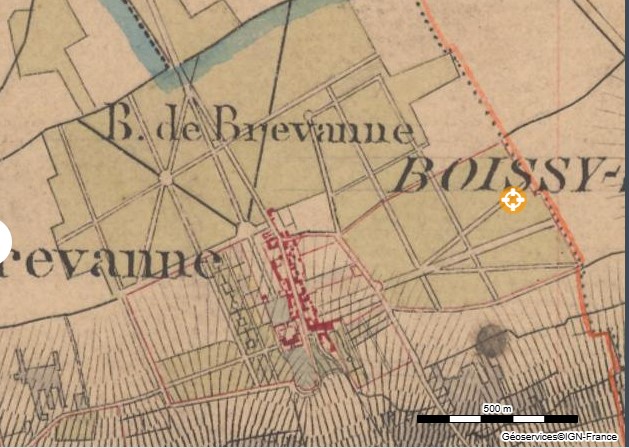
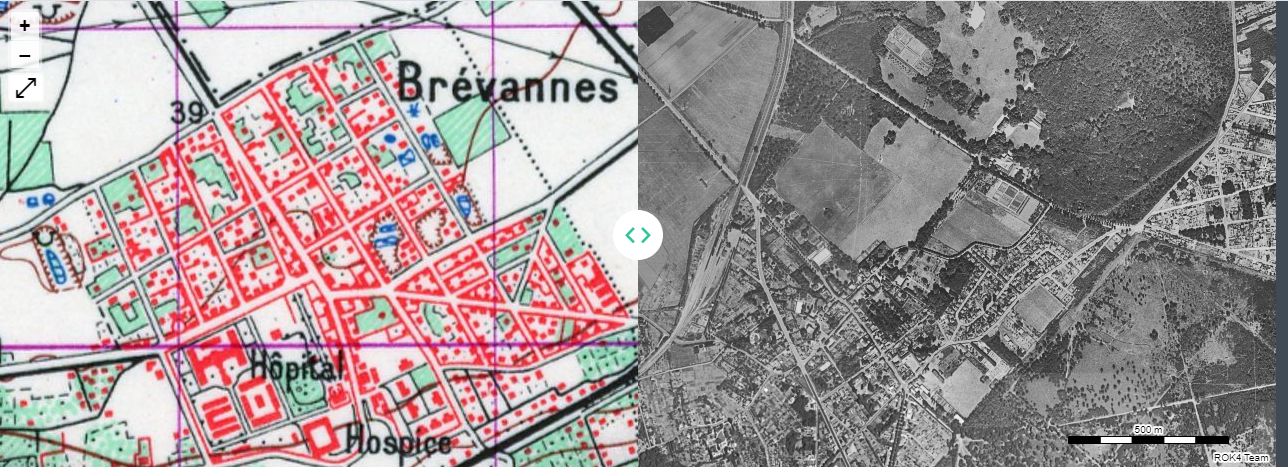
Source: The French National Geographical Institute (IGN) “go back in time” website
It would have been quick and easy for them to come and go between Paris and their country home by train via the former Paris-Bastille station.
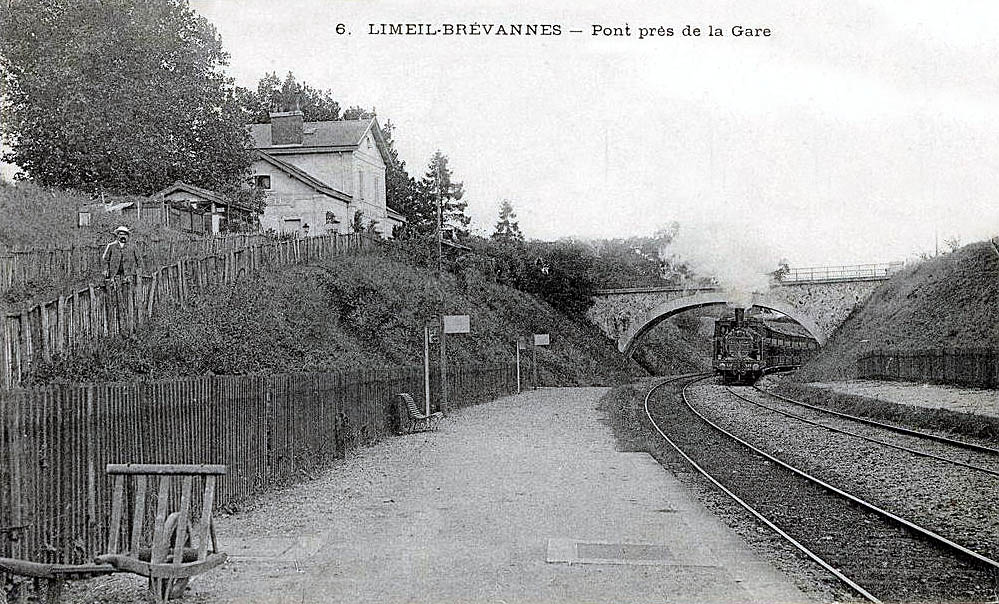
Source: Limeil-Brévannes municipal archives
While they were living in Limeil-Brévannes, the Fanchel family got to know some other families who spoke the same language. Based on the 1936 census, it is clear that the Polish community made up the largest number of foreigners in the town. Guy Lassalle also pointed out the following[15]:
According to the census of June 6, 1936, the town had a population of 5,865, including 1,090 in the sanatorium and 908 in the hospice.
The nationalities declared by the residents were:
- German 2
- American 1
- Belgian 17, including 2 children
- Spanish 2
- Dutch 2
- Italian 52, including 20 children
- Polish 112, including 47 children
- Portuguese 2
- Russian 4
- Serbian 1
- Swiss 17 including 2 children
- Czech 20 including 2 children
One of my initial hypotheses was to try to prove that these families, who spoke Yiddish and belonged to the same religious community, may have had social ties. Guy Lassalle investigated this and, by carefully examining the town’s census records for the period between the two world wars, he discovered something of interest:
“In 1921, living at 5 Rue de Boissy, was a man by the name of Laurent Dufossé. His, wife was Jeanne Dufossé, née Geninet, was a typist who worked for the Fanchel family. When Jeanne married Laurent in 1919, she was a sales clerk and was living at 13 rue de Boissy, which was… Nathan and Regina Pozega’s address.” She is then listed at other addresses in Brévannes and, interestingly, she worked at the Emile Roux Hospital. Again, according to Guy Lassalle: “The hospice in Limeil, which had a large sanatorium wing, had difficulty hiring nurses (they were afraid of catching diseases). In the early 1920s, 450 to 500 people died there each year. By 1932, the hospice had its own nursing school. Families came from other areas of France (Brittany and Auvergne, among others) to help meet the staffing needs.”
We can thus be quite certain that the Fanchel and Pozega families knew each other socially.
Laurent died during the war. His name is inscribed on the local war memorial. He was the uncle of Josette Soubry née Dufossé, who later gave a testimony. We shall come back to her later on.
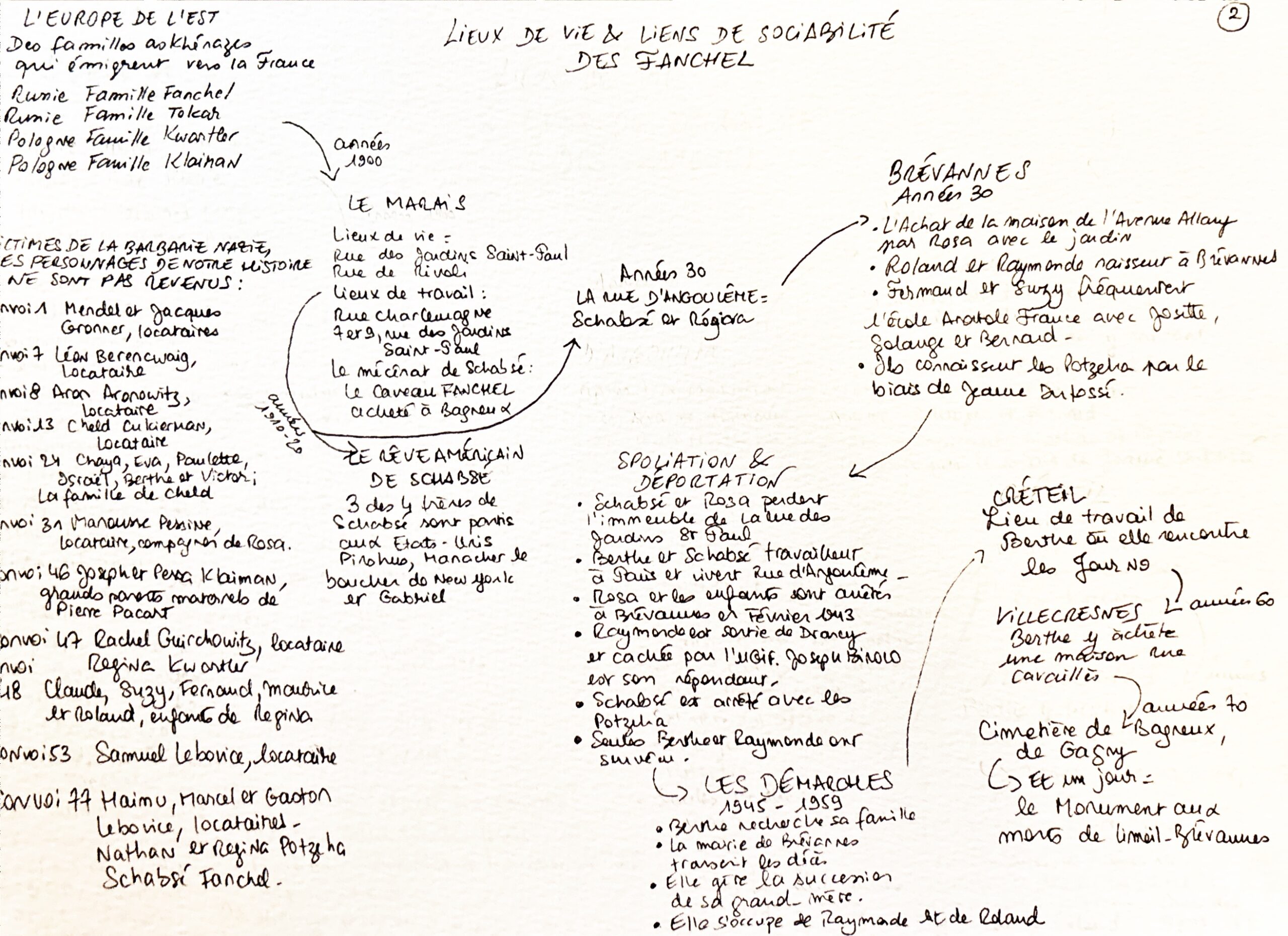
Places where the Fanchel family lived and their relationships with other families
This map shows the location of the Fanchel family home:
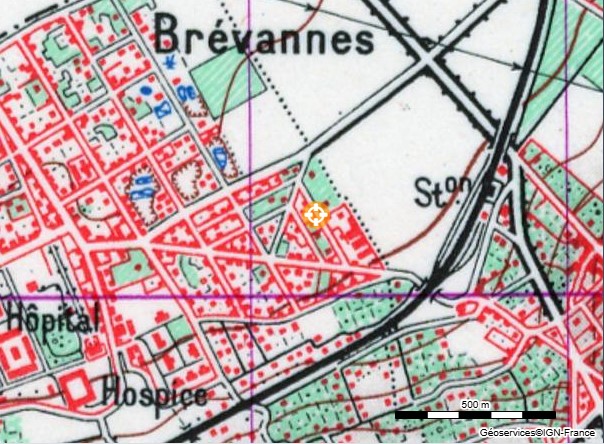
Research into the Napoleon-era cadastral records for buildings and undeveloped land at the Val-de-Marne Departmental archives provides some insight into the Fanchel family’s connection to Brévannes.
In 1930, Regina bought the house at 9, avenue Allary, as evidenced by this extract from the French land registry, the cadastre:
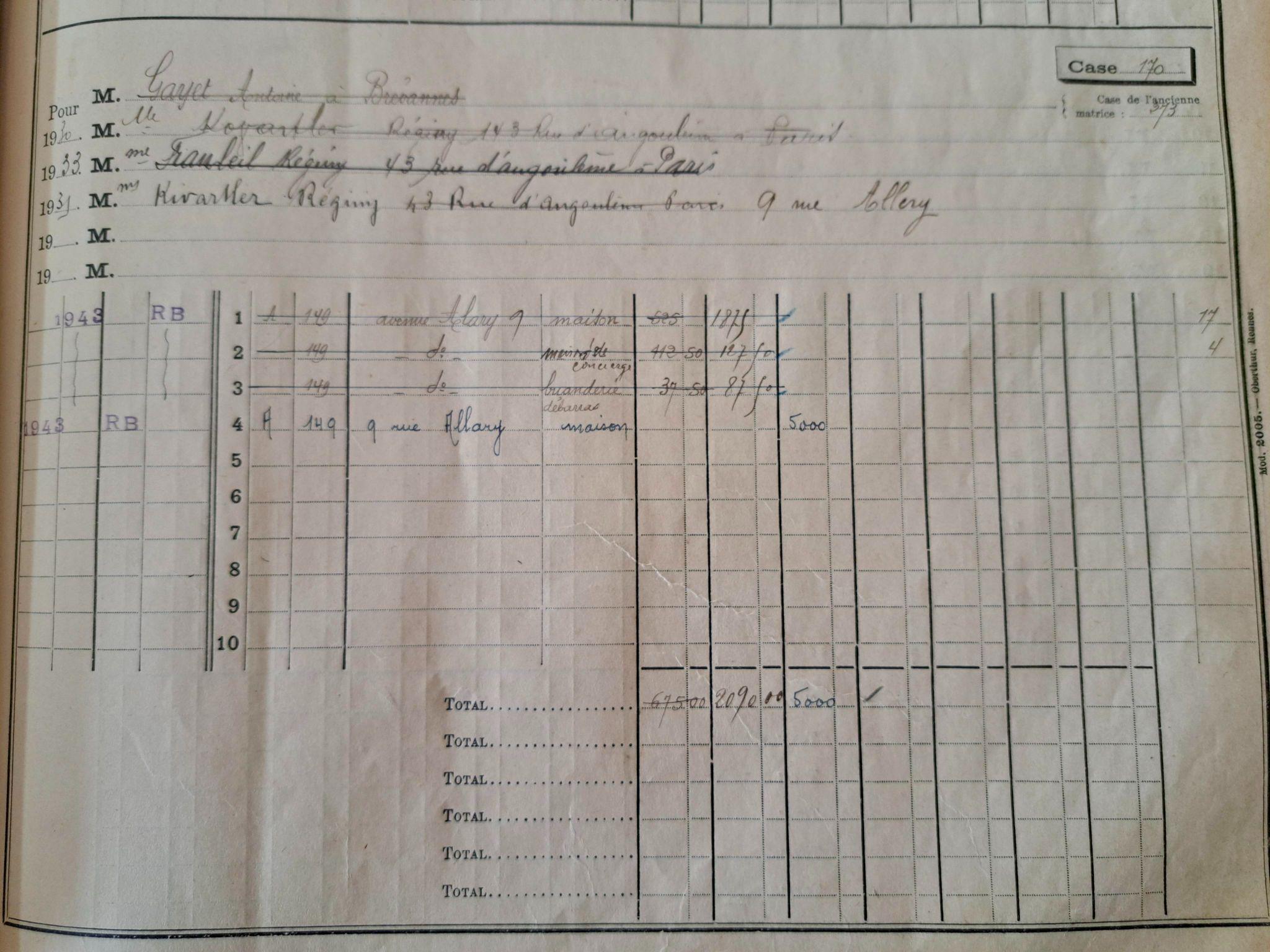
Source: cadastral records (land registry), Val-de-Marne Departmental archives
She also owned 39 ares (one are is around a third of an acre) of the park in Brévannes, folio 1187, which she bought in 1930. We do not know what happened to this after the war. No other owner is listed in the cadastral records. Nowadays, this plot is near the Picasso School.
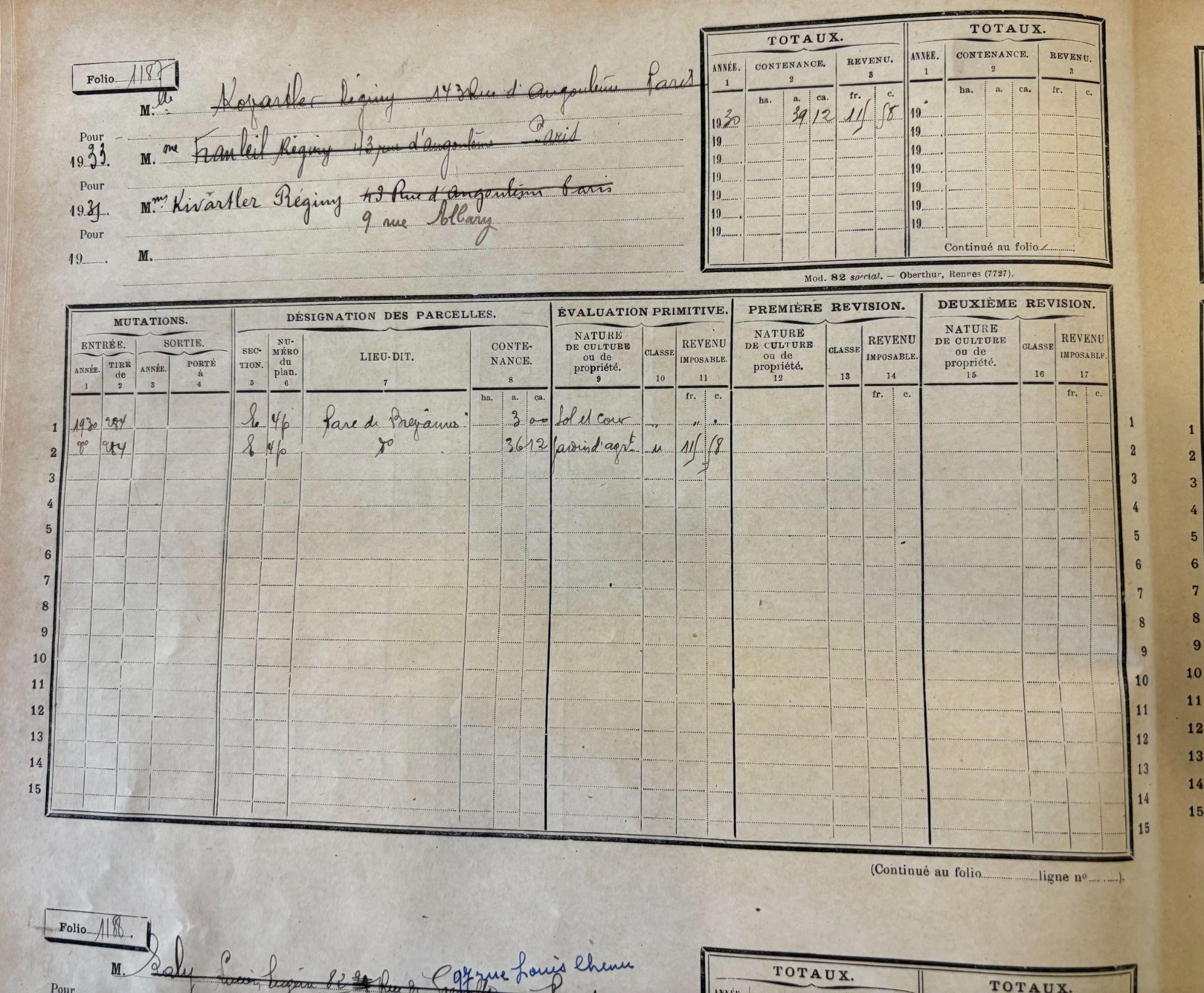
Source: cadastral records (land registry), Val-de-Marne Departmental archives
We can assume that Regina and the children settled permanently in Brévannes in 1935, firstly because this is the address listed in the land registry, and secondly because her last two children, Roland and Raymonde, were born there.
It is worth noting that the land registry also lists the owners of 11 avenue Allary, who also owned the house at 3 avenue Allary, the last known address of Chana Tokar. The building at 11 avenue Allary was a mat factory where looms were used to weave mats for covering crops in the fields. The mats were treated with sulfur to prevent them from rotting. The majority of the workers were Polish. The employer’s name was a Mr. Graff. On August 13, 1941, a huge fire broke out in the factory. According to the 1946 census, the same female factory workers are listed at number 11, along with the Graff family. A housing development, the Résidence du Clos de Boissy, has since been built on the site of 11–15 avenue Allary.
According to an article in La Journée industrielle on July 23, 1937, Regina also contributed to household expenses by purchasing materials at auction:
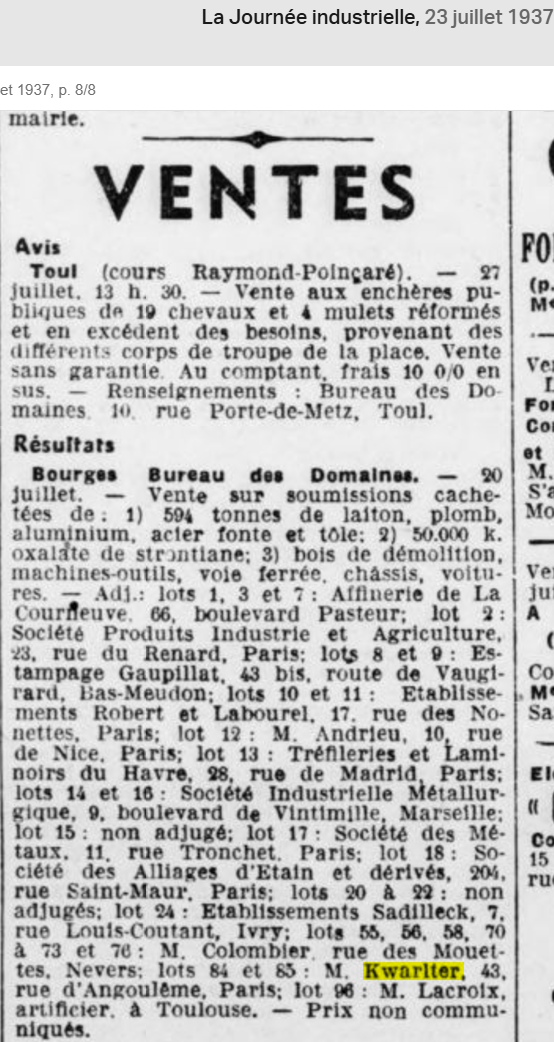
Source: Gallica.
Then, in early 1942, anti-Jewish policies in the occupied zone were stepped up and became more extreme: the number of roundups increased significantly.
Claude Singer, a historian at the University of Paris I (DUEJ), wrote in Les grandes rafles de Juifs en France (The great roundups of Jews in France):
As of summer 1942, all Jews in France, regardless of gender, age, or nationality, came under threat. The threat was very real, as in most cases, arrests resulted in deportation to an unknown destination outside the country. The public was unsettled by this radicalization, and voiced its disapproval. How could people condone the succession of horrific scenes that occurred during the roundups, in particular the young children’s screaming and crying as they were torn away from their parents? […] In 1943 and 1944, arrests, roundups and deportations continued in Paris, and in the both the occupied and southern zones. In total, between March 1942 and August 1944, 75,000 Jews were deported from France. The majority were foreign Jews, but around a third of these men, women and children were French Jews. The German authorities did not differentiate between French and foreign Jews. For Nazi Germany, all Jews, regardless of age or nationality, were targeted for deportation and extermination.
They targeted not only foreign nationals such as Régina, but also French citizens such as the Fanchel children. According to their classmates—Mr. Bernard Berton, Ms. Solange Falière, and Ms. Josette Soubriez, who all knew Guy Lassalle and his wife—the children went to the Anatole France School and wore the yellow star.
Regina was arrested in Brévannes on February 2, 1943 (the same day as von Paulus surrendered in Stalingrad) and interned in Drancy camp along with Claude, Maurice, Fernand, Suzy, Roland and little Raymonde, who was only eight months old. They were all subsequently deported.
When she arrived in Drancy camp on February 3, she was carrying 1600 francs, which was quite a large sum of money at the time.
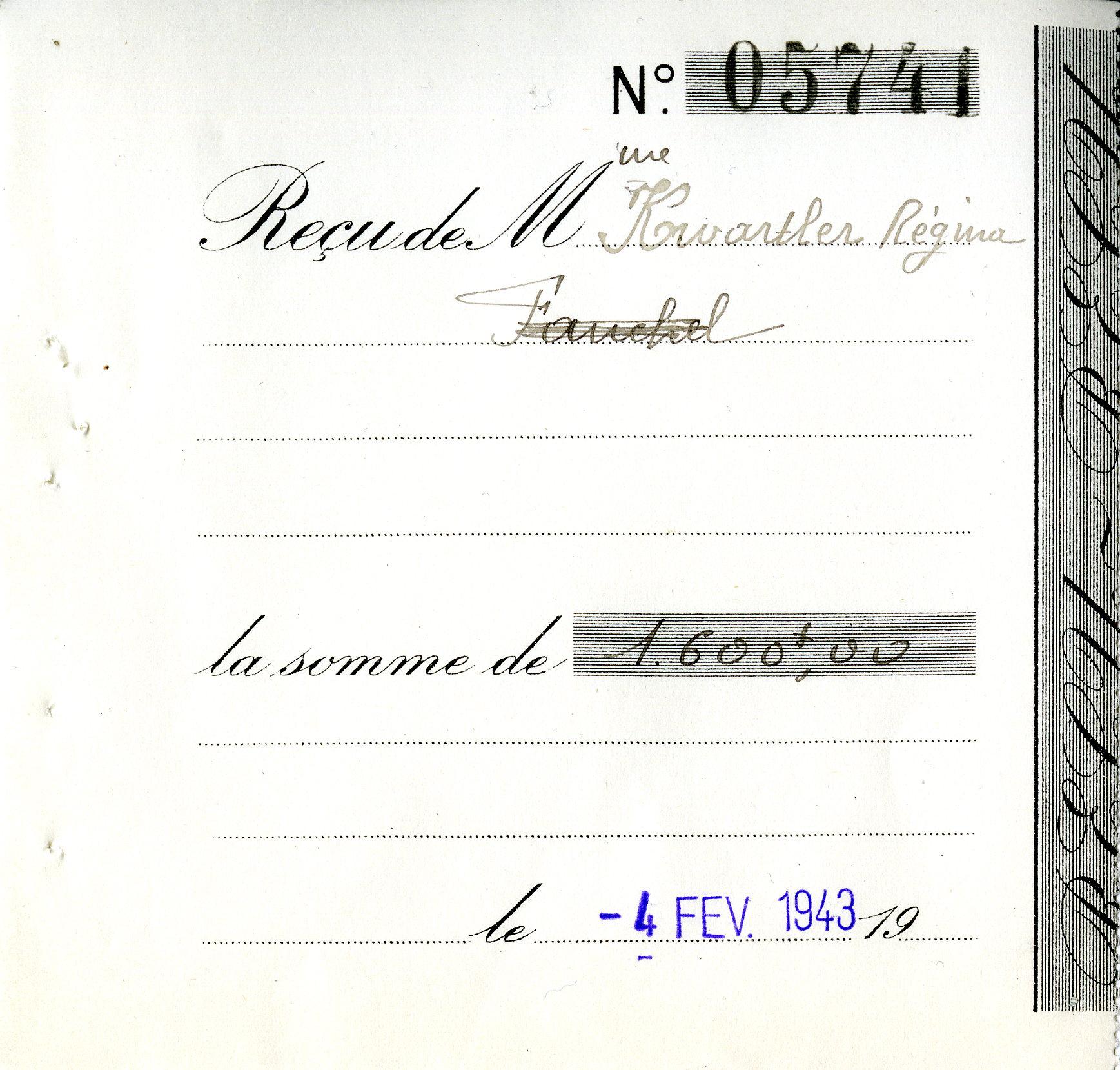
Source: Paris Police Headquarters archives
When she was deported, there was no mention her having any money on her:
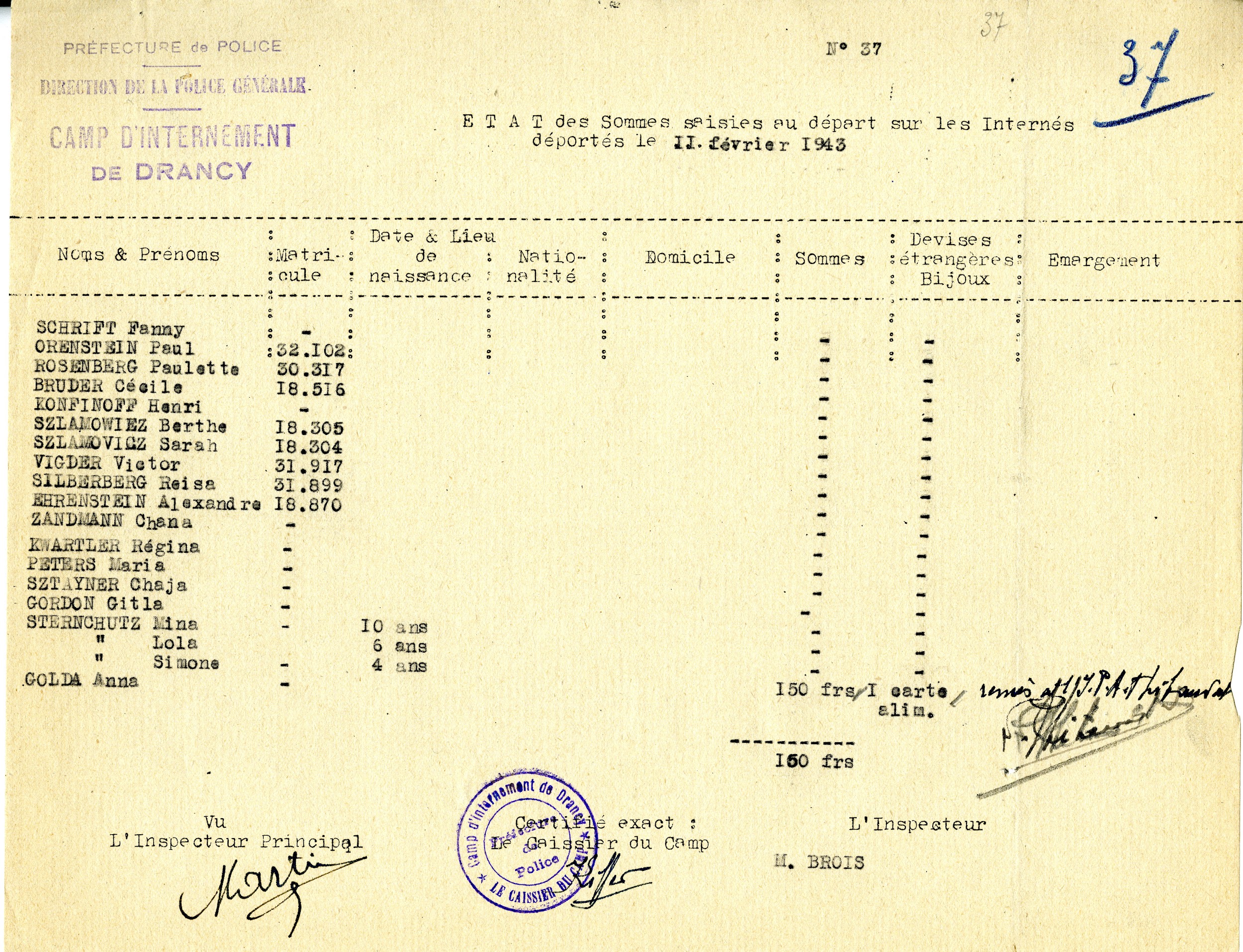
Source: Paris Police Headquarters archives
The money she handed over in Drancy was then deposited in the Caisse des dépôts, the French State holding account:
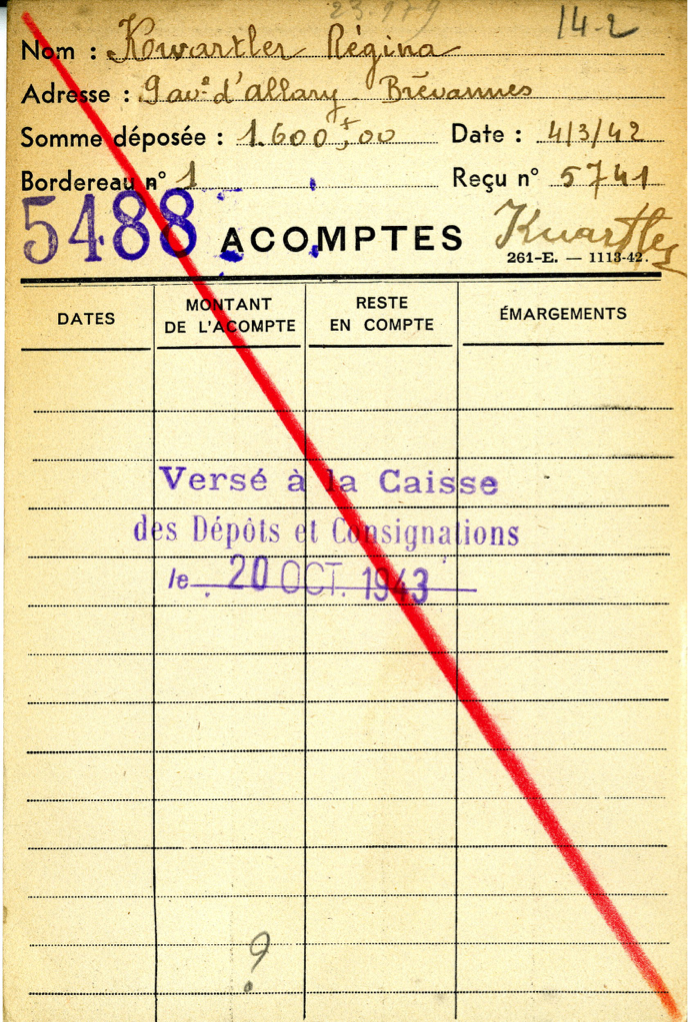
Source: Paris Police Headquarters archives
The following passage, taken from the 1978 edition of Serge Klarsfeld’s Mémorial de la Déportation des Juifs de France (Memorial to the Jews deported from France) explains the events that led up to their death sentence. The lists of names of people deported on the convoys were updated by Jean-Pierre Stroweis.
The transports were suspended for nearly two months. In December, Eichmann and the Sipo-SD in France reviewed the situation and the prospects for deportation in early 1943. On December 31, Knochen telegraphed Eichmann to say that deportations would resume in mid-February, but he was unable to say exactly how many Jews would be involved. But then, on January 21, 1943, Knochen cabled Eichmann again. He asked him what transport options were available for 1,200 Jews who were ready to be deported. He told him that 3,811 Jews were interned in Drancy, including 2,159 French Jews. Then he asked the crucial question: could French Jews be deported?
On January 25, Eichmann’s deputy Günther replied that the Reich Ministry of Transport had given the go-ahead to transport 1,500 to 2,000 Jews from Drancy to Auschwitz in freight cars. On the deportation of French Jews, Günther cabled saying there was no objection, as long as it was carried out in accordance with the guidelines for the evacuation of Jews from France. He also said that the escort from Drancy to the border of the Reich would be handled by an SD commando from Metz, and that from the border onwards, the Ordnungspolizei (order police) would take over and escort the convoy to Auschwitz. On January 26, Knochen sent a telex to all regional Gestapo offices: arrest all Jews subject to deportation and transfer them to Drancy. […]
On February 3, Röthke, the head of the Gestapo’s anti-Jewish department, sent a telex to Eichmann’s office at the RSHA in Berlin saying that on February 9 and 11, two trains were to leave for Auschwitz at 8:55 a.m. carrying around 1,000 Jews. On February 5, Röthke sent a telex to the Ordnungspolizei stating that three convoys were scheduled and that escort commandos of 12 to 15 men should be made available. On the same day, Röthke asked the Gestapo in Dijon to transfer all Jews in their custody so they could be deported on February 9 and 11. The day after the February 9 convoy left, Röthke, head of the Gestapo’s anti-Jewish department, wrote a detailed memo, which was initialed by the recipients, Knochen, head of the security services and the security police, the Sipo-SD, and General Oberg, head of the SS and the German police in France [XXVc-204].
In the memo, Röthke stated: 837 French Jews were interned in Drancy following the roundups of December 1941 and 1942, in addition to 661 French Jews who had broken the law. The Reich Security Main Office (RSHA) gave the green light for further transports of 1,000 Jews on February 9, 11, and 13, 1943.[…] Meanwhile, the second convoy was to depart with 1,000 Jews who were either stateless or held nationalities that made them liable for deportation. The third transport, on February 13, was to be made up of French Jews who had committed crimes and were interned in Drancy. In addition, by February 11, the French police wanted to intern some more “deportable” Jews, i.e., foreigners, caught during a series of small roundups. The French police made this request of their own accord because they were keen to stop French Jews being deported. French police representatives told Röthke that the matter of deporting Jews who held French nationality had not yet been settled between the French and German governments. As a result, the French police would not help to deport French Jews, even those punishable by law, until this issue had been resolved. Röthke concluded his memo as follows: “I replied to these gentlemen that I found this view surprising, given the fact that in 1942, we had already deported some French Jews who had contravened the laws applicable to them. Sauts (an associate of Prefect Leguay, who served as the representative of Bousquet, the Vichy Secretary of State for the Interior in the occupied zone) further stated that, in Bousquet’s view, we could deport the French Jews held in Drancy, but that the French police would be unable to assist us. After a decision made during a telephone conversation with the BdS (Knochen), I told Sauts that the transport planned for February 13 would go ahead regardless. I will submit another report to the RSHA this evening on the transport issue”.
After Germany was defeated in Stalingrad and the tables were turned, the Vichy government became more cautious in its anti-Jewish collaboration with the Nazi police. They were reluctant to support the deportation French Jews, who, in the event of an Allied victory, could hold them responsible more effectively, both legally and morally, than could the families of foreign Jews, who left behind fewer links with the French nation. This explains not only Vichy’s reluctance to deploy French police officers in plain sight at the departure points for transports carrying French Jews, but also the sheer cynicism of its policy of rounding up more foreign Jews in order to prevent French Jews from being deported. As Knochen wrote in his telegram report to Reich Gestapo chief Müller on February 12, regarding “the final solution to the Jewish problem in France,” in order to save French Jews from being deported, French police had spontaneously arrested 1,300 foreign Jews on February 11, and they would be deported along with the French Jews.
The second convoy in February, on the 11th, was thus made up mainly of foreign Jews. We have identified 372 Poles, 154 French (mostly children born in France to foreign parents), 109 Russians, 65 Dutch, 64 Romanians, 56 Germans, 41 Turks, 40 Greeks, 32 Hungarians, 20 Czechs, 16 Austrians, 15 Belgians, 10 Bulgarians, and a few others, even including a Jewish woman born in Poland and now a Chinese citizen by marriage. We counted 499 men, 477 women, and 22 of unknown gender. There were 175 children under the age of 18, including 123 under the age of 12. 172 deportees were over the age of 60 (elderly people were taken from nursing homes and brought to Drancy on February 10, at the same time as the children, to make up the numbers).
A routine telex sent to Eichmann and Auschwitz, dated February 12, stated that at 10:15 a.m. the previous day, a transport had left the Bourget/Drancy station for Auschwitz, carrying 998 Jews. The man in charge of escorting it was Oberleutnant Kassel, of the Schutzpolizei, and on February 14, he wrote a report about escape attempts that took place before the train reached French border. List No. 47 is in very poor condition. Many names are almost illegible because the characters have been erased from the thin paper. There are 9 sub-lists:
1. Romainville: These must have been foreign Jews who had broken the rules or were suspected of acts of resistance and were transferred from Fort Romainville to Drancy.
2. Romainville – French: 16 French citizens, as above.
3. Compiègne foreigners: 12 men transferred from the Compiègne camp to Drancy.
4. Compiègne – French: 39 men.
5. Drancy – 1: 56 people, including numerous families, such as Abraham and Mirla Checinski, aged 48 and 46, and their four children, Wolf, 16, Simon, 14, Elly, 11 and Anna, 8.
6. Drancy – 2: 745 names, 79 of them crossed out, so 666 who actually left. Numerous families, most of whom had French children: Henri Ajzenberg, aged 3; Maxime Borenheim, 3; Jeannette and Hélène Diamand, 4 and 2; Samy Grin, 9; Joseph Haber, 8; Tony Jakubovitch, 5; Hélène and Simone Zawidowicz, 8 and 6; Anna and Lucette Klein, 6 and 3; Michel Zelicki, 1; Gilles Lewinger, 1; Madeleine Wais, 1; Claudine Malach, 3; Micheline Muller, 1; Germaine and Pierre Roth, 7 and 3; Jacqueline Kravtchik, 2; Elie and Colette Salomon, 9 and 2; Myriam and Abel Sluizer, 5 and 2. Among the other families: Elie and Mathilde Azouvi, aged 50 and 39, and their three children, Eva, 17, Louisette, 14, and Gaston, 12; Samuel and Gracia Beraha, aged 46 and 37, and their three children, Albert, 9, Michèle, 8, and Monique, 4; Georges and Nesca Erdelyi, aged 34 and 31, and their three children, Betty, 4, Michèle, 3, and Annie-Rose, 2; Doudou Eskenazi and his four children, Rose, 13, Allegra, 10, Albert, 7, and Leon, 5; Perla Goldsztajn, aged 30, with Micheline, aged 2, and Françoise, aged 1; Moise and Perla Kavayero, aged 45 and 43, and their five children, Sarah, aged 19, Esther, aged 17, Elie, aged 14, Diamante, aged 10, and Suzanne, aged 6; Laja Kuperberg, aged 35, and her three children, Fajga, aged 13, Esther, aged 9, and Henri, aged 1; Djaya Lerea, aged 34, and her three children, Rebecca, aged 12, Esther, aged 8, and Isidore, aged 4; Sarah Namer, 47, and her four children, Maurice, 18, Dona, 15, Claire, 12, and Fanny, 9; Sarah Semel, 34, with Salomon, 2, and Isabelle, only 9 months old; Louise Szwarcbart and her baby Bernard; Zurek and Golda Wapniarz, both 42, and their three children, Regina, 8, Robert, 3, and Joseph, 1.
7. Drancy – 3: 67 departed. Among the children were Georges and Fernande Blachmann, aged 4 and 2; Berthe and Denise Lemel, 13 and 9; Lucienne Porjes, 1; and Blanche Skrzydlak, 9.
Although she was on the deportation list for Convoy 47, Denise Lemel, who unlike her sister was born in France, was able to leave Drancy. However, she was arrested again and deported on Convoy 77 in 1944.
8. Hospitals – Hospices – Orphanages: The Nazis filled the lists with sick, insane, and elderly people, as well as small children, all mixed together in this list: Theodore Bakra, 83; Gitel Mendelevitch, 91; Esther Krimer, 84; Caroline Neumann, 82; Bertha Schmulevitz, 85; Kiva Makline, 80; Gitla Wajselfisz, 84; Fania Krilitchevski, 87; Marie Dreyfuss, 86; Maria Kohn, 80; Peisach Linker, 70; and 15 other septuagenarians. Among the children were Edith Becker, 12; Sarah Beznovennu, 11; Berthold Bodenthal, 9; Marguerite and Simon Bogaert, 14 and 8; Ruth Buntmann, 10; Esther Don, 11; Jacques Fiszl, 4; Victor Grumberger, 6; Emile Huber, 12; Gaston Kahn, 7; Marie-José and Henri Klayminc, 14 and 10; Leib Kuzka, 10; Sarah Lerer, 13; Joseph, Zelman and Jeanine Lipschitz, aged 11, 8, and 3; Gisèle Messinger, 12; Joseph and Augusta Skoulsky, aged 10 and 5; Mina, Lola, and Simone Sternchuss, aged 9, 6, and 4.
9. Last minute additions list: 19 people.
The travelling conditions were so appalling that one of the deportees, Linda Geber, aged 64, died on the train in the Le Bourget/Drancy station, according to a handwritten note added to the convoy list by Röthke. When the convoy arrived in Auschwitz, on February 13, 143 men were selected to work and were assigned the numbers 102139 to 102280, as were 53 women, numbers 35290 to 35342. Everyone else was gassed immediately. In 1945, there were only 10 survivors, one of whom was a woman.
This convoy was made up of 314 people born in Poland, 156 in France, 81 in Ukraine, 57 in Germany, 56 in the Netherlands, 44 in Turkey, 43 in Romania, 40 in Greece, 29 in Belgium, 27 in Hungary, 17 in Russia, 16 in Belarus, 13 in Lithuania, and 12 in Bulgaria, with the borders as they stood in 2021.
Devan’s comment:
Regina Kwartler was born on February 24, 1904 (?) in Poland. She married Schabsé Fanchel, with whom she had 7 children. The family lived at 9 avenue Allary at Limeil Brévannes. She was arrested on February 2, 1943, interned in Drancy and then deported to Auschwitz on February 11, 1943 on Convoy 47. The children were deported on Convoy 48 and her husband on Convoy 77 on July 31, 1944.
Regina’s name is on the Wall of Names at the Shoah Memorial in Paris, on slab N°27, column N°, row N°3.
There is little information in the file on Regina, number 65 8 17, which is held by the French Defense Historical Service archives in Caen, in Normandy. On May 2, 1949, Berthe received a missing person’s certificate for her mother. Her foreigner’s identity card, numbered 39 AS 68 675, states that she was not working at the time. She was declared dead in a court ruling dated December 13, 1950, and her death was registered at the Brévannes town hall on February 10, 1951, and signed by the mayor, Marius Dantz. However, there is also a letter from Louis Véron, a notary in Boissy Saint-Léger, in which he notified Berthe that she would be exempt from transfer duties on her inheritance because Regina had died as a result of injuries sustained during the war. On January 7, 1957, Regina was officially recognized as a “political deportee”. In April, her daughters received a lump-sum compensation payment of 32,000 francs. She was then declared to have “died during deportation” on November 14, 1986.
Another letter in the file describes a guardianship hearing held in Brévannes on February 8, 1952, during which Berthe Odette was granted custody of Raymonde.
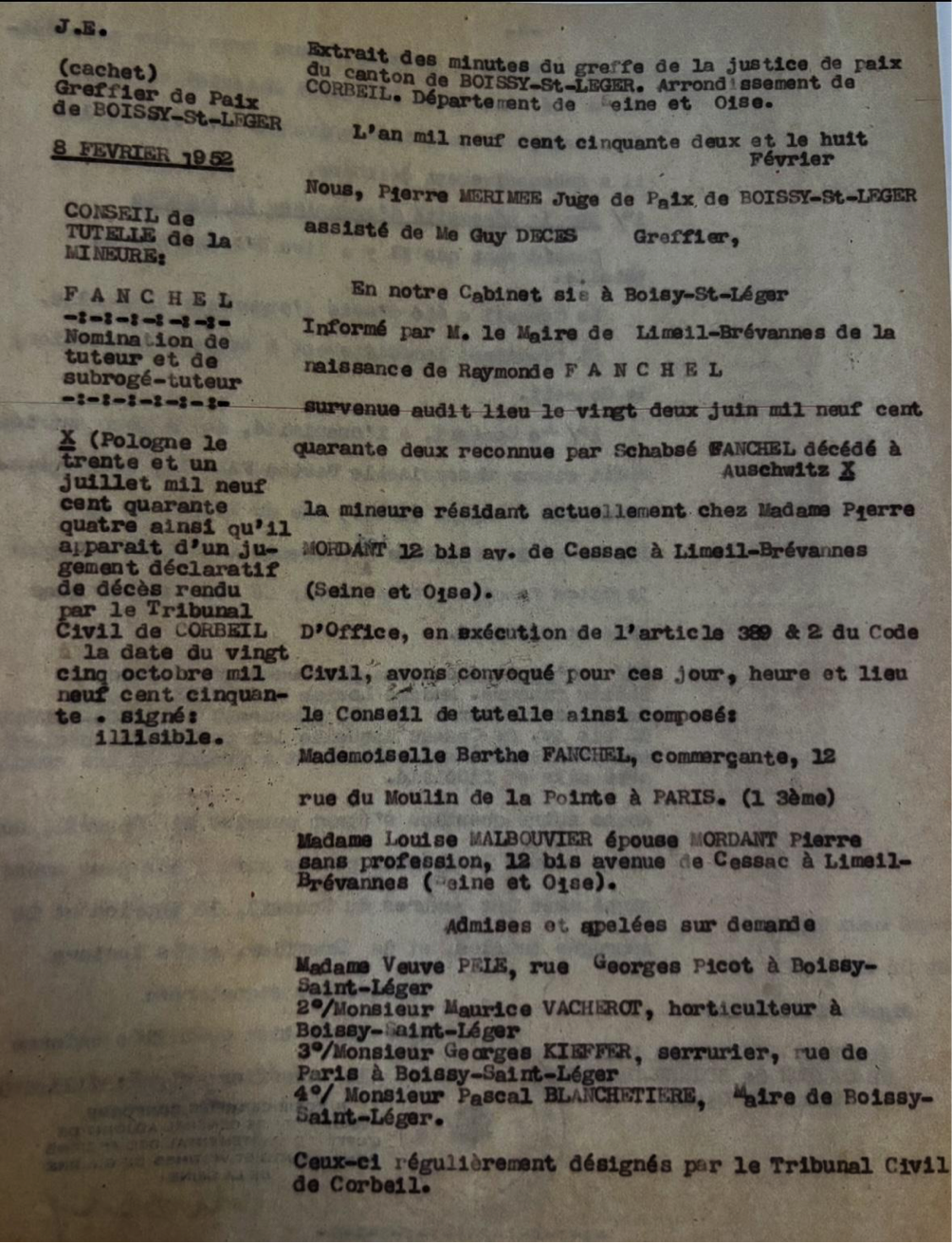
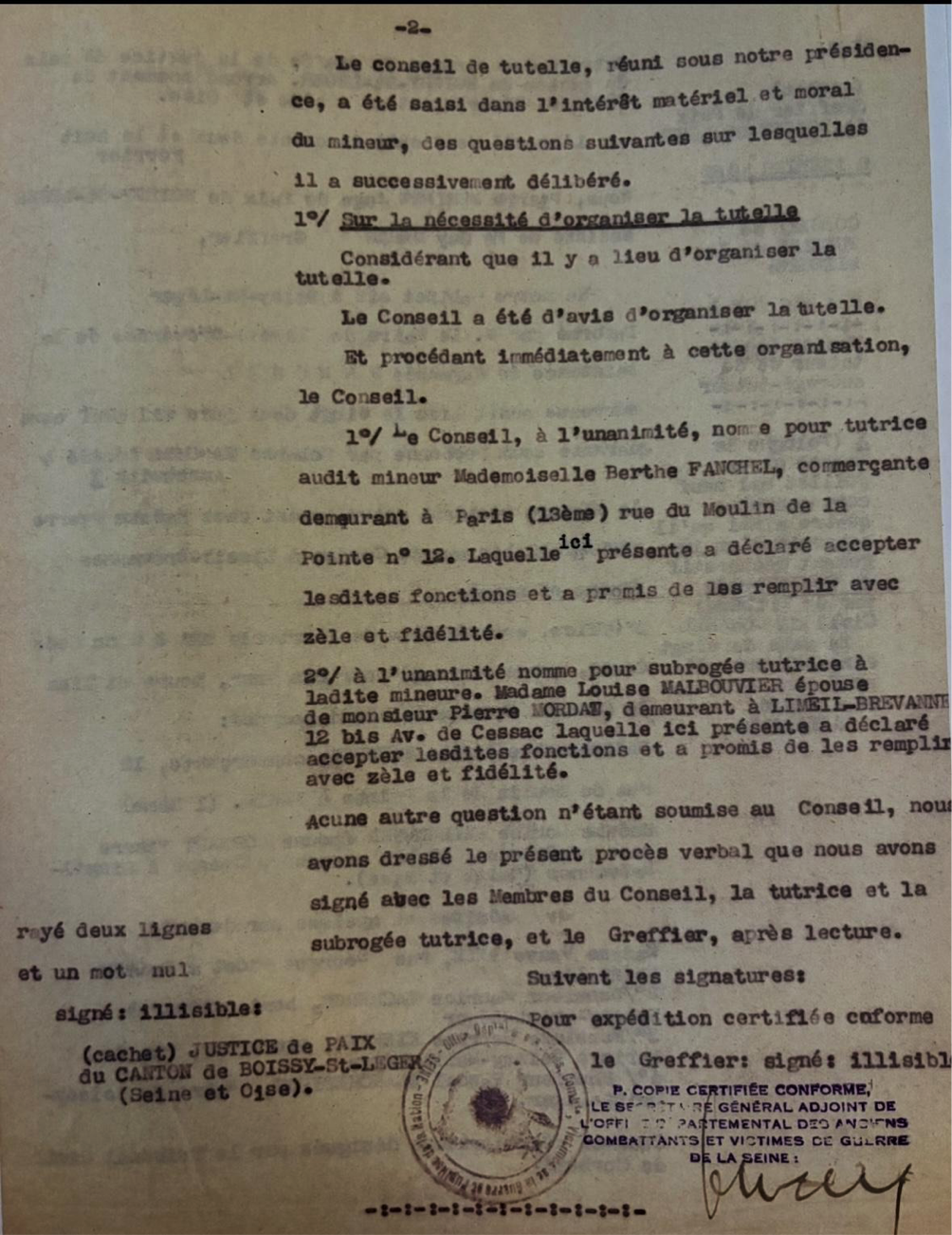
Source: French Defense Historical Service in Caen, Normandy
The five children who were deported: Claude, Maurice, Fernand, Suzy and Roland
Convoy N° 48, which departed on February 13, 1943
The following extract was taken from the 1978 edition of Serge Klarsfeld’s Mémorial de la Déportation des Juifs de France (Memorial to the Jews deported from France). The lists of names of people deported on the convoys were updated by Jean-Pierre Stroweis.
On February 6, the head of the Gestapo’s anti-Jewish department, Röthke, sent a telex to Berlin and to the Sipo-SD in Metz [XXVc-203 and XXVc-204] stating that a third convoy was leaving on February 11, departing at the same time (10:15 a.m.) and carrying the same number of Jews. This convoy was to deport French Jews imprisoned for having broken the law (see convoy notices 46 and 47). Then on February 13, Röthke sent his customary telex to Eichmann and to the Auschwitz camp, saying that at 10:10 a.m. that morning, a convoy of 1000 Jews had left the Bourget/Drancy station for Auschwitz, with lieutenant Nowak in charge of the escort. A note from Röthke dated February 16, [XXVc-207] stated that German forces had to be called in to dispatch the convoy but that, despite their initial hesitation, the French police eventually cooperated as the train departed. The convoy was made up of 466 men, 519 women, and 15 people of unknown gender. There were 150 children under 18 and nearly 300 under 21. This list is in very poor condition; holes made by the ring binder have damaged some of the names, which had to be painstakingly pieced back together. This convoy was made up entirely of French Jews. In fact, the title of the list is “list of a thousand French people.” The deportees had all been living in the Paris area. The list is made up of three smaller lists:
- Drancy – staircase 2: 388 names. Numerous families are among them: Rebecca and Isaac Alvo and their four children, Juliette, 18, Victoria, 17, Jacques, 11, and Rachel, 7. Mendel and Mindla Arm, aged 59 and 51, and their seven children, Hinda, 19, and Berthe, 15. Marcel, 13, 10-year-old twins Charles and Jeanine, Paulette, 7, and Daniel, 5; Haim and Hélène Leiba, aged 50 and 59, and their five children, Adèle, 23, Marcel, 21, Paulette, 19, Jacqueline, 17, and André, 15; Joseph and Esther Mantel, aged 37 and 36, and their four children, Salvator, 14, Renée, 10, Rosette, 9, and Jacqueline, 1; the 5 Fanchel children, deported without their parents; Claude, 17; Maurice, 16; Suzy, 13; Fernand, 11 and Raymonde, who was only six months old; Herman and Filica Avram, aged 35, and their son Christian, aged 1; Chana Esztein, 38, and her two sons, Abraham, 7, and Charles, 5; Lydia Jussim, 4; Jean and Serge Senders, both 6; Regina and Edith Wetzstein, 10 and 3; Ginette and Sylvain Ziemand, aged 7 and 5.
- Drancy – staircase 1: 340 names. Among them, Pierre Grumbach, 11; Pierre Gumpel, 10; Cécile Landau, 10, and her sister Fanny, 7; Alice Lévy, 10; Suzanne Lévy, 2; Léa and Rachel Zawidowicz, aged 13 and 12.
- Drancy – staircase 3: 263 names. Among the children, Berthe Alexandre, 3; Philippe Nozek, 10; Léon and Esther Szejmann, 6 and 10; Szmul Weberspiel, 2; Roland Fanchel 5, whose brothers and sisters are on the list for staircase 2; Claude Attali, 9; Jean and Claude Silberschmidt, 4 and 2; Pauline, Raymonde and Jeanine Yakir, aged 14, 13 and 11.
This convoy arrived in Auschwitz on February 15. 144 men were selected to work in the camp and were assigned serial numbers 102350 to 102492, as were 167 women, with serial numbers 35357 to 35523. Everyone else was gassed immediately. In 1945, there were only 12 survivors, one of whom was a woman.
Claude Fanchel, April 1, 1925 – February 18, 1943
“Died during deportation” at the age of 17, declared on December 24, 2013. Published in the French Official Gazette on February 19, 2014. Convoy number: 48.
Claude Fanchel was born on April 1, 1925 in Berck, in the Pas de Calais department of France. We were unable to find a record of her birth in the Berck municipal archives but she is listed in the ten-year table. Her parents were Schabsé Fanchel and Régina Kwartler. Claude was arrested on February 2, 1943, interned in Drancy and deported to Auschwitz on Convoy 48 on February 13, 1943, together with Maurice, Suzy, Fernand and Roland. She was later declared to have died on February 18.

Source: French Official Gazette.
Maurice Fanchel, January 13, 1927 – February 18, 1943
“Died during deportation”, at the age of 16, declared on December 24, 2013. Published in the French Official Gazette on February 19, 2014. Convoy number: 48.
Maurice Fanchel was born on January 13, 1927 in the 19th district of Paris. His parents were Schabsé Fanchel and Régina Kwartler. Maurice was arrested on February 2, 1943, interned in Drancy and deported to Auschwitz on February 13, 1943 on Convoy 48, together with Claude, Suzy, Fernand and Roland.

Source: Paris city archives

Source : JORF.
Suzy Clara Fanchel, March 13, 1929 – February 18,1943
“Died during deportation” at the age of 14, declared on May 13, 2014. Published in the French Official Gazette on July 11, 2014. Convoy number: 48.
Suzy Fanchel was born on March 13, 1929 in the 11th district of Paris. We were unable to find her birth certificate. Her parents were Schabsé Fanchel and Régina Kwartler. Suzy was arrested on February 2, 1943, interned in Drancy and deported to Auschwitz on February 13, 1943 on Convoy 48, together with Claude, Roland, Maurice et Fernand.

Source : JORF.
On May 5, 2025, thanks to Geneviève and Guy Lassalle, I spoke on the phone with Josette, who was born in 1932 and is now 93 years old. Here is her testimony:
“I’ve lived in Brévannes my whole life, and during the war, I lived on Place des Marronniers. Brévannes was bombed by the Germans, who were targeting Villeneuve-Saint-Georges; it during was the occupation. When I was in middle school, I went to the Anatole France school with Suzy Fanchel. Suzy was a lovely girl, always smiling, easygoing, and full of energy. She came from a loving and very close-knit family. Her parents were “good people.” Suzy had to wear the yellow star, and yet she was never made to feel unwelcome by her classmates; we didn’t treat her any differently. One morning, Suzy didn’t come to school, and we never saw her again.”
Josette found out what happened to Suzy after the war when Berthe Odette came back to live in her parents’ house with her nephew, Roland. She never met Suzy’s brothers, Maurice, Fernand, and Roland, because back then, boys and girls had separate classes. Her brother, meanwhile, knew them well, but sadly he has passed away so he is no longer able to share his memories of them.
I was also able to collect the testimony of Solange, who has also lived all her life in Brévannes. Now 95 years old, she is still actively involved in a nonprofit organization called Les fils d’argent, which puts on afternoon tea parties with old time dancing. Here is her testimony:
“During the war, many families disappeared because they were Jewish. The Fanchels had a beautiful house. The Germans were afraid to spend time in Brévannes because there was tuberculosis in the sanatorium. At least that was the rumor going around.
I was living with my grandparents at 13 Avenue Delaporte. In Paris, we had to hide in cellars during the air raids. My parents decided to send me to Brévannes. We didn’t have to hide there, and we had everything we needed, but it was a dreadful time. I used to go and gather grass for the rabbits; I went gleaning. I was in Miss Marchand’s class—she was the principal and a teacher at the Anatole France school—in eleventh grade. At that time, there were four classes in the girls’ school, each with over 30 students, ranging in age from 6 to 14. We also had a gym teacher, Ms. Malek, and a music teacher, Ms. Materne. Suzy Fanchel was in my class, with Ms. Nampon and Ms. Soubriez. She was a slim-built girl. One morning, the Germans came to arrest her in class. We knew only that she had been deported; that was all. After the war, we heard the sad news. We didn’t know what had happened to the Jews; we never talked about it. Many families disappeared, including the Fanchels and the Lapinskis.”
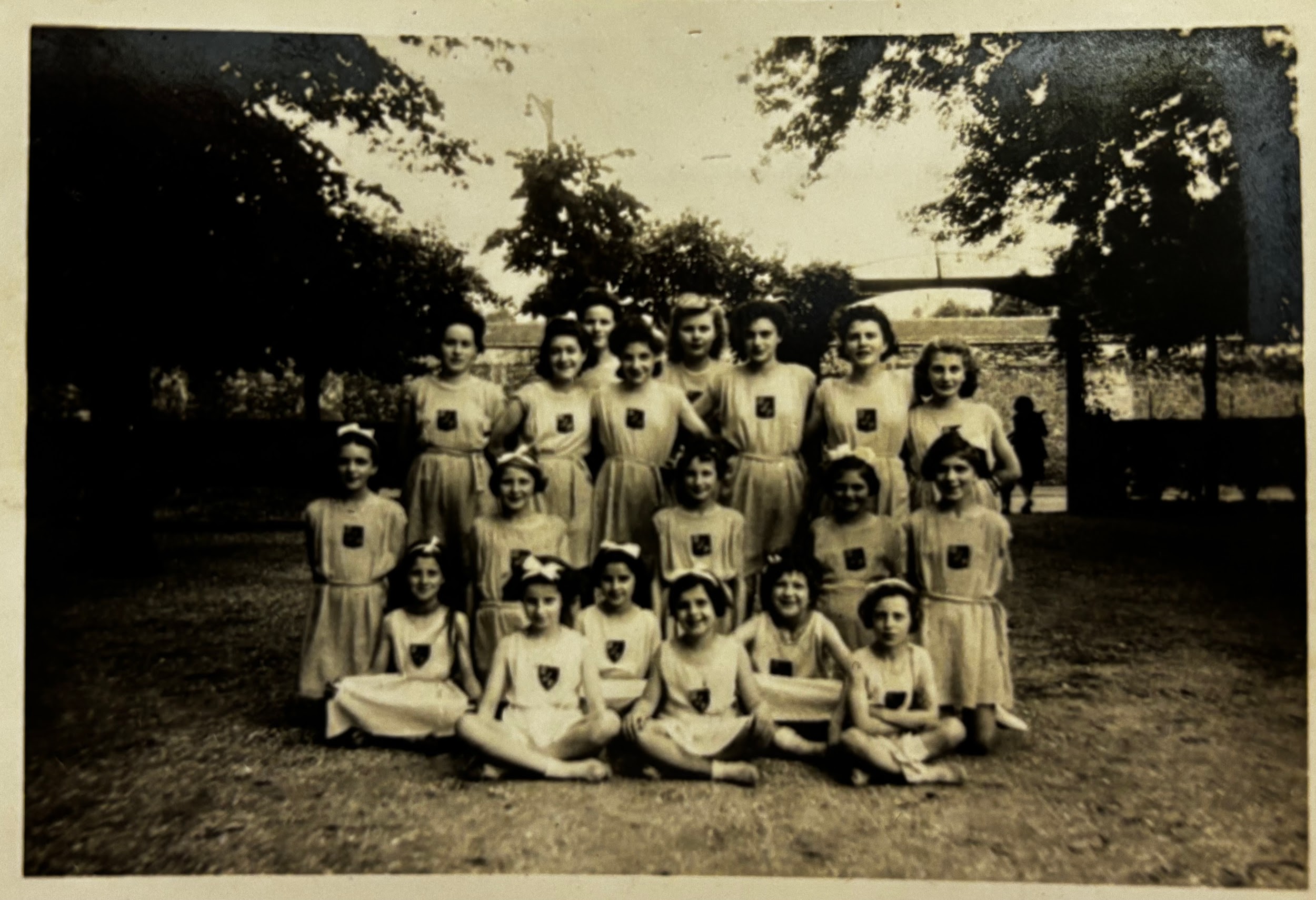
Source: Photo of the gym class at RSF espérance, taken in May 1943, published with the kind permission of Ms. Faluère
Suzy is not in the photo, unfortunately, but all her friends from the Anatole France School are in it.
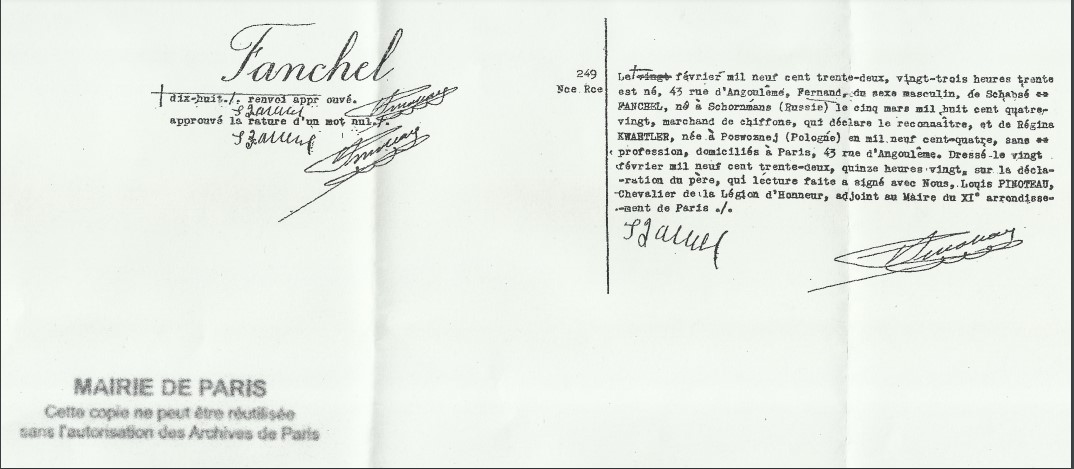
Source: French Official Gazette
Fernand Fanchel, February 18, 1931 – February 18, 1943
“Died during deportation” at the age of 14, declared on May 13, 2014. Published in the French Official Gazette on July 11, 2014. Convoy number: 48.
Fernand Fanchel was born on February 18, 1931 in the 11th district of Paris. His parents were Schabsé Fanchel and Régina Kwartler. He was arrested February 2, 1943, interned in Drancy and deported to Auschwitz on February 13, 1943 on Convoy 48, together with Claude, Suzy, Maurice and Roland.

Source: French Official Gazette
Roland Fanchel, July 25, 1937 – February 18, 1943
“Died during deportation” at the age of 5, declared on May 13, 2014. Published in the French Official Gazette on July 11, 2014. Convoy number: 48.
Roland Fanchel was born on July 25, 1937 in Limeil-Brévannes, in the Val-de-Marne department of France. His parents were Schabsé Fanchel and Régina Kwartler. He was arrested February 2,1943, interned in Drancy and deported to Auschwitz on February 13, 1943 on Convoy 48.
During his time in Drancy, as a little boy of just 5 years old, he separated from his brothers and sisters.
Source: Shoah Memorial archives
Lina’s comment:
Record from the Shoah Memorial.
The record is an extract from the original deportation convoy list.
It provides us with a list of names of people who were deported on Convoy 48, which left Drancy on February 13, 1943, bound for Auschwitz. The record includes the following information: first and last names, dates of birth, addresses, and places of residence. There were people of all ages, children and adults, women and men, from all over France. The list was type-written. On this image, there is the name of a member of the family that we are researching: Roland Fanchel. His birth date is listed as July 1, 1937.
His address was 43, rue d’Angoulême in Paris. From this record, I discovered that other people from Paris were deported along with Roland. The date of birth listed is incorrect, as we know he was born on July 25, 1937, and was only five years old when he was deported. His name is inscribed on the Wall of Names at the Shoah Memorial in Paris, on slab number 13, column number 5, row number 1.

Source: French Official Gazette
Schabsé Fanchel – arrest and deportation
We know little about what happened to Schabsé, Berthe, and Raymonde, the three remaining family members, between February 1943 and July 1944. Raymonde miraculously escaped being deported, as the U.G.I.F. (Union Générale des Israelites de France, or General Union of French Jews) intervened on her behalf and took her in. However, Schabsé and Berthe were arrested on July 3, 1944.
Agata’s comment:
We know that S. Fanchel was arrested on July 3, 1944, as his name is on a list kept by the Prefecture of the Seine et Oise department of France (Convoy 77 archives).
Schabsé and Berthe were arrested at their home on July 3, 1944, on the grounds their “race”. He was detained in Maisons-Laffitte, in the Yvelines department of France, before being transferred to Drancy. Nathan and Regina Potzeha, whose biographies we wrote previously, were with him.
Madeleine’s comment:
This record is dated October 14, 1957, and lists S. Fanchel’s civil status: it is a check sheet that details his arrests, first in Maisons-Laffitte and then in Drancy. (Shoah Memorial archives)
Tasnim’s comment:
This record comes from Drancy camp. It is about Schabsé Fanchel, and tells us that he was arrested on July 3. It teaches us about the historical context and helps us to remember the victims.
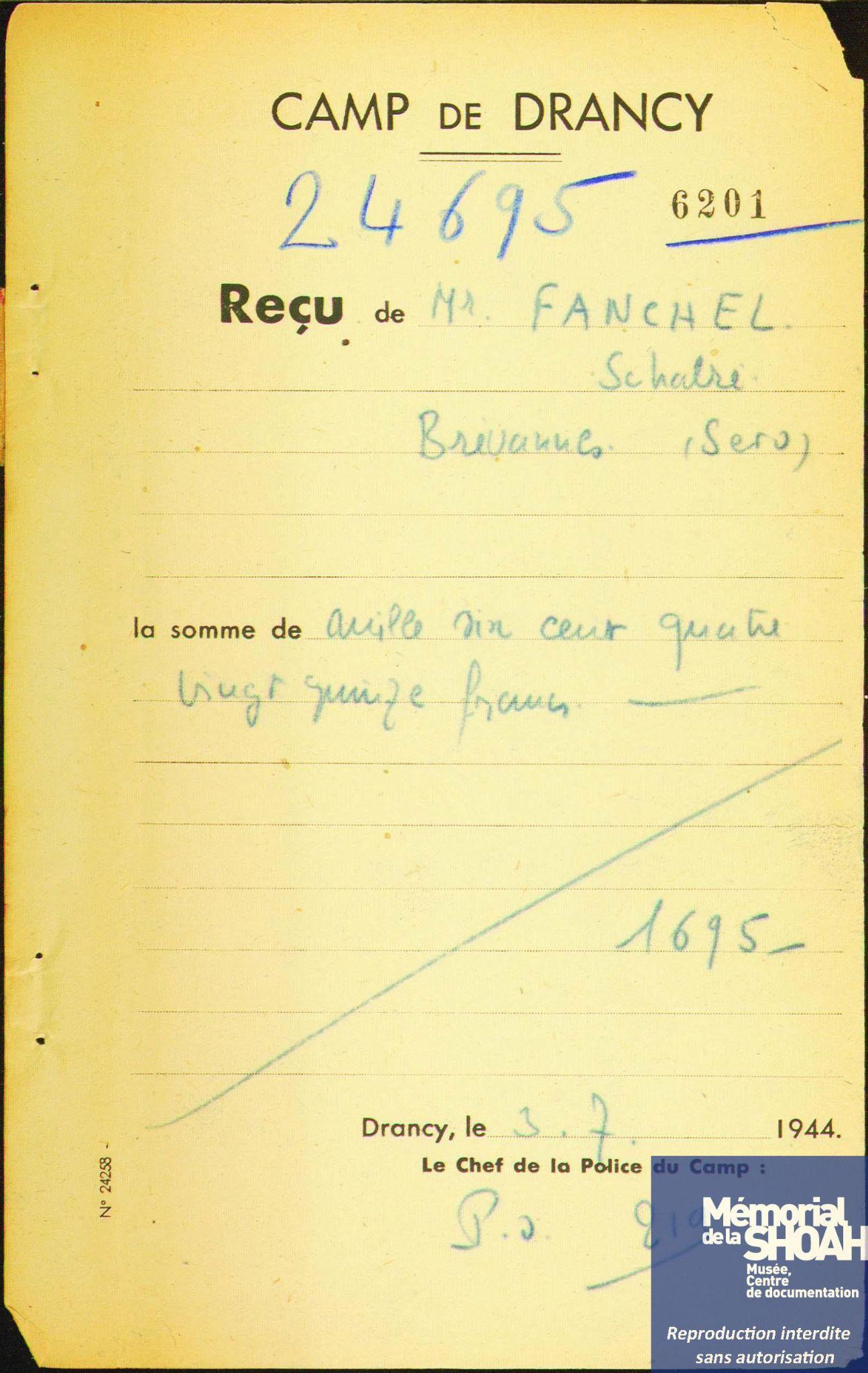
Source: Shoah Memorial, Paris
Mohammed’s comment:
According to the Drancy search log, Schabsé had 1695 francs confiscated from him when he arrived in the camp. His serial number was 24695.
Anaëlle Riou, in her paper Une micro-histoire de la Shoah en France. La déportation des Juifs du convoi 77 (A micro-history of the Holocaust in France. The deportation of Jews on Convoy 77), published by Caen University in 2019, says that 60 of the people who were deported on Convoy 77 were arrested in the Seine-et-Oise department, 56 of them in July 1944. “The persecution of Jews intensified as the Liberation drew nearer, and the Germans had no qualms in arresting people all over France, regardless of their age or nationality, with no regard for the French authorities.”
Only four people, including Schabsé, were sent to Maisons-Laffitte before being taken to Drancy, including the three from Brévannes.
By that time, Schabsé’s wife and other children had already been arrested. The Feldgendarmerie (military police) from Corbeil arrested him on the grounds that he was “of the Jewish race” or “Israelite”, according to a list issued by the Seine-et-Oise prefecture. His financial circumstances were described as “comfortable.”
On July 31, 1944, 1321 people were deported on Convoy 77, including many children that Aloïs Brunner had rounded up in U.G.I.F. homes, and Ida Grinspan’s father.
This passage, quoted by Anaëlle Riou, describes the circumstances surrounding the convoy’s departure:
July 31, 1944, Bobigny station. When convoy’s departure day drew near, the internees were told the evening before. “Everything was done to ensure that there were no delays with the buses taking them to the station or as they boarded the cattle cars. This was followed by a terrifying ritual in which the internees summoned for departure were locked in an area surrounded by barbed wire, where the men were shaved and searched and the women were searched and had all their jewelry confiscated. They then spent the night in storage rooms. Early the next morning, SS guards wielding truncheons herded the internees onto buses bound for Bobigny station. The instructions for the other internees in the camp were very clear: “Following particularly strict instructions given to me by SS Hauptsturmführer Brunner, it is strictly forbidden to open the metal window shutters tomorrow from 6 a.m. until the last bus has left. No one is to stand by the windows. The penalties for disobeying these orders will be very severe.”
In Convoy 77’s case, the first bus left at 7:10 a.m.: “The internees will go down into the courtyard at 6:30 tomorrow morning. The first group must be ready to leave at 7:00 a.m.. The first bus will leave at 7:10 a.m. The staff will carry out the roll call.”
Arrival at the camp: We know for a fact that the convoy arrived in the middle of the night, probably during the night of August 3 to 4, 1944, at around 3 a.m. It stopped inside the Birkenau camp. Since May 1944, deportees had no longer been unloaded on the Judenrampe. “It was pitch black; spotlights lit up the route. The train stopped inside the camp. There was no station.” The Jews disembarked and were selected either to go to the gas chambers or for forced labor, but neither group knew at that point what the camp doctor in charge of sorting the deportees had in store for them.
In total, 890 of the 1,294 people who were deported on Convoy 77 were gassed on arrival, including exactly 425 women and 465 men. They were aged between 15 days and 88 years old.
Schabsé Fanchel died on August 3 or 4, 1944, in Auschwitz, Poland. There are no records of the short time he spent in Auschwitz. He just disappeared without a trace.
Hanaé’s comment:
Shoah Memorial record.
There is a list of people deported on the various convoys. We can see that Schabsé was deported on Convoy 77.

Source: Shoah Memorial, Paris
Adam’s comment:
The record I have (from the Convoy 77 archives) is about Schabsé Fanchel’s death in Poland.
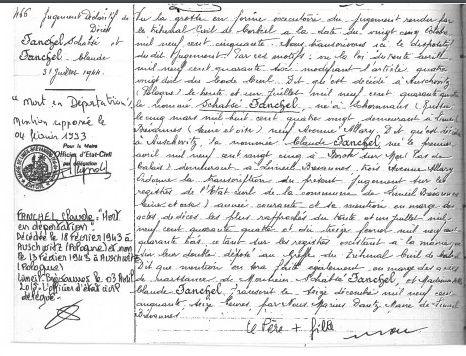
Source: Limeil-Brévannes town hall archives
Maïssane’s comment:
I worked on S. Fanchel’s death certificate (Limeil-Brévannes town hall archives), which contains some information about his life. Born in Russia in 1880, he lived in Limeil-Brévannes until he was deported to Auschwitz, where he died.
Claude Fanchel was one of his daughters. She was born on April 1, 1925 in Berck-sur-Mer in the Pas-de-Calais department. She then lived at 9, avenue Allary in Limeil-Brévannes. We do not know the exact cause of her death.
Rebuilding their lives: what happened to the family members who survived
Berthe, the oldest daughter, and Raymonde, the youngest, were not deported.
Berthe Odette Fanchel
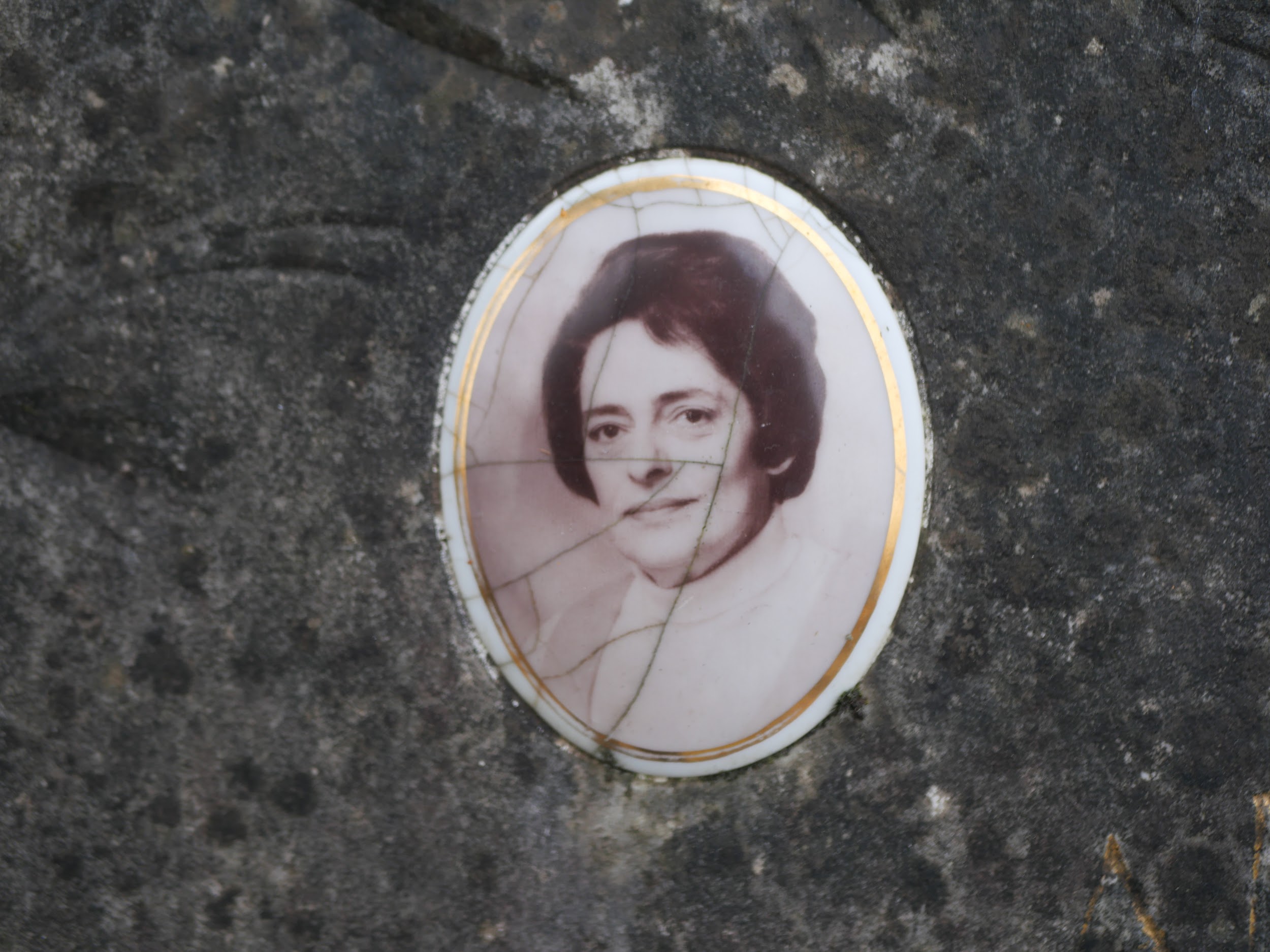
Photo on the headstone at Bagneux cemetery in Paris. Source: P. Deweerdt
Berthe Odette was born on October 30, 1921, in the 4th district of Paris. She died on July 4, 1976 in Fontenay-lès-Briis, in the Essonne department of France. Her mother, Régina, officially recognized Berthe as her daughter in 1922, and her father did the same on January 10, 1926. In the census records, she is listed under her maiden name, Kwartler, but in her adult life she used her father’s surname, Fanchel.
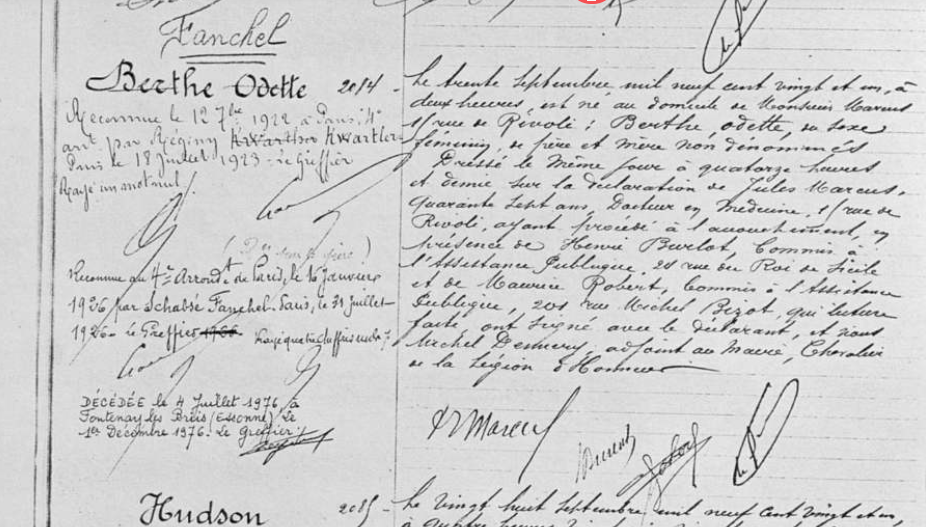
Source: Paris city archives.
She was a talented student, as reported in the French newspaper Le Temps: in 1931, she was one of the most frequently named students from Victor Hugo High School (when she was in 9th grade).
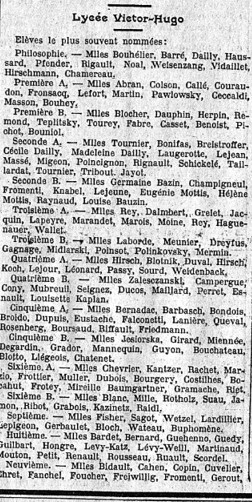
Source: Gallica
We know very little about Berthe’s life during the war, other than that the Germans kept her under surveillance, as can be seen here:
“In late 1942, the third section of the General Directorate of General Intelligence and Gaming carried out numerous surveillance operations, home searches, and inspections with the aim of identifying and punishing any Jews who were in breach of laws, decrees, and orders, or who might have been involve in some form of political activism”. It reveals that Berthe Odette and her father were arrested for failing to wear the star, and then released on the orders of SS Hauptsturmführer Heindon.
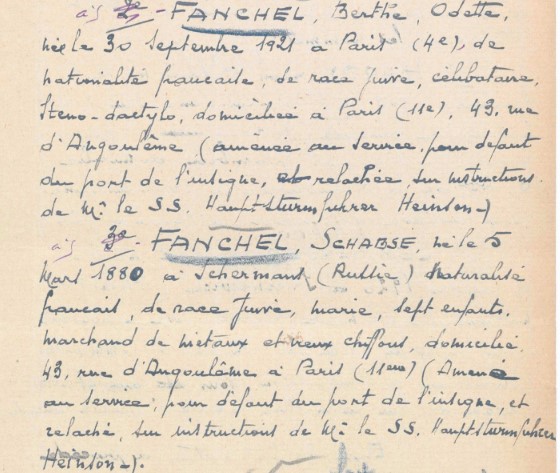
Source: Paris Police Headquarters archives
Berthe was arrested at the same time as her father, on July 3, 1944, but she was not deported. We do not know why this was the case.
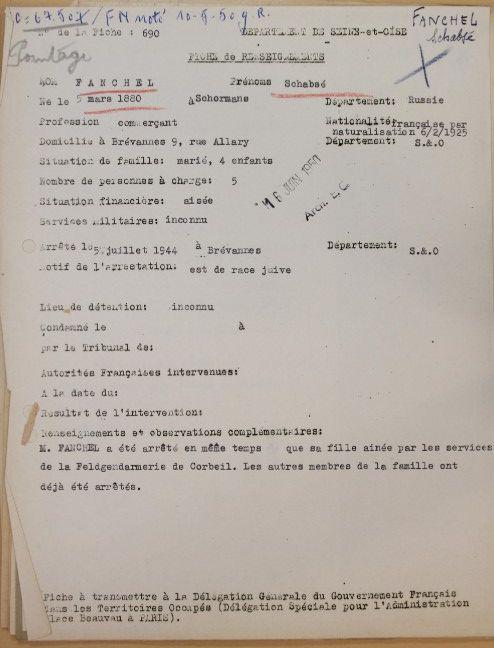
Source: FANCHEL_Schabse_21_P_448_583_9961
(C) French Ministry of Defense Historical Service, in Caen
On February 5, 1953, the French government made Berthe Odette’s youngest sister Raymonde, who also survived the war, a ward of the state. Berthe Odette Fanchel was then appointed her legal guardian.
In the late 1940s, she was living at 12, rue du Moulin de la Pointe in the 13th district of Paris. A man called Joseph Birolo, who we shall come back to later, had bought the property, which had previously belonged to Régina Kwartler.
After the war, Berthe Odette, who was described by people who knew her as a strong, courageous woman, juggled her professional career, raising Raymonde, and the lengthy process of having the deaths of her parents and siblings officially recognized, as well as arranging the settlement of the Fanchel-Kwartler estate. The French Defense Historical Service in Caen holds numerous files relating to the search for her missing family members, letters from lawyers regarding Raymonde, and correspondence from another law firm relating to their inheritance.
Berthe is buried in the Bagneux cemetery in Paris alongside her aunt Sarah Fanchel and her sister Raymonde, (their cousin, Jacques Tokar, from Schabsé’s mother’s side of the family, and his wife, Eliane are also buried there).
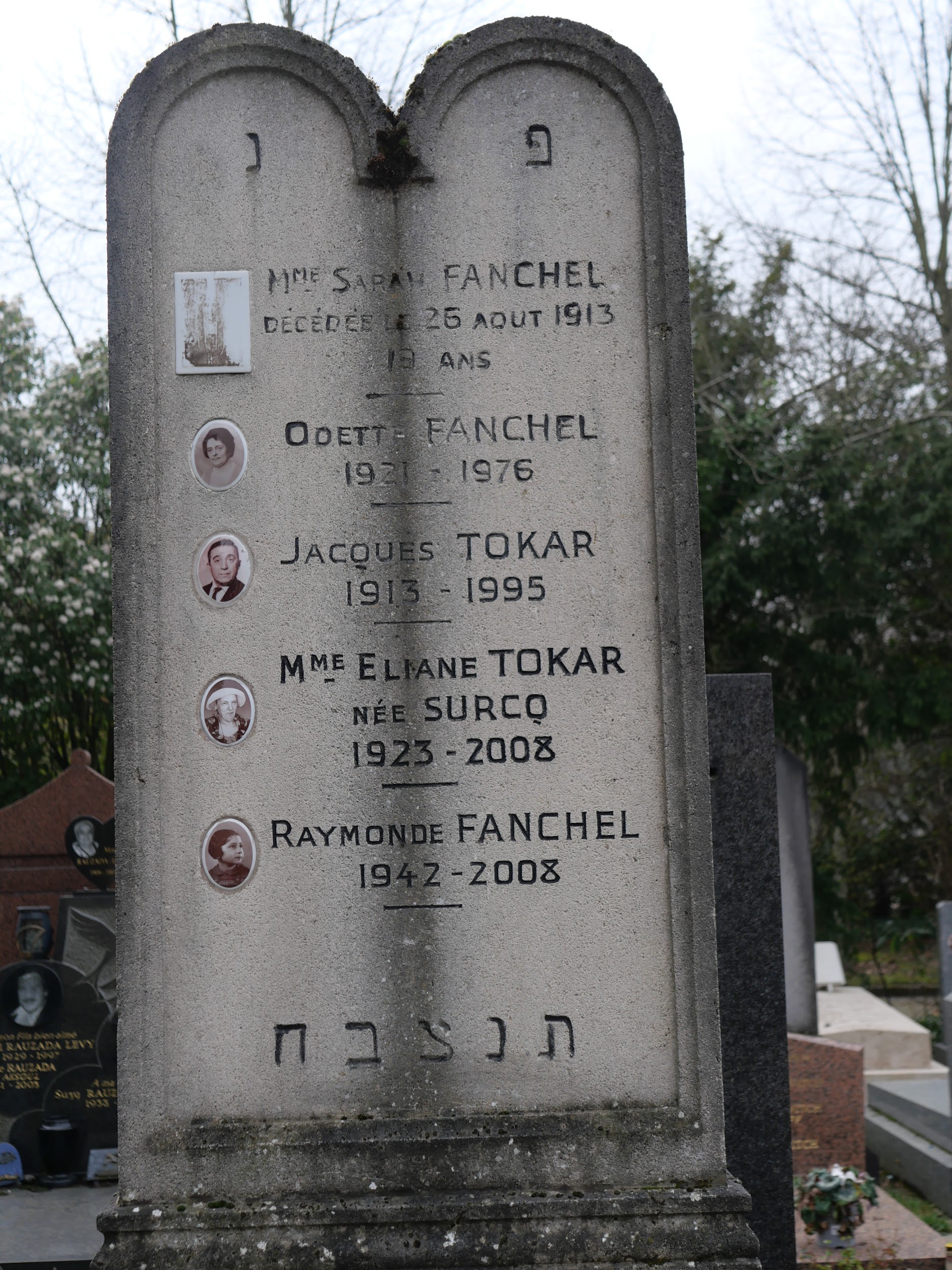
Source : P. Deweerdt
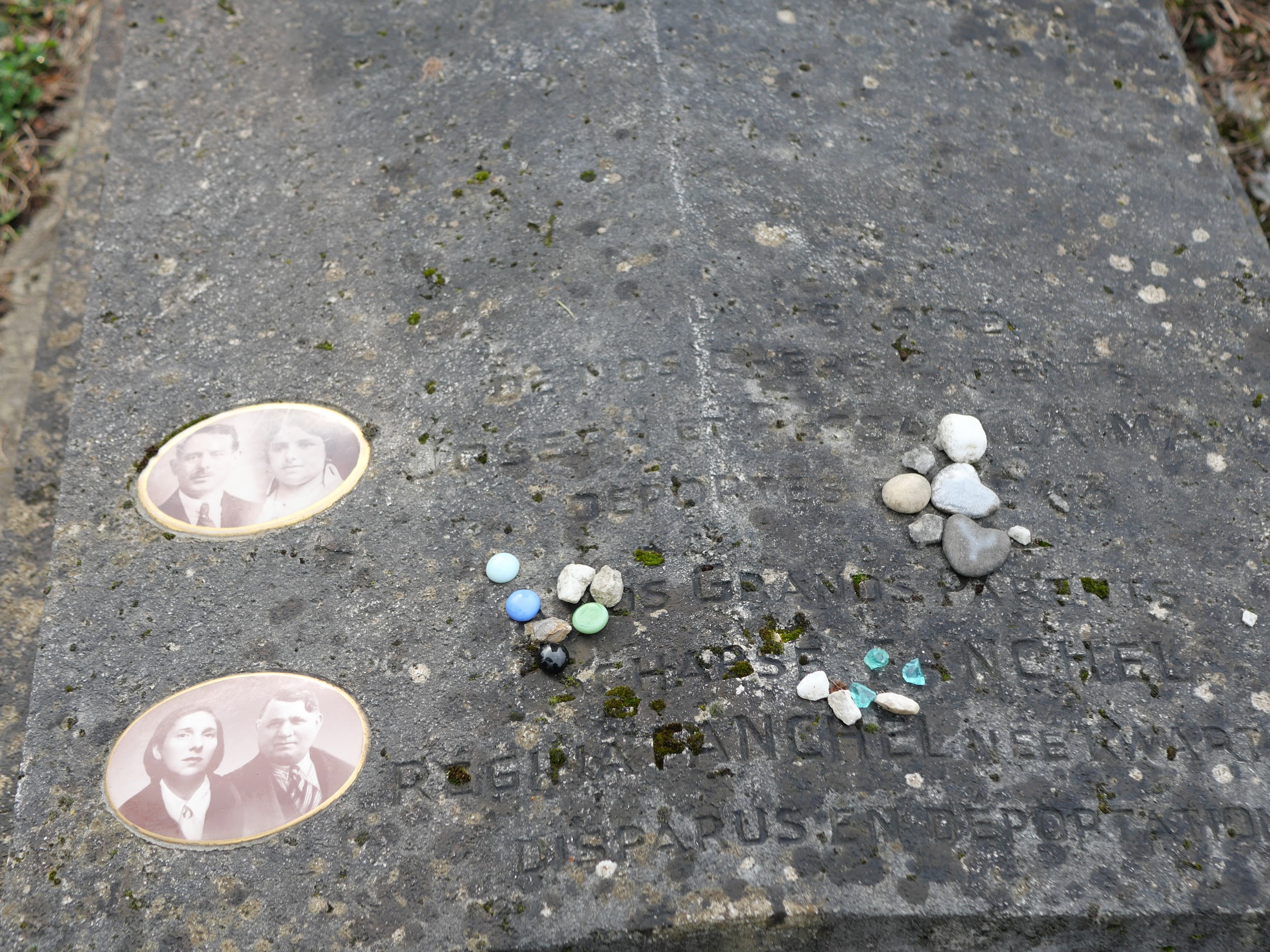
Crédit : P. Deweerdt
The inscription on the headstone reads:
In memory of our dear parents Joseph and Pessa Klaiman deported to Auschwitz[16].
And out grands-parents, Schabsé Fanchel et Régina Kwartler, deported and died.
The Tokar family tomb, which is beside that of the Fanchel family, reveals the parent-child relationship between Schabsé and Chana, who were father and daughter. The same is likely true of Rachel and Schabsé, who were presumably brother and sister. We know that the Tokar and Fanchel families lived in the same neighborhood and were involved in business dealings together. Israël Tokar, in his application for naturalization as a French citizen, also gave the name Fanchel as a reference.
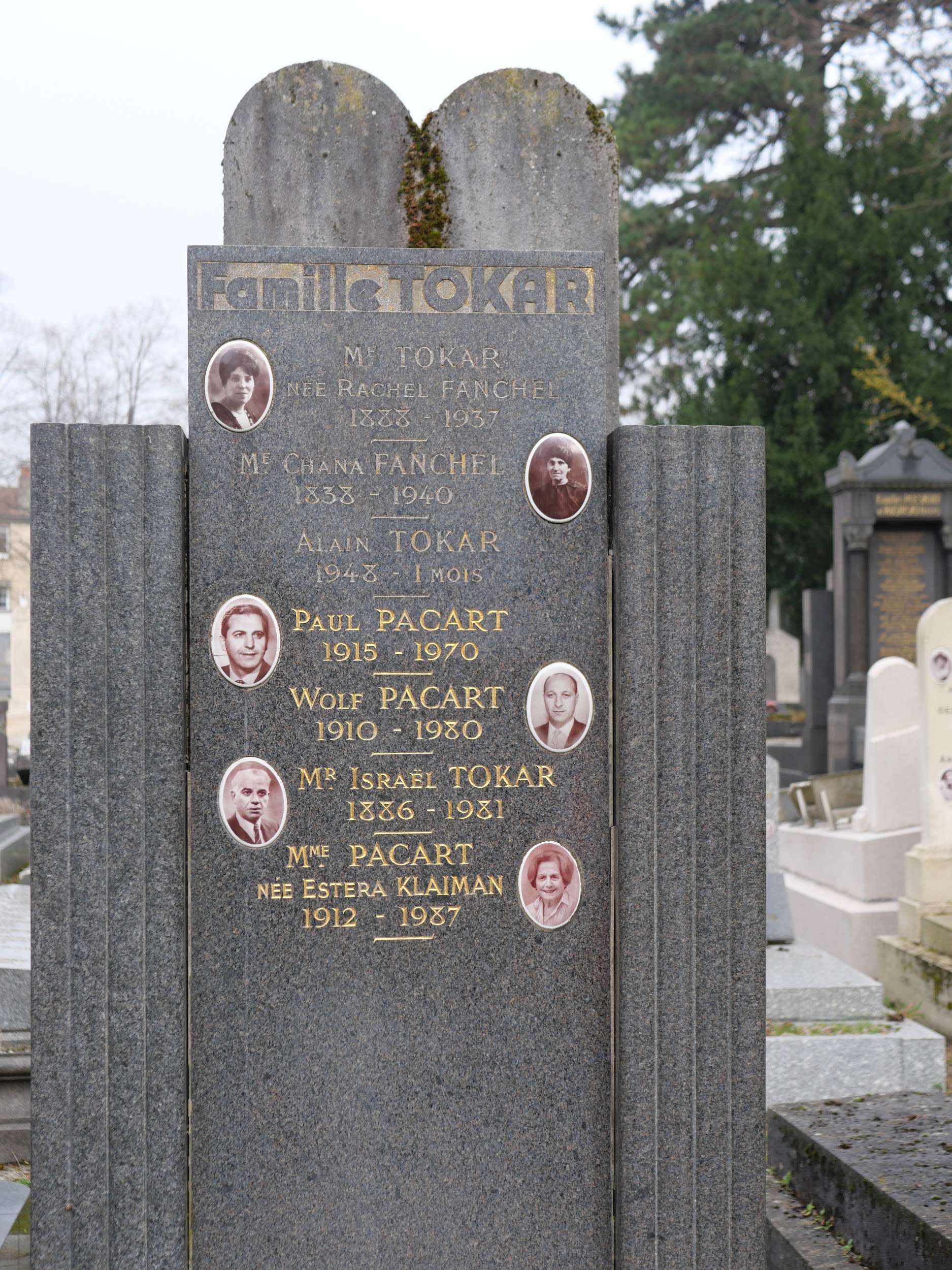
Crédit : P. Deweerdt
Raymonde FANCHEL
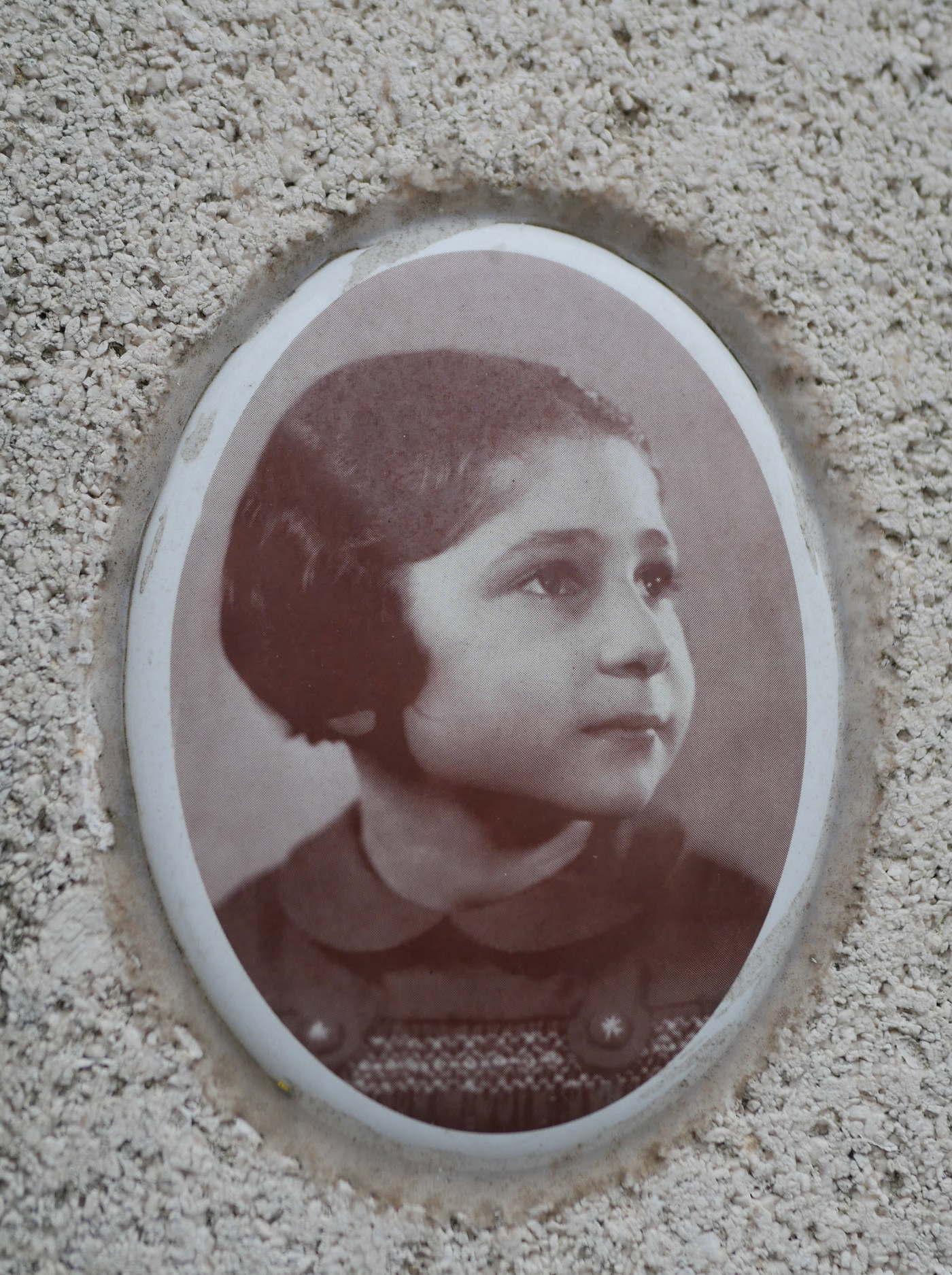
Photo on the headstone at Bagneux cemetery in Paris. Source: P. Deweerdt
Jo-Yie’s comment:
The record I worked on is a copy of Raymonde Fanchel’s birth certificate, from the town hall in Limeil-Brévannes. Raymonde was a girl, and the youngest of Schabsé Fanchel’s seven children. She was born at 1:20 p.m. on June 22, 1942, at 9 Avenue Allary. Her father, who was a merchant born on March 5, 1880, in a town in Russia, had officially recognized Ramonde as his daughter. Her birth certificate was issued at 11:30 a.m. on June 23, 1942, based on her father’s declaration. He read the certificate and signed it alongside the mayor of Limeil-Brévannes. Raymonde Fanchel died at the age of 66 on June 14, 2008 in Saint-Maurice, in the Val-de-Marne department of France. From this record I learned that a French birth certificate includes the exact time, date and place of the birth and the child’s parents’ details. In Raymonde’s case, we can see all the information about her and her parents, such as Schabsé’s date and place of birth, and his occupation at the time.
Diego’s comment:
I also studied a copy of Raymonde birth certificate, from the town hall in Limeil-Brévannes. She was born on June 22, 1942, in Brévannes. Her father came from Russia and her mother from Poland. They lived in Brévannes. She died on February 14, 2008, in Saint-Maurice.
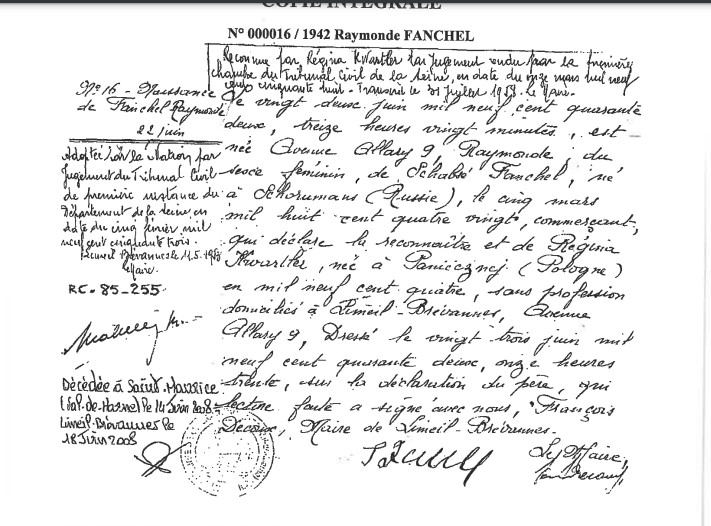
Raymonde Fanchel’s birth certificate. Source: Limeil-Brévannes town hall
Raymonde Fanchel was born on June 22, 1942 in Limeil-Brévannes, in the Val-de-Marne department of France. She was Régina Kwartler and Schabsé Fanchel’s youngest child, and Berthe Odette, Claude, Maurice, Suzy, Fernand and Roland’s youngest sister. Schabsé states that officially recognized her as his daughter when he registered her birth at the town hall on June 23. His mother, Régina, probably did not have time to do this. A ruling by the Seine Civil Court dated March 11, 1958, declared that Raymonde was indeed Régina’s daughter.
Raymonde was arrested on February 2, 1943 together with her mother, Claude, Maurice, Suzy, Fernand and Roland. They were all interned in Drancy the following day, February 3. On February 22, eight-month-old Raymonde was transferred to a U.G.I.F. children’s home, as documented in Léo Israelowicz’s letter dated February 19, to Mr. François, the Director of Administrative Affairs for the Paris General Police, about requests for the release of prisoners interned at Drancy (CDXXIV-44 p.120). She thus became what was known as a “blocked child”.
Raymonde[17] was not actually deported in the end, even though her name is on the Convoy 48 deportation list. This is because the list was drawn up in advance, when she was still scheduled to be deported.
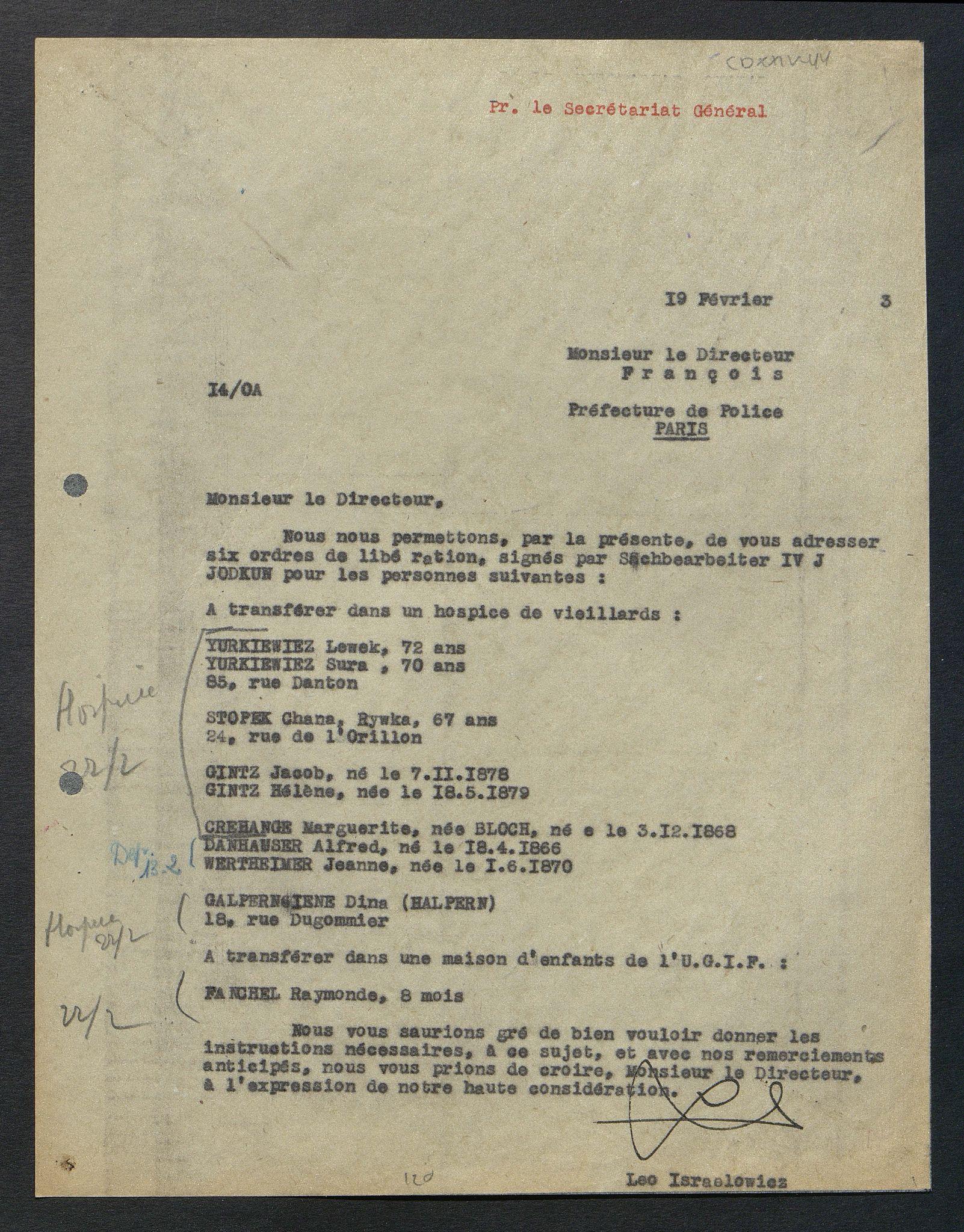
Léo Israelowicz’s letter of February 19,1943. Source: Shoah Memorial
Madeleine, Hana and Irem’s comment:
This record is dated February 19, 1943; It is a letter from Léo Israelowicz to the Director of Police Headquarters. It refers to people who had been released under a “liberation order”. It lists the individuals in question, along with their ages and addresses. It tells us that Raymonde Fanchel was released and transferred to a children’s home when she was 8 months old.
Lina, Jaya and Maïssane’s comment:
This document is a letter from the Paris Police Headquarters to the manager of the Drancy camp. It is dated February 19, 1943. It contains a list of elderly people and one child, eight-month-old Raymonde, who were to be transferred. It thus reveals that Raymonde Fanchel was not deported.
We also have a page from a register, kept by a priest, Father Devaux, of children taken into care during the war: it includes first and last names, dates of birth, the child’s place of residence, names of guardians, and the name of the person taking care of the child. This was sent to us by Héléna Rigaud, Archivist at the Sisters of Notre-Dame de Sion[18]. Raymonde must have been moved out of a U.G.I.F. home and placed with a family, just before the roundups in the U.G.I.F. homes.
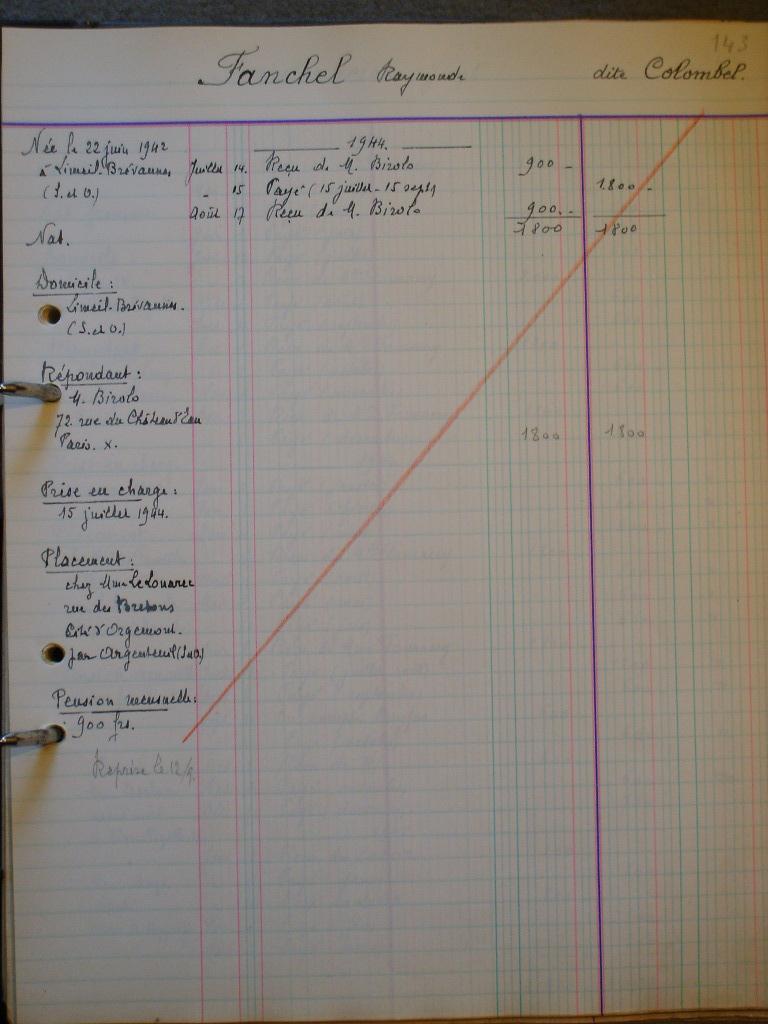
A page from the register kept by Father Devaux of children taken into care during the war. Source: Héléna Rigaud, Archivist at the Sisters of Notre-Dame de Sion
Diego and Devan’s comment:
This record tells us that Raymonde’s surname was changed to Colombel. She was kept hidden by a Mr. Birolo in 1944, when she was 2 years old. He received two payments of 900 francs to pay for the board and lodging of Raymonde’s nanny, Ms. Le Louarec.
Joseph Birolo, who was an Italian citizen, acted as guarantor for Raymonde Fanchel (also known as Colombel) when Ms. Le Louarec was taking care of her. By 1946, he and the two surviving Fanchel sisters were living at 72, rue du Château d’Eau, with Raymonde listed as his goddaughter.

Source: 1946 census of Paris
According to the French newspaper La loi , on March 11 and 29, 1944, Mr. Birolo bought a business from Régina. It was based at 12, rue du Moulin de la Pointe in the 13th district of Paris:
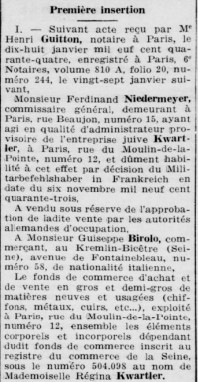
Source : Gallica.
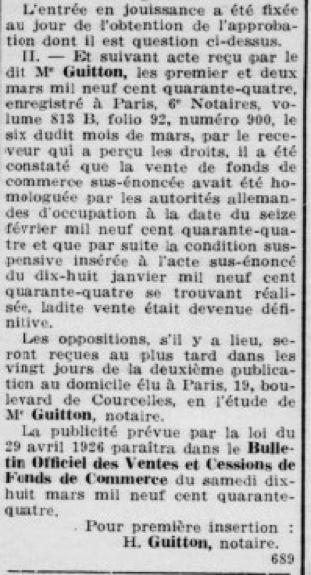
Source : Gallica.
Raymonde therefore miraculously survived, even though her mother was deported from Drancy to Auschwitz on Convoy 47 on February 11, 1943, followed by her five brothers and sisters on Convoy 48, on February 13, 1943. We do not know how her sister eventually managed to find her.
Her father, Schabsé, was deported on Convoy 77, which left Drancy on July 31, 1944.
Her eldest sister, Berthe Odette, was not deported either. She became Raymonde’s legal guardian after the war (according to records from her father, Schabsé Fanchel’s file, ref. DAVCC 21 P 448 583 and a questionnaire that Berthe herself completed, held at the Notre-Dame-de-Sion convent, ref. DI (100).
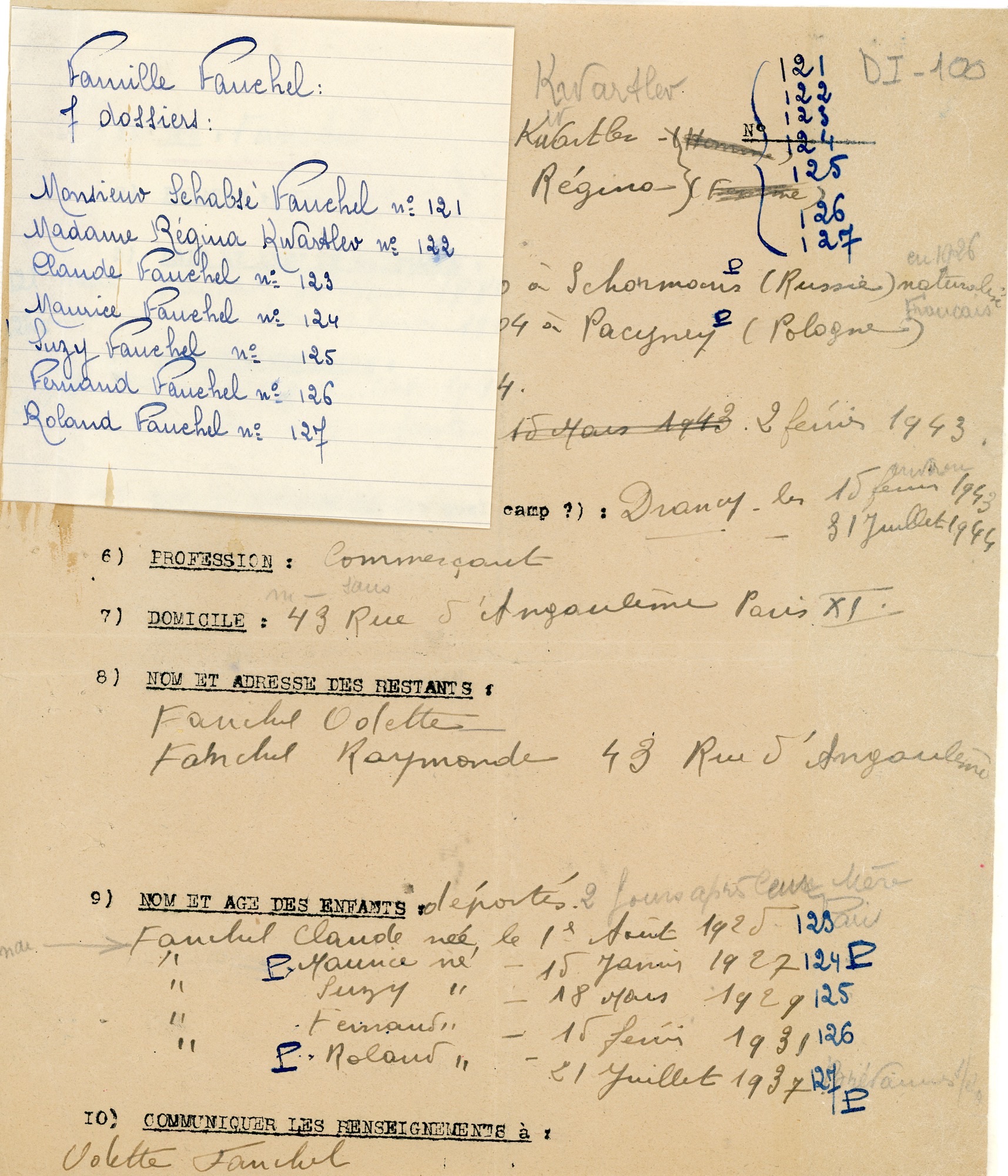
Source: FANCHEL_Schabse_21_P_448_583_9961
(C) French Ministry of Defense Historical Service, in Caen
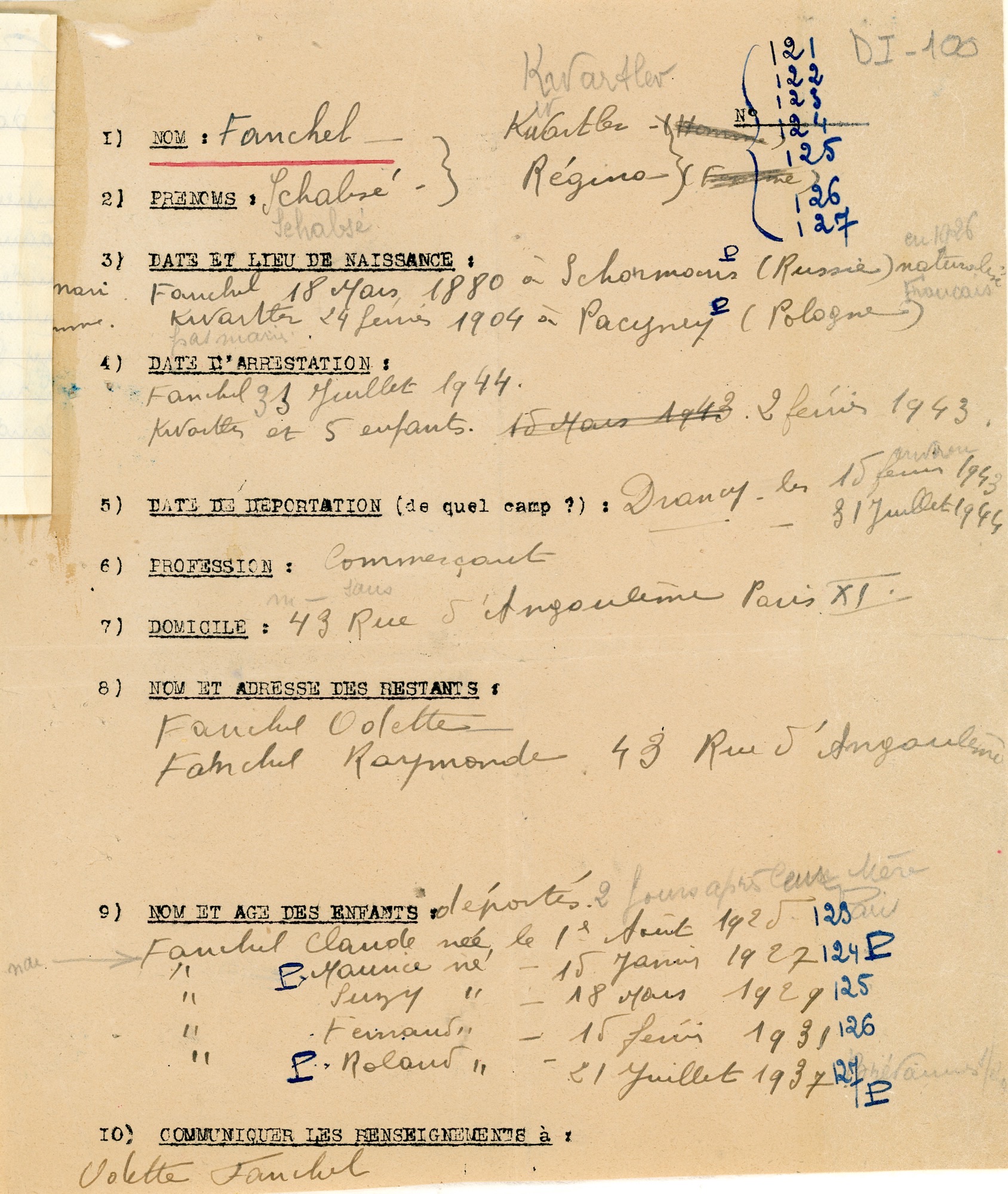
Source: FANCHEL_Schabse_21_P_448_583_9961
(C), French Ministry of Defense Historical Service, in Caen
Jo-Yie and Nola’s comment:
The document we studied is a contains information about the Fanchel family. The parents and five of their children died. The father was a salesman and lived on Rue d’Angoulême in Paris. His wife, Regina, was born in Poland. The only members of the Fanchel family who survived were Berthe and Raymonde. The letter was addressed to Berthe. The father of the family was arrested in July 1944 and the mother in February 1943, along with their five children. They were all deported. This document was drawn up after the war in order to determine what happened to them.
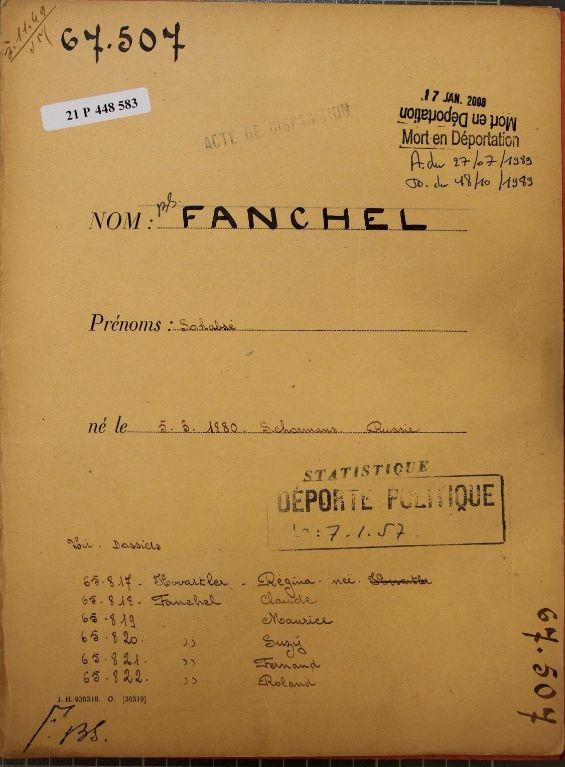
Source: FANCHEL_Schabse_21_P_448_583_9961, French Ministry of Defense Historical Service, in Caen.
Raymonde was made a ward of the State in 1953, in the Seine department of France. At the time, she was living with Berthe, who later became her legal guardian. As Régina and Schabsé were not married, Berthe had to prove that her sister was indeed her mother’s daughter. A note on Raymonde’s birth certificate states that the Seine court ruled that she was Regina’s daughter on March 11, 1958. The records relating to this, held in the Paris archives, are not available to the public because they are too recent.
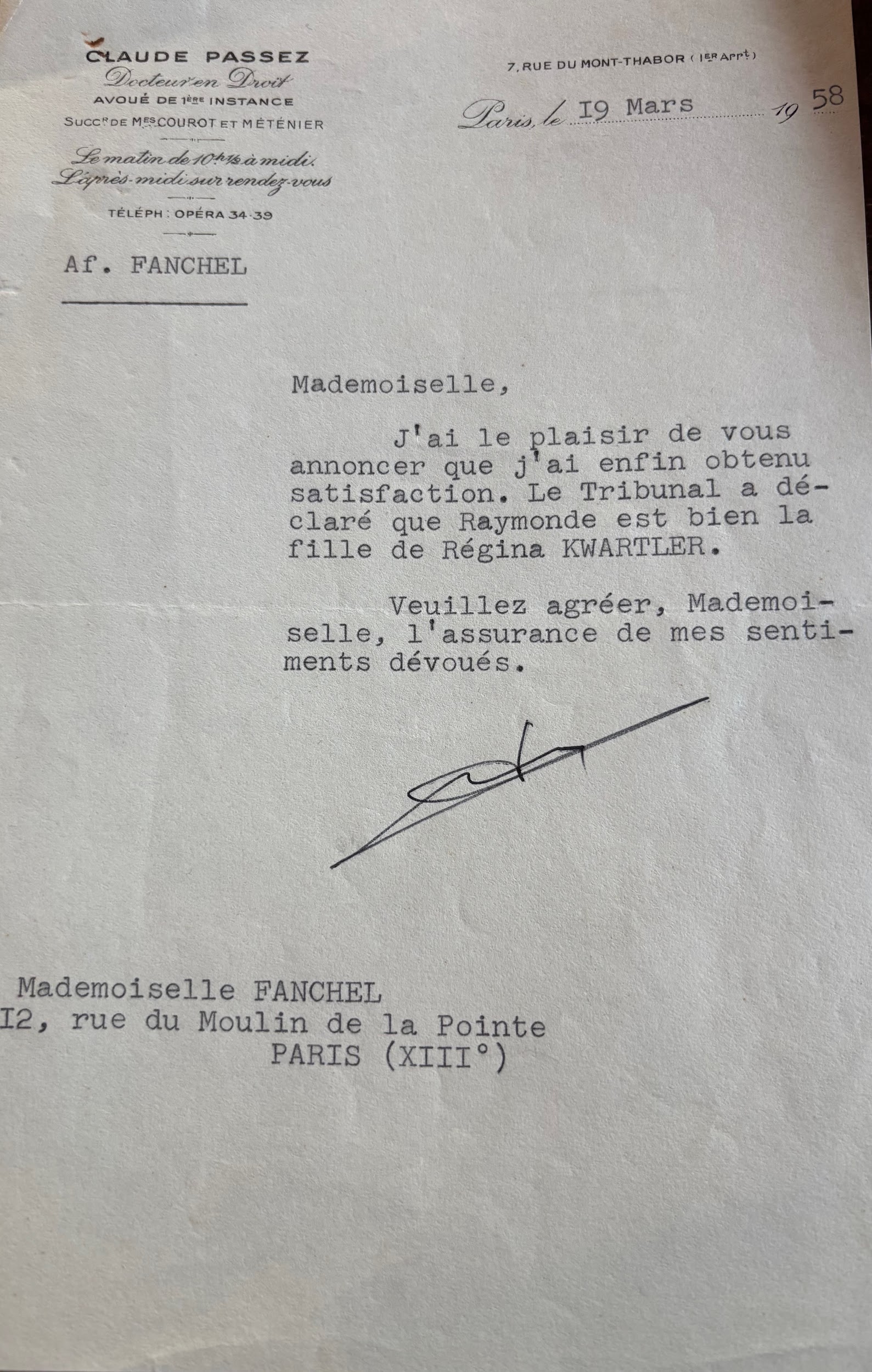
The letter addressed to Berthe. Source: Mr. Journo’s personal collection, published with his kind permission
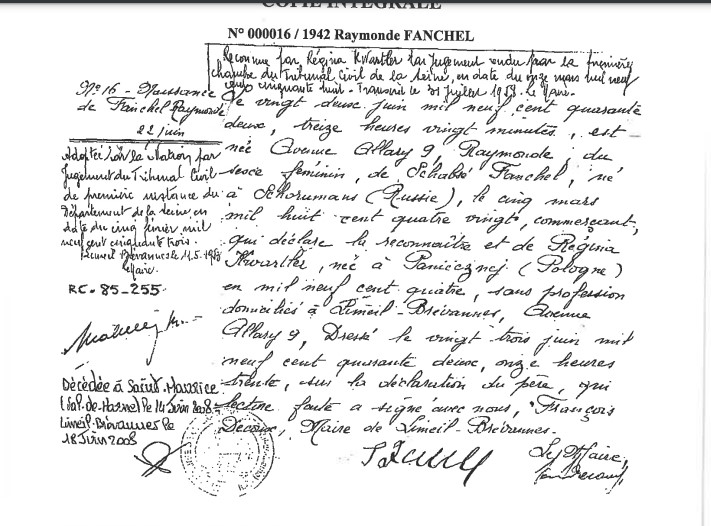
Raymonde’s birth certificate, with notes added. Source: Limeil-Brévannes municipal archives
Berthe had to deal with a great deal of paperwork and make numerous requests in relation to her family. The first step was to apply for her father to be granted the status of non-returned person. She submitted the request in Villeneuve Saint-Georges on October 15, 1949[19].
Anaëlle Riou, in her paper “A micro-history of the Holocaust in France. The deportation of Jews on Convoy 77”, wrote:
“The reconstruction of the families or survivors’ life stories often involved applying for the status of “Political Deportee” or “Deported Resistance Fighter.” This brought surviving family members not only official recognition from the State, but also financial compensation of a sort. It was especially difficult to prove that a person had been arrested because they were a member of the Resistance. As a result, 23 deportees were not awarded the title of Deported Resistance fighter, but were instead granted Political Deportee status. A total of 684 deportees were recognized as Political Deportees.”
Nola’s comment:
This record is dated March 16. It is a request to rectify the civil status of a “non-returned person”. It appears to involve administrative or legal questions relating to the identity or status of a person who was not previously listed in the civil registers. What I learned from this is that this type of document is often essential when it comes to proving legal rights or accessing support from the authorities. It also demonstrates how important it is for people to have their civil status rectified, as this can affect many aspects of a person’s life. (Convoy 77 archives).
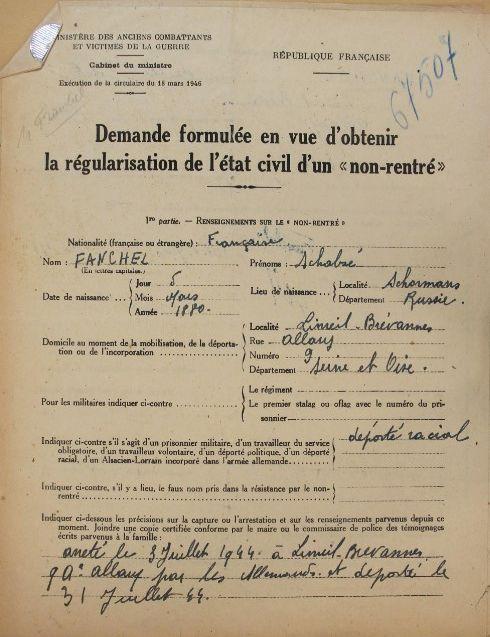
Source: FANCHEL_Schabse_21_P_448_583_9961
(C) French Ministry of Defense Historical Service, in Caen.
Amayas’ comment:
The record I studied is undated ( i.e. there is no date of issue on it). It is a request to have the civil status of a “non-returned person” rectified. It contains information about Schabsé Fanchel, including his date and place of birth, date of death and address. What I learned from the record: Schabsé Fanchel, who was born on March 5, 1880 and died in 1944, lived at 9, rue Allary in Limeil-Brévannes. He was arrested by the Germans on July 3, 1944 in Limeil-Brévannes and deported on July 31, 1944. He had traveled a lot and came to live in our town with his wife and seven children (Convoy 77 archives).
Berthe then obtained a missing persons certificate:
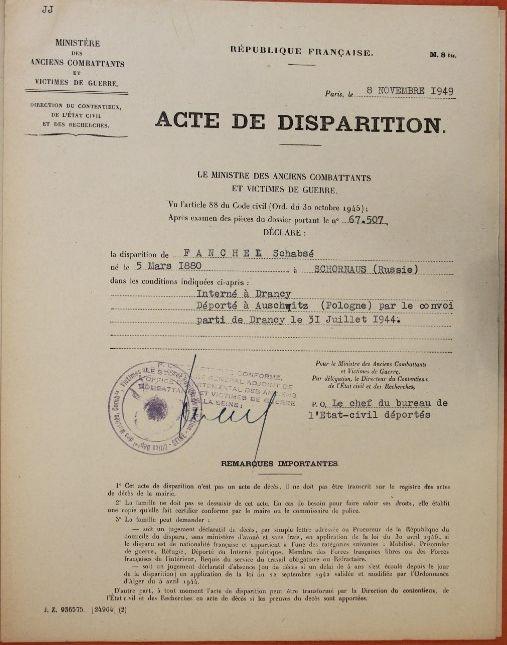
Source: FANCHEL_Schabse_21_P_448_583_9961
(C) French Ministry of Defense Historical Service, in Caen.
Lastly, Berthe applied for her father, who had tried to enlist in the French Foreign Legion during the First World War, to be granted the status of “Died for France”. However, her request was turned down because she could not prove that he had been died during the Second World War, since there was no record of his having been deported to Auschwitz.
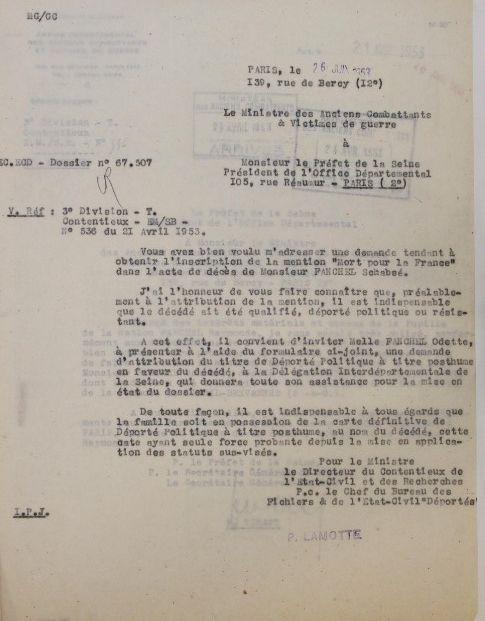
Source: FANCHEL_Schabse_21_P_448_583_9961
(C) French Ministry of Defense Historical Service, in Caen
Some of the records are kept in a green folder called the Fichier de Brinon (de Brinon File), which is named after Fernand de Brinon, who was the Vichy government’s delegate general.
It contains, among other things, Schabsé’s missing persons certificate, issued by the Ministry of Veterans’ Affairs. In 1949, Berthe applied to have his civil status rectified. The mayor of Limeil, Marius Dantz, recorded both Schabsé’s and Claude’s deaths in 1950.
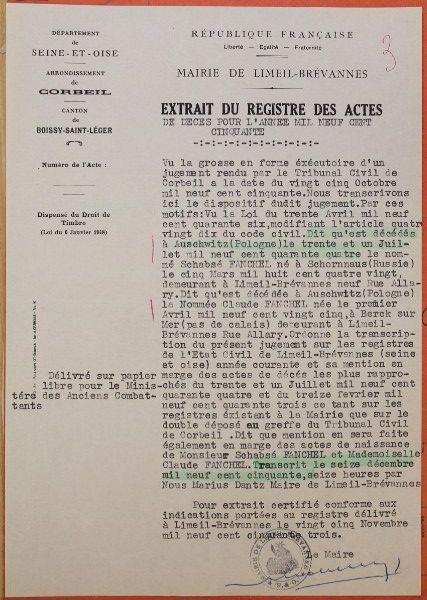
Source: FANCHEL_Schabse_21_P_448_583_9961 (C) French Ministry of Defense Historical Service, in Caen
In 1956, the case file on what happened to him during the war was still being dealt with:
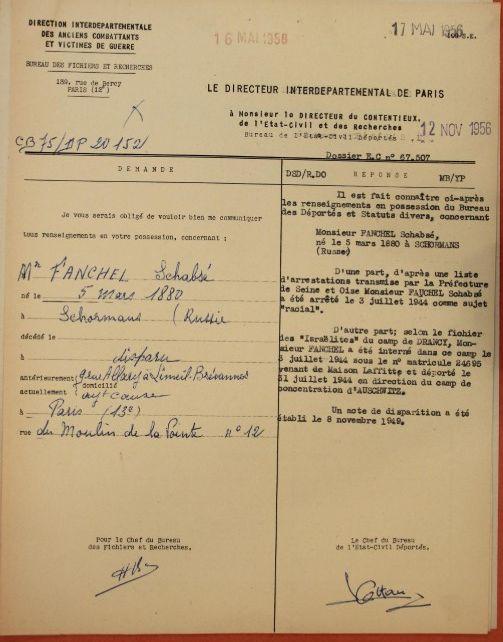
Source: FANCHEL_Schabse_21_P_448_583_9961
(C) French Ministry of Defense Historical Service, in Caen
Ismaïla and Ismaël’s comment:
This record dates from May 17, 1956: it was issued by the Interdepartmental Directorate for Veterans and Victims of War, and is addressed to the Litigation Office. It relates to Schabsé’s deportation to Auschwitz, when he was arrested on grounds of his “race”, detained at Drancy and then deported. It states that a missing persons certificate was issued on November 8, 1949.
In 1957, Berthe and Raymonde received a payment of 12,000 francs, the statutory compensation payment calculated according to the number of months during which the person was interned. The French National Institute for Statistics and Economic Studies (INSEE) conversion tool[20] estimates that this would have been the equivalent of 280 euros in 2023 (around 320 US dollars in 2026).
Source: FANCHEL_Schabse_21_P_448_583_9961
(C) French Ministry of Defense Historical Service, in Caen
At the same time, in 1957, Schabsé was granted “Political Deportee” status, but still not that of “Died for France”. His deportee card number was 117510784.
It was not until July 27, 1989 that he was finally declared to have “Died during Deportation”. This was published in the French Official Gazette on October 18, 1989.
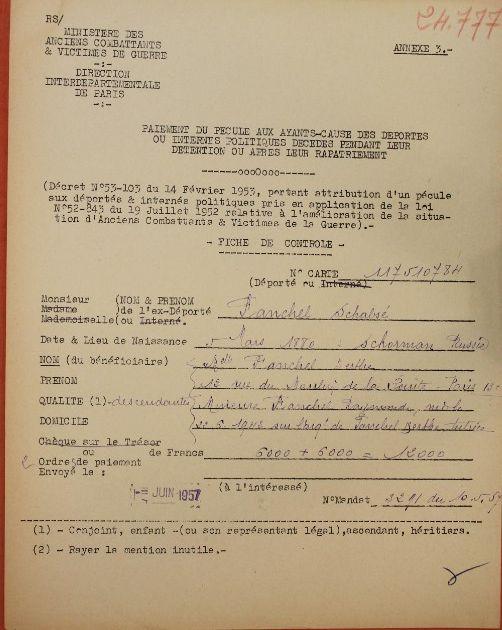
Source: FANCHEL_Schabse_21_P_448_583_9961
(C) French Ministry of Defense Historical Service, in Caen
Naïm and Mohamed’s comment:
The record dates from January 7, 1957. It relates to a decision by the French Ministry of Veterans and Victims of War to grant the status of political deportee. It is an official document awarding the status of political deportee to Mr. Fanchel, who was born on March 5, 1880 in Russia. Issued by the Interdepartmental directorate in Paris, it states that two periods of internment and deportation were taken into account: from July 3, 1944 to July 30, 1944, and from July 31, 1944 to August 5, 1944. From it, we learned that Mr. Fanchel was granted the title of political deportee. This was an important acknowledgement for people who had been imprisoned or deported for political reasons. Schabsé Fanchel was one of them. (Convoy 77 archives).
Ismaïla’s comment:
Even though I did not quite manage to decipher the record in its entirety, I tried my best and extracted the following information from it: it was issued by the Ministry of Veterans’ Affairs and is dated June 12, 1953. It refers to the death of Schabsé Fanchel, who died in Poland, and whose family requested that he be granted political deportee status. (Convoy 77 archives).
Amayas and Adam’s comment:
The record is dated January 7, 1957, and is about Schabsé Fanchel. It tells us that he was granted the title of Political Deportee. He was interned from July 3, 1944 to July 30, 1944. The record was issued by the Interdepartmental directorate in Paris. His deportee number was 117510784. The letter is addressed to his daughter, Berthe Odette.
Kylian and Fodye’s comment:
The record we studied is a letter from the Ministry of Veterans’ Affairs and is addressed to Berthe, who was living at 12, rue du moulin de la Pointe in the 13th district of Paris. The letter is dated December 9, 1957. It refers to her request for the status of Political Deportee.
We know very little about the sisters’ lives after the war, but Berthe did a lot to support her younger sister. She continued to try to claim her inheritance until 1949. Case file 1900 W1 257 in the Paris Archives contains the expropriation and administrative records for 7 and 9 Rue des Jardins Saint-Paul, known as the “Kwartler Estate”; it is unclear whether Berthe ever received the compensation owed to her grandmother. She worked as a stenographer in Créteil, sold her house in Limeil, and moved to Villecresnes. She traveled to New York in 1962 She died from cancer in 1976.
When Raymonde died, in 2008, no one claimed the money in her bank account. It was therefore invested in the French state Caisse des Dépôts (Deposits and Consignments Fund).
Two names came to light during our research on the French genealogy website, Geneanet: a Mr. Roland Schabsé Fanchel, who was born in London on September 29, 1960 and died on Wednesday, May 1, 2024 in the Draveil hospital at the age of 63. We then found a Ms. Suzie Nadia Fanchel, who was born on Sunday August 20,1967 in Villeneuve Saint-Georges, in the southeastern suburbs of Paris, and died at the age of 33 on Tuesday, July 3, 2001 in hospital at Lons le Saunier, in the Jura department of France. She lived in Cormoz, in the Ain department and worked on the markets. According to their death certificates, they were Raymonde’s children. Another interesting detail is that Roland Schabsé, who lived in Morangis, in the Essonne department of France, had also been adopted by Berthe Odette, his aunt.
Maïssane’s comment:
We discovered that Roland Schabsé Fanchel was born on September 29, 1960, in London. He was the son of Raymonde, who had passed away. He was then adopted by Berthe Odette Fanchel, who was single. He lived in Gagny, in the Seine-Saint-Denis department of France.
Suzie Nadia Fanchel, Raymonde’s daughter, died on July 3, 2001. She was single and lived in Cormoz in the Ain department of France.
Lina’s comment :
Roland Schabsé Fanchel died at 12:30 p.m. on May 1, 2024 in Draveil in the Essonne department of France, according to the copy of his death certificate.
Raymonde’s daughter, Suzie Nadia, died at 10:25 a.m. on July 3, 2001. She was born on August 20, 1967 in Villeneuve Saint-Georges, in the Val-de-Marne department of France.
One by one, the Fanchel family members died out…
When I wrote to the registry office at Limeil Brévannes town hall to ask for further information about where they lived, the deputy mayor, Mr. Daniel Gasnier, who dealt with my letter, remembered that around ten years ago, some cousins of the Fanchels had contacted him to find out what had happened to the house on avenue Allary, but that their letter was nowhere be found.
In late December, 2024, when I obtained copies of Roland Schabsé and Suzie Nadia’s death certificates, another question came to mind: if Raymonde had children, why had her estate never been settled? And why would her children have been buried so far away from her?
As for Roland, he had made a Will: I therefore wrote to the notary who dealt with his estate, but she replied to say that she was obliged to respect client confidentiality.
And then, just a few days later, on January 8, I got a phone call from a man who told me he was Roland’s adopted brother…
Jean-Noël Journo introduced himself to me as follows: his parents had worked with Berthe Odette, a secretary, in Créteil in the 1960s, and they had become friends. Berthe had officially adopted Roland, after having previously adopted Raymonde.
Raymonde always lived on the edge of mainstream society, despite her sister’s efforts to help her claim what she was entitled to.
While studying in England in 1960, Raymonde had given birth to a son, Roland Schabsé, on September 29.
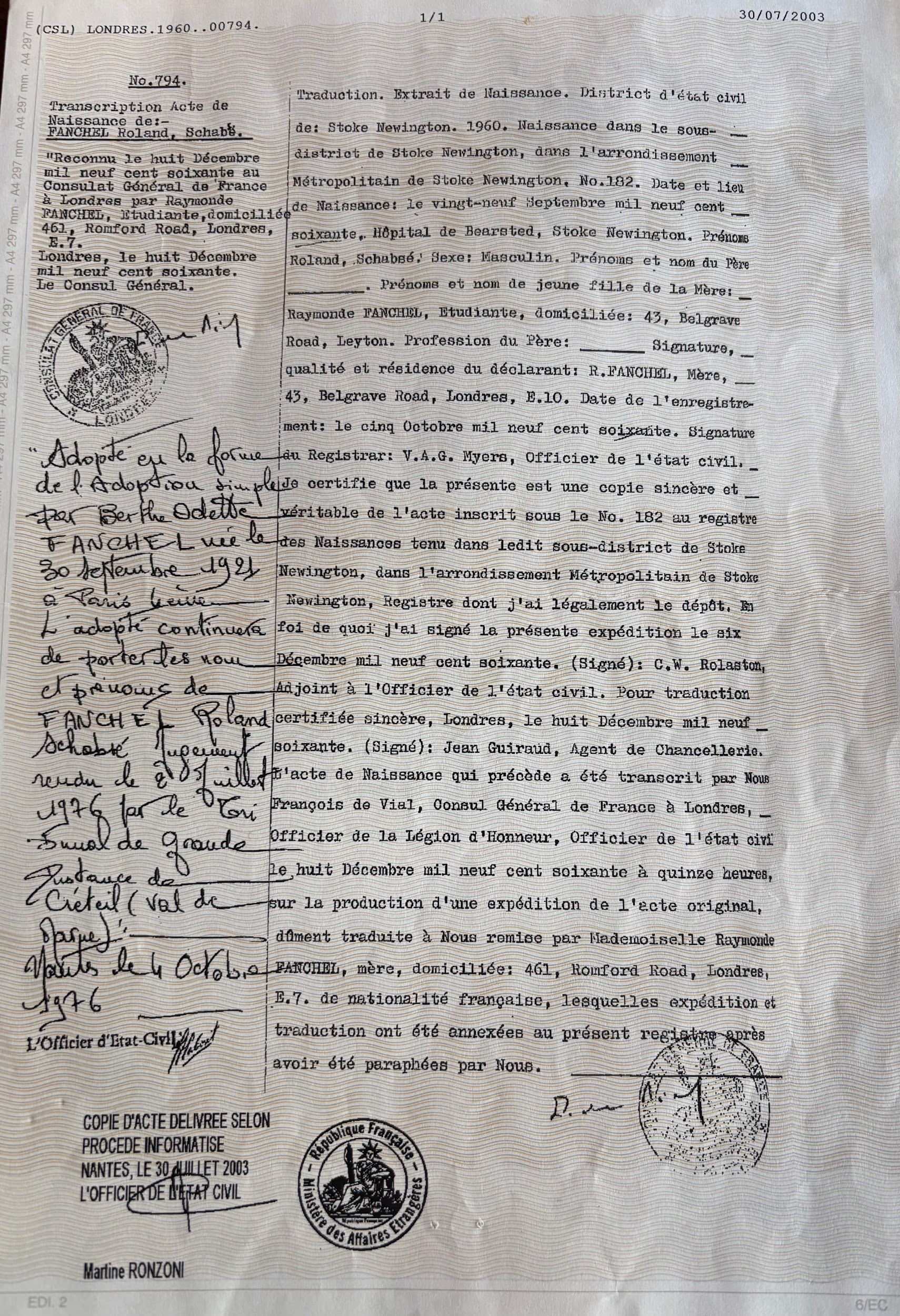
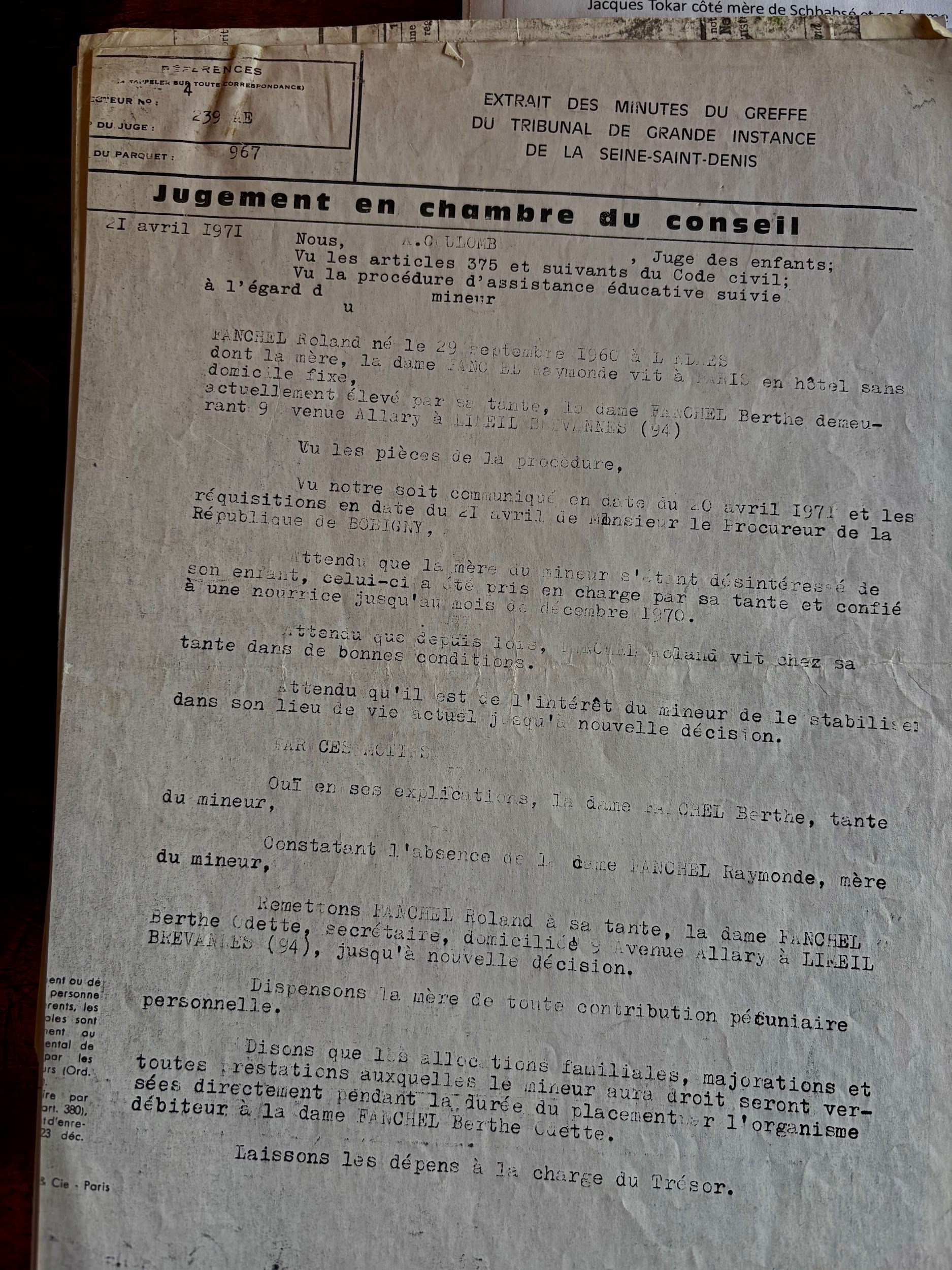
Source: Mr. Journo’s personal collection, published with his kind permission.
During her stay in London in 1960, Raymonde lived at 43 Belgrave Road in Leyton and at 461 Romford Road in Manor Park. She then returned to France and left her son with Berthe Odette, as documented in a ruling issued by the Bobigny court in 1971 and an adoption decree issued by the court in July 1976, presumably following Berthe’s death on July 4, 1976.
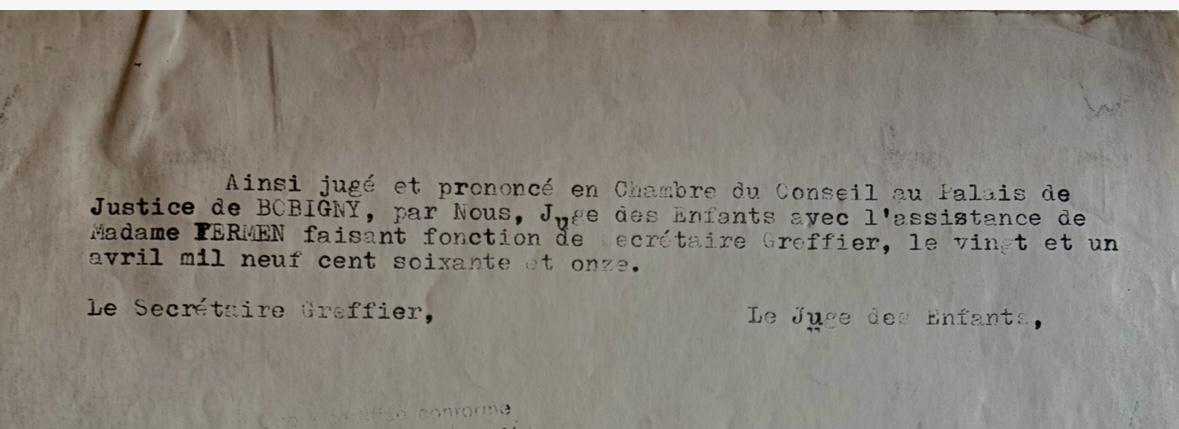
Source: Mr. Journo’s personal collection, published with his kind permission.
Berthe Odette employed a nanny to take care of Roland between September 1965 and 1970. The nanny also gave evidence in support of Berthe Odette during the adoption process.
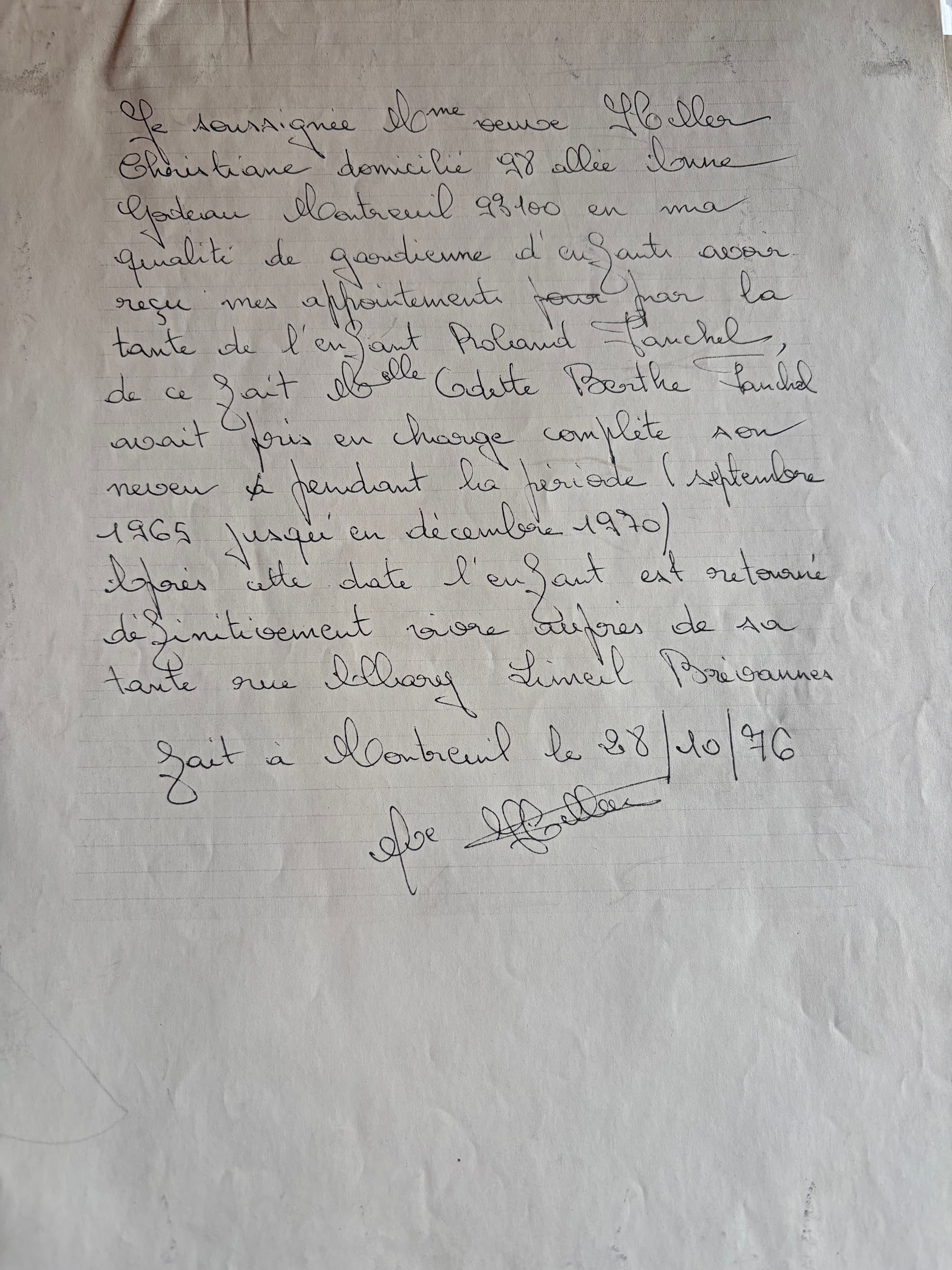
Source: Mr. Journo’s personal collection, published with his kind permission.
Raymonde also had a daughter, in 1967, in Villeneuve Saint-Georges. She was called Suzie Clara, and was probably taken into care or placed with a family.
Berthe and Raymonde stayed in touch, despite Raymonde’s problems.
At some point, Berthe moved from Limeil Brévannes to 2, rue Jean Cavaillès in Villecresnes, south east of Paris.
In 1974, Berthe, aware that she was seriously ill, asked the Journo family, who were work colleagues and close friends, to take care of Roland. They already had 8 children of their own.
The youngest, Jean-Noël, was a year younger than Roland, and as they grew up, they became very close.
Berthe Odette died in 1976, after which Raymonde vanished from Roland’s life, although she kept in touch with the Journo family sporadically until her death in 2008.
When Roland fell seriously ill in May 2023, he left his estate to Jean-Noël.
Jean-Noël on the left and Roland Schabsé on the right. Source: Mr. Journo’s personal collection, published with his kind permission.
When Roland died, Jean-Noël contacted the Bagneux cemetery, but staff there were unable to locate the Fanchel family vault. Roland is therefore buried with his foster parents, the Journos, in the Pantin cemetery in Paris.
It turned out that Berthe had sold the house on avenue Allary. The plot has since been divided into smaller lots, and several homes have been built on it.
Their notary, Ms. Lecaillon, then called me with her version of the story. During this very moving conversation, it became clear that Roland had never known his sister Suzie, 7 years his junior.
Roland, therefore, had never been aware of the whole story.
The notary explained that it was a once-in-a-lifetime situation.
Another thing was that it appears that Berthe was either unable, or did not know how, to make a claim for the assets taken from her family during the war.
The search for the last remaining piece of the puzzle began.
Jean-Noël and I, with the help of the notary, have filed a claim with the CIVS (the French Commission for the return of property and reparations for victims of anti-Semitic spoliation) for compensation for property confiscated during the war.
In April 2025, Mr. Guy Lassalle, a genealogy enthusiast from Brévannes who had heard about the Convoy 77 project and wanted to contribute his expertise, contacted me via the school. Some of Mr. Lassalle’s friends knew the Fanchel family and one of them had even gone to school with Suzy.
Sadly, my father would never witness the end of this odyssey, which began in 2019.
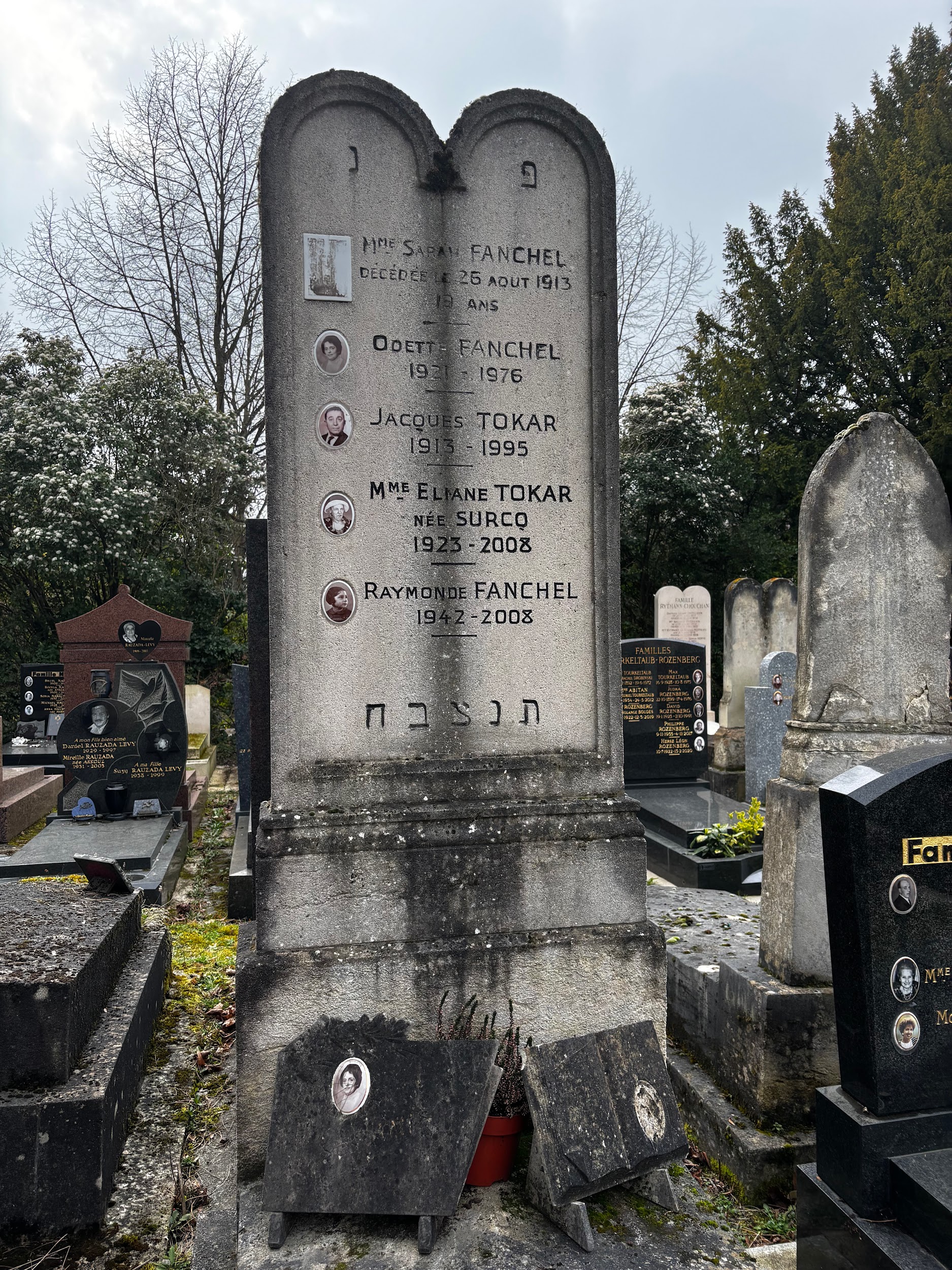
Source : M-A Deweerdt
The Fanchel family are buried in Bagneux Cemetery, in section 3, row 15, grave 5. Isaac is buried in row 14, grave 20. It is not known where Vincent is buried, and Rosa and Schabsé’s stillborn daughter is no longer in her original grave. Rosa is buried in Bagneux in a grave without her name on it. The Tokar family has a family vault in their name in row 16, grave 5, where Anna or Hona Tokar is buried, although she was previously interred in a temporary grave in Limeil-Brévannes; we found order forms from the Berton firm showing that these were permanent graves purchased by Schabsé. He also ordered an 18-space vault in section 16, row 10, plot 11, where several members of the Ashkenazi Jewish community are buried. I was able to meet Pierre and Liliane Pacart in March 2025. Pierre is the grandson of Israël Georges Tokar and Rachel Feinchel (Fanchel).
This investigation was carried out by the amazing students of class 4eC at the Daniel Féry secondary school in Limeil-Brévannes, led by Mr. Habert, the school principal, a keen amateur historian.
The students are: Irem, Lina, Maïssane, Tasnim, Edison, Fodye, Agata, Devan, Nola, Salimata, Mohamed, Inassio, Ismael, Diego, Abigaelle, Madeleine, Ismaïla, Gabriel, Amayas, Lana, Jo-Yie, Jaya, Kyilian, Naïm, Hanae, Adam and Malak.
The team at the Daniel Féry school is much more than just a gathering in the teachers’ common room, as is often the case elsewhere, and this is borne out by the work of these 13-year-old students.
Acknowledgments
I would like to thank Claire Podetti and Georges Mayer from Convoy 77 for their help, advice and kindness, as well as for visiting our school, all of which contributed to the success of this project.
Our thanks also go to the municipal registry offices that kindly answered our questions, to the archives services we contacted and, of course, to the Shoah Memorial and the rest of the Convoy 77 team.
Lastly, thank you to the notary, Ms. Lecaillon, for the trust she showed in me, and to Jean-Noël Journo, who I shall be seeing again, for enabling me to conclude many years of research.
Ms. P. Deweerdt, Limeil-Brévannes, January 27, 2025
Notes and references
[1] By asking an AI to write biographies of Schabsé and his wife, Rosa, and then of his partner, Regina, we gained access to new historical records. In this respect, although the AI’s conclusions were often rather vague or inaccurate, the sources it cited and enabled us to access were invaluable.
[2] One of our initial hypotheses in our research into Nathan Potzeha and his wife Regina was whether they were acquainted with other Jewish families in Brévannes. Many Jews were interned in the Brévannes sanatorium and were subsequently deported (on Convoy 63).
[3] Anna Tokar was born in Schornmans which was within the Jewish residence zone (Pale of Settlement) in the Russian Empire.
[4] The archives of the Mutual Aid Society of Russian Jews (Paris Historical Library) list an “A. Tokar” as a regular donor between 1895 and 1910, which is evidence of her involvement in cross-border solidarity efforts. Her name is also listed in the records of the synagogue on Rue des Tournelles (ACIP, call number ACIP-1890-12), which proves that she was a practicing Jew.
[5] The National Archives in Washington, DC; Washington, DC, USA; Passenger and Crew Lists of Vessels Arriving at New York, New York, 1897-1957; Nº de microfilm ou NAID: T715; Titre du groupe d’archives (RG): Records of the Immigration and Naturalization Service, 1787-2004; RG: 85
[6] This aspect of the research was particularly interesting because analyzing passenger manifests—even though some of them were difficult to read—provided a wealth of information about people’s financial circumstances, occupations, last place of residence, physical appearance, and migration strategies: staying with cousins, brothers, sisters, and so on. They were an invaluable source of information.
[7] This statement is not included in the book
[8] Some members of the Tokar family, another branch of Schabsé’s paternal family, are also buried in Bagneux.
[9] Robert Bronstein, died in 1926 / Eugénie Kritchewisk, died in 1926 / Slata Saxe, married name Lourie, died in 1926 / Dora Kulik, died in 1926 / Rosa Gropegue, died in 1925 / Rachel Mordskey, married name Tokarski, died in 1925 / Haya Padloum, married name Grinberg, died in 1926 / Rachel Weizer, died in 1926 / Rebecca Grinblat, married name Weizer, died in 1925 / Louba Goroch, married name Kouroriez, died in 1926 / Tema Zeftman, married name Arenstein, died in 1926 / Wolff Bernstein, died in battle on September 4, 1918, at the age of 32 / Israel Polichouk, died on October 4, 1929, at the age of 35 / Haim Hersch Bornstein, died on September 3, 1925, at the age of 33 / Salomon Janichewski, died on July 9, 1924, at the age of 35 / Michel Kauffmann, died on November 20, 1912, at the age of 27 / Israel Bakaltchuk, died on October 9, 1924, at the age of 4 / Philippe Bazoفسki, died on September 10, 1923, at the age of 54 / Joseph Weizer, died on September 14, 1925 / Samuel Surovitch, died on October 2, 1925 at the age of 18 ans /Abraham Bobroff, died on March 13 1925 at the age of 35.
[10] The name on the gravestone is spelled Chana Fanchel, born in 1838 and died in 1940.
[11] This record reveals that Regina was listed at the same address as Manouss Pessine, who was born in Odessa in 1882. , He was a Russian refugee and a cap maker who was deported on Convoy 31 on September 11, 1942, and killed in the gas chambers at Auschwitz.
[12] Bagneux: 31-12-7
[13] Malgré des recherches dans tous les cimetières parisiens, la tombe de Vincent n’a pas été retrouvée. En pratique, au début du XXe siècle, l’inhumation d’un enfant de trois jours était prise en charge par la Hevra Kadisha. L’enfant était déposé dans la tombe d’une personne inhumée ce jour-là.
[14] Dossier demandé en novembre 2024.
[15] Guy Lassalle, féru d’histoire, est passé au collège pour me dire qu’il avait des renseignements à me donner sur les Fanchel.
[16] Joseph Klaiman et Pessa Rappoport ont été déportés par le Convoi 46, ce sont les parents d’Estera Klaiman épouse Tokar.
[17] Correspondence from September 24, 1942 to June 25, 1943 between Léo Israelowicz of the U.G.I.F., northern zone, and Mr. J. François, director of administrative affairs with the General Police in Paris, about requests for liberation of internees detained in Drancy CDXXIV-44 P 120 Title: Fonds de l’Union générale des Israélites de France (UGIF) – instrument de recherche général / Author: Israelowicz, Léo Period: September 24, 1942 – June 25, 1943; Physical description: 157 documents Language: French Origin: Israelowicz, Léo Summary: Liberation orders, which made reference to Leo Israelowicz’s letters, were signed by Röthke, Ahnert and Heinrichsohn Terms of use: Obligatory acknowledgement: Shoah Memorial. No use without prior authorization Place: FRANCE
[18] The archives of the Fathers of Sion: The files referred to by the Shoah Memorial are kept by the Fathers, but there is no file relating to Raymonde Fanchel (questionnaire/response).
[19] Collection of documents, dated from the end of the Second World War and the post-war period, comprising questionnaires, photographs and letters, completed and addressed to the Order of Notre-Dame-de-Sion by relatives of deportees in order to obtain information about them: DI(1-264) DI(100) Title: Fonds Notre-Dame de Sion Author: Schwob, Lise Ameau, Norbert, 3 Meyer, Michel, 3 Period: November 13, 1944 – February 18, 1947; Physical description: 250 documents Particulars: Inscription, Signature, Photographs Language: French Summary: This collection of documents comprises mainly questionnaires filled in with information provided by relatives of deportees, including surnames, first names, dates and places of birth, dates of arrest, dates of deportation, occupations and residences of deportees, the names and ages of their children, and the names and addresses of any remaining persons to whom the information should be sent. Photographs of missing persons often accompany the questionnaires, as well as, more rarely, letters written by deportees’ relatives. A genealogy of Mr. and Mrs. Raymond and Antoinette Berr, a biography of Mr. Raymond Berr, a list of his military titles and decorations, as well as his scientific titles and publications, a note from the Kuhlmann company on the arrest of the Berr family, a letter from Norbert Ameau, secretary to Colonel Rebattet, dated April 9, 1945, addressed to Mr. Jean Cerf concerning the search for his brother, Mr. Paul Cerf, who had been deported; three “request for search for a deportee” forms from the Ministry of Prisoners, Deportees and Refugees concerning Messrs. Hersz Dreksler and Lévy Goldbroit; five “confirmation of death” forms dated February 18, 1947 concerning the Gattegno family (Jean, Letitia and their children, André and Eliane) and Mr. Armand Lambert, a postcard of the Château d’Habère-Lullin, which was set alight by the Germans on December 25, 1943, a letter dated August 3, 1944 from the French Minister of Justice and President of the Council of State to the French Ambassador, Delegate General of the Government for the Occupied Territories requesting information on Mr. Pierre Isidore Lévy, Senior Counsel at the Council of State and deportee, and a form from the Ministry of Prisoners, Deportees and Refugees dated October 20, 1945 certifying that their services had issued a certificate stating that Mr. Jankel Lewin had been deported to Germany on July 17, 1942. The files are in alphabetical order.
[20] Adjusted for inflation.
[21] https://www.siv.archives-nationales.culture.gouv.fr/siv/rechercheconsultation/consultation/ir/consultationIR.action?irId=FRAN_IR_057227&udId=denat6104&details=true&gotoArchivesNums=false&auSeinIR=true


